


Erhalten Sie Zugang zu diesem und mehr als 300000 Büchern ab EUR 5,99 monatlich.
- Herausgeber: Musaicum Books
- Kategorie: Poesie und Drama
- Sprache: Englisch
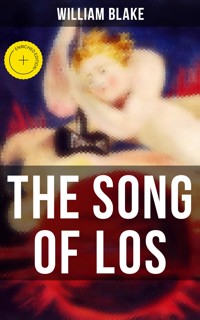
In William Blake's 'The Song of Los', readers are transported into a deeply symbolic and visionary world that explores themes of revolutionary fervor, oppression, and the struggle for liberation. Written in Blake's characteristic blend of poetry and visual artistry, the book is filled with rich imagery and complex allegory that invites readers to interpret its meanings on multiple levels. 'The Song of Los' is situated within Blake's larger body of work, known for its mystical elements and profound philosophical reflections on the human condition. The book exemplifies Blake's unique literary style, characterized by its poetic intensity and prophetic voice. Through vivid language and intricate symbolism, Blake challenges societal norms and encourages readers to question their assumptions about power and authority. Readers interested in exploring the intersection of art, literature, and social critique will find 'The Song of Los' to be a thought-provoking and rewarding read, offering glimpses into the radical imagination of one of the most visionary poets of the Romantic era. In this enriched edition, we have carefully created added value for your reading experience: - A succinct Introduction situates the work's timeless appeal and themes. - The Synopsis outlines the central plot, highlighting key developments without spoiling critical twists. - A detailed Historical Context immerses you in the era's events and influences that shaped the writing. - An Author Biography reveals milestones in the author's life, illuminating the personal insights behind the text. - A thorough Analysis dissects symbols, motifs, and character arcs to unearth underlying meanings. - Reflection questions prompt you to engage personally with the work's messages, connecting them to modern life. - Hand‐picked Memorable Quotes shine a spotlight on moments of literary brilliance. - Interactive footnotes clarify unusual references, historical allusions, and archaic phrases for an effortless, more informed read.
Sie lesen das E-Book in den Legimi-Apps auf:
Seitenzahl: 57
Veröffentlichungsjahr: 2017
Das E-Book (TTS) können Sie hören im Abo „Legimi Premium” in Legimi-Apps auf:
Ähnliche



THE SONG OF LOS
Published by
Books
Table of Contents
Introduction
At the heart of this book a solitary maker stands at his furnace, hammer rising and falling as empires, priesthoods, and fearful minds are thrust into the crucible, and the bright, dangerous sparks that leap into the air sketch a map of the earth where the struggle between constricting law and generative imagination rages across continents and eras, testing whether the human form will be cast into rigid mold or kept alive as glowing metal, shapable, resistant, and capable of igniting new light amid the smoke of history.
William Blake (1757–1827) published The Song of Los in 1795, during a decade of revolutions and wars that unsettled Europe and its empires. As with his other illuminated books, he wrote, designed, etched, printed, and often hand-colored the work himself, uniting craft and vision. The book belongs to Blake’s prophetic corpus, where symbolic figures dramatize conflicts of mind and society in mythic form. Compact yet expansive in scope, it stands at the threshold of Romanticism, challenging inherited aesthetics and political orthodoxies with a fiercely independent imagination. Its urgency, ambition, and formal ingenuity have secured its place among the essential expressions of Blake’s art.
The Song of Los unfolds as a brief prophecy in two complementary sections, titled Africa and Asia. Rather than narrating a conventional story, it stages a visionary overview of history and conscience, set against a global backdrop. Los, Blake’s figure of creative energy and temporal insight, provides the focus: his song contemplates how restrictive systems take hold and how human faculties respond. The poem’s initial setup contrasts living imagination with petrifying law, implying a contest that touches every region and tradition. Blake’s aim is not reportage but revelation, an unveiling of forces that shape collective life and individual perception.
Form is inseparable from meaning in this work. Blake’s relief-etched plates fuse poem and image, so that reading becomes a viewing and the page becomes a field of contention. Words press against figures; ornament guides emphasis; color, when present, inflects tone. The integrated design resists passive consumption and invites active interpretation, mirroring the book’s appeal to awaken imaginative sight. This handmade mode also underscores the argument: against mechanical reproduction of doctrine, Blake offers artisanal thinking—an art that must be forged, not received. The Song of Los thus exemplifies how technique can embody a philosophical position without recourse to commentary.
The book’s classic status arises from three converging achievements. First, it condenses Blake’s mythic system into an accessible compass, allowing readers to encounter his prophetic mode in concentrated form. Second, it articulates enduring themes—freedom, tyranny, moral vision, and the uses of reason—with uncommon intensity. Third, it helped shape a countertradition in English-language poetry, inspiring later writers to treat the lyric as a vehicle for prophecy and critique. Figures such as Algernon Swinburne and W. B. Yeats championed Blake’s prophetic art; twentieth-century poets, including Allen Ginsberg, found in it a model of ecstatic, socially engaged utterance that remains influential.
At its core, The Song of Los examines how structures of power enlist religious or rational authority to bind human energies. Blake does not reject reason or faith; he opposes their ossified, coercive forms. The poem dramatizes the difference between law as living guidance and law as instrument of domination, a distinction that has animated ethical debates for centuries. It also explores the psychology of consent and revolt: how fear can make chains seem necessary, and how vision can render them intolerable. By staging this drama on a planetary scale, the book insists that private imagination and public history are inseparable.
Los, the book’s presiding figure, is Blake’s archetype of the creative maker—the imaginative smith whose furnace shapes forms in time. As time’s human face, Los confronts the tendency of systems to harden, and he seeks to keep vision molten and generative. He does not act as a distant deity or impersonal narrator; his song is a labor, rhythmic and strenuous, that engages the reader as a fellow worker. Through Los, Blake proposes that art is not ornament but power: a forge where perception is recast, errors annealed, and new capacities tempered. The book’s energy springs from this artisanal metaphysics.
When Blake first printed the work in 1795, public life bristled with controversy. Britain was at war with revolutionary France; discussions of liberty, rights, and sedition saturated pamphlets and pulpits; campaigns against the transatlantic slave trade gained momentum; and imperial expansion accelerated. Though Blake speaks in symbols, his pages resonate with these conditions. The geographical titles themselves signal a planetary horizon and invite reflection on how ideas travel with power. The Song of Los does not offer journalism; it offers a lens, refracting contemporary upheavals into an allegory of human faculties under pressure, and thus making history legible as a drama of the mind.
Stylistically, the work moves with prophetic compression. Images arrive as emblems; sentences carry the cadence of proclamation; names function less as labels than as energies. The two sections, Africa and Asia, answer and amplify each other, together composing a cyclic pattern that begins rather than completes an argument. The brevity of the poem intensifies its effect: instead of exhaustive description, Blake gives catalytic scenes and mnemonic clusters that linger. The page’s visual design—its ornaments, its figures in relation to text—serves as a second voice. Readers encounter not a single thread, but a woven fabric of meanings experienced in time.
Because Blake produced the book himself in small numbers, its initial circulation was limited. Yet its reputation grew as interest in Blake revived in the nineteenth and twentieth centuries. Swinburne’s early advocacy and the editorial labors of Yeats and others helped bring the prophetic books to wider audiences. Later critics, among them Northrop Frye and Harold Bloom, recognized in Blake a foundational theorist of myth and imagination and placed works like The Song of Los within a larger visionary architecture. Today the poem is available in scholarly editions and digital facsimiles, allowing readers to study its text and images together.
Approaching The Song of Los benefits from patience and attention to correspondences. Readers need no esoteric key; the poem itself teaches how to read it, through echoes, contrasts, and recurring motifs. Attend to actions as gestures rather than episodes; track how a term changes value as it moves across contexts; notice how design steers emphasis. Above all, keep in view Blake’s conviction that imagination is an organ of knowledge. The book’s power lies not in decoding a single secret, but in quickening perception, so that historical and personal experience appear as fields where freedom may be exercised.




