


0,49 €
Niedrigster Preis in 30 Tagen: 1,99 €
Niedrigster Preis in 30 Tagen: 1,99 €
Mehr erfahren.
- Herausgeber: DigiCat
- Kategorie: Poesie und Drama
- Sprache: Englisch
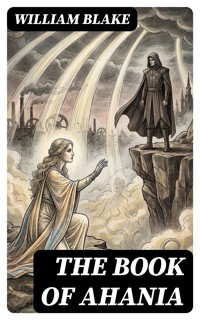
William Blake's "The Book of Ahania" is a profound exploration of the dualities of existence—specifically, the tensions between emotion and reason, and the feminine and masculine principles in human experience. In this remarkable poem, Blake employs a unique poetic form characterized by his distinct symbolic imagery and rhythmic cadences, inviting readers into a dreamlike realm filled with rich allegorical significance. As part of his larger mythological framework, Blake presents Ahania as the embodiment of wisdom, exploring her relationship with the divine and the material world as she navigates the interplay of love, despair, and enlightenment. Blake, an imaginative visionary and influential figure of the Romantic era, drew upon his own experiences and philosophical beliefs to craft this work. A staunch critic of the industrial revolution and societal norms, he sought to challenge the established order through his art. "The Book of Ahania" reflects Blake's deep interest in spiritual and metaphysical themes, showcasing his belief in the transcendent power of love and creativity while simultaneously critiquing the moral limitations he saw in his contemporary society. Readers seeking a profound philosophical dialogue will find "The Book of Ahania" to be a compelling and enriching experience. Blake's lyrical genius and the narrative's depth will resonate with anyone interested in the complexities of the human condition and the interplay of love and reason. This book is not merely a poem; it is an invitation to engage with the eternal questions that define our existence.
Das E-Book können Sie in Legimi-Apps oder einer beliebigen App lesen, die das folgende Format unterstützen:
Veröffentlichungsjahr: 2022
Ähnliche



The Book of Ahania
Table of Contents
Introduction
A god of constricting law confronts the unruly energies of desire and revolt, and the air crackles with the strain of a world divided. The Book of Ahania is one of William Blake’s most concentrated prophetic dramas, a work in which his mythic figures clash over the terms of creation, power, and freedom. Set within Blake’s visionary universe, it distills a conflict as old as culture itself: the drive to codify life against the impulse to live it. In these pages, poetic voice and emblematic images move together toward a crisis whose stakes are both cosmic and intimate, spiritual and political.
William Blake, poet, engraver, and radical visionary of the late eighteenth century, created The Book of Ahania in 1795. The work belongs to his series of illuminated “prophetic books,” in which he forged a personal mythology to think through the pressures of his age. The central premise introduces Urizen, a figure of stern law and abstract reason; Ahania, his sundered companion; and Fuzon, a rebellious force that refuses submission. Without disclosing outcomes, it is enough to say that their encounter sets a chain of challenges to authority and conscience. The drama becomes a lens for examining the boundaries between restraint and liberation.
Blake’s illuminated method is itself a declaration about unity. He wrote, designed, etched, printed, and hand-finished his books so that text and image form a single imaginative act. Relief-etched plates carry wiry lines of verse curling amid flames, bodies, and spectral landscapes, while color washes and line work complicate tone and meaning. Reading The Book of Ahania in an edition with the original illustrations restores the intended experience: the poem is not merely accompanied by art; it is built within it. This fusion invites a mode of attention that is visual, tactile, and meditative, attuned to nuance and echo.
Within this mythic theater, the cast embodies felt human tensions. Urizen consolidates systems, measures, categories, and prohibitions; Ahania represents an affection pushed to the margins; Fuzon thrusts forward with energy that will not be contained. Their world is not an allegory with one key but a charged field of forces where law and love, discipline and imagination, forever test one another. The opening movement sets these powers on a collision course that reverberates through landscapes of fire and desert, across sky and body. What follows traces the cost of division and the peril of mistaking control for wisdom.
The Book of Ahania holds classic status because it demonstrates how condensed a myth can be when a poet trusts symbol and cadence. It cannot be reduced to a treatise or parable; instead, it compels rereading, each time reorganizing its energies. Blake’s distinctive mix of lyric intensity, prophetic declamation, and emblematic image has shaped a lineage of visionary writing. The work’s economy is a marvel: a compact poem that contains a system of thought and a theater of signs. Its classicism lies not in deference to tradition but in the durable clarity of its central quarrel about freedom.
Blake’s prophetic books, including The Book of Ahania, influenced later poets who sought visionary authority without abandoning moral and political urgency. W. B. Yeats drew inspiration from Blake’s mythopoeic daring and edited his works with reverence. Twentieth-century writers such as Allen Ginsberg found in Blake’s audacity a model for marrying ecstatic perception to critique of social constraint. Critics and mythographers, too, returned to Blake to understand how symbolic systems can organize experience. Ahania’s drama, with its elemental characters and stark energies, offers a toolkit for later imaginations crafting their own cosmologies and counterhistories.
The poem arises from the charged historical moment of the 1790s, when revolutionary hope met reaction and surveillance. Blake’s London felt the tremors of the French Revolution, the debates over rights, and the anxious consolidation of state power. In this turbulent climate, The Book of Ahania transforms topical pressures into visionary narrative. Urizen’s enforcement and Fuzon’s defiance echo contemporary battles over law and liberty without becoming mere reportage. By staging these forces in a mythic arena, Blake grants them durability, allowing readers across eras to see their own political and ethical dilemmas reflected and intensified.
At the thematic core are questions about the uses and dangers of reason. Blake does not condemn thought; he diagnoses a habit of mind that hardens living truths into dead rules. Ahania’s presence suggests a counterweight: affection, pleasure, and the receptive imagination capable of softening rigid systems. The poem’s diction and pacing create a sensation of pressure—alternating stillness and explosive movement—as if the lines themselves measured and then shattered constraint. Without divulging the narrative turns, one can say that the poem’s music keeps the tension alive, refusing closure while exposing the effects of estrangement.
The illustrations deepen this tension through recurring motifs. Figures twist across plates in postures of strain or release, lean against borders that feel like bars, or surge in flame-backed arcs of motion. Rock, chain, tree, and desert form a symbolic environment where confinement and traversal alternate. Color is not ornamental but interpretive, making heat visible or draining vitality into ashen tones. When read alongside the verse, these images offer parallel arguments: some align with the text’s thrust toward revolt; others complicate it by showing the costs exacted on bodies and bonds. Interpretation thus becomes an embodied, visual practice.
The Book of Ahania also rewards psychological and existential readings. Blake’s language of “emanation” and division sketches a drama of the self that splits, projects, and seeks integration. Authority and rebellion can appear as aspects of a single being at war with itself. The poem invites readers to ask where their own inner Urizen and Fuzon collide, and what forms of Ahania—tenderness, delight, compassion—risk banishment under rigid regimes of identity. Such an approach does not cancel the poem’s historical charge; it amplifies it by showing how social fetters often mirror private armor and wounds.
Although The Book of Ahania stands on its own, it forms a crucial node in Blake’s larger myth, alongside works that introduce or revisit Urizen and related figures. Reading across the prophetic books reveals patterns: recurring images, reconfigured relationships, and evolving stances toward law and vision. Yet Ahania’s particular compression gives it a special intensity. For new readers, the best approach is simple: attend closely to the interplay of image and line, feel the rhythmic insistence of Blake’s voice, and allow ambiguity to remain fruitful rather than forced into single meanings.
Today, Blake’s parable of authority tested by imagination speaks with renewed urgency. Debates over surveillance, bodily autonomy, ideological purity, and the reach of law echo in the poem’s elemental contest. In an age saturated with images, the book’s integrated design models how art and language can resist fragmentation, restoring a unitary act of attention. The Book of Ahania endures because it refuses to flatter power or despair of change; it dramatizes the risks of rigidity and the promise of reimagined bonds. Its visionary clarity and artistic daring continue to invite readers into an inexhaustible conversation.
Synopsis
William Blake’s The Book of Ahania is an illuminated prophetic book produced in 1795, uniting poem and image to build a compact mythic drama. Within Blake’s personal mythology, it revisits the figure of Urizen, a remote lawgiver who embodies constrictive rational order, and introduces his emanation, Ahania, whose presence recalls a lost harmony. The work unfolds in a visionary register, moving between cosmic vistas and intimate emotional states. Its plates and verse function together, with designs echoing shifting moods and tensions. While the book intersects with other prophetic texts, it stands as a focused episode on fracture within authority, memory, and desire.
The narrative opens upon Urizen’s solitary regime, a domain defined by measure, decree, and an anxious need to stabilize creation. Ahania, once the companion aspect of Urizen, speaks from a place of yearning and reflection, sensing the disfigurement that follows the severance of wisdom from compassion. Through her perspective and the surrounding imagery, the poem frames a central conflict: the perils of reason hardened into law when divorced from its softer, imaginative double. The tone is ritual and incantatory, as if the text were both recounting a history and reenacting it, letting readers feel the weight of systems built to exclude doubt.
Into this rigid order enters Fuzon, a fiery figure who embodies passionate energy and revolt. He is introduced not merely as a character but as a principle antagonistic to the cold geometry of Urizen’s dominion. His emergence sets a counter-rhythm in the poem, one of acceleration and heat. Ahania recognizes in him a force that could heal or harm, depending on how it is met. The book carefully stages this encounter of principles—flame against stone, impulse against law—without fully committing to a single moral key, inviting readers to weigh vitality against stability and to measure the cost of both.
As Fuzon’s challenge gathers strength, the poem shifts into a mode of conflict whose imagery spans storms, desolations, and straining bodies. Urizen answers revolt with the creation of structures and instruments meant to preserve his order, forming a bulwark against what he reads as chaos. The atmosphere tightens: decrees multiply; boundaries harden. Ahania, meanwhile, voices unease at the direction of events, her reflections widening the poem’s scope from a familial dispute to a meditation on how worlds are made and unmade. The visual plates amplify this texture through contrasts of mass and motion, darkness and flare.
The confrontation between father and son becomes the book’s pivotal sequence. It is rendered in compressed episodes that feel ceremonial rather than merely descriptive, as if the struggle were the enactment of a law older than either figure. Blake turns the clash into a symbolic trial of claims: authority’s right to command versus passion’s claim to life. The poem marks a decisive act that wounds both sides, tipping the balance of the cosmos that surrounds them. Yet it withholds easy resolution, emphasizing instead the shock that follows an irreversible breach, and the way such moments reverberate through bodies, landscapes, and remembered bonds.
Throughout, Ahania’s voice grows in tragic clarity. She contemplates what is lost when a governing intelligence banishes the element that once completed it, articulating a vision in which wisdom requires tenderness as much as structure. Her meditations bring a counter-history into view: a time before the division, when unity gave rise to fruitful order rather than sterile control. Her separation is both personal and metaphysical, the sign of a world split along gendered and psychological lines. The poem uses her perspective to test whether reconciliation is possible, and to ask what must change in law for justice to live.
The aftermath of the central conflict unfolds as an altered landscape of power and memory. Systems reform themselves; grief shades decision; resistance does not vanish but is transmuted. The poem gestures to cycles of repression and revolt that echo beyond this episode, hinting at patterns recognizable across Blake’s wider myth. Yet it maintains narrative economy, allowing readers to sense consequence without closing possibility. In this register, The Book of Ahania becomes less a closed plot than a lens on recurring historical and spiritual dilemmas: how revolutions ignite, how authorities rationalize themselves, and how exiled insights continue to speak from the margins.
Blake’s illuminated designs are integral to the argument, not adjunct illustrations. Figures appear stretched, fallen, or striding, their poses conveying strain between heaviness and ascent. Architectonic forms suggest constructed orders; organic shapes evoke energies that evade confinement. Color washes and linework reinforce the poem’s transitions—cool restraint against heated motion—so that reading becomes an act of seeing principles contend. The plates do not merely depict events; they model a way of reading systems from bodies and gestures, prompting viewers to trace how harm and hope are inscribed in posture, terrain, and light as much as in words.
Taken together, The Book of Ahania offers a concentrated reflection on the dangers of authority that rejects its imaginative counterpart, and on the risks and promises of insurgent desire. Without resolving its tensions, the book presses a lasting question: what forms of law can shelter life rather than suppress it? Its enduring significance lies in showing how personal estrangement mirrors political arrangement, and how healing might begin where acknowledgment of loss becomes possible. By entwining visionary poetry with visual argument, Blake leaves a work that remains open to rereading, a touchstone for thinking power, freedom, and regret.
Historical Context
The Book of Ahania emerged from late eighteenth-century London, a metropolis transformed by commerce, war, and print. In the 1790s Britain was a constitutional monarchy under George III, governed by Parliament and anchored by the Church of England. The city’s guilds and trade networks still mattered, yet newer forms of capitalist enterprise and a burgeoning press were remaking public life. From Lambeth, across the Thames from Westminster’s political heart, William Blake shaped a private mythic response to a decade of turmoil. The book belongs to his prophetic sequence and was produced around 1795, when Britain faced revolutionary upheavals abroad and repression at home.
Blake’s path to this work began in artisanal training. Apprenticed to the engraver James Basire in the 1770s and a student at the Royal Academy, he mastered the craft that sustained him. After marrying Catherine Boucher in 1782, he increasingly pursued independent publishing. From 1790 to 1800 he lived at 13 Hercules Buildings, Lambeth, where he designed, etched, printed, and often hand-colored his books with Catherine’s assistance. The Book of Ahania is one of these Lambeth books, a small-run, illuminated manuscript whose text and images were made together, giving Blake unusual autonomy in a London dominated by powerful publishers and cautious booksellers.
The technological key was Blake’s illuminated printing, a relief-etching method devised in the late 1780s. He wrote and drew directly on copper plates with an acid-resistant medium, then etched away the surrounding metal, printing text and image as a single relief surface. Hand-coloring with watercolors followed. This technique let him avoid compositors, typefounders, and much editorial oversight, enabling experimental typography, integrated imagery, and rapid iteration with modest resources. It also kept circulation narrow. Very few copies of The Book of Ahania were produced, as with many of Blake’s illuminated works, which moved through private networks rather than the mainstream book trade.
The immediate historical backdrop was revolutionary. The American Revolution (1775–1783) had challenged imperial authority; the French Revolution beginning in 1789 overthrew monarchy in France and convulsed Europe. Britain entered war with revolutionary France in 1793, initiating years of military mobilization, taxation, and propaganda. The period polarized British politics between reformers and loyalists. Blake’s prophetic books adopt mythic figures—lawgivers and rebels, builders and destroyers—to interrogate the claims of authority and the energies of revolt. Without naming specific events, The Book of Ahania echoes this climate by staging conflicts between rigid law and insurgent vitality, dramatizing the costs of both repression and rupture.
War intensified state vigilance. In 1794 the British government suspended habeas corpus and prosecuted reform leaders; juries acquitted several defendants, yet surveillance expanded. After large protest meetings in 1795, Parliament passed the Treasonable Practices Act and the Seditious Meetings Act, curbing political speech and assembly. Loyalist associations and an assertive press depicted radicalism as a threat to order. In this atmosphere, allegory offered a protective veil. Blake’s choice to circulate visionary narratives in tiny editions minimized exposure while preserving sharp critique. The Book of Ahania’s lamentations over law’s violence and the suppression of joy resonate with a nation narrowing the bounds of permissible dissent.
London’s radical and dissenting print culture nonetheless flourished in pockets. The publisher Joseph Johnson fostered a circle that included Mary Wollstonecraft, Joseph Priestley, Erasmus Darwin, and William Godwin. Paine’s Rights of Man (1791–1792) made the case for popular sovereignty and cost him prosecution. Wollstonecraft’s Vindication of the Rights of Woman (1792) pressed for educational and civic reform. Blake worked as an engraver on projects connected to Johnson and Darwin and illustrated Wollstonecraft’s Original Stories. While not a pamphleteer, he absorbed debates over rights, reason, and moral reform. The Book of Ahania shares this milieu’s urgency while insisting on imagination as a measure of political and ethical health.
The period also witnessed intensifying debate over empire and slavery. The Society for Effecting the Abolition of the Slave Trade was founded in 1787; petitions, sugar boycotts, and print campaigns spread through the early 1790s. The Haitian Revolution, beginning in 1791, demonstrated enslaved people’s capacity to overturn colonial order. Blake had already addressed themes of bondage and liberation in works like Visions of the Daughters of Albion and America a Prophecy. While The Book of Ahania is not about the Atlantic world directly, its imagery of chains, law, and revolt reflects a culture confronting coercion as both a political system and a moral problem.
Philosophically, the 1790s were marked by Enlightenment confidence in empiricism and Newtonian science. The Royal Society, universities, and popular lectures promoted experimental knowledge. Figures like Locke and Newton were cultural touchstones. Blake contested what he saw as the narrowing of perception to measurement alone, later calling it single vision. In his myth, Urizen personifies constricting rational law, generating a world of division and fear when unbalanced by imagination. In 1795 Blake also produced large color prints, including Newton, that visualize this critique. The Book of Ahania’s struggle between codifying intellect and living energy draws directly on these late-Enlightenment controversies.
Religion supplied another charged context. The Church of England remained established; Dissenters were tolerated but restricted from universities and certain offices by the Test and Corporation Acts. Debates over prophecy, enthusiasm, and moral law animated sermons and tracts. Blake engaged with Emanuel Swedenborg’s writings in the 1780s before turning sharply against them in The Marriage of Heaven and Hell (circa 1790–1793). Ahania, associated with pleasure and wisdom in Blake’s system, contests the harshness of legalistic piety. The book’s mythic theology thus converses with contemporary disputes over reason, revelation, and the pastoral uses—and abuses—of religious authority.
Economic pressures shaped daily life as surely as ideology. Britain’s early Industrial Revolution accelerated in the late eighteenth century, especially in textiles, creating new rhythms of labor and widening inequality. Artisans like Blake navigated precarious markets as workshop traditions met mechanized production and expanding commercial publishers. War strained supplies; 1795 saw poor harvests and high grain prices, prompting bread riots and the Speenhamland system of poor relief in parts of southern England. The Book of Ahania’s atmosphere of scarcity, punishment, and anguished resistance aligns with a society negotiating discipline—of bodies, appetites, and time—under economic and political stress.
London’s visual culture prized history painting and classical forms, with the Royal Academy setting standards under figures like Joshua Reynolds. Simultaneously, satirical prints by James Gillray and others filled shop windows, turning politics into theatre. Blake moved against both currents. He questioned academic prescriptions in his annotations and refused to separate poetry from image. The Book of Ahania’s designs—elongated bodies, visionary landscapes, integrated lettering—depart from neoclassical harmony and caricature alike. They create a scriptural alternative, insisting that national debates over power and liberty require new, prophetic forms rather than inherited conventions or fashionable mockery.
Literary models also mattered. Blake revered the Bible and John Milton, whose Paradise Lost offered an epic framework for thinking about law, rebellion, and redemption. He read widely in ancient myth and later illustrated Milton and the Book of Job. In the mid-1790s he was preparing hundreds of drawings for Edward Young’s Night Thoughts, evidence of his engagement with graveyard meditations on mortality and moral law. The Book of Ahania adapts epic and lament traditions to the 1790s, crafting figures whose conflicts with authority recall Promethean rebellion without binding the poem to any single mythic source or contemporary politician.
Lambeth itself was a fruitful vantage. Located opposite Westminster, it combined proximity to power with relative remove from City publishers and court society. The area housed artisans, small trades, and gardens, with the river as conduit for goods and ideas. Blake walked across bridges and along embankments, absorbing both the spectacle of parliament and the anonymity of backstreets. Such geography aided a publishing strategy based on privacy, personal networks, and experimental production. The Book of Ahania’s inward, visionary scenes reflect a maker who watched political theatre closely yet sought a workshop lit by imagination rather than patronage or party.
Publication and circulation were necessarily narrow. The Book of Ahania was etched and printed on copper plates around 1795 in a very small run. Copies were hand-colored selectively, and each impression could differ subtly due to inking and brushwork. Surviving exemplars are rare; like many of Blake’s books, they likely reached sympathetic readers—artists, collectors, and friends—outside the larger commercial circuits. Blake’s earlier prospectuses show he occasionally advertised subscriptions, but the prophetic books remained artisanal productions. Their scarcity limited immediate impact while preserving a radical integrity that mass printing, under wary publishers, might have compromised.
Gender debates sharpened in the 1790s after Wollstonecraft’s interventions. Conduct literature and sermons defended patriarchal virtue, while reformers questioned women’s education and rights. Under coverture, married women’s legal identities were constrained. Blake’s mythic language of emanations gives feminine figures vital roles yet also subjects them to exile and silencing when law dominates. In The Book of Ahania, the title figure’s sorrow registers the social costs of repressing delight, sexuality, and mutuality. Without offering direct social prescriptions, the work resonates with a moment when the moral regulation of desire was inseparable from arguments about citizenship, authority, and reform.
Blake’s immediate reception was muted. His illuminated prophecies did not shape parliamentary debate or newspaper polemics. Yet the manuscripts and prints persisted. In the nineteenth century, Alexander Gilchrist’s Life of William Blake (1863) and advocacy by Algernon Swinburne and Dante Gabriel Rossetti helped reintroduce the prophetic books to broader audiences. The Book of Ahania then came to be read as a pivotal episode in Blake’s evolving myth of law and revolt. That delayed reception underscores the original context: a work crafted under pressure for a few attentive readers, designed to survive its moment’s constraints and speak to later struggles.
The Book of Ahania finally stands as a mirror and critique of its age. Its illuminated form resists the segmented production of the commercial press; its myth challenges the alliance of state power, moral legislation, and instrumental reason intensified by war. By embodying rebellion, tenderness, and lament in archetypal figures, Blake refracts the 1790s into a visionary history. The result neither endorses terror nor celebrates passive obedience. It questions what kind of law sustains life and what kind of freedom honors it. In doing so, the book preserves, in copper and color, a record of Britain’s conflict between control and imagination.
Author Biography
William Blake (1757–1827) was an English poet, printmaker, and painter whose hybrid art fused text, image, and prophetic vision. Working largely in London during the upheavals that framed the late Enlightenment and early Romantic era, he developed a distinctive method of self-publishing that enabled him to control every stage of production. Long marginal to the literary and artistic mainstream, Blake is now recognized as a foundational figure for British Romanticism and modern visionary art. His lyric clarity in works such as Songs of Innocence and of Experience coexists with dense mythmaking in his prophetic books, shaping a legacy that spans literature, theology, and visual culture.
Blake's early formation combined craft training with independent study. As a teenager he apprenticed to the engraver James Basire, gaining technical discipline and access to antiquarian subjects through drawing assignments among Gothic monuments. He later attended the Royal Academy Schools, where he absorbed academic debates while resisting prevailing doctrines associated with Joshua Reynolds. His declared allegiances leaned toward Michelangelo and the expressive line, and toward the Bible and English poets such as Milton. Blake also engaged with currents of dissenting religious thought, including the writings of Emanuel Swedenborg, which he would both explore and vigorously critique in subsequent work.
In the late 1780s Blake devised a relief-etching process he called illuminated printing, which allowed him to integrate words and images on copper plates, print the sheets, and hand-color them. This innovation underpinned his self-published books, beginning with Songs of Innocence and continuing with combined editions as Songs of Innocence and of Experience. The Book of Thel and other short works extended his experiments in symbolic narrative. His partner Catherine Blake, to whom he was married, assisted in printing and coloring, a collaboration frequently acknowledged by scholars. Through this method Blake crafted intimate, materially distinctive books outside conventional commercial channels.
The political revolutions of the 1790s formed a charged backdrop for Blake's artistic program. The Marriage of Heaven and Hell blends satire, aphorism, and visionary prose to challenge rationalist moral systems and to proclaim the generative power of imagination. He responded to transatlantic upheavals with prophetic productions such as America a Prophecy and Europe a Prophecy, alongside mythopoeic works including The Book of Urizen. These texts introduced a personal symbolic cosmos that reframed history and psychology through new figures and narratives. While difficult for contemporary readers, they consolidated Blake's reputation within a small circle attentive to experimental forms and radical ideas.
Blake's career oscillated between commissioned engraving and self-directed projects, often under financial pressure. Around 1800 he worked in Sussex under the patronage of the poet William Hayley, a period that yielded illustrations and renewed focus on larger ambitions. An altercation with a soldier led to a widely noted sedition trial, after which he was acquitted and returned to London. He produced designs for Edward Young's Night Thoughts and for poems by Thomas Gray, and he supplied celebrated images for Robert Blair's The Grave. As a professional engraver he executed prints after other artists, even as he pursued an independent visionary path.
Blake's mature epics Milton a Poem and Jerusalem extended across many years, elaborating his symbolic geography and arguments about imagination, oppression, and redemption. From the late 1810s new patrons and friends, notably the artist and engraver John Linnell, supported major late projects. These included the engravings for the Book of Job, often regarded as his finest printed series, and an ambitious cycle of illustrations to Dante's Divine Comedy, left unfinished at his death. A group of younger admirers—later dubbed "The Ancients," including Samuel Palmer—venerated his example, absorbing his emphasis on spiritual vision, linear design, and the authority of the handmade image.
Blake died in London in 1827, largely uncelebrated by the broader public. His posthumous reputation grew steadily, especially after Alexander Gilchrist's Victorian biography, which drew attention from the Pre-Raphaelites and other artists. Poets and critics in the later nineteenth and twentieth centuries, among them W. B. Yeats, helped canonize his work; Parry's setting of lines from Milton as the hymn "Jerusalem" further embedded his words in British culture. Today his synthesis of poetry and image, his critique of mechanistic thinking, and his insistence on imaginative freedom remain influential across literature, art, music, and philosophy, sustaining ongoing scholarly and popular engagement.
The Book of Ahania (Illuminated Manuscript with the Original Illustrations of William Blake)
Chap: 1
1: Fuzon, on a chariot iron-wing’d[1q]
On spiked flames rose; his hot visage
Flam’d furious! sparkles his hair & beard
Shot down his wide bosom and shoulders.
On clouds of smoke rages his chariot
And his right hand burns red in its cloud
Moulding into a vast globe, his wrath
As the thunder-stone is moulded.
Son of Urizens silent burnings
2: Shall we worship this Demon of smoke[2q],
Said Fuzon, this abstract non-entity
This cloudy God seated on waters[3q]
Now seen, now obscur’d; King of sorrow?
3: So he spoke, in a fiery flame,
On Urizen frowning indignant,
The Globe of wrath shaking on high
Roaring with fury, he threw
The howling Globe: burning it flew
Lengthning into a hungry beam. Swiftly
4: Oppos’d to the exulting flam’d beam
The broad Disk of Urizen upheav’d
Across the Void many a mile.
5: It was forg’d in mills where the winter
Beats incessant; ten winters the disk
Unremitting endur’d the cold hammer.
6: But the strong arm that sent it, remember’d
The sounding beam; laughing it tore through
That beaten mass: keeping its direction
The cold loins of Urizen dividing.
7: Dire shriek’d his invisible Lust
Deep groan’d Urizen! stretching his awful hand
Ahania (so name his parted soul[4q])
He siez’d on his mountains of jealousy.
He groand anguishd & called her Sin,
Kissing her and weeping over her;
Then hid her in darkness in silence;
Jealous tho’ she was invisible.
8: She fell down a faint shadow wandring
In chaos and circling dark Urizen,
As the moon anguishd circles the earth;
Hopeless! abhorrd! a death-shadow,
Unseen, unbodied, unknown,
The mother of Pestilence.
9: But the fiery beam of Fuzon
Was a pillar of fire to Egypt
Five hundred years wandring on earth
Till Los siezd it and beat in a mass
With the body of the sun.
Chap: 2
1: But the forehead of Urizen gathering[5q],
And his eyes pale with anguish, his lips
Blue & changing; in tears and bitter
Contrition he prepar’d his Bow,
2: Form’d of Ribs: that in his dark solitude[6q]
When obscur’d in his forests fell monsters,
Arose. For his dire Contemplations
Rush’d down like floods from his mountains
In torrents of mud settling thick
With Eggs of unnatural production
Forthwith hatching; some howl’d on his hills
Some in vales; some aloft flew in air
3: Of these: an enormous dread Serpent[7q]
Scaled and poisonous horned
Approach’d Urizen even to his knees
As he sat on his dark rooted Oak.
4: With his horns he push’d furious.
Great the conflict & great the jealousy
In cold poisons: but Urizen smote him
5: First he poison’d the rocks with his blood
Then polish’d his ribs, and his sinews
Dried; laid them apart till winter;
Then a Bow black prepar’d; on this Bow,
A poisoned rock plac’d in silence:
He utter’d these words to the Bow[8q].
6: O Bow of the clouds of secresy!
O nerve of that lust form’d monster!
Send this rock swift, invisible thro’
The black clouds, on the bosom of Fuzon




