


1,99 €
Niedrigster Preis in 30 Tagen: 1,99 €
Niedrigster Preis in 30 Tagen: 1,99 €
Mehr erfahren.
- Herausgeber: DigiCat
- Kategorie: Poesie und Drama
- Sprache: Englisch
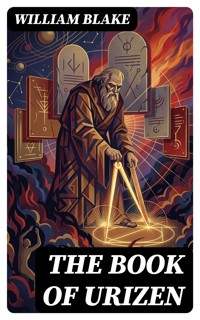
William Blake's "The Book of Urizen" presents a profound exploration of cosmology and creation, captivating readers with its intricate blend of poetic language and visual artistry. Written in 1794, this work reflects Blake's characteristic visionary style, where he intertwines imaginative narrative with philosophical inquiry. Delving into the figure of Urizen, a representation of rationalism and patriarchal authority, the text critiques Enlightenment thought while simultaneously embracing the chaos and creativity inspired by the Romantic spirit. The fantastical illustrations accompanying the text enhance the themes of duality and conflict, establishing a rich interplay between word and image that is central to Blake's oeuvre. William Blake, an English poet, painter, and printmaker, was greatly influenced by the tumultuous socio-political landscape of 18th-century England. His deep-seated spirituality and opposition to institutionalized religion fueled his desire to explore the human condition through myth and symbolism. "The Book of Urizen" serves as a testament to Blake's inventive genius, mirroring his own spiritual struggles and philosophical contemplations, as he sought to transcend the confines of rationalism. This book is highly recommended for readers who are eager to engage with the symbolic complexities of literature and art. Blake's work invites a reflective consideration of creativity versus constraint, making it an essential read for students of Romanticism, literary philosophy, and those interested in the intersections of art and literature.
Das E-Book können Sie in Legimi-Apps oder einer beliebigen App lesen, die das folgende Format unterstützen:
Veröffentlichungsjahr: 2022
Ähnliche







The Book of Urizen
Table of Contents
Introduction
A solitary lawgiver spreads a grid of cold reason over chaos while a prophetic craftsman hammers imagination into life, and in the heated space between measurement and making—a furnace bright with hope yet rimmed by iron—oceans, bodies, and names begin to congeal, each seeking freedom, each testing the bars that promise order even as they cast shadow and flame across a world not yet decided.
The Book of Urizen, by William Blake, is a classic because it forges a myth equal to its age’s upheavals and ours, uniting poetry and painting into a single visionary architecture. Presented as an illuminated manuscript with Blake’s own designs, it proposes that art can be scripture without dogma, a cosmogony without a single gatekeeper. The work’s audacity—its creation of an original mythic language and a system of images—has secured its ongoing relevance, inviting readers to experience not only narrative but also the birth of symbolic thinking on the page.
Composed and first printed in 1794, in London, the book belongs to Blake’s series of Prophetic Books, produced through his innovative method of relief etching and hand coloring. That historical moment—straddling the Enlightenment and the revolutionary ferment of the late eighteenth century—supplies a charged backdrop for Blake’s experiment. He self-published and printed the work, integrating text and image on engraved copper plates. The result is neither conventional poem nor mere illustration portfolio but an inseparable hybrid, a crafted object in which the medium’s physical processes echo the content’s themes of forming, bounding, and kindling.
At its outset, the poem imagines a creation drama centered on the figure of Urizen, an austere power associated with abstraction, law, and the impulse to systematize. Opposed to him stands Los, a prophetic maker whose forge represents creative energy and time-bound becoming. Around these presences, a nascent world gathers form. The premise is not a retelling of the Bible but a reimagining of beginnings: how principles harden into institutions, how imagination wrestles with control, and how the shaping of a cosmos simultaneously shapes the human mind that must live within it.
The classic status of this book rests partly on the daring fusion of disciplines. Blake’s original illustrations are not ornaments; they choreograph the reading. Figures strain at chains or stride through flames; vines and nebulae curl around lines of verse; pigments deepen moods. The plates stage a dialogue between image and word wherein posture, gesture, and color carry philosophical pressure. Encountered together, poem and picture produce resonance that neither could achieve alone, turning each page into an event of seeing-thinking—a performance of meaning as much as a communication of it.
In language, the poem moves with incantatory rhythms, compact episodes, and names that feel both personal and planetary. Blake’s diction is elemental—fires, voids, bones, seeds—yet the patterning is intricate, so that readers sense a system without being forced into a single interpretive key. This balance between clarity and opacity has helped the work endure. It invites re-reading, and with each return the symbolic relationships reorganize, like constellations shifting as the eye learns their geography. The book thus performs its theme: systems form; perception remakes them.
The Book of Urizen has influenced how later writers and artists conceive myth-making as an act of modernity rather than nostalgia. By inventing a personal pantheon that speaks to public crises, Blake showed that poetry could rival theology and philosophy in scope. His mythic method helped clear space for Romantic and post-Romantic experiments in symbolic narrative, encouraging creators to bind ethics, psychology, and politics within visionary forms. That example—myth as a living, authored structure—remains a template for world-building across literature and the arts.
Blake’s prophetic enterprise, including this book, left a deep wake in cultural history. Poets and critics have repeatedly returned to it: nineteenth-century admirers helped recover Blake’s visual and verbal achievement; twentieth-century thinkers such as Northrop Frye used Blake to articulate new kinds of literary criticism; modern poets found in his prophetic stance a license for visionary utterance. Artists and book-makers have likewise taken inspiration from the illuminated method, seeing in Blake a precedent for multimedia practice where form and meaning are welded at the level of the page.
Within Blake’s broader system, the dramatis personae of this book—Urizen, Los, and others who recur across the Prophetic Books—chart antagonisms that are psychological, spiritual, and social at once. Yet The Book of Urizen stands on its own as a striking origin-story of a fallen order and the energies that contest it. Read independently, it offers a compact entrance to Blake’s mythic universe; read alongside his companion works, it reveals patterns that knit his visionary cosmos into a coherent, if deliberately challenging, whole.
The material history of the work matters to its reading. Blake printed multiple copies over years, with variations in coloring and, at times, in the selection and ordering of plates. Such variability turns the book into a living artifact rather than a fixed text. Editions that reproduce the original illustrations honor this fluidity, allowing readers to register how hue, line, and layout inflect narrative emphasis. Engaging the poem through its images clarifies that the act of interpretation is also an act of looking, attentive to texture, contour, and illumination.
Approach the book as one would a map whose legend must be learned progressively. Let unfamiliar names work first as tones before they resolve into characters; follow the visual motifs as they echo and transform; notice how acts of framing—borders, grids, chains—do semantic labor. The story announces an initial situation and a set of tensions rather than offering quick certainties. That design is intentional: the poem proposes that understanding is forged, not received, and that to read it is to rehearse the very struggle it depicts between bound and unbound life.
Today, the book’s drama—between system and spirit, codified knowledge and living vision—feels strikingly current. In an era fascinated by metrics, algorithms, and plans, Blake’s illuminated myth cautions against the tyranny of abstraction while acknowledging the necessity of form. Its pages offer an art of resistance that is also an art of making, a reminder that the humane order we desire must be tempered in imagination’s forge. For these reasons, The Book of Urizen endures: as poem, as artwork, and as a touchstone for readers seeking freedom inside the forms that shape them.
Synopsis
William Blake’s The Book of Urizen (1794) is an illuminated prophetic book, written and printed by the author with his own etched designs. Conceived as part of Blake’s mythopoetic cycle, it functions as a creation narrative that parallels and contests biblical cosmogony. The text unfolds in numbered chapters and plates, with images that echo and complicate the verse. At its center stands Urizen, a figure who embodies restrictive law and abstract reason. Blake presents the origins of a bounded, suffering world through Urizen’s withdrawal from Eternity, tracing how cosmic separation leads to form, matter, and mortality within a visionary, deliberately archaic diction.
The poem opens in a formless expanse where the Eternals abide. A solitary impulse disturbs this equilibrium: Urizen isolates himself to define principles and set boundaries. His self-assertion inaugurates a break from communal Eternity, and his desire for certainty condenses the indefinite into measured space and time. Blake stages this as both metaphysical and psychological division, describing the birth of an identity ruled by law, book, and instrument. The act of measurement becomes an act of exile, and the universe begins to contract. Around this contraction arise shadows, veils, and nets, signs that an organized, sensible world will emerge at the cost of freedom.
As Urizen writes and inscribes his system, the cosmos takes shape in lines, grids, and stratified regions. The abstract reaches of eternity harden into elements, climates, and orbs, while the new lawgiver surveys and calculates with relentless precision. Blake emphasizes the ambivalence of this achievement: order produces stability, yet it also breeds solitude, fear, and the loss of visionary communion. The imagery moves from swelling clouds to contracted bones, as vitality becomes constraint. Urizen’s dominion promises knowledge through classification and decree, but the very apparatus of knowing—rule, canon, and memory—gathers into a web that confines the being who spun it.
Against this narrowing universe arises Los, the prophetic smith who embodies creative imagination and the pulse of living time. Compelled to attend the fallen power, he hammers and shapes a corporeal form for Urizen within furnaces of perception. The forging anchors the abstract lawgiver in material existence, giving him a body and senses even as it binds him to mortality. Los’s labor is double-edged: it humanizes and limits, rescues and imprisons. The conflict between the visionary maker and the architect of law becomes the poem’s engine, expressed through heat and metal, breath and measure, as creation proceeds under the pressure of necessity.
Los’s vigil over Urizen strains his own integrity until he divides, and from this division arises Enitharmon, his emanation and companion. With her emergence, generation begins: time becomes cyclical, and the rhythms of birth, sexuality, and nurture enter the cosmos. The pair establish a habitation where human forms can arise, but their world also brings a new moral sensibility, with modesty, jealousy, and shame appearing alongside care and beauty. Blake associates this shift with the dawning of history, the weaving of garments and codes that shelter life while obscuring visionary nakedness. The universe now carries memory, gendered relation, and social ordering.
Within this generative realm, living beings proliferate, and a human order unfolds under the distant, brooding presence of Urizen. Laws and ritual practices spread, promising coherence and safety yet often hardening into prohibitions that shadow everyday life. The poem charts how institutions of teaching, worship, and authority take root, giving shape to communities while enshrining the book and measure as supreme. The stars and landscapes mirror these developments, their courses set, their spaces fenced. Blake traces the cost of such security: fear of transgression, internalized guilt, and a quieting of ecstatic perception, as culture matures within a lattice first spun by exile.
Amid this consolidation, Blake introduces a counterforce to Urizen’s regime: the eruptive energy of youthful rebellion, figured in the myth as a child of imagination and generation. This presence ignites desire, renewal, and resistance to codified restraint, threatening to overturn the settled order. Yet the energies that call it forth also fear its excess, and the narrative shows attempts to restrain, bind, or delay its transformative surge. The result is an unstable equilibrium, a cosmos suspended between prophetic renewal and legal permanence. The poem does not resolve the struggle but lets it reverberate through bodies, seasons, and cities, testing the limits of law.
Formally, the book is inseparable from its images: figures bend, crouch, or measure beside the text, their postures intensifying the poetry’s argument. Blake’s pseudo-scriptural cadence and chaptering echo sacred narrative while subverting its authority with visionary paradox. The sequence remains deliberately broken and emblematic, inviting readers to navigate correspondences rather than linear explanations. At its core are conflicts between reason and imagination, law and prophecy, separation and community. The myth translates abstract critique into personified drama, treating intellectual systems as living agents whose virtues and violences shape worlds. The illuminated surfaces invite contemplation of how ideas, once pictured, become powers.
The Book of Urizen closes without doctrinal certainty, offering a cosmogony that is also a cautionary tale. It interrogates how the human craving for order can generate both knowledge and bondage, and how creativity may rescue and imperil in the same stroke. Blake’s enduring contribution lies in fusing art and poetry to stage the birth of a moralized, measured universe and the perpetual counter-impulse of imaginative freedom. Rather than settle the contest, he renders its necessity, asking how societies might honor clarity without extinguishing vision. The work’s resonance persists as a critique of systems that forget the living beings they aim to serve.
Historical Context
The Book of Urizen emerged in the 1790s, when London was the most populous city in Europe and the political heart of Hanoverian Britain under George III. The Church of England remained established, the law courts guarded property and order, and the Royal Academy shaped artistic norms. The Royal Society and Newtonian science embodied Enlightenment prestige. London’s trade networks, printers, and booksellers made it a nerve center of ideas and surveillance alike. In this setting, religious authority, legalism, and scientific rationalism formed dominant institutions. Blake’s illuminated manuscript arises against this backdrop, staging a contest between imaginative vision and the era’s celebrated structures of reason, discipline, and law.
William Blake was born in London in 1757, apprenticed to the engraver James Basire in the 1770s, and studied briefly at the Royal Academy. He established himself as a professional engraver while pursuing poetry and design. By 1790 he and his wife Catherine had settled at Hercules Buildings, Lambeth, where he produced a series of “Lambeth books,” including The Book of Urizen (first etched and printed in 1794). Blake’s career positioned him at the intersection of London’s artisan culture and its intellectual fringes. His training in historical monuments, biblical art, and print workshops fed his conviction that spiritual form, not academic convention, should guide art and poetry.
Blake’s technical innovation—“illuminated printing”—crystallized in the late 1780s. Using a relief-etching process, he wrote text and drew images directly onto copper plates with acid-resistant varnish, then etched away the background, printed the raised lines, and hand-colored impressions in watercolor. Catherine Blake assisted with inking, printing, and coloring. This method let him integrate word and image, control the entire bookmaking process, and operate outside the typesetter–publisher system. It also limited circulation: each copy required laborious finishing and could vary in palette and emphasis. In an era of expanding print capitalism, Blake’s artisanal press offered a self-governed counter-model of production and reception.




