


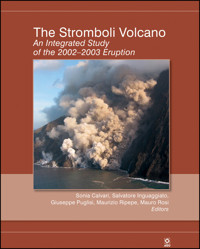
The Stromboli Volcano E-Book
124,99 €
Mehr erfahren.
- Herausgeber: John Wiley & Sons
- Kategorie: Wissenschaft und neue Technologien
- Serie: Geophysical Monograph Series
- Sprache: Englisch
Published by the American Geophysical Union as part of the Geophysical Monograph Series, Volume 182.
This book presents a study of the "eruptive crisis" that took place at the Stromboli volcano from December 2002 to July 2003. It features an integrative approach to the monitoring of eruptive activity, including lava flow output, explosive activity, flank instability, submarine and subaerial landslides, tsunami, paroxysmal explosive events, and mitigation strategies.
The book comes with a DVD with spectacular photos and video of
- The landslide and the tsunami that hit the coast of the island;
- The 5 April 2003 paroxysmal event;
- The whole eruption showing the stages of effusive activity and growth of the lava flow field;
- Selected data useful for testing geochemical, petrological, seismological, thermal, and ground deformation models.
This multidisciplinary and multimedia experience, unique for the amount, quality, and variety of data it covers, can be applied to other active volcanoes. Stromboli will appeal to solid Earth scientists and students working in seismology, geodynamics, geochemistry, and mineral physics, as well as nonspecialists with an interest in the inner workings of our planet and others.
Sie lesen das E-Book in den Legimi-Apps auf:
Seitenzahl: 990
Veröffentlichungsjahr: 2013
Ähnliche




















Contents
PREFACE
The Stromboli Volcano: An Integrated Study of the 2002–2003 Eruption—Introduction
Section I: The Volcanic System of Stromboli
Geological–Structural Framework of Stromboli Volcano, Past Collapses, and the Possible Influence on the Events of the 2002–2003 Crisis
1. INTRODUCTION
2. GEOLOGICAL AND STRUCTURAL EVOLUTION OF THE ISLAND
3. LATERAL INSTABILITY
4. SUBMERGED STRUCTURES
5. DISCUSSION AND CONCLUSIONS
Volcanology and Magma Geochemistry of the Present-Day Activity: Constraints on the Feeding System
1. INTRODUCTION
2. VOLCANOLOGICAL CHARACTERISTICS OF THE PRESENT-DAY ACTIVITY
3. MINERALOGICAL, CHEMICAL, AND ISOTOPIC CHARACTERISTICS OF PRODUCTS FROM THE PRESENT-DAY ACTIVITY
4. CONTRIBUTIONS FROM MICROANALYTICAL SR ISOTOPE DATA
5. CONTRIBUTIONS FROM MELT INCLUSIONS
6. CONSTRAINTS ON THE FEEDING SYSTEM AND DYNAMICS OF THE PRESENT-DAY ACTIVITY
Dynamics of Strombolian Activity
1. CURRENT EXPLOSIVE ACTIVITY AT STROMBOLI
2. SHALLOW CONDUIT PROCESSES
3. DYNAMICS OF THE GAS SLUG
4. POSITION OF THE MAGMA LEVEL
5. GAS FLUX CONTROL
6. DEGASSING MAGMA COLUMN
7. CONCLUSIONS
Fluid Geochemistry of Stromboli
1. INTRODUCTION
2. VOLATILE BUDGET AT STROMBOLI ISLAND
3. GEOCHEMICAL INVESTIGATIONS ON THERMAL WATERS
4. CONCLUDING REMARKS
Crater Gas Emissions and the Magma Feeding System of Stromboli Volcano
1. INTRODUCTION
2. METHODOLOGIES FOR CRATER GAS STUDIES
3. QUIESCENT MAGMA DEGASSING
4. EXPLOSIVE MAGMA DEGASSING
5. IMPLICATIONS FOR THE MAGMA FEEDING SYSTEM
6. CONCLUSIONS
Upper Conduit Structure and Explosion Dynamics at Stromboli
1. INTRODUCTION
2. CONDUIT STRUCTURE IMAGED FROM WAVEFORM INVERSION
3. DISCUSSION AND CONCLUSIONS
Section II: Eruption Onset
Volcanic and Seismic Activity at Stromboli Preceding the 2002–2003 Flank Eruption
1. INTRODUCTION
2. METHODS
3. VOLCANIC ACTIVITY AT STROMBOLI PRIOR TO THE 2002–2003 ERUPTION
4. SEISMIC INVESTIGATIONS ON STROMBOLI DURING 2002
5. DISCUSSION
6. CONCLUSIONS
The Eruptive Activity of 28 and 29 December 2002
1. INTRODUCTION
2. METHODS
3. RESULTS
4. DATA INTERPRETATION
5. CONCLUSIONS
Geochemical Prediction of the 2002–2003 Stromboli Eruption From Variations in CO2 and Rn Emissions and in Helium and Carbon Isotopes
1. INTRODUCTION
2. DATA GATHERING: METHODOLOGY
3. THE PIZZO SOPRA LA FOSSA AREA
4. THE BASAL THERMAL AQUIFER
5. GEOCHEMICAL CHANGES BEFORE THE ERUPTION ONSET
6. CONCLUSIONS
Section III: Landslides, Tsunami, and the Sciara del Fuoco Instability
Slope Failures Induced by the December 2002 Eruption at Stromboli Volcano
1. INTRODUCTION
2. GEOLOGIC FRAMEWORK
3. INVESTIGATIONS
4. THE 28–30 DECEMBER INSTABILITY SEQUENCE
5. RECONSTRUCTION OF THE GEOMETRY OF THE SLIDES
6. HYPOTHESES ON THE INSTABILITY MECHANISMS
7. Conclusive Remarks
The Double Landslide-Induced Tsunami
1. INTRODUCTION
2. INSTRUMENTAL DATA
3. EYEWITNESS ACCOUNTS
4. TSUNAMI FIELD SURVEYS
5. NUMERICAL SIMULATIONS
6. CONCLUSIONS
Deep-Sea Deposits of the Stromboli 30 December 2002 Landslide
1. INTRODUCTION
2. STROMBOLI ISLAND
3. THE SUBAERIAL SDF AND THE 30 DECEMBER 2002 PARTIAL COLLAPSE EVENT
4. DATA AND METHODS
5. OUTLINE MORPHOLOGY
6. BATHYMETRIC DIFFERENCE ANALYSIS OF THE SDF FLANK
7. THE LANDSLIDE DEPOSITS
8. DISCUSSION
9. CONCLUSIONS
Integrated Subaerial–Submarine Morphological Evolution of the Sciara del Fuoco After the 2002 Landslide
1. INTRODUCTION
2. FIELD SURVEYS AND DATA PROCESSING
3. DATA ANALYSIS AND DISCUSSION
4. CONCLUSIONS
Movements of the Sciara del Fuoco
1. INTRODUCTION
2. MONITORING NETWORKS
3. COMPARISON AMONG EDM, THEODOROS, AND GB-INSAR DATA
4. WARNING SYSTEM
5. DISCUSSION AND CONCLUSIVE REMARKS
Section IV: The Lava Flow Emission on the Sciara Del Fuoco
Evolution of the Lava Flow Field by Daily Thermal and Visible Airborne Surveys
1. INTRODUCTION
2. METHODOLOGY
3. CHRONOLOGY OF THE ERUPTION
4. LAVA FLOW FIELD EMPLACEMENT MECHANISMS
5. MAIN PARAMETERS CONTROLLING LAVA FLOW EMPLACEMENT
6. DISCUSSION
7. CONCLUSIONS
Textural and Compositional Characteristics of Lavas Emitted During the December 2002 to July 2003 Stromboli Eruption (Italy): Inferences on Magma Dynamics
1. INTRODUCTION
2. THE 2002–2003 ERUPTIVE ACTIVITY
3. SAMPLING
4. PETROGRAPHY AND CHEMISTRY OF THE PRODUCTS
5. DISCUSSION
6. THE TRIGGER OF THE EFFUSIVE ACTIVITY
2002-2003 Lava Flow Eruption of Stromboli: A Contribution to Understanding Lava Discharge Mechanisms Using Periodic Digital Photogrammetry Surveys
1. INTRODUCTION
2. REMOTE-SENSING TECHNIQUES FOR LAVA FLOW MONITORING
3. 2002-2003 STROMBOLI ERUPTION MONITORING
4. METHOD ADOPTED FOR DEFINING THE LAVA FLOW FIELD AND VOLUME COMPUTATION
5. ERUPTION NARRATIVE AND EVOLUTION OF THE LAVA FLOW FIELDS
6. RESULTS FROM THE PHOTOGRAMMETRIC SURVEYS
7. LAVA DISCHARGE BEHAVIOR DURING THE ERUPTION
8. CONCLUDING REMARKS
Ground Deformations Related to the Effusive Eruptions of Stromboli: The 2002–2003 Case
1. INTRODUCTION
2. MONITORING SYSTEM DESCRIPTION
3. DATA DISCUSSION
4. CONCLUSIONS
Gas Flux Rate and Migration of the Magma Column
1. INTRODUCTION
2. DATA ACQUISITION
3. VERY LONG PERIOD EVENTS AND GAS FLUX DURING THE ERUPTION
4. MAGMA SUPPLY RATE, LAVA EFFUSION, AND SO2 FLUX
5. INFRASONIC-THERMAL DELAY TIMES AND POSITION OF THE MAGMA COLUMN
6. MIGRATION OF THE VLP SEISMIC SOURCE
7. CONCLUSION
Variations of Soil Temperature, CO2 Flux, and Meteorological Parameters
1. INTRODUCTION
2. STRUCTURE OF THE MONITORING NETWORK
3. SYNTHESIS OF THE ERUPTION PHASES
4. DATA PRESENTATION AND DISCUSSION
5. CONCLUDING REMARKS
Seismological Insights on the Shallow Magma System
1. INTRODUCTION
2. VOLCANIC TREMOR
3. LP EVENTS AND EXPLOSION QUAKES
4. VLP EVENTS
5. DISCUSSION
Fluid Circulation and Permeability Changes in the Summit Area of Stromboli Volcano
1. INTRODUCTION
2. FLUID FLOW MEASUREMENT TECHNIQUES
3. DATA ACQUISITION
4. RESULTS
5. INTERPRETATION AND DISCUSSION
6. CONCLUSION
Section V: The 5th April Paroxysmal Explosive Event
The 5 April 2003 Explosion of Stromboli: Timing of Eruption Dynamics Using Thermal Data
1. INTRODUCTION
2. THE 5 APRIL PAROXYSM
3. EFFECTS ON THE INSTRUMENT ARRAYS AND THERMAL IMAGE ACQUISITION
4. EVENT CHRONOLOGY
5. TIMING ERRORS AND UNCERTAINTIES
6. CONCLUSIONS
The Paroxysmal Event and Its Deposits
1. INTRODUCTION
2. METHODS
3. DEPOSIT FEATURES
4. PHYSICAL FEATURES OF THE ERUPTED MATERIAL
5. ERUPTIVE DYNAMICS
6. COMPARISON WITH OTHER PAROXYSMAL EVENTS
7. CONCLUSIONS
Mineralogical, Geochemical, and Isotopic Characteristics of the Ejecta From the 5 April 2003 Paroxysm at Stromboli, Italy: Inferences on the Preeruptive Magma Dynamics
1. INTRODUCTION
2. JUVENILE EJECTA
3. SUBVOLCANIC LITHIC EJECTA
4. CONCLUSIONS
The 5 April 2003 Paroxysm at Stromboli: A Review of Geochemical Observations
1. INTRODUCTION
2. ERUPTIVE ACTIVITY DURING 2002–2003
3. METHODS
4. GEOCHEMICAL CHANGES HERALDING THE 5 APRIL PAROXYSM
5. CONCLUDING REMARKS
Ground Deformation From Ground-Based SAR Interferometry
1. INTRODUCTION
2. THE INSTRUMENT
3. THE 5 APRIL 2003 PAROXYSM AS MEASURED BY THE LISA SYSTEM
4. EVALUATION OF THE EXPLOSION ONSET TIME
5. ANALYSIS OF THE EXPLOSION-INDUCED GROUND DEFORMATION
6. CONCLUSION
Section VI: Risk Management
Stromboli (2002–2003) Crisis Management and Risk Mitigation Actions
1. INTRODUCTION
2. THE ISLAND OF STROMBOLI BEFORE THE CRISIS
3. VOLCANIC ERUPTIONS AND DAMAGE OF THE 20TH CENTURY
4. EFFECTS OF THE 30 DECEMBER TSUNAMI AND 5 APRIL EXPLOSION
5. THE ITA LIAN CIVIL PROTECTION SYSTEM
6. FIRST RESPONSE TO THE TSUNAMI
7. EMERGENCY MANAGEMENT
8. INTEGRATION OF CIVIL PROTECTION AND THE SCIENTIFIC COMMUNITY
9. OTHER MEASURES FOR THE VOLCANIC RISK MITIGATION
10. INFORMATION AND EMERGENCY EXERCISE
11. DISCUSSION
12. CONCLUSIVE REMARKS
Scientific Community and Civil Protection Synergy During the Stromboli 2002–2003 Eruption
1. INTRODUCTION
2. ONSET OF THE ERUPTIVE ACTIVITY AND THE ASSOCIATED EMERGENCY
3. MAIN IMMEDIATE INTERVENTIONS
4. MAIN SCIENTIFIC ACTIONS PLANNED AND UNDERTAKEN IN THE COURSE OF 2003
5. CONCLUDING REMARKS
Index
Download CD/DVD content
Geophysical Monograph Series
Published under the aegis of the AGU Books Board
Kenneth R. Minschwaner, Chair; Gray E. Bebout, Joseph E. Borovsky, Kenneth H. Brink, Ralf R. Haese, Robert B. Jackson, W. Berry Lyons, Thomas Nicholson, Andrew Nyblade, Nancy N. Rabalais, A. Surjalal Sharma, Darrell Strobel, Chunzai Wang, and Paul David Williams, members.
Library of Congress Cataloging-in-Publication Data
The Stromboli Volcano : an integrated study of the 2002-2003 eruption / Sonia Calvari ... [et al.], editors.
p. cm. — (Geophysical monograph ; 182)
Includes bibliographical references and index.
ISBN 978-0-87590-447-4
1. Stromboli (Italy)—Eruption, 2002. 2. Stromboli (Italy)—Eruption, 2003. 3. Volcanism—Italy—Stromboli. I. Calvari, Sonia, 1962-
QE523.S9S77 2008
551.210945’811—dc22
2008047928
ISBN: 978-0-87590-447-4
ISSN: 0065-8448
Cover Photo: Landslides after the tsunami of 30 December 2002 (courtesy of Istituto Nazionale di Geofisica e Vulcanologia, sezione di Catania (INGV-CT)).
Copyright 2008 by the American Geophysical Union
2000 Florida Avenue, N.W.
Washington, DC 20009
Figures, tables and short excerpts may be reprinted in scientific books and journals if the source is properly cited.
Authorization to photocopy items for internal or personal use, or the internal or personal use of specific clients, is granted by the American Geophysical Union for libraries and other users registered with the Copyright Clearance Center (CCC) Transactional Reporting Service, provided that the base fee of $1.50 per copy plus $0.35 per page is paid directly to CCC, 222 Rosewood Dr., Danvers, MA 01923. 0065-8448/08/$01.50+0.35.
This consent does not extend to other kinds of copying, such as copying for creating new collective works or for resale. The reproduction of multiple copies and the use of full articles or the use of extracts, including figures and tables, for commercial purposes requires permission from the American Geophysical Union.
PREFACE
Stromboli is recognized among volcanologists to have been characterized by a persistent, mild explosive (strombolian) activity for at least 1500 years, with gas, ash, and bombs ejected up to heights of 50-300 m in explosive events, typically at a rate of ~10 times an hour. Because of its persistent activity and the easy access to its summit craters, Stromboli has always been considered a volcano laboratory by volcanologists who have used it to investigate eruptive and degassing processes, organize experiments and test new techniques of volcano monitoring.
In addition to eruptive processes, Stromboli is also an important site for the study of volcano flank instability problems, as its NW flank (Sciara del Fuoco) has produced at least four major catastrophic collapses during the past 10,000 years. Flank instability on volcanic islands is one of the main sources of tsunami waves and thus represents a volcanic hazard with a major impact on society.
Between December 2002 and July 2003, an effusive eruption occurred at this volcano and involved a number of processes (such as lava flow output, explosive activity, flank instability, submarine and subaerial landslides, tsunami, paroxysmal explosive events). It activated the entire spectrum of hazards related to a volcano, making the monitoring of this volcano a real challenge. To face this eruptive crisis, and estimate the potential hazard, a number of novel multidisciplinary techniques have been applied to this volcano.
Volcanic risk climaxed on December 30th, when landslides triggered tsunami waves that hit the settled areas of Stromboli and of other Aeolian Islands, reaching the Sicilian and Calabrian coasts. Had the tsunami occurred during the tourist season, the number of victims and economic loss could have been enormous. The volcanic crisis was a challenge for the national Civil Protection and for the volcanological community that was called on to give scientific support to manage the crisis.
The scientific community was required to rapidly (within weeks) upgrade the already existing monitoring system on Stromboli. Thus, a large number of instruments, some of which were used for the first time in a volcanic context, were deployed, providing an unprecedented documentation on eruptive phenomena at Stromboli. In the meantime, a new observatory was set up on the island, collecting in one place all data coming from different institutions and monitoring networks. The observatory also acted as the headquarters, facilitating the interaction between the scientific community and the Civil Protection. Indeed, a valuable result of this experience was the daily, multidisciplinary scientific approach to the evaluation of the hazard, with continuous exchanges concerning the results from the multi-disciplinary networks among the scientists involved.
We believe that the multi-disciplinary monitoring systems applied to this volcano and the resulting interpretative theoretical models obtained by the analysis of data collected during this eruptive crisis, discussed during a number of meetings, can be used as examples for monitoring other active volcanoes.
The volume derives from presentations and discussions at several informal meetings devoted to comparing results and understanding the volcanic processes occurring during the 2002–03 volcanic crisis. To further enhance the project, several other researchers, who had long-time experience with the monitoring of Stromboli, were asked to join the project, and many agreed.
As editors, we are very grateful to all authors, who worked hard to meet the deadline and did everything they could to make this project a success. We appreciate the help, patience, and expertise of AGU staff, who worked diligently to publish the book. We are grateful to the reviewers who devoted so much of their time and effort helping to improve the volume, and especially to Stephen Conway for having improved the English in all the papers from INGV Catania. We would like to thank the technical staff of the geochemical laboratories of INGV Palermo. These colleagues made a great effort to acquire a solid and unique geochemical data set, which allowed improving our knowledge of the Stromboli plumbing system.
Sonia CalvariIstituto Nazionale di Geofisica e VulcanologiaSezione di Catania, Catania, Italy
Salvatore InguaggiatoIstituto Nazionale di Geofisica e VulcanologiaSezione di Palermo, Palermo, Italy
Giuseppe PuglisiIstituto Nazionale di Geofisica e VulcanologiaSezione di Catania, Catania, Italy
Maurizio RipepeUniversity of Firenze, Firenze, Italy
Mauro RosiUniversity of Pisa, Pisa, Italy
The Stromboli Volcano: An Integrated Study of the 2002–2003 Eruption—Introduction
Sonia Calvari,1 Salvatore Inguaggiato,2 Giuseppe Puglisi,1 Maurizio Ripepe,3 and Mauro Rosi4
1Istituto Nazionale di Geofisica e Vulcanologia, sezione di Catania, Catania, Italy.
2Istituto Nazionale di Geofisica e Vulcanologia, sezione di Palermo, Palermo, Italy.
3University of Florence, Florence, Italy.
4University of Pisa, Pisa, Italy.
On 28 December 2002, after 17 years of steady strombolian activity, following a gradual increase in the frequency of explosions and in the magma level within the summit craters, a 300-m-long eruptive fissure opened on the upper NE flank of Stromboli volcano. As a result, low energy explosive activity from a lateral vent fed hot avalanches that flowed down the Sciara del Fuoco (SDF) to the sea. The avalanche activity was followed, minutes later, by an intense emission of lava spilled from the NE crater that fed a very fast lava flow. Eruptive activity stopped a few hours later and resumed early morning on 29 December with a new small lava flow from the lowermost tip of the fissure.
On 30 December, fractures formed along the SDF, causing the failure of two large portions of this already unstable flank of the volcano. The landslides triggered two tsunami waves extending over 100 m inland, that caused extensive damage to buildings and boats along the east coast of the island, and minor injuries to a few people. Large waves also struck the town of Milazzo on the northern coast of Sicily, 60 km south of Stromboli. Starting from 30 December, the national Department of Civil Protection, operating under the direct authority of the Prime Minister, took responsibility for the management of the emergency. The first action consisted in providing lodging and full assistance to residents who spontaneously decided to leave the island. The temporarily evacuated residents returned to the island at the beginning of February. A significant effort of the scientific community has since been devoted to monitoring the movement of the SDF and the summit craters, with different kinds of novel techniques employed at this volcano for the first time.
The major landslide of 30 December was accompanied by intrusion of lava into the fracture, and a new effusive vent formed within the largest landslide scar. Explosive activity ceased at the summit craters of Stromboli following the start of the flank eruption. Persistent effusive activity became concentrated within the 30 December landslide scar on the SDF, resulting in a perched, compound lava flow field.
While lava was still erupting on the upper SDF, an extremely powerful explosive event began on 5 April 2003 at the summit craters, which had been inactive since the onset of the flank eruption. This event was the strongest recorded at Stromboli during the last century, and its timing has been reconstructed on the basis of photos and thermal images taken during a helicopter survey over the volcano before, during and after the paroxysm. The paroxysm lasted about 9 min, with bombs up to 4 m wide falling on the village of Ginostra, on the west flank of the island, and destroying two houses. This event signaled the start of the declining phase of the effusive eruption. Around 20 June, a resumption of strombolian explosions at the summit craters and a corresponding declining phase in the lava output, were observed. After 10 July, lava flows had become confined to the upper, proximal lava field, and there was a total cessation of effusive activity between 21 and 22 July.
This book examines the December 2002—July 2003 eruptive crisis at Stromboli which involved a variety of processes. We present the experience gained from a multi-disciplinary, integrated approach to the monitoring of the eruptive activity, including an overview and synthesis of the over 60 papers published in selective international journals, as well as new results.
The book is organized in six sections. The first section is an overview of the volcanic system of Stromboli gained over the last two decades. The second, third, fourth, fifth sections describe special phases of the eruption: the eruption onset, the landslide on the SDF and its related tsunami and slope instability, the effusive phase, the 5 April paroxysmal event, respectively. The last section describes the Civil Protection management of the crisis and its synergy with the scientific community. Each chapter contains multi-disciplinary, integrated contributions from the scientists who have contributed to the monitoring of the eruption. Most of the papers are reviews of previously published data, and present integrated models and interpretations of the phenomena that took place during the crisis. However, the book is also a record of all the relevant original information that has been collected but had not yet been published in scientific papers.
Major advances in the fields of structural geology, dynamics of strombolian activity, degassing processes, and petrology of the active plumbing system of the volcano have been made in the last two decades. Flank instability processes and caldera collapses were recognized to play a fundamental role in controlling the Holocene and late Pleistocene evolution of the volcano. The paper by Tibaldi et al. offers a review of work published on these topics, discussing this process in the light of the mechanical properties of materials of the volcanic cone and flank stability models. One of the outstanding discoveries made on the plumbing system of the volcano was the identification of a gas-rich, crystal-poor magma erupted during highly energetic explosive events (paroxysms). Bertagnini et al. discuss the origin of the most energetic phases in relationship to the rapid rise of gas-rich magma pockets through the resident crystal-rich volatile poor magma. The dynamics of the persistent strombolian activity has been extensively investigated over the past two decades with the aid of geophysical tools. The papers by Ripepe et al. and Chouet et al. provide complementary aspects regarding the mechanism of generation, ascent and explosion of gas slugs in the upper conduit.
An accurate description of the geochemical system is outlined by Grassa et al. based on a review of the main scientific results obtained during the past decade. Allard et al. complete the picture showing the primary control of the magmatic gas phase on the eruptive regime of the volcano.
The second section presents several integrated and multi-parametric data illustrating the conditions of the volcano before and during the initial stages of the flank eruption. On the basis of thermal mapping, gas measurements and geophysical monitoring, Burton et al. present an integrated analysis of the events that preceded the onset of the flank eruption, suggesting a gradual increase in the magma level within the upper conduit. Pioli et al. describe small-scale instability processes occurring during the opening of the eruptive fissure on the uppermost SDF through eyewitness reports, geophysical monitoring, field and laboratory studies of the erupted products, and daily temperature measurements using a handheld thermal camera. A geochemical surveillance program started at Stromboli in 1999 focused on identifying signals that might predict impending energetic explosive events. Federico et al. present the main geochemical signals occurring before the 2002 eruption, with the significant anomalies recorded prior to the eruption both in the coastal aquifer and in the summit area, indicative of a new gas-rich magma batch.
The instability of the SDF was one of the distinctive features of the 2002-03 eruption. The contributions of the third section focus on investigating the origin, effects and evolution of the December 2002 landslides, as well as their relationships with the eruption and with the current dynamics of this flank of the volcano. Tinti et al. propose a critical reconstruction of the two tsunamis based on field observations, eyewitness statements and results from numerical simulations. Aerophotogrammetric and bathymetric surveys carried out before and after the eruption were fundamental for assessing the flank dynamics of the SDF as well as the geometry and evolutions of the lava flow field. By integrating these data together with field observations and with the geotechnical behavior of the volcanics, Tommasi et al. set out a reconstruction of the sequence of landslides that occurred soon after the eruption onset. Baldi et al. monitored the continuous morphological changes on the subaerial and submarine flank of the SDF during the whole eruption, estimating the volume involved. Marani et al. estimated the volume of sediments deposited on the offshore from the SDF landslide from multi-beam bathymetry, side-scan sonar data and seabed visual observations. Heritage of the 2002-03 eruption was the integrated multi-parametric system for monitoring ground deformations on the SDF, which comprises a ground-based linear synthetic aperture radar (GB-InSAR), and an automated topographic monitoring system (named THEODOROS). Bonforte et al. described the design and set up of this system, initially based on periodic geodetic surveys and an innovative real-time GPS network, both destroyed during the eruption, and of its evolution during and after the 2003.
The fourth section deals with the emplacement of the lava flow field on the SDF. It describes the monitoring techniques used to analyze and quantify flow field growth in terms of structure, effusion rate, volume erupted, composition, deformation caused by the emplaced mass, gas released through the magma column and the ground surrounding the craters, and associated seismic activity. Spampinato et al. show the lava flow field growth monitored with a thermal camera from land and helicopter, describing its structure and relationship with the measured parameters. Periodic lava sampling carried out during the entire duration of the effusive eruption, and a fairly homogeneous composition of the lava, allowed Landi et al. to rule out important changes in the dynamics of the plumbing system shortly before the eruption. Marsella et al. studied the filling of the subaerial and submarine landslide scars by lava flows and debris, using a quantitative analysis of the photogrammetric surveys carried out during the effusive eruption. Integrated with field observations, this showed that at the end of the eruption the scar left by the December 2002 landslide was only partially filled.
Aloisi et al. describe the newly installed ground deformation systems necessary to monitor the effusive phases. This supported the Civil Protection in making decisions related to hazards from landslide movements and volcanic activity, and allowed the authors to make some hypotheses on the dynamics of the craters. The transition from effusive to explosive activity was investigated by Marchetti et al. through the analysis of VLP seismic activity, delay times between infrasonic and thermal onsets of explosions, and SO2 flux recorded during a one-year period. The synergy of these multiple geophysical observations pointed to a migration of the magma column.
Continuous monitoring of CO2 flux from soil performed by Madonia et al. and integrated by daily field observations, showed that CO2 flux and soil temperature are closely related to volcanic events. The seismological data set used by Martini et al. covers most of the effusive phase and the subsequent recovery of the explosive activity, and shows that the shallow magmatic system has not undergone significant changes during this period. Fluid flow mapping and profiles carried out by Finizola and Sortino with self-potential, temperature, and soil gas measurements since 1994 in the summit area, show the importance of old structural boundaries in the opening of part of the 2002-03 fracture field.
The fifth section describes many aspects of the 5 April paroxysm, and opens with a paper from Harris et al. presenting a new and updated revision of the timing and dynamics of this episode on the basis of thermal and visual images recorded during the explosion from helicopter, and from a fixed thermal sensor 450 m away. Pistolesi et al. present detailed mapping through field and laboratory description of the explosive deposits that allowed to calculate the volume, assess the eruptive mechanism, and calculate the peak discharge rate (eruptive intensity) of the event. Mineralogical, geochemical and isotopic compositions of the juvenile and fresh subvolcanic ejecta have been carried out by Francalanci et al., indicating moderate pressure conditions for the mechanisms triggering this episode.
Thanks to a wide review of the published geochemical variations observed during the eruption, Rizzo et al. characterized the variations in chemical composition of ground waters and summit fumaroles before the paroxysm, identifying the progressive pressurization of the basal thermal aquifer due to the degassing of a new arrival of volatile-rich magma at depth. An in-depth analysis of the images acquired by the ground-based InSAR system installed before the 5 April explosion, allowed Tarchi et al. to detect the precursory signals of the explosion related to ground deformation and the occurrence of an elastic deformation which affected the volcanic edifice progressively from the craters down to the SDF depression.
The sixth section comprises two papers dealing with the emergency management. The first paper by Bertolaso et al. illustrates the role, responsibilities and activities of the Civil Protection Italian Department during the crisis. The different actions undertaken to mitigate the volcanic risk are also described and discussed in the frame of other volcanic crises management around the world. The second paper, again by Bertolaso et al., shows the multi-disciplinary cooperation and synergy between the Istituto Nazionale di Geofisica e Vulcanologia (INGV) and the Italian Civil Protection Department (DPC) during the Stromboli eruption, and describes the enormous effort made to complete and upgrade the observation network during the eruption. In addition, the vision of the system of civil protection envisaged by Italian law, in which DPC promotes and coordinates the administrations of the State during emergencies, and INGV supplies scientific support, has proved valid and functional.
A very useful addition to the monograph is the annexed DVD, which includes photos, videos and data dealing with several aspects of the eruption. Many of these electronic materials are related with, and complete, the written contributions of the book, but others are exclusive documents relevant to the most significant episodes of the eruption. For instance, this is the case of the images related to the 5 April paroxysm, which represent an incomparable and valuable collection of visible photos and SAR images describing, second by second, the evolution of such a phenomenon. Furthermore, videos filmed and edited by scientists involved in the eruption monitoring, included in the DVD, are not only useful to learn about the field operation, but also an authentic way to share the experience of those involved in the days of the eruption.
Acknowledgment. We wish to thank Stephen Conway for checking and improving the English.
S. Calvari, Istituto Nazionale di Geofisica e Vulcanologia, sezione di Catania, Piazza Roma 2, 95123 Catania, Italy. ([email protected])
S. Inguaggiato, Istituto Nazionale di Geofisica e Vulcanologia, sezione di Palermo, Via Ugo La Malfa, 153, 90146 Palermo, Italy. ([email protected])
G. Puglisi, Istituto Nazionale di Geofisica e Vulcanologia, sezione di Catania, Piazza Roma 2, 95123 Catania, Italy. ([email protected])
M. Ripepe, Dipartimento di Scienze della Terra, Università di Firenze, Via La Pira 4, 50121 Firenze, Italy. ([email protected])
M. Rosi, Dipartimento di Scienze della Terra, Università di Pisa, Pisa, Italy. ([email protected])
Section I
The Volcanic System of Stromboli
Geological–Structural Framework of Stromboli Volcano, Past Collapses, and the Possible Influence on the Events of the 2002–2003 Crisis
Alessandro Tibaldi and Claudia Corazzato
Dipartimento di Scienze Geologiche e Geotecnologie, Università di Milano-Bicocca, Milan, Italy
Tiziana Apuani
Dipartimento di Scienze della Terra “Ardito Desio,” Università di Milano, Milan, Italy
Federico A. Pasquaré and Luigina Vezzoli
Dipartimento di Scienze Chimiche e Ambientali, Università dell’Insubria, Como, Italy
We delineate the geological–structural framework of Stromboli volcano through the description of the deposits and structures that developed during the various phases of buildup and morphostructural reorganization of the edifice. Piling of lava and minor pyroclastic deposits was repeatedly interrupted by summit caldera collapses during the late Pleistocene and by nested flank and sector collapses towards the NW in the Holocene. Field data suggest a strong instability of this volcano flank, and numerical modeling contributes to describing the process. In the Holocene, fissuring and dyking along a main NE-trending weakness zone crossing the island interacted with other magma paths with a horseshoe-shaped geometry in plan view. A brief discussion is aimed at deciphering the possible influence of the previous geological–structural history of the volcano on the location and type of events which occurred during the 2002–2003 crisis.
1. INTRODUCTION
Stromboli is a volcanic complex located in the southern Tyrrhenian Sea, Italy (Figure 1a). It is composed of two main joint cones: the northern one testified by the Strombolicchio islet neck and the other one forming the Stromboli Island (Figure 1b). This complex has a SW–NE elongation parallel to the main tectonic structures recognized in the eastern sector of the Aeolian archipelago. This sector is characterized by extensional dynamics related to the rapidly extending Marsili oceanic basin and the southwestward migration of the Calabrian arc (Figure 1a) [De Astis et al., 2003; Goes et al., 2004; Billi et al., 2006]. Focal mechanisms in this part of the southern Tyrrhenian basin show NNE- and NE-striking normal faulting [Falsaperla et al., 1999; Neri et al., 2003]. Contractional and transcurrent deformations have been found farther west [Ventura et al., 1999; Argnani et al., 2007].
Figure 1. (a) Location of Stromboli volcano with respect to the structure of the Aeolian archipelago in the southern Tyrrhenian Sea and main tectonic features of the area (adapted from Neri et al. [2003], Goes et al. [2004], and Billi et al. [2006]). (b) Stromboli Island, Strombolicchio islet and the submerged morphology of the volcanic complex. Digital elevation model data of the emerged portion courtesy of M. Marsella and coworkers, Università di Roma. Bathymetric data (simplified) from Gabbianelli et al. [1993].
After the cessation of activity at Strombolicchio, dated 204 ± 25 ka B.P. [Gillot and Keller, 1993], the last 100-ka growth of Stromboli was interrupted by at least eight main collapses, through caldera formation or lateral failure events [Tibaldi, 2001]. Repetition of such events is thus well established in the geological record of this volcano, and its history can help unravel the present situation. However, it is necessary to take into account the morphological, structural, and lithological variations of the volcano, which can influence magma-feeding paths and the edifice lateral instability [Tibaldi, 2003]. Therefore, the present review will provide a brief summary of the lithostratigraphic, structural, and morphological evolution of the cone, with special emphasis on the Holocene reorganization of the volcanic system and its influence on the present behavior and the 2002–2003 events, and will present the state of the art of the knowledge about lateral instability.
2. GEOLOGICAL AND STRUCTURAL EVOLUTION OF THE ISLAND
The geology and stratigraphy of Stromboli were described and reported in geological maps by Magnani [1939], Rosi [1980], Keller et al. [1993], and Hornig-Kjarsgaard et al. [1993]. More recently, the stratigraphic study and geological mapping based on the reconnaissance of unconformity-bounded stratigraphic units were performed by Tibaldi [2008]. A simplified version of this map and a comparison with the previous stratigraphic studies are provided in Figure 2 and in the cross sections of Figure 3. The volcanic history of Stromboli is characterized by a series of caldera-type collapses, and one lateral collapse toward the southeast during the older period of activity and lateral collapses after ~13 ka ago [Pasquarè et al., 1993; Tibaldi et al., 1994; Tibaldi, 2001]. In the map by Rosi [1980], one of these caldera collapses was already recognized; in Keller et al.’s [1993] map, three caldera collapses and one lateral collapse are portrayed, although in the explanatory notes, one more sector collapse is suggested [Hornig-Kjarsgaard et al., 1993; Tibaldi [2001, 2008], which recognized the occurrence of four lateral collapses in the Holocene (Figure 3).
One of the peculiar characteristics of Stromboli is the frequent coincidence between structural modifications and changes in magma composition [Francalanci et al., 1988, 1989, 1993; Hornig-Kjarsgaard et al., 1993] that ranges from calc-alkaline (CA) to potassic (KS), high-K calc-alkaline (HKCA), and shoshonitic (SHO). On the basis of structural unconformities and rock composition, the volcanic sequence of the subaerial cone has been subdivided into six periods of activity (Figures 2 and 3): (1) Paleostromboli I (Cavoni synthem), (2) Paleostromboli II, (3) Paleostromboli III (Gramigna synthem), (4) Lower, Middle, and Upper Vancori (Frontone and Vancori synthems), (5) Neostromboli (Fossetta synthem), and (6) Recent Stromboli (Pizzo, Fili di Baraona, and Sciara synthems).
2.1. Late Pleistocene History
The stratigraphically lowermost rocks of Stromboli, cropping out along the eastern coast of the island (Lava A informal unit; Figure 2) are represented by lavas and breccias. Lavas and pyroclastic fall, flow, and lahar deposits with HKCA basaltic-andesite and andesite compositions were emplaced during the Paleostromboli I period (Cavoni synthem; Lower and Upper Paleostromboli I lavas; Figures 2 and 3). These rocks crop out in the Petrazza, Malopasso, and Cavoni areas and are dated to <100 and 85.3 ± 2 ka B.P. [Gillot and Keller, 1993]. In the upper part of the Cavoni canyon, the rim of the first caldera collapse cuts the Paleostromboli I volcanic sequence (caldera collapse 1; Figure 2).
During the Paleostromboli II period (Gramigna synthem, Rina subsynthem; Figures 2 and 3), prevalent lava flows and subordinate scoria fall deposits, with CA basaltic– andesite composition, filled up and overlapped the caldera 1 depression (Figure 2). The oldest lavas of Paleostromboli II, cropping out at the base of Vallone di Rina (Lower Rina lavas; Figure 2), are dated at 61±12 ka B.P. [Condomines andAllègre, 1980] and are characterized by a boundary composition between the CA and HKCA series. The successive activity led to the emplacement of a thick lava sequence dated at 64.3 ± 4.9 and 54.8 ± 9.1 ka B.P. [Gillot and Keller, 1993] from Vallone di Rina to La Petrazza (Omo lavas; Figure 2), followed by red scoria agglomerates.
During the Paleostromboli III period (Gramigna synthem, Aghiastro subsynthem; Figures 2 and 3), the Stromboli cone was built up by lavas and pyroclastic rocks with HKCA and weakly SHO compositions. Pyroclastic deposits, mainly composed of lapilli fall and some lahars, are interbedded with HK basalt to HK andesite and shoshonite lavas. The Paleostromboli III rocks mainly crop out in the southern part of the island up to a height of about 700 m above sea level (asl). The Middle Rina lavas (dated at 35 ± 6 ka B.P. [Condomines andAllègre, 1980; Gillot and Keller, 1993]) and Upper Rina lavas crop out from Vallone di Rina to Vallone del Monaco, whereas the uppermost Aghiastro lava unit is found above Malo Passo (Figure 2). The Paleostromboli III activity ended with the caldera collapse 3 (Figure 2), whose rim is marked by a clear unconformity.
The Scari complex, found at the Scari and La Petrazza localities above Paleostromboli I and II products, is considered to be coeval with the Paleostromboli III products, having an age of 34.6 ± 3 ka B.P. [Gillot and Keller, 1993]. It mainly consists of pyroclastic fall deposits and one lava flow ranging between HK and SHO basalts to shoshonites and latites. A lateral collapse towards SE (2 in Figure 2) occurred after the emplacement of the Scari complex.
The Vancori period, characterized by a prevalent effusive SHO activity which led to the emplacement of the topmost rocks of the island (Figures 2 and 3), has been subdivided into three subperiods (Lower, Middle, and Upper Vancori) on the basis of structural unconformities, volcanological criteria, and magma composition. The Lower Vancori lavas (Frontone synthem in Figure 2), ranging from SHO basalts to shoshonites (26.2 ± 3.2 ka B.P.; Gillot and Keller [1993]), filled the depression and overflowed the rim of the caldera 3, reaching the sea level in the S–SE part of the island. This activity was followed by the caldera collapse 4, whose depression was filled by the shoshonitic lavas of Middle Vancori (Vancori synthem, Vari subsynthem in Figure 2), with an age of 21 ± 6 ka B.P. [Gillot and Keller, 1993]. The Upper Vancori period (Vancori synthem, Liscione subsynthem in Figure 2) began with a pyroclastic series and is characterized by a more evolved magma composition ranging from shoshonites to trachytes, through latites. The lava sequence, dated 13 ± 1.9 ka B.P. [Gillot and Keller, 1993], is closed by an explosion breccia (Frontone breccia) cropping out in the summit area and representing a hybrid magma between the evolved Upper Vancori magmas and the leucite-bearing shoshonitic magmas erupted soon after [Hornig-Kjarsgaard et al., 1993]. The Middle and Upper Vancori sequences were widespread on the eastern sector of the volcano from the summit to the sea level, although their outcrops to the NW are now rare. The Vancori edifice was affected by the first lateral collapse of the volcano towards NW (lateral collapse 5 in Figure 2) that involved a larger area than the present Sciara del Fuoco (SdF) [Tibaldi, 2001].
2.2. Holocene History
During the Neostromboli period (Fossetta synthem; Figure 2), volcanic activity was mainly concentrated in the NW part of the volcano, producing thin and scoriaceous lava flows characterized by high potassium contents (KS series) associated with prevalent basic to intermediate compositions (leucite-bearing trachybasalts and shoshonites). These lavas were erupted either from central craters/fractures sited at about 750 m asl in the previously NW collapsed area, or from eccentric vents and eruptive fissures, such as the Timpone del Fuoco, Punta Labronzo, Vallonazzo, and Nel Cannestrà (Figure 2). A lava flow emitted from the central crater gave an age of 13.8 ± 1.9 ka [Gillot, 1984; Gillot and Keller, 1993], whereas an age of 5.6 ± 3.3 ka [Gillot, 1984; Gillot and Keller, 1993] was obtained on a lava sample from the Punta Labronzo eccentric vent. The NW sector of the Neostromboli edifice failed during the lateral collapse 6. This collapse surface was nested in the collapse 5 depression [Tibaldi et al., 2003; Apuani et al., 2005a]. The phreatomagmatic explosive event of the Lazzaro pyroclastic deposits [Bertagnini and Landi, 1996], found all over the island in small outcrops above the Neostromboli lavas, seems to be the last eruptive event of this period and was probably triggered by the decompression of the shallow subvolcanic system during lateral collapse 6 [Renzulli and Santi, 1997].
Figure 2. (Opposite) Simplified geological map of Stromboli Island showing the main stratigraphic units (unconformity-bounded stratigraphic units, based on the study of Tibaldi [2008]), with indication of caldera and sector collapse traces (modified after Tibaldi [2001]), sheet intrusions (partially from Tibaldi [2003], Corazzato et al. [2008], and unpublished data), eruptive fissures and vents. The map is draped over a shaded view of the island (digital elevation model data courtesy of M. Marsella and coworkers, Rome University) (universal time meridian coordinates in meters). UBSU, unconformity bounded stratigraphic units; PSTI, Paleostromboli I; MU, main unconformities with number as referred in the text; LC, lateral collapse; CC, caldera collapse; AU, angular unconformity. 1, After Tibaldi [2008]; 2, major periods and informal lithostratigraphic units, after Keller et al. [1993] if not differently indicated; 3 after Hornig-Kjarsgaard et al. [1993]; 4, after Petrone et al. [2006]; 5, ages from Condomines and Allegre [1980] and Gillot and Keller [1993]. a–b is the subaerial trace for model cross section of Figure 4.
The Recent Stromboli period (Pizzo, Fili di Baraona, and Sciara synthems; Figure 2) refers to the volcanic activity following the Neostromboli period, including the present-day Strombolian activity. The products are lavas and pyroclastic deposits with HK and SHO basaltic compositions, and some ages were recently obtained with archeomagnetic dating in the work of Arrighi et al. [2004] and Speranza et al. [2004] to better constrain this period of activity. The Pizzo Sopra la Fossa pyroclastic cone [Pizzo synthem; Figure 2] was built up to an elevation of 918 m asl from a central crater inside the depression of the lateral collapse 6. It was cut by the northwestward lateral collapse 7 and was followed by explosive activity which emplaced alternating ash tuff layers and scoriaceous spatters (Post-Pizzo Sequence, Petrone et al. [2006]). The sub-Recent Sciara lavas (Fili di Baraona synthem; Figure 2) dated 1350 ± 60 A.D. [Arrighi et al., 2004)] lateral collapse 7. These lavas were in turn involved in the final lateral collapse 8, which led to the formation of the SdF depression in its present shape. The HK basalts of San Bartolo lavas (Fili di Baraona synthem; Figure 2), with an age of 2 ka B.P. [Arrighi et al., 2004], were erupted outside the central crater area from an eccentric vent sited at 600 m asl in the NE part of the island [Laiolo and Cigolini, 2006]. They formed a quite large lava delta at sea level where the Stromboli village was partially built up. The Recent Sciara deposits (Sciara synthem; Figure 2) have been erupted by the present-day Strombolian activity which occurs inside the SdF depression from vents sited in a crater terrace at 750 m asl (usually three active craters). Blocks, scoriaceous bombs, lapilli, and ash are the products of the moderately explosive, normal Strombolian activity, whereas light pumice and lava flows are erupted during paroxysms and effusive activity, respectively (e.g., eruptive crisis of 2002–2003 and 2007 [Landi et al., 2006, and reference therein]).
Three magma feeding zones, testified by the alignment of the active summit vents, eruptive fissures, and sheet swarms, were recognized at Stromboli [Tibaldi, 1996; Tibaldi, 2003; Tibaldi et al., 2003; Corazzato et al., 2008]: (1) the NEtrending zone passing through the volcano summit, characterized by a gradual migration of dyking from SW to NE throughout the history of the volcano and geometrically controlled by the active NW-trending regional tectonic extension; (2) the north-trending zone affecting the southern part of the island; and (3) the zone located parallel and close to the shoulders of the northwestward collapse zone; it developed from 13 ka B.P. interacting with fissuring and dyking along the main NE-trending weakness zone (Figure 2).
3. LATERAL INSTABILITY
The first paper dedicated to the numerical modeling of the mechanical stability of Stromboli is the one by Russo et al. [1996], dealing with an elastic model and considering the influence of the regional stresses and magma reservoir. The geological history of lateral collapses alternated to building phases has been simulated by finite difference numerical modeling by Apuani et al. [2005a] with FLAC 4.0 code (Itasca), in terms of stress–strain evolution. This simulation revealed that (1) the gravitational forces alone are not sufficient to generate the hypothesized past collapses as single mechanisms, while magma pressure in dykes can represent a destabilizing factor; (2) deformations and superficial landslides mark the beginning of, and contribute to, the retrogressive plasticization and perhaps to the deepening of the failure surface; (3) shallow submarine landslides represent a possible triggering mechanism. The landslide events of 30 December 2002 fit the simulated evolution.
The numerical code has proved to be a useful tool for modeling such a complex system and investigating the cause– effect relationships in deep-seated instability phenomena, allowing calibrating the response of the geotechnical model and testing the validity of the assumptions.
Figure 3. Geological cross sections of the subaerial portion of the Stromboli volcano. (a) After Rosi [1980]. T3, Older pyroclastic formation; L1, L2, Lava flows complex covering the older pyroclastic formation; Vs, Upper Vancori complex; Tp, Pizzo Sopra la Fossa tuffs; Lr, lava flows of stratovolcano near the SdF; At, Timpone del Fuoco parasitic cone; Ls, SdF lava flows and scoriae. (b) After Kelleret al. [1993]. PST, Paleostromboli; SC, Scari unit; LV, MV and UV, Lower, Middle and Upper Vancori; NS, Neostromboli; RS, Recent Stromboli; (c) after Tibaldi [2008]. UBSU, Unconformity Bounded Stratigraphic Units.
Actually, to support the stability analyses, it is necessary to define a geological–technical model of the volcano, based on an adequate knowledge of the geotechnical properties of the involved materials, as well as on stratigraphical, lithological, and structural data. Only recently have studies begun to quantify volcanic material properties [Watters et al., 2000; Thomas et al., 2004; Apuani et al., 2005b; Moon et al., 2005; Tommasi et al., 2005; Malheiro and Nunes, 2007]. Apuani et al. [2005b] provided a dataset of the physical–mechanical properties of the Stromboli volcanic rock masses by integrating: (1) laboratory geotechnical and geomechanical tests on intact rocks; (2) rock-mass structural and geomechanical characterization [ISRM, 1981]; (3) evaluation of rock-mass strength and elastic parameters according to Hoek–Brown nonlinear strength law [Hoek et al., 2002], for property scaling to rock-mass scale. These authors then defined four lithotechnical units, considering the relative percentage of the breccia fraction vs. lava deposits. Tommasi et al. [2005] focused on characterizing the volcaniclastic material of the SdF slope.
Slope instability phenomena are represented not only by (1) giant deep-seated gravitational slope deformations as those recognized in the past history of Stromboli, with mobilized volumes >10 Mm3, but also by (2) shallower, large, and more frequent landslides, such as the one which occurred in December 2002–January 2003, involving loose deposits and rock masses and mobilizing volumes <10 Mm3, and (3) very surficial landslides, involving loose or weakly consolidated deposits, that also represent a natural hazard and threaten residents and tourists, with mobilized volumes in the order of 100,000 m3.
The researches published up to now were focused on stability analyses and numerical modeling concerning these different typologies of slope instability, and the effect of different instability factors and external forces, such as magma pressure and seismicity, initially explored by limit equilibrium analyses [Apuani et al., 2005a].
Considering deep-seated gravitational slope deformations (1) and large landslides (2), Apuani and Corazzato [2008] dealt with the Stromboli NW flank instability, focusing on the effects of magma pressure in the feeding system. A two-dimensional numerical model was developed by the finite difference FLAC code, considering a cross section of the entire volcano, orthogonal to the SdF, and including both subaerial and submerged slopes (Figure 4, steps 1–3). The stability of the volcano was analyzed under gravity alone and by introducing the magma pressure effect, including magmastatic and overpressure components (Figure 4, step 4). The results indicate that gravity alone is not sufficient to affect the stability of the volcano slopes, nor is the magmastatic pressure component. If a magma overpressure is introduced, instability is produced in accordance with field evidence and recent slope dynamics.
Another crucial issue to be analyzed in evaluating the stability of a volcanic edifice is represented by the effect of seismicity, related to tectonic activity or due to magma migration mechanisms. Apuani et al. [2007a] analyzed, by the FLAC code, the effects of seismic events associated to magma migration mechanisms on the stability of the volcano flanks, coupling the dynamic analysis with the effects of the magma pressure in the feeding conduits. The dynamic input was applied on both sides of the conduit, extended vertically below the active crater zone. Based on geophysical data [Chouet et al., 2003], the dynamic source was located between 300 and 700 m deep (Figure 4, step 5). The effects of the dynamic perturbation were analyzed in terms of displacements vectors, strain increments, and pore pressure variations. The model showed that seismic activity alone is not a sufficient cause of deep-seated instability, but when coupled with magma overpressure during feeding processes, critical deep surfaces can develop. Their geometry and continuity is controlled by the entity and distribution of magma pressure and depth of the dynamic source. Consequently, the modality of a possible instability process and the involved volumes are strongly dependent on the stress concentration resulting from the applied triggering factors.
Concerning the development of minor very surface landslides (3), these can involve potentially unstable masses of loose or weakly cemented deposits that can be mobilized evolving in granular flow moving down the SdF into the sea, eventually forming small tsunami waves. Apuani et al. [2005c, 2007b] analyzed the surface local stability of the SdF recent volcanic debris, using the particle-based code PFC2D (Itasca) and building up a conceptual model (Figure 5a) made of a close-packed assembly of bonded or unbonded particles, interacting according to their specific particle contact properties. After the necessary calibration of the numerical model [Apuani et al., 2005c], based on the comparison with experimental geotechnical data and aimed at finding particle micromechanical parameters that better represent the rheology of the volcanic debris, the analysis performed by Apuani et al. [2007b] could investigate the effect on local slope stability of some possible triggering factors such as the impact of large ejected boulders, like the ones emitted during major eruptions or paroxysmal events, which in any case affect only small areas, or the accumulation of lava (Figure 5b), which instead can be responsible for the development of superficial landslides at the front of the lava flow.
Figure 4. Conceptual steps of the numerical modelling: idealization of the model, applied forces, and results (after Apuani et al. [2007a]).
4. SUBMERGED STRUCTURES
The 1988–1990 oceanographic surveys around Stromboli documented [Gabbianelli et al., 1993] that the subaerial portion of the volcano represents only about 1/25 of the area occupied by the whole volcanic complex. The entire edifice slopes gradually to both sides of a 18-km long, NE–SW trending axis [Romagnoli et al., 1993]. Normal faults with the same orientation have been documented by Gabbianelli et al. [1993]. The island is bordered to the NE and SW by submerged abrasion platforms [Gabbianelli et al., 1993; Romagnoli et al., 1993; Favalli et al., 2005], which are missing offshore the SE and the NW portion of the island, the latter dominated by the SdF (Figure 2b). The submarine extension of this major collapse scar has been identified prolonging to 700 m below sea level [Gabbianelli et al., 1993; Romagnoli et al., 1993; Kokelaar and Romagnoli, 1995]. Two seamounts are located southwest of Stromboli Island, at a depth of 700 and 1000 m, respectively (Figure 2b). The shallower one, named Cavoni, was already documented [Gabbianelli et al., 1993]; the deeper one was recently described and informally named Casoni seamount [Gamberi et al., 2006]. The collection of fresh lavas and scoriae from the Casoni seamount showed that the Stromboli plumbing system feeds also submarine activity, both effusive and explosive [Gamberi et al., 2006]. The Stromboli edifice is circled to the west and to the north by the Stromboli valley, a main morphologic feature originating on the slopes of the Sicilian margin and crossing the Aeolian volcanic arc between Stromboli and the Lametini seamounts [Kidd et al., 1998; Gamberi and Marani, 2007].
Figure 5. (a) Position of the modelled slope along the SdF. (b) Particle horizontal displacement at the lava front (after Apuani et al. [2007a]).
5. DISCUSSION AND CONCLUSIONS
This review of Stromboli delineates an evolution, in the last 100 ka, characterized by a series of phases of buildup of the edifice via dominant lava flows, interrupted by phases of destruction of part of the cone, ranging from slow slope erosion to rapid removal of huge masses. Different interpretations focus on the number (i.e., frequency) and type of large mass collapse. Hornig-Kjarsgaard et al. [1993] recognized three calderas and two sector collapses, whereas Pasquaré et al. [1993] and Tibaldi [1996, 2001] distinguished another flank collapse to the SE plus other two sector collapses to the NW. The latter reconstruction shows the dominant occurrence of summit caldera collapse in the Pleistocene and lateral collapses in the Holocene, and several recent papers now agree that the NW flank of Stromboli has been a zone of high-gravity instability, although technical difficulties are still present in precisely dating the Holocene collapses. This series of lateral collapses is consistent with the lack of the submarine abrasion platform along the northwestern side of Stromboli, which was most likely removed by the failures. Similarly, flank failures towards SE (at least one documented by Tibaldi [1996, 2001]) and accelerated erosion rate can account for the lack of the same platform also on the opposite southeastern side. In any case, since landslides interact with the sea producing tsunami, the hazard posed by these unstable areas is considerably high.
Another, still open issue is to assess whether each lateral collapse occurred in a single major event, or through the occurrence of several, closely spaced in time, minor pulses. The relationship between causes and modalities of such events is one of the most interesting topics addressed and is worth being further investigated.
The fact is that the active part of Stromboli is growing into a lateral collapse depression, and in this case, geometries and locations of the magma rising into the uppermost part of the cone are subject to the concomitant conditions imposed by both the regional tectonic and local gravitational and magmatic stresses. This has been demonstrated at several other active multiple-collapsed volcanoes by field data [e.g., Tibaldi et al., 2005; Vezzoli et al., 2008, and references therein] and by analogue experiments [Walter and Troll, 2003]. The possible “draining” effect exerted by the debuttressed zone of the SdF depression on the magma rising into the cone was recently recognized [Tibaldi, 2004; Acocella and Tibaldi, 2005], a process which, in turn, has the feedback effect of further enhancing slope instability. The Holocene geological history of the volcano indicates that after a sector collapse develops, sheets tend to intrude preferentially along the shoulders of the amphitheater depression or within it. These intrusions, in turn, can deform the infilling of the collapse depression producing smaller landslides capable, however, of triggering tsunamis. This occurred in the past and could also be an explanation for the 2002–2003 events.
The geological–structural history of Stromboli also indicates that, in the Pleistocene, magma was mostly injected along the main NE-trending weakness zone, with single dykes striking from NNE to E-W. In the Holocene, sheet intrusions into the NW cone flank have been accompanied by frequent dyking also along the NE weakness zone, where single dykes and fissure eruptions had a dominant NE strike and concentrated in the zone between the summit crater and the present location of the Stromboli village. This suggests a shift of the magma paths towards NE along the main weakness zone.
Volcanoes are prone to undergo phases of lateral instability mostly when magma intrudes the cone [Voight and Elsworth, 1997; Donnadieu et al., 2001] and when the piling of lava and pyroclastic deposits reach a critical height [Borgia et al., 1992]. The numerical modeling performed for Stromboli shows that magma overpressure during feeding processes is the dominant cause in generating deep-seated lateral collapses and/or large landslides, in agreement with the evidence of historical collapses. Even minor instability phenomena, which certainly represent the most frequent hazard scenario, can be controlled by dyke propagation and effusive events as those which occurred in 2002–2003, in agreement with the cited stability analyses. Concerning the mobilization of loose deposits, it has been demonstrated that the accumulation of lava on the slope can be responsible for the development of superficial landslides which develop at the front of the lava layer.
Pyroclastic rocks and loose deposits infilling the SdF are characterized by very poor physical properties, and this can account for the higher propensity of the present northwest volcano flank to lateral instability. We believe that this sector is prone to gravity instability also without intervening magma intrusions at a high level in the cone, as testified also by the acceleration of seaward displacement of a portion of the SdF during 2000–2001, with the development of a series of dry fissures [Tibaldi et al., 2003] in a time interval without major volcanic events. This lateral instability can promote intrusions into the northwestern volcano flank, which, in turn, are capable of further destabilizing this sector with the possible development of landslides.
With special reference to the structural dynamics of the 2002–2003 event, different views have been suggested. According to Bonaccorso et al. [2003], the two vents which opened in the SDF at 500 and 600 m of altitude on 29–30 December were not located along a new eruptive fissure, but they formed at the intersection between the steps caused by the initial detachment of the SDF wall and the shallow feeding system of the volcano. Calvari et al. [2005] suggested that the three vents, opened on 28, 29, and 30 December, were due to lava tubes protruded by the main magma conduit at different levels. Acocella and Tibaldi




