


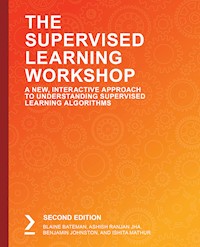
32,36 €
Mehr erfahren.
- Herausgeber: Packt Publishing
- Kategorie: Wissenschaft und neue Technologien
- Sprache: Englisch
Cut through the noise and get real results with a step-by-step approach to understanding supervised learning algorithms
Key Features
- Ideal for those getting started with machine learning for the first time
- A step-by-step machine learning tutorial with exercises and activities that help build key skills
- Structured to let you progress at your own pace, on your own terms
- Use your physical print copy to redeem free access to the online interactive edition
Book Description
You already know you want to understand supervised learning, and a smarter way to do that is to learn by doing. The Supervised Learning Workshop focuses on building up your practical skills so that you can deploy and build solutions that leverage key supervised learning algorithms. You'll learn from real examples that lead to real results.
Throughout The Supervised Learning Workshop, you'll take an engaging step-by-step approach to understand supervised learning. You won't have to sit through any unnecessary theory. If you're short on time you can jump into a single exercise each day or spend an entire weekend learning how to predict future values with auto regressors. It's your choice. Learning on your terms, you'll build up and reinforce key skills in a way that feels rewarding.
Every physical print copy of The Supervised Learning Workshop unlocks access to the interactive edition. With videos detailing all exercises and activities, you'll always have a guided solution. You can also benchmark yourself against assessments, track progress, and receive content updates. You'll even earn a secure credential that you can share and verify online upon completion. It's a premium learning experience that's included with your printed copy. To redeem, follow the instructions located at the start of your book.
Fast-paced and direct, The Supervised Learning Workshop is the ideal companion for those with some Python background who are getting started with machine learning. You'll learn how to apply key algorithms like a data scientist, learning along the way. This process means that you'll find that your new skills stick, embedded as best practice. A solid foundation for the years ahead.
What you will learn
- Get to grips with the fundamental of supervised learning algorithms
- Discover how to use Python libraries for supervised learning
- Learn how to load a dataset in pandas for testing
- Use different types of plots to visually represent the data
- Distinguish between regression and classification problems
- Learn how to perform classification using K-NN and decision trees
Who this book is for
Our goal at Packt is to help you be successful, in whatever it is you choose to do. The Supervised Learning Workshop is ideal for those with a Python background, who are just starting out with machine learning. Pick up a Workshop today, and let Packt help you develop skills that stick with you for life.
Das E-Book können Sie in Legimi-Apps oder einer beliebigen App lesen, die das folgende Format unterstützen:
Seitenzahl: 411
Veröffentlichungsjahr: 2020
Ähnliche



















The Supervised Learning Workshop
Second Edition
A New, Interactive Approach to Understanding Supervised Learning Algorithms
Blaine Bateman, Ashish Ranjan Jha, Benjamin Johnston, and Ishita Mathur
The Supervised Learning Workshop
Second Edition
Copyright © 2020 Packt Publishing
All rights reserved. No part of this book may be reproduced, stored in a retrieval system, or transmitted in any form or by any means, without the prior written permission of the publisher, except in the case of brief quotations embedded in critical articles or reviews.
Every effort has been made in the preparation of this book to ensure the accuracy of the information presented. However, the information contained in this book is sold without warranty, either express or implied. Neither the authors, nor Packt Publishing, and its dealers and distributors will be held liable for any damages caused or alleged to be caused directly or indirectly by this book.
Packt Publishing has endeavored to provide trademark information about all of the companies and products mentioned in this book by the appropriate use of capitals. However, Packt Publishing cannot guarantee the accuracy of this information.
Authors: Blaine Bateman, Ashish Ranjan Jha, Benjamin Johnston, and Ishita Mathur
Reviewers: Tiffany Ford, Sukanya Mandal, Ashish Pratik Patil, and Ratan Singh
Managing Editor: Snehal Tambe
Acquisitions Editor: Anindya Sil
Production Editor: Samita Warang
Editorial Board: Shubhopriya Banerjee, Bharat Botle, Ewan Buckingham, Megan Carlisle, Mahesh Dhyani, Manasa Kumar, Alex Mazonowicz, Bridget Neale, Dominic Pereira, Shiny Poojary, Abhishek Rane, Brendan Rodrigues, Mugdha Sawarkar, Erol Staveley, Ankita Thakur, Nitesh Thakur, and Jonathan Wray
First published: April 2019
Second edition: February 2020
Production reference: 1280220
ISBN 978-1-80020-904-6
Published by Packt Publishing Ltd.
Livery Place, 35 Livery Street
Birmingham B3 2PB, UK
Table of Contents
Preface i
1. Fundamentals of Supervised Learning Algorithms 1
Introduction 2
When to Use Supervised Learning 3
Python Packages and Modules 4
Loading Data in Pandas 5
Exercise 1.01: Loading and Summarizing the Titanic Dataset 7
Exercise 1.02: Indexing and Selecting Data 10
Exercise 1.03: Advanced Indexing and Selection 14
Pandas Methods 17
Exercise 1.04: Splitting, Applying, and Combining Data Sources 21
Quantiles 23
Lambda Functions 24
Exercise 1.05: Creating Lambda Functions 25
Data Quality Considerations 28
Managing Missing Data 28
Class Imbalance 33
Low Sample Size 34
Activity 1.01: Implementing Pandas Functions 35
Summary 37
2. Exploratory Data Analysis and Visualization 39
Introduction 40
Exploratory Data Analysis (EDA) 40
Summary Statistics and Central Values 42
Exercise 2.01: Summarizing the Statistics of Our Dataset 43
Missing Values 48
Finding Missing Values 49
Exercise 2.02: Visualizing Missing Values 50
Imputation Strategies for Missing Values 54
Exercise 2.03: Performing Imputation Using Pandas 55
Exercise 2.04: Performing Imputation Using Scikit-Learn 56
Exercise 2.05: Performing Imputation Using Inferred Values 58
Activity 2.01: Summary Statistics and Missing Values 61
Distribution of Values 65
Target Variable 65
Exercise 2.06: Plotting a Bar Chart 65
Categorical Data 67
Exercise 2.07: Identifying Data Types for Categorical Variables 68
Exercise 2.08: Calculating Category Value Counts 70
Exercise 2.09: Plotting a Pie Chart 71
Continuous Data 73
Skewness 75
Kurtosis 75
Exercise 2.10: Plotting a Histogram 75
Exercise 2.11: Computing Skew and Kurtosis 77
Activity 2.02: Visually Representing the Distribution of Values 79
Relationships within the Data 84
Relationship between Two Continuous Variables 84
Pearson's Coefficient of Correlation 85
Exercise 2.12: Plotting a Scatter Plot 85
Exercise 2.13: Plotting a Correlation Heatmap 87
Using Pairplots 90
Exercise 2.14: Implementing a Pairplot 90
Relationship between a Continuous and a Categorical Variable 92
Exercise 2.15: Plotting a Bar Chart 92
Exercise 2.16: Visualizing a Box Plot 95
Relationship Between Two Categorical Variables 97
Exercise 2.17: Plotting a Stacked Bar Chart 97
Activity 2.03: Relationships within the Data 99
Summary 105
3. Linear Regression 107
Introduction 108
Regression and Classification Problems 108
The Machine Learning Workflow 109
Business Understanding 110
Data Understanding 110
Data Preparation 111
Modeling 111
Evaluation 112
Deployment 112
Exercise 3.01: Plotting Data with a Moving Average 112
Activity 3.01: Plotting Data with a Moving Average 123
Linear Regression 125
Least Squares Method 126
The Scikit-Learn Model API 126
Exercise 3.02: Fitting a Linear Model Using the Least Squares Method 127
Activity 3.02: Linear Regression Using the Least Squares Method 132
Linear Regression with Categorical Variables 137
Exercise 3.03: Introducing Dummy Variables 139
Activity 3.03: Dummy Variables 150
Polynomial Models with Linear Regression 152
Exercise 3.04: Polynomial Models with Linear Regression 154
Activity 3.04: Feature Engineering with Linear Regression 159
Generic Model Training 163
Gradient Descent 165
Exercise 3.05: Linear Regression with Gradient Descent 168
Exercise 3.06: Optimizing Gradient Descent 176
Activity 3.05: Gradient Descent 181
Multiple Linear Regression 183
Exercise 3.07: Multiple Linear Regression 185
Summary 193
4. Autoregression 195
Introduction 196
Autoregression Models 196
Exercise 4.01: Creating an Autoregression Model 197
Activity 4.01: Autoregression Model Based on Periodic Data 214
Summary 221
5. Classification Techniques 223
Introduction 224
Ordinary Least Squares as a Classifier 224
Exercise 5.01: Ordinary Least Squares as a Classifier 226
Logistic Regression 232
Exercise 5.02: Logistic Regression as a Classifier – Binary Classifier 236
Exercise 5.03: Logistic Regression – Multiclass Classifier 242
Activity 5.01: Ordinary Least Squares Classifier – Binary Classifier 248
Select K Best Feature Selection 249
Exercise 5.04: Breast Cancer Diagnosis Classification Using Logistic Regression 250
Classification Using K-Nearest Neighbors 254
Exercise 5.05: KNN Classification 257
Exercise 5.06: Visualizing KNN Boundaries 259
Activity 5.02: KNN Multiclass Classifier 266
Classification Using Decision Trees 267
Exercise 5.07: ID3 Classification 269
Classification and Regression Tree 280
Exercise 5.08: Breast Cancer Diagnosis Classification Using a CART Decision Tree 281
Activity 5.03: Binary Classification Using a CART Decision Tree 284
Artificial Neural Networks 286
Exercise 5.09: Neural Networks – Multiclass Classifier 288
Activity 5.04: Breast Cancer Diagnosis Classification Using Artificial Neural Networks 292
Summary 294
6. Ensemble Modeling 297
Introduction 298
One-Hot Encoding 299
Exercise 6.01: Importing Modules and Preparing the Dataset 300
Overfitting and Underfitting 302
Underfitting 304
Overfitting 305
Overcoming the Problem of Underfitting and Overfitting 306
Bagging 307
Bootstrapping 308
Exercise 6.02: Using the Bagging Classifier 310
Random Forest 312
Exercise 6.03: Building the Ensemble Model Using Random Forest 313
Boosting 314
Adaptive Boosting 316
Exercise 6.04: Implementing Adaptive Boosting 316
Gradient Boosting 319
Exercise 6.05: Implementing GradientBoostingClassifier to Build an Ensemble Model 320
Stacking 321
Exercise 6.06: Building a Stacked Model 324
Activity 6.01: Stacking with Standalone and Ensemble Algorithms 328
Summary 331
7. Model Evaluation 333
Introduction 334
Importing the Modules and Preparing Our Dataset 336
Evaluation Metrics 338
Regression Metrics 338
Exercise 7.01: Calculating Regression Metrics 341
Classification Metrics 342
Numerical Metrics 342
Curve Plots 346
Exercise 7.02: Calculating Classification Metrics 348
Splitting a Dataset 350
Hold-Out Data 350
K-Fold Cross-Validation 352
Sampling 353
Exercise 7.03: Performing K-Fold Cross-Validation with Stratified Sampling 354
Performance Improvement Tactics 355
Variation in Train and Test Errors 356
Learning Curve 356
Validation Curve 357
Hyperparameter Tuning 358
Exercise 7.04: Hyperparameter Tuning with Random Search 360
Feature Importance 364
Exercise 7.05: Feature Importance Using Random Forest 364
Activity 7.01: Final Test Project 366
Summary 369
Appendix 371
Preface
About
This section briefly introduces this book and software requirements in order to complete all of the included activities and exercises.
About the Book
You already know you want to learn about supervised learning, and a smarter way to do that is to learn by doing. The Supervised Learning Workshop focuses on building up your practical skills so that you can deploy and build solutions that leverage key supervised learning algorithms. You'll learn from real examples that lead to real results.
Throughout The Supervised Learning Workshop, you'll take an engaging step-by-step approach to understanding supervised learning. You won't have to sit through any unnecessary theory. If you're short on time, you can jump into a single exercise each day or spend an entire weekend learning how to predict future values with various regression and autoregression models. It's your choice. Learning on your terms, you'll build up and reinforce key skills in a way that feels rewarding.
Every physical print copy of The Supervised Learning Workshop unlocks access to the interactive edition. With videos detailing all exercises and activities, you'll always have a guided solution. You can also benchmark yourself against assessments, track your progress, and receive content updates. You'll even earn a secure credential that you can share and verify online upon completion. It's a premium learning experience that's included with your print copy. To redeem this, follow the instructions located at the start of the book.
Fast-paced and direct, The Supervised Learning Workshop is the ideal companion for those with some Python background who are getting started with machine learning. You'll learn how to apply key algorithms like a data scientist, learning along the way. This process means that you'll find that your new skills stick, embedded as best practice, establishing a solid foundation for the years ahead.
Audience
Our goal at Packt is to help you be successful in whatever it is you choose to do. The Supervised Learning Workshop is ideal for those with a Python background who are just starting out with machine learning. Pick up a copy of The Supervised Learning Workshop today and let Packt help you develop skills that stick with you for life.
About the Chapters
Chapter 1, Fundamentals of Supervised Learning Algorithms, introduces you to supervised learning, Jupyter notebooks, and some of the most common pandas data methods.
Chapter 2, Exploratory Data Analysis and Visualization, teaches you how to perform exploration and analysis on a new dataset.
Chapter 3, Linear Regression, teaches you how to tackle regression problems and analysis, introducing you to linear regression as well as multiple linear regression and gradient descent.
Chapter 4, Autoregression, teaches you how to implement autoregression as a method to forecast values that depend on past values.
Chapter 5, Classification Techniques, introduces classification problems, classification using linear and logistic regression, k-nearest neighbors, and decision trees.
Chapter 6, Ensemble Modeling, teaches you how to examine the different ways of ensemble modeling, including their benefits and limitations.
Chapter 7, Model Evaluation, demonstrates how you can improve a model's performance by using hyperparameters and model evaluation metrics.
Conventions
Code words in text, database table names, folder names, filenames, file extensions, pathnames, dummy URLs, user input, and Twitter handles are shown as follows: "Use the pandas read_csv function to load the CSV file containing the synth_temp.csv dataset, and then display the first five lines of data."
Words that you see on screen, for example, in menus or dialog boxes, also appear in the text like this: "Open the titanic.csv file by clicking on it on the Jupyter notebook home page."
A block of code is set as follows:
print(data[pd.isnull(data.damage_millions_dollars)].shape[0])
print(data[pd.isnull(data.damage_millions_dollars) &
(data.damage_description != 'NA')].shape[0])
New terms and important words are shown like this: "Supervised means that the labels for the data are provided within the training, allowing the model to learn from these labels."
Before You Begin
Each great journey begins with a humble step. Before we can do awesome things with supervised learning, we need to be prepared with a productive environment. In this section, we will see how to do that.
Installation and Setup
Jupyter notebooks are available once you install Anaconda on your system. Anaconda can be installed for Windows systems using the steps available at https://packt.live/2P4XWqI.
For other systems, navigate to the respective installation guide from https://packt.live/32tU7Ro.
These installations will be executed in the 'C' drive of your system. You can choose to change the destination.
Installing the Code Bundle
Download the code files from GitHub at https://packt.live/2TlcKDf. Refer to these code files for the complete code bundle. Make sure to copy the code bundle to the same drive as your Anaconda installation.
If you have any issues or questions about installation, please email us at [email protected].
The high-quality color images used in this book can be found at https://packt.live/2T1BX6M.




