


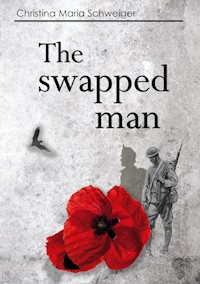
Erhalten Sie Zugang zu diesem und mehr als 300000 Büchern ab EUR 5,99 monatlich.
- Herausgeber: Books on Demand
- Kategorie: Gesellschafts- und Liebesromane
- Serie: Aiden Mc Gilles
- Sprache: Englisch
In memory of all fallen soldiers and those who survived the cruelty of war. World War 1 Ireland 1916 Young Aiden McGilles falls into the clutches of British soldiers roaming Ireland to recruit young men to fight on the Western Front in Flanders, France. It is not until he is exposed to the incredible horror of war on the front lines that he realizes he will never return to his family in Ireland. When he falls injured into a bomb crater under the great Battle of the Sommé, he encounters the German soldier Franz v. Letten, who is lying badly injured in the bomb crater and struggling to die. Aiden quickly realizes that Franz is not an enemy, but a friend who, in the last hours of his life, makes him an incredible proposal to give him, Aiden, a chance to escape the cruelty of war. Aiden sees no other way out and agrees. Thus begins for him an adventurous and dangerous journey.
Sie lesen das E-Book in den Legimi-Apps auf:
Seitenzahl: 349
Veröffentlichungsjahr: 2021
Das E-Book (TTS) können Sie hören im Abo „Legimi Premium” in Legimi-Apps auf:
Ähnliche



















The book
World War 1 Ireland 1916
Young Aiden McGilles falls into the clutches of British soldiers roaming Ireland to recruit young men to fight on the Western Front in Flanders, France.
It is not until he is exposed to the incredible horror of war on the front lines that he realizes he will never return to his family in Ireland.
When he falls injured into a bomb crater under the great Battle of the Sommé, he encounters the German soldier Franz v. Letten, who is lying badly injured in the bomb crater and struggling to die.
Aiden quickly realizes that Franz is not an enemy, but a friend who, in the last hours of his life, makes him an incredible proposal to give him, Aiden, a chance to escape the cruelty of war.
Aiden sees no other way out and agrees. Thus begins for him an adventurous and dangerous journey.
Author
Christina Maria Schweiger was born in 1965 and works as a secretary at the office of a hotel. Her passions are social projects such as hospice and grief worker and writing. Since 2007 she has been working as an author. She has already published a trilogy of novels as well as a village chronicle of her hometown.
ON HURTING GROUND
Poetic Silhouettes
On soldiers, history, love and tragedy
By
Michael J. Whelan
On Hurting Ground
That membrane
The dusty soil
Keeps departed souls
Loved ones
Disconnected
An echoing earth
Repository of broken bones
Separated
We long for them
Those gone before
To reconnect
Like those who live
Once more to walk
On hurting ground
In memory of all fallen soldiers and those who survived the cruelty of war.
The poppy is a reminder of the fields of Flanders, reddened
by the blood of the soldiers of the First World War, in
reference to the poem "In Flanders Fields" by the Canadian
John McCrae. In addition, at that time on the freshly raised
hills of the soldiers' graves, the first thing to begin to bloom
was the corn poppy.
(source: wikipedia: remembrance poppy)
Contents
The Leprechaun
Prologue
Ireland, Hill of Tara March 1916: Aiden Mc Gilles
West Front/ France 1916
West Front/France September 1916: Field hospital
West Front/France 1916: Saint Quentin - Field hospital 10 September
Heidelberg, Germany War hospital: 30 September 1916
Arrival Heidelberg, Germany: 02 October 1916
Arrival Munich: 28 October 1916
Munich: December 1916
Munich: September 1917
Anna: Munich, November 1917
The Leprechaun
In a shady nook one moonlit night,
A leprechaun I spied
In scarlet coat and cap of green,
A cruiskeen by his side.
Twas tick, tack, tick, his hammer went,
Upon a weeny shoe,
And I laughed to think of a purse of gold,
But the fairy was laughing too.
With tiptoe step and beating heart,
Quite softly I drew nigh.
There was mischief in his merry face,
A twinkle in his eye;
He hammered and sang with tiny voice,
And sipped the mountian dew;
Oh! I laughed to think he was caught at last,
But the fairy was laughing too.
As quick as thought I grasped the elf,
"You're fairy purse," I cried,
"My purse?" he said, "tis in her hand,
That lady by your side."
I turned to look, the elf was off,
And what was I to do?
Oh! I laughed to think what a fool I'd been,
And, the fairy was laughing too.
Robert Dwyer Joyce 1830-1883
Prologue
Ireland 1905
Calbhach and the golden coin
It happened many, many years ago.
The year was 1905 and was slowly drawing to a close. The day began gloomy and grey. Hardly any light penetrated the thick clouds of mist that had been drifting over the green, hilly area of the Hills of Tara since early morning.
In the midst of this lush, green hilly landscape of today's province of Leinster, County Meath in Ireland, at the top of the Hill of Tara, on the hill, a so-called fairy hill, stood an old wooden bench, weathered by much rain, well hidden under a low-growing tree.
A little man was sitting on this bench. He didn't seem to be affected by the rain and the cold and wet weather. No, on the contrary. He lolls on the bench with a satisfied expression on his face. He had just woken up from a short nap.
The male was very elegantly dressed in a green doublet over which he wore a brown waistcoat. On his head was a huge green hat, which he pulled deep into his wrinkled forehead. A bulbous nose stood out, as did the reddish-brown beard that framed the lower part of his face. A long grey pipe protruded from his thick-lipped mouth, from which thick smoke poured out as soon as he pulled on it.
He just stretched his stocky short legs and examined his elegant shoes, which were made of fine brown leather and emblazoned with a brightly polished golden clasp on the top. He looked proudly at his new shoes. He had only finished them yesterday. Like many other Leprechauns, Calbhach was a shoemaker.
With a contented sigh, he picked up the bottle of whiskey that stood on the bench next to him, took a big swig, and belched contentedly after the whiskey had coagulated warm and burning through his throat towards his stomach.
Yes, that's the way to live,' thought Calbhach and let his arms sink down on the bench beside him, lazily and contentedly. But he had not remembered that just before he had fallen asleep, he had placed his two precious coins next to him on the bench. Before that, he had polished them, as he often did, and looked at them proudly, which he loved to do.
Now, in his carelessness, he had nudged the coins off the bench with his hand and before he could react and reach for them, they were already rolling down the hill. The big silver coin in front and the golden one followed at a short distance. Calbhach jumped up from the bench and rushed excitedly down the hill after his coins. But as the leather of his new shoes was still very stiff and the sole very slippery, it was not at all easy for Calbhach to find a secure grip with his shoes in the wet grass. He slipped again and again, throwing his short, stocky arms up in the air to keep his balance and avoid falling.
Cursing and swearing, he ran stumbling and sliding down the hill, not taking his eyes off his two coins despite the effort. They did not let themselves be slowed down or stopped by the long grass, but rolled down the hill faster and faster in an upright posture. Even when it became flatter and the hill turned into a green, flat meadow, they kept on rolling.
Calbhach just reached the bottom of the hill and tripped so badly over a stone that he did two somersaults head first before he could lie on his side and thus stop his rapid fall.
For a short moment he lay there completely dazed. But after a few seconds he thought of his coins and he quickly jumped up and ran on.
'Damn é arís!' he kept shouting angrily in Gaelic, which meant 'Damn it', waving his short arms wildly in the air as if he could use them to make the coins stop.
Again and again he stumbled with his new, not yet broken-in shoes. As beautiful as he found them, he just regretted not wearing his old, well-worn shoes, with which he would certainly have been much faster.
But he had no choice and didn't care how many times he fell. Again and again he jumped on his short, stocky legs and kept running after his coins. They were very valuable to him, as they were to every other leprechaun. Each of the coins had a special, special gift.
The silver one, for example, could be spent by its owner as often as he wanted, it would always return to his hands and thus grant him eternal wealth.
The golden coin had the special gift of freeing its owner from difficult situations. With this coin you always find a way to follow the right intuition so that true miracles could happen.
Calbhach felt panic rising in him at the thought that he would not find his coins again, or that someone else would find them and take them. He, Calbhach, would be lost. How could he survive in this harsh, hard world without his treasure, without the protection of the coins?
All this flashed through his mind while he was still running. He had long since lost sight of his coins, having fallen too many times. He followed the slight indentation in the damp grass left by the coins as they rolled on tirelessly.
A little way down the slope, Calbhach suddenly saw a small, old, very dilapidated cottage standing directly in the alignment of the coins' path. Calbhach hoped so much that would the coins finally stop there.
When he arrived at the cottage, breathing heavily, he saw that a small, blond boy was sitting on the floor in front of the door, playing with a small piece of wood in the damp, brown mud. This piece of wood functioned for him as a kind of hammer, because with it he kept hitting something of a shiny nature that flashed out of the brown mud.
Calbhach stopped abruptly and was about to shout out loud when he thought better of it. He did not want to frighten the boy.
If the boy lured his parents out of the house by shouting and they discovered the two coins on the boy, his chances of ever getting them back would be even slimmer.
The families here were very poor, they would stop at nothing to get their hands on some money or gold. And everyone in Ireland knew that if they came across a leprechaun, gold and silver would not be far away, just like whiskey and tobacco.
It wasn't often that you got to see a leprechaun, and if you ever did encounter one, you wouldn't let it out of your sight, let alone escape. Because only then, only then will you become it manage to elicit from the leprechaun the secret of the place where the treasure of gold lay hidden. As the legend says, this mysterious place was at the end of a rainbow.
That is why the goblins are reluctant to stay near inhabited houses or places.
But Calbhach had no other chance now. He had to approach the boy diplomatically and calmly coax the two coins from him.
His plan turned out to be very difficult. The boy only noticed Calbhach when he was already standing right in front of him. Curious, but not afraid, he looked at the little male.
"Who are you?" the boy asked curiously, continuing to pound the two coins in the mud, causing them to sink further and further into the soft earth.
"My name is Calbhach," the male replied outwardly friendly, but inwardly trembling with excitement.
"And who are you? And how old are you?" the male asked hypocritically.
"My name is Aiden and I am six years old. But tomorrow is my birthday and I'll be seven. " he says excitedly.
"Aha... aha... aha! Nice little fellow you are. "
Calbhach thought feverishly about how best to talk about the two coins.
It was a quirk of Calbhach to comment on everything with his 'aha..aha..aha'.
"Aiden, aha. aha. aha. so, you're not cold out here?" he began his conversation cautiously.
The boy was only wearing a half-tattered grey jacket that had more holes than there was fabric to be seen.
Aiden looked up at him briefly and shook his head.
"Are your parents not at home?", Calbhach continued to question him.
"No, they've gone into town, but they should be home soon," little Aiden told him candidly.
"And you're home all alone?"
"No, my sister is still here, she's making dinner."
"Aha aha aha...Shit...So, so!" he fretted, still frantically thinking of how he could take the coins from the boy without him making a fuss.
"Are you a goblin?" the boy asked, looking curiously at Calbhach, then dug the two coins out of the mud, took each in one hand and stood up.
When Calbhach saw the boy holding the two coins in his hands, he was startled and wanted to grab them quickly, but the boy was quicker and put the two coins in his pocket without cleaning them.
"What have you got there?" asked Calbhach hypocritically, as if he did not know that these were his coins.
Aiden looked at him suspiciously. There was no way he was going to give up his treasure, which had rolled into his life so easily. And as he had guessed from his parents' stories, there was a goblin, a leprechaun, standing in front of him.
Aiden was not afraid of the little male. He actually looked quite friendly, he thought to himself.
Calbhach decided to talk to the boy quite honestly and tell him that what he had found there belonged to him. And would then insist that he had to give him back the two coins.
"Little boy. Those things you found there, those are my coins. They rolled off that hill up there and I couldn't catch them until they ended up with you. But now I've found them and you'll give them back to me, won't you?" and he made a droll face.
Aiden looked at Calbhach irresolutely. He sank his dirty hand into his trouser pocket and slowly took out the two coins.
Again and again he looked from the coins to Calbhach and back again. He did not know what to do and tears came to his eyes.
Calbhach saw his sad and disappointed look and pity spread through his otherwise very selfish heart.
He would simply get a new golden coin from his treasure chest.
"You know what, my boy? You give me back the silver coin and you can keep the gold coin.
What do you think, is that a deal?" he suggested to little Aiden, visibly touched.
The latter pondered with childlike seriousness and kept looking wistfully at the two coins. Finally he raised his eyes to Calbhach.
"All right, then I'll give you back the silver coin," Aiden replied hesitantly, and he handed Calbhach the silver coin, but he immediately put the gold one back in his trouser pocket.
"Thank you little boy. Always keep this coin safe and always carry it with you. And if one day you should be in need or find yourself in a difficult situation, take this coin in your hand and it will help you, whatever may happen."
"Thank you dear Leprechaun!" he called out joyfully to Calbhach in response.
At that moment, the red-painted front door of the small cottage opened and his sister called loudly for Aiden.
He turned to her.
"Look, Eimear!", excitedly he pointed with his hand in the direction of Calbhach. But he had disappeared. Aiden looked around irritated.
"What do you want me to see?" his sister asked impatiently.
"Come on in and wash your hands. Mummy and Daddy will be right back."
Aiden's gaze was still searching in vain for Calbhach, while he held his gold coin, his treasure, in his left hand, which he had buried in his pocket.
"Oh nothing. I'm coming," he called out to his sister, with a mysterious smile on his face and the knowledge, that he had just met a goblin who had given him a gold coin.
And he would always remember Calbhach's words and cherish the coin and always carry it with him.
Ireland, Hill of Tara March 1916
Aiden Mc Gilles
Aiden quickly slipped on his brown woollen waistcoat. He wanted to help his parents in the field to round up the sheep.
It was an unusually mild March and the animals were already spending a lot of time in the pastures around the cottage.
He quickly finished his cup, even though the tea had already gone cold, when there was a wild knock on the door of the cottage.
Aiden ran to the door in surprise at the energetic and impatient knocking. Who could that be? They very rarely got visitors out here.
Eimear was in Dublin for a few days to sell sheepskins. She was able to stay with an aunt and enjoyed these days very much and the freedom to spend time alone in the city and hoped to meet a man there soon.
When Aiden opened the door, there were several soldiers from the British army, as he recognised from their uniforms.
Among them was a neighbour's boy named John.
Proud and excited, he explained that he had decided to follow the British soldiers and the British army into the war.
And if he came along, he could also fight in the Irish 16th Division formed under Major General W.B. Hickie.
The 16th Division of Irish Volunteer Recruits marched into France in December 1915 to support the British there.
But they needed a constant supply of 'human weapons', as they called it.
And so they were again on their way across the country to mobilise new soldiers and take them with them to France to join the large-scale British-French offensive against the German positions planned for 1 July 1916, which would eventually also contest the planned, large-scale battle at the Sommé, one of the soldiers explained to him.
Aiden had already heard that British soldiers were on their way to Irish shores. As many Irish as possible should join the British to go into battle together.
The independence movement 'Irish Volunteers', founded in 1913, was now divided into two camps. While the founders of the movement had fundamentally rejected recruitment to Ireland to replenish the British army, the majority, almost 70% of the Irish Volunteers now supported the war against Germany and allowed themselves to be commanded by the British.
So the British haggled for every Irish volunteer they could recruit.
It did not matter whether these young men were inexperienced in combat. From the age of 17 they were considered fit for military service and were sent to the front completely unaware and not sufficiently trained in weapons.
Aiden listened attentively and with interest as the British soldiers spoke to him in glowing terms of the service and honour he would be contributing to his country and also to Britain by going to war with them.
The soldiers explained to him that he would first be trained in arms and only then fight at the front.
Aiden let himself be drawn more and more into this spell of the soldiers' dazzling words.
His parents were in the field at the time and he told the soldiers that he would like to discuss this with his parents first.
One of the soldiers then grabbed him roughly by the arm.
"If you want to be there, then you have to come right away. We don't have time to wait for you until tomorrow," he shouted urgently to Aiden, putting him under pressure.
"Pack up a few things. You won't need much. You'll get your uniform and equipment from the British Army. We'll let your parents know on the field and you can say goodbye there."
Aiden felt a little queasy in his stomach. What should he do? On the one hand, he would be very happy to join and he would be able to prove himself in the fight of war for his country. In his youthful inexperience of all things violent and warlike, he never grasped the magnitude of this decision. He only saw the glory and honour he could win and then proudly return to his homeland, Ireland, as a hero.
But on the other hand, he remembered that he could not leave his parents alone with all the work in the fields.
His father had been very sickly for a long time and often could not get up from bed all day.
Then Aiden had to be here and take over his father's work.
And besides, what would his mother say?
While he was still struggling with himself to make a decision, the soldiers pushed him more and more until he finally gave in and had allowed himself to be so blinded that he went into his chamber and hastily stuffed some clothes into his old canvas bag.
He looked down at himself. He was wearing old, patched trousers and a grey-striped shirt, which was also torn at the sleeves.
But apart from his Sunday suit, he had nothing to wear that was presentable.
He reached for his sturdy shoes and his woollen jacket.
When he was already at the door, he suddenly stopped, turned around again and looked at his bed.
He walked up to it, knelt down and pulled out an old tin from under the bed. Aiden opened the tin and took out the golden coin that was inside. He looked at it for a moment and remembered again when it had rolled at his feet many years ago, while playing outside the cottage.
He still remembered the little man with the green duster who stood in front of him and wanted the coins back.
Aiden knew he hadn't been dreaming, although when he went to introduce him to his sister Eimear, the goblin was no longer in sight.
But the goblin even told him his name and had given him this golden coin and told him that he should always carry this coin with him, as it will bring him luck and would always free him from any situation, no matter how hopeless.
Aiden thought of that now at this moment and smiling, he put it in his pocket. He would always carry the coin with him and he trusted that it would bring him luck and protect him.
Then he went back to the soldiers who were already waiting for him outside the door and they set off for the fields.
*
His mother cried out in despair when Aiden came towards her in the field with the soldiers. He didn't have to say anything, she knew what had happened. Tearful, she fell around his neck and begged him not to follow the soldiers voluntarily. His father just stood there silently, looking into his son's eyes.
"You have to do what you have to do, son. Don't disgrace your country," was all he said. He knew he could not stop him, as hard as it was for him.
Aiden looked over his mother's shoulder, still hanging on his neck, at his father. He could not assess what he was really thinking. His face looked expressionless.
Aiden would have wished in that brief moment, soaked in emotion, that his father had stopped him. But the moment passed and not another word was spoken. Apart from his mother's desperate crying, the field was dead silent.
The soldiers now impatiently called for haste and roughly pulled the mother away from her son.
Tears came to Aiden's eyes, but he didn't want to show his face to the soldiers and bravely swallowed the sudden panic, straightened up and ran after the soldiers who were already hurrying away. He did not turn around. He heard his mother crying and wailing loudly and his heart threatened to burst.
*
West Front/ France 1916
The Irish recruits were first brought from Ireland to England on a large cargo ship, where they remained in a camp for a fortnight and were taught how to shoot and handle the various weapons in a makeshift manner.
At the end of April, Aiden was sent to the Western Front in France with many thousands of soldiers to support the French against the German Army by helping to build front line trenches and ammunition dumps.
Before the trip to France, they were all shaved bald and Aiden's reddish-blond mop of hair fell to the muddy ground below. When he looked in the mirror, he hardly recognised himself.
His big blue eyes looked much bigger than usual and his fair skin, with the pale pink freckles spreading down his nose to his cheeks, stood out much more without hair. His whole face seemed sunken, as he had already lost quite a bit of weight.
The hard work and meagre food rations played their part.
More and more, during those weeks when he worked near the front line in the newly dug trenches and saw many wounded and cruelly mutilated soldiers, he became aware of what he had gotten himself into.
Most of the soldiers around him were also rookies and not much older than him.
But he could not share this eagerness to fight, which many underlined with motivated battle cries. Some days he no longer knew what he was doing here. He felt nothing in himself of heroism and glory.
Only hard work, horror and dismay marked his day and more and more he closed himself off from feelings and emotions in order to be able to endure and persevere. The weeks passed slowly and the month of June began with very warm temperatures.
*
Aiden was now to be sent with a squad to Fort Vaux in Verdun, France, near the village of Vaux-Devant-Damloup, in mid-June, to join the French in repelling massive German attacks on the fort.
But things turned out differently, because on 7 June 1916, the troops under commander Sylvain Eugéne Raynal surrendered to the Germans and the counterattacks to defend the fort on the following days were unsuccessful.
And so it happened that the Germans were to occupy Fort Vaux until the end of October.
Therefore, in mid-June, the French gave the order to send the squad with the still very young, strong and fresh soldiers destined for Fort Vaux directly to the front at the Sommé.
Its mission was to support the 7-day artillery preparations from 24 June 1916 for the start of the Sommé battle between Gommécourt northwest of Bapaume and Vermandovillers southwest of Péronne. The start of the infantry attack was planned for 1 July 1916.
So they were split up partly by trains, partly by long marches, Aiden arrived with the troop in the French region of Hauts-de-France on the river Sommé in Flanders, in the west of France.
*
On arrival on 23 June 1916, Aiden was posted to the Irish 36th Division. What he could not yet know was that this Ulster Division, with which he was to fight on 1 July 1916, would lose over half its soldiers in this one battle alone.
This became the heaviest losing day in British military history. On that day alone, the British troops lost around 60,000 men, including around 20,000 killed in action.
In total, there were 104 divisions with 2.5 million soldiers in the Battle of the Sommé from July 1916 to November 1916. This first major combat mission became a traumatic event for Aiden. He later realised that he had probably only survived that day because his inexperience meant that he had been ordered, along with many other newcomers, not to leave the front line trench but to hold position there to eliminate any invading enemies.
Aiden did not know after hours how many shots he had fired and how many soldiers he had shot.
The trench was full of corpses and wounded. Germans, French and British united in death. For although the battlefields were very wide, soldiers from the enemy German camp kept advancing far and wide.
During breaks in the fighting, more trenches were dug and fortified, well into the night. Every day the neglect increased and the soldiers' strength diminished.
Every fortnight, they were replaced for a few days by other soldiers and taken to the front camp, which was located a short distance behind the front line, so that they could gather strength.
The weeks in July and August were marked by cruelty and suffering.
Aiden could hardly feel himself and, like most of the other soldiers, only functioned on command.
*
September had already arrived. For two days, Aiden had been sitting in the trenches with the other soldiers, or lying in their cramped and dirty dugouts, waiting for the next big attack.
The front lines were far apart. The men kept to themselves in the trenches. Reaching the German trenches would have been dangerous, as they were on the move with machine guns, firing from fixed positions and mowing down any advancing troops.
The soldiers were waiting for an order and thought that there might be a counterattack by the Germans, but this did not happen. So they had no desire to move further than necessary from their front trench. They lay tired in their sleeping bays or sat in the mud in the wider corridors of the trenches, since it had rained the days before, waiting for the next meal and the redeeming sleep.
But the next morning, the planned big battle was to begin.
By order of the general, the fire would be opened.
At 6 o'clock on the morning of 6 September, the French General Joseph Joffre issued the order of the day:
"to the poor.... At a moment when a battle is taking place on which the fate of the country depends, it is important to remind everyone that this is not the moment to look backwards; every effort must be made to attack and repel the enemy. A force that makes no further progress must, whatever the cost, hold the ground it has captured and allow itself to be killed in place rather than retreat. In the present circumstances, further hesitation cannot be tolerated." (Source Wikipedia "Battle of the Sommé)
*
Aiden hardly slept on this last night of the impending battle. He lay with his comrades in the dugout of the trench and stared up at the black sky.
Every now and then a mouse or a rat as big as rabbits scurried between their feet and he was afraid of being attacked by one of these giant rats.
He closed his eyes so as not to see those darting shadows any more. But sometimes he blinked, his eyes open a crack, at the sky. There he could make out individual stars in the black night sky, but they were always obscured by grey clouds. He had not seen his friend John, with whom he had left Ireland, for weeks.
He had been assigned to another unit.
Around Aiden, many Englishmen among his Irish compatriots. Many soldiers in his units had been fighting for some time and were jaded and apathetic. Most seemed cold and hardened. But many, like Aiden, had the sheer fear of the coming battle written all over their faces.
It was unusually quiet that night. Each of the soldiers was aware that in a few hours they would have to be ready and open fire.
Some took out their letters that they had received from their wives or families and read them again.
Looked at the pictures of their wives and children for a long time or showed them to their comrades. No one spoke up, some even slept. Nerves were on edge to such an extent that this had already led to rigidity or even insanity in many.
The soldiers who had already been on duty since the beginning of the war in 1914 were particularly affected. Again and again they alternated between two weeks in the trenches, then they were transferred to the stage for a few days. But these days passed too quickly and they had to return to the trenches and face an undignified existence and constant danger to their lives.
Many of the soldiers were only a functioning shell of themselves.
Usually, soldiers who served directly at the front were sent home after two years because they were so burnt out that they could no longer perform in combat. But the troops could no longer be replenished with enough fresh soldiers and therefore every man was needed, even if many hardly knew what they were doing anymore.
Aiden retreated in his mind in those hours before the battle to his own world, to Ireland, to a life that was poor but he had grown up in peace and in beautiful surroundings near the Hills of Tara.
The night passed and he watched and listened more and more to the silent orders moving through the trench.
Again and again, new observers were sent out to scout the enemy.
This was a very dangerous task that was only undertaken by experienced soldiers, as snipers and artillery observers from the enemy would sense any movement and immediately launch an attack.
As the morning slowly began to dawn, many of the soldiers became very restless.
Hardly anyone spoke a word as they shovelled their meagre breakfast, a bowl of porridge, into their mouths with a spoon and drank the thin broth infused with coffee substitute powder.
Aiden was already leaning against the trench wall, loading his rifle, again and again.
His hands were shaking with excitement and he was afraid that he would not manage to reload the cartridges.
A somewhat older soldier who came from London, his name was James, he told him, watched Aiden as he handled his rifle.
James shook his head as he examined the rifle.
There were different versions of the operational weapon. The Enfield rifle, whose standard equipment included a bayonet, could fire a maximum of 20 rounds in succession.
The rifle Aiden was holding was a version of one that was actually only used for training purposes and every single shot had to be reloaded.
He had received this rifle yesterday as a replacement, as there was a shortage of weapons of war.
James took the rifle from Aiden's hand.
"I'll get you another one. It's madness with this rifle that you have to reload after every shot."
James walked away and returned shortly afterwards with a new rifle that could fire twenty rounds in succession.
Aiden thanked him and took a closer look at the weapon.
"You will not be spared this time and must also go out onto the field. The order says that all men must fight on the battlefield beyond the trenches," the soldier informed him.
Aiden broke out in a sweat at the thought. But he knew he had no choice.
James gave him a few more tips and advised him to shoot only from the trench for as long as possible. He grasped his shoulder fatherly and wished him good luck.
The moment had come.
The commander hurriedly ran through the trench and gave the first signal for the attack. On the opposite German front, everything was still quiet, as the artillery observers had reported.
Some soldiers crept cautiously over the edge of the trench. Dusk had already set in, but it was not yet light. Not a cloud showed in the sky, so it would be a sunny day.
At dawn, the outlines of the counter-front could be seen in the distance.
Everything was still quiet. The lush green landscape between the fronts still seemed fairytale-like and calm for the moment.
Aiden stopped in the trench and no one took any notice of him. Every single person was busy with himself, waiting for the order to attack.
Then it was time.
He flinched as the first volleys of gunfire erupted. Everyone started running and a hellish noise began.
Aiden didn't know what was happening to him for the first few minutes. A hail of bullets everywhere.
Some soldiers who were particularly ready to fight charged up the makeshift wooden ladders, only to run and die in the vast vegetation, towards the opposite side.
He continued to hold back, thinking of James' words to stay in the trench or near his own trench as long as possible to defend it from advancing enemies.
Great fear gripped Aiden and he was shocked to see the many dead already lying around him.
But then everyone was called to rush into open combat on the field in front of them and attack and push back the opponent.
Aiden tried to block out his fear. Suddenly he felt sick and had to throw up, but it was no use, he had to follow the other soldiers.
With trembling knees, he climbed up the wooden ladder, seeing the vast battlefield before him. Like an ant invasion, comrades were also climbing up the ladders next to him and running screaming.
Aiden's knees seemed to give way, only with difficulty did he hold on to the ladder. Then he grabbed his rifle, took hold of his bayonet, which was attached to the front of his belt, and charged off, shooting wildly, without a precise target.
Again and again he fell, stumbling over wounded and already dead soldiers.
He didn't know how long he had been running, was it minutes or hours, when he stumbled and just lay there. His face was in the mud and he could only breathe a little.
He did not move. He didn't look left or right, just lay motionless. Frozen in fear and terror, he thought to himself to simply close his eyes and not get up again.
Suddenly he was grabbed under the shoulder and dragged up.
Aiden let it happen and expected to be shot immediately. But he was dragged along by the strong arms.
He didn't know where to go until he was laid down on the edge of the trench.
"Are you hurt? Jump back in the trench boy, quick!" the soldier who had dragged him here shouted at him. It was James who kept shouting at him.
Aiden didn't move, just lay there and stared at the man, who then gave him a shove with his foot and he fell into the trench with full force unchecked.
When he hit the bottom, he cried out and woke up as if from a trance.
He awoke from his rigidity and slowly saw and thought clearly again. He struggled to pull himself up. Completely exhausted, he leaned against the trench wall. Powerless, he sank to his knees and dropped his rifle. He hated weapons and hated this war even more.
For a brief moment he closed his eyes.
He was so tired and didn't know how long he had to hold out, how long the fight would last. There was complete chaos around him.
His comrades were either running around uncontrollably or lying injured, moaning loudly at the foot of the trench, waiting for help. In between lay the dead.
He blanked out the cruel happenings around him. He only wanted to rest for a short moment. Powerlessly, he raised his trembling hands.
He already couldn't remember what it was like not to shiver.
He thought of how the sky had still been blue yesterday morning. And he saw this sky in front of him, the black clouds of smoke from the guns, tanks and cannons had vanished in his imagination, no sounds could be heard, no gunshots, no cries of the wounded or dying.
He looked up at the sky, closed his eyes and for a brief moment he breathed in the cool, fresh air of memory, transporting himself for moments back to his homeland in Ireland. He saw the green, lush meadows, the old oak tree, high up on the hill, near his childhood home. He thought of the old, huge, green-covered hilltop burial ground, New Grange, which he could see in the distance from there. He loved his native Ireland more than anything.
He thought of his parents, of his sister Eimear and of the fact that he would probably never see them again. This war was so cruel and yet there was no escape.
*
Still leaning with his back against the wall of the trench, with trembling hands and tears in his eyes, Aiden thought of his parents and the day he had left them.
If only he had had an inkling that this was a journey of no return, he would have made a different decision.
But today, almost six months later, he was here in the trenches in France, in the midst of a cruel battle, surrounded by the wounded and the dead. Today, 6 September, was his birthday. He turned 19 years old.
His birthday was spent in this cruel battle and he feared that his birthday would also be the day of his death.
Automatically, Aiden grabbed the pocket of his grey, dirty uniform trousers. Thank God, it was still there. Through the fabric of the trousers, he could feel the outline of the coin.
"Please help me," Aiden whispered desperately, "I don't want to die."
Tears streamed down his face while a soldier fell down the trench next to him and lay bleeding. Aiden bent down to him.
The man grabbed his hand and held on to him. Aiden looked around frantically and began to shout loudly for the paramedics. But no one heard him.
The air was too permeated with rifle shots, cannon blasts and the screams of soldiers on the battlefield and in the trenches.
He bent towards the man again, but he had closed his eyes and his hand went limp.
Aiden's hand was still shaking. His gaze wandered wildly. He knew he had to get back to the field. He couldn't stay down here and wait until it was all over.
He knew that even if he survived this fight, which was unlikely given the scale of it, the next fight would come and it would start all over again.
No, Aiden had no choice.
One last time he closed his eyes briefly, thought of his parents and his sister and quickly said a prayer.
Christ with me,
Christ before me,
Christ behind me,
Christ within me,
Christ below me,
Christ above me,.
Christ on my right hand,
Christ on my left hand,
Christ on my sleeping,




