


Erhalten Sie Zugang zu diesem und mehr als 300000 Büchern ab EUR 5,99 monatlich.
- Herausgeber: Mórula Editorial
- Kategorie: Bildung
- Sprache: Englisch
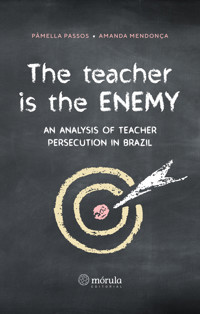
In recent years, Brazil has experienced a situation that brings together serious and constant episodes of attacks on human rights. In addition to this factor, we have the withdrawal of basic social rights, such as access to food, housing, health, education, work, among others. A scenario where the dismantling of the State, social deprotection, and the insecurity of the population are directed towards a supposed threat of destruction of the family and the hegemonic moral order. To talk about the construction of this new enemy, Pâmella Passos and Amanda Mendonça recapture the trajectory of one of the people responsible for this invention: the Escola Sem Partido Movement (MESP). This movement, by defending supposed pedagogical neutrality, accuses educators of influencing their students by exercising persuasive power over them compared to pathology. It is also important to say that MESP started to bring together a diversity of actors, fundamentally combining sectors of the country's intellectual and party rights, the Christian religious summit, sectors of the Brazilian business community, among others. The combined performance of agents through a conservative coalition in defense of the "neutral school". A scenario where the family is at risk is consolidated; a scenario where the education of children is in danger and the teacher is the important piece of this threat.
Sie lesen das E-Book in den Legimi-Apps auf:
Seitenzahl: 40
Veröffentlichungsjahr: 2021
Das E-Book (TTS) können Sie hören im Abo „Legimi Premium” in Legimi-Apps auf:
Ähnliche














CONTENTS
[ COVER ]
[ COVER SHEET ]
[ AUTHORS’ NOTES ]
The construction of teachers as enemies
United Against the democratic education: getting to know the Brazilian
conservative coalition
Moral panic is not smokescreen: strategies of neoconservatism
The ongoing disdemocracy and its impacts on education
[ REFERENCES ]
[ ABOUT THE AUTHORS ]
[ CREDITS ]
[ BACK COVER ]
AUTHORS’ NOTES
This publication is the result of a commitment we have with the socialization of the academic production in our country. As researchers of the research group Technology, Education and Culture (CPTEC/IFRJ), we have been investigating the impacts of the conversative advances in the country during the last years and its repercussions in Brazilian education.
The post-doctoral internship in Education that we did in 2020 at the Federal Fluminense University (UFF) dialogued directly with this theme. Although with different projects, our researches converged in reflections about the persecution of teachers and its consequences in Brazilian democracy. The pages that follow seek to share the conclusions, albeit provisional, that we have reached.
We must thank the Federal Institute of Education, Science, and Technology of Rio de Janeiro (IFRJ), especially the Rio de Janeiro Campus, which, by financing the extension project “II Seminar on Democratic Education and Human Rights” made the publication of this book possible.
We hope that this reading is an invitation to fight for a democratic education committed to the defense of Human Rights.
PÂMELLA PASSOS AND AMANDA MENDONÇA
The construction of teachers as enemies
In recent years, Brazil has experienced a situation that brings together serious and constant episodes of attacks on human rights. In addition to this factor, we have the withdrawal of basic social rights, such as access to food, housing, health, education, work, among others. A scenario where the dismantling of the State, social deprotection, and the insecurity of the population are directed towards a supposed threat of destruction of the family and the hegemonic moral order.
Thus, feelings such as fear, the fear of a possible change in the social structures known by most of the population, have been produced and triggered as part of the ongoing power project in the country. A significant part of this project, which guarantees its existence, consists of building an enemy. And it is in this context that the “teacher indoctrinator”, or new enemy, has gained notoriety in recent years in Brazil.
To talk about the construction of this new enemy, it is necessary to briefly recover the trajectory of one of the main responsible for this invention: the School without Party Movement- SWPM. According to Penna (2016), the movement continued for some time without great expression, finding a greater echo in society in three moments: in the controversy generated in 2007 by the column of journalist Ali Kamel in the newspaper O Globo[1], in which he made tough criticism of Mario Schmidt’s collection of coursebooks New Critical History (Nova História Critica); the second moment would have occurred in the controversy involving the distribution of the anti-homophobia kit[2] by the Ministry of Education in 2011 and lastly, in 2014, during the political crisis and the polarization of society around the presidential campaigns of then-President Dilma Rousseff and the Senator Aécio Neves. We believe it is relevant to point out that the clashes surrounding the National Education Plan, also approved in 2014[3], are part of this framework of episodes that contributed to leveraging the social and political expressiveness of MESP.
This movement, by defending supposed pedagogical neutrality, accuses educators of influencing their students by exercising persuasive power over them compared to pathology, as we can see in the following excerpt:
Victim of a true “intellectual kidnapping”, the indoctrinated student almost always develops, concerning the teacher/indoctrinator, an intense affective connection. As it has already been said about Stockholm Syndrome, depending on the degree of identification with the kidnapper, the victim can deny that the kidnapper is wrong, admitting that the possible liberators and their insistence on punishing the kidnapper are, in fact, responsible. for your situation. Similarly, many students not only refuse to admit that they are being manipulated by their teachers but are furious in their defense when someone shows them what is going on. (SCHOOL WITHOUT PARTY, 2016).
Comparing the teacher-student relationship with that of a kidnapped-kidnapper, MESP creates a scenario in which families are called upon to save and defend their children from this intellectual violence. It is noted that the two main pillars of the project are: the sovereignty of the family, which overrides the student’s right to obtain elements to produce autonomously his worldview, and a supposed idea of “neutrality” of the teachers, of the curricula and pedagogical projects.




