


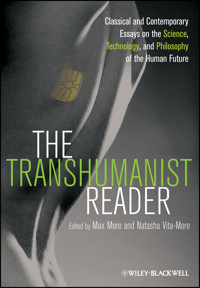
The Transhumanist Reader E-Book
43,99 €
Mehr erfahren.
- Herausgeber: John Wiley & Sons
- Kategorie: Geisteswissenschaft
- Sprache: Englisch
The first authoritative and comprehensive survey of the origins and current state of transhumanist thinking
The rapid pace of emerging technologies is playing an increasingly important role in overcoming fundamental human limitations. Featuring core writings by seminal thinkers in the speculative possibilities of the posthuman condition, essays address key philosophical arguments for and against human enhancement, explore the inevitability of life extension, and consider possible solutions to the growing issues of social and ethical implications and concerns. Edited by the internationally acclaimed founders of the philosophy and social movement of transhumanism, The Transhumanist Reader is an indispensable guide to our current state of knowledge of the quest to expand the frontiers of human nature.
Sie lesen das E-Book in den Legimi-Apps auf:
Seitenzahl: 1207
Veröffentlichungsjahr: 2013
Ähnliche




















Contents
Contributor Biographies
Part I Roots and Core Themes
1 The Philosophy of Transhumanism
I. The Philosophy
II. History
III. Currents
IV. Misconceptions
2 Aesthetics
Introduction
Current Discussion
Form and Perception
Adaptation
Relationship
A Field
A Study
Concluding Thoughts
3 Why I Want to be a Posthuman When I Grow Up
I. Setting the Stage
II. Becoming Posthuman
III. Healthspan
IV. Cognition
V. Emotion
VI. Structure of the Argument, and Further Supporting Reasons
VII. Personal Identity
VIII. Commitments
IX. Ways of Life
X. Human Nature
XI. Brief Sketches of Some Objections and Replies
XII. Conclusion
4 Transhumanist Declaration (2012)
5 Morphological Freedom – Why We Not Just Want It, but Need It
Morphological Freedom as a Right
What Possibilities Do We See Today and Tomorrow?
Morphological Freedom and Society
Why Do We Want It?
Why Do We Need Morphological Freedom?
Morphological Freedom and Future Healthcare
Conclusions
Part II Human Enhancement: The Somatic Sphere
6 Welcome to the Future of Medicine
Introduction
What is Nanomedicine?
Nanorobotics
Nanorobotics Revolution by the 2020s
Conclusions
7 Life Expansion Media
Living
Matter
Degeneration/Regeneration
Transmutation
Dialectics of Desirability and Viability
Cybernetics
Human-machine Interfaces and the Prosthetic Body
Life Expansion
8 The Hybronaut Affair
Techno-Organic Environment
The Umwelt Bubble
Network and the Hybronaut
The Appendix-tail
Conclusion
9 Transavatars
Avatars and Simulation
Avatar Censuses
Secondary and Posthumous Avatars
Conclusion
10 Alternative Biologies
Biology as Technology
The Rise of Machines
Complexity
The Science of Complexity
Synthetic Biology – Complex Embodied Technology
Top-Down Synthetic Biology
Bottom-Up Synthetic Biology
Protocells
Artificial Biology
From Proposition to Reality
Future Venice
Artificial Biology and Human Enhancement
Part III Human Enhancement: The Cognitive Sphere
11 Re-Inventing Ourselves
I. Introduction: Where the Rubber Meets the Road
II. What’s in an Interface?
III. New Systemic Wholes
IV. Incorporation Versus Use
V. Extended Cognition
VI. Profound Embodiment
VII. Enhancement or Subjugation?
VIII. Conclusions
12 Artificial General Intelligence and the Future of Humanity
The Top Priority for Mankind
AGI and the Transformation of Individual and Collective Experience
AGI and the Global Brain
What is a Mind that We Might Build One?
Why So Little Work on AGI?
Why the “AGI Sputnik” Will Change Things Dramatically and Launch a New Phase of the Intelligence Explosion
The Risks and Rewards of Advanced AGI
13 Intelligent Information Filters and Enhanced Reality
Preface
Text Translation and Its Consequences
Enhanced Multimedia
Structure of Enhanced Reality
Historical Observations
Truth vs. Convenience
Biofeedback and Self-Perception
Distant Future
Terminological Exercises: ER < - > EP - > …- > IE - > ?! - > .
Social Implications
14 Uploading to Substrate-Independent Minds
Your Mind, but not Constrained to the Biological Brain
Whole Brain Emulation
Main Developments toward SIM
Structural Connectomics and Functional Connectomics
Structure-Function and Questions of Resolution and Scope
SIM within our Life-Spans
What is the Rationale for Investing in SIM Projects Now?
15 Uploading
How Many Bits to Describe a Molecule?
Do We Really Need to Describe Each Molecule?
How Many Bits Do We Really Need?
A Functional Estimate of Human Long-Term Memory Capacity
How Much Computing Power?
The Brain Uses Energy
Nerve Impulses Use Energy
The Energy of a Nerve Impulse
Our Model Isn’t Perfect
The Ultimate in Experimental Evidence: Try it and See!
Summary
Part IV Core Technologies
16 Why Freud Was the First Good AI Theorist
17 Pigs in Cyberspace
Mind without Body?
18 Nanocomputers
What’s a Nanocomputer?
Nanotechnology
General Computer Principles
Additional Constraints for Nanocomputers
Entropy
Drexler’s Mechanical Logic
Registers and Memory
Motors
Other Logics for Nanocomputers
Other Mechanical Logics
Electronic Logic
Conclusion
19 Immortalist Fictions and Strategies
Introduction: Something Like Penicillin for Immortality
Immortality in Fiction
Science of Biological Immortality
Technological Prospects for Near-Term Human Biological Immortality
Fictitious Technology vs Actual Technology
20 Dialogue between Ray Kurzweil and Eric Drexler
Part V Engines of Life: Identity and Beyond Death
21 The Curate’s Egg of Anti-Anti-Aging Bioethics
22 Medical Time Travel
23 Transhumanism and Personal Identity
Personal Identity and the Enlightenment
Enhancement, Transhumanism and Personal Identity
24 Transcendent Engineering
I. Cornerstones of Transcendent Engineering
II. Two Possibilities of Resurrection
III. Conclusion
Part VI Enhanced Decision-Making
25 Idea Futures
Introduction
Concept
Scenario
Scope
Procedures
Advantages
Criticisms
Related Work
An Appeal
Conclusion
26 The Proactionary Principle
The Origin of the Proactionary Principle
The Wisdom of Structure
The Failure of the Precautionary Principle
The Proactionary Principle
Preamble to the Proactionary Principle
Be Objective and Comprehensive
Prioritize Natural and Human Risks
Embrace Diverse Input
Make Response and Restitution Proportionate
Revisit and Revise
27 The Open Society and Its Media
Improving Society
Media Matter
Xanadu
Links
Hyperlinks
Emergent Properties
Transclusion
Remembering the Past: Historical Trails
Preparing for the Future: Detectors
The WidgetPerfect Saga
Permissions
Reputation-Based Filtering
External Transclusion
Conclusions
Part VII Biopolitics and Policy
28 Performance Enhancement and Legal Theory
29 Justifying Human Enhancement
Rationalizing Medical Interventions on a Slippery Slope
Life as a Commodity
The Accumulation of Biocultural Capital
Counterpoint: Reducing Human Diversity?
Conclusion
30 The Battle for the Future
Who Will the Early Enhancers Be?
The Threat of Human Enhancement
Protecting the Human Race
A Spiritual Crossroads
31 Mind is Deeper Than Matter
Persona Creatus
The Sex of an Avatar
Counting Cyberfolks
Papering a Transhuman
Is Consciousness Like Pornography?
Bio-Cyber-Ethics
32 For Enhancing People
Do the Technologies that Enable Human Physical and Intellectual Enhancement Undermine Virtue?
The Dangers of Immortality
The Politics of Toleration
What about the Genetically Engineered Children?
Enhancement Wars?
The End of Gene Tyranny
Moral Toleration
So How Will Enhancement Enable People to Flourish?
33 Is Enhancement Worthy of Being a Right?
Introduction
So What Does Putting the Question of Enhancement in Terms of Rights Do?
What is the Problem with Putting the Question of Enhancement in Terms of Rights?
How Might One Make the Case that Enhancement Be Treated as a Right?
Appeal to Autonomy
Appeal to Interests
Appeal to Natural Law
Conclusion
34 Freedom by Design
Introduction
Legal Right by Design: Cognitive Liberty
Design Thinking and Cognitive Liberty
Caveats on Concept: Fictions of Freedom
Freedom in Spite of All Else
Part VIII Future Trajectories: Singularity
35 Technological Singularity
I. What is the Singularity?
II. Can the Singularity Be Avoided?
III. Other Paths to the Singularity
IV. Strong Superhumanity and the Best We Can Ask For
36 An Overview of Models of Technological Singularity
Introduction
Definitions of Technological Singularity
Models
Accelerating Change
Discussion
37 A Critical Discussion of Vinge’s Singularity Concept
Comment by David Brin: Singularities
Comment by Damien Broderick
Comment by Nick Bostrom: Singularity and Predictability
Comment by Alexander Chislenko: Singularity as a Process, and the Future Beyond
Comment by Robin Hanson: Some Skepticism
Comment by Max More: Singularity Meets Economy
Comment by Michael Nielsen
Comment by Anders Sandberg: Singularity and the Growth of Differences
Part IX The World’s Most Dangerous Idea
38 The Great Transition
What is Transhumanism?
Anxieties
Evolution and Ethics
Naïvety about Progress
The Apocalyptic Temptation
39 Trans and Post
40 Back to Nature II
41 A Letter to Mother Nature
42 Progress and Relinquishment
Index
About the Editors
Max More, PhD is President and CEO of the Alcor Life Extension Foundation, the world’s leading cryonics organization. An internationally acclaimed strategic philosopher and co-founder of the first explicitly transhumanist organization, Extropy Institute, Dr. More is recognized for his thinking on the philosophical and cultural implications of emerging technologies.Natasha Vita-More, PhD is a leading expert on human enhancement and emerging and speculative technologies and is a Professor at the University of Advancing Technology. Dr. Vita-More’s writings have appeared in Technoetic Arts:A Journal of Speculative Research, Metaverse Creativity, and Sistemi Intelligenti. She has been featured in numerous televised documentaries on media design, culture, and the future.
This edition first published 2013© 2013 John Wiley & Sons, Inc
Wiley-Blackwell is an imprint of John Wiley & Sons, formed by the merger of Wiley’s global Scientific, Technical and Medical business with Blackwell Publishing.
Registered OfficeJohn Wiley & Sons, Ltd, The Atrium, Southern Gate, Chichester, West Sussex, PO19 8SQ, UK
Editorial Offices350 Main Street, Malden, MA 02148-5020, USA9600 Garsington Road, Oxford, OX4 2DQ, UKThe Atrium, Southern Gate, Chichester, West Sussex, PO19 8SQ, UK
For details of our global editorial offices, for customer services, and for information about how to apply for permission to reuse the copyright material in this book please see our website at www.wiley.com/wiley-blackwell.
The right of Max More and Natasha Vita-More to be identified as the authors of the editorial material in this work has been asserted in accordance with the UK Copyright, Designs and Patents Act 1988.
All rights reserved. No part of this publication may be reproduced, stored in a retrieval system, or transmitted, in any form or by any means, electronic, mechanical, photocopying, recording or otherwise, except as permitted by the UK Copyright, Designs and Patents Act 1988, without the prior permission of the publisher.
Wiley also publishes its books in a variety of electronic formats. Some content that appears in print may not be available in electronic books.
Designations used by companies to distinguish their products are often claimed as trademarks. All brand names and product names used in this book are trade names, service marks, trademarks or registered trademarks of their respective owners. The publisher is not associated with any product or vendor mentioned in this book. This publication is designed to provide accurate and authoritative information in regard to the subject matter covered. It is sold on the understanding that the publisher is not engaged in rendering professional services. If professional advice or other expert assistance is required, the services of a competent professional should be sought.
Library of Congress Cataloging-in-Publication Data
The transhumanist reader : classical and contemporary essays on the science, technology, and philosophy of the human future / edited by Max More and Natasha Vita-More. pages cm Includes bibliographical references and index.
ISBN 978-1-118-33431-7 (pbk. : alk. paper) – ISBN 978-1-118-33429-4 (cloth : alk. paper) 1. Medical technology–Social aspects. 2. Humanism–History. 3. Human body (Philosophy)–History. 4. Genetic engineering–Social aspects. I. More, Max, 1964– II. Vita-More, Natasha, 1950–R855.3.T73 2013 610.285–dc23
2012050378
A catalogue record for this book is available from the British Library.
Cover designer: www.simonlevyassociates.co.ukCover images: Main image © Edvard March/Corbis. Chip © Aldis Kotlers / Shutterstock
Contributor Biographies
Rachel Armstrong, MD, is a Teaching Fellow, the Bartlett School of Architecture, and a TED Global Fellow. She authored Living Architecture (TED Books, 2012); and co-authored with Neill Spiller Protocell Architecture: Architectural Design (Wiley-Blackwell, 2011).Roy Ascott, is President, Planetary Collegium, Visiting Professor, School of the Arts, University of California Los Angeles. He authored “Behaviourist Art and the Cybernetic Vision” (Cybernetica: Journal of the International Association for Cybernetics, 1964); and co-authored with Edward A. Shanken Telematic Embrace: Visionary Theories of Art, Technology, and Consciousness (University of California Press, 2007).Ronald Bailey, is Science Correspondent, Reason Magazine, and University Lecturer, Harvard University. He authored Liberation Biology: The Scientific and Moral Case for the Biotech Revolution (Prometheus Books, 2005); and Ecoscam: The False Prophets of Ecological Apocalypse (St. Martin’s Press, 1994).William Sims Bainbridge, PhD, is Co-Director, Human-Centered Computing, at the National Science Foundation. He authored The Warcraft Civilization: Social Science in a Virtual World (MIT Press, 2010); Nanotechnology: Societal Implications (Springer, 2007); and co-edited with Mihail C. Roco Converging Technologies for Improving Human Performance (Kluwer Academic Publishers, 2010).Laura Beloff, PhD, is Associate Professor, IT University of Copenhagen and a Visiting Lecturer, Aalto University, Helsinki, Finland. She authored “Shared Motifs: Body Attachments in RL; and SL” (Metaverse Creativity 1, 2011), and “Wearable Artifacts as Research Vehicles” (Technoetic Arts: A Journal of Speculative Research 8.1, 2010).Russell Blackford, PhD, is Editor-in-Chief, Journal of Evolution & Technology. He authored Freedom of Religion and the Secular State (Wiley-Blackwell, 2012) and An Evil Hour (I Books, 2003); and co-authored with Van Ikin and Sean McMullen Strange Constellations: A History of Australian Science Fiction (Praeger, 1999).Nick Bostrom, PhD, is Director, Future of Humanity Institute, Oxford University. He has written numerous papers and authored Anthropic Bias (Routledge, 2010); and co-edited with Julian Savulescu Human Enhancement (Oxford University Press, 2011) and Global Catastrophic Risks with Milan Cirkovic (Oxford University Press, 2011).David Brin, PhD, authored Existence (Tor Books, 2012); The Transparent Society: Will Technology Force Us to Choose Between Privacy and Freedom? (Basic Books, 1999); The Postman (Bantam Spectra, 1997); and “Future of Surveillance,” in Changing Minds (Penguin Academics Series, 2009).Damien Broderick, PhD, is Senior Fellow, School of Culture and Communication, University of Melbourne. He authored The Spike: How Our Lives Are Being Transformed by Rapidly Advancing Technologies (Tor, 2002); co-authored with Paul di Fillippo and David Pringle Science Fiction: The 101 Best Novels 1985–2010 (Nonstop, 2012); and co-authored with Barbara Lamar Post Mortal Syndrome (Wildside, 2011).Alexander “Sasha” Chislenko (1959–2000) MS, was an AI theorist, former Researcher Society of Mind Group, MIT. He authored “Technology as Extension of Human Functional Architecture,” delivered at Extro3 Conference 1999, and “Intelligent Information Filters and Enhanced Reality” (1997). Many of his essays can be found at http://www.lucifer.com/~Sasha/.Andy Clark, PhD, is Professor and Chair in Logic and Metaphysics, University of Edinburgh. He authored Supersizing the Mind: Embodiment, Action, and Cognitive Extension (Oxford University Press, 2010); Natural Born Cyborgs: Minds, Technologies, and the Future of Human (2003); and Intelligence Mindware (Oxford University Press, 2000).Aubrey de Grey, PhD, is Chief Science Officer, Strategies for Engineered Negligible Senescence Foundation. He co-authored with Michael Rae Ending Aging: The Rejuvenation Breakthroughs that Could Reverse Human Aging in Our Lifetime (St. Martin’s Griffin, 2008); and “Combating the Tithonus Error: What Works?” (Rejuvenation Research 11, 2008).Eric Drexler, PhD, is an academic visitor at Oxford University. He authored Engines of Creation: The Coming Era of Nanotechnology (Doubleday, 1986); and Nanosystems: Molecular Machinery, Manufacturing and Computation (Wiley, 1992).Robert A. Freitas Jr., JD, is Senior Research Fellow, Institute of Molecular Manufacturing. He has published three books: co-authored with Ralph Merkle, Kinematic Self-Replicating Machines (Landes Bioscience, 2004); authored Nanomedicine, vol. 1: Basic Capabilities (Landes Bioscience, 1999); and Nanomedicine, vol. 11a: Biocompatibility (Landes Bioscience, 2003).Ben Goertzel, PhD, is an AGI Researcher, Novamente LLC, Chief Scientist, Aidyia Holdings, and Vice Chair, Humanity+. He authored The Hidden Pattern: A Patternist Philosophy of Mind (Brown Walker Press, 2006); A Cosmist Manifesto: Practical Philosophy for the Posthuman Age (Humanity + Press, 2010); and co-edited with Cassio Pennachin Artificial General Intelligence (Springer, 2007).Robin Hanson, PhD, is Associate Professor of Economics, George Mason University. He authored “Meet the New Conflict, Same as the Old Conflict” (Journal of Consciousness Studies 19, 2012); “Enhancing our Truth Orientation” (Human Enhancement, Oxford University Press, 2009); and “Insider Trading and Prediction Markets” (Journal of Law, Economics, and Policy 4, 2008).Patrick D. Hopkins, PhD, is Associate Professor, Philosophy and Gender Studies, Millsaps College. He authored Sex/Machine: Readings in Culture, Gender, and Technology (Indiana University Press, 1999); and co-authored with Larry May et al. Rethinking Masculinity: Philosophical Explorations in Light of Feminism (Rowman & Littlefield, 1996).James Hughes, PhD, is Director, Institutional Research and Planning, Trinity College. He authored Citizen Cyborg: Why Democratic Societies Must Respond to the Redesigned Human of the Future (Basic Books, 2004); and “Embracing Change with All Four Arms: A Post-Humanist Defense of Genetic Engineering” (Eubios Journal of Asian and International Bioethics 6, 1996).Randal A. Koene, PhD, is Founder and CEO, Carboncopies.org. He authored “Fundamentals of Whole Brain Emulation: State, Transition and Update Representations” (International Journal on Machine Consciousness 4, 2012); and “Embracing Competitive Balance: The Case for Substrate-Independent Minds and Whole Brain Emulation” (The Singularity Hypothesis: A Scientific and Philosophical Assessment, Springer, 2012).Ray Kurzweil, PhD, is Founder, Kurzweil Technologies, Inc., Co-Founder and Chancellor, Singularity University. He authored How to Create a Mind: The Secret of Human Thought Revealed (Viking Adult, 2012); The Singularity if Near: When Humans Transcend Biology (Penguin Books, 2006); and The Age of Spiritual Machines: When Computers Exceed Human Intelligence (Penguin Books, 2000).Ralph C. Merkle, PhD, is Senior Research Fellow, Institute for Molecular Manufacturing, Faculty, Singularity University. He authored “Nanotechnology: What Will It Mean?” (Spectrum, 2001); “It’s a Small, Small, Small, Small World” (MIT Technology Review, 1997); and co-authored with Robert A. Freitas Kinematic Self-Replicating Machines (Landes Bioscience, 2004).Andy Miah, PhD, is Chair of Ethics and Emerging Technologies, University of the West of Scotland. He authored Genetically Modified Athletes: Biomedical Ethics, Gene Doping and Sport (Routledge, 2004); and co-authored with Beatriz Garcia The Olympics: The Basics (Routledge, 2012); and co-authored with Emma Rich The Medicalization of Cyberspace (Routledge, 2008).Mark S. Miller is Chief Architect, Hewlett-Packard Labs. He authored with K. Eric Drexler “The Agoric Papers” (The Ecology of Computation, Elsevier Science, 1988); and Robust Composition: Towards A Unified Approach to Access Control and Concurrency Control (PhD dissertation, 2006).Marvin Minsky, PhD, is co-founder MIT AI Laboratory. He authored The Society of Mind (Simon & Schuster, 1988); and The Emotion Machine: Commonsense Thinking, Artificial Intelligence, and the Future of the Human Mind (Simon & Schuster, 2007).Hans Moravec, PhD, is Research Professor at Robotics Institute, Carnegie Mellon University. He authored Robot: Mere Machine to Transcendent Mind (Oxford University Press, 2000); and Mind Children: The Future of Robot and Human Intelligence (Harvard University Press, 1990).Max More, PhD, is President of Alcor Life Extension Foundation and Co-Editor of The Transhumanist Reader. He authored “The Overhuman in the Transhuman” (Journal of Evolution and Technology 21, 2010); “True Transhumanism” (Global Spiral 2009); and “The Extropian Principles” (Extropy: The Journal of Transhumanist Thought 8).Michael Nielsen is one of the pioneers of quantum computing. He is an essayist, speaker, and advocate of open science. His most recent book is Reinventing Discovery: The New Era of Networked Science (2012).Ravi Pandya is Systems Software Architect, Microsoft. He co-authored with Sergey Bykov, Alan Geller, Gabriel Kliot, et al. “Orleans: Could Computer for Everyone” (ACM Symposium on Cloud Computing, 2011); and with Sergey Bykov, Alan Geller, Gabriel Kliot, et al. “Orleans: A Framework for Cloud Computing” (Microsoft Research, 2010).Giulio Prisco, is a physicist, and former Senior Manager, European Space Agency. He authored “Transcendent Engineering” (The Journal of Personal Cyberconsciousness 6, 2011); “Let a Thousand Turtles Fly” (Quest for Joyful Immortality, 2012); and “Transhumanist Avatars Storm Second Life” (H+Magazine, 2011).Michael R. Rose, PhD, is Professor and Director of NERE, Ecology & Evolutionary Biology, School of Biological Sciences, University of California Irvine. He authored Evolutionary Biology of Aging (Oxford University Press, 1994); and The Long Tomorrow: How Advances in Evolutionary Biology Can Help Us Postpone Aging (Oxford University Press, 2005).Martine Rothblatt, PhD, JD, is Chief Executive Officer, United Therapeutics and Inventor, Sirius Satellite Radio. She authored Apartheid of Sex: A Manifesto on the Freedom of Gender (Crown, 1995); and Your Life or Mind: How Geoethics Can Resolve the Conflict between Public and Private Interests in Xenotransplantation (Ashgate Publishing, 2004).Anders Sandberg, PhD, is a James Martin Research Fellow, Future of Humanity Institute, Oxford University. He co-authored with Nick Bostrom “Converging Cognitive Enhancements” (Annals of the New York Academy of Science, 2006); and “Whole Brain Emulation: A Roadmap” (Technological Report, 2008).Wrye Sententia, PhD, is Postdoctoral Lecturer, University of California Davis. She authored “Neuroethical Considerations: Cognitive Liberty & Converging Technologies for Improving Human Cognition” (Annals of the New York Academy of Sciences 1013, 2004); and “Written Comments to the President’s Council on Bioethics on the Topic of Mind Enhancing Technologies and Drugs” (Journal of Cognitive Liberties 4, 2003).Michael H. Shapiro, PhD, is Professor of Law, University of Southern California. He authored Cases, Materials, and Problems on Bioethics and Law (Thomson West, 2003); edited and authored Biological and Behavioral Technologies and the Law (Praeger, 1982); and “The Identity of Identity: Moral and Legal Aspects of Technological Self-Transformation” (Social Philosophy and Policy 22, 2005).Marc Stiegler is a Researcher, Intelligent Infrastructure Lab, Hewlett-Packard. He authored The Gentle Seduction (Baen Books, 1990); and David’s Sling (Baen Books, 1987); and co-authored with Joseph H. Delaney Valentina: Soul in Sapphire (Baen Books, 1984).Gregory Stock, PhD, is Chief Executive Officer, Signum Biosciences, former Director of Medicine, Technology and Society, University of California Los Angeles. He authored Redesigning Humans: Choosing Our Genes, Changing Our Future (Mariner Books, 2003; and Metaman: The Merging of Humans and Machines into a Global Superorganism (Simon & Schuster, 1993).J. Storrs Hall, PhD, is Founding Chief Scientist, Nanorex, Inc. He authored Beyond AI: Creating the Conscience of the Machine (Prometheus Books, 2007); and What’s Next for Nanotechnology (Prometheus Books, 2005).E. Dean Tribble is Principal Architect, Microsoft. He authored nine patents, including: with Mark S. Miller, Norman Hardy, and Christopher T. Hibbert “Diverse goods arbitration system and method for allocation resources in a distributed computer system” (Sun Microsystems, 1997); and with Norman Hardy, Linda L. Vetter “System and method for generating unique secure values for digitally signing documents” (2000).Vernor Vinge, PhD, is former Professor of Mathematics, University of California San Diego. He authored A Fire Upon the Deep (Tor, 1993, 2011); “The Coming Technological Singularity: How to Survive in the Post-Human Era” (Whole Earth Review, 1993); and True Names … and Other Dangers (Baen Book, 1987).Natasha Vita-More, PhD, is Professor of Design University of Advancing Technology, co-founder, Institute for Transhumanism, chairman of Humanity+, and co-editor of The Transhumanist Reader. She authored “Epoch of Plasticity” (Metaverse Creativity 1, 2010); and “Aesthetics of the Radically Enhanced Human” (Technoetic Arts: A Journal of Speculative Research 8, 2003).Brian Wowk, PhD, is Senior Scientist, 21st Century Medicine, Inc. He authored “Thermodynamic aspects of vitrification” (Cryobiology 60, 2010), “Cryopreservation of complex systems (Cryobiology, 2007) and “Cryonics Revived: Verification Unjustly Vilified” (Skeptic, 2005).
Part I
Roots and Core Themes
Transhumanism developed as a philosophy that became a cultural movement, and now is regarded as a growing field of study. It is often confused with, compared to, and even equated with posthumanism. Transhumanism arrived during what is often referred to as the postmodernist era, although it has only a modest overlap with postmodernism. Ironically, transhumanism shares some postmodernist values, such as a need for change, reevaluating knowledge, recognition of multiple identities, and opposition to sharp classifications of what humans and humanity ought to be. Nevertheless, transhumanism does not throw out the entirety of the past because of a few mistaken ideas. Humanism and scientific knowledge have proven their quality and value. In this way, transhumanism seeks a transmodernity or hypermodernism rather than arguing explicitly against modernism. One aspect of transhumanism that we hope to explore and elucidate throughout this book is the need for inclusivity, plurality, and continuous questioning of our knowledge, as we are a species and a society that is forever changing. The roots and core themes of transhumanism address some of the underlying themes that have formed its philosophical outlook.
The first section of the book presents a definitive overview of transhumanism. Transhumanism is a class of philosophies that seeks the continued evolution of human life beyond its current human form as a result of science and technology guided by life-promoting principles and values. Transhumanism promotes an interdisciplinary approach to understanding and evaluating the opportunities for enhancing the human condition and the human organism opened up by the advancement of technology.
To begin this section, philosopher Max More sets forth the core values, goals, and principles shared by transhumanists and outlines commonly shared epistemological and metaphysical views, while noting the various distinct schools of transhumanist thought. More provides a briefing on the historical roots of the philosophy from the ancients through to the twentieth-century precursors, explains transhumanism’s relationship to humanism and to other concepts including extropy and the technological singularity, and then outlines contemporary variations. He concludes by identifying several misconceptions about transhumanism.
Although the philosophical, scientific, technological, and even political aspects of transhumanism have received much attention over the past decades, the aesthetic aspects have often been treated as secondary, especially to technology. Natasha Vita-More fills that gap. Vita-More explores the artistic, design-based approaches to the classical human form stemming from the Renaissance and on to the cyborg and the transhuman and asks: “What might be concerns of artistic works and design-based practices that approach human enhancement and life extension?”
In his essay “Why I Want to be a Posthuman When I Grow Up,” philosopher Nick Bostrom notes that extreme human enhancement could result in “posthuman” modes of being. Being posthuman would mean possessing a general central capacity (healthspan, cognition, or emotion) greatly exceeding the maximum attainable by any current human being. Bostrom argues that some possible posthuman modes of being would be very good, and that it could be very good for us to become posthuman.
The Transhumanist Declaration sets forth values and practical goals for transhumanism and the many organizations and scholarly research associated with transhumanism that largely evolved out of the seminal work of Extropy Institute, an educational non-profit organization and, more recently, Humanity+. The Declaration was co-authored by a collection of transhumanists with diverse backgrounds.
Part I concludes with an essay by Anders Sandberg arguing that we have sound reasons to affirm a right to morphological freedom. A right to freedom and the right to one’s own body implies that one has a right to modify one’s body. Morphological freedom is a negative right – it is the right to be able to do certain things without interference but it does not create any claim on others to support one’s exercise of that right. Sandberg argues that we want morphological freedom because of an ancient drive for self-creation through self-definition. We need morphological freedom because not accepting it as a basic right would have negative effects. Sandberg concludes by briefly considering some implications for the future of healthcare.
1
The Philosophy of Transhumanism
Max More
I. The Philosophy
To write of “the” philosophy of transhumanism is a little daring. The growth of transhumanism as a movement and philosophy means that differing perspectives on it have formed. Despite all the varieties and interpretations we can still identify some central themes, values, and interests that give transhumanism its distinct identity. This coherence is reflected in the large degree of agreement between definitions of the philosophy from multiple sources.
According to my early definition (More 1990), the term refers to:
Philosophies of life (such as extropian perspectives) that seek the continuation and acceleration of the evolution of intelligent life beyond its currently human form and human limitations by means of science and technology, guided by life-promoting principles and values.
According to the Transhumanist FAQ (Various 2003), transhumanism is:
The intellectual and cultural movement that affirms the possibility and desirability of fundamentally improving the human condition through applied reason, especially by developing and making widely available technologies to eliminate aging and to greatly enhance human intellectual, physical, and psychological capacities.
A corollary definition (also from the FAQ) focuses on the activity rather than the content of transhumanism:
The study of the ramifications, promises, and potential dangers of technologies that will enable us to overcome fundamental human limitations, and the related study of the ethical matters involved in developing and using such technologies.
Thus transhumanism is a life philosophy, an intellectual and cultural movement, and an area of study. In referring to it as a life philosophy, the 1990 definition places transhumanism in the company of complex worldviews such as secular humanism and Confucianism that have practical implications for our lives without basing themselves on any supernatural or physically transcendent belief. Transhumanism could be described by the term “eupraxsophy,” coined by secular humanist Paul Kurtz, as a type of nonreligious philosophy of life that rejects faith, worship, and the supernatural, instead emphasizing a meaningful and ethical approach to living informed by reason, science, progress, and the value of existence in our current life.
What is the core content of this philosophy? A simple yet helpful way to grasp its nature is to think of transhumanism as “trans-humanism” plus “transhuman-ism.” “Trans-humanism” emphasizes the philosophy’s roots in Enlightenment humanism. From here comes the emphasis on progress (its possibility and desirability, not its inevitability), on taking personal charge of creating better futures rather than hoping or praying for them to be brought about by supernatural forces, on reason, technology, scientific method, and human creativity rather than faith.
While firmly committed to improving the human condition and generally optimistic about our prospects for doing so, transhumanism does not entail any belief in the inevitability of progress nor in a future free of dangers and downsides. The same powerful technologies that can transform human nature for the better could also be used in ways that, intentionally or unintentionally, cause direct damage or more subtly undermine our lives. The transhumanist concern with rationality and its concomitant acknowledgment of uncertainty implies recognizing and proactively warding off risks and minimizing costs.
Lesen Sie weiter in der vollständigen Ausgabe!
Lesen Sie weiter in der vollständigen Ausgabe!
Lesen Sie weiter in der vollständigen Ausgabe!
Lesen Sie weiter in der vollständigen Ausgabe!
Lesen Sie weiter in der vollständigen Ausgabe!
Lesen Sie weiter in der vollständigen Ausgabe!
Lesen Sie weiter in der vollständigen Ausgabe!
Lesen Sie weiter in der vollständigen Ausgabe!
Lesen Sie weiter in der vollständigen Ausgabe!
Lesen Sie weiter in der vollständigen Ausgabe!
Lesen Sie weiter in der vollständigen Ausgabe!
Lesen Sie weiter in der vollständigen Ausgabe!
Lesen Sie weiter in der vollständigen Ausgabe!
Lesen Sie weiter in der vollständigen Ausgabe!
Lesen Sie weiter in der vollständigen Ausgabe!
Lesen Sie weiter in der vollständigen Ausgabe!
Lesen Sie weiter in der vollständigen Ausgabe!
Lesen Sie weiter in der vollständigen Ausgabe!
Lesen Sie weiter in der vollständigen Ausgabe!
Lesen Sie weiter in der vollständigen Ausgabe!
Lesen Sie weiter in der vollständigen Ausgabe!
Lesen Sie weiter in der vollständigen Ausgabe!
Lesen Sie weiter in der vollständigen Ausgabe!
Lesen Sie weiter in der vollständigen Ausgabe!
Lesen Sie weiter in der vollständigen Ausgabe!
Lesen Sie weiter in der vollständigen Ausgabe!
Lesen Sie weiter in der vollständigen Ausgabe!
Lesen Sie weiter in der vollständigen Ausgabe!
Lesen Sie weiter in der vollständigen Ausgabe!
Lesen Sie weiter in der vollständigen Ausgabe!
Lesen Sie weiter in der vollständigen Ausgabe!
Lesen Sie weiter in der vollständigen Ausgabe!
Lesen Sie weiter in der vollständigen Ausgabe!
Lesen Sie weiter in der vollständigen Ausgabe!
Lesen Sie weiter in der vollständigen Ausgabe!
Lesen Sie weiter in der vollständigen Ausgabe!
Lesen Sie weiter in der vollständigen Ausgabe!
Lesen Sie weiter in der vollständigen Ausgabe!
Lesen Sie weiter in der vollständigen Ausgabe!
Lesen Sie weiter in der vollständigen Ausgabe!
Lesen Sie weiter in der vollständigen Ausgabe!
Lesen Sie weiter in der vollständigen Ausgabe!
Lesen Sie weiter in der vollständigen Ausgabe!
Lesen Sie weiter in der vollständigen Ausgabe!
Lesen Sie weiter in der vollständigen Ausgabe!
Lesen Sie weiter in der vollständigen Ausgabe!
Lesen Sie weiter in der vollständigen Ausgabe!
Lesen Sie weiter in der vollständigen Ausgabe!
Lesen Sie weiter in der vollständigen Ausgabe!
Lesen Sie weiter in der vollständigen Ausgabe!




