


32,99 €
Mehr erfahren.
- Herausgeber: ibidem
- Kategorie: Geisteswissenschaft
- Sprache: Englisch
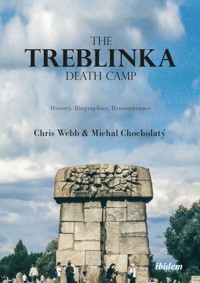
A number of books have been written on the death camp of Treblinka, but The Treblinka Death Camp: History, Biographies, Remembrance is unique. Webb and Chocolaty present the definitive account of one of history's most infamous factories of death where approximately 800,000 people lost their lives. The Nazis who ran it, the Ukrainian guards and maids, the Jewish survivors and the Poles living in the camp's shadow—every angle is covered in this astonishingly comprehensive work. The book attempts to provide a Roll of Remembrance with biographies of the Jews who perished in the death camp as well as of those who escaped from Treblinka in individual efforts or as part of the mass prisoner uprising on August 2nd, 1943. It also includes unique and previously unpublished sketches of the camp's ramp area and gas chamber, drawn by the survivors. For this second, revised edition, the authors incorporated new information and provided sources for the Jewish Roll of Remembrance. A significant number of new entries have been added. The Roll of Remembrance has also been greatly expanded to include the names of Jews deported from Germany to Treblinka. In addition, more names have been added to the Perpetrators’ biographies, and other entries have also been enhanced with additional information.
Das E-Book können Sie in Legimi-Apps oder einer beliebigen App lesen, die das folgende Format unterstützen:
Seitenzahl: 834
Veröffentlichungsjahr: 2021
Ähnliche















ibidem-Press, Stuttgart
For Artur Hojan and Robert Kuwalek
Dedicated to the memory of Richard Glazar, Shmuel Goldberg,
Eliahu Rosenberg, Kalman Teigman, Samuel Willenberg and all the victims of Treblinka
And to a special arrivals
Genevieve-Arden and Amelia Rae
Contents
Foreword
Authors' Introduction for the revised editon
Abbreviations (used in the footnotes)
Preface
Part I The Hell Called Treblinka
Chapter 1 Penal Labor Camp: Treblinka I
Chapter 2 Construction of the Death Camp: Treblinka II
Chapter 3 Initial Phase under Dr. Eberl: July–August 1942
Chapter 4 Chaos and Reorganization
Chapter 5 Industrialized Mass Murder: September–December 1942
Chapter 6 Deceptions and Diversions: Late 1942–early 1943
Chapter 7 Visit by the Reichsführer-SS: Orders to Erase Evidence of Crimes
Chapter 8 Jewish Work Brigades
Chapter 9 The Camp Revolt: August 2, 1943
Chapter 10 The End of Treblinka and Aktion Reinhardt: August–November 1943
Part II Survivors, Victims and Perpetrators
Chapter 11 Interviews with Treblinka survivors
Chapter 12 Wartime Reports about the Death Camp
Chapter 13 Transports and Death Toll
Chapter 14 Treblinka War Crimes Trials
Chapter 15 From Trawniki to Treblinka
Chapter 16 The Real “Ivan the Terrible”
Chapter 17 Roll of Remembrance: Jewish survivors and victims
Chapter 18 The Perpetrators
Postscriptum Lublin Concentration Camp (Majdanek) A part of Aktion Reinhardt?
Supplementary Documents
Appendix 1
Appendix 2
Appendix 3
Appendix 4
IIustrations and Sources
Maps, Documents and Drawings
Selected Bibliography
Acknowledgements
Foreword
The Holocaust was a set of events that engulfed an entire continent. The Nazi occupation of Europe pursued Jews from Greece to the Soviet Union. The survivors have been scattered around the globe. In recent years the memory of these events has become a global discourse—there is a UN mandated Remembrance Day and the Holocaust has become a kind of moral touchstone which is held up as the central event of the twentieth century. As a consequence, whenever one thinks of the Holocaust, one inevitably thinks in terms of scale—of six million dead, of journeys of thousands of miles. The rhetoric of Holocaust studies—as attempts to understand the Holocaust have become defined—also emphasize the enormity of the events with which we are grappling. We are constantly reminded of the idea that the Holocaust is both unrepresentable and unimaginable. Part of this rhetoric is the idea that the Final Solution operated on an industrial scale, and that the concentration camps need to be understood as factories of death. Within this epic memory it is the camp at Auschwitz that provides much of the iconography both through contemporary images (the unmistakable tower at the entrance of Auschwitz-Birkenau for example) and the images bequeathed by the memorial museum, the apparently endless stacks of human hair, or the piles of shoes and suitcases.
Reading Chris Webb and Michal Chocholatý’s book on Treblinka one is somewhat paradoxically struck by the essential truth of that epic memory, but at the same time of some of its inherent distortions—by the degree to which Treblinka in some ways conforms and in some ways denies this epic memory. In Treblinka a meticulously constructed factory of death did emerge, where killing ultimately was the only function of the facility. This factory consumed, according to the numbers collected here, some 885 thousand lives. Such an observation is scarcely credible and one is tempted to simply throw up one's arms in despair and declare such events unimaginable.
Yet the detail brought together here, some of it for the first time in the English language, also provides a timely warning about surrendering to such rhetoric. This is not an unrepresentable or more precisely unimaginable horror. As Alan Confino argues in his recent Foundational Pasts, the Final Solution was and is imaginable—precisely because it was imagined by its perpetrators. Chris Webb's reconstruction of Treblinka reminds us of this over and over again. This was a camp in which the technology of death was continuously refined and made more efficient. While the end result might have been a cleaner process, it was not one in which the perpetrators were distanced from their crimes because the means of carrying out those crimes had been considered, reconsidered; imagined and re-imagined, over and over again.
One is also reminded in Webb and Chocholatý’s book of another, at times neglected reality of the Holocaust. Despite the implications of the epic memory I described, the Final Solution did not take place on another planet. Despite the desires of the perpetrators to keep their crimes secret—the building of an imaginary train station at Treblinka being the most obvious indicator of that—they were not. Although the reality of what was occurring in the death camps might have been obscured, these places were public spaces with which local populations engaged in a variety of ways—some of which are testified to here.
And despite the scale of the death toll, one is also reminded by Webb's book just how small places like Treblinka were and as such that the seismic events of the Holocaust were in many ways rather intimate too. Covering just a few hundred square meters, and with a largely identifiable staff, Treblinka was a place in which victims and perpetrators confronted one another repeatedly. This intimacy is reconstructed here and as such Treblinka emerges as very much representable. These are epic events, but they took place in spaces that are only too conceivable in the human imagination.
And it was of course because Treblinka was constructed on a small scale that in the aftermath of Aktion Reinhardt the camp could be dismantled and disguised. One of the consequences of this is that to visit Treblinka today is to visit a space in which there are no visible remains from the camp itself. Treblinka therefore stands, perhaps more than any other place, as representative of the void which the Final Solution represents.
Yet it is thanks to works like Webb's and the scholarship that he and his co-author represent here that we can know something of what happened there. We can hear the voices of surviving victims, and of course of the perpetrators themselves. We can in that sense win a small victory over the Nazis' efforts to destroy and to expunge Jews and Judaism from this world, and of course to expunge the memory of their own destructiveness. We can, thanks to collections of material like this, continue to proclaim that, in the words of Primo Levi, it has been. We can, however imperfectly, see into the void.
Professor Tom Lawson
Northumbria University
A mightly important book, one sure to contribute to both scholarly and popular understandings of this human inferno—highly relevant for those wanting to better understand the Nazis’ unprecedented industrialized mass-murder that formed such a horrifically integral part of the Holocaust.
Professor Matthew Feldman, Director Centre For Analysis of the Radical Right (CARR)
Chris Webb has been studying the Holocaust for over forty-five years. He has had five books published by ibidem-Verlag on Adolf Hitler’s extermination camps. He has also given lectures and presentations at a number of universities, on Aktion Reinhardt and other aspects of the Holocaust. He has founded and co-founded a number of Holocaust websites, such as the Holocaust Historical Society, and has acted as an advisor to the Imperial War Museum and the BBC. He is a member of the Tiergartenstrasse4 Association and a Senior Fellow of CARR. He is also a member of The Treblinka Extermination Camp Group online-resource.
Michal Chocholatý is a historian who focuses on Treblinka and Sobibor. He hails from Pilsen, Czech Republic. He has interviewed a number of the Treblinka and Sobibor death camp survivors, and has published a book of these interviews during 2019, in his native Czech language.
Authors' Introduction for the revised editon
Chris Webb at the Treblinka Death Camp—July 23, 2002
This is a revised and updated version, incorporating new information and providing sources for the Jewish Roll of Remembrance. A significant number of new entries have been added and incorrect entries have been removed. I am extremely grateful to ibidem-Verlag for allowing the printing of a second edition. I must thank Valerie Lange of ibidem for her expertise and support. The Roll of Remembrance has also been greatly expanded to include the names of Jews deported from Germany to Treblinka. In addition, more names have been added to the Perpetrators biographies, and other entries have also been enhanced with additional information.
I have also taken the opportunity to include in this version some of the contents of my private correspondence with Treblinka survivors Kalman Teigman and Eliahu Rosenberg to further increase the reader’s knowledge of Treblinka. I have to pay tribute here to Yaniv Teigman, the grandson of Kalman Teigman, who helped in a number of ways to strengthen our relationship with numerous correspondences, photographs, and drawings throughout our long association.
This modern day contact with the past has now sadly ended with the death of Kalman in July 2012, and with the passing of Samuel Willenberg, in February 2016. There are no more living survivors of Treblinka to question. However, one should not underestimate the contribution of relatives of Treblinka survivors and victims and I must thank Mary Ziegler who contacted me in July 2015, to say that I had omitted to include Adek Bulkowstein, in the list of Treblinka survivors. That has now been rectified.
My thanks also go to Dr. Dov Rotenberg, who provided me with the moving account of Rose Rotenberg, whose parents Beryl and Riva Epelbaum, and other relatives tragically perished in Treblinka during 1943. She sadly passed away on May 10, 2019. I must also thank Karen I. Treiger, from Seattle, Washington, USA, the daughter-in-law of Shmuel Goldberg, who supplied me with his biography and photograph in June 2017. These new additions mean so much, for the relatives of survivors, and the wider public at large and deserve to be added.
I am indebted to a number of people from the Treblinka Exterination Camp Group online resource, which is managed by the excellent Jerry Steinberg, and I am proud to be a member of this group.
Members of this group including Linda Mayer, Malka Silver, Cindy Halpern and Warren Grynberg, have all contributed to this edition, and I want to thank them from the bottom of my heart.
Linda Mayer provided me with details of her late father Abraham Kolski, who escaped from Treblinka death camp during the revolt in August 1943. She also provided me with information about the Kramarski family from Tarczyn, who perished in the camp.
I am very grateful to Malka Silver, who also made contact with me, and provided me with information about her father Chaim Sztajer, from Częstochowa, and a photograph to enrich the book. I have provided her with information from my private archive, to assist her with her family research. Also Cindy Halpern provided me with information about her relatives.
Lastly another member who has made contact with me is Warren Grynberg. Some of his family members were deported from Łosice, near Siedlce in August 1942, to Treblinka. He has provided me with information regarding his father, Herschel, who fought in the British Army and saw Germany defeated. Warren has also provided me with photographs and other material, for which I am most grateful. I have met Warren in London, and this is living proof that the Nazis failed in their mission to wipe out the Jewish race in Europe.
The history of the death camp has been told in comprehensive detail in the first edition published in 2014, and that has largely been untouched, but important additions have been included. The interviews conducted by Michal Chocholatý, are unchanged. Michal has kindly supported me with answers to a number of questions, on a range of issues, for the second edition and that has been most appreciated.
We have discovered a major find concerning Želo Bloch, who served as a Lieutenant in the Czech National Army. With further research, it appears that his first name was Zoltan.
Firstly the deportation list of Jewish deportees from Presov in Slovakia, to the Lublin District dated May 12, 1942, contained the name Zoltan Bloch,who was born on August 5, 1912. Further research indicated that the profession of Zoltan Bloch, was that of a photographer in Presov, and we knew from previous survivor testimony that’ Zhelo’ Bloch had been a photographer. Both Michal and I had previously contacted the Czech Army Archives, but they could find no trace of Zhelomir. However, the Military History Archive in Bratislava have confirmed that Zoltan Bloch from Presov did serve in the Military between 1934–1936 and in 1938. This is a major find, and literally does re-write the history of the death camp.
On another positive note Michal has uncovered the first name of Professor Mering from Częstochowa, the history teacher of Samuel Willenberg. These small finds are important to the history and fabric of Treblinka, in keeping the victims memory alive.
The illustration and document sections have been completely revised, with the inclusion of new documents and more modern day photographs. Also extensive use has been made of a number of online websites such as the Bundesarchiv Memorial Gedenkbuch, the holocaust cz, website, the Warsaw ghettopl.website and the Yad Vashem Central Database of Shoah victims. One major improvement on the original Roll of Remembrance, the sources have been credited, which has allowed for a more accurate record to be produced.
Another chapter that has been enhanced is the biographies of the perpetrators, in no small measure to the excellent book written by Sara Berger, Experten der Vernichtung: das T4 Reinhardt—Netwerkin den Lagern Bełżec, Sobibór und Treblinka. This book has filled in many gaps from my previous research and has proved invaluable. I am indebted to Robert Parzer and Cameron Munro from the Tiergarten4 Association in Berlin, for their help with this chapter. Robert Parzer has also been of incredible help in obtaining documents regarding the erection of barracks at the Treblinka penal camp and for assisting me with great patience and skill, in tracking down the full names of the Schmidt and Munstermann construction firm that helped build the two Treblinka camps and the Warsaw Ghetto wall. This was one search I thought would never end, but it ended thanks to Kevin Morrow, historical researcher, who found the firms entry in the Warsaw District Telephone Directory for 1942, in the USHMM Archives.
In addition to thanking all of the people who helped with the first edition, this revised version has benefitted from the efforts of Tania Mühlberger, who has expertly copy edited this edition. Tania has now performed this role on three of my previous books, and I cannot thank her enough. It is thanks to Professor Matthew Feldman, who put me in touch with Tania. He is truly a friend for all seasons, and I value his friendship and support very much indeed.
A strong link to Teesside University is the design of the cover. I am extremely grateful to Tom Nixon from the University for his excellent cover design for the revised edition, using one of my own photographs taken on a visit to the death camp. He too is a jewel in the crown, and has provided three covers now, and I must thank him publically, for his undoubted talents.
I would like to thank Dr. Jörg Müller of the Staatsarchiv Chemnitz for the Astrawerke Warschauer Ghetto documents that included the roster with Kalman Teigman’s name on it, which has been included in this book. Also from Germany the support of Lutz Moser from the Bundesarchiv in Berlin, who has provided documents from their extensive archive, which have been included in this updated version.
Also of great assistance has been Emmanuelle Moscovitz from Yad Vashem, who provided a number of documents and testimony from their extensive archives, some of which have been included.
I closed the original introduction by mentioning the sad death of Artur Hojan in December 2013. Some six months later another dear friend in our Holocaust circle, Robert Kuwalek passed away unexpectedly on June 5, 2014 on a visit to Lvov. Robert was a giant in Holocaust research and provided much information, particularly for the Jewish Roll of Remembrance. He will be greatly missed.
In terms of paying respects, I must also thank the late Sir Martin Gilbert CBE, who kindly allowed me to use his expert maps and drawings in my published works. He passed away on February 3, 2015, and he too has left a difficult void to fill.
Lastly I must thank my wife Shirley, and all of my family, for their continued love and support.
Chris Webb
Whitehill, UKAugust 2, 2019
Abbreviations (used in the footnotes)
Abt. Abteilung (Section)
Auß. Außenstelle (Branch Office)
Bd. Band (Volume)
BA Bundesarchiv (Federal Archive)
Coll. Collection
GFH Ghetto Fighters' House
HHS Holocaust Historical Society, United Kingdom
HStA Hauptstaatsarchiv (Main State Archive)
HStA(H) Hauptstaatsarchiv (Hessen)—Main State Archive (Hesse)
IPN Izba Pamięci Narodowej (Institute of National Memory)
NA National Archives Kew, United Kingdom
NARA National Archives, Washington DC, USA
NIOD Institute of Holocaust and Genocide Studies, Amsterdam, Holland
OSI/DJ Office for Special Investigations at the Department of Justice, Washington, DC, USA.
RG Record Group
USHMM United States Holocaust Memorial Museum
YVA Yad Vashem Archive
ZIH Żydowski Instytut Historyczny (Jewish Historical Institute)
PREFACE
Aktion Reinhardt
An Overview
Aktion Reinhardt—also known as Einsatz Reinhardt—was the code name for the extermination of primarily Polish Jewry from the so-called Generalgouvernement and the Białystok area. The term was used in remembrance of SS-Obergruppenführer Reinhard Heydrich, Head of the Reich Security Main Office (RSHA) and co-ordinator of the “Final Solution of the Jewish Question” (Endlösung der Judenfrage)—the extermination of the Jews living in the European countries occupied by German troops during the Second World War.
On May 27, 1942, in a suburb of Prague, Jozef Gabčík and Jan Kubiš, members of the Czech resistance, ambushed Heydrich in his car while he was en—route from his home in Panenské Březany to his office in Prague. Heydrich died from his wounds at Bulovka Hospital on June 4, 1942.1
Four days after his death, about 1,000 Jews left Prague in a single train that was designated AaH (Attentat auf Heydrich—Assassination of Heydrich). This transport was officially destined for Ujazdów in the Lublin district, Poland, but the deportees were gassed at the Bełżec death camp in the far south-eastern corner of the Lublin District. The members of Odilo Globocnik's resettlement staff henceforward dedicated the murder program to Heydrich's memory under the code name Einsatz Reinhardt.2
The head of Aktion Reinhardt was SS-Brigadeführer Odilo Globocnik, the SS and Police Chief of the Lublin District, appointed to this task by Reichsführer-SS Heinrich Himmler. At the Führer's Headquarters in Rastenburg, East Prussia (Kętrzyn in present day Poland) on October 13, 1941, Heinrich Himmler, Friedrich-Wilhelm Krüger, Higher SS and Police Leader East in the Generalgouvernement and Odilo Globocnik, met at a conference during which Globocnik was authorized to build a death camp at Bełżec in the far south-eastern corner of the Lublin District of the Generalgouvernement. This was to be the first death camp constructed with static gas chambers, although the first mass extermination camp in the east, at Kulmhof in the Reichsgau Wartheland (today, Chełmno nad Nerem in Poland) used gas vans from early December 1941.3
On January 20, 1942, at a villa in the Wannsee suburb of Berlin, Heydrich organized a conference on the Final Solution of the Jewish Question in Europe. The conference had been postponed from December 8, 1941, as Heydrich wrote to one of the participants, Otto Hoffman, on account of events in which some of the invited gentlemen were concerned, which was an allusion to the massacres that had taken place in the East. Dr. Fritz Lange, for example had overseen the murder of Jews at Riga; these executions were notable as this was the first time German Jews from the Reich had been executed en masse. These Jews came from Berlin.4
Those who attended the Wannsee Conference included the leading officials of the relevant ministries, senior representatives of the German authorities in the occupied countries, and senior members of the SS, including Heinrich Müller, head of the Gestapo, and Adolf Eichmann, head of Department IV B4, the sub-section of the Gestapo concerned with Jewish affairs. Dr Josef Buhler, Staatssekretär who was representing Dr Hans Frank from the Generalgouvernement, demanded that the ‘Final Solution’ should be first applied to the Jews of the Generalgouvernement. This request was granted thus setting in train the mass murder program, which was later to be known as AktionReinhardt.
*
Odilo Lothario Globocnik was born on April 21, 1904 in Trieste, the son of an Austro-Slovene family, and a construction engineer by trade. In 1930, he joined the Nazi party in Carinthia, Austria, and after the banning of the Nazi Party in Austria in 1934, earned a reputation as one of the most radical leaders of its underground cells. In 1933, Globocnik joined the SS, which was also a prohibited organization in Austria since 1934, and was appointed Deputy Party District Leader (Stellvertretender Gauleiter).5
After serving several short terms of imprisonment for illegal activities on behalf of the Nazis, he emerged as a central figure in the pre-Anschluss plans for Austria, serving as a key liaison figure between Adolf Hitler and the leading pro-Nazi Austrians.6
After the Anschluss of March 1938, Globocnik's star continued to rise and on May 24, 1938, he was appointed to the coveted key position of Party District Leader (Gauleiter) of Vienna. His tenure was short-lived, however, and on January 30, 1939 he was dismissed from this lofty position for corruption, illegal speculation in foreign exchange and tax evasion—all on a grand scale.7
After demotion to a lowly SS rank and undergoing basic military training with an SS-Standarte, he took part with his unit in the invasion of Poland. Eventually Globocnik was pardoned by Himmler, who needed such unscrupulous characters for future “unsavory plans”. Globocnik was appointed to the post of SS and Police Leader (SS- und Polizeiführer) of the Lublin District in the Generalgouvernement on November 9, 1939.
In Lublin, Globocnik surrounded himself with a number of his fellow Austrians, SS-officers like Herman Julius Höfle, born in Salzburg on June 19, 1911. Höfle became Globocnik's Deputy in Aktion Reinhardt, responsible for personnel and the organization of Jewish deportations, the extermination camps and the re-utilization of the victim's possessions and valuables. Höfle was later to play a significant role in the mass deportation Aktionen in Warsaw and Białystok. Ernst Lerch from Klagenfurt became Globocnik's closest confidante and adjutant. Georg Michalsen, a Silesian from Oppeln, was another adjutant and he too, participated with Höfle in the deportation of Jews from the ghettos in Warsaw and Białystok. Another, early member of this group was Amon Göth who cleared the Kraków, Tarnów, and Zamość ghettos, and later became notorious as Commandant of the Płaszów labor camp, which was located in a suburb of Kraków.8
The headquarters of Aktion Reinhardt was located in the “Julius Schreck Barracks” (Julius-Schreck-Kaserne) at Litauer-Straße 11, a former Polish school close to the city center in Lublin, where Höfle not only worked but also lived in a small apartment. Also located in Lublin were the buildings in which the belongings and valuables seized from the Jews were stored: the former Catholic Action (Katholische Aktion) building on Chopin-Straße, and in the pre-war aircraft hangers on the Old Airfield (Alter Flugplatz) on the south-eastern outskirts of Lublin.9
The most notorious member of Aktion Reinhardt was SS-Obersturmführer/Kriminalinspektor Christian Wirth, the first commandant of the Bełżec death camp and later Inspector of the SS-Sonderkommando of Aktion Reinhardt. Before his transfer to Poland, Wirth had been a leading figure in Aktion T4, the extermination of the mentally and physically disabled in six so-called “euthanasia” killing centers in the Reich.
The role of the “T4” euthanasia program was fundamental to the execution of Aktion Reinhardt because the great majority of the staff in the death camps served their “apprenticeships” in mass murder at the euthanasia institutes of Bernburg, Brandenburg, Grafeneck, Hadamar, Hartheim and Pirna-Sonnenstein where the victims had been murdered in gas chambers using CO gas from steel cylinders. The senior officers in both Aktion T4 and Aktion Reinhardt were all police officers with equivalent SS ranks, and with Himmler's approval SS-NCO's had emptied the gas chambers and cremated the bodies of the victims in portable furnaces. The SS-men performed this work wearing civilian clothes because Himmler did not want the possibility to arise of the public becoming aware of the participation of the SS in the killing.
During Aktion Reinhardt the SS authorities also supplemented the forces guarding the death camps by employing former Red Army troops who had been captured or had surrendered to the Germans, mostly ethnic Germans (Volksdeutsche) from the Ukraine, the Baltic States and the Volga region of Russia who were trained in an SS camp in the village of Trawniki, 25 kilometers south-east of Lublin. The majority of these individuals were already anti-Semitic (equating Bolsheviks with Jews) and were ideally suited to the persecution and extermination of Jews.
On November 1, 1941, construction of the first Aktion Reinhardt death camp began near the village of Bełżec, 125 kilometers south-east of Lublin, and became operational in mid-March 1942. Construction of the second camp, at Sobibór, between the town of Włodawa and the city of Chełm on the River Bug, north-east of Lublin, came into operation at the end of April 1942. The third and last of these camps was located near the railroad station of Treblinka,10 about 100 kilometers north-east of Warsaw. All three camps shared some common vital facts: they were all situated on or close to main railway lines for the speedy delivery of the victims to their deaths, and they were located in sparsely-populated regions. The true fate of the Jews was initially hidden from them by announcing that they were being “transported to the east for resettlement and work”. The Aktion Reinhardt death camps were very similar in layout, each camp being an improvement on its predecessor, and the “conveyor-belt” extermination process developed at Bełżec by Christian Wirth was implemented, improved and refined at the other two camps.
On March 27, 1942, Dr. Josef Goebbels, Minister for Propaganda in the Reich, wrote the following entry in his diary concerning the deportations of Jews from Lublin, which marked the commencement of Aktion Reinhardt:
“Beginning with Lublin, the Jews in the Generalgouvernement are now being evacuated Eastward. The procedure is pretty barbaric and is not to be described here more definitely. Not much will remain of the Jews. About sixty per cent of them will have to be liquidated. Only about forty per cent can be used for forced labor.
The former Gauleiter of Vienna (Globocnik), who is to carry out this measure, is doing it with considerable circumspection and in a way that does not attract much attention… the ghettos that will be emptied in the cities of the Generalgouvernement will now be re-filled with Jews thrown out of the Reich. The process will be repeated from time to time.11
The personnel assigned to Aktion Reinhardt came from a number of sources, SS and policemen who served under Globocnik's command in the Lublin district, other SS men and civilians drafted into the Aktion, and members of the “T4” euthanasia program.12
Yitzhak Arad quotes in his book Bełżec, Sobibór, Treblinka that a total of 450 men were assigned to Aktion Reinhardt, including 92 from “T4”,13 more recent research by the authors, however, has identified a slightly higher total of 105 men, of whom 64 are known to have served in Treblinka at one time or another. (See chapter 18: members of the SS-garrison).
The Old Lublin Airfield was also used throughout Aktion Reinhardt as a mustering center for personnel transferred from the T4 “euthanasia” institutions in the Reich, to the extermination of the Jews in the Generalgouvernement. The SS-men, police and civilians thus transferred were usually met at the airfield by Wirth personally, on occasions accompanied by Reichleitner from Sobibór and Stangl from Treblinka. According to witnesses, at these selections of personnel, all three officers wore Schutzpolizei uniforms and none of them mentioned anything about their future employment or where they would be based. At the airfield depot the newcomers received Waffen-SS uniforms, provided by the SS-Garrison Administration (SS-Standortverwaltung) in Lublin, but without the SS runes on the right hand collar patches. The civilian employees from “T4”, especially the male psychiatric nurses among them, were sent first to the SS training camp at Trawniki for a two-week basic military training course.14
The men selected in Lublin and distributed to the three Aktion Reinhardt death camps were augmented by a company-sized unit of about 120 black-uniformed auxiliary guards who had also been trained at the SS training camp in Trawniki—the so-called “Trawnikimen” (Trawnikimänner), usually referred to as “Ukrainians” because they were the majority.
Those who spoke fluent German were appointed platoon or senior platoon leaders—Zugführer or Oberzugführer.15 The rest were known as Wachmänner (lit. guardsmen). A select few of the Trawnikimänner were given other, special duties, including the maintenance and operation of the engines that pumped their poisonous exhaust fumes into the gas chambers. Among them were the infamous Ivan Marchenko (“Ivan the Terrible”), Nikolay Shalayev, Fedor Fedorenko at the Treblinka death camp, and Ivan Demjanjuk at the Sobibór death camp.
*
In the course of Aktion Reinhardt approximately 1.6 million Jews were murdered in the death camps at Bełżec, Sobibór and Treblinka. Jewish property to the value of 178,045,960 Reichsmark (RM) was seized by the SS, which represents the minimum known amount. Through the theft of large amounts of cash and valuables by SS-Brigadeführer Globocnik, SS-men, policemen and guards, the true total will never be known.
The Aktion Reinhardt extermination operation ended officially in November 1943 and Himmler ordered Globocnik, who was by then the Higher SS and Police Leader (Höhere SS- und Polizeiführer) for the Adriatic Coastal Region (Adriatisches Küstenland), based in Trieste, to produce a detailed “Balance Sheet” for the murder program. Globocnik produced the requested financial accounts and suggested that certain SS-officers should be suitably rewarded for their “invaluable contribution” to Aktion Reinhardt. Globocnik received Himmler's thanks for his “services to the German people”, but made no mention of medals for any of Globocnik's subordinates.16
After completion of the extermination work in the Generalgouvernement, most of the men who had served in Aktion Reinhardt were transferred to northern Italy where their headquarters was in a disused rice mill in the San Sabba suburb of the Adriatic port of Trieste (Risiera di San Sabba). Divided into three SS-units: R-I, R-II and R-III, they operated under the code designation “Operation R” (Einsatz R), still under the command of SS-Obersturmführer Christian Wirth. Their primary task was the round-up and deportation to Auschwitz-Birkenau of the surviving Italian Jews, and confiscation of their property and valuables. Einsatz R was simply a smaller version of Aktion Reinhardt. Additionally, Italian-Jewish mental patients were removed from their hospitals and sent to the T4 “euthanasia” institution at Schloss Hartheim in Austria for gassing. The units not engaged in these operations were assigned to security and anti-partisan patrols on the Istrian peninsula.
Wirth turned San Sabba into an interrogation and execution center where not only Jews but also Italian and Yugoslavian partisans were tortured, beaten to death, or simply shot and their bodies cremated in a specially installed furnace in the courtyard.17 The human ashes were dumped in the Adriatic Sea. There is also evidence that a gas van was used in San Sabba.
*
The key members of Aktion Reinhardt mostly escaped justice. Christian Wirth and Franz Reichleitner (the second Commandant of Sobibór death camp) were killed by partisans in northern Italy in 1944. Amon Göth was tried and sentenced to death in Kraków in September 1946 for crimes committed in the forced labor camp in Płaszów (today a suburb of Kraków). Dr. Irmfried Eberl, the first Commandant of Treblinka, committed suicide in a West German prison in 1948 while awaiting trial. Only Franz Stangl (the first Commandant of Sobibór and second Commandant of Treblinka)18 and Kurt Franz, the last Commandant of Treblinka, were brought to trial in Düsseldorf. Both were found guilty of crimes against humanity and sentenced to life imprisonment. Other key figures who served in Treblinka, were also tried in Düsseldorf, including Heinrich Matthes, August Miete and Willy Mentz who were given life sentences. Other members of the SS garrison were also brought to justice, such as Otto Horn, Gustav Munzberger, Franz Suchomel and others, but they received much lesser sentences.19
1 R. Cowdery, P. Vodenka, Reinhard Heydrich Assassination. University of Southern Maine Press, Lakeville 1994, pp. 49, 63.
2 G. Reitlinger, The Final Solution. Valentine, Mitchell, London 1953, pp. 105–106.
3 P. Longerich, The Unwritten Order—Hitler's Role in the Final Solution. Tempus, Stroud 2001, p. 85.
4 Reitlinger, The Final Solution …, op. cit., p. 101.
5 J. Poprzeczny, Hitler's Man in the East—Odilo Globocnik. McFarland, Jefferson 2004, p. 10.
6 Reitlinger, The Final Solution …, op. cit., p. 262.
7 Poprzeczny, Hitler's Man …, op. cit., p. 76.
8 Ibid., p. 95.
9 Reitlinger, The Final Solution …, op. cit., p. 314.
10 The nearest village to the death camp was not Treblinka village but the village of Poniatowo; not to be confused with the village and forced labor camp at Poniatowa in Lublin District.
11 G. Reitlinger, The Final Solution …, op. cit., pp. 267-268.
12 Y. Arad, Belzec, Sobibór, Treblinka—The Aktion Reinhardt Death Camps. Indiana University Press, Bloomington and Indianapolis 1987, p. 17.
13 Ibid., p. 17.
14 F. Suchomel, Christian Wirth. Altötting 1972, (private typewritten report), Michael Tregenza Collection, Lublin, Poland.
15 Arad, Bełżec, Sobibór, Treblinka …, op. cit., p. 22.
16 Ibid., p. 375.
17 Ibid., p. 399.
18 It is a significant fact that Eberl, Reichleitner, and Stangl, as well as many other key members of Aktion Reinhardt were Austrian nationals.
19 A. Donat, The Death Camp Treblinka. Holocaust Library, New York 1979, p. 278.
Part I
The Hell Called Treblinka
Chapter1Penal Labor Camp: Treblinka I
The village of Treblinka is located approximately 100 kilometers north-east of Warsaw and approximately 4 kilometers from the important railway junction of Małkinia Górna, which is mentioned in the Karl Baedeker Das Generalgouvernment–Reisehandbuch as an important rail junction and former border station with the Soviet Union.1
In the book by Vasily Grossman, The Treblinka Hell, the description of the countryside is very apt:
The terrain to the east of Warsaw along the Western Bug is an expanse of alternating sands and swamps, interspersed with evergreen and deciduous forests. The landscape is dreary and villages are rare. The narrow sandy roads where wheels sink up to the axle and walking is difficult are something for the traveler to avoid.
In the midst of this desolate country stands the small out-of-the-way station of Treblinka on the Siedlce railroad branch line. It is some one hundred kilometers from Warsaw and not far from Małkinia station where tracks from Warsaw, Białystok, Siedlce and Łomża meet.
Many of those who were brought to Treblinka in 1942 may have had occasion to travel this way before the war. Staring out over the desolate landscape of pines, sand, more sand and again pines, scrubland, heather, unattractive station buildings and railroad crossings, the pre-war passenger might have allowed his bored gaze to pause for a moment on a single-track spur running from the station into the forest to disappear amid the dense pines. The spur led to a gravel pit where white sand was extracted for industrial purposes.2
In preparation for the Nazi attack on the Soviet Union in June 1941 the German authorities took over the gravel pit, near Treblinka and used the raw material for fortifications and other military purposes. After the gravel pit had been abandoned by the Wehrmacht, the Kreishauptmann in Sokołów Podlaski, Ernst Gramms, established a company for concrete products and the need arose for a cheap labor force to work in the gravel pit. Thus, the idea for creating a penal labor camp was born, with the approval of Dr. Ludwig Fischer, the civilian governor of Warsaw District. Later, this camp received the name of “Labor Camp Treblinka” (Arbeitslager Treblinka).
In the early phase the camp was designed exclusively as a place of incarceration for “stubborn elements” from the whole Sokołowski-Węgrowski district, then for the farmers unwilling to deliver their quotas of agricultural supplies demanded by the German authorities, persons evading forced labor, or involved in anti-German activity. At first, the camp held only several scores of prisoners who were accommodated in the buildings formerly belonging to the gravel works, and came under the jurisdiction of the local Kreishauptmann in Sokołów.
The German authorities published various notices, such as in the Official Gazette for the Warsaw District (Amtsblatt für den DistriktWarschau) on December 16, 1941, announcing that Arbeitslager Treblinka had been set up under the jurisdiction of the SS and Police Leader of Warsaw.
The Commandant of the camp was SS-Hauptsturmführer Theodor van Eupen, who was born on April 24, 1907, in Düsseldorf. He had previously been in charge of the Main Accommodation Administration Office) (Heersunterkunftsverwaltung in Sokołów. The camp staff consisted of approximately twenty SS men and one detachment of Ukrainian Trawnikimänner who served as guards. One of those guards was Alexey Kolgushkin from the Trawniki training camp who provided this statement on September 24, 1980, in the city of Rybinsk, Yaroslavl Oblast (Province) in the USSR, providing a description of the camp in which he served:
Near the entrance to the work camp where I served there was a barrier and guard tower. The portion of the camp that contained the prisoners was isolated from the camp in general. This area that contained the prisoners was surrounded by a double barbed-wire fence, which in turn contained a patrolled region between the two fences. This controlled region consisted of a strip of ploughed earth where the footprints of anyone who crossed it would be left. The entire camp was surrounded by a single barbed-wire fence, there were buildings situated in the camp that held clothing, there were also warehouses and stables.
There were barracks where the guards lived and there were barracks where the Germans from the camp administration lived. None of the guards were permitted to enter the area where the prisoners were kept, and the guards were forbidden from entering the controlled area.
The area containing the prisoners was divided into three sections. One section contained a kitchen, stoves and sewing shops. The Jewish prisoners who were artisans lived there along with Jewish tailors, barbers, stove workers and drivers. They were dressed in civilian clothes, each wore their own clothes. In the next section lived the Jews who were used for forced labor. They were dressed in striped uniform and they wore wooden clogs on their feet. I do not know if there were skilled laborers among these Jews, who had a specialty. They were sent to work in the sand pit where they hauled sand; they were also taken to work in the forest removing tree stumps. The sand from the sand pit was sent off in the direction of Małkinia station.
In the third section of the camp were kept the Polish prisoners. As a rule, the Poles were used for auxiliary work in the camp—they were dressed in civilian clothes, like the Jewish skilled workers. I do not know if their food was on the same level as that of other prisoners.
The guards were divided into sections, platoons and companies. The camps administration was made up of Germans only—they occupied the supervisory positions. The guards were divided into four sections, each containing 12–15 men. Besides providing security for the camp the guards took the prisoners to work by convoy and they guarded them during work.
I do not know who shot prisoners on the way to work. I personally had occasion to take prisoners by convoy to the sand pit and accompany them into the forest to remove tree stumps and to auxiliary jobs—in general wherever they went to work. I also led prisoners by convoy to Małkinia railroad station where they worked at unloading and stacking.3
The history of the penal labor camp was closely connected with the history of the death camp—Polish and Jewish prisoners from the labor camp participated in the construction of the death camp. The penal labor camp at Treblinka therefore served not only as a concentration camp “for criminal elements”, it also served the function of a reservoir of manpower for the construction of the Treblinka extermination camp.
Jan Sułkowski, a Polish bricklayer by profession, had been sent to the labor camp on May 19, 1942 for evading forced labor for the German authorities. He was released in the summer of 1942, after helping with the construction of the death camp. This was a typical term of imprisonment which usually lasted from two to six months, after which time the prisoners were either released or sent to a concentration camp.
During the weeks of Sułkowski's incarceration and construction of the death camp, Jews began arriving in the camp. He personally witnessed the brutality and murderous behavior of the camp guards towards these Jews:
Germans killed Jews at work by shooting them or beating them to death with sticks. I saw two such cases in which SS-men, during the grubbing-out jobs, forced Jews to walk under the falling tree by which they were crushed. In both cases several (two, three or four) Jews were killed. It also happened that SS-men would often rush into the barracks where, drunk or sober, they went on shooting at the Jews who were inside.4
Richard Glazar, a prisoner from the Treblinka death camp, visited the penal labor camp on one occasion. He recounted this experience in a post-war interview:
There's one thing to say that's not so well known, there was another Treblinka camp (…) not very far away from Treblinka extermination camp. It was a forced labor camp. A small camp, it was just a quarry.
Once I was taken there with my Kommando just to bring sand and stones to Treblinka. So I saw how it looked. It was a normal concentration camp. And one can imagine the Germans, the Nazis, they camouflaged it, with the existence of this labor camp, the existence of the extermination camp.5
Israel Cymlich, a Polish Jew, a baker by profession, was deported from the Falencia ghetto on August 20, 1942 and he described in his memoirs his journey and arrival at the labor camp:
Our car was the last in the transport and started moving only toward evening. We kept looking out of the window and through all the cracks with great curiosity. And there we were, passing through the Treblinka railroad station, through the woods, until all of a sudden, we beheld a sight straight out of Dante’s Inferno…. a huge mountain of clothes, naked people running all around it, throwing more clotheshigher and higher, black smoke billowing from huge pits.
We didn’t have much time to observe everything that was happening there, because our car was shunted and the remaining cars moved on inside. We barely had the time to make out the number of barracks, machine-guns mounted on the roofs, firing frequently. Then we saw only a fence of young pine trees, and smelled the terrible odor of burning bodies….
We were puzzled why a different treatment was extended to us, and asked the guard who stood by the gates about our destination, “You are going to do forced labor,” he replied.
Our car pulled up at the Treblinka labor camp. A tall SS-man accompanied by guards, came over, and we were escorted to the camp. Above the entrance we saw an innocent-sounding sign: Arbeitslager Treblinka. Noticing double barbed-wire and elevated platforms in the four corners of the camp, I realized we were in for hard times. We were told to form a column of three persons abreast, and under threat of being sent to the “forest”, to hand over money and valuables. We realized that executions took place in the forest. Most people handed over everything they had on their person and I, too, parted with 600 złotys. We were terribly thirsty and could barely stand on our feet. Finally, some black coffee and water was brought in. (…)
Each of us got 200 grams of bread, half a spoonful of marmalade and sugar. In the evening, together with others, we lined up for a roll call. The SS-men counted us, and we went inside the barracks. It was a fairly long barrack, lined on both sides with two-tiered rows of bunk beds, so that people slept beneath and above. The floor was made of asphalt (sic).
Most of the residents of this barracks (C) were German and Czech Jews.6
Saul Kuperhand, another prisoner of the penal labor camp, recalled in his book Shadows of Treblinka how he was incarcerated in the same barracks: “we were herded to the barracks marked with the letter C. We slept on double-decker bunks made of raw wood: we did not have even a single sheet or piece of straw. The bottom level of each bunk held 13 men, the top level 12.”7
The average number of prisoners in the penal labor camp amounted to about 1,000–1,200 people, Poles and Jews, who were all forced to work under brutal conditions, with very low rations. Between 800 and 900 prisoners toiled from dawn to dusk, either in the gravel pit, where the work was exhausting, digging out gravel and sand or loading railroad trucks.8
Another group of prisoners were employed at Małkinia railroad station where they too, loaded railroad trucks. Female prisoners were employed at the farm attached to the camp, while another group consisting of 250 Jewish skilled artisans worked in the camp's workshops. Throughout the long day's labor, the prisoners were brutally treated, beaten, tortured or simply shot for the slightest misdemeanor, with only a brief respite from the back-breaking work at noon each day.9
The camp diet consisted of half a liter of watery soup or ersatz coffee in the morning, one liter of the same soup at noon, and a cup of ersatz coffee without sugar, with 20 dkg of black bread in the evening. On such a diet bereft of any nourishment, the prisoners succumbed to diseases; epidemics spread throughout the camp resulting in a high mortality rate.10
The key members of the penal labor camp garrison, including their characteristics, are described by the former prisoner Israel Cymlich in his memoirs:
The chief of the entire camp was a Hauptsturmführer, some kind of Baron [Theodor van Eupen, authors' note] who had his headquarters in Ostrów Mazowiecki. He hardly ever came into direct contact with the Jews, and was responsible only for the Treblinka camp. (…)
The camp Commandant was Untersturmführer Prefi, a madman and a thug, a great fan of shooting people to death at every opportunity. He often carried out massacres single-handedly, by shooting from a hand-held machine-gun at a group of Jews assembled for roll call. (…)
The labor-force Commandant in the camp was Untersturmführer Einbuch,11 known as the “thug in white gloves”. He was gifted with a phenomenal memory; recognized people well, did not cause a mess like others, granted favors to some, and surrounded himself with Jewish informers. (…) Probably the correct name for this member of the camp staff was Hans Heinbuch, who originated from Frankfurt am Main.
The Commandant of the guards was Unterscharführer Stumpe. He always carried his knout, and very much enjoyed hitting everyone over the head with it, including the guards. He was especially fond of urging people to work harder by calling out, “Tempo, tempo, cali, cali!” which earned him the nickname of “Cali” among the guards.
Unterscharführer Lindeke was the manager (…) his Deputy was Hagen (…) who left for Warsaw after some time. He often visited the camp to attend drinking bouts. After getting drunk, he liked to play cat-and-mouse with the Jews, and would kill at least a dozen of them. (…)
The supervisor of the workshops was Unterscharführer Lanz, a boxing fan. I have no words to describe his humiliating treatment of people. He didn't treat his own people badly, but woe to anyone who became his target.
Rottenführer Werhan was in charge of the stable and the farm, he treated his own people fairly. (…)
Finally, there was the notorious henchman of the camp, head of the group (of prisoners) working in Małkinia, Unterscharführer Schwarz (allegedly a butcher by trade). (…) He derived sadistic satisfaction from tormenting, torturing and killing. He usually killed with a club, a hammer, or some other blunt instrument. Małkinia was the worst place to work in the entire camp. Every day, more than a dozen corpses of people whom he had tortured to death were brought in from Małkinia.12
The penal labor camp existed from December 1941 to August 1944 when it was liquidated. The camp guard Alexey Nikolaevich Kolgushkin, whose platoon was on patrol duty on the day the camp was liquidated, has stated:
Supplementary patrols were deployed next to ours in order to guard the area where prisoners were being held. (…) in the morning camp security (…) strengthened. At approximately 8 or 9 a.m. the prisoners began to be led out of the barracks. They were led out by the Germans and assembled in the yard, the guards who were not on patrol also participated in this.
After they were all assembled, they began to beat them in groups of five and forced them to the ground. After counting out a certain number of prisoners they made them stand up and made them pull their pants down to their knees, so they could not run, to dig holes, they were all shot. (…)
Approximately 500–600 prisoners were executed in these holes in all. The figure is an approximate one since I did not count the number of people condemned to death. I only remember that when I walked up to these holes on the second day, I saw they were filled up with bodies and dirt. After the liquidation of the camp the Germans and the guards fled together, since Soviet troops were already advancing on Treblinka.13
Post-war investigations by the Main Commission for the Investigation of Nazi Crimes in Poland revealed that at least forty mass graves containing the remains of 6,500 prisoners lie within half-a-kilometer of the penal labor camp. Throughout the existence of the camp at least 10,000 people passed through its gate.14
1 K. Baedeker, Das Generalgouvernement—Reisehandbuch. Verlag Karl Baedeker, Leipzig 1943, p. 102.
2 V. Grossman, The Treblinka Hell. Gershon Aharoni, Tel Aviv 1984, p. 13.
3 OSI/DJ, Washington, DC: Aleksey Nikolaevich Kolgushkin, September 24, 1980.
4 W. Chrostowski, Extermination Camp Treblinka. Vallentine, Mitchell, London 2004, p. 27.
5 Richard Glazar interview with Bonnie Gurewitsch-Brooklyn, USHMM Council Conference of Liberators, USHMM Washington, DC, 26 October 1981.
6 I. Cymlich, O. Strawczyński, Escaping Hell in Treblinka. Yad Vashem/The Holocaust Survivors' Memoirs Project, New York and Jerusalem 2007, pp. 31–32.
7 M. Kuperhand, S. Kuperhand, Shadows of Treblinka. University of Illinois Press, Champaign 1998, p. 110.
8Treblinka, Council for the Protection of Combat and Martyrdom Monuments, Warsaw 1963 (no pagination).
9 Ibid.,
10 Ibid.,
11 This is most likely to be Hans Heinbuch, born February 10, 1907, Frankfurt am Main. SS Personnel File.
12 Cymlich, Strawczyński, Escaping Hell ..., op. cit., pp. 33–35.
13 OSI/DJ, Washington, DC, Alexey Nikolaevich Kolgushkin, 24 September 1980.
14Treblinka, Council for the Protection of Combat …, op. cit. (no pagination).
Chapter 2Construction of the Death Camp: Treblinka II
The death camp in Treblinka was situated in the north-eastern region of the Generalgouvernement. The camp was erected in a sparsely populated area near Małkinia-Górna, an important railway junction on the Warsaw-Białystok railway line, four kilometers north-west of Treblinka village and its railroad halt.1
The site chosen was in an open, sandy area dotted with copses of trees and small woods. A patch of forest separated the site from the village of Wółka Okrąglik, which was just over a kilometer from the extermination area with its gas chambers and mass graves.2
Franciszek Ząbecki was the Polish stationmaster at Treblinka village station, and a member of the Polish Underground. He had been placed at Treblinka by the AK (Armia Krajowa–Home Army), the biggest Polish Underground movement, originally to report on the movement of German troops and equipment. He was therefore the only trained observer on the spot throughout the entire existence of the Treblinka extermination camp. He recalled:
The first inkling we had that something more was being planned in Treblinka was in May 1942 when some SS-men arrived with a man called Ernst Grauss3 who—we found out from the German railroad workers—was the chief surveyor at the German HQ.
They spent the day looking around and the very next day all fit male Jews in the neighborhood—about a hundred of them—were brought in and started work on clearing the land. At the same time they shipped in a first lot of Ukrainian guards.
It was said that it was to be another labor camp, a camp for Jews who would work on damming the River Bug, a military installation, a staging or control area for a new secret military weapon. And finally, German railway workers said it was going to be an extermination camp. But nobody believed them—except me.4
The extermination camp was the third and final camp built as part of Aktion Reinhardt, and was constructed along similar lines to Bełżec and Sobibór, although on a bigger scale.
Work commenced at the beginning of April 1942. The contractors were the German construction firms Robert Schönbrunn, with their Warsaw office in Dreikreuzplatz 13 (Plac Trzech Krzyży—Three Crosses Square) and Hans Schmidt and Heinrich Münstermann,5 who also had offices in Warsaw at Mars Straße 8/3.6 Schmidt and Münstermann were also responsible for the construction of the ghetto wall in Warsaw, the Treblinka Penal Camp and the erection of the barracks at the Jewish Labor Camp at Poniatowa.
Jews from the Warsaw ghetto, and neighboring towns, as well as inmates from Treblinka I, the penal labor camp, were used to complete the building work. One of them, Israel Cymlich states “they had worked for a long time at constructing the other camp, without a clue as to what they were building. The contingent that used to go to work there was called the ‘T-Group’”.7
Another prisoner from the penal labor camp, Lucjan Puchała, recalled the initial phase of the construction of the death camp:
Initially we did not know the purpose of building the branch track, and it was only at the end of the job that I found out from the conversations among Germans that the track was to lead to a camp for Jews. The work took two weeks, and it was completed on 15 June 1942. Parallel to the construction of the track, earthworks continued.
The works were supervised by a German, an SS-Hauptsturmführer. At the beginning, Polish workers from the labor camp, which had already been operating in Treblinka, were used as the workforce. Subsequently, Jews from Węgrów and Stoczek Węgrowski started to be brought in by trucks. There were 2–3 trucks full of Jews that were daily brought into the camp. The SS-men and Ukrainians supervising the work killed a few dozen people from those brought in to work every day. So that when I looked from the place where I worked to the place where the Jews worked the field was covered with corpses. The imported workers were used to dig deep ditches and to build various barracks. In particular, I know that a building was built of bricks and concrete, which as I learned later, contained people-extermination chambers.8
Jan Sułkowski also worked on the construction of the death camp and he noted a strange building with a hermetically sealed door:
SS-men said it was to be a bath. Only later on when the building was almost completed, I realized it was to be a gas chamber. What was indicative of it was a special door of thick steel insulated with rubber, twisted with a bolt and placed in an iron frame and also the fact that an engine was placed in one of the building's compartments, from which three iron pipes led through the roof to the remaining three parts of the building. (…) A specialist from Berlin came to lay tiles inside and he told me that he had already built such chambers elsewhere.9
Wolf Sznajdman was one of the Jews brought to Treblinka from Stoczek, to build the death camp. He represents an almost unique exception refuting the theory that none of the Jews who built Treblinka survived throughout the entire history of the death camp. Sznajdman managed to survive the thirteen months from June 1942 until the camp revolt on August 2, 1943. Indeed another death camp survivor Shmuel Goldberg, also from Stoczek, was another survivor from these early days. Wolf recalled very well the early summer of 1942 when he was brought to the penal labor camp in Treblinka to participate in the construction of the death camp:
Construction of a new camp had started. A spur railroad line had already been started we have to finish the job. We were erecting the barracks, we dug the first pit. It measured 10 meters deep. It was dug in levels, step-like. It was a pit for bodies in the Totenlager (death camp), in the second camp.
There was no fence there then. We walked all around. They treated us very badly. They beat us on the way, while working, they put bicycles on our heads, and they burn with cigarettes on the head. We lived in the barracks which were built for us by the people from Polish Penal Camp Treblinka. Working hard! It was hard work: to dig the pits, to build the spur line, to eradicate the forest, to prepare the timber for building purposes. We were working here for six weeks.10
Shmuel Goldberg recalled his arrival at Treblinka in June 1942:
I was in Stoczek, there were Germans and Ukrainians, they surrounded the Shetl. So they put us on a truck, 135 people and they took us to Treblinka, and they took us off the truck…… they put us in groups of five…. So they took me to make a roof from bundles of straw and to bind them together and to make the roof from that.
When I finished the roof, they asked, “Can you wash laundry?” I said, “Yes.” So they brought me a basin with a board, and they said I should wash clothes. I wasn’t alone, there were five or six. Two people from Stoczek were killed right away because they didn’t want to work.11
The construction of the Treblinka death camp was supervised by SS-Hauptsturmführer Richard Thomalla from the Construction Office of the Waffen-SS and Police (Bauleitung der Waffen-SS und Polizei) in Zamość in Lublin District. Thomalla was attached to the staff of SS-Brigadeführer Globocnik in Lublin. Thomalla had previously also supervised the construction of the other Aktion Reinhardt camp at Sobibór and had been involved at Bełżec, in the construction of border defences, known as the “Otto Line”. He was serving in Russia at the time, on the SS




