


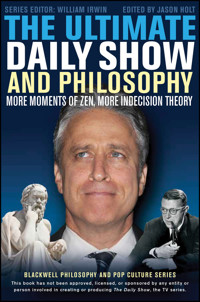
The Ultimate Daily Show and Philosophy E-Book
12,99 €
Mehr erfahren.
- Herausgeber: John Wiley & Sons
- Kategorie: Geisteswissenschaft
- Serie: The Blackwell Philosophy and Pop Culture Series
- Sprache: Englisch
Savor moments of Zen like never before, with our Senior Philosophical Correspondents
The Ultimate Daily Show and Philosophy is revised, expanded, and updated to probe deeper than ever before the philosophical significance of the quintessential “fake” news show of the 21st century.
- Features significant revisions and updates from the first 2007 edition
- Includes discussion of both The Daily Show and its spin-off, The Colbert Report
- Reveals why and how The Daily Show is philosophically engaging and significant
- Showcases philosophers at their best, discussing truth, knowledge, reality, and the American Way
- Faces head on tough and surprisingly funny questions about politics, religion, and power
Sie lesen das E-Book in den Legimi-Apps auf:
Seitenzahl: 635
Veröffentlichungsjahr: 2013
Ähnliche




















Contents
Acknowledgments
Introduction: From Wiley-Blackwell’s World Philosophy Headquarters in Malden
Segment 1 HEADLINES: FAUX NEWS IS GOOD NEWS
Chapter 1: Rallying Against the Conflictinator
Amusing Ourselves to Death
The Huxleyan Warning
Postman and Television News
The Daily Show and Television News
Conversation and Crossfire
Business News, CNBC, and Jim Cramer
Fox News Sunday and TV’s Entertainment Bias
The Rally to Restore Sanity and/or Fear
A Huxleyan Moment of Zen?
Notes
Chapter 2: The Fake, the False, and the Fictional
Is The Daily Show Fiction?
Hilarious Make-’Em-Ups
Sheer Outrageousness and Surprising Truth
The Role of “Senior” Correspondents
Playing Dumb
The Daily Show, Our Government, and Other News Outlets
The Daily Show v. The Onion
Fake News, Real Messages
Chapter 3: The Daily Show
All the Fake News Fit to Print
The Voice of the People
The Fifth Estate as a State of Mind
Notes
Chapter 4: Seriously Funny
The Politics of Laughter
The Dark Side of Mockery
Mockery, Censorship, and the Free Spread of Ideas
The Place of Mockery in Politics
Notes
Chapter 5: Keeping It (Hyper) Real
Baudrillard’s World2
The Walking Talking Hyperreal
Organize a Fake News Broadcast
The “Best F#@king News Team Ever”
The Larger Argument
Notes
Segment 2 LIVE REPORT: JON STEWART (NOT MILL) AS PHILOSOPHER, SORT OF
Chapter 6: Jon Stewart
Why Americans Hate Intellectuals
You Know It’s Hard out Here for a Public Intellectual8
Stewart’s Ironic Blah, Blah, Blah
“Help Us Hebrew One! You’re Our Only Hope!”
Chapter 7: Stewart and Socrates
Here Come the Sophists!
To Scoff at the Sophist in Office
Men with a Mission
A Method to Their Madness
The Audience: Questioning Youths or Stoned Slackers?
The Irony of It All
“Monkey” Idol or Thoughtful Partisan Satirist?
Notes
Chapter 8: Jon the Cynic
Rebel with a Cause
Humor Leads to Truth
A Healthy Dose of Cynicism
Notes
Chapter 9: “Jews! Camera 3”
Really? You’re Jewish?
Team Buber
Passover v. Easter
Earth (The Book)—Mocking the Sacred
The New Jersey Connection
Notes
Segment 3 FIELD REPORT: POLITICS AND CRITICAL THINKING
Chapter 10: More Bullshit
The Essence of Bullshit and the Truth about Lies
Liars, Liars, Pants on Fire
More Bullshit, Piled Higher and Deeper
A New Spin on an Old Art
Was Frankfurt BS-ing about Spin?
PR-ization of the Media
Spin Alley
Truth Matters
Notes
Chapter 11: The Senior Black Correspondent
Satire: A Tradition of Cultural Criticism
Operating at the Border
Heading West
Larry Wilmore’s Jazz Hands
Notes
Chapter 12: The Daily Show ’s Exposé of Political Rhetoric
A Cavalcade of Fallacies
Tugging at the Heartstrings
Spin: The Systematic Use of Persuasive Language
Satirized for Your Protection
Notes
Chapter 13: The Daily Show Way
Civil Disservice
The Red (Herring) Menace
“Diss” Ingenuous Bullshitting: Scapegoating and Leaping to Judgment (Day)
In the Line of Ire: Reframing the Debate
Look Who’s Not Talking Now: Going Beyond Experience
Show Me the Meta
Self-Effacement and Good Faith
Segment 4 INTERVIEW: RELIGION AND CULTURE
Chapter 14: GOP Almighty
Newt Gingrich on a Potato
Pious Politickin’
Thus Saith Pat
No Really, It’s in the Bible
Pat “Gay People Cause Hurricanes” Robertson
Remember, You’re Only Human
Notes
Chapter 15: Profaning the Sacred
Exclusivism! −There Can Be Only One
Inclusivism!−One of Us
Pluralism!−Inter-Religious Harmony (Against Gays) in Jerusalem
A Plurality of Pluralisms
“The God Exchange” Is Now Closed
Eulogy: The Safe Turn to Politics
Notes
Chapter 16: Jon Stewart and the Fictional War on Christmas
There Is No War on Christmas
The First War for Christmas
The Modern War for Christmas
A Wall of Separation between Christians and Christmas
The Original Meaning of Christmas
Notes
Chapter 17: Evolution, Schmevolution
Evolution: The Fundamentals
Why, Then, Is There a Problem?
What Is Intelligent Design, Anyway?
So, Evolution or Schmevolution?
Postscript: After (and Before) Dover
Segment 5 YOUR MOMENT OF ZEN: BEYOND THE DAILY SHOW
Chapter 18: America (The Book)
Humor with a Point
Reversing Democracy Inaction
Government of, by, or for the People?
Mediating the Media
Putting Knowledge to Work
Postscript: Earth (The Book)
Notes
Chapter 19: A Tea Party for Me the People
We the People
Anti-History
Notes
Chapter 20: Neologization à la Stewart and Colbert
Humpty Dumpty and the French Academy
Wordplaying by the Rules
Your Moment of Zen
Notes
Chapter 21: Irrationality and “Gut” Reasoning
A Little Background
Truthiness and Problems of Irrationality
Wishful Thinking and Self-Deception: What Are They?
The Paradoxes of Irrationality
One Solution: Divide the Mind
An Alternative Account
Truthiness and Self-Deception
Feeling the Truth: Can Our Guts Get Us Justified Belief?
A Tip of the Hat
Notes
Chapter 22: Thank God It’s Stephen Colbert!
Ironists: People Destroying America
Colbert Nation-Building
Proust-Spouting, Atheist Gay Truck Mechanics
Speaking Truthiness to Power
Better Know an Ironist
Notes
Senior Philosophical Correspondents
Index
The Blackwell Philosophy and PopCulture SeriesSeries Editor: William Irwin
A spoonful of sugar helps the medicine go down, and a healthy helping of popular culture clears the cobwebs from Kant. Philosophy has had a public relations problem for a few centuries now. This series aims to change that, showing that philosophy is relevant to your life—and not just for answering the big questions like “To be or not to be?” but for answering the little questions: “To watch or not to watch South Park?” Thinking deeply about TV, movies, and music doesn’t make you a “complete idiot.” In fact it might make you a philosopher, someone who believes the unexamined life is not worth living and the unexamined cartoon is not worth watching.
Already published in the series:
24 and Philosophy: The World According to JackEdited by Jennifer Hart Weed, Richard Brian Davis, and Ronald Weed30 Rock and Philosophy: We Want to Go to ThereEdited by J. Jeremy WisnewskiAlice in Wonderland and Philosophy: Curiouser and CuriouserEdited by Richard Brian DavisArrested Development and Philosophy: They’ve Made a Huge MistakeEdited by Kristopher Phillips and J. Jeremy WisnewskiThe Avengers and Philosophy: Earth’s Mightiest ThinkersEdited by Mark D. WhiteBatman and Philosophy: The Dark Knight of the SoulEdited by Mark D. White and Robert ArpBattlestar Galactica and Philosophy: Knowledge Here Begins Out ThereEdited by Jason T. EberlThe Big Bang Theory and Philosophy: Rock, Paper, Scissors, Aristotle, LockeEdited by Dean KowalskiThe Big Lebowski and Philosophy: Keeping Your Mind Limber with Abiding WisdomEdited by Peter S. FoslBlack Sabbath and Philosophy: Mastering RealityEdited by William IrwinThe Daily Show and Philosophy: Moments of Zen in the Art of Fake NewsEdited by Jason HoltDownton Abbey and Philosophy: The Truth Is Neither Here Nor ThereEdited by Mark D. WhiteEnder’s Game and PhilosophyEdited by Kevin S. DeckerFamily Guy and Philosophy: A Cure for the PetardedEdited by J. Jeremy WisnewskiFinal Fantasy and Philosophy: The Ultimate WalkthroughEdited by Jason P. Blahuta and Michel S. BeaulieuGame of Thrones and Philosophy: Logic Cuts Deeper Than SwordsEdited by Henry JacobyThe Girl With the Dragon Tattoo and Philosophy: Everything is FireEdited by Eric BronsonGreen Lantern and Philosophy: No Evil Shall Escape this BookEdited by Jane Dryden and Mark D. WhiteHeroes and Philosophy: Buy the Book, Save the WorldEdited by David Kyle JohnsonThe Hobbit and Philosophy: For When You’ve Lost Your Dwarves, Your Wizard, and Your WayEdited by Gregory Bassham and Eric BronsonHouse and Philosophy: Everybody LiesEdited by Henry JacobyThe Hunger Games and Philosophy: A Critique of Pure TreasonEdited by George Dunn and Nicolas MichaudInception and Philosophy: Because It’s Never Just a DreamEdited by David JohnsonIron Man and Philosophy: Facing the Stark RealityEdited by Mark D. WhiteLost and Philosophy: The Island Has Its ReasonsEdited by Sharon M. KayeMad Men and Philosophy: Nothing Is as It SeemsEdited by James South and Rod CarvethMetallica and Philosophy: A Crash Course in Brain SurgeryEdited by William IrwinThe Office and Philosophy: Scenes from the Unfinished LifeEdited by J. Jeremy WisnewskiSouth Park and Philosophy: You Know, I Learned Something TodayEdited by Robert ArpSpider-Man and Philosophy: The Web of InquiryEdited by Jonathan SanfordSuperman and Philosophy: What Would the Man of Steel Do?Edited by Mark D. WhiteTerminator and Philosophy: I’ll Be Back, Therefore I AmEdited by Richard Brown and Kevin S. DeckerTrue Blood and Philosophy: We Wanna Think Bad Things with YouEdited by George Dunn and Rebecca HouselTwilight and Philosophy: Vampires, Vegetarians, and the Pursuit of ImmortalityEdited by Rebecca Housel and J. Jeremy WisnewskiThe Ultimate Daily Show and Philosophy: More Moments of Zen, More Indecision TheoryEdited by Jason HoltThe Ultimate Harry Potter and Philosophy: Hogwarts for MugglesEdited by Gregory BasshamThe Ultimate Lost and Philosophy: Think Together, Die AloneEdited by Sharon KayeThe Ultimate South Park and Philosophy: Respect My Philosophah!Edited by Robert Arp and Kevin S. DeckerThe Walking Dead and Philosophy: Shotgun. Machete. Reason.Edited by Christopher RobichaudWatchmen and Philosophy: A Rorschach TestEdited by Mark D. WhiteX-Men and Philosophy: Astonishing Insight and Uncanny Argument in the Mutant X-VerseEdited by Rebecca Housel and J. Jeremy Wisnewski
Forthcoming:
Sons of Anarchy and PhilosophyEdited by George Dunn and Jason EberlSupernatural and PhilosophyEdited by Galen A. Foresman
This edition first published 2013© 2013 John Wiley & Sons, Inc
Wiley-Blackwell is an imprint of John Wiley & Sons, formed by the merger of Wiley’s global Scientific, Technical and Medical business with Blackwell Publishing.
Registered OfficeJohn Wiley & Sons, Ltd, The Atrium, Southern Gate, Chichester, West Sussex, PO19 8SQ, UK
Editorial Offices350 Main Street, Malden, MA 02148-5020, USA9600 Garsington Road, Oxford, OX4 2DQ, UKThe Atrium, Southern Gate, Chichester, West Sussex, PO19 8SQ, UK
For details of our global editorial offices, for customer services, and for information about how to apply for permission to reuse the copyright material in this book please see our website at www.wiley.com/wiley-blackwell.
The right of Jason Holt to be identified as the author of the editorial material in this work has been asserted in accordance with the UK Copyright, Designs and Patents Act 1988.
All rights reserved. No part of this publication may be reproduced, stored in a retrieval system, or transmitted, in any form or by any means, electronic, mechanical, photocopying, recording or otherwise, except as permitted by the UK Copyright, Designs and Patents Act 1988, without the prior permission of the publisher.
Wiley also publishes its books in a variety of electronic formats. Some content that appears in print may not be available in electronic books.
Designations used by companies to distinguish their products are often claimed as trademarks. All brand names and product names used in this book are trade names, service marks, trademarks or registered trademarks of their respective owners. The publisher is not associated with any product or vendor mentioned in this book.
Limit of Liability/Disclaimer of Warranty: While the publisher and author(s) have used their best efforts in preparing this book, they make no representations or warranties with respect to the accuracy or completeness of the contents of this book and specifically disclaim any implied warranties of merchantability or fitness for a particular purpose. It is sold on the understanding that the publisher is not engaged in rendering professional services and neither the publisher nor the author shall be liable for damages arising herefrom. If professional advice or other expert assistance is required, the services of a competent professional should be sought.
Library of Congress Cataloging-in-Publication Data
The Ultimate Daily Show and Philosophy : More Moments of Zen, More Indecision Theory / edited by Jason Holt. pages cm. – (The Blackwell Philosophy and PopCulture Series) Includes bibliographical references and index.
ISBN 978-1-118-39768-8 (pbk. : alk. paper)1. Daily show (Television program) I. Holt, Jason, 1971– editor of compilation. PN1992.77.D28D35 2014 791.45′ 72–dc23
2013006643
A catalogue record for this book is available from the British Library.
Cover image: Jon Stewart © Kristin Callahan/Rex Features; Socrates © thegreekphotoholic/iStockphoto; Jean-Paul-Sartre © Bettmann/CORBISCover design by www.simonlevy.co.uk
To Megan
Acknowledgments
Thanks to everyone at Wiley-Blackwell, especially Series Editor Bill Irwin, for making this book possible. Thanks also to the contributors, whose patient hard work made it actual. Thanks to The Daily Show (and The Colbert Report) for continuing to give so much to write about, and to those of you fan enough to buy this book.
Introduction
From Wiley-Blackwell’s World Philosophy Headquarters in Malden
Welcome toThe Ultimate Daily Show and Philosophy. I’m your editor, Jason Holt, and let me just say first off, thanks for not being deterred by the title. How brash to dub this the “ultimate” with the show still in production, popular as ever. Ultimate indeed! Other modifiers—“more,” “2.0,” “TNG,” and such were considered, but here we are at “ultimate.” If you thought the first edition was amazing, or pretty good, or just adequate, brace yourself. This one’s, well, better.
I think we’re okay with the subtitle:More Moments of Zen, More Indecision Theory. Everyone who’s seenThe Daily Show knows its practice of ending each show with a clip, the so-called moment of Zen. What could be more philosophical than a moment of Zen? When putting together the original volume in 2006, I supposed one of the contributors would explain moments of Zen, perhaps even devoting a chapter to the subject. Didn’t happen. But, when the call came to put together this “ultimate” edition you now hold in your hand, or “on” your digital thingamabob, or listen to as an audiobook, it didn’t happen either. So, I guess I’ll have to saysomething about it here. It’s a matter of conscience. So what are moments of Zen? Short video clips, usually of politicians or other public figures, which encapsulate an implicit yet evident point: be it the hypocrisy of the speaker, an obvious truth that’s gone unsaid, criticism that’s been marginalized, and so on. What do such often-poignant clips have to do with Zen? Well, not much, really. At most there might be a kind of loose acknowledgment byThe Daily Show of the importance of simplicity, and of not trying to explicitly utter what perhaps can only, or best, be gestured at. Seems a bit “Zennish,” even if it’s not Zen.
As for “indecision theory,” fans of The Daily Show are familiar with their longstanding election coverage tag: “Indecision 20__” (there having been Indecisions 2000, 2004, 2008, and 2012, plus midterm Indecisions 2002, 2006, and 2010—although “Democalypse 2012” seems to have proved a more popular label, at least up until Stewart and Colbert’s joint election-night coverage). There’s a branch of philosophy that studies how principles of rationality apply to decision-making: decision theory. As this book is—yes—philosophy, it only makes sense to combine the two, especially as one of The Daily Show’s ongoing concerns is how to critically evaluate information sources in making rational political choices.
It has been gratifying that in the years since the original edition was published there has been a palpable increase in scholarly interest in The Daily Show and its increasingly significant role in contemporary culture—whether this is seen through the lens of the alleged “Daily Show effect” or, more optimistically, that of acknowledging what is truly special—even profound—about the particular humor of the show. You know that The Daily Show is funny, really funny, and that the performers and writers are pretty sharp. You also know that it’s much more than run-of-the-mill late night entertainment. In its over fifteen-year run The Daily Show has remained topical, and has achieved an undeniable cultural significance, as fit for ranting blogs as for academic treatises.
Why philosophy? Not only does The Daily Show tackle issues that interest philosophers and that matter in many people’s daily lives, it does so in instructive ways that deserve and are well-served by philosophical treatment. Contemporary philosophers have even appeared as guests on the show. Each chapter in this book shows why and how The Daily Show is philosophically engaging and significant. If you’re hoping that The Colbert Report also gets a going-over, you won’t be disappointed.
Like the show itself, this book is divided into five “segments.” We start by focusing on fake news: what’s distinctive about it, what it does, how it works (“headlines”). Then we segue into discussions of Jon Stewart as a (kind of) philosopher figure, reflecting deep concerns some of which have existed for—literally—millennia (“live report”). Next comes politics and critical thinking (“field report”), followed by religion and culture (“interview”), and finally topics like The Colbert Report that are “Daily Show adjacent” (“moment of Zen”).
On behalf of all the Senior Philosophical Correspondents here—and it’s a cliché, I know, but it’s also true—we hope you enjoy reading the book as much as we did writing it.
Segment 1
HEADLINES
FAUX NEWS IS GOOD NEWS
Chapter 1
Rallying Against the Conflictinator
Jon Stewart, Neil Postman, and Entertainment Bias
Gerald J. Erion
While The Daily Show with Jon Stewart is certainly entertaining, it can also deliver a deeper analysis of our contemporary media environment. Indeed, hidden within many of host Jon Stewart’s funniest jokes are implicit critiques of the way television tends to conduct its public discussions of important issues. For instance, Stewart’s opening rundown of the news as covered by the 24-hour cable networks doesn’t merely ridicule the day’s major players and events; often, it goes even further, making fun of television’s most basic reporting and presentation techniques. In this way, over-the-top visual and audio elements, attractive but superficial “Senior Correspondents,” and all the other trappings of TV newscasts become fodder for The Daily Show’s writing staff. Not simply a “fake news” program, then, The Daily Show offers a rare brand of humor that requires its audience to recognize a more serious and philosophical criticism of contemporary television journalism.
From time to time, Stewart takes these implicit criticisms of contemporary media and makes them explicit. Such was the case during his October 2004 appearance on CNN’s Crossfire, during which he begged his hosts to “stop hurting America” with their substitution of entertaining pseudo-journalism for serious reporting and debate. Through this bold, format-breaking effort, Stewart highlighted the difference between thoughtful discussion and the theater of today’s vapid television punditry. Subsequent exchanges with CNBC’s Jim Cramer and Fox’s Chris Wallace allowed Stewart to further advance his argument. And as we will see, Stewart’s analysis echoes that of the celebrated New York University media theorist Neil Postman, whose discerning insights seem to ground some of The Daily Show’s sharpest comic bits.
Amusing Ourselves to Death
Postman’s Amusing Ourselves to Death is a book that aims to show how the media we use to communicate with one another can influence the content of our conversations. Postman acknowledges a significant intellectual debt to Marshall McLuhan, and sees his own thesis as something of a revised version of McLuhan’s famous pronouncement that “the medium is the message.”1 However, Postman extends McLuhan’s ideas in ways that are both distinctive and significant.
For example, consider Postman’s discussion of smoke signals. While the medium of smoke might be an effective way to communicate relatively simple messages over intermediate distances, many other types of messages can’t be carried this way. Philosophical arguments, for instance, would be especially difficult to conduct with smoke signals because, as Postman puts it,
Puffs of smoke are insufficiently complex to express ideas on the nature of existence [or other philosophical concepts], and even if they were not, a Cherokee philosopher would run short of either wood or blankets long before he reached his second axiom. You cannot use smoke to do philosophy. Its form excludes the content.2
So, the medium of smoke has a significant influence on the kinds of content it can convey. At a minimum, smoke signaling restricts both the complexity and the duration of the messages it carries. Likewise, we shall see that television influences its content, and that ’s jokes often poke fun at these effects.
Lesen Sie weiter in der vollständigen Ausgabe!
Lesen Sie weiter in der vollständigen Ausgabe!
Lesen Sie weiter in der vollständigen Ausgabe!
Lesen Sie weiter in der vollständigen Ausgabe!
Lesen Sie weiter in der vollständigen Ausgabe!
Lesen Sie weiter in der vollständigen Ausgabe!
Lesen Sie weiter in der vollständigen Ausgabe!
Lesen Sie weiter in der vollständigen Ausgabe!
Lesen Sie weiter in der vollständigen Ausgabe!
Lesen Sie weiter in der vollständigen Ausgabe!
Lesen Sie weiter in der vollständigen Ausgabe!
Lesen Sie weiter in der vollständigen Ausgabe!
Lesen Sie weiter in der vollständigen Ausgabe!
Lesen Sie weiter in der vollständigen Ausgabe!
Lesen Sie weiter in der vollständigen Ausgabe!
Lesen Sie weiter in der vollständigen Ausgabe!
Lesen Sie weiter in der vollständigen Ausgabe!
Lesen Sie weiter in der vollständigen Ausgabe!
Lesen Sie weiter in der vollständigen Ausgabe!
Lesen Sie weiter in der vollständigen Ausgabe!
Lesen Sie weiter in der vollständigen Ausgabe!
Lesen Sie weiter in der vollständigen Ausgabe!
Lesen Sie weiter in der vollständigen Ausgabe!
Lesen Sie weiter in der vollständigen Ausgabe!
Lesen Sie weiter in der vollständigen Ausgabe!
Lesen Sie weiter in der vollständigen Ausgabe!
Lesen Sie weiter in der vollständigen Ausgabe!




