


Erhalten Sie Zugang zu diesem und mehr als 300000 Büchern ab EUR 5,99 monatlich.
- Herausgeber: Luath Press
- Kategorie: Lebensstil
- Serie: Ultimate Scotland
- Sprache: Englisch
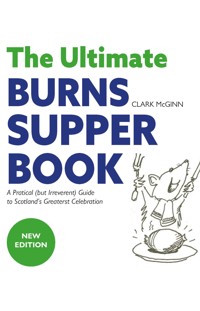
What makes the Ultimate Scot? Is it the ability to identify a tartan pattern from 50 yards? Maybe it's being able to recite the two forgotten verses of Auld Lang Syne? Or perhaps it's knowing your single malt from a double malt? The Ultimate Guide to Being Scottish examines in hilarious detail the history, politics and traditions that make Scots great. Exploring the best of scottish culture, this book focuses on the celebrations that Scots have made their own, from Hogmanay to the Edinburgh Fringe Festival. Mixing fact and practical hints (like the ideal recipe for boiled sheep's head) with witty banter, The Ultimate Guide to Being Scottish is perfect for injecting Scotland's unique and beloved brand of merriment into life.
Sie lesen das E-Book in den Legimi-Apps auf:
Seitenzahl: 430
Veröffentlichungsjahr: 2013
Das E-Book (TTS) können Sie hören im Abo „Legimi Premium” in Legimi-Apps auf:
Ähnliche















CLARK McGINN was born in Ayr and talked so much as an infant his granny claimed he’d been vaccinated with a gramophone needle. Educated at Ayr Academy and University of Glasgow, he clocked up enough exams (in between speeches and debates) to embark on a banking career that would take him to London and New York and establish him as a specialist advisor to the global mission-critical helicopter industry.
Burns has been a key joy since addressing his first Haggis in 1975 and he has toasted the ‘Immortal Memory’ every year since 1977, with nearly 200 speeches performed in 35 towns and cities across 16 countries, travelling the equivalent of twelve times around the globe.
He was awarded a PHD by the University of Glasgow for his research on the history of the Burns Supper and is an honorary research fellow in its award-winning Centre for Robert Burns Studies. He is a Past President of the Burns Club of London (No 1) and of the Dublin Burns Club. In 2009, he gave the Eulogy at Burns’s 250th Anniversary service in Westminster Abbey.
He is an honorary fellow of the University of Glasgow, a Fellow of the Chartered Banking Institute and an Arkansas Traveler (Honorary Ambassador of Arkansas).
He and his wife Ann live in Harrow-on-the-Hill, near their three daughters and two grandchildren, and in Fowey in Cornwall.
By the same author:
The Burns Supper: A Comprehensive History, Luath Press, 2019
The Burns Supper: A Concise History, 2019
Out of Pocket: How Collective Amnesia Lost the World its Wealth, Again, Luath Press, 2009
The Ultimate Burns Supper Book, Luath Press, 2006, 2010, 2024
First published 2008
Revised edition 2013
Reprinted 2013, 2015
Third edition 2024
ISBN: 978-1-909912-34-2
Typeset in 10.5pt Sabon by Lapiz
The author’s right to be identified as author of this book under the Copyright, Designs and Patents Act 1988 has been asserted.
Illustrations © A. Martin Pittock
Text © Clark McGinn 2008, 2013, 2024
To Ann, always!
and
to welcome
Lucy and Alfred
to ‘Bonnie Scotland.’
Contents
Thoughts on a Third Edition
Acknowledgements
Foreword
Introduction: What Does it Mean to Be Scottish?
1Hogmanay All the Way
2New Year and New Fire
3The Burns Supper
4The Scottish Diet (And Other Oxymorons)
5Celtic Calendars
6Check out the Tartan
7Hands across the Seas
8Blood on the Borders
9Summer Games
10Kings, Courtiers and Comedians
11The National Spirit
12Balls
13In Good Spirits: Hallowe’en
14Town and Gown
15It’s Good to Have Friends in High Places
16The Christmas Warm-up
Last Thoughts: Here’s Tae Us – Wha’s Like Us
Epigraph
Appendix
Of all the small nations of the world,
only the ancient Greeks surpass the Scots
in their contribution to mankind.
There is only one thing wrong with Scotsmen.
There are too few of them.
Sir Winston Churchill
Life is supposed to be fun.
It’s not a job or occupation.
You’re only here once and we should
have a bit of a laugh.
Sir Billy Connolly
I love Scotland.
One of the biggest problems I have in winning,
I won’t be able to get back there so often.
President Donald Trump
Touch a Scotsman’s head, and he will bargain
with you to the last: touch his heart
and he will fall on your breast.
Andrew Carnegie
Thoughts on a Third Edition
SIXTEEN YEARS on from first publication. That’s a lot of haggis, whisky and bonhomie under my (expanded) kilt belt, but still there’s no doubt in my mind that being Scottish is a great deal of fun, especially if we share our traditions and outlook with friends and visitors.
The biggest change since first writing the book is, of course, the Independence Referendum and the issues swirling around the constitution through the bodge of ‘Brexit.’ This book is not a political discourse in any way but revels in the fact that there are many ways to be, or to feel, Scottish and each deserves equal respect wherever you were born, wherever you now live and however you vote.
I hope this wee book will help remind folk of the good-hearted way to enjoy life, remembering the many things that join us, rather than the few that separate us.
Then let us pray that come it may,
(As come it will for a’ that,)
That Sense and Worth, o’er a’ the earth,
Shall bear the gree, an’ a’ that.
For a’ that, an’ a’ that,
It’s coming yet for a’ that,
That Man to Man, the world o’er,
Shall brothers be for a’ that.
– Robert Burns.
Clark McGinn
Harrow-on-the-Hill
St Andrew’s Day, 2024
Acknowledgements
I HADN’T EXPECTED to be writing another dedication, and so it’s tempting to say that the acknowledgements from my other books are incorporated herein by reference.
But if you’ll forgive me, I’d like to say thanks again, even if it’s repeating myself. (Not for the first time, I hear from the back of the room.)
Thank you Ann, my Abu Ben Adhem, first and foremost in my life, my speaking and my writing. How many times have you heard these stories and yet never steal the punch line. A true partner – to you this book is dedicated, as am I.
And thanks to the payroll – all three daughters who inspire, annoy, and reflect my pride in them. To you Claire, Eleanor and Emma, whatever profits arise from this volume I may as well dedicate to you as you’ll charm them out of my pocket anyway. It’s always fun to have you and your husbands at our Scottish parties! Not forgetting to celebrate the next generation with Lucy’s first Burns Supper in 2020 and Alfred’s first in 2022!
I had a fortunate early life, with Mum and Dad encouraging me not just to read, but to eat books and talk about them (sometimes too often and too much), particularly about our history, culture and tradition, and it was then that the peculiar (in both senses) culture of Scotland and the rich literature we give to the world captured my imagination. Growing up and exploring Scotland through Ayr Academy and via the Bursary Exams into Glasgow University, where the GU Union took me around our small country, book in one hand, glass in the other (and always speech notes in pockets), fostered a lively interest in all the different parts of our culture. Ferment this in the 40 years of friendships made in freshers’ week and that distilled the spirit behind this book. Certainly many of the ideas came out of late night conversations with Douglas and Marion at Carson Towers, or from debating the Union with Murray and Jimmy.
Thanks to my friends and colleagues who have taken me to see many mad and merry aspects of life in Scotland, and especially to my late friend Charles (who taught me, amongst other things, that Scotland looks best from the back of a taxi) for his insight in the foreword and Anne for capturing the book in its drawings. Thanks too to Gavin and the Luath team, perched atop the Royal Mile on their own castle rock of manuscripts.
To the many guests and colleagues who have asked me over the years – just what is going on here? What is the essence of Scotland and the Scots? Well, to all of you, my thanks, and I hope I answer some of the questions.
Clark McGinn
Foreword
‘OH, THAT MINE ENEMY would write a book!’ exclaimed Jo Grimmond of Harold Wilson’s 1964–70 government memoirs. Well, I’m no Grimmond and Clark would not thank me for likening him in any way to Wilson – but with this offering my friend has produced another book and taken a sweep of quite enormous cultural and historical dimensions.
McGinn on Surviving Scottishness? (Surely a potential working title for the follow-up? Publisher please take note – our author is a senior banker and therefore needs every penny these days). In some respects it’s a bit like letting King Herod loose in the maternity ward. Knowing the author and the subject-matter this is a guaranteed must read and an invaluable guide to keep on the shelf or by the bedside.
In asking me to pen a few words by way of introduction (strictly no sales, no fee basis) Clark encapsulates an essence of Scottishness which he neatly captures early on – that happy coexistence of contrasts and contradictions which keep us going, make us tick and which enable a global identity sales process which is at once remarkable and unique. Kennedy: Highlander, Roman Catholic, liberalish; McGinn: Lowlander, Presbyterian, conservative. Yet both Scots and seemingly comfortable in our skins. Each of us ply a trade in London and in years gone by have dipped our respective toes in time spent living in the United States. Neither of us, I think, get exercised about this sense of multiple or layered identity: Highland/Lowland, Scottish, British, European (well, to be fair, even the legendary McGinn sense of humour seems to evaporate when he contemplates my preference for a richly federal future within an ever closer European Union).
Am I allowed a personal plug? I tried to sum it up with the title of a documentary I made for BBC television on the 300th anniversary of the Act of Union. I called it ‘A Chip On Each Shoulder.’
Years ago, in those depressing pre-devolution, Thatcherite days at Westminster I shared a Q&A session with Labour’s George Robertson in front of an audience of visiting West Germans. They were puzzled indeed by our obvious sense of shared nationhood, yet coupled to the absence of an elected national legislature within and for Scotland. How so? George explained patiently the complications involved, remarking that the Scots were historically adept at running anywhere in the rest of the world – it was just that we were never so sure about running our own backyard. (He was later to prove the point by opting for the much cushier option of carrying responsibility for NATO’s nuclear warheads in preference to administering Scotland).
The late, great Donald Dewar made a similar point when Malcolm Rifkind was recalled from the Foreign Office to become our Secretary of State. He would soon realise, Donald observed, how much easier political life was when you only had the rest of the world to worry about.
MacKenzie King, the Scots-born and phenomenally long-serving Canadian Prime Minister, remarked once in a moment of political frustration that the trouble with Canada was that it had too much geography and not enough history. Our own dear little land somehow seems to have more than its fair share of both.
In this utterly engaging book Clark manages somehow to convey just that conundrum – and a lot more wealth of fascinating detail along the way.
My friend must write yet another book…
The Rt Hon. Charles KennedyMP
Remembering Charles fondly (1959 – a far too early 2015.)
INTRODUCTION:
What Does it Mean to Be Scottish?
Away, ye gay landscapes, ye gardens of roses,
In you let the minions of luxury rove,
Restore me the rocks where the snow-flake reposes,
Though still they are sacred to freedom and love.
Yet Caledonia, belov’d are thy mountains,
Round their white summits tho’ elements war,
Though cataracts foam ’stead of smooth-flowing fountains,
I sigh for the valley of dark Lochnagar.
Ah! there my young footsteps in infancy wander’d,
My cap was the bonnet, my cloak was the plaid.
On chieftains long perish’d my memory ponder’d
As daily I strode thro’ the pine-cover’d glade.
I sought not my home till the day’s dying glory
Gave place to the rays of the bright Polar star,
For fancy was cheer’d by traditional story,
Disclos’d by the natives of dark Lochnagar!
Years have roll’d on, Lochnagar, since I left you!
Years must elapse ere I tread you again.
Though nature of verdure and flow’rs has bereft you,
Yet still are you dearer than Albion’s plain.
England, thy beauties are tame and domestic
To one who has roamed over mountains afar
Oh! for the crags that are wild and majestic,
The steep frowning glories of dark Lochnagar.1
THERE IS SOMETHING UNIQUE about being Scottish.
I’ve travelled around the world to meet Scots expats, descendants, employees, golfers, drunks,2 usually in the guise of a Burns performer – celebrating that man, the greatest of the great gifts we have given the world – in the popular format of a Burns Supper. Sometimes in the corners of the US or Canada or parts of that former empire built on Scots capital, engineering and military bravery, the format of the evening is a St Andrew’s Dinner – although those who wake up from the alcohol in the middle of this format probably assume it is a Burns Supper out of season. However you get involved, you can see in every member of the audience pride in having however tiny a percentage of tartan in the blood.
At other times you catch the glint of recognition in eyes across the world, or of smiles at remembered shared history. Last year, I was walking to a Burns Supper in Stockholm when a Kiwi guy flagged me down to say hello: he’d just spent the season playing rugby in Scotland and wanted a chat. What is going on here? What is the essence of being Scottish and why does our culture and its celebration resonate across the world?
One of the oddest parts of coming from Scotland is the scale of our country. If you are in California (whose population is a six-fold multiple of Scotland’s) or in Australia (a land mass that would fit in 96 Scottish mainlands with a bit to spare) it seems amazing that the Scots are recognised and applauded – how can this wee, old country stand out so?
What is it that makes a ‘true Scot’? Is it just a question of adopting some peculiar habits?
•Stop wearing underwear.
•Grow significant amounts of hair on your knees.
•Drink more3 than average.
•Exchange your food processor for a deep fat fryer.
•Find some bawbees and look after them well.
•Enjoy playing golf in the rain.
•Stop tipping.4
Or is the qualification of being Scottish something inherent? And if so, what tests do we have to pass or what defining characteristics must be present to be defined as Homo Caledonius?
Is it a matter of BIRTH? And if so, is that defined as being born in Scotland, or of one or two Scottish parents, or will one Scottish granny carry you over the genetic scoreline? In some ways, RESIDENCY remains important – though we have a fierce and proud expatriate community; while AFFILIATION – by dint of marriage, education, taste in whisky or employment adds emphasis it doesn’t intuitively grant full-blooded status.
In many ways, for me being Scottish is part genealogical but a great deal attitudinal. This book looks at those Scottish attitudes through the prism of our history, culture and traditions, and above all our festivals and celebrations, to see how we, the Scots (in the broadest sense), act and interact with the wider world.
The most popular intersection of Scots, Scottophiles and non-Scot friends is, of course, the Burns Supper. On these convivial evenings everyone shares in our tradition, culture, cuisine and drink. But there are many other ways to throw a traditional party, and in this voyage together I hope we’ll share a toast at some well-remembered but not-so-visited feasts, for it’s the joie de vivre that can be seen in the people of Scotland and her festivals that is the true, nay the ULTIMATE guide to being Scottish!
Scotland the What?
Land of brown heath and shaggy wood,
Land of the mountain and the flood,
Land of my sires! What mortal hand
Can e’er untie the filial band
That knits me to thy rugged strand.5
The successful marketing of Scotland, built on the foundation of Burns’s works by the energies of Sir Walter Scott6 and patronised7 by Queen Victoria, encourages outsiders and visitors to see a unitary Scotland of kilted Highland warriors. But this is far too simplistic.
Scotland small? Our multiform, our infinite Scotland small?8
Sometimes our pride makes us define ourselves by what we are not: the English.
In the longest running9 football match in history, these two kingdoms on one island have enjoyed10 an on–off relationship that seems more soap opera than history. The Romans sensed this shortly after the birth of Christ. Having consumed the oysters of Colchester, subdued Boadicea11 and built roads to York, the mighty legionaries of the imperial superpower came to the Scottish border. You can imagine these grim soldiers from the warmth of Italy peering into the typical drizzle of an August afternoon: debating whether the bare-bummed savages were scarier than the flying, biting midges.
At this point in history, we had neither whisky nor golf to offer tourists and so the Romans called it a day and built Hadrian’s Wall – whether to mark the boundaries of Rome, or to create the world’s first safari park, I’ll leave you to judge. Traditionalists would assert that, with proto-Braveheart12 ferocity, the eagles of Rome feared the foe in front and thus drew the line of boundary. I can’t help but thinking that, after the sun-kissed shores of the Mediterranean and the gentle scent of tree-ripened citrus, the prospect of sitting in garrison under Scotland’s grey mist and rain was just too unappealing for the legions. And so, as the ancient history says, the emperor solved the problem:
Ergo conversis regio more militibus Britanniam petiit, in qua multa correxit murumque per octoginta milia passuum primus duxit, qui barbaros Romanosque divideret.13
That architectural barrier defined, and still defines, our identity.
When I graduated in the dark, depressed days of 1983 there were few jobs in Scotland but I obtained a post in one of the English banks in London. A banker was bad enough, but in England – michty-me – my Mum was so mortified she told everyone that I’d been committed to jail. I daren’t write what she said about 2007’s financial crisis! Following the Global Financial Crash she promoted me to be the lead piano player in a strip club.
The rivalry has spawned many music hall jokes (and not a few political policies, now that you mention it):
The Scots view of
The English view of
The Scots
Prudent and thrifty
Tight-fisted
Generous hosts
Drunks
Patriotic
Bleating
Brave sportsmen
Losers
Rich literary heritage
Incomprehensible14
The English
Cold and aloof
Independent
Class conscious15
Upwardly mobile
Rich football clubs
World-class sportsmen
Morris dancing
Unique heritage
Cold fish
Stiff upper lips
Truly, as Burns says:
O wad some Pow’r, the giftie gie us,
Tae see ourselves, as ithers see us…16
But I won’t get involved – except to say that my professor expressed great pleasure when I moved from Glasgow to London – he felt it would raise the average IQS of both cities.
For centuries, the tussle of power ebbed and flowed across a band of land on either side of the present border. You might recall that Shakespeare17 describes the meeting of the French Ambassador and King Henry v, where Westmoreland, one of the chief English nobles whose lands bordered Scotland, recalls the politics of war to his master:
But there’s a saying very old and true;
‘If that you will France win,
Then with Scotland first begin’:
For once the eagle England being in prey,
To her unguarded nest the weasel Scot
Comes sneaking and so sucks her princely eggs,
Playing the mouse in absence of the cat,
To tear and havoc more than she can eat.18
The Ambassador insults Henry with a gift of tennis balls – suggesting that he was more fit for a game than a battle. How wrong they were! But this struck a chord, for the wars between Scotland and England were not unlike the formality of a tennis match – the Scots playing off a base line from Edinburgh to the Solway, and the English from Newcastle to Carlisle. With each battle equivalent to a game, the sets of history fell thus:
So under the masterful management of King Robert I (he learned tactics, you’ll remember, by watching the spider in his cave try and fail, try and fail and try once more to succeed20) the Scots lads go into the second set ahead, but maybe a bit of overconfidence creeps in.
The next set started off with a win for each side (Ancrum Moor23 and Pinkie Cleuch24) but of course, following the death of the childless English Queen Elizabeth I in 1603, the Scots (represented by her closest male relative, King James) won the third set and the match without having to go into battle.
Land of the Mountain and the Flood
There are hills beyond Pentland and lands beyond Forth,
Be there lairds in the south, there are chiefs in the north!
There are brave duniwassals, three thousand times three,
Will cry ‘Hoy!’ for the bonnets o’ bonnie Dundee.25
The mistake that is made is to see the whole northern nation within our islands as a single defined culture. Oh no. It is much more complex.
The most obvious divide is that between the Highlander and the Lowlander.26
The Highland line, which isn’t just a straight line east to west, at times seems more a division in age rather than geography.27 You could look at it as the north containing traditional, pre-industrial (almost mythic) values compared to the commercial, industrial and agricultural certainties of the ‘modern’ Lowlands.
Still, some of my favourite stories are those told about that culture clash: the Highland laird who boasted of his estates that he could drive his car for the whole afternoon without getting to the boundary, and the Glasgow man who replied ‘I had an old car like that too’.
Or what about the Edinburgh banker who went to the remote Highland shop to buy the Financial Times? The nice lady gave him yesterday’s edition. ‘But I wanted today’s paper’, he spluttered. ‘A weel ye’ll have to come back tomorrow’, she admonished him.
It is interesting that while the industrial revolution and the collapse of the clan system changed the economics of the Highlands and saw many leave (voluntarily or, I am ashamed to say, often involuntarily28), much of the image of Scotland internally and abroad is a function of the history of the Highlands.
East, West, Hame’s Best
Glasgow plays the part of Chicago to Edinburgh’s Boston.29
The formerly tense relationship across the Highland line has few real repercussions nowadays. It’s within the Lowlands that the greatest rivalry is spawned: Glasgow vs Edinburgh. The slug-fest between the Capital City and the Great Industrial Powerhouse30 carries on through TV and radio, rival newspapers (Scotsman vs Herald31), football teams32, even the weather: warm and wet33 in the west or chilly blue skies34 in the east. The people, the architecture35 and the culture are noticeably different but perhaps the rivalry has somewhat of the fake about it.
One of the greatest periods in Scottish cultural history was the Enlightenment at the end of the 18th century:
Really it is admirable how many Men of Genius this country produces at present. Is it not strange, that at a time when we have lost our Princes, our Parliaments, our independent Government, even the presence of our chief Nobility… Is it not strange, I say, that in these Circumstances, we should really be the People most distinguished for Literature in Europe?36
In the 25-odd years from 1776, mainly in Edinburgh,37 the power and energy which would have gone into government, parliament or court intrigue were channelled instead into pure thought – but pure thought with a very Scottish twist – it was done with a practical use and outcome in mind.
Not just philosophies and inventions but whole new sciences sprung out of the salons. Adam Smith founded economics, David Hume remains the greatest moral philosopher in the English language, Hugh Blair was the first professor to teach English literature, Adam Ferguson created social science, Hutton set geology on a scientific footing, Black revolutionised chemistry, Hunter took surgery from the barbers and John Millar brought the first elements of what we’d recognise as MBA training into his commercial law lectures. Outwith the universities, the Adam brothers changed architecture, Walter Scott created the historical novel, Burns was an early romantic and Byron a late and naughty one, and Cochrane was admiral of five navies.38 The list is if not endless, at least boastful.39
No wonder so many foreigners visited and expressed praise and wonder. Ben Franklin opined that:
Did not strong connections draw me elsewhere, I believe Scotland would be the country I would choose to end my days in.
While Voltaire famously complimented us by saying:
It is to Scotland that we look for new ideas nowadays.
It’s fair to say that the rivalry hasn’t diminished over the years: when Glasgow won the title European City of Culture and Mr Happy (adopted as the city’s mascot) trudged around Edinburgh trying to find a nice comment.40 Edinburgh has had a boost in the re-founded, devolved parliament and has the trappings of a political capital city for the first time in many long years. Glasgow’s industries are turning more entrepreneurial; Edinburgh makes good money for all of us in the financial services sector (although its two banks fared badly in the global financial crisis). Both Edinburgh and Glasgow have staged the Commonwealth Games in 1986 with Glasgow to again in 2014 and planning for 2026; Edinburgh was named UNESCO City of Literature in 2024, then Glasgow was made a unesco City of Music four years later and hit the world’s headline in 2021 by hosting cop26. Ping Pong. One remains cold, the other damp. The only links are incomprehension and rivalry!41
A Tale of Two Cities: the Old and the New
Stately Edinburgh, throned on crags42
Of course, those of you who know Edinburgh will recall that she is in so many ways two towns conjoined as twins.
In the south beyond the railway line from Glasgow we have the Old Town, a gem (albeit somewhat unpolished) all hugger-mugger and helter-skelter, with hidden stairs and steep cobbled slopes linking the brooding castle with the part-time palace. Now fortunately cleaner than ever in history,43 you can still feel the ancient heart of our capital.
On the right side of the tracks44 is the greatest piece of urban planning in Europe – the New Town – a triumph of elegant Georgian houses in geometrical street patterns, set around with pretty gardens, squares and churches,45 the epitome of the rationalism of the Enlightenment.
This juxtaposition of two towns was cultural as well as architectural. The old, douce, smelly folk on the hill looking down at the effete modern manners of the parallel streets below. The modern-thinking, outwardlooking people embracing the 19th century opposed to the backwardness found in towering shared blocks of flats, stuck like limpets on the castle rock.
There was one man who exemplified this – he’s commemorated by a pub on the Royal Mile46 – called Deacon Brodie.
What a character.
He was the third most important magistrate in the city and lived up in the eyrie of the Old Town. As a cabinetmaker and locksmith he made a pile of money in fitting out the New Town. He also, alas, made a copy of the key whenever he sold a lock. At night, off with the magistrate’s three-cornered hat and into a black mask – for the Deacon was a burglar bold!
He got caught – over-reaching ambition as usual – and an irony which he found quite funny47 was that he was executed on a modern drop gallows that he’d invented and sold to the council.
Whoops.
The real gratitude I have to the old Deacon was that his life of two halves, hat by day and mask by night, stimulated Robert Louis Stevenson’s imagination, where it came out in a slightly different story:
Doctor Jekyll and Mr Hyde.48
That’s the Point
I learned to recognise the thorough and primitive duality of man; I saw that, of the two natures that contended in the field of my consciousness, even if I could rightly be said to be either, it was only because I was radically both.49
I think it’s that duality, which Stevenson expressed so well, that is the interesting thing about Scotland and the Scots. You can see it in hundreds of ways:
•Scots and English in one United Kingdom.
•Nationalists and Unionists.
•Highlanders and Lowlanders.
•East coast and West coast.
•Old Town and New Town.
•At Home and Abroad.
The essential element in our Scottish psyche is this: our mindset, which is passionately partisan yet can hold both the pro and the contra in its hands and juggle with them.
Yes, a small physical plot was granted to us to build our nation. Yes, there are relatively few of us in the balance of the population of the world. Yes, we are relatively poor in physical resources, assets and wealth (certainly at today’s oil price). Yet overarching this is that recognition that we are one and that duality is not a bar to unity.
Scotland is only as small as each of us wants her to be.
On with the new coat and into the new life! Down with the Deacon and up with the robber!…
There’s something in hypocrisy after all. If we were as good as we seem, what would the world be? The city has its vizard on, and we – at night we are our naked selves. Trysts are keeping, bottles cracking, knives are stripping; and here is Deacon Brodie flaming forth the man of men he is! – How still it is!… the night for me; the grimy cynical night that makes all cats grey, and all honesties of one complexion. Shall a man not have HALF a life of his own? – not eight hours out of 24? Only the stars to see me! … I’m a man once more till morning. (GETS OUT OF THE WINDOW.)50
___________________
1‘Lochnagar’, George Gordon, Lord Byron.
2Sorry, that should be ‘malt whisky aficionados’.
3Much more, actually.
4First out the minicab, yet last to the bar …
5‘The Lay of the Last Minstrel’, Sir Walter Scott.
6Whose books stimulated the tourist trade, still an important part of the economy of Scott-Land.
7In one, maybe two definitions of the word.
8‘Scotland Small?’, Hugh MacDiarmid; a great Scottish poet of the 20th century, though his combination of communism/fascism/ nationalism/pessimism alongside an ill-tempered attack on Burns Suppers has always left me wary.
9And worst tempered.
10If that’s the word!
11Or Boudicca, or more truly the ultimate cross mother. Could have been Scottish really…
12At the risk of annoying the fans, it is an appalling historical train wreck, even without the white van seen at Wallace’s wife’s wedding.
13‘And so, having reformed the army quite in the manner of a monarch, he set out for Britain, and there he corrected many abuses and was the first to construct a wall, 80 miles in length, which was to separate the barbarians from the Romans’, Historia Augusta, Hadrianus, pars i, xi, 2 (Loeb Classical Library, Vol. i p.35).
14Even when sober.
15‘Snobby’, actually.
16‘To a Louse’ – one of the significant phrases of genius in Burns, directly linked to the moral philosophy of Adam Smith, who was a favourite author of R.B.
17William Shakespeare (1564–1616), playwright, occupies a position in English letters not dissimilar to Burns’s (without an annual dinner though). Interestingly, while Shakespeare’s company of actors played for Good Queen Bess three times a year on average, after the accession of Scotland’s own Jamie the Saxt the annual demand from the court rose to 13 performances.
18The Life of King Henry the Fifth, W. Shakespeare, Act i, Scene ii, Line 171.
19Please sing along: ‘O Flower of Scotland’, ‘Scots Wa Hae’, etc., etc.
20Still the favoured way of playing sports in the blue jersey.
21Is he?
22Now you have to sing ‘The Flowers o’ the Forest’ and other laments… 9 September 1513 wasn’t a good day: amongst the dead on Scotland’s side were: the king, the archbishop, nine earls, 14 lords, three Highland chiefs, and 10,000 men.
231545.
241547 – although this might have been a disease, not a battle…
25‘Bonnie Dundee’ – good song, great tune, complex history. This is the version arranged by Scott. A duniwassal is a tenant of the chief who owes feudal fighting service.
26With sincere apologies to my Aberdonian friends, who inhabit an independent corner outwith this dichotomy. They will, however, have the opportunity to see themselves as others see them in a later tome (‘Scotland on Five Pounds a Day – with £4.95 Change’). I sincerely hope they will not be offended when they see these comments when they borrow this book!
27Many forget that Aberdeen and its adjacent counties don’t count as Highland.
28In the Highland Clearances, when the lairds believed that the best economic return on the hills could be obtained by demolishing the subsistence farms and villages and populating the land with sheep. Ironically, the emigration of Scots to Australia to work in the wool industry there contributed to the collapse of the Highland flocks, many of the hills becoming shooting estates.
29In Search of Scotland, H.V. Morton, London, 1929.
30Although the last few years have seen Glasgow diminish economically while Edinburgh has regained much of the political apparatus of government once more.
31Formerly the Glasgow Herald but now reaching out beyond the city, but not quite as far as Edinburgh....
32Though the real rivalry is inside each city: Rangers vs Celtic and Hearts vs Hibs.
33And the smell of the Glasgow Subway – or, as it’s affectionately known by its denizens, the Clockwork Orange.
34And the damp, cold potato smell of the hops brewing in the beer which wafts across the Capital. As redevelopment takes these industrial eyesores out of town, let’s hope there’s a way to keep the distinctive aroma!
35Edinburgh is a world-class beauty, but Glasgow has many fine buildings – it used to be said ‘if you want to see Glasgow – look up’ and it was the castiron buildings in a grid pattern that inspired the Chicago School of architects and changed the world with the skyscraper.
36‘Letter’, David Hume to Gilbert Elliot of Minto, July 1757.
37But with sound input from Glasgow and Aberdeen!
38UK, Chile, Venezuela, Brazil and Greece. Chile sends an annual honour guard to lay a wreath at his monument in Westminster Abbey.
39The intellectual base was so strong that the great James Watt, it must be remembered, was not even a professor, but the lab technician at Glasgow University!
40Unsuccessfully.
41I am plainly biased (though I love Edinburgh, where my two elder daughters studied at that very nice but post-Reformation institution, the University of Edinburgh). So the appendix has some objective evidence from a unique Scottish viewpoint: William Topaz McGonagall, widely believed (with quite a lot of objective evidence too) to be the worst poet in the world.
42‘The Excursion’, William Wordsworth. Ironically, although the poet liked Edinburgh, the affection was not reciprocated. The influential Edinburgh Review panned this poem with the immortal put-down, ‘This will never do.’
43The Old Town had virtually no drainage for centuries and so the inhabitants used to empty their bedpans out of their windows at night into the street. You had to watch your feet in the gutters, but especially your head – the neighbours would shout ‘GARDY LOO’! (from the French ‘gardez-l’eau’ – ‘beware of the water’) and then out it went from the upper-storey windows! Edinburgh’s ancient nickname was ‘Auld Reekie’ – linked to the reek or smoke from its myriad chimneys. It became progressively reekier by dint of the rather quaint hygienic approach referred to here.
44Actually it’s on the left as you come in from Glasgow Queen Street.
45Then bank branches and now all-day pubs. Can’t win them all.
46And there’s no greater honour than that.
47He literally died laughing about it!
48Although set in London, if you know Edinburgh, you can see that’s the city being described by Stevenson.
49The Strange Case of Dr Jekyll and Mr Hyde, R.L. Stevenson, 1886.
50Deacon Brodie or The Double Life: A Melodrama in Five Acts and Eight Tableaux, W.E. Henley and R.L. Stevenson, Act I, Scene IX.
1
Hogmanay All The Way
So may the Auld year gang out moanin’
To see the New come laden, groanin’,
Wi’ double plenty o’er the loanin’,
To thee and thine:
Domestic peace and comforts crownin’
The hale design.1
IF FESTIVALS ARE WHAT define a culture, then marking the end of the old year and bringing in the new is a fundamental thread in Scots DNA. For even if you never wear tartan, can’t abide whisky and hate the TV shows of geriatric Scots performing on accordions or guitars, I bet every Scot2 undertakes some festive ritual to welcome in the New Year in style.
Now, when Christmas is the biggest religious, quasi-religious and commercial event globally,3 it is almost unimaginable that until 1958, Christmas Day was an ordinary working day in Scotland. The post was delivered, the courts sat in judgment, the bakers baked, the offices hummed (slowly); the English and other ‘heathen nations’ might well dance in their blindness, but in pure Scotland there was no backsliding4 and no festal joy would taint our Holy Days.
However, the powers-that-be couldn’t bottle in the natural enthusiasm of the whole Scottish nation, so the celebration of starting a New Year became the focal point of an entire country, and even today, when most Scots homes will have a Christmas tree, a turkey and stockings hanging at the mantelpiece, our national festival remains overnight on 31 December into 1 January – Seeing in the New Year. This remains a cornerstone of what it is to be Scottish.
First things first. We call New Year’s Eve ‘Hogmanay’5 – but here’s a confession: I have absolutely no idea where this funny word came from – nor what it actually means!6 Just about everyone else in the country has an idea (or two) about the etymology: the Oxford English Dictionary says:
Hogmanay: corresp. in meaning and use to OFr. Aguillanneuf last day of the year, new year’s gift (given and asked for with the cry ‘aguillanneuf’) of which the Norman form hoguinané may be the immed. source of the Eng word.7
Other equally inadequate theories depend on mispronunciations of other languages: could it be the Gaelic for ‘a new morning’ (‘oge maidne’)? But there are 365 or more new mornings a year, so I don’t think that’s a persuasive idea.8 Or the Anglo Saxon could have given us ‘haleg monath’ or ‘Holy Month’, but that’s the opposite problem – now it’s too wide a time period. The theory that the French party around the mistletoe (‘au gui’) must have been invented by lovers of Asterix.
Some rely on guesswork: on the Edinburgh Hogmanay website they quote a writer from 1824:
I think Hog-ma-nay means hug-me-now9
Which stands the test of time in my opinion. In my last book, I thought that it might be the future tense of the verb ‘to be hungover’10 but that’s just making up a cheap laugh (and using it twice!).11
What about the lads and lassies who make up the body o’ the kirk? What do they say? They say Hogmanay means a great, great party.
And one unique to Scotland.12
Preparation is Everything13
Now that’s over, we have some hard work to do. A very significant part of the celebration at New Year is the preparation.
The obvious part is in cleaning the house. For those of you who believe (like Quentin Crisp) that dust ceases to accumulate after the first inch, this is going to be bad news. Every corner of your home, whether it’s a but-and-ben14, a tenement15 or a castle,16 has to be scrubbed, dusted and polished.
Imagine the scene: an Edinburgh dowager was inspecting the house before the Bells and called the housemaid down to the parlour to berate her for not dusting well enough in the run-up to midnight:
‘Look Bessie – I can actually write my name in the dust on the sideboard – what have you to say about that?’
‘There’s nothing like a good education, ma’am.’
Particular care has to be paid to the fireplaces. Remembering our ancient worship of fire, some bright spark has taught us that the hearth on this night becomes again our link with the mysteries of nature. All ashes have to be emptied out the back door, while the grate and irons are polished to glisten in the flames. When you light the fire that’s going to warm you through the last hours of the dying year into the new hope of next year, it mustn’t be allowed to die down (or heaven forefend, go out) until the New Year is safe in. When it does expire naturally, the ashes can be read by the wise to foretell the joys and travails of the upcoming 12 months: if the ashes form a pattern like a foot with the heel closest to the room, then someone is going to walk away from the house (typically a death); while if the foot can be discerned with the toes pointing into the room, a new arrival will be at the fireplace at the next Hogmanay.17
After preparing the food and drinks for your family and guests, the kitchen gets the same treatment18 and all the bins and wastepaper baskets in the house need to be emptied.
While this was going on, in the old times, the children were thrown out of the house to get out from under mum’s feet so she could make a good cleaning from top-to-bottom.19 These happy bands would marauder the streets calling out for sweeties to celebrate the Hogmanay. This has its roots in French traditions from the time of Mary Queen of Scots,20 along with the sheer practicality of shifting idle hands out the house. (The men would still be at work – or, much more likely, be down the pub!)
There were a number of traditional street rhymes, all now defunct I think, that the children would chant:
Rise up gude wife an shak’ yer feathers,
An dinna think that we are beggars,
We are bairns come oot to play,
Rise up! An gie’s oor Hogmanay!
The day will come when ye’ll be deid;
Ye’ll neither care for meat nor breed;
Rise up! Guid wife an’ dinna spare
Ye’ll hae less an we’ll hae mair!
Up stocks! Doon stools!21
Dinna think that we are fules,
We are bairns come oot to play
Rise up! An gie’s oor Hogmanay!22
Now it’s time to prepare yourself!
On the 31st, in years gone by, the working men and merchants would go round their business colleagues and would pay up any monetary debts or repay any favours, to stand free and clear at the New Year’s dawning.23 Now it’s just a question of getting home sharp, and as the sun goes down, we all have to wash and wear new clothes to greet the New Year as a party guest.
I forgot to mention one crucial taboo: you must NEVER talk about the New Year ahead of time. When wishing people ‘A Good New Year’ in advance of midnight, you should always hedge your bets by adding ‘when it comes’ or some other phrase as it is most high presumption to assume that the gifts of the New Year will be given to us. In the strictest regimes (including the hard-line element of the McGinn household24), you wouldn’t write in the upcoming year’s diary if you had one, which for the more forgetful amongst us usually causes some social mishap in the first few days of the New Year. (It might just be practicality; if you don’t make it to midnight your executors might manage to take the diary back to the shop and exchange it!)
The Bells25
Now it’s close to 11.30pm and we are in our nicest clothes, before our flaming logs and with a glass in our hands, it’s time to reflect on the last year. But before we move into the height of the celebrations: just before midnight the father of the house has a very important ritual duty. The back door (or a back window if there’s but one door) must be unlocked and opened so that any bad luck lying in the house will fly away.
I’ll drink to that!
!!!!!!!!!!!!!!!!!!!!!!!!!!!!HAPPY NEW YEAR!!!!!!!!!!!!!!!!!!!!!!!!!!! I’m not a big counting down sort of a chap, but in a big crowd or party, there will inevitably be those excited enough to chant out the Old Year.26 Then pandemonium breaks out.
This moment is traditionally called ‘The Bells’ because all the bells of Scotland ring from church towers, town halls and chiming clocks with the twin purposes of ‘seeing in’ the New Year and creating a clamour to scare away the lingering vestiges of bad luck that we didn’t throw out hard enough from our back doors.
There is nothing as poignant as hearing the bell in a wee kirk ringing out the good news as you walk along on a cold, icy night, with the coal-black sky scattered with starry diamonds above your head.27 In Glasgow, in its role of the shipyard of the Empire,28 all of the ships berthed along the Clyde and the harbours of Greenock and Gourock would sound their horns and whistles for minutes and minutes of naval cacophony.29
Interestingly, in the Reformation, while the church organ and musical instruments were abandoned, the use of bells to mark the times of worship remained, so our New Year bell ringing is an old, old tradition. One of my favourite bell inscriptions is on the Great Bell of Glasgow Cathedral, which now stands on the floor, rather in the bell tower. This is written on its awesome 12-foot one-inch circumference:
In the year of grace
1594,
Marcus Knox,
a merchant of Glasgow,
zealous for the interests of the reformed religion,
caused me to be fabricated in Holland
for the use of his fellow citizens in Glasgow,
and placed me with solemnity
in the tower of their cathedral.
My function
was to announce, by the impress on my bosom,
(Me audito venias doctrinam sanctam ut discas;)30
and
I was taught to proclaim the hours of unheeded time.
195 years had I sounded these awful warnings,
when I was broken
by the hands of inconsiderate and
unskilful men.
In the year 1790,
I was cast into the furnace,
refounded at London,
and returned to my sacred vocation.
Reader,
thou also shall know a resurrection,
may it be to eternal life.
Thomas Mears fecit, London, 1790.31
Auld Lang Syne: Should Auld Song Lyrics Be Forgot?
After the bells, whistles, possibly fireworks and certainly cheering, everyone in the world sings Robert Burns’s famous song, ‘Auld Lang Syne’.32
There’s a running argument over which is the most sung song in the world: ‘Auld LS’ or ‘Happy Birthday to You’ and a few hold out for ‘For He’s A Jolly Good Fellow’. But I think that you have to say there is a bit more poetic ability in the former.33 Certainly ALS takes a bit more effort and has had a number of quite disparate uses. In Japan it is often used as the signal that a department store is closing; it was even the national anthem of Mauritius for a while. Now it is famed as the signature tune of the Hogmanay celebrations not just in Scotland but all over the world, mainly, to be fair, through Guy Lombardo, the famous Canadian big band leader, who used it in his New Year’s Eve broadcasts from 1929.34 And it is well-known that every Scot knows all the words.35
It does have its own set of problems. Not least of all – what is it going on about?
What exactly does ‘for auld lang syne’ mean? The connotations run deeper than the literal translation of ‘for old long ago’. It’s a very Scottish thought, which appealed to Burns as soon as he heard it – and there are many, many examples of the emotional response to the way that Scots carry the fond remembrance of old friends, old landscapes and glories gone by.
My old school, Ayr Academy (where Burns himself attended a few lessons under the aegis of his friend, John Murdoch), knows a bit about the ages gone past, having been founded in 1233;36 the school motto is ‘Respice Prospice’37 – which could do as a Latin translation of our song at a pinch.
For those of you – the silent majority – who are still neither sure, nor impressed, I hope this new verse translation will be helpful:
SHOULD auld acquaintance be forgot,
Should our old friendship be forgot,
And never brought to mind?
And memories never grow?
Should auld acquaintance be forgot,
Should our old friendship be forgot,
And auld lang syne!
From long, long ago?
Chorus—
Chorus—
For auld lang syne, my dear,
For long, long ago, my dear,
For auld lang syne.
For long, long ago.
We’ll tak a cup o’ kindness yet,
We’ll share a toast in friendship now,
For auld lang syne.
For long, long ago.
And surely ye’ll be your pint stowp!
So gather up your full flagon!
And surely I’ll be mine!
And my own beer will flow!
And we’ll tak a cup o’kindness yet,
We’ll share a toast in friendship now,
For auld lang syne.
For long, long ago.
Chorus
Chorus
We twa hae run about the braes,
We two have run around the hills,
And pou’d the gowans fine;
And picked the daisies, so
But we’ve wander’d mony a weary fit,
We’ve trudged a good few weary miles,
Sin’ auld lang syne.
Since long, long ago.
Chorus
Chorus
We twa hae paidl’d in the burn,
We’ve both been playing in the stream,
Frae morning sun till dine;
From dawn to sun’s last glow;
But seas between us braid hae roar’d
But seven seas had sundered us
Sin’ auld lang syne.
Since long, long ago.
Chorus
Chorus
And there’s a hand, my trusty fiere!
And there’s my hand, my own true friend!
And gie’s a hand o’ thine!
And on me your hand bestow!
And we’ll tak a right gude-willie waught,
We’ll find goodwill in a shared glass,
For auld lang syne.
For long, long ago.
For auld lang syne, my dear,
For long, long ago, my dear,
For auld lang syne.
For long, long ago.
We’ll tak a cup o’ kindness yet,




