


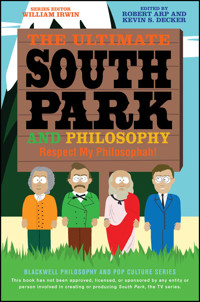
The Ultimate South Park and Philosophy E-Book
13,99 €
Mehr erfahren.
- Herausgeber: John Wiley & Sons
- Kategorie: Geisteswissenschaft
- Serie: The Blackwell Philosophy and Pop Culture Series
- Sprache: Englisch
Enlightenment from the South Park gang faster than you can say, "Screw you guys, I'm going home"! The Ultimate South Park and Philosophy: Respect My Philosophah! presents a compilation of serious philosophical reflections on the twisted insights voiced by characters in TV's most irreverent animated series. * Offers readers a philosophically smart and candid approach to one of television's most subversive and controversial shows as it enters its 17th season * Draws sharp parallels between the irreverent nature of South Park and the inquiring and skeptical approach of Western philosophy * Journeys deep beyond the surface of the show's scatological humor to address the perennial questions raised in South Park and the contemporary social and political issues that inspire each episode * Utilizes familiar characters and episodes to illustrate such philosophical topics as moral relativism, freedom of expression, gay marriage, blasphemy, democracy, feminism, animal ethics, existential questions, and much more * It's a Bigger, Longer & Uncut version of the highly acclaimed South Park and Philosophy: You Know, I Learned Something Today--and is guaranteed to be much funnier than killing Kenny
Sie lesen das E-Book in den Legimi-Apps auf:
Seitenzahl: 484
Veröffentlichungsjahr: 2013
Ähnliche




















Contents
Introduction: “Well, I’m Afraid It’s About to Happen Again”
Note
Part I: Doing Philosophical Things with South Park
1 Flatulence and Philosophy
Oh my God! They Killed Socrates! You Bastards!
Cartman Gets a Banal Probe
Friendship Kicks Ass! The Dialogues of Kyle and Stan
An Apology for South Park: Getting in Touch with Your Inner Cartman
The Talking Cure for Our Culture
Notes
2 You Know, I Learned Something Today
Belief and Evidence
Faith, Self-Interest, and Evidence
What’s the Harm, Dude?
Inquiry, Hard Work, and Progress
Notes
3 “Imaginationland,” Terrorism, and the Difference Between Real and Imaginary
Critical Thinking and Theory
Unimaginative Leadership?
Just Because They’re Imaginary Doesn’t Mean They’re Not Real
Only You Can Help Us Win This Battle
Notes
4 Dude, Listen to Reason!
If You Do Drugs, Then You’re a Hippie
Deductions and Inductions
The Good, the Bad, and … Well, That’s It Really
“If Chewbacca Lives on Endor, You Must Acquit”
Slippery Slopes
The Defense Rests
Note
Part II: South Park and … Religion
5 Science, Religion, South Park, and God
Hail Science! Hail Science!
Being Too Soft?
Ha, Ha, Ha. You Believe in a Supernatural Being
Maybe Just Believing in God Makes God Exist
Oh My Science!
Getting Rid of All of the Isms
Notes
6 “Your Magic Is No Match for Our Powers Combined!”
Let’s Meet the Super Best Friends
Pick Any Religion, and Picture It in Your Mind
Go God Go
“David Blaine Will Now Eat His Own Head”
You Gotta Have Faith
Waiting for God (Oh!)
Notes
7 Cartmanland and the Problem of Evil
“And That’s It?” The Story of Job
The Sweet Milk of Our Tears
“You Are Up There!”
Free Hat, Free Willzyx, Free Will
“Are You There God? It’s Me, Jesus”
“Go God Go”
Notes
Part III: South Park Versus … Religion
8 “Respect My Religiositah!”
Don’t Make Fun of My Faith!
Suck My Balls: Is Nothing Sacred?
Can’t We All Just Get Along?
Comedy Central Caves In
200–201: The Cartoon Wars Escalate and Guess Who Caves Again?
Is South Park Responsible for the Decline of Western Civilization?
Notes
9 Mary’s Menses and Morality
What in God’s Name Is Blasphemy?
Do You Care at All About People’s Feelings? A Utilitarian Perspective
South Park Has the Potential to Make People Think
You Have to Hit Them With a Sledgehammer
Just Pissing People Off
Notes
10 South Park, The Book of Mormon, and How Religious Fundamentalists Always Find a Way to Be Naive and Arrogant at the Same Time
A Mormon Just Believes
You’re Making Things Up Again
Boys Should Be With Girls, That’s Heavenly Father’s Plan
God Has a Plan for All of Us (That Plan Involves Me Getting My Own Planet)
I Am a Latter-Day Saint!
Notes
Part IV: Respecting My Authoritah! in South Park
11 Juvenile Hijinks With Serious Subtext
Karl Popper, the Open Society, and Its Enemies
South Park and the “Enemies”
Not Tolerating a Tolerance for Intolerance
Thomas Jefferson and the Foundations of Modern Democracy
Notes
12 Of Marx and Mantequilla
Work, Proletariat Work
Of Jobs and Meheecans
Window… Wiiiiiiindow: The (Mis)uses of Meheecan Labor Power
Marx, Race, and Nation
All You Have to Lose Is Your Encadenamientos
Notes
13 “Vote or Die, Bitch”
Enfranchised? So What!
Going to (Electoral) College
Liberty or Death?
Vote for Me, and Only for Me
You Wanna (Third) Party?
Stability in a Political Storm
Notes
14 Socioeconomic Darwinism from a South Park Perspective
Class Warfare Over the One-Percent Fat Fucking Pigs
Zombie See, Zombie Do Among the Economic Undead
Corporate CEOs as Underpants Gnomes
Moral in a Nutshell
Notes
Part V: Liber-arianism in South Park
15 Cartman Shrugged
High Philosophy and Low Comedy
Speaking the Unspeakable
A Plague on Both Your Houses
Defending the Undefendable
The Town of South Park versus Harbucks
The Great Gnome Mystery Solved
The Wal-Mart Monster
Notes
16 Sitting Downtown at Kentucky Fried Chicken
Libertarianism and Legislating Lifestyles
In Harm’s Way?
Drugs Are Bad, M’Kay
Mary Jane, M.D.
I’ll Make Sure You’re Hooked Up for Life
Fuck You, You Intersubjective Fuck!
“I Just Want You to Look at Me When We Make Love, and Not Just at My Balls.”
Douchebag Prisoners’ Dilemma
“Sharon, You Got a Scrotum Coat? Lucky!”
Notes
17 Cat Urine, Medicinal Fried Chicken, and Smoking
Self-Ownership and Paternalism
Consequentialist Reasons to Avoid Paternalism
Deontological Reasons to Avoid Paternalism
The Final Say As to How to Run One’s Life
Notes
Part VI: There’s a Time and a Place for Everything, Children
18 You (Still) Can’t Get Married, You’re Faggots
My God, Nature, and the Dictionary Say “No!”
You Think Kids Can Be Raised by Queers?
They’re Going to Allow Queers and Homos to Get Married, Huh?
Teacher, Our Egg Is Fine−Gays Can Get Married
Being “Butt Buddies” Isn’t the Same as Being Married
Notes
19 Cute and Cuddly Animals versus Yummy Animals
All Animals Are Created Equal … Not Really! (and the Japanese Hate Whales and Dolphins)
Tortured Baby Cows and Vaginitus
Kids versus Adults and Cuddly Animals versus Yummy Animals
The Line Goes Here, Not There!
Don’t Worry, You Probably Won’t Turn into a Giant Pussy
Fun with Animals and Crazy Animal Rights Activists
Notes
20 Aesthetic Value, Ethos, and Phil Collins
“Maybe I Can Put It Best in the Words of a Timeless Song”
Diegesis in South Park
Musical Spraying
Music to Move Plato’s Soul
Phil Collins and Aesthetic Value
Schopenhauer and “Death”
The Only Way It Works Is Through Music
Notes
Contributors
Index
The Blackwell Philosophy and Pop Culture Series
Series editor: William Irwin
A spoonful of sugar helps the medicine go down, and a healthy helping of popular culture clears the cobwebs from Kant. Philosophy has had a public relations problem for a few centuries now. This series aims to change that, showing that philosophy is relevant to your life—and not just for answering the big questions like “To be or not to be?” but for answering the little questions: “To watch or not to watch South Park?” Thinking deeply about TV, movies, and music doesn’t make you a “complete idiot.” In fact it might make you a philosopher, someone who believes the unexamined life is not worth living and the unexamined cartoon is not worth watching.
Already published in the series:
24 and Philosophy: The World According to JackEdited by Jennifer Hart Weed, Richard Brian Davis, and Ronald Weed
30 Rock and Philosophy: We Want to Go to ThereEdited by J. Jeremy Wisnewski
Alice in Wonderland and Philosophy: Curiouser and CuriouserEdited by Richard Brian Davis
Arrested Development and Philosophy: They’ve Made a Huge MistakeEdited by Kristopher Phillips and J. Jeremy Wisnewski
The Avengers and Philosophy: Earth’s Mightiest ThinkersEdited by Mark D. White
Batman and Philosophy: The Dark Knight of the SoulEdited by Mark D. White and Robert Arp
Battlestar Galactica and Philosophy: Knowledge Here Begins Out ThereEdited by Jason T. Eberl
The Big Bang Theory and Philosophy: Rock, Paper, Scissors, Aristotle, LockeEdited by Dean Kowalski
The Big Lebowski and Philosophy: Keeping Your Mind Limber with Abiding WisdomEdited by Peter S. Fosl
Black Sabbath and Philosophy: Mastering RealityEdited by William Irwin
The Daily Show and Philosophy: Moments of Zen in the Art of Fake NewsEdited by Jason Holt
Downton Abbey and Philosophy: The Truth Is Neither Here Nor ThereEdited by Mark D. White
Family Guy and Philosophy: A Cure for the PetardedEdited by J. Jeremy Wisnewski
Final Fantasy and Philosophy: The Ultimate WalkthroughEdited by Jason P. Blahuta and Michel S. Beaulieu
Game of Thrones and Philosophy: Logic Cuts Deeper Than SwordsEdited by Henry Jacoby
The Girl With the Dragon Tattoo and Philosophy: Everything is FireEdited by Eric Bronson
Green Lantern and Philosophy: No Evil Shall Escape this BookEdited by Jane Dryden and Mark D. White
Heroes and Philosophy: Buy the Book, Save the WorldEdited by David Kyle Johnson
The Hobbit and Philosophy: For When You’ve Lost Your Dwarves, Your Wizard, and Your WayEdited by Gregory Bassham and Eric Bronson
House and Philosophy: Everybody LiesEdited by Henry Jacoby
The Hunger Games and Philosophy: A Critique of Pure TreasonEdited by George Dunn and Nicolas Michaud
Inception and Philosophy: Because It’s Never Just a DreamEdited by David Johnson
Iron Man and Philosophy: Facing the Stark RealityEdited by Mark D. White
Lost and Philosophy: The Island Has Its ReasonsEdited by Sharon M. Kaye
Mad Men and Philosophy: Nothing Is as It SeemsEdited by James South and Rod Carveth
Metallica and Philosophy: A Crash Course in Brain SurgeryEdited by William Irwin
The Office and Philosophy: Scenes from the Unfinished LifeEdited by J. Jeremy Wisnewski
South Park and Philosophy: You Know, I Learned Something TodayEdited by Robert Arp
Spider-Man and Philosophy: The Web of InquiryEdited by Jonathan Sanford
Terminator and Philosophy: I’ll Be Back, Therefore I AmEdited by Richard Brown and Kevin S. Decker
True Blood and Philosophy: We Wanna Think Bad Things with YouEdited by George Dunn and Rebecca Housel
Twilight and Philosophy: Vampires, Vegetarians, and the Pursuit of ImmortalityEdited by Rebecca Housel and J. Jeremy Wisnewski
The Ultimate Harry Potter and Philosophy: Hogwarts for MugglesEdited by Gregory Bassham
The Ultimate Lost and Philosophy: Think Together, Die AloneEdited by Sharon Kaye
The Walking Dead and Philosophy: Shotgun. Machete. Reason.Edited by Christopher Robichaud
Watchmen and Philosophy: A Rorschach TestEdited by Mark D. White
X-Men and Philosophy: Astonishing Insight and Uncanny Argument in the Mutant X-VerseEdited by Rebecca Housel and J. Jeremy Wisnewski
Superman and Philosophy: What Would the Man of Steel Do?Edited by Mark D. White
The Ultimate Daily Show and Philosophy: More Moments of Zen, More Moments of Indecision TheoryEdited by Jason Holt
The Ultimate South Park and Philosophy: Respect My Philosophah!Edited by Robert Arp and Kevin S. Decker
Forthcoming:
Ender’s Game and PhilosophyEdited by Kevin S. Decker
Sons of Anarchy and PhilosophyEdited by George Dunn and Jason Eberl
Supernatural and PhilosophyEdited by Galen A. Foresman
This edition first published 2013© 2013 John Wiley & Sons, Inc
Wiley-Blackwell is an imprint of John Wiley & Sons, formed by the merger of Wiley’s global Scientific, Technical and Medical business with Blackwell Publishing.
Registered OfficeJohn Wiley & Sons, Ltd, The Atrium, Southern Gate, Chichester, West Sussex, PO19 8SQ, UK
Editorial Offices350 Main Street, Malden, MA 02148-5020, USA9600 Garsington Road, Oxford, OX4 2DQ, UKThe Atrium, Southern Gate, Chichester, West Sussex, PO19 8SQ, UK
For details of our global editorial offices, for customer services, and for information about how to apply for permission to reuse the copyright material in this book please see our website at www.wiley.com/wiley-blackwell.
The right of Robert Arp and Kevin S. Decker to be identified as the authors of of the editorial material in this work has been asserted in accordance with the UK Copyright, Designs and Patents Act 1988.
All rights reserved. No part of this publication may be reproduced, stored in a retrieval system, or transmitted, in any form or by any means, electronic, mechanical, photocopying, recording or otherwise, except as permitted by the UK Copyright, Designs and Patents Act 1988, without the prior permission of the publisher.
Wiley also publishes its books in a variety of electronic formats. Some content that appears in print may not be available in electronic books.
Designations used by companies to distinguish their products are often claimed as trademarks. All brand names and product names used in this book are trade names, service marks, trademarks or registered trademarks of their respective owners. The publisher is not associated with any product or vendor mentioned in this book.
Limit of Liability/Disclaimer of Warranty: While the publisher and author(s) have used their best efforts in preparing this book, they make no representations or warranties with respect to the accuracy or completeness of the contents of this book and specifically disclaim any implied warranties of merchantability or fitness for a particular purpose. It is sold on the understanding that the publisher is not engaged in rendering professional services and neither the publisher nor the author shall be liable for damages arising herefrom. If professional advice or other expert assistance is required, the services of a competent professional should be sought.
Library of Congress Cataloging-in-Publication Data
The ultimate South Park and philosophy : respect my philosophah! / edited by Robert Arp, Kevin S. Decker.pages cm – (The Blackwell philosophy and pop culture series ; 83)Includes bibliographical references and index.
ISBN 978-1-118-38656-9 (pbk.) 1. South Park (Television program) I. Arp, Robert. II. Decker, Kevin S.PN1992.77.S665S68 2013791.45′72–dc23
2013006624
A catalogue record for this book is available from the British Library.
Cover image: Background © Roman Okopny; spacecraft © Sven Herrmann; city © Murat Giray Kaya (all istockphoto); boy © Tim Kitchen/Getty Images.Cover design by www.simonlevy.co.uk
12013
Introduction
“Well, I’m Afraid It’s About to Happen Again”
Introducing The Ultimate South Park and Philosophy
Robert Arp and Kevin S. Decker
We’re convinced.South Park is one of the most important series on TV.
Why? Because the show isn’t afraid to lampoon the extremist fanatics that are associated with any social, ethical, economical, or religious position. This is extremely important and necessary in our diverse society of free and autonomous persons who hold a plurality of beliefs and values. Why? Because someone who thinks they have the “corner on truth” can become fanatical. Fanatics usually stop thinking issues through and, ultimately, they’re primed to cause harm to others through their actions. We want to be critical thinkers, and part of thinking critically means that we’re committed to having beliefs that aren’t treated as so sacred that we never, ever doubt them—or laugh at them. In other words, we need a healthy dose of skepticism about any belief, and this is one of the important lessons that South Park teaches us.
Unfortunately, even philosophers have caved in to the temptation to be “dogmatic” about their beliefs. But in the long, long dialogue that is philosophy, every dogma has its day, and other philosophers sweep in to point out the extremist (if not very fanatical) views of their predecessors. This can be done in a number of different ways, each equally interesting. The American pragmatist Charles Sanders Peirce (1839–1914), for example, pounced on the fact that all our thinking is done through the medium of signs, and that the meaning of every sign is incomplete since it has been shaped by previous thinking—earlier signs—each of which is even less complete. Although you would never confuse him for Peirce, the French deconstructionist Jacques Derrida (1930–2004) wrote that all our concepts are defined negatively by what they’re not—that is, by their difference from other concepts. For Derrida, thinking is the “play of differences” that presents alternative possibilities, rather than hard realities. The penetrating insights of Peirce and Derrida provide excellent case studies in the healthy type of skepticism that South Park affirms.
There are other important lessons to be gained from South Park, and the chapters in this book are a testament to this fact. First, and foremost, we need to laugh. We need to laugh at the extremist fanatics not just because their ideas are usually, well, extreme and fanatical, but because when their reasoning is exposed to sunlight, it withers. Critical thinkers need to be fair-minded, pragmatic, and balanced in their recognition that people’s perceptions of the truth are just that, people’s perceptions. The creators of South Park intend their show to poke fun at the “kooks” of any position, and, according to Parker in an interview with Charlie Rose, “What we say with the show is not anything new, but I think it is something that is great to put out there. It is that the people screaming on this side and the people screaming on that side are the same people, and it’s OK to be someone in the middle, laughing at both of them.”1
There’s been a lot of laughter and philosophy that South Park has offered us over the years. In 2006, the book South Park and Philosophy: You Know, I Learned Something Today was published, and in that pioneering book, philosophers tackled issues like whether it’s morally appropriate to laugh at the nurse with the dead fetus attached to her head, or the fact that Scott Tenorman has just been fed his own parents, or that Mr. Garrison’s parents did not molest him when, apparently, they should have. A big part of us says no, this isn’t appropriate, but another part affirms a joyous yes! (Take that, Nietzsche!) Other issues they took on included Cartman’s “authoritah” and the source of the binding force of laws; whether a robot can understand; the ethics of capitalism; the fear and question of death; arguments for the existence of a divine being; how people are objectifying, or turned into things; and what makes you who you are—the question of identity. Such is the depth and breadth of South Park that the earlier book needed to dive into disciplines like sociology, psychology, and political science, as well as philosophy.
This book is such a bigger project that it required taking on an additional editor and several consignments of Chef’s Salty Balls to keep up the pace of writing and editing. It’s made up of wholly new chapters and some of the best chapters, revised in the face of new philosophical problems and fresh South Park heresies, from the earlier book. We think you’ll find it’s equally engaging a read, for sure. For example, along with Kevin Murtagh, whose chapter deals with blasphemous humor, you might cringe at the thought of a statue of the Virgin Mary bleeding out of its vagina. But you might also agree with Murtagh that there is value in metaphorically “hitting people over the head with a sledgehammer” to get them to start thinking. Philosophers will often do that simply by introducing philosophical ideas to students for the first time. Still, if you look at Willie Young’s chapter, you’ll likely agree with him that the claim that South Park corrupts people is “a lot of hot air.”
Religious fanatics get hit pretty hard by the creators ofSouth Park and rightly so. The kind of connection between fanaticism and harm we mentioned already is most obvious in the countless examples of terrorist actions committed in the name of some god throughout history. As Henry Jacoby says in his chapter, this link between fanaticism and violence can be blatant or it can be subtle. And the point Jacoby makes through the words of the famous philosopher and mathematician, William K. Clifford, is that you’re intellectually “wrong,” as well as morally wrong, when you think you’ve got the corner on truth with little or no evidence. However, in another chapter, Jeffrey Dueck argues that it’s possible to be a rational, reflective individual and still be a believer in some god. “It’s good to beware the Blainetologists of our world,” Dueck thinks, “but we should also be careful about surrendering rationally justifiable ways of life that may help to define us.”
These days, when you think of fanatics the next thought that comes to mind is the religious right and its connection to American politics and government. In his chapter, John Scott Gray considers recent American politics as discussed in the South Park episode, “Douche or Turd.” Did we really have a decent choice in the 2004 presidential election? Religious fanaticism and politics make another appearance in Jacob Held’s chapter about those “faggots who want to get married” but still face a social “glass ceiling” many places in the world.
As you’ll see throughout this book, philosophy deals with the love and pursuit of wisdom, and this quest makes us ask what kinds of things really exist, what we’re justified in believing, what we ought to do, and how we ought to be living, among other things. In the context of this book, it also forces us to face whether the threat of Manbearpig is real or not, or whether the greater threat is an Al Gore unleashed on the world. The authors have skillfully deployed characters, events, and situations in South Park episodes in order to drag important and interesting philosophical issues, kicking and screaming, into the light. Our hope is that (if you are, in fact, able to read), you’ll have indeed “learned something today” as a result of your reading the following chapters. So, let’s go on down to The Ultimate South Park and Philosophy and meet some philosophical friends of mine … ours, really, since there are two of us editing this book.
Note
1. The Charlie Rose Show, September 26, 2005.
Part I
DOING PHILOSOPHICAL THINGS WITH SOUTH PARK
1
Flatulence and Philosophy
A Lot of Hot Air, or the Corruption of Youth?
Willie Young
In the episode “Death,” Kyle’s mother leads a boycott of the boys’ favorite cartoon show, Terrance and Phillip, because of its continuous farting, name-calling, and general “potty humor.” While the parents are up in arms over this supposedly “moral” issue, the boys wrestle with the problem of euthanasia and Stan’s grandfather, something none of the parents will discuss with them. “Death” brings together many central issues that have made South Park successful and controversial—vulgarity, the misplaced moral concerns of American culture, the discussion of controversial moral topics, and the criticism that South Park itself is a “disgusting” show. Since “Death” that criticism has only grown—getting even bigger than Cartman’s fat ass—drawing fire for its obscene language, making fun of religion, and emphasis on freedom of speech.
Like the parents protesting Terrance and Phillip, critics of South Park make claims that are strikingly similar to those that have been leveled against Western philosophy since its beginnings. Philosophy, it’s been charged, also mocks religious beliefs, leads younger folks to question accepted authority and values, and corrupts our children and culture. These condemnations formed the basis for Socrates’ (470–399 ) trial and execution in Athens. So in this chapter we’ll explore the heretical possibility that people perceive as dangerous precisely because it is a form of philosophy. The “danger” poses has to do with its depiction of dialogue and free thought. In the end, we’ll have learned something: like Socrates, harms no one. Philosophy and actually instruct people and provide them with the intellectual tools they need to become wise, free, and good.
Lesen Sie weiter in der vollständigen Ausgabe!
Lesen Sie weiter in der vollständigen Ausgabe!
Lesen Sie weiter in der vollständigen Ausgabe!
Lesen Sie weiter in der vollständigen Ausgabe!
Lesen Sie weiter in der vollständigen Ausgabe!
Lesen Sie weiter in der vollständigen Ausgabe!
Lesen Sie weiter in der vollständigen Ausgabe!
Lesen Sie weiter in der vollständigen Ausgabe!
Lesen Sie weiter in der vollständigen Ausgabe!
Lesen Sie weiter in der vollständigen Ausgabe!
Lesen Sie weiter in der vollständigen Ausgabe!
Lesen Sie weiter in der vollständigen Ausgabe!
Lesen Sie weiter in der vollständigen Ausgabe!
Lesen Sie weiter in der vollständigen Ausgabe!
Lesen Sie weiter in der vollständigen Ausgabe!
Lesen Sie weiter in der vollständigen Ausgabe!
Lesen Sie weiter in der vollständigen Ausgabe!
Lesen Sie weiter in der vollständigen Ausgabe!
Lesen Sie weiter in der vollständigen Ausgabe!
Lesen Sie weiter in der vollständigen Ausgabe!
Lesen Sie weiter in der vollständigen Ausgabe!
Lesen Sie weiter in der vollständigen Ausgabe!
Lesen Sie weiter in der vollständigen Ausgabe!
Lesen Sie weiter in der vollständigen Ausgabe!
Lesen Sie weiter in der vollständigen Ausgabe!
Lesen Sie weiter in der vollständigen Ausgabe!




