


27,99 €
Mehr erfahren.
- Herausgeber: John Wiley & Sons
- Kategorie: Fachliteratur
- Sprache: Englisch
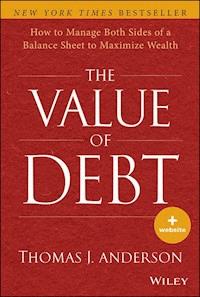
A New York Times bestseller and one of the Ten Best Business Books of 2013 by WealthManagement.com, this book brings a new vision of the value of debt in the management of individual and family wealth In this groundbreaking book, author Tom Anderson argues that, despite the reflex aversion most people have to debt--an aversion that is vociferously preached by most personal finance authors--wealthy individuals and families, as well as their financial advisors, have everything to gain and nothing to lose by learning to think holistically about debt. Anderson explains why, if strategically deployed, debt can be of enormous long-term benefit in the management of individual and family wealth. More importantly, he schools you in time-tested strategies for using debt to steadily build wealth, to generate tax-efficient retirement income, to provide a reliable source of funds in times of crisis and financial setback, and more. * Takes a "strategic debt" approach to personal wealth management, emphasizing the need to appreciate the value of "indebted strengths" and for acquiring the tools needed to take advantage of those strengths * Addresses how to determine your optimal debt ratio, or your debt "sweet spot" * A companion website contains a proprietary tool for calculating your own optimal debt ratio, which enables you to develop a personal wealth balance sheet Offering a bold new vision of debt as a strategic asset in the management of individual and family wealth, The Value of Debt is an important resource for financial advisors, wealthy families, family offices, and professional investors.
Sie lesen das E-Book in den Legimi-Apps auf:
Seitenzahl: 373
Veröffentlichungsjahr: 2013
Ähnliche
















Contents
Foreword
Acknowledgments
Introduction
Part 1: The Value of Debt in the Management of Wealth
Chapter 1: Strategic Debt Philosophy: An Overview
How This Book Can Add Value to Your Life
The Five Tenets (or Action Principles) of Strategic Debt Philosophy
Chapter 1: Summary and Checklist
Chapter 2: The Basic Idea: Limiting the Costs, the Impacts, and the Duration of Financial Distress
Risk of Financial Distress
The Direct and Indirect Costs of Financial Distress
The Impact of Financial Distress: Five Levels
The Duration of Financial Distress
The Four Indebted Strengths: A First Look
The One Thing You Must Consider!
Chapter 2: Summary and Checklist
Chapter 3: Strategic Debt Practices: An Overview
Understanding and Taking Advantage of Strategic Debt Philosophy
Achieving and Maintaining an Optimal Debt-to-Asset Ratio
Calculating Your Debt-to-Asset Ratio
Should Your Primary Residence Be Included in Your Debt Ratio?
When to Pay Down Your Debt, and When Not To
Advanced Practices and Scenarios
Chapter 3: Summary and Checklist
Part 2: The Assets-Based Loan Facility
Chapter 4: The Value of an Assets-Based Loan Facility (ABLF)
What an ABLF Is and How It Works
The Many Advantages of Having an ABLF in Place
Why Virtually Every Company Has a Line of Credit
Surviving Storms and Other Natural Disasters
The Criticality of Being Proactive and Assessing Risks
Family Finances: First Bank of Mom and Dad; Elder Care Bridge Loan
Taking Advantage of Opportunities and Distressed Sales
Average ABLF Usage and the Win-Win-Win Scenario
Chapter 4: Summary and Checklist
Part 3: Scenarios for Success
Chapter 5: Long-Term Wealth Amplification through Capturing the Spread
The Basic Concept: Inherent Risks with Great Potential Rewards
Three Key Factors to Consider
Some Scenarios for Capturing the Spread
Synching with Your Investment Strategy
Chapter 5: Summary and Checklist
Chapter 6: Holistic Financing of the Expensive Things You Need and Want
A Better Way to Buy: In the Company of Holistic Financial Thinkers
Four Principles When Financing the Purchase of a Desired Item
A Better Way to Purchase a Vehicle (or Almost Anything Else)
Purchasing a Second Home: Pluses and Minuses
100 Percent Financing: The No Down Payment Real Estate Purchase Option
Chapter 6: Summary and Checklist
Chapter 7: Generating Tax-Efficient Income in Retirement or Divorce
Introduction: Three Goals (and Some Disclaimers)
An Opening Scenario for No Taxes in Retirement
Borrowing Versus Selling to Access Your Money
A Better Alternative to a Familiar Story
Tying It Back to Capturing the Spread
Revisiting Tax Issues
Making Use of Strategic Debt Strategies and Practices in Divorce
Chapter 7: Summary and Checklist
Chapter 8: Conclusion: What This Book Is Really About
What We Hope You Have Taken Away
Strategic Debt as a Financial Engine over the Decades
Paradoxes of Plenty: Some Surprises in Maintaining an Ideal Debt Ratio
Investing in the Future: A Cautionary Reminder
A Final Thought
Chapter 8 Summary: A Recap of the Book’s Significant Lessons
Part 4: Appendixes
Appendix A: The Varieties of Debt
Appendix B: Strategic Debt Practice for the Young and Those with Limited Assets
Appendix C: No Guarantees: Limiting the Risks of Investing in a Crazy World
Appendix D: Some Examples of Ideal Debt Ratios
Glossary
Bibliography
About the Author
About the Companion Website
Index
Cover image: © iStockphoto.com/Feng Yu
Cover design: Paul McCarthy
Copyright © 2013 by Thomas J. Anderson. All rights reserved.
Published by John Wiley & Sons, Inc., Hoboken, New Jersey.
Published simultaneously in Canada.
No part of this publication may be reproduced, stored in a retrieval system, or transmitted in any form or by any means, electronic, mechanical, photocopying, recording, scanning, or otherwise, except as permitted under Section 107 or 108 of the 1976 United States Copyright Act, without either the prior written permission of the Publisher, or authorization through payment of the appropriate per-copy fee to the Copyright Clearance Center, Inc., 222 Rosewood Drive, Danvers, MA 01923, (978) 750-8400, fax (978) 646-8600, or on the Web at www.copyright.com. Requests to the Publisher for permission should be addressed to the Permissions Department, John Wiley & Sons, Inc., 111 River Street, Hoboken, NJ 07030, (201) 748-6011, fax (201) 748-6008, or online at http://www.wiley.com/go/permissions.
Limit of Liability/Disclaimer of Warranty: While the publisher and author have used their best efforts in preparing this book, they make no representations or warranties with respect to the accuracy or completeness of the contents of this book and specifically disclaim any implied warranties of merchantability or fitness for a particular purpose. No warranty may be created or extended by sales representatives or written sales materials. The advice and strategies contained herein may not be suitable for your situation. You should consult with a professional where appropriate. Neither the publisher nor author shall be liable for any loss of profit or any other commercial damages, including but not limited to special, incidental, consequential, or other damages.
For general information on our other products and services or for technical support, please contact our Customer Care Department within the United States at (800) 762-2974, outside the United States at (317) 572-3993 or fax (317) 572-4002.
Wiley publishes in a variety of print and electronic formats and by print-on-demand. Some material included with standard print versions of this book may not be included in e-books or in print-on-demand. If this book refers to media such as a CD or DVD that is not included in the version you purchased, you may download this material at http://booksupport.wiley.com. For more information about Wiley products, visit www.wiley.com.
Library of Congress Cataloging-in-Publication Data:
Anderson, Thomas J. (Certified investment management analyst)
The value of debt : how to manage both sides of a balance sheet to maximize wealth / Thomas J. Anderson, CIMA, CRPC.
pages cm
Includes bibliographical references and index.
ISBN 978-1-118-75861-8 (hardback); ISBN 978-1-118-75851-9 (ebk);
ISBN 978-1-118-75863-2 (ebk)
1. Finance, Personal. 2. Debt. I. Title.
HG179.A55976 2013
332.024′02—dc23
2013020675
For Sarah, John, Rosemary, and Oliver
Foreword
Change is the one constant in the financial services industry. In 1970, there were many days where trading volume on the New York Stock Exchange did not exceed 10 million shares. Recently, there have been multiple days with over 5 billion shares traded, an increase of 500 times. We have seen the development of integrated money market accounts, explosive growth in mutual funds, and the proliferation of such instruments as exchange-traded funds, separately managed accounts, hedge funds, private equity, structured products, and managed futures for commodities. This is taking place not just in the United States but across the world.
With time, advice has evolved as well. It had to. Clients have more investment choices than ever before. The global economy has become more interconnected and global capital markets have gone through explosive growth in both size and depth. The financial services industry has listened to the demands of its clients and responded accordingly. Investors today have the opportunity to invest in more asset classes through more vehicles in more places around the world than ever before.
So, where do we go from here? I had the opportunity to visit with Tom Anderson while he was putting together this book and he pointed out a glaring omission that I believe holds true for most all of us: throughout his primary school years, college education, graduate school, and professional life, Tom had not been educated as to the virtues of correctly structured debt. One can fill a library with books on debt strategies and capital structures for corporations, but there is virtually no material on the subject for individuals or families. Why? As I reflected on this some more, I found it shocking that there is not more material, education, debate, and discussion on this topic.
The financial industry has largely treated debt as though it were an outside force, considered and controlled independently of the rest of an individual’s financial life. But who has not used a mortgage to finance a home, obtained a student loan to cover college tuition, or borrowed to buy a new car? It seems common sense to treat these moments of capital acquisition holistically, as part of an overall financial plan. However, this happens all too infrequently in practice. While most financial firms and advisors today are able to deliver integrated solutions by and large, they are not yet delivering integrated advice.
Most advisors give sound advice when it comes to equity but overlook the other half of the balance sheet. Getting sound advice on liability management can be critical especially during those first years of retirement. Tom has written a must-read book for anyone looking to make better financial decisions. This book should be a staple for Financial Advisors who want to do a complete job of advising their clients.
Tom’s background, at some of the top schools in finance in the United States and abroad, combined with his experience in investment banking and as a financial advisor, affords him a unique perspective to address this gap. His ideas come together in this book to deliver a new perspective that represents a substantial step forward toward a cohesive solution.
The excesses of debt and reckless lending at the heart of our recent financial crisis have been well documented. This is no reason to ignore debt as an effective financial arrow in your quiver. In fact, it’s all the more reason to approach debt in an intelligent and educated fashion. What’s true about investing is that it entails risk, yet can offer rewards. The same principle applies to a debt philosophy.
The ideas expressed in this book may or may not be appropriate for your individual situation. The most important contribution of this work is that it should create more questions than answers. These questions in turn should lead to quality, holistic conversations about all aspects of your financial life with your tax, legal, and financial advisors. Change is constant, but as the book describes, with integrated, holistic advice we can be better prepared for this change, and for the future ahead.
Robert D. Knapp
President
Supernova Consulting Group
Author of The Supernova Advisor: Crossing the Invisible
Bridge to Exceptional Client Service and Consistent Growth
Acknowledgments
This book is an amalgamation of all aspects of my education and career. I wish to thank my many professors at Washington University and The University of Chicago—you have greatly influenced this work. To Professor Jaffe from the Wharton School of Business, I’ll never forget the CIMA final exam, and I hope you see how often your textbook is cited in the endnotes, for those who want additional detail on corporate finance.
My coworkers from my time in investment banking in wealth management inspire me; I have learned from each of you.
Carl Klaus defined the value of debt as the unique idea to develop into this book. His advice and guidance have been invaluable. Molly Chehak taught me about the process of creating a book and the publishing industry.
Phil Burrelle, I appreciate your modeling assistance. John Osako and team at Informatics, thank you for your amazing technical support.
Rafe Sagalyn, you are an outstanding agent, and I sincerely appreciate your guidance. David Zylstra and Denny Redmond, I value your advice and counsel.
Jordan S. Gruber turned my initial ideas and writing forays into an actual publishable manuscript, and I can’t thank him enough for his incredible efforts. He is an artist and helped me express complicated ideas in an easy to understand language. RJ, I am so grateful that you introduced us.
I would like to thank the following readers for their thoughtful and insightful advice: Greg Boester, Alex Dunlap, Jim Harris, Dr. Curt Hass, Kate Hladky, Jim Hoffman, John Huey, Dave and Patricia Knuth, Randy Kurtz, Chris Merker, Eliot Protsch, Dr. Jerry Shirk, Dick Siders, Julianne Smith, Nathan Swanson, and Steve Vanourny. The book is a better book because of you.
To the incredible team at Wiley; thank you for all of your support through the development and production phases of this book. Tula Batanchiev has been my North Star and guided me through every step. Judy Howarth, my development editor and Melissa Lopez, my production editor were invaluable to me; I appreciate their superb editorial skills. Any remaining mistakes are my own.
Mom, thanks for sending me to Wall Street Camp when I was 16; I wouldn’t be in the industry without you. I value your advice and treasure your love and support.
I would particularly like to thank my team: Kerry Abdoney, Jon Bancks, Stacey Halyard, Darla Lowe, JoAnn Masters, Fred Rose, Julie Vogt, and summer analyst Ben Rees. You not only made tremendous contributions to this book, but also enabled me to dedicate time to writing this while maintaining growth and excellence within our practice.
Kids, I love who you are and who you are becoming. I am proud to be your father. You give me more joy than I ever thought was possible.
Sarah, you are an incredible partner in every aspect of my life. None of this would be possible without you. You make me a better person and I enjoy life more because of you. I love you.
Introduction
Who is this book for? This book is not for everybody. To make best use of it, there are three prerequisites, as follows:
Now, if you don’t yet have sufficient investable assets, you very likely will still find many of the ideas useful and interesting, and something to aim at incorporating into your financial life over time. However, many of the book’s concepts and principles simply cannot be effectively applied to individuals without a high enough net worth. In fact, many of the ideas could have a very negative effect if used by lower net worth individuals, particularly if the concepts are misapplied. Nonetheless, if you aren’t yet part of the target market for this book but you find the ideas interesting, please see Appendix B, “Strategic Debt Practice for the Young and Those with Limited Assets,” where we discuss how you can use the ideas found here as a frame for your thinking and a guide to your actions.
In general, then, the real sweet spot for making use of the ideas, principles, and practices found in this book is individuals and families who
Have sufficient investible assets.
Want to position their lives so that they can retire in relative comfort.
Are committed to taking care of their family members for the long run regardless of what type of emergency or natural disaster might arrive.
Are interested in minimizing the taxes they pay or in buying a second home or other substantial assets in a much better way.
Assuming that you are part of the audience this book was written for, the next question is how you can most effectively make use of the ideas found here? This brings us to the question of what this book is . . . and what it is not.
Simply put, this book is a general guide. It will show you how to take on and make intelligent use of an optimal amount of Strategic Debt by comprehensively and holistically managing both sides of your balance sheet, that is, both your debts and your assets. What this book is not, however, is a detailed how-to guide for implementing the ideas found here. As already stated in this section, if you are going to move forward with the ideas in this book, you should almost certainly consult with a knowledgeable financial advisor or private banker who can not only help you do things in the best way possible, but also make sure that the ideas found here are actually appropriate for you.
Even the most risk averse individuals—those with the lowest risk tolerances and the least ability to psychologically or financially absorb an unexpected shock—may benefit from the ideas in this book. At a minimum such individuals may want to seriously consider putting an assets-based loan facility, or ABLF, in place, as we’ll get to briefly.
Why might the ideas found here not be appropriate for you even if you fall into the target market defined previously? Well, life is risky, and risk and reward are directly interrelated. So even though we feel that the ideas and practices you’ll find here may tend to systematically reduce your risk and may make you wealthier in the long run in a number of ways, you still have to keep in mind that things could change, these ideas could backfire, or they may not be right for you. To this point, Appendix C is perhaps the most important part of this book—it is an absolute must read. In an earlier draft this appendix was called “All of the reasons the ideas in this book can be bad for you.”
In addition to this appendix it is important that you read the endnotes in each section where additional risks and topics for discussion with your advisors are identified. In the interest of not having multiple disclaimers and risk factors repeating over and over throughout the book, we have packed a lot of important information about risk into the appendix and endnotes, so please pay close attention to both of them. Accordingly, it is important to know that all of the ideas in this book go together. You can’t just pick up this book and read one part of it. This includes, but is not limited to, the discussion of risks and disclaimers throughout the book. It is all interconnected and it all goes together. The material is presented with a goal of encouraging thoughtful conversation and rigorous debate on the risks and potential benefits of the concepts between you and your advisors.
Not about Buying What You Can’t Afford, but about Strategy
Once, after I gave a presentation, some people came up to me afterward and said, “So your goal is to have everybody take on a lot of debt?”
That is not the objective of this book. Instead, the intent is to express ideas and concepts as to what is optimal, and to encourage people to have a strategy around their debt. Too often people either have way too much debt or they are completely debt averse and have too little debt. There is an optimal middle ground, and the purpose of this book is therefore to set forth a reasonable framework for having an optimal debt strategy.
The Book’s Real Goal
The specific strategies outlined in this book may, in fact, not be optimal for your particular situation. However, the ideas found here should help lay the foundation for you to create your own personalized, optimized debt philosophy. In a certain sense then, the real goal of this particular book is to challenge your basic assumptions and beliefs about the wise and strategic use of debt. Ideally, if the book is successful, it will raise many more questions than it answers, questions you should investigate—with regard to your own situation—with your tax, legal, and financial advisors.
In the eyes of its author, however, this book will be considered a success if by the time you are done reading it, some or all of the following have happened:
You choose to have some debt at all points in your life.
You choose to
not
aggressively pay down debt in the years leading up to retirement.
You choose to a much greater degree how much tax you will pay the government when you are retired (versus having the government tell you how much tax you need to pay).
You think about and monitor your optimal debt ratio and how it changes over time.
You think about ways to reduce the costs, impact level, and duration of any potential financial distress.
You have more questions than answers.
Part 1
The Value of Debt in the Management of Wealth
Ignorance is the curse of God; knowledge is the wing wherewith we fly to heaven.
—William Shakespeare, Henry VI, Part 2
Chapter 1
Strategic Debt Philosophy: An Overview
How This Book Can Add Value to Your Life
This book aims to bring forth a new vision of the value of debt in the management of individual and family wealth. On the one hand, virtually every company already looks at both sides of its balance sheet—assets and debts—and consciously strives to come up with an optimal debt ratio.1 On the other hand, the vast majority of individuals, wealthy or not, are either dramatically overleveraged (have too much debt) or, at the other extreme, are substantially underleveraged (have no debt at all).2 Those in this second camp typically hold the notion that debt is always bad, should almost always be avoided, and if taken on, should be paid off as soon as humanly possible.
There is a reason, however, why practically all companies acknowledge the value of debt and seek to have an optimal debt ratio in place.3 Simply put, by strategically taking on and managing debt, these companies realize that they can take advantage of what we’ll call the Indebted Strengths that come along with that debt, which, as we’ll describe shortly, include Increased Liquidity, Increased Flexibility, Increased Leverage, and Increased Survivability.
As it turns out, despite the general antidebt knee-jerk reaction that most people have, many wealthy individuals and families—from the moderately affluent to the ultra-affluent—can also make use of these Indebted Strengths to their own substantial long-term advantage. For starters—in later chapters I will get into the details on all of these and more—the strategic use of debt can help enable you and your family to do the following:
Quickly come up with the funds needed to respond to natural disasters, health crises, or personal difficulties of nearly any kind.
Generate tax-efficient income in retirement (and potentially access your money tax free).
Purchase a second home in a much less expensive manner.
Become progressively wealthier by “capturing the spread” between the cost of debt and the return on investment that you can likely generate through appropriate low-risk investing strategies.
The Five Tenets (or Action Principles) of Strategic Debt Philosophy
There are five tenets—or action principles—that form the core of Strategic Debt Philosophy:
Each of the five action principles is expressed as a kind of injunction, starting with words like adopt, explore, and understand—words that tell you to do something specific. This is done to let you know that while this may be a chapter on the philosophy of Strategic Debt, it is not meant to be a vague, head-in-the-clouds type of exercise. There is real work—internal thinking and questioning, consulting first with one’s spouse and family members and then with one’s professional advisors—that is absolutely necessary before going forward with any of the specific Strategic Debt Practices recommended in this book. Let’s, then, now turn to the five tenets.
First Tenet: Adopt a Holistic (Comprehensive)—Not Atomistic—Approach
The first tenet of Strategic Debt Philosophy—and for that matter, the first tenet of all true wealth management philosophies—is to adopt a holistic approach. Merriam-Webster.com defines holistic as “Relating to or concerned with wholes or with complete systems rather than with the analysis of, treatment of, or dissection into parts.” Similarly, TheFreeDictionary.com defines holistic as “Emphasizing the importance of the whole and the interdependence of its parts.”
For purposes of this book, the terms holistic and comprehensive will be treated as synonymous. A holistic wealth management approach, then, is one that goes far beyond the typical investment portfolio approach. Instead, it starts with the needs, goals, and dreams of an individual or family, then looks not only at their immediate financial situation but also the entirety of their wealth, and then takes into account everything from estate and retirement planning to taxes and insurance to end-of-life concerns (health care, residency, medical powers of attorney, etc.), and then, finally, methodically backs out cash-flow needs and projections.
What’s important about a holistic approach is that it doesn’t separate analysis and action into atomistic silos, where decisions on everything from buying a car to making long-term investments are made without taking into account the impacts and effects of that decision on the entirety of an individual’s or family’s wealth. A holistic approach does its best to take everything into account (as well as how everything interacts with everything else) and does so on many levels, from the most general to the most detailed. This often means calling in experts—like high-level tax accountants, lawyers, insurance experts, and so on—to ensure that the best possible informed choices are made.
Adopting a holistic—and not atomistic or fragmented—approach to the value of debt has a number of consequences and implications. First, it brings to the table the critical importance of looking at both assets and debts, as we’ll continue to explore throughout this chapter and the rest of this book. Second, without a holistic approach to wealth management that does indeed take into account both assets and debts, it is very difficult if not impossible to adopt and follow through on a holistic wealth management philosophy overall. That is, thoughtfully considering and factoring in everything that is known about debt, as well as what is known about assets, is essential to deriving maximum value from a comprehensive wealth management approach. Finally, a holistic approach to Strategic Debt Philosophy enables the exploration of the four Indebted Strengths that will be explored in detail in Chapter 2.
Second Tenet: Explore Thinking and Acting Like a Company
According to Corporate Finance (Ross, Westerfield, and Jaffe 2013),
The goal of financial management is to make money or add value for the owners.4
A company is generally focused on gaining profits. That is, with the exception of nonprofit and not-for-profit companies, in the vast majority of cases the raison d’être—reason for being—of a company is to do well financially.5 One would think, then, that when it comes to money, companies would tend to know what they are doing, which is one reason why it’s important for wealthy individuals and families to explore thinking and acting the way that companies do.
One objection to thinking and acting like a company may be that, indeed, individuals and families are not companies, and their main purpose is not to gain profits. While that’s quite true, it’s also true that the exploration of thinking and acting like a company can have many benefits for individuals and families. Importantly, companies are often much more objective about financial-related matters than are individuals and families. So while their ultimate goals may differ, there is a lot of good learning that can come from exploring how companies think and what they do. Put differently, while you as an individual or family may not be primarily focused on making a profit, you nonetheless constitute an organized system of inputs and outputs that absolutely relies on having sufficient financial resources at the ready in order to get on with “the business of life.”
A related factor is that companies have specialized financial leaders—chief financial officers, or CFOs—who are very clear about what does and doesn’t work in the financial realm.6 Much training, much education, and much knowledge about best practices reside within these individuals. If the vast majority of CFOs follow a particular practice, you can bet there’s a good reason why.
A second objection to thinking and acting like a company can also be raised: In the pursuit of profits, companies may ultimately be much more willing to go bankrupt than you, as an individual or family, are willing to take a chance on. That is, for the most part, companies are so ultimately focused on making a profit that they engage in certain types of behaviors that you, as an individual or family, might not be willing to risk. This may or may not be true and it still doesn’t mean that there aren’t some huge lessons to be learned from at least the simple exploration of thinking and acting like a company.
Now that we’ve looked at the general reasons and objections as to why you could explore thinking and acting like a company, let’s turn toward what it is, in particular, that sets companies apart in the realm of a holistic approach to Strategic Debt Philosophy. First, and most importantly, consider the following true proposition:
In fact, as of this writing, there are four U.S. publicly traded companies that have a AAA rating (and even they use different forms of debt!).8 This is not because there aren’t many companies that are big enough and wealthy enough to pay off their debt entirely. (Could Coca-Cola, Walmart, or Procter & Gamble, for example, pay off all of their debt if they wanted to? Of course they could . . . but they don’t, and they won’t.) Instead, it’s because companies—which are all about doing well financially—consciously choose to have an optimal amount of debt.
Yes, they are mindful of how much debt they have and how that debt is structured, but they take on debt and keep debt on their balance sheet on purpose. They do this so they can make use of what I will later define as their various Indebted Strengths, that is, to increase their liquidity, the amount of capital they have to work with, their long-term survivability, and so on. Companies, then, go out of their way not just to embrace debt where it is useful—for example, by issuing debt to buy back more of the company’s publicly traded stock—but to determine and make use of their optimal debt ratio, that is, the optimal ratio between their assets and their debts.9
A great deal of research has gone into what the optimal debt ratio is for companies. As Eugene Brigham and Joel Houston explain in Fundamentals of Financial Management (2004), “The optimal capital structure must strike a balance between risk and return so as to maximize the firm’s stock price.” In just a little while, we’ll discuss what average company debt ratios tend to actually look like in the real world.10
If you think about it, there is no question that shareholders of all companies want, need, and expect their companies to be successful. Proper design and implementation of the company’s capital structure—and their overall debt philosophy—is a key part of these expectations. Interestingly, there are some theories out there that say companies should be almost 99 percent debt and 1 percent equity!11 Nobel Prizes have been awarded for the theories with respect to corporate finance and the optimal corporate capital structure. It is important that we are familiar with that work and consider its potential implications on our personal lives.
Consider, then, for a moment, what the role of the CFO in a company is. He or she starts by taking a holistic approach to the company’s balance sheet. This begins by considering the corporation’s total assets and the likelihood of the company encountering financial distress, along with what the fallout of that financial distress would be in terms of direct and indirect costs, the impact level of that financial distress, and its duration. (See Chapter 2 for a description of these terms and dynamics.)
With all this in mind, the CFO then determines the cash flow needs of the organization, and then looks at how much debt the company should have in terms of accessing the indebted strengths of Increased Liquidity, Flexibility, Leverage, and Survivability. Structuring the right amount of debt in the right way is critical, because if the company takes on too much risk in the form of increased debt then it could go bankrupt. If it doesn’t take on enough of the right kind of debt then it may not be maximizing value and/or may increase the chances of either running into a liquidity crisis or being bought out by a hostile party. It’s not surprising, then, that most companies have fairly constant debt ratios from year to year (as opposed to individuals, who tend to either have way too much debt or who want to pay off all of their debt as soon as they can).12
Companies and their CFOs, then, spend a lot of time—a whole lot of time in a holistic frame of mind—thinking all of this through. The big take-away here, then, is that there is an incredible disconnect between something that almost all companies do and something that far too few wealthy individuals and families do or are even willing to think about.
As previously stated, individuals clearly are not corporations. It would be extreme to say that they are the same, and it would be equally extreme to say that they have nothing in common. Our goal is to explore that white space in the middle.
Third Tenet: Understand Limitations on Commonly Held Views of Personal Debt
How can we understand this “incredible disconnect” between how companies holistically think about their balance sheets and how the great majority of individuals tend to never think this way? It all begins with the perception that popular culture has of debt. For example, consider the words of the great William Shakespeare, who in his play Hamlet has Lord Polonius say,
Neither a borrower nor a lender be;
For loan oft loses both itself and friend,
And borrowing dulls the edge of husbandry.
Basically, debt has a terrible reputation. “I’m an accumulator; no debt for me,” you might hear someone you respect say. Or perhaps you had a grandparent or other family member say, “When I die, I want to die debt free so I can pass my wealth, not my obligations, on to my children or grandchildren.” Or you might know some fiercely independent person who has told you, time and again, that they don’t want anyone—least of all a bank or financial institution—having “anything over me.”
This general, sweeping, negative view of debt can also be found in financial articles and books written for individuals and families. As part of putting this book together, an in-depth online research effort was conducted to assess whether Strategic Debt Philosophy and Practices were fairly evaluated and considered. After wading through many online articles that simply focus on the best way to restructure and get rid of debt as soon as possible, about 20 online articles were discovered that had something positive to say about debt.
Mainly, these 20 or so articles discussed the difference between good debt (for example, taking on debt for educational purposes or to buy a house—a subject we’ll return to later on) and bad debt (for example, credit card debt). None of these articles—not a single one—recommended that wealthy individuals and families investigate the idea of attaining an optimal debt ratio throughout their lives. Instead, the simplistic idea that all debt is bad kept popping up, and the importance of eventually getting rid of all debt showed up time and time again.
What we are facing, then, is a knee-jerk antidebt reaction—ingrained aversion to debt. In a certain sense, this makes sense, because many people are either totally debt averse (either have no debt at all or have the goal of having no debt at all) or have way too much debt and are overleveraged and have therefore put themselves at an increased risk of financial distress. Those who see others getting into trouble have their prejudice against all debt in all circumstances reinforced. Similarly, as some of the concepts in this book may at first seem unusual, counterintuitive, or even controversial, it is easy to see why a quick look might just serve to further fan the flames of the all-debt-is-bad perspective.
The lack of education has been compounded by strong antidebt prejudices that have been reinforced throughout popular culture for centuries. While it may be true that for many individuals debt should be avoided like the plague, it’s just as certainly true that a wealthy individual or family can intelligently take advantage of the Indebted Strengths that come from taking on the right kind of debt and achieving an optimal debt ratio.14
In short, most popular views on debt are extremely limited. They don’t consider how a wealthy individual or family can greatly benefit from the right kind of debt. They don’t consider the value of thinking and acting like a company in appropriate circumstances, and they don’t explore the Indebted Strengths that come hand in hand when strategically taking on appropriate debt.
Instead, they simply rely on the knee-jerk reaction that most people have toward debt, as if all people taking on debt were the same and all types of debt were the same. By understanding these limitations on popularly held notions of debt, you can free your mind, shed your prejudices, and begin the investigation of whether the ideas and practices suggested here might make sense and be appropriate for you and your family.
Fourth Tenet: Set Your Sights on an Optimal Personal Debt Ratio
One premise of this book is that when it comes to an ideal debt ratio, there is an optimal sweet spot for individuals, just like there is for companies, and that those of us who can afford to do so should most certainly be targeting that sweet spot. As pointed out earlier, there tend to be two types of people: those who are very highly leveraged and take on way too much debt and those who are totally debt adverse and don’t have any debt whatsoever.




