


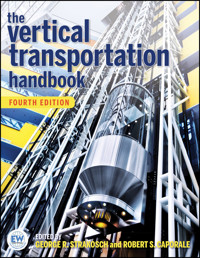
The Vertical Transportation Handbook E-Book
153,99 €
Mehr erfahren.
- Herausgeber: John Wiley & Sons
- Kategorie: Wissenschaft und neue Technologien
- Sprache: Englisch
This new edition of a one-of-a-kind handbook provides an essential updating to keep the book current with technology and practice. New coverage of topics such as machine-room-less systems and current operation and control procedures, ensures that this revision maintains its standing as the premier general reference on vertical transportation. A team of new contributors has been assembled to shepherd the book into this new edition and provide the expertise to keep it up to date in future editions. A new copublishing partnership with Elevator World Magazine ensures that the quality of the revision is kept at the highest level, enabled by Elevator World's Editor, Bob Caporale, joining George Strakosch as co-editor.
Sie lesen das E-Book in den Legimi-Apps auf:
Seitenzahl: 1007
Veröffentlichungsjahr: 2010
Ähnliche




















Table of Contents
Title Page
Copyright
Preface
Acknowledgments
Contributors
1 The Essentials of Elevatoring
Early Beginnings
Elevator Safety Devices
Hydraulic Elevators
Elevatoring
Traction Elevators
Gearless Traction Elevators
Geared Traction Machines
Hydraulic Elevators
Escalators and Moving Walks
Dumbwaiters and Materials-Handling Systems
Handicapped Lifts
Study of Elevatoring
Modernization
2 The Basis of Elevatoring a Building
Early Population
Elevator Traffic
Pedestrian Planning Considerations in Elevatoring
Positioning of a Building's Vertical Transportation System
Modernization
3 Passenger Traffic Requirements
The Elevator Trip
Requirements Of Good Elevator Service
Calculating The Time Factors
4 Incoming Traffic
Introduction
Incoming Traffic Period Interval
Incoming Traffic Operation of Elevators
Down Traffic During Up-Peak
General Conclusions
5 Two-Way Traffic
Importance Of Two-Way Traffic Considerations
Two-Way And Interfloor Traffic Requirements
Sample Calculations
Elevator Operation During Two-Way And Interfloor Traffic
General Conclusions
6 Outgoing Traffic
Importance Of Outgoing Traffic
Outgoing Traffic Requirements
Calculations For Outgoing Traffic
Sample Calculations
Special Operations
General Conclusions
7 Elevator Operation and Control
Part I: General Overview of Computer Technology as Related to Elevator Operation
Part II: Operation and Control Systems
Operation Systems
Traffic Definitions and Operations
Special Operating Features
Adjusting Operation to Traffic
Advances in Operational Strategy—Artificial Intelligence
Needs for Future Development
About the Author
8 Space and Physical Requirements
Space for Elevators
Required Space
Overhead and Pit Requirements
Elevator Reactions
Additional Machine Room Considerations
Elevator Layouts
Special Layout Requirements
About the Author
9 Escalators and Moving Walks
Escalators Versus Moving Walks
Effective Application
Traffic-Handling Ability
Arrangement and Location
Space Requirements
Features Of Escalators And Moving Walks
Escalators Versus Elevators
Calculating Escalator Or Moving Walk Requirements
Application Of Escalators And Moving Walks
About The Author
10 Elevatoring Commercial Buildings
Definition
Population
Elevator Traffic in Commercial Buildings
Layout and Grouping of Elevators
Transfer Floors
Elevator Operation in Commercial Buildings
Typical Office Building Elevatoring
Rules of Thumb
Maximum Elevator Size in Office Buildings
Elevatoring Stores
Passenger Elevators in Garages
Professional Buildings
Merchandise Marts
Industrial Buildings
Summary
11 Elevatoring Residential Buildings
Population
Characteristic Traffic and Intensity
Calculating Elevator Requirements
Elevator Equipment and Layout
Hotels and Motels
Service Elevators
Sample Hotel Elevatoring
Apartments
Sample Calculations
Dormitories and Residence Halls
Senior Citizen Housing
Elevators in Residential Buildings
Elevators in Private Residences
Summary
12 Elevatoring Institutional Buildings
Definition
Population
Elevator Traffic in Institutional Buildings
Hospitals
Institutions For Long-Term Care
Secondary Schools, Universities, and Colleges
Courthouses
Jails
Museums, Exhibits, Sports Arenas, and Observation Towers
General
Operation
13 Service and Freight Elevators
Service and Freight Elevators
Freight Elevators
Elevator Design
Service Elevators
Operation of Service and Freight Elevators
Elevators in Industrial Plants
Elevators in Warehouses
Elevators in Garages and For Off-Street Loading
Other Freight and Service Elevator Considerations
Unusual Installations
About The Authors
14 Nonconventional Elevators, Special Applications, and Environmental Considerations
Nonconventional Elevator Applications
Multipurpose Buildings
SKY Lobby Elevatoring
Double-Deck Elevators
Observation and Outside Elevators
Inclined Elevators
Shipboard Elevators
Elevators in Mines
Industrial-Type Elevators
Rack and Pinion Elevators
Building Compression
Car Ride
Wind Effects and Building Sway
Stack Effect
Earthquake Design
Noise
Elevators in Problem Locations
Flooding
Trailer Truck Elevator
Parking Garage Elevator With Horizontal Carriage
Nonelevator Vertical Transportation
Summary
About The Author
15 Automated Materials-Handling Systems
Developing Technology
Automated Materials Handling in Public Buildings
Pneumatic Tube Systems
Selective Vertical Conveyor (SVC)
Electric “CAR on Track” Conveyor Systems
Tote Box Lifts
Automated Cart Lifts
Track Systems—Overhead
Track Systems—in-Floor
Automated Guided Vehicle (AGV) Systems
Pallet Lifts
Economics
Summary
About the Author
16 Codes and Standards
Introduction
History
Overview of Applicable Codes and Standards
Code Adoption
Enforcement Conflicts
Conflict Resolution
Code Coordination
Future Trends
Locating Codes and Standards
Conclusion
About the Author
17 Elevator Specifying and Contracting
Preparing to Bid
Specifications
Construction Specification Institute
Codes and Standards
Performance Criteria
Proposal Bidding
Negotiation
Establishing a Contract
Temporary Operation
Acceptance
New Installation Service
Actual Elevator Construction
Approvals
Delivery Scheduling
Relation of Elevator Work to Other Trades
Changes and Alterations
Contract Completion and Acceptance
Elevator Modernization
Summary
About the Author
18 Economics, Maintenance, and Modernization
Cost
Return on Investment
Vertical Transportation Arrangements
Equipment Selection
Elevator Maintenance and Repair
Proposals for Elevator Maintenance
Elevator Modernization
Equipment Survey
Specifications
Safety and Liability
Role of the Consultant
Use of Maintenance Management Software
Summary
Acknowledgments
About the Author
19 Traffic Studies and Performance Evaluation Using Simulation
Introduction
Quantifying Traffic Demand
Traffic Analyzers
Manual Traffic Surveys
Sample Results for Office Buildings
Application of Simulation
Conclusions
Acknowledgments
About The Author
20 The Changing Modes of Horizontal and Vertical Transportation
Introduction
Scissor Jacks
Accelerating Moving Walks
Escalators: Transit Stations
Elevator-Transit Stations
People Movers
Skywalks
Cable-Driven People Movers
Automated People Movers
Water Towers
The Future
About the Authors
Appendix: Literature on Elevators and Escalators
Index of Tables and Charts
Index of Examples
Subject Index
This book is printed on acid-free paper.
Copyright © 2010 by John Wiley & Sons, Inc. All rights reserved
Published by John Wiley & Sons, Inc., Hoboken, New Jersey
Published simultaneously in Canada
No part of this publication may be reproduced, stored in a retrieval system, or transmitted in any form or by any means, electronic, mechanical, photocopying, recording, scanning, or otherwise, except as permitted under Section 107 or 108 of the 1976 United States Copyright Act, without either the prior written permission of the Publisher, or authorization through payment of the appropriate per-copy fee to the Copyright Clearance Center, 222 Rosewood Drive, Danvers, MA 01923, (978) 750-8400, fax (978) 646-8600, or on the web at www.copyright.com. Requests to the Publisher for permission should be addressed to the Permissions Department, John Wiley & Sons, Inc., 111 River Street, Hoboken, NJ 07030, (201) 748-6011, fax (201) 748-6008, or online at www.wiley.com/go/permissions.
Limit of Liability/Disclaimer of Warranty: While the publisher and the author have used their best efforts in preparing this book, they make no representations or warranties with respect to the accuracy or completeness of the contents of this book and specifically disclaim any implied warranties of merchantability or fitness for a particular purpose. No warranty may be created or extended by sales representatives or written sales materials. The advice and strategies contained herein may not be suitable for your situation. You should consult with a professional where appropriate. Neither the publisher nor the author shall be liable for any loss of profit or any other commercial damages, including but not limited to special, incidental, consequential, or other damages.
For general information about our other products and services, please contact our Customer Care Department within the United States at (800) 762-2974, outside the United States at (317) 572-3993 or fax (317) 572-4002.
Wiley also publishes its books in a variety of electronic formats. Some content that appears in print may not be available in electronic books. For more information about Wiley products, visit our web site at www.wiley.com.
Library of Congress Cataloging-in-Publication Data
The vertical transportation handbook / George R. Strakosch, Robert S. Caporale, editors. – 4th ed.
p. cm.
Includes index.
ISBN 978-0-470-40413-3 (cloth); ISBN 978-0-470-91971-2 (ebk); ISBN 978-0-470-91972-9 (ebk); ISBN 978-0-470-91973-6 (ebk); ISBN 978-0-470-94981-8 (ebk)
1. Elevators. 2. Escalators. I. Strakosch, George R. II. Caporale, Bob.
TJ1370.V476 2010
621.8′77–dc22
2010005154
Preface
It is hard to believe how much the vertical transportation industry has changed since the first edition of Vertical Transportation was published in 1967. Back then the industry was dominated by the major manufacturers and installers, Otis being the most prominent of all. The United States was the major source of equipment, and only Otis was worldwide. I was fortunate to be part of the changes that have taken place. My own career—from Otis to the consulting firm of Jaros, Baum & Bolles, to Elevator World, and, finally, on my own—has been a reflection of some of these changes. In the early years consultants were a minor factor, but that started to change in the 1970s. Competition among manufacturers started to change as companies such as Haughton and Dover gained substantial shares of the market. Otis and Westinghouse dominated the escalator market, but Montgomery and Peelle made inroads. Elevator contractors and suppliers started to take a substantial share of the low-rise and specialized market, and consultants became a factor.
Regarding the latter, I feel I helped the rise of consultants, since they now had a guidebook. The mystery of elevatoring became available knowledge, and the first edition of Vertical Transportation was the source. I was delighted, and somewhat put out, when part of my book was entered as an exhibit in a court case without my being given any credit. I also realized how limited my book was and, in the early 1980s, I decided to update it. Being a consultant myself, I could see where additional knowledge was needed and became cognizant of the changes in the industry that were taking place. I also had the benefit of meeting many of the diverse agencies from both the buyer and seller sides. During my tenure at Jaros, Baum & Bolles, I can safely say that I was involved in many of the major buildings planned or built from 1977 to 1987. It was an exciting time for me, and much of the experience is reflected in the second edition of Vertical Transportation.
Joining Elevator World in 1987 gave me a chance to substantially expand my knowledge of the elevator industry. One of my first chores was to review and classify most of the articles published on various aspects of the industry since Elevator World started publication in 1953. The result was the four-volume “Educational Package” currently available and further expanded. That experience led to the recognition of the need for an expanded educational effort to benefit both the suppliers and buyers of equipment and services. After consultations with Bill Sturgeon, the publisher of Elevator World, and Bob Jacobs, chairman of the board, we decided that seminars were a good way to initiate an educational effort.
Two 8-hour seminars were developed, one for purchasers, specification writers, and users of elevators and escalators and the other for suppliers, installers, and service providers. Written material and slides covering subjects such as equipment choice, application, space requirements, layout development, the various types of operation and control, and forms of service contracts were also prepared. Once we were ready to go, we picked six cities and did a mass mailing both to the Elevator World subscribers and to individuals in various organizations. Our initial seminar was in Boston in March of 1988 and, after expanding our chosen cities to 10, we concluded the series in Los Angeles in December of 1989.
The seminar series gave us a number of collateral results. The need for written educational material expanded, and more literature was required to feed that need. The seminar series was developed into a manual, and other publications, both readily available and newly produced, became popular. We learned that seminars, as such, were too costly and that distance learning was a more effective way to go. A review of the current Elevator World Educational Publications Catalog will attest to the expansion that developed.
I started to receive requests for private consulting and, by mutual agreement, reduced my time with Elevator World. This also gave me the opportunity to consider expanding Vertical Transportation to reflect the current state of the elevator and escalator “art.” (I'm sure anyone totally involved in the field will agree that it is both an art and a science.) I realized that the technicalities of the industry had changed so that specialists needed to be enlisted to cover many aspects. The third edition of Vertical Transportation was a result of the input of these specialists, and I assumed the role of editor. The industry now had a “handbook,” and the effort of the many contributors is greatly appreciated.
The third edition was published in 1998 and became The Vertical Transportation Handbook both to reflect the input of the many experts in the field and to update the status of the industry. The basics remained, with minor updates, and they have withstood the test of time. It continued to show the technology of elevators and people's unchanging reactions to elevators—and they still fret about how long it takes after they push the button before an elevator responds.
For the fourth edition we were fortunate to be able to call upon the same experts, with minor exceptions, to update their contributions. They were also asked to address any changes in their areas that have taken place in the past 10 or more years. Regretfully, one of our contributors, Wayne Gilchrist, has passed away, while some others are joined by younger counterparts and continue to contribute their knowledge to the various chapters. The readers and users of the book will benefit from their input.
Acknowledgments
I am most fortunate to have Bob Caporale as my associate editor for the fourth edition. Bob and I have been friends and associates since I first met him when I joined Jaros, Baum & Bolles in 1977. As editor of Elevator World he brings the most up-to-date view of the elevator industry that anyone can, and his help and efforts are one of the main reasons the fourth edition was possible. I will be eternally grateful.
When I entered the elevator industry as a construction helper in 1946, little did I realize that I would be writing this. It was a job that evolved into a career, and I can honestly say I enjoyed most of the time I have spent in its various aspects. To use a hackneyed saying, I've enjoyed the ups and downs and wouldn't trade one moment of the time.
My appreciation is extended to the many people in the industry who have supported my efforts to record the many aspects of the proper application of elevators and escalators. My special appreciation goes to my wife and family, who have helped me create what I feel is my legacy.
GEORGE R. STRAKOSCH
This fourth edition of The Vertical Transportation Handbook would not have come to fruition were it not for Mouse! Mouse was a big guy who stood 6 feet 4 inches tall, and was one of my best high school buddies, with whom I not only spent much of my teenage years but went on to college with as well. Struggling through the first two years of what in the 1960s was for us young guys a grueling mechanical engineering curriculum, Mouse left school and went to work full time as a draftsman at Jaros, Baum & Bolles (JB&B), an engineering firm in downtown New York City. When I confided in Mouse that my studies were killing me as well, he suggested that I “come on down!” and apply for a job at what we later learned was one of the finest mechanical/electrical engineering companies in the world. After a successful interview with Cal Kort (6 feet 8 inches tall), who not only did the first cut on interviews for the company but also ran the elevator department, I was hired to start work on the world's tallest buildings and largest construction project to date, the twin towers at the World Trade Center. This turned out to be the start of my 45-year career in the elevator industry.
I was blessed to have been pointed in this direction and taken under the wing of Cal Kort and those who succeeded him at JB&B—most of whom, though not nearly as tall as Cal, were truly giants in the elevator industry. Bill Lewis succeeded Cal Kort and brought George Strakosch (6 feet 3 inches) on board, and I literally worked alongside George for 10 years. I had the incredible opportunity to serve my apprenticeship with the previously mentioned leading elevator industry engineers, as well as Chet Chrobot of Otis Elevator Company and Joe Montesano of Westinghouse Elevator Company, who were their companies' sales engineers assigned to work with JB&B and therefore visited us often. It was these folks—in addition to numerous elevator field engineers, mechanics, and adjusters from all of the major elevator companies—that I spent days and in some cases weeks with, on major projects all over the world, and from whom I learned the intricacies of elevator system design, operation and control, testing, and inspection. As a draftsman, project designer, and NAESA-certified Qualified Elevator Inspector (QEI) for JB&B, I absorbed all of the knowledge that I could from those elevator industry people who surrounded me day after day. I am indebted to all of the people I worked for and with, and in particular to George Strakosch, not only for the knowledge that he imparted to me but especially for the bond that he was instrumental in nurturing between Bill Sturgeon and me. Working for and with these giants of the elevator industry has been a blessing for me, and it is because of all these people that I have been able to be a part of the development of this fourth edition of The Vertical Transportation Handbook.
In 1993, after holding engineering positions at DTM Consulting and Syska and Hennessy Engineers, I was hired by Bill Sturgeon to come on board as the associate editor of Elevator World Magazine. This was something that in my wildest 1960s and '70s dreams I could never have imagined to be possible…but here it was. After working with—and being so significantly influenced by—the brightest minds in the elevator industry, I was now going to be working for another giant: Bill Sturgeon, one of the most intelligent men that I have ever encountered, and from whom I was to learn not only more about the elevator business but also about the publishing of magazines, books, and journals. And as he often said he would, Bill taught me “how to lead the orchestra!” “Being an editor,” Bill often stated, “is like being the conductor of an orchestra. A conductor strives to bring out the best in the musicians before him while taking little credit for doing so. Our job,” Bill used to say, “is to make those that write for ELEVATOR WORLD sound and look good, and this is the most satisfying job that anyone can have.” And he was right! I owe much to Bill Sturgeon, who not only taught me how to lead the band but also allowed and encouraged me to expand my horizons and learn from all of those that I encountered in my life.
When the time came for George Strakosch to update the third edition of The Vertical Transportation Handbook, he asked a number of us in the industry to assist him with this project by editing some of the chapters of the previous edition. George had spent years on the first two editions and had done more than the yeoman's share of the work; therefore at that time, for us, it was just a matter of editing and, where necessary, updating and expanding each of our sections.
It is often said that the hardest part of writing is completing the opening sentence, and anyone who writes regularly knows just how true this is. Well, George hadn't just given us opening sentences to work with but entire chapters, and 10 of us gratefully agreed to provide the needed assistance. Not only because we loved the elevator industry but also because, as does everyone who knows him, we loved George! He has always been there to help us and has always done so with an open heart and a smile on his face. This project was truly a labor of love for us all and one that was very satisfying as well.
Much gratitude for this work is also due to the following individuals, without whom the third and consequently this fourth edition of The Vertical Transportation Handbook would not have been possible.
Ed Donoghue, often referred to as “The Code God,” for his work throughout his career on elevator and escalator codes and standards and for the fine work he has done on the material on this subject.
George Gibson, the mechanical engineer extraordinaire in our industry, for his chapter updates on the mechanical design aspects of elevators in general and special-application elevators in particular.
Wayne Gilchrist, who, although he is no longer with us, is still one of my dearest friends. In my mind I turn to him often for guidance, as if he were still physically at my side…which sometimes I think he is. His previous work on the chapter “Automated Materials-Handling Systems” was so thorough for the third edition that it didn't need to be updated for this latest edition. Thanks, Wayne…!
Jon Halpern, our brilliant electrical engineering guru, who provided the updates on elevator operation and control.
Len LeVee, the nicest guy you ever want to meet and a fine elevator man, who did the previous work on the economics, maintenance, and modernization of elevator systems.
Joe Montesano, tough as nails when he needs to be, but with the heart and soul of a saint, who updated the chapter on elevator specifications and contracts.
Nick Montesano, my adopted brother, who loves everything elevators and most things escalators, always gets the job done, and does so with precision and thoroughness—and also brings more fun to the job than anyone could ever imagine. Nick took over the task of updating the chapter “Economics, Maintenance, and Modernization” from Len LeVee, who retired from the industry prior to our starting work on the fourth edition of this book.
Al Saxer, the elevator maintenance and modernization master, who pulled together the third-edition chapter “Service and Freight Elevators.”
Hank Peelle, another one of the nicest guys I know and an extraordinarily intelligent engineer, who, like the two generations before him, has dedicated his career to looking after the well-being of freight elevators and freight elevator doors. Hank updated Al Saxer's previous chapter on service elevators and added an extensive amount of new material to his section on freight elevators.
Davis Turner, whose brilliance is only surpassed by his sense (and often nonsense) of humor, who has been not only a tremendous help to me in my day-to-day work at Elevator World, but who is also an incredibly bright engineer, mathematician, and philosopher. Dave has looked after the escalator work in the third and fourth editions of this book, and we are forever grateful to him for his assistance and for his goofy sense of humor.
Jim Fortune, a true twenty-first-century visionary, who has not only traveled the world over but also designed the elevator systems in some of the world's most remarkable high-rise and super-tall buildings. Jim is a world-renowned expert on the conceptual analysis of super-tall buildings and their elevator systems. His additions to the chapter on the changing modes of vertical transportation reflect his involvement in this important aspect of our industry and his ability to remain on the cutting edge of elevator technology and building design.
Richard Peters, developer of elevator traffic analysis and simulation software, who has become a leading authority on the subject of elevator performance.
Bill Sturgeon is only listed following the others because his is the final chapter in the book. Bill has been my good friend for over 20 years and my mentor for over 15 years and has taught me not only a tremendous amount about the elevator industry from a trade publication editor's perspective but also so much about life in general. He has been an inspiration to me, and I can't thank him enough for all of the encouragement that he has given me, to always do the best that I can and to use all aspects of my conscious and subconscious mind to accomplish tasks. Thank you, Bill, for handing the ball off to me and not only letting me run with it but also constantly encouraging me to take it into the end zone.
This work could also not have been completed without the support of Elevator World's publisher, Ricia Hendrick, and the assistance of the magazine's special projects manager and research associate, Monica Tapper. Thank you, Ricia and Monica, for your support and help on this project.
And to George Strakosch I have to say that I have been truly blessed to have you in my life. Thanks for taking me under your wing and teaching me how to fly without getting in anyone's way. You showed me and so many others how to share knowledge and understanding with others and to always be there to provide inspiration and help to those around us. And for this I will be forever grateful. And a special thanks for having the confidence in me to let me assist you with this important elevator industry project.
And of course thanks to Mouse, who got me into this mess! Thanks, Big Guy.
ROBERT S. CAPORALE
Contributors
ROBERT CAPORALE, Editor
Elevator World Magazine
354 Morgan Avenue, P.O. Box 6507
Mobile, AL 36606
EDWARD A. DONOGHUE, Edward A. Donoghue Associates, Inc.
1677 County Route 64, P.O. Box 201
Salem, NY 12865-0201
JAMES FORTUNE, Fortune Consultants, Ltd.
2102 Mechanic Street
Galveston, TX 11788
GEORGE GIBSON, G. Gibson & Associates
555 Deer Pass Drive
Sedona, AZ 86351
WAYNE A. GILCHRIST, deceased, formerly of the Translogic Corporation
JON HALPERN, Jon B. Halpern & Associates, LLC
49 Hidden Ridge Drive
Syosset, NY 11791
LEN LEVEE, retired, formerly of Len Levee & Associates
JOSEPH MONTESANO, DTM Elevator Consulting
120-02 14th Road
College Point, NY 11356
NICHOLAS J. MONTESANO, DTM Elevator Consulting
120-02 14th Road
College Point, NY 11356
HANK PEELLE
The Peelle Company
373 Nesconset Highway
Hauppauge, NY 11788
DR. RICHARD PETERS, Peters Research Ltd.
Boundary House
Missenden Road
Great Kingshill, Bucks HP15 6EB, UK
AL SAXER, retired, formerly of Otis Elevator
38 Schoville Road
Avon, CT 06001
WILLIAM C. STURGEON, Founder and Editor Emeritus
Elevator World Magazine
354 Morgan Avenue, P.O. Box 6507
Mobile, AL 36606
DAVIS L. TURNER, Davis L. Turner & Associates
27615 Belmonte
Mission Viejo, CA 92692
1
The Essentials of Elevatoring
Early Beginnings
Since the time man has occupied more than one floor of a building, he has given consideration to some form of vertical movement. The earliest forms were, of course, ladders, stairways, animal-powered hoists, and manually driven windlasses. Ancient Roman ruins show signs of shaftways where some guided movable platform type of hoist was installed. Guides or vertical rails are a characteristic of every modern elevator. In Tibet, people are transported up mountains in baskets drawn by pulley and rope and driven by a windlass and manpower. An ingenious form of elevator, vintage about the eighteenth century, is shown in Figure 1.1 (note the guides for the one “manpower”). In the early part of the nineteenth century, steam-driven hoists made their appearance, primarily for the vertical transportation of material but occasionally for people. Results often were disastrous, because the rope was of fiber and there was no means to stop the conveyance if the rope broke.
Figure 1.1 A very early type of vertical transportation.
In the modern sense, an elevator1 is defined as a conveyance designed to lift people and/or material vertically. The conveyance should include a device to prevent it from falling in the event the lifting means or linkage fails. Elevators with such safety devices did not exist until 1853, when Elisha Graves Otis invented the elevator safety device. This device was designed to prevent the free fall of the lifting platform if the hoisting rope parted. Guided hoisting platforms were common at that time, and Otis equipped one with a safety device that operated by causing a pair of spring-loaded dogs to engage the cog design of the guide rails when the tension of the hoisting rope was released (see Figure 1.2).
Figure 1.2 (a) Otis's demonstration, Crystal Palace, New York, 1853. (b) Otis's patent sketch for a safety device (Courtesy Otis Elevator).
Elevator Safety Devices
Although Otis's invention of the safety device improved the safety of elevators, it was not until 1857 that public acceptance of the elevator began. In that year the first passenger elevator was installed in the store of E. V. Haughwout & Company in New York. This elevator traveled five floors at the then breathtaking speed of 40 fpm (0.20 mps).2 Public and architectural approval followed this introduction of the passenger elevator. Aiding the technical development of the elevator was the availability of improved wire rope and the rapid advances in steam motive power for hoisting. Spurring architectural development was an unprecedented demand for “downtown” space. The elevator, however, remained a slow vertical “cog” railway for quite a few years. The hydraulic elevator became the spur that made the upper floors of buildings more valuable through ease of access and egress. Taller buildings permitted the concentration of people of various disciplines in a single location and caused the cities to grow in their present form during the 1870s and 1880s.
Hydraulic Elevators
The hydraulic elevator provided a technological plateau for quite a few years; it was capable of higher rises and higher speeds than the steam-driven hoist-type elevator, limited by its winding drums (). The hydraulic elevator also evolved from the direct ram-driven elevator to the so-called geared or roped hydraulic () capable of speeds of up to 700 fpm (3.5 mps) and rises of 30 or more stories. The cylinder and sheave arrangement was developed to use multiple sheaves and was mounted vertically for the higher rises. The 30-story building did not appear until after 1900, well after steel-frame construction was introduced, but the hydraulic elevator served practically all of the 10- to 12-story buildings of the 1880 to 1900 era.
Lesen Sie weiter in der vollständigen Ausgabe!
Lesen Sie weiter in der vollständigen Ausgabe!
Lesen Sie weiter in der vollständigen Ausgabe!
Lesen Sie weiter in der vollständigen Ausgabe!
Lesen Sie weiter in der vollständigen Ausgabe!
Lesen Sie weiter in der vollständigen Ausgabe!
Lesen Sie weiter in der vollständigen Ausgabe!
Lesen Sie weiter in der vollständigen Ausgabe!
Lesen Sie weiter in der vollständigen Ausgabe!
Lesen Sie weiter in der vollständigen Ausgabe!
Lesen Sie weiter in der vollständigen Ausgabe!
Lesen Sie weiter in der vollständigen Ausgabe!
Lesen Sie weiter in der vollständigen Ausgabe!
Lesen Sie weiter in der vollständigen Ausgabe!
Lesen Sie weiter in der vollständigen Ausgabe!
Lesen Sie weiter in der vollständigen Ausgabe!
Lesen Sie weiter in der vollständigen Ausgabe!
Lesen Sie weiter in der vollständigen Ausgabe!
Lesen Sie weiter in der vollständigen Ausgabe!
Lesen Sie weiter in der vollständigen Ausgabe!
Lesen Sie weiter in der vollständigen Ausgabe!
Lesen Sie weiter in der vollständigen Ausgabe!
Lesen Sie weiter in der vollständigen Ausgabe!




