


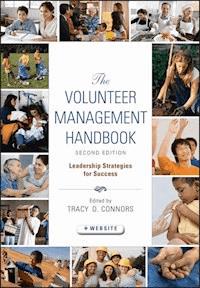
The Volunteer Management Handbook E-Book
56,99 €
Mehr erfahren.
- Herausgeber: John Wiley & Sons
- Kategorie: Fachliteratur
- Serie: Wiley Nonprofit Law, Finance, and Management Series
- Sprache: Englisch
Completely revised and expanded, the ultimate guide to starting--and keeping--an active and effective volunteer program Drawing on the experience and expertise of recognized authorities on nonprofit organizations, The Volunteer Management Handbook, Second Edition is the only guide you need for establishing and maintaining an active and effective volunteer program. Written by nonprofit leader Tracy Connors, this handy reference offers practical guidance on such essential issues as motivating people to volunteer their time and services, recruitment, and more. Up-to-date and practical, this is the essential guide to managing your nonprofit's most important resource: its volunteers. * Now covers volunteer demographics, volunteer program leaders and managers, policy making and implementation, planning and staff analysis, recruiting, interviewing and screening volunteers, orienting and training volunteers, and much more * Up-to-date, practical guidance for the major areas of volunteer leadership and management * Explores volunteers and the law: liabilities, immunities, and responsibilities Designed to help nonprofit organizations survive and thrive, The Volunteer Management Handbook, Second Edition is an indispensable reference that is unsurpassed in both the breadth and depth of its coverage.
Sie lesen das E-Book in den Legimi-Apps auf:
Seitenzahl: 1559
Veröffentlichungsjahr: 2011
Ähnliche




















Contents
Cover
Title Page
Copyright
Dedication
Preface
The Present of Volunteer Resource Management
Volunteer Management Handbook
Annotated Volunteer Resource Management Model
References
Part I: Volunteer Resource Program Assessment, Analysis, and Planning
Chapter 1: Volunteer Models and Management
Volunteers and Their Essential Management
Review of Major Volunteer Resource Management Models
Empirically Based Model of Volunteer Resource Management: PEP Model of Volunteer Administration
Conclusion: Volunteer Resource Management Today and in the Future
References
Chapter 2: Volunteer Demographics
Volunteer Demographics: Considering Both the Forest and the Trees
Snapshot of Selected Volunteer Demographics in the United States
Volunteerism Across the Life Span: Understanding “Seasons of Service” in Human Development
Volunteerism and Generational Cohorts
Summary: Considering the Big Picture
References
Chapter 3: Preparing the Organization for Volunteers
Setting Reasonable Expectations for Volunteers: Weighing the Benefits and Costs of Volunteer Participation
Establishing the Rationale and Goals for the Volunteer Program: Making Volunteer Involvement Matter
Involving Paid Staff in Designing the Volunteer Program: Smoothing the Way toward Effectiveness
Housing the Volunteer Program: Integrating Volunteer Participation into the Organization
Creating Positions of Program Leadership: Providing Responsibility and Direction for the Volunteer Effort
Developing Job Descriptions for Volunteer Positions: Sharing the Workplace
Designing Systems and Supports to Facilitate Citizen Participation and Program Management: Preparing for Volunteer Involvement
Conclusion
References
digital A: Volunteer Management of Governance Volunteers
Role in the Nonprofit Organization
Expectations
Governance Roles
Conclusion
References
Chapter 4: Shaping an Organizational Culture of Employee and Volunteer Commitment
Organizational Culture: What It Is and Why It Matters
Measuring Culture: A Four-Dimensional Model and Analysis Tool
Monitoring Organizational Culture: A Leadership Responsibility
Implications for Volunteer Resource Managers
References
digital B: Understanding the Changing Organization as a Primary Context for Volunteering
A Time of Organizational Change
Understanding the Industrial Era Organization
Moving to the Postindustrial Era Organization
Implications for Volunteer Resource Managers
References
digital C: Organizational and Programmatic Benefits from Adversity: Comprehending the Centrality of the Role of Adverse Experiences in and on the NPO and Its Programs
Organizational Genesis: Why Start a Not-for-Profit?
Power of Connection and Relationship
Adverse Experiences: The Invisible Epidemic
Impact of Adverse Experiences on Organizational Process
Developing an Experience-Informed Culture
Creating the Experience-Informed Culture
Volunteer Program Cycle: Programmatic Considerations to Minimize the Impact of Adverse Experiences on Volunteers and Staff
Experience-Informed Programming
References
Chapter 5: Maximizing Volunteer Engagement
Understanding Volunteer Motivations and Trends
The Volunteer Involvement Framework
Developing a Vision for Volunteer Engagement
Managing the Volunteer Investment
Minimizing Challenges, Embracing Opportunities
Conclusion
Worksheet: Assessing Current Patterns of Volunteer Engagement
References
Chapter 6: Assessment, Planning, and Staffing Analysis
Major Organizational Benefits and Challenges of Having a Volunteer Program
Trends in Volunteering and Impact on Volunteer Program Planning and Management
Organizational Assessment: Establishing a Volunteer Program
Identifying Volunteer Roles: Understanding Strategic Job Analysis
Using Strategic Job Analysis to Remain Competitive
Competency Modeling as a Tool for Success
Job Analysis Evaluation
Relating Job Analysis and Competencies to Organization's Strategic Goals
Comparing Volunteer Role Descriptions and Role Specifications
Bringing It All Together: Creating the Job Description
References
Chapter 7: Policy Development for Volunteer Involvement
What Are Policies?
Why Write Policies?
Where Policies Are Needed
Policy Development Process
How to Write Policies for Volunteer Programs
Getting Started—Introducing the Policy
Conclusion
References
digital D: Options for Volunteer Involvement
Market for Volunteers
Social, Economic, and Cultural Trends Driving the Options for Volunteer Involvement
Types of Volunteer Involvement
From Volunteer Management to Professional Volunteer Management
Conclusion
References
digital E: Managing Voluntourism
Defining Voluntourism
History and Trends in Voluntourism
Who are Voluntourists and Why do They Voluntour?
The Voluntourism Partnerships
Voluntourism Operators and Tourism Industry Linkages
Marketing and Recruiting Voluntourists
Voluntourism Operator Responsibilities
Voluntourism Project Host Responsibilities
Voluntourist Responsibilities
Issues and Future Direction
References
Part II: Strategic Deployment and Implementation
Chapter 8: The Latest Approach to Volunteer Recruitment: Competency-Competence Pathways and Volunteer Resource Management Systems
Challenges with Volunteer Recruitment Today
Volunteer Resources Management System
Competency and Competence
Recruiting Volunteers Using Competencies
Interviewing
Assigning
Implications for Using a VCMS
Conclusion
References
digital F: Marketing Volunteerism for Specialized Cohorts
What do Volunteers Want?
Getting Ready for Specialized Volunteer Programs
Target Marketing for Corporations
Targeting Baby Boomers
Targeting Students
References
Chapter 9: Orientation: Welcoming New Volunteers into the Organization
Defining Orientation
When Does Orientation Begin?
Why Bother with Orientation?
Components to Cover in Orientation
Formats for Delivery
All on Day 1?
Episodic Volunteers Need Orientation Too
When Orientation Becomes Training
Conclusion
References
Chapter 10: Training Volunteers
Learning Styles
Generational Issues
Nuts and Bolts of Training
Conclusion
References
Chapter 11: Volunteer and Staff Relations
Defining the Volunteers and Staff Team
Characteristics of the Effective Volunteer-Staff Team
Managing Different Types of Volunteer-Staff Teams
Recognizing the Symptoms of Poor Volunteer-Staff Relationships
Why Assess Volunteer-Staff Relationships?
Causes of Poor Volunteer-Staff Relationships
Sequential Process to Build the Volunteer-Staff Team
Tips to Enhance Volunteer-Staff Relations
Conclusion
References
Chapter 12: Communicating with Volunteers and Staff
Communication Process
Communication Model Applied to Internal Audiences
Communications Campaigns
Potential Pitfalls of Internal Communication
Conclusion
References
digital G: Social Media and Volunteer Programs
Social Media: Definitions and Usage
Types of Social Media
Planning to Use Social Media: The Good, Bad, and Scary
Manager of Volunteer Functions and Social Media
Conclusion
References
Chapter 13: Volunteer Performance Management: The Impact Wheel
Linking Performance Management, Volunteer Resources, and Competency
Managing Performance Tools and Techniques
Impact Wheel Overview
Introducing the Impact Wheel for Volunteer Resources Performance Management
Using the Impact Wheel
Summary Tools
Conclusion
References
digital H: Effective Leadership and Decision-Making
Leadership and Management
Models of Volunteer Leadership
Leadership and Management
Community Development
Integrating Leadership Theory into a Volunteer Program
Putting Theory into Practice
Conclusion
References
Chapter 14: Risk Management in Volunteer Involvement
Context for Risk Management
Risk Management and Liability
Risk Management
Use a Risk Management Model
Steps of Risk Management
Supporting the Risk Management Process
Conclusion
References
digital I: Information System Tools for Volunteer Management
Tools to Support the Engagement of Volunteers
Tools to Support the Training of Volunteers
Tools to Support the Retention of Volunteers
Tools Which Can be Used in Support of Communications
Tools for Evaluating and Reporting
Challenges to Using Information Systems
Establishing Foundations for Information Systems
Conclusion
References
digital J: Executive and Managerial Coaching in Nonprofits: Critical Leadership Development
Defining Managerial Coaching
Other Forms of Leadership Development
When External Coaching Can be Useful
Coaching Competencies
Selection of a Managerial/Coached Coach
Limits and Boundaries of Coaching
The Experience of Being Coached
Conclusion
References
Part III: Results and Evaluation
Chapter 15: Evaluating the Volunteer Program: Contexts and Models
Defining Evaluation
Role of Stakeholders in Evaluation
Purposes of Evaluation
Purpose-Based Evaluation Framework for Valuing Volunteers
Valuing Volunteering for Organizations, Volunteers, and Clients
Value of Volunteering to the Volunteers
Logic Models
Conclusion
References
Chapter 16: Evaluating Impact of Volunteer Programs
Evaluation in Volunteer Programs
A Symbiotic Relationship: Evaluation, Impact, and Accountability
Four Fundamental Questions in Any Volunteer Program Impact Evaluation
References
Part IV: Applied Management Practice
digital K: Mission Fulfillment (Even During Challenging Times)
Product Comparisons
Mission Fulfillment Best Practices Based on Behavioral Science
Cutting Edge Mission Activation-Boosting Practices and Tools: An Example
Conclusion
References
digital L: Ethics: Professional Ethics for Volunteers
Strategic Human Resources Management
Professional Volunteer Administration and Management
Ethical Standards for Human Resources Management
Professional Ethics in Volunteer Management
Assumptions of Codes of Ethics
Conclusion
References
digital M: Professionalism and Credentialing in the Field of Volunteer Management
Making the Case for Professionalizing the Field of Volunteer Management
History, Background, and Literature Review
Framework for Professionalism in Volunteer Management
A Competency-Based Framework for Advancing the Profession of Volunteer Management
Credentialing and Certification
Conclusion
References
digital N: Advocacy in Volunteer Management
Historical Context and Definitions
Traditions of Volunteerism
Lead Through Service Learning and Community Service
Find Your Individual Voice
Engage in Personal Empowerment
Advocate for Your Program
Advocate for Your Place at the Table
Advocate for a Peer Network
Advocate for Your Organization
Promote the Organization/Agency in the Public Arena
Conduct an Advocacy Campaign
Advocate Within the Law
Conclusion
References
digital O: National, State, and Local Community Programs for Volunteer Resource Managers
Social Media as a Resource for Recruiting and Managing Volunteers
National Resource Programs for Volunteer Managers
State and Regional Resource Programs for Volunteer Managers
Local/Community Resource Programs for Volunteer Managers
Conclusion
References
digital P: Volunteer Management: Hospice Organizations
Organizational Environment
Recruiting Hospice Volunteers
Screening/Interviewing Potential Hospice Volunteers
Orientation/Training for Hospice Volunteers
Placing Hospice Volunteers in Appropriate Assignments
Supervising and Evaluating Hospice Volunteers
Risk Management in Hospice Volunteer Programs
Hospice Volunteer Recognition and Retention
Stressors for Hospice Volunteer Managers
Conclusion
References
digital Q: Volunteer Resource Management in Local Development Organizations: An International Perspective (Portugal)
Organizational Culture and Programs
Volunteer Resource Management and Planning for Local Development
Budgeting
Volunteer Role or Job Analysis
Identification of Potential Volunteers
Recruitment and Selection
Volunteer Supervision, Orientation, and Integration in the Organization
Logistical Support and Training
Volunteer Recognition and Rewards
Performance Appraisal and Feedback
Evaluation of Volunteer Resource Management and Planning
Organizational Development
An Organizational Tool for Community Involvement
Conclusion
References
digital R: International Volunteer Management
Meaning of Volunteerism: International Perspectives
Turning Points
A Movement: International Volunteer Programs
Volunteerism Around the World
Civic Service
Structures: A Comparison of International Volunteer Resource Management
Recruitment, Selection, and Training
Established Volunteer Competencies—Volunteer Resource Management Systems
Legislation Affecting Volunteer Resource Management
Partnerships: Local with International
International Youth Volunteers
Benefits and Impacts of International Volunteerism
References
About the Editor
About the Contributors
Index
Copyright©2012 by John Wiley & Sons, Inc. All rights reserved.
Published by John Wiley & Sons, Inc., Hoboken, New Jersey.
Published simultaneously in Canada.
No part of this publication may be reproduced, stored in a retrieval system, or transmitted in any form or by any means, electronic, mechanical, photocopying, recording, scanning, or otherwise, except as permitted under Section 107 or 108 of the 1976 United States Copyright Act, without either the prior written permission of the Publisher, or authorization through payment of the appropriate per-copy fee to the Copyright Clearance Center, Inc., 222 Rosewood Drive, Danvers, MA 01923, (978) 750-8400, fax (978) 646-8600, or on the Web at www.copyright.com. Requests to the Publisher for permission should be addressed to the Permissions Department, John Wiley & Sons, Inc., 111 River Street, Hoboken, NJ 07030, (201) 748-6011, fax (201) 748-6008, or online at www.wiley.com/go/permissions.
Limit of Liability/Disclaimer of Warranty: While the publisher and author have used their best efforts in preparing this book, they make no representations or warranties with respect to the accuracy or completeness of the contents of this book and specifically disclaim any implied warranties of merchantability or fitness for a particular purpose. No warranty may be created or extended by sales representatives or written sales materials. The advice and strategies contained herein may not be suitable for your situation. You should consult with a professional where appropriate. Neither the publisher nor author shall be liable for any loss of profit or any other commercial damages, including but not limited to special, incidental, consequential, or other damages.
For general information on our other products and services or for technical support, please contact our Customer Care Department within the United States at (800) 762-2974, outside the United States at (317) 572-3993 or fax (317) 572-4002.
Wiley also publishes its books in a variety of electronic formats. Some content that appears in print may not be available in electronic books. For more information about Wiley products, visit our web site at www.wiley.com
Library of Congress Cataloging-in-Publication Data
The volunteer management handbook: leadership strategies for success / edited by Tracy Daniel Connors.—2nd ed.
p. cm.—(Wiley Nonprofit law, finance and management series)
Includes index.
ISBN 978-0-470-60453-3 (hardback); ISBN 978-1-118-12740-7 (ebk); ISBN 978-1-118-12741-4 (ebk); ISBN 978-1-118-12742-1 (ebk)
1. Voluntarism—United States—Management. 2. Nonprofit organizations—United States—Personnel management. I. Connors, Tracy Daniel.
HN90.V64V65 2011
361.3 07068—dc23
2011015869
To Faith Raymond Connors,my beloved “volunteerresource manager” for over 50 years
Preface
Nonprofit organizations (NPOs) provide the majority of human services in the United States—collectively called “quality of life.” Better management and leadership within these organizations directly contribute to an improved quality of life for millions of Americans. This has been the overarching goal of the many books, articles, and training courses that have been developed in recent years focused on NPO and volunteer management (Connors, 2010 a).1
It has been slightly more than 30 years since the first Nonprofit Organization Handbook was published (Connors, 1980). The handbook's organization, fulfilled by 28 contributors, established for the first time the fact that regardless of the specific public service provided, not-for-profit organizations shared seven areas of management—from fundraising to volunteer administration.
“Volunteers: An Indispensable Human Resource in a Democratic Society” was the title of the section in the NPO Handbook that covered all major areas of volunteer management and administration. All five of the chapters in that section were written by Dr. Eva Schindler-Rainman, a gifted visionary in several fields. A brief overview of her remarkably accurate predictions made in 1980 about the world of volunteer resource management provides a benchmark against which we can both measure progress and chart a course into the future:
Volunteers will be in every sector of the community, Schinder-Rainman predicted, all over the country, and they will be affecting policy making, changes, and growth.
New courses will be offered in community colleges and universities for administrators of volunteer programs as well as for volunteers themselves.
Credit will be given for volunteer work. (Agencies will keep track of what volunteers do so that volunteers can include this experience in their resumes.)
Research on values and the effect of volunteers on the delivery of human services will increase.
New collaborative bodies will emerge to utilize better the human and material resources that are available.
New, portable, interesting, participative training programs for paraprofessionals, professionals, and volunteers will be developed.
New ways to recognize volunteers will be developed (Schindler-Rainman, 1980, pp. 3–7).
“This is probably the most exciting time in the history of the United States to be active in the volunteer world,” Dr. Schindler-Rainman concluded her prescient perspective. “These times offer a tremendous opportunity for volunteers to make important contributions to the quality of life and to human services in their communities. It is clear that the volunteer administrator is a key person in translating the motivation, interest, resources, and skills of volunteers into human services to the clients of our people-helping agencies and organizations.”
The Present of Volunteer Resource Management
A work such as this handbook is designed for both the present and the future. As an “answer book” for volunteer resource management, it attempts to provide useful perspective and guidance for current issues as well as to anticipate—and cover—where possible, those trends, issues, and developments that lie ahead for this important area of management.
Despite the challenges and pressures of America's struggling economy, Americans are still volunteering in record numbers. Their generosity and willingness to serve their communities account for a significant proportion of the enormous variety of human services provided by the nation's voluntary action sector. As our economy has slowed and charities have struggled to provide services based on budgets that were ever more constrained, volunteers have become even more vital to the health of our communities and their ability to sustain quality of life for their citizens. Most charities that use volunteers to provide all or a portion of their public services and mission fulfillment report they are increasing the number of volunteers they use. This further validates how important volunteers are to any nation depending on voluntary action organizations to provide an astonishing variety of services on which many aspects of national quality of life are based. In addition to the invaluable services delivery contributions volunteers provide, they are also much more likely than nonvolunteers to donate to a charitable cause.
Assessments and Projections
As we move into the second decade of the 21st century, any assessment and projection of volunteer resource management should begin with the professionals currently leading in this important field. Much of this overview is derived from a 2010–2011 “Future of Volunteer Resource Management Study” conducted by the author to provide new, more specific data from volunteer resource manager (VRM) professionals (Connors, 2010). The data were derived from a convenience sample but represented a wide range of VRM professionals across the country and from Canada, England and Australia. The generalized findings were used to support initiatives by the Council for Certification in Volunteer Administration, ARNOVA, and the Florida Association of Volunteer Managers.
Lesen Sie weiter in der vollständigen Ausgabe!
Lesen Sie weiter in der vollständigen Ausgabe!
Lesen Sie weiter in der vollständigen Ausgabe!
Lesen Sie weiter in der vollständigen Ausgabe!
Lesen Sie weiter in der vollständigen Ausgabe!
Lesen Sie weiter in der vollständigen Ausgabe!
Lesen Sie weiter in der vollständigen Ausgabe!
Lesen Sie weiter in der vollständigen Ausgabe!
Lesen Sie weiter in der vollständigen Ausgabe!
Lesen Sie weiter in der vollständigen Ausgabe!
Lesen Sie weiter in der vollständigen Ausgabe!
Lesen Sie weiter in der vollständigen Ausgabe!
Lesen Sie weiter in der vollständigen Ausgabe!
Lesen Sie weiter in der vollständigen Ausgabe!
Lesen Sie weiter in der vollständigen Ausgabe!
Lesen Sie weiter in der vollständigen Ausgabe!
Lesen Sie weiter in der vollständigen Ausgabe!
Lesen Sie weiter in der vollständigen Ausgabe!
Lesen Sie weiter in der vollständigen Ausgabe!
Lesen Sie weiter in der vollständigen Ausgabe!
Lesen Sie weiter in der vollständigen Ausgabe!
Lesen Sie weiter in der vollständigen Ausgabe!
Lesen Sie weiter in der vollständigen Ausgabe!
Lesen Sie weiter in der vollständigen Ausgabe!
Lesen Sie weiter in der vollständigen Ausgabe!
Lesen Sie weiter in der vollständigen Ausgabe!
Lesen Sie weiter in der vollständigen Ausgabe!
Lesen Sie weiter in der vollständigen Ausgabe!
Lesen Sie weiter in der vollständigen Ausgabe!
Lesen Sie weiter in der vollständigen Ausgabe!
Lesen Sie weiter in der vollständigen Ausgabe!
Lesen Sie weiter in der vollständigen Ausgabe!
Lesen Sie weiter in der vollständigen Ausgabe!
Lesen Sie weiter in der vollständigen Ausgabe!
Lesen Sie weiter in der vollständigen Ausgabe!
Lesen Sie weiter in der vollständigen Ausgabe!
Lesen Sie weiter in der vollständigen Ausgabe!
Lesen Sie weiter in der vollständigen Ausgabe!
Lesen Sie weiter in der vollständigen Ausgabe!
Lesen Sie weiter in der vollständigen Ausgabe!
Lesen Sie weiter in der vollständigen Ausgabe!




