


139,99 €
Mehr erfahren.
- Herausgeber: John Wiley & Sons
- Kategorie: Wissenschaft und neue Technologien
- Sprache: Englisch
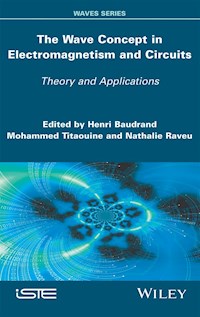
The Wave Concept Iterative Procedure (WCIP) method has found an increasing number of users within electromagnetic theory and applications to planar circuits, antennas and diffraction problems. This book introduces in detail this new formulation of integral methods, based on the use of a wave concept with two bounded operators, and applications in a variety of domains in electromagnetics. This approach presents a number of benefits over other integral methods, including overcoming the problem of singularity, and reduced computing time.
Through the presentation of mathematical equations to characterize studied structures and explanation of the curves obtained, via validated examples, the authors provide a thorough background to electromagnetism as well as a professional reference to students and researchers.
Sie lesen das E-Book in den Legimi-Apps auf:
Seitenzahl: 198
Veröffentlichungsjahr: 2016
Ähnliche



















Table of Contents
Cover
Title
Copyright
Preface
1 General Principles of the Wave Concept Iterative Process
1.1. Introduction
1.2. The iterative wave method
1.3. General definition of waves
1.4. Application to planar circuits
1.5. Applications to quasi-periodic structures
1.6. Circuits with localized components
1.7. General principles of quasi-periodic circuits
1.8. The significance of using auxiliary sources
1.9. Unidimensional circuits
1.10. Application: transmission line
1.11. Comparison of current density for different cell lengths
1.12. Bi-dimensional circuits
1.13. Two-source bi-dimensional circuits
1.14. Three-source bi-dimensional circuits
1.15. Validation examples
1.16. Lenses and meta-materials
1.17. Conclusion
2 Formulation and Validation of the WCIP Applied to the Analysis of Multilayer Planar Circuits
2.1. Introduction
2.2. WCIP formulation
2.3. Real and ideal polarizers within planar structures using WCIP
2.4. Amplifier structure of compact micro-waves
3 Applications of the WCIP Method to Frequency Selective Surfaces (FSS)
3.1. Introduction
3.2. Formulation of the iterative WCIP method
3.3. Application of the iterative WCIP method to different FSSs
3.4. Anisotropic FSS
3.5. Measurement system
3.6. Conclusion
3.7. Acknowledgments
4 WCIP Applied to Substrate Integrated Circuits: Substrate Integrated Waveguide (SIW) and Substrate Integrated Non-Radiative Dielectic (SINRD) Circuits
4.1. Introduction
4.2. Formulation of WCIP for SIC circuits
4.3. Results for SIW circuits
4.4. Results for the SINRD circuits
4.5. Conclusion
5 WCIP Convergence
5.1. Introduction
5.2. Summary of WCIP
5.3. Improvement of WCIP by mathematical techniques
5.4. Improvement of WCIP by physical considerations
5.5. Conclusions
6 Application of WCIP to Diffraction Problems
6.1. Introduction
6.2. Application
6.3. Coupling simulation
6.4. Conclusion
Bibliography
List of Authors
Index
End User License Agreement
List of Tables
1 General Principles of the Wave Concept Iterative Process
Table 1.1. Possible different dual variables
5 WCIP Convergence
Table 5.1. Choice of the initial value
4 WCIP Applied to Substrate Integrated Circuits: Substrate Integrated Waveguide (SIW) and Substrate Integrated Non-Radiative Dielectic (SINRD) Circuits
Table 4.1. Cut-off frequencies and relative error between the HFSS and WCIP for different LSE-LSM waveguide core widths
6 Application of WCIP to Diffraction Problems
Table 6.1. The various diffraction operators in the case of a single fictitious cylinder
Table 6.2. The various diffraction operators in the case of two coaxial cylinders
Guide
Cover
Table of Contents
Begin Reading
Pages
C1
iii
iv
v
ix
x
xi
xii
1
2
3
4
5
6
7
8
9
10
11
12
13
14
15
16
17
18
19
20
21
22
23
24
25
26
27
28
29
30
31
32
33
34
35
36
37
38
39
40
41
42
43
44
45
46
47
48
49
50
51
52
53
54
55
56
57
58
59
60
61
63
64
65
66
67
68
69
70
71
72
73
74
75
76
77
78
79
80
81
82
83
84
85
86
87
88
89
90
91
92
93
94
95
96
97
98
99
100
101
102
103
104
105
106
107
108
109
110
111
112
113
115
116
117
118
119
120
121
122
123
124
125
126
127
129
130
131
132
133
134
135
136
137
138
139
140
141
142
143
144
145
146
147
148
149
150
151
152
153
154
155
156
157
158
159
160
161
162
163
164
165
166
167
168
169
170
171
172
173
174
175
176
177
178
179
180
181
182
183
184
185
186
187
188
189
190
191
192
193
194
195
197
198
G1
G2
G3
G4
G5
Series Editor
Daniel Pasquet
The Wave Concept in Electromagnetism and Circuits
Theory and Applications
Edited by
Henri Baudrand
Mohammed Titaouine
Nathalie Raveu
First published 2016 in Great Britain and the United States by ISTE Ltd and John Wiley & Sons, Inc.
Apart from any fair dealing for the purposes of research or private study, or criticism or review, as permitted under the Copyright, Designs and Patents Act 1988, this publication may only be reproduced, stored or transmitted, in any form or by any means, with the prior permission in writing of the publishers, or in the case of reprographic reproduction in accordance with the terms and licenses issued by the CLA. Enquiries concerning reproduction outside these terms should be sent to the publishers at the undermentioned address:
ISTE Ltd27-37 St George’s RoadLondon SW19 4EUUK
www.iste.co.uk
John Wiley & Sons, Inc.111 River StreetHoboken, NJ 07030USA
www.wiley.com
© ISTE Ltd 2016




