


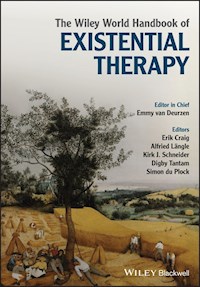
The Wiley World Handbook of Existential Therapy E-Book
41,99 €
Mehr erfahren.
- Herausgeber: John Wiley & Sons
- Kategorie: Fachliteratur
- Sprache: Englisch
An existential therapy handbook from those in the field, with its broad scope covering key texts, theories, practice, and research
The Wiley World Handbook of Existential Therapy is a work representing the collaboration of existential psychotherapists, teachers, and researchers. It's a book to guide readers in understanding human life better through the exploration of aspects and applications of existential therapy. The book presents the therapy as a way for clients to explore their experiences and make the most of their lives. Its contributors offer an accurate and in-depth view of the field. An introduction of existential therapy is provided, along with a summary of its historical foundations. Chapters are organized into sections that cover: daseinsanalysis; existential-phenomenonological, -humanistic, and -integrative therapies; and existential group therapy. International developments in theory, practice and research are also examined.
Sie lesen das E-Book in den Legimi-Apps auf:
Seitenzahl: 1616
Veröffentlichungsjahr: 2019
Ähnliche




















Table of Contents
Cover
About the Editors
Editor in Chief
Editors
Notes on Contributors
Contributors to the Introduction
Contributors to Part I
Contributors to Part II
Contributors to Part III
Contributors to Part IV
Contributors to Part V
Contributors to Part VI
Conclusions
Acknowledgments
Preface
Introduction:
What is Existential Therapy?
What is existential therapy?
Historical Foundations
Existential thought and literature
Hermeneutics
Phenomenology
Phenomenological and Existential Psychiatry
Søren Kierkegaard (1813–1855)
Friedrich Nietzsche (1844–1900)
Martin Heidegger (1989–1976)
Jean‐Paul Sartre (1905–1980), Merleau‐Ponty (1908–1961), and Simone de Beauvoir (1908–1986)
Martin Buber (1878–1965), Karl Jaspers (1883–1969), Max Scheler (1874–1928), Paul Tillich (1886–1965), Paul Ricoeur (1913–2005), and Emmanuel Levinas (1906–1995)
The schools of existential therapy
Daseinsanalysis
Existential‐phenomenological therapy
Existential‐humanistic and Existential‐integrative therapy
Logotherapy and existential analysis
Existential group therapy
Dimensions of existential practice
About the handbook
Conclusion
References
Part I: Daseinsanalysis
1 The History of Daseinsanalysis
A Preliminary Overview
Ancestry of Existential Psychotherapy
1900: A Milestone Year
Sigmund Freud: Reluctant Doctor, Unhappy Philosopher
A Philosophical Revolt: Tilling the Soil for Daseinsanalysis
Martin Heidegger: From Consciousness to Existence
Daseinsanalysis: The Birth of Existential Psychiatry, Psychology, and Psychotherapy
Fundamental Ontology: The Philosophical Foundation of Daseinsanalysis
Heidegger’s “Turn” (
Kehre
): Fundamental Ontology to the Reciprocal Openness (
Offenheit
) of Being and Dasein
References
2 Philosophy and Theory:
Daseinsanalysis – An Ontological Approach to Psychic Suffering Based on the Philosophy of Martin Heidegger
Introduction
Ludwig Binswanger: Daseinsanalytic Psychiatric Research Guided by a Transcendental‐ontological Perspective
Medard Boss: Daseinsanalysis as the endeavor to overcome the possessive subjectivism of Descartes’ philosophy in the field of medicine and psychology
Alice Holzhey: Daseinsanalysis as an Existential‐Hermeneutic Approach to Psychic Suffering
References
3 Method and Practice:
Daseinsanalytic Structure, Process, and Relationship
Introduction
The Early Years of Daseinsanalytic Psychotherapy and Training
Contemporary Daseinsanalytic Psychotherapy
Three Contemporary Approaches to Daseinsanalytic Practice
References
4 Case Studies:
A Therapist’s Search for His Own Way of Being Daseinsanalytic
Introduction
A Young Woman with Idiopathic Grand Mal Epilepsy
After a Thirty‐Year Interlude
Purgatory, Hell, or Nothing
Discussion
References
5 Key Texts in Daseinsanalysis
Introduction to Daseinsanalytic Literature in English
Annotated Bibliography
Bibliography of Key Daseinsanalytic Works in English
6 Challenges and New Developments
Developments From 1971–1990
Daseinsanalytic Voices beyond Binswanger and Boss
Erik Craig (1944–)
The International Federation of Daseinsanalysis (IFDA)
Challenges for the Future of Daseinsanalysis
References
Part II: Existential‐Phenomenological Therapy
7 History of Existential‐Phenomenological Therapy
Introduction
R.D. Laing’s contribution
Van Deurzen’s contribution
Spinelli’s contribution
Hans Cohn’s contribution
Conclusions
References
8 Existential Phenomenological Therapy:
Philosophy and Theory
Introduction
Phenomenology: Husserl
Existential Philosophy: Kierkegaard, Heidegger, Sartre
Phenomenology, Truth, and Authenticity: The Philosophical Aims of Existential‐Phenomenological Therapy
Conclusion
References
9 Existential‐Phenomenological Therapy:
Method and Practice
Skills and existential‐phenomenological therapy
Phenomenology
Principles of existential‐phenomenological practice
Epoché – discovering meaning through clarification
Horizontalization – discovering meaning through gaining perspective
Verification – discovering meaning through challenging and interpretation
Open dialogue as the agent of change
Working existentially with presenting issues
Working with themes and issues
Working with values and beliefs
Working with choice and responsibility
Working with endings and termination
The skills learning process
Conclusion
References
10 Existential‐Phenomenological Therapy Illustration:
Rahim’s Dilemma
The client
11 Key Texts in Existential‐Phenomenological Therapy
Introduction
Laing: text and critique
Emmy van Deurzen and Structural Existential Analysis
Ernesto Spinelli
The Heidegger Controversy; Why Heidegger?
12 Challenges and New Developments in Existential‐Phenomenological Therapy
Introduction
Philosophical and Political Challenges to Existential‐Phenomenological Therapy
Meaning and existential‐phenomenological therapy
Online Developments
Coaching and Pastoral Care: What is Existential Coaching?
References
Part III: Existential‐Humanistic and Existential‐Integrative Therapy
13 The History of Existential‐Humanistic and Existential‐Integrative Therapy
Early History (1958–1979)
The Middle Years (1980–1999)
Contemporary Developments (2000–current)
Emergent Trends
Conclusion
References
14 Existential‐Humanistic and Existential‐Integrative Therapy:
Philosophy and Theory
A Thumbnail Sketch of the Founders
Current Directions
EH/EI Theoretical Frameworks in Depth
Recognizing Freedom’s Limitations
Integrating Freedom and Limitation
Varied Interpretations of Experiential Encounter
A Central Concern: The Present Moment
The Cultivation of Presence
Four Core Aims Distinguishing Features of EH/EI Therapy
References
15 Existential‐Humanistic and Existential‐Integrative Therapy:
Method and Practice
Editor’s Preface
Introduction
Principles of Practice Related to Identity Formation and Personal Context
An EH Theory of Human Change Processes
Method and Practice: The Process of Therapeutic Change
Conclusion
References
16 Case Illustrations of Existential‐Humanistic and Existential‐Integrative Therapy
Introduction
The Case of Mimi
EH Couples Therapy: A Study of Mary and Jeff
The Case of Elva: I Never Thought It Would Happen to Me
The Case of Janice: An Existential‐Integrative Approach
References
17 Key Texts of Existential‐Humanistic and Existential‐Integrative Therapy
Annotated Bibliography of Key Works
References
18 Challenges and New Developments in Existential‐Humanistic and Existential‐Integrative Therapy
Introduction
Multicultural Developments in Existential‐Humanistic Therapy
Existential‐Humanistic Therapy in China
The Contemplative Heart of Existential‐Integrative Therapy
Psychotherapy and the Arts: Becoming Who We Are
Epilogue: Toward an Integrative, Awe‐Based Psychotherapy
References
Part IV: Logotherapy and Existential Analysis
19 The History of Logotherapy and Existential Analysis
Summary
Frankl’s work
The origins of Viktor Frankl’s Logotherapy
The Existential Proof – The Deportation to the Concentration Camps
A worldwide impact
The Experience of LT in Practice
Facing the Problems in the Application of Logotherapy
Questioning the Logotherapeutic Foundation in Psychopathology
The Turn Towards Phenomenology – PEA
The Substantial Change of EA: The Concept of the Fundamental Existential Motivations
Existential Analysis today
EA‐societies around the world
Logotherapy today
Acknowledgment
References
20 Logotherapy and Existential Analysis:
Philosophy and Theory
Introduction
The Anthropology of Logotherapy
The Anthropology of Existential Analysis
References
21 Logotherapy and Existential Analysis:
Method and Practice
Summary
Introduction and Basics
Indication and Duration
The Anthropological Foundation
Specific Methods
Unspecified Methods: Socratic Dialogue and Phenomenology
Therapeutic Effect of Logotherapy and Existential Analysis
References
22 Logotherapy and Existential Analysis Therapy Illustration:
Personal Existential Analysis in Clinical Practice
Joanna’s Impasse: A Story of Loss and Betrayal
The Clinical Implementation of Personal Existential Analysis
Reflecting on the PEA Process
Case Discussion
Conclusion
References
23 Key Texts:
From Frankl to Längle
Why Logotherapy and Existential Analysis?
Frankl’s Central Theme: Meaning
Will to Meaning
Meaning of Life and Meaning in Life
Frankl’s Dimensional Anthropology and Ontology
Self‐Distancing
Viktor Frankl and the Concentration Camp (Self‐transcendence)
Existential Vacuum – Frankl’s Diagnosis of the Zeitgeist
Frankl’s Logotherapeutic Techniques: Paradoxical Intention and Dereflection
Existential Analysis in Development
Modern Existential Analysis by Alfried Längle
References
24 Challenges and New Developments in Logotherapy and Existential Analysis
Introduction
Practice Developments and Challenges
Developments and Challenges in Measurement, Research, and Training
The Future Horizon of Existential Analysis and Logotherapy
References
Part V: Existential Group Therapy
25 History and Philosophy of Existential Group Therapy
Aloneness
Husserl’s phenomenology
Ontology
Nothing and annihilation
Suggestibility: Great men, and large groups
Scheler’s typology of groups
Reciprocity
Conclusion
References
26 Existential and Phenomenological Theories of Group Relations
Introduction
Psychobiographies
Awakening
Shame
Meaning
Two modes of relating
Inter‐Subjectivity and Group Analytic Psychotherapy
Conclusions
References
27 Existential Group Therapy:
Method and Practice
Introduction
Different forms of existential group therapy
Themes of existential group psychotherapy
Research findings
Methods of longer‐term existential group therapy
Conclusions
References
28 Existential Group Therapy:
Therapy Illustrations
Case study 1: GyneGals – An online support group for gynecologic cancer
Case study 2: Supervision Group with Irvin Yalom
Case study 3: Meaning‐Centered Existential Group Therapy: Discovering Meaning in Life after Traumatic Experiences
Case study 4: Existential settings and groups. Our Weekly Greencare Group
References
29 Key Texts in Existential Group Therapy
Definition of Group
Role of the Therapist
Existential Approaches
Group Membership
Health and Dialogue and Curative Factors
References
30 Challenges and New Developments in Existential Group Therapy
The survival of treatment methods
Predictors of outcome, are these the same as therapeutic factors?
Developing an inter‐subjectively based existential group therapy
Conflicting communication
Opening up to inter‐subjectivity
References
Part VI: International Developments:
Theory, Practice, and Research
31 Introduction
References
32 The Development of Existential Therapy in Scandinavia
Introduction
Denmark
SWEDEN
NORWAY
References
33 Eastern Europe and Russia
Existential Therapy in the Baltic Countries
Existential Therapy in Russia and Ukraine
The Philosophical Roots of Russian Existentialism
References
34 Southern Europe
Introduction
France
Portugal
Spain
Existential Psychotherapy in Italy
Turkey
Other Southern European Countries
The Development of Existential Psychotherapy in Israel
Conclusions
References
35 Latin American Developments
Introduction
Existential Therapy in Argentina
The Mexican School of Existential Therapy
Conclusion
References
36 An East–West Dialogue:
An outline of existential therapy development in China and related Asian countries
An Encounter
Introduction
East–West Dialogue: Existential Psychology East–West
Existential Psychology Forum
The First International Conference on Existential Psychology
The Second International Conference on Existential Psychology
The Third International Conference on Existential Psychology
The Fourth International Conference on Existential Psychology
Training
Practice
Reflection
References
37 A Review of Research on Existential‐Phenomenological Therapies
The Historical‐Philosophical Context
Epistemological position
Effectiveness research
Fundamental research on phenomenology
Applied phenomenological research
Research on existential themes
Research on therapeutic relationships and processes
Conclusions and future directions
References
38 Conclusions by the Editors
Index
End User License Agreement
List of Illustrations
Chapter 11
Figure 11.1 Dimensions of existence.
Figure 11.2 Compass of emotions.
Chapter 21
Figure 21.1 Double openness of the person as a result of double relatedness. ...
Chapter 22
Figure 22.1 The steps of the process of Personal Existential Analysis (Längle...
Chapter 23
Figure 23.1 First law of dimensional ontology: Inconsistency.
Figure 23.2 Second law of dimensional ontology: Isomorphism.
Figure 23.3 The human being as a person is in a continuous inner and outer ex...
Chapter 37
Figure 37.1 Visual overview of clinical, etiological, and therapeutic assumpt...
Guide
Cover
Table of Contents
Begin Reading
Pages
i
ii
iii
ix
x
xi
xii
xiii
xiv
xv
xvi
xvii
xviii
xix
xx
1
2
3
4
5
6
7
8
9
10
11
12
13
14
15
16
17
18
19
20
21
22
23
24
25
26
27
29
30
31
32
33
34
35
36
37
38
39
40
41
42
43
44
45
46
47
48
49
50
51
52
53
54
55
56
57
58
59
60
61
62
63
64
65
66
67
68
69
70
71
72
73
74
75
76
77
78
79
80
81
82
83
84
85
86
87
88
89
90
91
92
93
94
95
96
97
98
99
100
101
102
103
104
105
106
107
108
109
110
111
112
113
114
115
116
117
118
119
120
121
122
123
124
125
126
127
128
129
130
131
133
134
135
136
137
138
139
140
141
142
143
144
145
146
147
148
149
150
151
152
153
154
155
156
157
158
159
160
161
162
163
164
165
166
167
168
169
170
171
172
173
174
175
176
177
178
179
180
181
182
183
184
185
186
187
188
189
190
191
192
193
194
195
196
197
198
199
200
201
202
203
204
205
206
207
208
209
210
211
212
213
214
215
216
217
218
219
220
221
222
223
224
225
226
227
228
229
231
232
233
235
236
237
238
239
240
241
242
243
244
245
246
247
248
249
250
251
252
253
254
255
256
257
258
259
260
261
262
263
264
265
266
267
268
269
270
271
272
273
274
275
276
277
278
279
280
281
282
283
284
285
286
287
288
289
290
291
292
293
294
295
296
297
298
299
300
301
302
303
305
306
307
309
310
311
312
313
314
315
316
317
318
319
320
321
322
323
324
325
326
327
328
329
330
331
332
333
334
335
336
337
338
339
340
341
342
343
344
345
346
347
348
349
350
351
352
353
354
355
356
357
358
359
360
361
362
363
364
365
366
367
368
369
370
371
372
373
374
375
376
377
378
379
380
381
382
383
384
385
386
387
388
389
390
391
392
393
394
395
396
397
398
399
400
401
402
403
405
406
407
408
409
410
411
412
413
414
415
416
417
418
419
420
421
422
423
424
425
426
427
428
429
430
431
432
433
434
435
436
437
438
439
440
441
442
443
444
445
446
447
448
449
450
451
452
453
454
455
456
457
458
459
460
461
462
463
464
465
466
467
468
469
470
471
472
473
474
475
476
477
478
479
480
481
482
483
484
485
486
487
488
489
490
491
492
493
494
495
496
497
498
499
500
501
502
503
504
505
507
508
509
510
511
512
513
514
515
516
517
518
519
520
521
522
523
524
525
526
527
528
529
530
531
532
533
534
535
536
537
538
539
540
541
542
543
544
545
546
547
548
549
550
551
552
553
554
555
556
557
558
559
560
561
562
563
564
565
566
567
568
569
570
571
572
573
574
575
576
577
578
579
580
581
582
583
584
585
586
587
588
589
590
591
592
593
594
595
596
597
598
599
600
601
602
603
604
605
606
607
608
609
610
611
612
613
614
615
616
617
618
619
620
621
622
623
624
625
626
627
628
629
630
631
632
633
634
635
636
637
The Wiley World Handbook of Existential Therapy
Edited by
Emmy van Deurzen (editor in chief)Erik CraigAlfried LängleKirk J. SchneiderDigby TantamSimon du Plock
This edition first published 2019© 2019 John Wiley & Sons Ltd
All rights reserved. No part of this publication may be reproduced, stored in a retrieval system, or transmitted, in any form or by any means, electronic, mechanical, photocopying, recording or otherwise, except as permitted by law. Advice on how to obtain permission to reuse material from this title is available at http://www.wiley.com/go/permissions.
The right of Prof Emmy van Deurzen, Dr Erik Craig, Prof Alfried Längle, Dr Kirk J. Schneider, Prof Digby Tantam, and Prof Simon du Plock to be identified as the authors of the editorial material in this work has been asserted in accordance with law.
Registered Office(s)John Wiley & Sons, Inc., 111 River Street, Hoboken, NJ 07030, USAJohn Wiley & Sons Ltd, The Atrium, Southern Gate, Chichester, West Sussex, PO19 8SQ, UK
Editorial Office111 River Street, Hoboken, NJ 07030, USAFor details of our global editorial offices, customer services, and more information about Wiley products visit us at www.wiley.com.
Wiley also publishes its books in a variety of electronic formats and by print‐on‐demand. Some content that appears in standard print versions of this book may not be available in other formats.
Limit of Liability/Disclaimer of WarrantyWhile the publisher and authors have used their best efforts in preparing this work, they make no representations or warranties with respect to the accuracy or completeness of the contents of this work and specifically disclaim all warranties, including without limitation any implied warranties of merchantability or fitness for a particular purpose. No warranty may be created or extended by sales representatives, written sales materials or promotional statements for this work. The fact that an organization, website, or product is referred to in this work as a citation and/or potential source of further information does not mean that the publisher and authors endorse the information or services the organization, website, or product may provide or recommendations it may make. This work is sold with the understanding that the publisher is not engaged in rendering professional services. The advice and strategies contained herein may not be suitable for your situation. You should consult with a specialist where appropriate. Further, readers should be aware that websites listed in this work may have changed or disappeared between when this work was written and when it is read. Neither the publisher nor authors shall be liable for any loss of profit or any other commercial damages, including but not limited to special, incidental, consequential, or other damages.
Library of Congress Cataloging‐in‐Publication data is available9781119167150 (paperback), 9781119167181 (epdf), 9781119167174 (epub)
Cover design by WileyCover image: © Metropolitan Museum of Art / Wikimedia Commons
To all existential therapists worldwide, past, present, and future.
In celebration of what it is to be human,In appreciation of the thinkers who came before us,and with gratitude to those who will take up the challenges after us.
About the Editors
Editor in Chief
Emmy van Deurzen is a philosopher, psychologist, and psychotherapist who has worked as an existential therapist since 1973, both in France and the United Kingdom and has lectured on existential therapy around the world since the 1980s. She has been a professor with five universities and has contributed 17 books and hundreds of papers and chapters to the literature with her work being translated into many languages. She founded the Society for Existential Analysis, the School of Psychology and Psychotherapy at Regent’s and also the New School of Psychotherapy and Counselling at the Existential Academy in London, where she is Principal. Her best sellers include Everyday Mysteries (Routledge), Paradox and Passion in Psychotherapy (Wiley), and Existential Counselling and Psychotherapy in Practice (Sage).
Editors
Erik Craig is an existential psychologist, author, and independent scholar and practitioner. He has published over 60 articles and edited two ground‐breaking journal issues on Daseinsanalysis and existential depth psychotherapy. Having practiced for years in New England he now lives and works in Santa Fe, New Mexico. He is most interested in the intricacies of therapeutic relating, the analysis of dreams, and human affect and attachment. Having served on the full‐time faculties of several graduate psychology programs, he now lectures and trains internationally. A past president of several psychological societies, he is currently president of the New Mexico Psychoanalytic Society.
Alfried Längle, born in 1951 in Austria, has a private practice in psychotherapy, general medicine and clinical psychology in Vienna (since 1982). He had a close collaboration with Viktor Frankl from 1981 to 1991. Alfied was a founder (1983) of the International Society for Logotherapy and Existential Analysis (Vienna). He is also a faculty member and professor of Applied Psychology at the Moscow’s HSE‐university (since 2004), at Vienna’s Sigmund Freud university (2011), and Docent at the psychological department of the university of Klagenfurt, Austria. He is a founder of the state‐approved training school of Existential‐Analytical Psychotherapy, Vice President of the International Federation of Psychotherapy (2002–2010), and was, until 2017, President of the International Society for Logotherapy and Existential Analysis.
Kirk J. Schneider is a psychologist and leading spokesperson for contemporary existential‐humanistic psychology. A protégé of Rollo May and James Bugental, Kirk is past president of the Society for Humanistic Psychology of the American Psychological Association, recent past editor of the Journal of Humanistic Psychology, president of the Existential‐Humanistic Institute, and adjunct faculty at Saybrook University and Teachers College, Columbia University. Kirk is also a Fellow of the American Psychological Association and has authored or edited 12 books, including Existential‐Integrative Psychotherapy and (with Orah Krug) Existential‐Humanistic Therapy.
Digby Tantam is Emeritus Professor of Psychiatry at the University of Sheffield and Visiting Professor at Middlesex University and the New School of Psychotherapy and Counselling. He has trained in family therapy, group analysis, cognitive behavioral therapy, psychodynamic psychotherapy, and more recently in existential therapy. He has practiced and supervised other therapists in one or other of these modalities since 1977. He is a Consultant Psychotherapist and Psychiatrist, Dilemma Consultancy Ltd. He is the author of several hundred scientific papers and a dozen books, most recently The Interbrain published in 2018, (Jessica Kingsley).
Simon du Plock is Head of the Faculty of Post‐Qualification and Professional Doctorates at the Metanoia Institute, London, UK, where he leads joint PhD, DPsych, and DCPsych research programs with Middlesex University, with whom he is a professor. He lectures internationally and has authored over 80 texts and journal papers. He has edited Existential Analysis, the journal of the British Society for Existential Analysis, since 1993. In 2006 he became the first Western therapist to be made an Honorary Member of the East European Association for Existential Therapy in recognition of his contribution to the development of collaboration between East and West European existential psychotherapy.
Notes on Contributors
Contributors to the Introduction
Editors
Erik Craig and Emmy van Deurzen
Contributor
Mick Cooper is Professor of Counselling Psychology at the University of Roehampton, where he is Director of the Centre for Research in Social and Psychological Transformation (CREST). A chartered psychologist, a UKCP‐registered psychotherapist, and a Fellow of the British Association for Counselling and Psychotherapy (BACP), he is the author and editor of a range of texts on existential and relational approaches to therapy, including Existential Therapies (2e, Sage, 2017), Existential Counselling and Psychotherapy: Contributions to a Pluralistic Practice (Sage, 2015), Existential Counselling Primer (PCCS, 2012), and Working at Relational Depth in Counselling and Psychotherapy (2e, Sage, 2018, with Dave Mearns).
Contributors to Part I
Section Editor
Erik Craig, EdD is an existential psychologist, author, and independent scholar and practitioner. Erik has studied and collaborated intensively with the Daseinsanalysts Medard Boss and Paul Stern and currently practices in Santa Fe, NM.
Contributors
Loray Daws, PhD, is a clinical psychologist and psychoanalytic psychotherapist in British Columbia, Canada. She is a senior faculty member at the International Masterson Institute, NY and editor and author of various books and articles in psychoanalytic psychotherapy.
Thanasis Georgas, MD, is a psychiatrist, Daseinsanalyst, President of The Greek Society of Daseinsanalysis and IFDA board member. He has published and translated a number of important Daseinsanalytic texts and is co‐editor of the Greek journal, Eποχή/Epoché: Phenomenology‐Psychotherapy‐Hermeneutics.
Alice Holzhey‐Kunz, PhD, is a Swiss Daseinsanalyst, president of the Society for Hermeneutic Anthropology and Daseinsanalysis and co‐president of the Daseinsanalytic Seminar in Zurich. She has published three books and numerous articles on a new approach to Daseinsanalytic thought and practice.
Perikles Kastrinidis, MD, is a Swiss psychiatrist and psychotherapist in private practice, teaching and supervising Daseinsanalysts. He was trained in Daseinsanalysis under Medard Boss and also studied short‐term dynamic psychotherapy with Habib Davanloo and integrates aspects of these approaches.
Robert D. Stolorow, PhD, is a psychoanalyst, philosopher, and author of World, Affectivity, Trauma: Heidegger and Post‐Cartesian Psychoanalysis (2011) and Trauma and Human Existence (2007). Has been absorbed for a half‐century rethinking psychoanalysis as a form of phenomenological inquiry.
Contributors to Part II
Section Editor
Emmy van Deurzen,PhD, MPsych, MPhil, CPsychol, Fellow of BPS, UKCP, and BACP, is an existential therapist with Dilemma Consultancy Ltd, a Visiting Professor at Middlesex University, and Principal at the Existential Academy, London.
Contributors
Martin Adams, BSc, MA, ADEP, BACP (reg.), and UKCP (reg.) is an existential psychotherapist, supervisor, and writer whose most recent book is An Existential Approach to Human Development. He is a lecturer at the New School for Psychotherapy and Counselling and is also a sculptor.
Claire Arnold‐Baker, BSc(Hons), MA, DCPsych, UKCP, and HCPC (reg.) is DCPsych Course Leader at NSPC, where she is also a lecturer, and a clinical and research supervisor. Claire is a counselling psychologist and existential psychotherapist who specialises in perinatal therapy in her private practice.
Laura Barnett, MA(Oxon), MA, MBACP (Sen. Accred.), UKCP (reg.), is an existential psychotherapist; for almost 20 years, she has two specialist services that she set up in the National Health Service (UK). She is editor of two books for Routledge on the dialogue between existential thought and therapeutic practice.
Chris Blackmore, BSc, MA, DipCoun, PhD, is a Senior University Teacher at the University of Sheffield. He has developed online psychotherapy training resources and has a special interest in the role of emotions in e‐learning.
Edgar Correia, PhD, AdvD, Post‐MA, MA, PgD, is a clinical psychologist and psychotherapist, a founding member of Portuguese Society for Existential Psychotherapy, and researcher at the Applied Psychology Research Center.
Helen Hayes, MA, UKCP Reg., BACP (Sen. Accred.), is an existential psychotherapist, lecturer, and clinical supervisor at the NSPC. She works in several voluntary sector and National Health Service (UK) services, and in private practice.
Ann Lagerström is a senior leadership consultant, certified existential coach, and writer. She studied existential philosophy and psychology at Södertörn University and at the Society for Existential Psychotherapy at an advanced level. She introduced existential coaching in Sweden.
Neil Lamont, DCPsych, CPsychol, BA (Hons), is a chartered psychologist and existential psychotherapist based in London, UK. Neil is a practitioner, tutor, and doctoral research supervisor at the Existential Academy.
Sasha van Deurzen‐Smith, MA, is an existential coach specializing in creativity, self‐esteem, and autism spectrum disorders. She is program leader of the MA in Existential Coaching at the New School of Psychotherapy and Counselling.
Simon du Plock, FRSM, AFBPsS, CPsychol, CSci, is Head of the Faculty of Post‐Qualification and Professional Doctorates at the Metanoia Institute, London, UK, where he leads joint DPsych, DCPsych, and PhD research programs with Middlesex University with whom he is a professor.
Alison Strasser, DProf (Psychotherapy & Counselling) UKCP, PACFA, AAOS, is a psychotherapist, supervisor, coach, and Educator. She is also the Director of the Centre for Existential Practice in Sydney, Australia.
Digby Tantam, MA, MPH, PhD, FRCPsych, FBPsS, FBACP, UKCPF, FHEA, is Deputy Principal of the New School of Psychotherapy and Counselling at the Existential Academy in London and Consultant Psychotherapist and Psychiatrist at Dilemma Consultancy Ltd., Visiting Professor, Middlesex University, and Emeritus Professor of Psychiatry, University of Sheffield
Joel Vos, PhD, is psychologist and philosopher, program leader for the professional Doctorate in Existential Psychotherapy and Counselling at New School of Psychotherapy and Counselling, researcher at Metanoia, and chair of IMEC Meaning Conferences.
Contributors to Part III
Section Editor
Kirk J. Schneider, PhD, is a leading spokesperson for existential‐humanistic psychology. A protégé of James Bugental and Rollo May, Kirk is president of the Existential‐Humanistic Institute and has authored 12 books.
Contributors
Ken Bradford, PhD, is a Contemplative‐Existential Psychologist. Publications include: The I of the Other: Mindfulness‐Based Diagnosis & the Question of Sanity; and Listening from the Heart of Silence.
Nathaniel Granger, Jr., PsyD is the President‐elect of the Society for Humanistic Psychology (American Psychological Association, Division 32) and is an Adjunct Faculty member at Saybrook University.
Louis Hoffman, PhD, is a licensed psychologist practicing in Colorado Springs, CO. He teaches at Saybrook University and through the International Institute for Existential‐Humanistic Psychology.
Theopia Jackson, PhD, is Professor of Psychology and Director of the clinical psychology program at Saybrook University.
Orah T. Krug, PhD, has a psychotherapy practice in Oakland, CA, is the author of texts on existential‐humanistic therapy and supervision, and is the past Program Director of Clinical Training and Education at the Existential Humanistic Institute, current Director of Krug Counseling, and Adjunct Professor at Saybrook University.
Ed Mendelowitz is a clinician, essayist, and psychologist living and working in Boston, MA. He received the Rollo May Award for “independent and outstanding pursuit of new frontiers in humanistic psychology.”
Shawn Rubin, PsyD is in independent Private Practice with children, adolescents, adults, and families, Is LGBTQIA and kink‐competent, and is the chief editor of the Journal of Humanistic Psychology.
Ilene A. Serlin, PhD., BC‐DMT, is an existential‐humanistic psychologist and dance therapist in San Francisco and Marin, Fellow of the American Psychological Association, past‐President of the Society for Humanistic Psychology, and editor of Whole Person Healthcare.
Xuefu Wang, PhD, is founder and Director of the Zhi Mian Institute for Existential Therapy in Nanjing, China.
Irvin Yalom is Professor Emeritus of psychiatry at Stanford University and author of Existential Psychotherapy and Staring At the Sun.
Mark Yang is co‐founder and Director of the International Institute of Existential‐Humanistic Psychology.
Contributors to Part IV
Section Editor
Alfried Längle, MD, PhD, MSc, holds multiple honorary Doctorships, multiple honorary Professorships, Professor for Applied Psychology (HSE Moscow), guest professor for psychotherapy (SFU Vienna), and founder of GLE‐International (Society of Logotherapy and Existential Analysis).
Contributors
Emmanuel J. Bauer, Mag. Dr. Phil., Mag. Theol., psychotherapist (Existential Analysis), Professor for Philosophy, and Director of the Department of Philosophy at the Catholic theological faculty of the University of Salzburg.
Barbara Gawel, is a Doctor of Public Health, Master of Educational Science, and a psychotherapist in Vienna.
Derrick Klaassen, PhD, R. Psych., is an Assistant Professor of Counselling Psychology, Trinity Western University, Langley, BC, Canada.
Janelle Kwee, PsyD, RPsych, is an Associate Professor, Trinity Western University, a registered psychologist in private practice, Langley, BC, Canada.
Silvia Längle, Ph.D., chief editor of Existenzanalyse‐Journal, trainer, supervisor, psychotherapist in own practice. She has a special interest in phenomenological research.
Mihaela Launeanu, PhD, Assistant Professor at Trinity Western University, psychotherapist in private practice in Vancouver, Canada.
Bruce A. Muir, CD, BA, BSW, MA, RSW, is a family therapist, Comox Valley, British Columbia, Canada.
Claudia Reitinger, MA Biology, PhD Philosophy, is a psychotherapist in private practice in St Johann/Pongau.
Karin Steinert, MA Psychology, is a psychotherapist in private practice in Vienna.
Contributors to Part V
Section Editor
Digby Tantam, MA, MPH, PhD, FRCPsych, FBPsS, FBACP, UKCPF, FHEA, is: Deputy Principal of the New School of Psychotherapy and Counselling at the Existential Academy in London; Consultant Psychotherapist and Psychiatrist, Dilemma Consultancy Ltd.; Visiting Professor, Middlesex University; and Emeritus Professor of Psychiatry, University of Sheffield
Contributors
Lynda Ansell has been a member of Slough therapeutic community for three years and has completed training with the Royal College of Psychiatrists as a Community of Communities peer reviewer. She also a peer mentor with Hope Recovery College.
Catherine C. Classen, PhD, CPsych., works for the Women’s College Hospital, Toronto.
Emmy van Deurzen, PhD, CPsychol, FBPsS, is an existential psychotherapist who has worked with groups since the early 1970s. She is the Principal of the School of Psychotherapy and Counselling at the Existential Academy in London.
Marie S. Dezelic, PhD, PsyD, MS, LMHC, CCTP, CFTP, CCFP, NCLC, CFRC, NCAIP, Diplomate in Logotherapy, is an author, educator, and has a private psychotherapy, coaching, and consulting practice. Her clinical research focuses on an integrative meaning approach in trauma, grief, spirituality, relationships, and psycho‐oncology.
Rex Haigh, is an National Health Service Consult (UK) consultant psychiatrist in medical psychotherapy in Berkshire. He has been in therapeutic communities as a medical student, a junior doctor, and for the last 24 years as a consultant. He has particular interests in co‐creation, “personality disorders,” and critical psychiatry.
Sarah Hamilton studied with the Bridge Pastoral Foundation at Douai Abbey to qualify as an Integrative Psychotherapist, and came along to the greencare group for the day as a professional visitor.
Orah T. Krug, PhD, is in private practice and is also the author of texts on Existential‐Humanistic therapy and supervision. She is the past Program Director of Clinical Training and Education at the Existential Humanistic Institute, Director of Krug Counseling, and Adjunct Professor at Saybrook University.
Simone Lee, Adep, UKCP (reg.), MBACP, works as an existential phenomenological therapist and supervisor in private practice in London. She also works as a supervisor, tutor, and group facilitator in London‐based training colleges.
Fiona Lomas went through the non‐residential therapeutic community in Buckinghamshire several years ago. She then worked with the national personality disorder program and local services as an expert by experience, and greencare coordinator.
Sharon Tizzard has been under Slough mental health services for seven years and feels she has now (nearly) “come out the other side.” She is a buddy, a peer mentor, and a Community of Communities peer reviewer.
Hilary Welsh is an Integrative Psychotherapist registered with BACP who works as a volunteer with Growing Better Lives CIC. Hils has always worked with youth and communities, and now works in private practice.
Contributors to Part VI
Section Editor
Professor Simon du Plock is Head of the Faculty of Post‐Qualification and Professional Doctorates at the Metanoia Institute, London, UK, where he leads joint DPsych, DCPsych, and PhD research programs with Middlesex University.
Contributors
Lennart Belfrage, PhD Psychology of Religion, MA Existential Psychology, is a certified psychologist and has a private practice in Helsingborg, Sweden.
Lodovico E. Berra, MD, psychiatrist, and existential psychotherapist, is a Director of the Institute of Philosophy, Psychology, Psychiatry (ISFiPP).
Edgar A. Correia, PhD, AdvDipExPsy, MA, PgD, is a clinical psychologist and psychotherapist, as well as a founding member of Social Psychiatry and Psychiatric Epidemiology (SPPE).
Anders Dræby Sørensen, DProf, is a philosopher and existential therapist and supervisor in private practice. He is a lecturer at the Universities of Copenhagen and Aarhus.
Evgenia T. Georganda, PsyD, ECP, is a clinical psychologist‐psychotherapist and a founding member and chief administrator of the Hellenic Association for Existential Psychology.
Bo Jacobsen, DPhil, PhD, is a psychologist and existential therapist, Copenhagen, Denmark and a Professor at the University of Copenhagen.
Jak Icoz clinical psychologist and existential therapist is also a founder of the Existential Academy of Istanbul.
Rimantas Kočiūnas, PhD, is Professor of the University of Vilnius, Director of the Institute of Humanistic and Existential Psychology, Birstonas, Lithuania, and Secretary General of the East European Association for Existential Therapy.
Dmitry Leontiev, PhD, Dr. Science, Professor of Psychology, Moscow State University, and is President of the Institute of Existential Psychology and Life Enhancement, Moscow.
Gideon Menda, Dr. of existential psychotherapy, and co‐founder and head of the postgraduate existential psychotherapy program at Kibbutzim College, Tel‐Aviv, Israel.
Yaqui Andrés Martínez Robles, PhD in Psychotherapy, and Founder of the Círculo Existencial México.
Yali Sar Shalom, MA, is an existential psychotherapist, and co‐founder and coordinator of the postgraduate existential psychotherapy program at Kibbutzim College, Tel‐Aviv, Israel.
Susana Signorelli, is a psychologist and President of the Latin‐American Association of Existential Psychotherapy.
Joel Vos, PhD, is a psychologist, philosopher, researcher, and lecturer at Metanoia Institute, London and New School of Psychotherapy and Counselling, London. He is also the Director of Meaning Online.
Semjon Yesselson, is Chair of the Board of the International Institute of Existential Consultancy (MIEK) – Russia, Ukraine, Kazakhstan and is also Editor‐in‐chief of the journal Existential Tradition: Philosophy, Psychology, Psychotherapy.
Xuefu Wang, PhD, is founder and leading psychotherapist of the Zhi Mian School of Counselling and Psychotherapy, which offers a Chinese existential approach to psychotherapy and cultural transformation.
Conclusions
Emmy van Deurzen, Kirk J. Schneider, Alfried Längle, Digby Tantam, Simon du Plock, and Erik Craig.
Acknowledgments
The editors would like to express their appreciation for the work that was put into this handbook by all the contributors to the various parts of the book. Without their expertise and dedication to existential therapy this book could not have been produced. We are particularly grateful to Mick Cooper for having worked so closely with us in writing the “Introduction.” We are also grateful to the anonymous reviewers of the first draft of this book. Their feedback made us think about our writing in a new way and was helpful in improving the standard of the book. Any and all mistakes and failings of the book remain our own. We look forward to having further feedback after publication and to producing a much more complex, updated second edition of the book some time in the future.
Preface
This volume, which we can finally hold in our hands, is the joint achievement of a large group of people who have worked as existential psychotherapists, teachers, and researchers separately and independently in our own cultures for decades. Now, inspired by the First World Congress for Existential Therapy, we have found ourselves working together like members of a big family who are all inspired by the same desire to understand life and human existence better. We share the same goal of finding out how to gain and give greater access to the life knowledge and living wisdom that have been gathered over so many years, in order to pass these on to our clients and patients, our colleagues, our students, and indeed to ourselves, seeking to throw some much‐needed light in the darkness.
Together we have worked on this amazing and unprecedented project for many months and we have savored the different textures, shapes, and flavors of existential therapy that it has brought out into the open. We hope that the rich international and multicultural vista that has unfolded will make the field both more accessible and more faithful to its founding vision.
We are all equally passionate about existential therapy and we have read many of the same original texts and have felt touched and inspired by them. Yet we each represent a different aspect of the many existential ways of working, in the same way in which individuals differ from each other.
In true phenomenological tradition, by bringing together these different facets of existential therapy we have been able to create a more accurate, in‐depth picture of our field and have been able to cover a broader and wider area than any one of us might have done individually.
We have gained greater perspective by acknowledging our differences and we have found surer ground under our feet by recognizing our profound similarities. The entire project has been a fascinating adventure of discovery for all of us and we now offer you our varied views with the joy and pleasure of seeing them so closely bound together in one volume.
We hope that the clarity that this book brings will add focus and definition to your way of working. Yet we are adamant that the book, far from restricting or normalizing the existential method, will paradoxically provide greater freedom for each of us to practice in our own individual manner, which may vary with each of our cultures, each of our backgrounds, each of our clients, each of our moments of practice. Existential therapy is a therapy of continuous change and diversity.
Committing to an experience‐near‐philosophical understanding of the human troubles with which our clients struggle, we celebrate the condition we all have in common: that of being present on this earth for the briefest of time and of aiming to make the most of the challenges and possibilities we encounter.
We entrust this volume to you, reader, in the hope that it will throw light on your path in the same way it has done for us, who edited and wrote it.
Emmy van Deurzen, Erik Craig, Alfried Längle,Kirk J. Schneider, Digby Tantam, Simon du Plock, January 2019
Introduction: What is Existential Therapy?
Mick Cooper, Erik Craig, and Emmy van Deurzen1
What should we do with these lives that we have? These existences? Borne out of nothingness, hurtling towards annihilation…. How can we make sense of these fragile, fleeting moments of existence that we have been given? More precisely, how can we do justice to the being that has been bestowed upon us? This incomprehensible, awesome gift that is so easy to lose sight of: buried beneath the detritus of everyday mundanity.
Different therapies focus – no doubt helpfully – on different things. The cognitive approaches, for instance, explore our thoughts and our misperceptions; the psychodynamic approaches turn to our pasts and our modes of relating. But it is only in the existential therapies where our being – as a complex, whole gestalt – is taken as the focus of the work. Existential therapies explore our lives, as an engagement with existence and the world: they explore what it means to ex‐ist, to stand out in the world. They investigate what it means to be here, right now, as a living being. Faced with choices, dilemmas and limitations existential therapies ask what it means to be human and how to best tackle our challenges, obstacles and problems. They explore – with courage, openness, and humility – the very grounds of human being.
What is existential therapy?
So what, actually, is existential therapy? In 2014 and 2015, a group of leading international existential therapists facilitated by Stephen Diamond, under the auspices of the World Confederation for Existential Therapy, worked together to create a broad definition of the existential approach (see http://www.existentialpsychotherapy.net/definition‐of‐existential‐psychotherapy/). After two years, and following numerous discussions, disagreements, and revisions, they reached a consensually agreed statement on the nature of existential therapy. This remains the most collaborative and comprehensive description of the approach available to date, albeit one likely to continue developing over time. Due to its historical significance, we reproduce it here in its entirety. The statement begins:
Existential therapy is a philosophically informed approach to counselling or psychotherapy. It comprises a richly diverse spectrum of theories and practices. Due partly to its evolving diversity, existential therapy is not easily defined. For instance, some existential therapists do not consider this approach to be a distinct and separate “school” of counselling or psychotherapy, but rather an attitude, orientation, or stance towards therapy in general. However, in recent years, existential therapy is increasingly considered by others to be a particular and specific approach unto itself. In either case, it can be said that though difficult to formalize and define, at its heart, existential therapy is a profoundly philosophical approach characterized in practice by an emphasis on relatedness, spontaneity, flexibility, and freedom from rigid doctrine or dogma. Indeed, due to these core qualities, to many existential therapists, the attempt to define it seems contradictory to its very nature.
As with other therapeutic approaches, existential therapy primarily (but not exclusively) concerns itself with people who are suffering and in crisis. Some existential therapists intervene in ways intended to alleviate or mitigate such distress when possible and assist individuals to contend with life’s inevitable challenges in a more meaningful, fulfilling, authentic, and constructive manner. Other existential therapists are less symptom‐centered or problem‐oriented and engage their clients in a wide‐ranging exploration of existence without presupposing any particular therapeutic goals or outcomes geared toward correcting cognitions and behaviors, mitigating symptoms or remedying deficiencies. Nevertheless, despite their significant theoretical, ideological and practical differences, existential therapists share a particular philosophically‐derived worldview which distinguishes them from most other contemporary practitioners.
Existential therapy generally consists of a supportive and collaborative exploration of patients’, or clients’, lives and experiences. It places primary importance on the nature and quality of the here‐and‐now therapeutic relationship, as well as on an exploration of the relationships between clients and their contextual lived worlds beyond the consulting room. In keeping with its strong philosophical foundation, existential therapy takes the human condition itself – in all its myriad facets, from tragic to wondrous, horrific to beautiful, material to spiritual – as its central focus. Furthermore, it considers all human experience as intrinsically inseparable from the ground of existence, or “being‐in‐the‐world,” in which we each constantly and inescapably participate.
Existential therapy aims to illuminate the way in which each unique person – within certain inevitable limits and constraining factors – comes to choose, create and perpetuate his or her own way of being in the world. In both its theoretical orientation and practical approach, existential therapy emphasizes and honors the perpetually emerging, unfolding, and paradoxical nature of human experience, and brings an unquenchable curiosity to what it truly means to be human. Ultimately, it can be said that existential therapy confronts some of the most fundamental and perennial questions regarding human existence: ‘Who am I?’ ‘What is my purpose in life?’ ‘Am I free or determined?’ ‘How do I deal with my own mortality?’ ‘Does my existence have any meaning or significance?’ ‘How shall I live my life?’
The statement goes on to describe existential therapy in practice.
Existential therapists see their practice as a mutual, collaborative, encouraging and explorative dialogue between two struggling human beings – one of whom is seeking assistance from the other who is professionally trained to provide it. Existential therapy places special emphasis on cultivating a caring, honest, supportive, empathic yet challenging relationship between therapist and client, recognizing the vital role of this relationship in the therapeutic process.
In practice, existential therapy explores how clients’ here‐and‐now feelings, thoughts and dynamic interactions within this relationship and with others might illuminate their wider world of past experiences, current events, and future expectations. This respectful, compassionate, supportive yet nonetheless very real encounter – coupled with a phenomenological stance – permits existential therapists to more accurately comprehend and descriptively address the person’s way of being in the world. Taking great pains to avoid imposing their own worldview and value system upon clients or patients, existential therapists may seek to disclose and point out certain inconsistencies, contradictions or incongruence in someone’s chosen but habitual ways of being…. [The] therapeutic aim is to illuminate, clarify, and place these problems into a broader perspective so as to promote clients’ capacity to recognize, accept, and actively exercise their responsibility and freedom: to choose how to be or act differently, if such change is so desired; or, if not, to tolerate, affirm and embrace their chosen ways of being in the world.
Existential therapy does not define itself predominantly on the basis of any particular predetermined technique(s). Indeed, some existential therapists eschew the use of any technical interventions altogether, concerned that such contrived methods may diminish the essential human quality, integrity, and honesty of the therapeutic relationship. However, the one therapeutic practice common to virtually all existential work is the phenomenological method. Here, the therapist endeavors to be as fully present, engaged, and free of expectations as possible during each and every therapeutic encounter by attempting to temporarily put aside all preconceptions regarding the process. The purpose is to gain a clearer contextual in‐depth understanding and acceptance of what a certain experience might signify to this specific person at this particular time in his or her life.
The overall purpose of existential therapy, then, “is to allow clients to explore their lived experience honestly, openly and comprehensively.” It provides clients with an opportunity to look at their lives in depth and detail, and to find ways forward that may be more satisfying, fulfilling and rewarding. Existential therapy does not provide easy answers. From an existential perspective, there are no quick solutions. But through persistence, courage, and a willingness to look into the darkness, clients can be helped to make the most of the lives that they have.
Historical Foundations
Most forms of contemporary existential psychotherapy owe their ancestry to the confluence of two distinguished streams of European thought and practice: first, to the contemplative, wisdom traditions of continental philosophy of nineteenth‐century existential thought, hermeneutics, and phenomenology, and, second, to the psychological healing traditions of depth psychology.
The philosophical ground for the very possibility of existential psychotherapy, well before it appeared as such, was laid by the venerable wisdom traditions of ancient Greece and Rome, but also in Persia, India, China, and Japan, which continue to inspire many existential therapists today. These old philosophies each describe human existence in their own way in order to arrive at better ways of living by entering into dialogue. All these philosophers, including Socrates, Plato, Aristotle, Epicurus, and Zeno in the West and Zoroaster, Buddha, Confucius, Laozi, and many others in the East were committed to helping people live more thoughtfully and deliberately by having a clearer grasp of what life was about.
The psychological healing tradition of depth psychology also owes is origins to a synthesis of traditions, namely the religio‐magical and medical‐scientific healing traditions, both of which gradually developed through centuries of irregular but unrelenting progress going back to the Greeks and before (Ellenberger 1970). Over the centuries following the Asklepion healing temples of ancient Greece, pre‐scientific mystical cures were performed both locally and regionally by various shamanistic, religious, and popular healers. It was not until Franz Mesmer (1734–1815) that a few notable physicians began developing more medical‐scientific approaches to relieving psychological suffering. Although Mesmer’s early medical efforts were initially abandoned they were picked up nearly a century later by the French physicians Jean‐Martin Charcot (1825–1893) and Pierre Janet (1859–1947), the German Neurologist Hippolyte Bernheim (1840–1919), and, eventually, Sigmund Freud, the founder of modern depth psychotherapy.
Whether speaking of either the wisdom or healing dimensions of practice, for existential therapists the notion of depth manifests in fundamental questions about human existence. Who are we? Why do we suffer? How might we best live while knowing in our living that we “owe” life our death? Even partial answers to these questions remain largely hidden from view, inaccessible. Eugen Bleuler (1910) was the first to refer to the scientific concern with this hiddenness as “depth psychology” (Tiefenpsychologie, p. 623). However, for phenomenologically oriented existential psychotherapists, the term depth psychology is understood spiritually or metaphorically and not in any substantial or topographical sense. The hermeneutic significance of depth is in its reference to the ontologically given circumstance that human existence is both finite and mysterious. Heidegger called the human being’s phenomenologically given worldedness a clearing (Lichtung) that is simultaneously disclosive and concealing. When existential thinkers raise foundational questions about human existence, they know from the beginning that they do so in the face of two inescapable ontological conditions: our inherent human finitude and the fact that, as Heraclitus asserted, “things keep their secrets” (2001, p. 9).
The more ancient grounds for existential psychotherapy mentioned above lay largely fallow over many centuries, only to be tilled anew by three auspicious nineteenth‐century intellectual developments in Europe, namely, early existential thought and literature, hermeneutics, and phenomenology.
Existential thought and literature
Born on the heels of Romanticism and the Enlightenment, existential thinking first re‐appeared in the philosophical and creative literatures of the nineteenth century. Philosophically speaking, the works of Arthur Schopenhauer (1788–1860), So¨ren Kierkegaard (1813–1855), and Friedrich Nietzsche (1844–1900) variedly but significantly influenced such twentieth century existential thinkers as Heidegger, Camus, Sartre, Jaspers, Buber, and Tillich. Schopenhauer, Kierkegaard, and Nietzsche issued an implicit invitation to philosophers, psychologists, and lay persons alike to pay more attention to the human condition in its everydayness and especially in its problematic and paradoxical nature. For Schopenhauer that meant an emphasis on will, destiny, desire, love, sexuality, and human suffering; for Kierkegaard the focus was on individuality, subjectivity, anxiety, choice, responsibility, despair, and spiritual commitment; and for Nietzsche the important issues were fate, tragedy, power, transcendence, individuality, morality, and will.
Concurrent with these philosophers, the great nineteenth Century philo‐psychological novelists, poets, and playwrights like Johann Wolfgang von Goethe (1749–1832), Fyodor Dostoyevsky (1821–1881), and Hendrik Ibsen (1828–1906) embodied these same ideas in the characters they created. Faust, Werther, Raskolnikov, Prince Mishkin, the nameless protagonist of Notes from the Underground, Brand, Peer Gynt, Hedda Gabler, and The Master Builder, and Halvard Solness were all existential “heroes” who suffered human tragedies with which readers could resonate. They brought to life the new philosophical understanding and applied it to daily life, in the same way the ancient Greek philosophers were mirrored by the famous Greek tragedies. This combination of philosophers and writers helped prepare Western culture for what was to become, in the twentieth century, a concentrated gathering of philosophies concerned with the human condition, broadly referred to as existential philosophy.
Yet, in science and philosophy, ideas are not enough. Epistemology, new ways of investigating, knowing, and understanding are also necessary, and it was two new “sciences of understanding and knowing” that became most critical for the development of existential psychotherapy, namely hermeneutics and phenomenology.
Hermeneutics
Hermeneutics, as the art, science, and practice of interpretation precedes by millennia the practice of phenomenology, which itself is the predominant method of existential psychotherapy. The Greek verb hermēneuein means to interpret or to translate and refers to a process or method that aims to understand the implicit meaning of things, not only that which appears at first glance but also that which shows itself only gradually over time with a continuing, openly reflective gaze. To be hermeneutic is to be concerned with grasping, understanding, and translating meanings, especially those secreted meanings hibernating within the things themselves. The term is widely thought to be derived from the name of the Olympic god, Hermes, who was the emissary of the gods, passing and translating messages between gods as well as between gods and men. Palmer (1969) notes that “the Greek word, hermeois referred to the priest at the Delphic Oracle” (p. 13). Heidegger also noted the relation of the word hermeneutic to the name Hermes in his 1923 summer course on Ontology – The Hermeneutics of Facticity (1988/1999) while also acknowledging the ultimate obscurity of its etymology. In any case, it is not known whether the word was derived from the name of the god or the name of the god from the word. Thus, appropriately enough in this case, Hermes was also known as a trickster.
Hermeneutic practice today refers to the process by which we gain an understanding of the meaning of things, particularly the hidden or so‐called deep meanings. It is a way of making explicit what is implicit and of putting text into its context, while also revealing its so‐called subtext. By paying close attention to what is initially hermetically sealed, we read the hidden depths of messages in order to bring them into awareness and understanding. One might say hermeneutics is a process of enlarging our awareness, moving, from mystery to meaning, from silence to speech, or from the concealed to the unconcealed.
Early use of the term hermeneutics is most commonly traced back to Aristotle’s Peri hermēnaias (On Interpretation). Although popularly associated with biblical exegesis, historically the use of the term also came to apply to interpretation in philology, jurisprudence, linguistics, and philosophy. The early‐nineteenth‐century German philosopher Friedrich Schleiermacher (1768–1834) established hermeneutics as a science in and of itself, independent of any particular discipline and coined the term “the hermeneutic circle” to designate the ongoing reciprocal contribution of the part and the whole, the word and the sentence, the phenomenon and its context in all human understanding. An admirer and biographer of Schleiermacher, Wilhelm Dilthey (1833–1911) made the practice more widely accessible. Dilthey is still most widely recognized and remembered for his distinction between the natural sciences (Naturwissenschaften) and the human sciences (Geisteswissenschaften) first made in his Introduction to the Human Sciences (1883/1989). The following year, in Ideas for a Descriptive and Analytic Psychology, he explicated his focus on Life as it is lived and proposed hermeneutics as the only appropriate approach to the study of human beings (Geisteswissenschaften), particularly with reference to his own descriptive approach to psychology called the psychology of understanding (Verstehens‐Psychologie). Dilthey’s work was devoted to an understanding of life, life itself, the meaning of our actually lived experience (Erlebnis




