



0,49 €
Niedrigster Preis in 30 Tagen: 1,99 €
Niedrigster Preis in 30 Tagen: 1,99 €
Mehr erfahren.
- Herausgeber: Booksell-Verlag
- Kategorie: Fantasy und Science-Fiction
- Sprache: Englisch
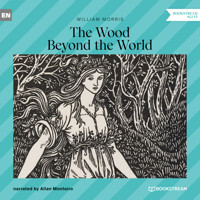
"The Wood Beyond the World" is a seminal work by William Morris that intricately weaves elements of fantasy, romance, and medievalism into a rich narrative tapestry. Written in 1894, the novel unfolds the adventures of Walter, a man who ventures into a mystical forest, a realm that serves as both a physical and metaphorical journey. Morris employs a lyrical and archaic prose style, reminiscent of Old English literature, punctuating the text with vivid imagery and a deep appreciation for nature, which reflects the author's socialist beliefs and desire for a more harmonious existence. The story resonates with themes of love, self-discovery, and the quest for meaning, positioning it firmly within the context of the Romantic and Pre-Raphaelite movements that influenced Morris's artistic development. William Morris was not only a writer but also a designer, activist, and key figure in the Arts and Crafts Movement. His fascination with the medieval world and a yearning for a simpler, more beautiful existence deeply informed his literary creations. Influenced by his socialist ideals and the Industrial Revolution's impact on society, Morris sought to advocate for a return to craftsmanship and authenticity, which can be clearly seen in the lush, detailed landscapes and rich characterizations that populate "The Wood Beyond the World." For readers seeking an escape into a beautifully rendered fantasy filled with moral and philosophical depth, Morris's "The Wood Beyond the World" presents an exquisite experience. Its exploration of longing and the sublime nature of existence invites readers to reflect on their own lives while enjoying the enchanting journey into a world that feels both timeless and relevant. This novel is a must-read for those interested in the intersection of art, literature, and social thought. In this enriched edition, we have carefully created added value for your reading experience: - A succinct Introduction situates the work's timeless appeal and themes. - The Synopsis outlines the central plot, highlighting key developments without spoiling critical twists. - A detailed Historical Context immerses you in the era's events and influences that shaped the writing. - An Author Biography reveals milestones in the author's life, illuminating the personal insights behind the text. - A thorough Analysis dissects symbols, motifs, and character arcs to unearth underlying meanings. - Reflection questions prompt you to engage personally with the work's messages, connecting them to modern life. - Hand‐picked Memorable Quotes shine a spotlight on moments of literary brilliance. - Interactive footnotes clarify unusual references, historical allusions, and archaic phrases for an effortless, more informed read.
Das E-Book können Sie in Legimi-Apps oder einer beliebigen App lesen, die das folgende Format unterstützen:
Veröffentlichungsjahr: 2019
Ähnliche











The Wood Beyond the World
Table of Contents
Introduction
A man crosses from the known world into a forested realm where desire, power, and freedom contend for mastery.
William Morris’s The Wood Beyond the World is a classic not because it pioneered the fantastic—older romances and fairy tales did that—but because it helped reassert the serious literary possibilities of invented worlds in modern English prose. Its status rests on the coherence of its imagined setting, the moral pressure exerted by its conflicts, and the deliberate craft of its style, which recalls medieval romance while speaking to nineteenth-century readers. The novel’s combination of quest narrative, symbolic landscape, and ethical testing has remained influential for readers who look to fantasy for more than escapism.
Morris (1834–1896) is best known as a poet, designer, and leading figure of the Arts and Crafts movement, and he also wrote a sequence of prose romances late in his life. The Wood Beyond the World was first published in 1894, during a period when Morris was experimenting with narrative forms that turned away from contemporary realism toward revived medieval and mythic modes. Written in English that is intentionally archaic in flavor, it aims to evoke the cadence of older storytelling rather than the idiom of the Victorian novel.
The central premise is straightforward and inviting: a merchant named Golden Walter leaves his familiar life after personal turmoil and ventures by sea into strange lands. What begins as flight becomes a journey of discovery, in which the boundaries between commerce and chivalry, appetite and conscience, are tested. The title’s “wood” is not merely a backdrop but a threshold, a space that signals a change in the rules of ordinary life. Within that altered landscape, Walter encounters forces that promise wonder and peril in equal measure.
Morris’s romance draws on medieval sources and the broader tradition of quest literature, yet it is not a simple imitation. It uses the spare directness and patterned movement of earlier tales—departures, trials, meetings, reversals—to build a narrative whose pleasures are structural as well as imaginative. The prose often feels ceremonial, as though events were being set down for a communal memory rather than private confession. That effect gives the story a fable-like clarity while still allowing complexity in motivation and consequence.
One reason the book endures is its handling of desire as a shaping power. The narrative does not treat longing as merely romantic ornament, but as an energy that can distort judgment, unsettle social ties, and provoke courage or cruelty. Against that pressure, Morris stages questions of self-command and responsibility that remain recognizable regardless of setting. The forest and the courtly spaces beyond it become arenas where inner impulses are made visible as outward choices, and where the cost of those choices cannot be wished away.
Equally enduring is Morris’s preoccupation with power—who holds it, how it is maintained, and what it does to those who seek it. The romance format allows him to externalize power in vivid figures and locations, but the stakes are not purely political. Control over others, possession, and the urge to dominate appear alongside the more constructive forms of authority that arise from loyalty, skill, and mutual obligation. In that tension, the book explores freedom not as abstract ideal but as lived condition, negotiated under pressure.
Morris’s influence is often discussed in relation to the later development of modern fantasy in English. Without claiming single-handed origin, The Wood Beyond the World stands as an important example of a consciously secondary world in which the setting is not allegorical shorthand but a fully functioning environment for story. That achievement helped demonstrate that romances could be written for modern audiences with seriousness and artistic intent. Later writers who valued mythic structure, invented geographies, and a sense of archaic depth found in Morris a model of possibility.
The novel also reflects the Arts and Crafts imagination that shaped Morris’s work across media. His attention to making—whether in textiles, printing, or poetic form—has an analogue here in the careful construction of scenes and the tactile sense of place. Landscapes, dwellings, and objects carry weight not as decorative inventory but as signs of how a world is lived in and labored upon. This emphasis can make the romance feel grounded even when it turns most strange, and it quietly asserts the dignity of craft against the abstractions of mere wealth.
Readers sometimes approach Morris expecting either pure nostalgia or pure escapism, and the book rewards a more attentive stance. The archaism of the language can slow the pace, but it also creates a measured distance that encourages reflection on motives and consequences. The simplicity of the plot’s forward motion does not preclude moral complication; instead, it clarifies what is at stake by removing clutter. In this way the romance becomes a laboratory for testing values, conducted in the clean light of story.
Historically, the book belongs to the late Victorian moment, yet it refuses the dominant assumptions of the period’s realist fiction. Rather than focus on social minutiae or psychological interiority in modern terms, it turns to emblematic action and the shaping force of place. That choice is itself an argument: that older narrative modes still have critical power, and that an imagined world can speak to real conditions. The Wood Beyond the World thus participates in a broader revival of romance as an artistic alternative in nineteenth-century literature.
To read the novel now is to encounter a work that invites patience and offers durable rewards: a sense of mythic spaciousness, a clear-eyed view of temptation and coercion, and an insistence that freedom requires more than mere escape. In an age still preoccupied with autonomy, exploitation, and the costs of desire, Morris’s romance remains relevant without needing to be updated. Its lasting appeal lies in how it makes a journey outward mirror a struggle within, and how it uses the language of wonder to think seriously about human choice.
Synopsis
The Wood Beyond the World is a fantasy romance by William Morris, first published in 1894, and often noted as part of his late prose tales that helped shape early modern fantasy. The narrative follows Golden Walter, a young man from a merchant household in a northern port, who becomes dissatisfied with his constrained life and the injuries of domestic conflict. Seeking distance from familiar obligations and reputational strain, he resolves to go to sea and make his own fortune. The opening establishes a world of guilds, ships, and commercial routine, set against Walter’s desire for a more meaningful existence than the one offered by his inherited station.
Walter’s departure quickly shifts the story from the everyday to the perilous and unknown. His voyage exposes him to the uncertainty of maritime travel and to forces beyond ordinary calculation, and he is separated from the secure frameworks of law and custom that defined his home. Through mischance and wandering he comes to an unfamiliar shoreline and then inland terrain, where landmarks and languages offer little guidance. Morris emphasizes the disorientation of entering a space that is both physical and moral frontier, in which Walter must rely on prudence, courage, and restraint rather than on the protections of community or commerce.
As Walter moves deeper into this strange region, he encounters signs of a social order unlike the one he has left: small holdings, isolated dwellings, and people living under fear or compulsion. The landscape itself seems to press toward enchantment, culminating in the approach to the “wood beyond the world,” a place described as remote from common routes and common expectations. Walter’s curiosity and need for refuge draw him onward, yet he also recognizes the risk of becoming entangled in local powers he does not understand. The narrative’s central tension begins to form between his longing for freedom and the possibility of new forms of bondage.
Within this liminal country Walter becomes involved with three women whose roles are shaped by captivity, authority, and desire. He encounters a Lady who holds power in the woodland domain, a Maid who serves her, and another woman whose position reflects the costs of submission and coercion. Walter’s responses to them combine attraction, compassion, and apprehension, and he must navigate an atmosphere in which personal relationships are inseparable from control over bodies, labor, and movement. Morris develops a courtly yet unsettling dynamic, where Walter’s choices are tested by temptations of gain and by the ethical demands of aiding those constrained by tyranny.
The story then turns toward negotiation and attempted escape, as Walter learns more about the rules governing the woodland household and the dangers of defying them. The Lady’s authority is maintained through threats and surveillance, and Walter’s presence alters the balance of power among the inhabitants. He is compelled to measure direct action against caution, and to consider what he owes to strangers whose lives have been narrowed by force. Morris keeps the immediate stakes concrete—food, shelter, routes, and weapons—while allowing the interpersonal conflict to stand for larger questions about domination and consent.
As Walter’s involvement deepens, the narrative follows a sequence of travel, pursuit, and shifting alliances that carry him beyond the initial enclosure of the wood. The wider world that emerges is still fragmented, with pockets of insecurity and rulers who exert power through custom and fear. Walter’s skills as a sailor and his practical intelligence prove as important as his courage, and he must repeatedly decide when to conceal his intentions and when to assert them. The tale balances romantic adventure with the steady pressure of consequences, as each attempt to move forward creates new risks for him and for his companions.
Along the way, Walter encounters additional communities and figures whose responses to outsiders reveal the instability of the region’s political and moral landscape. Hospitality, betrayal, and reluctant assistance appear in close succession, underscoring how fragile safety is when legal protections are weak. Morris uses these episodes to expand the story’s scope beyond a single enchanted household, suggesting an entire frontier society shaped by violence and longing for order. Walter’s evolving sense of responsibility becomes more pronounced, and the narrative focuses on whether he can act not merely for personal deliverance but also in recognition of others’ dignity.
The latter movement of the book concentrates on the effort to reach a place where life can be governed by fairer bonds than those of the wood, without presenting any simple path to that goal. Walter’s relationships continue to develop under strain, and affection is repeatedly tested by suspicion, past harms, and the demands of survival. Power remains the story’s central problem: who holds it, how it is used, and what it costs to challenge it. Morris maintains suspense through reversals of fortune and uncertain passages, keeping outcomes contingent on character and circumstance rather than on easy enchantment.
In closing, the novel sustains its focus on the moral weight of choices made in conditions of danger and inequality, while preserving the romance of distant places and the pull of imagined worlds. Without reducing the tale to a single lesson, Morris frames Walter’s journey as a search for a life ordered by mutual obligation rather than coercion, and for love that does not require domination. The Wood Beyond the World endures as an early landmark of secondary-world fantasy, notable for its archaic, formal style and for the way it binds adventure to questions of freedom, responsibility, and the shaping of just community.
Historical Context
The Wood Beyond the World, first published in 1894, is set in an imagined, quasi-medieval world of walled towns, merchant ships, and contested lordship. Its dominant institutions resemble those of late medieval Europe: guild-regulated commerce, household-based production, landholding elites, and a pervasive Christian cultural horizon refracted through romance rather than explicit doctrine. Morris frames the narrative around travel, bargaining, service, and captivity, all familiar to medieval tale literature. This setting matters historically because Morris wrote at a moment when “the Middle Ages” were being actively reinvented in Britain as a cultural language for debating modern industrial life and social hierarchy.
Morris’s medievalism grew out of the nineteenth-century revival of interest in medieval art and literature, especially in Britain. From the 1840s onward, the Gothic Revival in architecture and design, and the Pre-Raphaelite movement in painting (founded in 1848), treated medieval forms as alternatives to academic classicism and industrial standardization. Morris became closely associated with this environment in the 1850s and 1860s, including through friendships with artists such as Edward Burne-Jones and Dante Gabriel Rossetti. The Wood Beyond the World continues this revival by adopting a romance idiom—quests, strange lands, and courtly peril—to explore values that Morris believed modernity had damaged.
The immediate literary background includes the late nineteenth-century “romance revival,” which repurposed medieval and early modern adventure forms against the dominance of the realist novel. Morris wrote several prose romances in the 1890s, and The Wood Beyond the World is among the earliest of these, appearing in the same decade as his utopian socialist fiction News from Nowhere (1890). Romance let Morris treat history not as a museum of facts but as a field of social imagination. Yet his prose also bears the imprint of serious philological and antiquarian scholarship then thriving in Britain, including renewed study and translation of Icelandic sagas and medieval English texts.
Morris’s commitment to medieval sources was not merely aesthetic; it was also shaped by his work as a printer, designer, and craftsman. By the 1880s and early 1890s he was increasingly concerned with the conditions of book production and the decline, in his view, of typographic and material standards under industrial capitalism. In 1891 he founded the Kelmscott Press, which produced handcrafted books inspired by fifteenth-century printing and earlier manuscript traditions. The Wood Beyond the World was later issued by Kelmscott (in 1894), tying the romance’s medievalizing content to a deliberately medievalizing mode of production. The physical book thus became part of the historical argument: that labor, beauty, and use should be reunited.
The romance’s attention to merchants and sea travel also reflects real medieval economic structures that were widely discussed in nineteenth-century historical writing. Medieval English and European commerce depended on coastal and riverine transport, organized through merchant networks and regulated by local privileges and tolls. Morris does not present a documentary Middle Ages, but his narrative assumes a world where trade and social rank are entangled, and where mobility creates risk as well as opportunity. This emphasis resonates with Victorian interest in the origins of capitalism and the transition from feudal land relations to market relations—an interest sharpened by contemporary debates about class conflict and economic justice.
Morris’s own politics provide a crucial historical context. In the early 1880s he became an outspoken socialist, joining organizations associated with the British socialist movement and writing and lecturing extensively. He was involved with the Social Democratic Federation before helping to found the Socialist League in 1884. His socialism was rooted in a critique of wage labor, economic inequality, and the degradation of work under industrial conditions. While The Wood Beyond the World is not a programmatic political tract, its preoccupation with coercion, service, and the struggle for autonomy can be read alongside Morris’s public arguments that freedom required transforming the organization of labor and property.
Industrialization in nineteenth-century Britain also shaped the longing for “elsewhere” that animates Morris’s romances. By the 1890s Britain was a heavily industrial and urban society, with large manufacturing centers, crowded housing, and persistent poverty alongside immense wealth. Morris had witnessed the expansion of railways, factories, and mass-produced goods; he criticized the ugliness and environmental damage he associated with profit-driven production. The Wood Beyond the World’s forests, coasts, and small-scale communities offer an imaginative counterpoint to this reality. The natural and handmade textures of the story align with Morris’s broader defense of beauty as a social necessity, not a luxury.
The Arts and Crafts movement, with which Morris is closely identified, provides another direct link between the book and its era. Emerging in the 1880s, Arts and Crafts advocated the value of skilled workmanship, honest materials, and the integration of art into everyday life, in reaction to industrial division of labor and cheap ornament. Morris & Co., founded earlier (1861), produced textiles, wallpapers, furniture, and stained glass that embodied these ideals. The Wood Beyond the World’s evocation of crafted objects, clothing, and lived spaces reflects this cultural program. Even when the narrative is fantastical, it privileges material culture as meaningful rather than disposable.
Victorian medievalism was also bound up with nationalism and empire, and Morris’s stance was complex. Medieval symbols and legends were often used to legitimize modern national identities, while the British Empire expanded across Africa and Asia in the late nineteenth century. Morris criticized many aspects of imperialism in his political writing and associated imperial expansion with capitalist exploitation. The Wood Beyond the World is not an imperial adventure story; its travel is perilous and morally charged rather than triumphant. By presenting unfamiliar lands as spaces of danger, negotiation, and ethical testing, the romance can be read as resisting the confident imperial narratives common in popular fiction of the period.
Gender and power relations in the late nineteenth century also form part of the context for Morris’s portrayal of authority, desire, and constraint. The decades around 1890 saw intensified public debate over women’s legal status, employment, and suffrage in Britain, with organized suffrage activism expanding and the “New Woman” becoming a cultural figure. Morris supported women’s participation in socialist politics and worked alongside women in socialist circles and the Arts and Crafts milieu. His romance draws on older narrative patterns—courtly pursuit, enchantment, captivity—that historically encoded gendered power. The result is not a direct commentary on Victorian feminism, but it inevitably refracts contemporary anxieties about autonomy and control through medievalized forms.
The legal and economic realities of marriage and property in Morris’s Britain give additional weight to the romance’s concern with bondage and freedom. In England, reforms such as the Married Women’s Property Acts (notably 1870 and 1882) expanded married women’s control over property, reflecting broader shifts in family economy and legal personhood. Victorian discourse often linked personal morality to social order, while socialist critique linked family dependence to economic structures. The Wood Beyond the World uses premodern conventions—lords, households, bargains—to dramatize how power can be exercised through personal relations. In doing so, it parallels Victorian arguments that private life was deeply political, even when expressed through allegory.
Morris’s engagement with medieval and Norse literature was also scholarly and translational, shaping the texture of his prose. He worked on translations of Icelandic sagas in collaboration with Eiríkr Magnússon in the late nineteenth century, and he drew on medieval narrative pacing, formulaic speech, and a deliberately archaic diction. This was part of a broader Victorian philological culture, in which universities, learned societies, and periodicals promoted the study of early languages and texts. The Wood Beyond the World reflects this movement through its stylized language and its preference for oral-tale clarity over psychological realism. The style itself is historically situated: it signals resistance to contemporary literary norms and asserts alternative values.
The book’s publication context in the 1890s also matters because British print culture had become highly industrialized and commercial. Cheap serial fiction, circulating libraries, and mass-market publishing shaped what many readers consumed, while advertising and new printing technologies changed the economics of literature. Morris disliked the commodification of books and the decline of craft in printing, which helped motivate the Kelmscott Press. Issuing a romance in a carefully designed, labor-intensive form was therefore a cultural intervention. The Wood Beyond the World participates in a late-Victorian debate about whether art should be a market commodity or a shared public good embedded in dignified labor.
The romance’s moral universe also reflects Victorian debates about religion, secularization, and ethics, though indirectly. In Morris’s Britain, traditional Christian authority remained influential, but it faced challenges from scientific developments, biblical criticism, and new philosophical currents. Morris himself moved away from orthodox religious commitment, and his socialism often framed morality in terms of human welfare and social cooperation rather than divine command. The Wood Beyond the World does not preach theology; instead it uses the ethical vocabulary of romance—oaths, loyalties, temptations, and choices. That emphasis aligns with a Victorian tendency to seek moral seriousness in literature even when formal religious certainty was contested.
Class conflict and the politics of labor in the 1880s and 1890s provide further context for how Morris’s readers might have interpreted themes of service and hierarchy. Britain experienced significant labor organizing in this period, including the growth of trade unions and high-profile strikes, and socialism became a visible, if divided, political force. Morris participated in public agitation and wrote about the hardship produced by unemployment and low wages. The romance’s attention to bargaining, obedience, and the struggle to escape domination does not map neatly onto modern class categories, but it echoes a society preoccupied with the legitimacy of authority. The medieval setting becomes a safe distance from which to question coercion without writing a contemporary industrial novel.
The environmental dimensions of Morris’s thought also connect to the romance’s landscapes. Industrial pollution, urban overcrowding, and the transformation of countryside by railways and extraction were prominent Victorian realities, and Morris lamented the loss of beauty and public access to nature. Late nineteenth-century Britain saw growing preservation impulses and debates about public parks and commons, even if modern environmentalism as a movement came later. The Wood Beyond the World repeatedly returns to woods, waters, and open travel routes as spaces of danger but also renewal. In historical context, these settings are not neutral scenery; they reflect a critique of the damaged environments and constrained lives produced by industrial capitalism.
Finally, the book sits at the intersection of aestheticism and political commitment that characterized much of Morris’s career. Unlike “art for art’s sake” positions associated with some late-Victorian circles, Morris argued that art was inseparable from the conditions of labor and the structure of society. The Wood Beyond the World demonstrates this by making pleasure in story, language, and imagined craft compatible with a persistent concern for freedom and dignity. Its medievalism is neither escapist nor purely antiquarian; it is polemical through form and atmosphere. By offering a world where power is visible and contestable, the romance mirrors Morris’s era and critiques it through a reimagined past.




