


17,99 €
Mehr erfahren.
- Herausgeber: Independent Thinking Press
- Kategorie: Bildung
- Sprache: Englisch
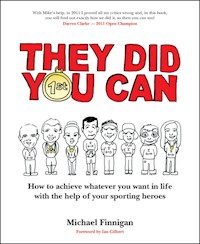
Mike Finnigan has been working in performance psychology since 1991 and he has also worked in the elite sports arena in golf, cricket, rugby and football. His latest success is with Darren Clarke, who recently won golf's Open Championship. Mike believes that, with the help of their sporting heroes, young people can achieve anything they want in the sporting world. By interviewing many sporting celebrities he has discovered just what it was that helped them to make it. Mike says "We can all make up excuses but you have to want to win more than you want the alibi for losing. Once you do that, you give yourself a proper chance of winning." Find out the secrets of success of: Sir Clive Woodward, Martin Johnson CBE, David Moyes, Sir Tom Finney, Philip Neville, Gordon Banks, Gary Kirsten, Karen Barber, Dame Mary Peters, Jeremy Snape, Eric Simons, Beth Tweddle and Jonathan Davies MBE. Revised edition of ISBN 978-1-84590-064-9 with new and updated material.
Das E-Book können Sie in Legimi-Apps oder einer beliebigen App lesen, die das folgende Format unterstützen:
Veröffentlichungsjahr: 2012
Ähnliche















Praise for They Did You Can
In my work with UK Sport and the Youth Sport Trust I know the vital importance for everyone, whether elite performer or young person at school, is to have self-belief in order to achieve their goals. Sport has the power to change lives and can be a great motivator. Using these strategies from leading sports stars can really make a difference – whoever we are!
Baroness Sue Campbell CBE — Chief Executive, Youth Sport Trust
A positive and engaging book which enables the reader to be interactive and involved with the ideas and activities presented.
It is fantastic to get the views of the sports men and women, and the coaches that they have worked with, to get a clear view of what can (and usually does) lead to success.
These exercises and ideas draw from ancient and current thinking, and include effective coaching strategies from NLP and a number of other areas.
Most of all they help the reader to raise their awareness of their current strengths, recognise areas for development and give clear and simple tasks to do, which if followed will support the development of the focus required to achieve your goals.
Attitude comes up time and again with the professionals points of view and supports the research that it is not the talented that necessarily succeed, but those with the drive, attitude and confidence to pursue the dreams and goals, “you don’t have to be the best to get where you want to go but you do have to be mentally strong and remind yourself why you have committed yourself to great goals and dreams” p 91.
Attitude is everything – and My Reminder questions will help students and adults alike to gain clarity and focus on what they want and most importantly why they want it.
Emotional intelligence is key – whatever field you choose to go into – this book will enable those who read it and apply it to achieve in every area of their life – not just sport.
I really enjoyed this text.
Jenny Palmer — Deputy Head, Mark Rutherford School
Being a young sport loving person I enjoyed this book a lot and would recommend it to anyone who like me lives a life of sport and dreams of getting to the top one day. It gives an insight into what the pro’s and the legends did to get where they are and what hurdles you will come up against in the journey to the top.
They Did You Can, is an inspiration for young people who dream about being like their heroes. Anyone who wants to be world champion or to stand alongside their heroes should really read this book to find out what it takes to get there. It’s a brilliant way to find out how the stars got to where they are and what attitude you need to be the best. For young people who love their sport whether it be Football, Rugby, Athletics or anything else this book is the perfect word in the ear you need to succeed! If you want to stand on the podium at the Olympics one day or run out in the world cup final for your country then They Did You Can is the perfect read for you and may even help you get there and lift that trophy or wear that winner’s medal!
Alex Lambert — age 16
What a good idea! This is an inspiring resource for young people – and a few oldies too! The real life quotations make it realistic and the exercises are proven cognitive behaviour changers. A must read!
Susan Moss — Teenage Coach
I am a teacher at comprehensive school in Staffordshire. I am in the process of setting up a coaching scheme for year 10 students to raise their self-esteem, aspirations and hopefully improve behaviour and ultimately their results! This book is superb! I have already put into practice some of the strategies even on myself! A wonderful book.
Mark Goodwin — John Taylor High School, Barton-under-Needwood, Staffs
The current buzz target in education and business is raising aspirations of pupils and students at all levels. Professionals in their areas are aware of the positive impact that realistic and relevant role models can have on individuals and groups. I will certainly use this book with students to enable them to gain the intrinsic motivation and desire to say, “I Can” and as Jonathan Davies underlines, “I Can Do It”. This book has essential ideas for developing individual inspiration to improve motivation and attitude. A key book for use in schools, colleges, sport and business.
John T Morris — Director, JTM Educational Consultants
Full of stories, quotes, worksheets and tips this book is intended to appeal to – and thus to motivate – teenagers, but also includes material directed at their coaches, mentors, teachers or parents. This book deserves a place in every football academy and every football club where there are talented young players, needing the right kind of advice, support and inspiration to realise their potential.
Welsh Football Magazine
It doesn’t matter where you live, what your family background is or how talented you are academically – never say ‘IF only’. IF is a BIG word, but IF you believe in your ability, like all of the sporting heroes in this book, take up the challenge. YOU can make a difference!
JonathanDavies MBE
Mike has been an inspiration for me since we first met on that incredible tour of England in 2003. I love the book and am proud to be in it.
Eric Simons— Bowling Coach to the Indian Cricket Team, 2011 World Champions, former Coach of the South African Cricket Team
Mike and his team have helped me so much since we first met in 1999. He’s always brilliant, like this book!
Andrew Flintoff
Success for me at the highest level in sport is about having the mental strength to make sure you play to one hundred percent of your potential, and They Did You Can will help you to do that.
David Moyes — Manager, Everton Football Club
The great thing about this book is that it will help you whatever your level of interest. If you put into action the ideas in this book, you will find that ‘winning’ is well within your reach.
Sir Clive Woodward — England Rugby Union World Cup winning coach, Director of Elite Performance British Olympic Association
Mike Finnigan is to be congratulated for what he has achieved with this book. Through some of the great sportsmen and women of our lifetime, he introduces us to ordinary people who, through dedication and hard work, have lived extraordinary lives. This book is about encouragement.
Don Mullan — author of Gordon Banks:A Hero Who Could Fly
Michael and the team are simply inspirational. If you want to be a champion in any walk of life, read the book and apply its teachings.
Ed Smethurst — Prosperity Sports Management, represent professional footballers and world champion Olympians Danielle Brown and Sarah Stevenson
Praise for Michael Finnigan
Finn, as I call him, is just such tremendous value and brilliant in front of your people. We go back to 1999 and had fun ‘creating history together’ for Bolton Wanderers with a period of success the fans who witnessed it will remember forever.
Sam Allardyce
We have been so impressed with Mike’s work that in 2011 we asked him to join the International Sports Management team as our Performance Director.
Chubby Chandler — Managing Director of ISM, the management team behind so many talented sports people, including Andrew Flintoff, Lee Westwood, Rory McIlroy and Darren Clarke
Michael and his ‘impossible to inevitable’ team have been working wonders with Premier League footballers and stars of the future on the Players Programme since 2009.
Simon Andrews — CEO, English Premier League’s Players Programme
Being at the head of professional sporting organisations can be a lonely and stressful experience. Building teams to perform both on and off the field, generating a collective and positive mentality requires expert assistance. Once I’d introduced Mike and his team to Lancashire CCC, there was an immediate shift in attitude. Everyone understood their role in the organisation, we all became players and a winning ethos emerged. This approach works, and even when administrators were hovering at the doors of Turf Moor, imparting the belief that we would survive became a reality and Burnley did become a premier club and did play Premiership football. That mantra united the Club from 2003 and it all started for me with Mike Finnigan in 1998 at Old Trafford.
Dave Edmundson, Price of Wales Ambassador
Acknowledgements
I owe so much to so many people but I do want to mention a few of them. First of all, Art Niemann, my mentor and inspiration since our very first meeting on 9th November 1992. I never even would have got started on all this had it not been for his intervention when my life was on pause. He taught me about the great W. Clement Stone and his positive life and business philosophies, and I am forever grateful. One day I promise I will write their stories.
Thanks to all our friends at the Youth Sport Trust, Matt Pauling and Shaun Dowling in particular, and to Martin Callagher and Dave Botes at Corpus Christi High School; Dave’s application for a YST Innovation Award, its subsequent formal public recognition as ‘Highly Commended’ and the resulting features in the Times Educational Supplement were all pivotal in our development and we will never be able to thank them all enough for the faith they have showed in us since the very beginning.
Here at i2i HQ, it’s thanks to Tom Young and Matt Whyatt for their excessive levels of talent, comradeship, loyalty and hard work, and to our whole ‘Young i2i’ education team, too numerous to mention individually, who help teachers and children every day to aspire to become their very best; your contribution to our success is incalculably huge.
Thanks also to my daughter Lucy, of Lucy Lu Cards, for her funny, sharply observed illustrations – if you ever need a greeting card for any occasion which is cheerful, cheeky and affordable, visit her site at www.lucyludesigns.com
My family’s pride in what I am striving to achieve keeps me going when the going is tough. Thanks Cheryl, my Wonder Woman; thanks Pauline, the Helicopter Flying Mum and Grandma; thanks David, Dad, Granddad and Fish Finger Butty Maker par excellence, and thanks Bob and Marie Wallbank, the in-laws of your dreams. I am so determined to make them proud of me and to set a good example to my four gorgeous daughters, Lucy, Rose, Grace and Daisy. One thought of them and I can do anything. My friends, some of whom are in the book, some of whom helped knock it into shape and some who just keep encouraging me, will probably never know how much they mean to me and I thank them all. No need to name them, they know who they are.
The people who gave up their time to appear in the pages have been inspirational and most generous. They have made the book worth doing and I hope that I have represented them all with the dignity and respect they deserve. I am humble and grateful.
My editor, Fiona Spencer Thomas, her skill, coaching, friendship, long lunches and experience have been much appreciated.
Caroline Lenton, at Crown House, who is a bundle of energy, believed in the project from the very first moment we talked and gave it one hundred percent from then on. Without her, there would be no book. She has been an inexhaustible inspiration.
All these people are making my dream come true, proving, as the great Beth Tweddle says, that anything is possible.
Contents
Title Page
Acknowledgements
Foreword by Ian Gilbert
Introduction
Wise Words: Sir Tom Finney
Wise Words: Sir Clive Woodward
Wise Words: David Moyes
Wise Words: Martin Johnson
Chapter 1 The Powerful Three
Chapter 2 The Best Friend
Chapter 3 The Snap Out
Chapter 4 The Why Words
Chapter 5 The Reminder
Chapter 6 Part 1: The Moments of Magic
Part 2: The Power of GDB
Chapter 7 The Right Track
Chapter 8 The Dreamer
Chapter 9 Go Get It
Chapter 10 Secrets of Great Teams and Individuals
Chapter 11 What it Takes to Succeed at Anything
Chapter 12 A Message for the Coach, Teacher, Mentor or Parent
And Finally …
Bibliography
Index
Copyright
Foreword
Despite being full of interviews and anecdotes from some of the world’s leading sports men and women, this book is as much about sport as Baywatch was about lifeguard techniques and Britain’s Got Talent is about British people having talent.
It is, first and foremost, a book about what human beings can do if they put their mind to it. And when I say human beings, I mean you.
This is a book about what it takes to achieve something, anything, in any walk of life and how, when you scratch the surface of any high achiever you find the same rag tail collection of anxieties, fears, insecurities and self-doubt that the rest of us experience too on a daily basis.
The difference is that high achievers don’t let the negative thoughts win.
It didn’t have to be about sport, this book. It could have been about film directors and shown you how George Lucas hand-wrote the original Star Wars scripts despite struggling with his spelling and was also turned down by nearly every Hollywood movie company. Or it could have been about engineers and James Dyson failing 5,127 times to invent a better vacuum cleaner. It could have been about clothes designers and Sir Paul Smith who left school with no qualifications and still is haunted by not being clever enough. It could even have been about insurance salesmen and one I used to know who fared badly at school, ended up as a bricklayer but then set out not to be any old insurance salesman but to be the best insurance salesman. In the world. Last time I saw him he had just won a place at the Million Dollar Round Table, ‘an exclusive forum for the world’s most successful life insurance and financial services professionals’ according to their website. Not bad for an under-qualified bricklayer who went to the same school as Martin Johnson (as did I, but that’s another story).
The book could also be about a film cameramen called Mike. Mike is a friend and colleague whose life has included highlights such as being in a rock band, flying light airplanes, crashing racing cars at high speed and almost swimming in the Olympics. Whenever I go out long-distance running, something I have taken up in my forties, and it starts to hurt, I think of Mike. Mike has MS. Mike is in pain a great deal of the time and his brain gets fuddled quite easily. Mike doesn’t give up. ‘The pain’s in the brain’, he says with the slightest of grimaces that he thinks he has concealed. If Mike can get up and look into the eyes of his family on a daily basis and go out the door to make a difference despite everything, then I can run up a hill in the rain. In fact, it’s the least I can do.
So this book isn’t about sport even though it is very much about sport. It’s about the very least you can do. If a tiny boy with a severe glandular problem that has him going to hospital twice a week can go on to score thirty goals for England then what’s the least you can do? If a boy who never really wanted to be a goalkeeper and let in fifteen goals on his first trial can go on to make the greatest save in the history of football, and from Pelé to boot, if you’ll pardon the pun, then what’s the least you can do?
This is a book about ordinary people like me and you who contemplated what the least they could do was and then went and did the opposite.
And if they did, you can.
Ian Gilbert Santiago November 2011
Introduction
Let me tell you why I have written this book. Let me tell you about a time when I was a lot younger and in my final year at school and on track to get what I had always dreamed of, a contract to become an Apprentice Professional Footballer with Blackburn Rovers.
I had been ‘spotted’ when I was fourteen, and invited for a trial. I felt it was long overdue. I was an outstanding natural talent. A centre forward in the mould of Teddy Sheringham, Kenny Dalglish or Eric Cantona, not quick, but a great finisher and player of the killer two yard pass that splits defences. I averaged one goal and one assist per game and everyone knew I was going to make it. Everyone that is, except me.
The confidence I had when I was fourteen was fading fast. At Rovers, they picked you up on your faults and nobody reminded you how good you were, they just killed you when you made an error. I stopped enjoying it.
At school, John Allsopp and I (John was in my year and a terrific midfield player; just like Xabi Alonso or the great David Beckham, he scored regularly with shots from our half!), left early every Tuesday and Thursday to train and even that became a chore. I would rather have stayed in Henshaw’s History class than gone to play football. How bad is that?
A fear of failure slowly took hold of me. Instead of thinking ‘won’t it be great when …’ I was thinking ‘what if I don’t make it?’ or ‘what if I’m not good enough?’ I used to imagine the feelings of rejection and embarrassment so much that eventually they totally replaced the feelings of pride and excitement that I once had.
At the end of the season, I quit. I never told them. I just didn’t go back and I never played football properly again, ever. I became a hero, in fact an antihero. “That’s Finni; he could have been a footballer but he didn’t want to,” people would say. Wrong. “That’s Finni; he could have been a footballer but he didn’t have the bottle.” That is what they should have been saying. That was the truth.
So what did I need? I needed inspiration. I needed to know that what I was feeling, everyone feels. I needed to be reminded that I was a fantastically gifted young man who took apart every defence he ever played against. I needed help with my focus and with my goals. It wasn’t there, or if it was, I couldn’t own up to anyone about how I was feeling anyway. Not even John Allsopp, who just went from strength to strength. Only a terrible knee injury stopped him; no human being ever could, certainly not himself! I needed my heroes to tell me that they felt just like I did. I know now that George Best did. He ran away from Manchester United the first time, all the way home to Belfast, but they brought him back. I know now, but I needed to know then.
This book was what I needed then; words of inspiration and advice from people who had been there and done it. I have written it so that you don’t have to go through what I went through. I have written it so that you can reach your goal. I’ve written it so that you don’t have to wait to discover the secrets of mental strength until you are thirty-two, like I did.
Let me tell you right now that you have enough talent to succeed in whatever you have set your heart on. Talent is never the real reason why people succeed. Too much talent is usually a curse. So don’t go thinking you’re not good enough. You are.
What will stop you is a loss of focus or self-belief and this book will make sure that it cannot and does not happen.
Look, I can’t do it all for you. You have to take these lessons from these great people and put them to use in your own life but They Did You Can will be there for you and so will the people who believe in you, to help you along the way.
Nothing great is achieved easily, nothing. Everyone struggles. Each one of us is fighting demons. We just have to beat them and our talent will then take care of the rest.
Share this book with your teachers, coaches, friends and your parents or guardians. Make sure that they know how to help you on your magnificent journey, whatever your dreams are.
You can make it. You will make it. Then you can appear in one of our future editions and inspire the next generation with a story or two of your own.
Come on!
Wise Words: Sir Tom Finney
Michael has asked me to write a few words and I suppose I had better explain who I am first.
I played seventy-six matches for England, mostly on the wing, a few as a centre forward, and was fortunate to score thirty goals which was a record for a while. I also played 433 games in what is now called the Premier League and scored 187 goals for my club, again mostly from the wing. We got to two FA Cup Finals, winning one and losing one, and were runners-up in the League twice. Apparently I was also the first person to be voted Footballer of the Year twice. I played in three World Cups too.
Being a professional footballer was great and it was all I ever dreamed of as a child, the only thing I ever wanted to be when I grew up. However I must say that, although I was a good player as a boy, I not only had to battle a long glandular illness which meant going to hospital twice a week for many years, but I was also really tiny! Even when I was fourteen I weighed just five stone and was only four feet nine inches tall, and that was when I had my trial with Preston North End. They had said I was too small and wouldn’t even let me have a trial, but my father met the Chairman in a bar and was so insistent that, eventually, they gave up and let me have a go! I owe a lot to my father.
I think my story proves that if you really want to do something you can do it, in spite of whatever problems you face.
I wasn’t going to let anything get in the way of my dream and you shouldn’t let anything get in the way of yours.
Wise Words: Sir Clive Woodward
When Michael asked if I would write something for this book, I looked at the messages he was working on and thought how useful they would be to young people and to coaches too. So many of Michael’s messages dovetail with my own philosophy which I encapsulated in my book Winning, which featured our success in bringing home the 2003 Rugby World Cup.
When thinking about individual or team sport, I look at people on three levels in an attempt to see where they are.
Participating is when your interest is to become actively involved for the enjoyment of taking part.
Competing means that you become serious about your sport to secure victories.
Winning is when you play at an elite level and become obsessed with being prepared to do whatever it takes to be victorious; where you have the drive and the motivation to excel and dominate in a competitive environment.
The great thing about this book is that it will help you, whatever your level of interest.
When I gave Jonny Wilkinson his England debut when he was only eighteen in what is a sport of immense physical contact, people said he wasn’t ready, yet I knew that picking him was no gamble. There could be no doubt that Jonny wanted to be the very best, as his hours of kicking goals from the age of thirteen with coach Dave Alred proved.




