


0,49 €
Niedrigster Preis in 30 Tagen: 0,00 €
Niedrigster Preis in 30 Tagen: 0,00 €
Mehr erfahren.
- Herausgeber: DigiCat
- Kategorie: Gesellschafts- und Liebesromane
- Sprache: Englisch
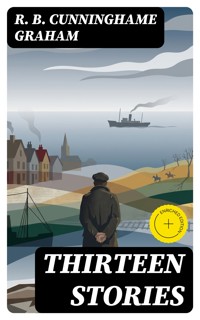
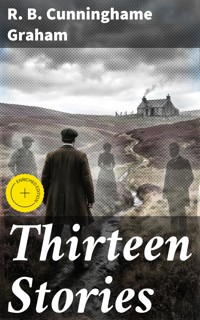
In "Thirteen Stories," R. B. Cunninghame Graham offers a collection of short narratives that delve into the intricacies of human experience, intertwining elements of realism with lyrical prose. Each story provides a vivid portrayal of characters grappling with their inner lives and external challenges, providing insights into the broader social and cultural contexts of early 20th-century Britain and its colonial enterprises. Cunninghame Graham's narrative style combines rich descriptions with nuanced character studies, encouraging readers to engage deeply with the poignant themes of identity, conflict, and the passage of time. R. B. Cunninghame Graham was a multifaceted figure, not only a writer but also a politician, social reformer, and a passionate advocate for Scottish nationalism. His diverse experiences, from travels in South America to his engagement in various political causes, infused his writing with a sense of urgency and a deep understanding of social issues. These facets of his life are echoed in the stories within this collection, reflecting his keen observations on society and the human condition. Recommendation for readers lies in the profound depth and emotional resonance of Cunninghame Graham's narratives, which invite reflection on timeless themes. "Thirteen Stories" is essential for those who appreciate literature that challenges conventions and evokes empathy through its vivid storytelling, making it a worthwhile addition to the canon of early modern literature. In this enriched edition, we have carefully created added value for your reading experience: - A comprehensive Introduction outlines these selected works' unifying features, themes, or stylistic evolutions. - A Historical Context section situates the works in their broader era—social currents, cultural trends, and key events that underpin their creation. - A concise Synopsis (Selection) offers an accessible overview of the included texts, helping readers navigate plotlines and main ideas without revealing critical twists. - A unified Analysis examines recurring motifs and stylistic hallmarks across the collection, tying the stories together while spotlighting the different work's strengths. - Reflection questions inspire deeper contemplation of the author's overarching message, inviting readers to draw connections among different texts and relate them to modern contexts. - Lastly, our hand‐picked Memorable Quotes distill pivotal lines and turning points, serving as touchstones for the collection's central themes.
Das E-Book können Sie in Legimi-Apps oder einer beliebigen App lesen, die das folgende Format unterstützen:
Veröffentlichungsjahr: 2022
Ähnliche














Thirteen Stories
Table of Contents
Introduction
Thirteen Stories presents a single-author gathering of R. B. Cunninghame Graham’s shorter prose, comprising thirteen stories framed by a preface. The scope is selective rather than exhaustive, designed to display the range of his narrative art across continents and milieux he knew first-hand. These are not extracts or novel chapters, but complete short fictions and sketches standing on their own, chosen to introduce new readers while rewarding those already familiar with his work. The presence of a preface provides context and orientation, after which the sequence moves through varied scenes of travel, encounter, and ordeal that typify his contribution to modern short narrative.
The texts assembled here are prose narratives: short stories, tales of character and place, and pieces that draw upon the travel sketch without surrendering the autonomy of fiction. Their modes include the vignette, the parable-like episode, and the closely observed scene from life. Titles such as Cruz Alta, La Pulperia, and Sidi Bu Zibbala indicate settings in the Hispanic world and the Maghreb; others, like In a German Tramp or Rothenberger’s Wedding, point toward Central European or maritime frames. Alongside them stand narratives of dream, trial, and departure, each shaped with the economy and suggestiveness characteristic of the form.
Across these pages, Graham’s persistent themes appear with clarity: the dignity of ordinary people, the encounter across languages and faiths, the costs of pride and freedom, and the melancholy knowledge that victory often carries its own contradictions. His protagonists are travelers, settlers, pilgrims, and outsiders—gauchos, sailors, villagers, and expatriates—observed without condescension. The author’s political conscience is present not as doctrine but as an ethical attention to injustice and to those left at the margins of history. The collection’s unity lies less in plot than in a temper of mind: curious, skeptical, and steadfast in sympathy for human courage under pressure.
Graham’s style is unmistakable: spare yet musical, with precise physical detail and a cadence shaped by spoken storytelling. He is a master of the revealing aside and the decisive, unfussy image. Local terms—Spanish, Arabic, or German—appear where necessary, anchoring the prose to lived experience without sliding into display. Scenes open quickly, characters are sketched in a few decisive strokes, and endings resist neat closure, inviting reflection rather than delivering moral summaries. The prose travels lightly, yet it is dense with implication, the surface calm carrying undercurrents of irony, tenderness, and a hard-earned skepticism about power and pretension.
The premises are varied but clearly proposed at each outset. Cruz Alta evokes a frontier town on the South American plain; La Pulperia centers on the social theatre of a wayside store; Sidi Bu Zibbala turns to a Moroccan shrine and those who pass through it. In a German Tramp records a passage among strangers; Rothenberger’s Wedding studies custom and community; La Clemenza de Tito uses an evening at the opera to refract private motive and public ritual. Elsewhere, The Gold Fish contemplates beauty and caprice, A Pakeha the vantage of an outsider, Higginson’s Dream the temptations of escape, Victory the ambiguities of success, Calvary an ordeal, A Hegira a flight, and Sohail a star by which to steer.
Although written at different times and in scattered places, the stories converse with one another. Images recur: thresholds, roads, ships, shrines, crossings of borders formal and invisible. The narrators—sometimes named, sometimes not—observe with a traveler’s humility and a craftsman’s exactness, alert to the sly humor that accompanies misrecognition and to the quiet heroism of patience. Graham neither romanticizes nor debunks: he listens, letting circumstance and speech reveal character. The result is a cosmopolitan realism that resists exoticism, bringing distant settings near without flattening their strangeness, and turning the foreign into a mirror in which readers recognize their own predicaments.
The continuing significance of Graham’s short fiction lies in this poise: humane without sentimentality, adventurous without bravado, worldly without cynicism. In a moment when questions of movement, belonging, and encounter remain urgent, these stories retain their force. They demonstrate how compressed narrative can bear the weight of history and conscience while preserving the pleasures of scene and voice. The present collection offers an accessible path into a body of work that ranges far beyond these pages, yet is fully represented in spirit here. The preface opens the door; the thirteen pieces furnish rooms whose windows look out on many horizons.
Historical Context
Composed and issued around 1900, Thirteen Stories emerged from the late Victorian world’s intense mobility and reporting. Steamship lanes after Suez (opened 1869) and dense telegraph networks linked Buenos Aires, Tangier, Hamburg, and London, routes Cunninghame Graham had personally worked and wandered in the 1870s–1890s. The short-story form let him compress borderland encounters into sharp vignettes that balanced romance with documentary detail. A Scottish laird turned socialist, he wrote against the background of high imperialism and growing labor unrest, inviting readers to judge power, class, and custom across continents. This global frame organizes pieces as various as Cruz Alta, Sidi Bu Zibbala, and In a German Tramp.
River Plate society was transformed between the 1870s and 1890s by railways, chilled-meat exports, and mass immigration from Italy and Spain. The Conquest of the Desert (1878–1885) pushed Argentine frontiers south, expanding estancias while displacing Indigenous communities. In that setting, the pulpería functioned as store, tavern, and news hub, memorialized in La Pulpería, while frontier towns such as Cruz Alta evoke the itinerant ranch hands, petty traders, and horse thieves Graham had known while ranching in South America. His sympathetic gaucho portraits resisted elite modernization narratives, drawing on contemporaries like W. H. Hudson to contest how the nation imagined “progress.”
North Africa at century’s end stood at a diplomatic crossroads. In Morocco, Sultan Abdelaziz (r. 1894–1908) struggled amid European encroachment that culminated in the French Protectorate of 1912. Graham’s 1897 journey, later recounted in Mogreb-el-Acksa (1898), exposed him to maraboutic cults, caravan commerce, and the precarious etiquette of travel under restrictive permits. Stories such as Sidi Bu Zibbala and Sohail capture this threshold moment, when tribal jurisdiction, Islamic saint veneration, and portable astronomy met consular pressure and gunboat diplomacy. The star “Suhail” (Canopus), long a navigational marker in Arabic lore, becomes a figurative compass for characters negotiating peril and wonder.
Iberia, which Graham loved and repeatedly toured, reeled from the 1898 “Disaster” that ended Spain’s overseas empire. Rural poverty, Carlist memories, and fervent Catholic ritual persisted alongside anarchist agitation in Barcelona during the 1890s. Calvary distills the sober splendor of Holy Week processions, with confraternities, pasos, and penitents dramatizing pain, mercy, and communal identity. Elsewhere, ironies around triumph and humiliation echo through Victory, a title sharpened by Spain’s recent defeats. Graham’s admiration for Cervantine irony and Goya’s eye for popular spectacle shapes an Iberian sensibility that neither exoticizes nor flatters, but dwells in endurance, pride, and loss.
Germany and Central Europe exemplified fin-de-siècle modernity. After unification in 1871, the Kaiserreich industrialized rapidly; by the 1890s it boasted vast merchant fleets under HAPAG and Norddeutscher Lloyd, while Wilhelmine navalism flourished. Tramp steamers—unfixed to timetables—stitched minor ports into global trade, a backdrop for In a German Tramp. Urbanization and petty-bourgeois respectability coexisted with social democracy’s rise after the Anti-Socialist Laws lapsed in 1890. Rothenberger’s Wedding glances at provincial custom within that new economy of wages, tickets, and savings clubs, where aspiration and conformity weigh on intimate decisions as heavily as any imperial proclamation.
Back in Britain, the 1880s–1900s saw New Unionism, Keir Hardie’s parliamentary breakthrough in 1892, and the founding of the Scottish Labour Party in 1888, of which Graham was first president. The Second Boer War (1899–1902) split opinion, sharpening his anti-imperial stance. Stories like Higginson’s Dream and Victory resonate with these debates, probing utopian hope, official bombast, and the ordinary costs of expansion. His socialism aligned him with readers seeking ethical critique, yet alienated imperial loyalists, tempering mainstream reception. Naturalist techniques—plain diction, class attention, unsentimental endings—root these tales in the metropolitan arguments that framed overseas adventures.
Settler worlds in the Pacific offered another mirror. In New Zealand, the term Pākehā marked European settlers whose prosperity rested on land transfers orchestrated since the Native Land Court’s creation in 1865, after the New Zealand Wars (1845–1872). By the 1890s, the colony combined reformist milestones—women’s suffrage in 1893—with persistent Māori dispossession. A Pakeha studies an outsider’s moral poise within this order, while A Hegira invokes migration as flight and refounding, echoing the Islamic Hijra (622) and late nineteenth-century mass mobility. Maritime routes linking Sydney, Wellington, and Valparaíso made the South Pacific part of Graham’s continuous Atlantic world.
The collection’s reception rested on recognizable networks. London publishers like Heinemann marketed exotic verisimilitude to Edwardian readers, while Graham’s friendships with figures such as Joseph Conrad and W. H. Hudson positioned him within a transnational realist circle. Travel writing was fashionable, yet his Moroccan candor had already irked diplomats in 1898, signaling a tension between adventure and critique that colors these tales. Newspapers and monthlies amplified his reach, but political independence kept him outside fixed schools. Thirteen Stories thus mediates between late Victorian romance and early modernist skepticism, its restless geographies and marginal protagonists capturing the era’s exhilarations and unease.
Synopsis (Selection)
PREFACE
A brief, plainspoken manifesto introduces the collection by presenting the author as a wandering observer of borderlands and working people.
It primes the reader for compressed, unsentimental sketches where irony, compassion, and fatalism replace tidy morals.
Pampas and River Plate Sketches (CRUZ ALTA; LA PULPERIA)
Cruz Alta and La Pulpería trace life in remote outposts and taverns where frontier codes of honor and hospitality govern fragile communities.
The tone is laconic and dust-dry, attentive to pride, poverty, and the way vast landscapes shape stoic dignity.
German Sketches (IN A GERMAN TRAMP; ROTHENBERGER’S WEDDING)
In a German Tramp and Rothenberger’s Wedding study itinerant life and small‑town ritual, balancing wry humor with a tender eye for working people.
They probe class, respectability, and the quiet compromises of survival through crisp observation and restrained irony.
Maghreb and Andalusian Borders (SIDI BU ZIBBALA; SOHAIL)
Sidi Bu Zibbala and Sohail move through North African and southern border spaces where faith, hospitality, and reputation arbitrate daily exchange.
The narratives blend travel-witness with a faintly legendary aura, reflecting on fate, belief, and the ethics of encountering the unfamiliar.
Colonial Edges and Exiles (A PAKEHA; A HEGIRA)
A Pakeha and A Hegira follow outsiders navigating new worlds and abrupt departures, where identity is provisional and belonging contested.
Stoic, unsentimental prose underscores the costs of movement—loneliness, compromise, and the ambiguous morality of escape.
Allegories of Fate, Art, and Dream (THE GOLD FISH; HIGGINSON’S DREAM; CALVARY; VICTORY; LA CLEMENZA DE TITO)
The Gold Fish, Higginson’s Dream, Calvary, Victory, and La Clemenza de Tito adopt fable, dream, and parable to test desire, sacrifice, and the price of apparent triumph.
Their spare style and dry irony shift from documentary realism toward emblematic scenes where art, faith, and chance refract human motive.




