


0,49 €
Niedrigster Preis in 30 Tagen: 1,99 €
Niedrigster Preis in 30 Tagen: 1,99 €
Mehr erfahren.
- Herausgeber: Booksell-Verlag
- Kategorie: Sachliteratur, Reportagen, Biografien
- Sprache: Englisch
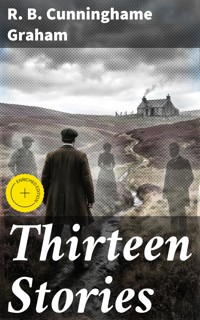
In 'Thirteen Stories,' R. B. Cunninghame Graham offers a compelling collection of narratives that showcase his masterful command of language and keen psychological insight. The stories are imbued with a sense of place, often reflecting the Scottish landscape and its cultural nuances, while employing a modernist style that fuses realism with elements of character-driven exploration. The collection provides a rich tapestry of human emotion, weaving together themes of identity, loss, and the search for meaning, which resonate powerfully within the late Victorian and early 20th-century literary context that grapples with rapid social changes. Cunninghame Graham, a Scottish writer, politician, and adventurer, drew upon his diverse life experiences when crafting this collection. His work often reveals the complexities of the human condition, a reflection of his own journey through both the political landscape and the natural world. His fascination with storytelling, combined with an innate ability to capture the essence of his characters' struggles, is emblematic of the period'Äôs literary movements, echoing the sentiments of contemporaries like Joseph Conrad and Henry James. Readers seeking a profound exploration of the human psyche will find 'Thirteen Stories' not only illuminating but also a vital addition to the modern literary canon. Cunninghame Graham'Äôs ability to intertwine vivid imagery with poignant storytelling makes this collection a rewarding read for those interested in the depth of human experience and literary artistry. In this enriched edition, we have carefully created added value for your reading experience: - A comprehensive Introduction outlines these selected works' unifying features, themes, or stylistic evolutions. - A Historical Context section situates the works in their broader era—social currents, cultural trends, and key events that underpin their creation. - A concise Synopsis (Selection) offers an accessible overview of the included texts, helping readers navigate plotlines and main ideas without revealing critical twists. - A unified Analysis examines recurring motifs and stylistic hallmarks across the collection, tying the stories together while spotlighting the different work's strengths. - Reflection questions inspire deeper contemplation of the author's overarching message, inviting readers to draw connections among different texts and relate them to modern contexts. - Lastly, our hand‐picked Memorable Quotes distill pivotal lines and turning points, serving as touchstones for the collection's central themes.
Das E-Book können Sie in Legimi-Apps oder einer beliebigen App lesen, die das folgende Format unterstützen:
Veröffentlichungsjahr: 2019
Ähnliche
















Thirteen Stories
Table of Contents
Introduction
Thirteen Stories gathers a small but representative sequence of R. B. Cunninghame Graham’s shorter prose, presented together to make visible the range and coherence of his art. It is not a novel or a continuous narrative but a collection shaped by juxtaposition: a preface followed by discrete pieces that stand on their own while speaking to one another in tone and preoccupation. Read as a whole, the volume offers an encounter with an author whose work moves readily across borders of place and circumstance, and whose independent stories reward attention to voice, cadence, and moral pressure.
The texts collected here are short stories and closely related sketches—compact narratives that favor incident, atmosphere, and character over extended plotting. Their titles point to a broad field of experience: “Cruz Alta,” “La Pulperia,” and “Sohail” evoke distinct settings; “In a German Tramp,” “A Hegira,” and “A Pakeha” suggest movement, dislocation, and contact between cultures; “Higginson’s Dream” and “Victory” hint at interior or emblematic designs; “Rothenberger’s Wedding” and “La Clemenza de Tito” signal social or historical occasions. The preface frames the collection’s aims without turning it into a treatise.
Cunninghame Graham is often associated with travel and with a deliberately spare, observant prose, and this selection foregrounds those strengths without reducing them to mere local color. Across the stories he tests how much can be carried by a scene, an encounter, or a decisive moment, allowing implication to do the work of explanation. The narrative stance frequently feels close to the ground, attentive to speech rhythms, to what is customary and what is improvised, and to the way a journey or a chance meeting can reveal a life. The collection’s purpose is to preserve that immediacy and to show its variations from piece to piece.
The unifying themes are less a single subject than a consistent ethical and imaginative orientation. Again and again these stories turn toward marginal situations—people on the move, people caught between languages or allegiances, people whose daily labor and private loyalties are rarely granted the center of the page. Without needing programmatic statements, the writing registers the friction between authority and autonomy, between the neat categories of institutions and the messy facts of individual experience. The attention to place is never merely scenic; it functions as pressure on character, shaping choices, endurance, and the meaning of belonging.
Stylistically, the collection invites readers to notice an economy that is not thinness but concentration. The prose tends toward directness and clarity, yet it leaves room for abrupt shifts of weather, fortune, and feeling, as though the world itself were the principal engine of narrative. Cunninghame Graham’s pieces often proceed by accumulation of concrete particulars—routes, rooms, animals, tools, clothing, and the small negotiations of hospitality or suspicion—so that a story can be built from the texture of lived conditions rather than from elaborate exposition. That method gives the book a distinctive unity across diverse locales.
The variety of titles also indicates the breadth of cultural reference that these stories can contain, from the everyday to the ceremonial, and from the intimate to the public. In some pieces the central interest is the discipline of travel and the precariousness it entails; in others it is the social scene—festivity, conflict, ritual, or memory—seen from an angle that resists sentimentality. A reader need not approach them in a fixed order to follow their meaning, yet reading consecutively brings out recurring patterns: the weight of chance, the ambiguities of victory and loss, and the way small actions can carry lasting consequence.
Thirteen Stories endures because it offers a compact demonstration of what short prose can accomplish when it is alert to the world and unwilling to simplify it. The collection preserves a voice that is historically situated yet not bound to a single time or readership: a voice capable of sympathy without condescension and of skepticism without cynicism. These pieces ask for close reading, not for secret keys, and they repay it by opening onto questions that remain current—how people move through unfamiliar systems, how identities are assigned and resisted, and how narrative can honor experience without flattening it into certainty.
Historical Context
R. B. Cunninghame Graham (1852–1936) wrote the pieces later gathered as Thirteen Stories at the turn of the twentieth century, when Britain’s global reach and internal unrest sharpened attention to borders, labor, and identity. A Scottish aristocrat with first-hand experience as a traveler and rancher in Argentina in the 1870s, he turned those encounters into fiction and sketches that were neither purely “imperial adventure” nor metropolitan realism. The collection’s international settings reflect a fin-de-siècle reading public fascinated by distant frontiers, while its skepticism toward authority and sympathy for the dispossessed align with the period’s widening debate about empire, class, and moral responsibility.
The author’s political formation mattered to how these stories were framed and received. In the 1880s and 1890s he became a prominent socialist agitator: he joined the Social Democratic Federation, co-founded the Scottish Labour Party (1888), and served as a Member of Parliament (1886–1892), where he became known for challenging orthodoxies on land, labor, and foreign policy. This political career coincided with mass strikes, unemployment agitation, and the aftershocks of the “New Unionism” wave (1889–1890). Across the collection, wanderers, exiles, and marginal workers appear not as curiosities but as human tests of systems—an outlook informed by both aristocratic proximity to power and radical dissent against it.
Cunninghame Graham’s South American experiences were filtered through major post-independence transformations in the Río de la Plata. Argentina’s consolidation after mid-century civil conflict, the federalization of Buenos Aires in 1880, and the export-led boom of the 1880s–1890s reshaped the pampas he had known. Large estancias expanded, railways and meat packing integrated the countryside into global markets, and a flood of European immigration altered rural labor and urban politics. The period’s “frontier” mythology—gauchos, caudillos, and border violence—was already being remade under state-building and commercial pressures. Stories drawing on that world register both nostalgia for older codes and unease at modernization’s winners and casualties.
The collection also reflects European mass migration and the social friction it produced. From the 1880s to 1914, millions moved within and into Western Europe, creating new populations of seasonal laborers, itinerants, and the urban poor—figures that appear in narratives set on roads, in ports, and across linguistic boundaries. Germany’s rapid industrialization after 1871 and its expanding railway network made cross-border movement easier while policing it more systematically; Britain, too, saw intensifying debate over “vagrancy,” public order, and the treatment of the unemployed. Cunninghame Graham’s attention to tramps, petty officials, and the improvisations of survival belongs to this wider context of mobility, surveillance, and contested belonging in modern Europe.
North Africa and the Mediterranean background in the stories aligns with late nineteenth-century imperial rivalry and the tightening of colonial administration. France’s protectorate in Tunisia began in 1881, and French rule in Algeria, established earlier in the century, deepened through military campaigns and bureaucratic control; Spain’s footholds and ambitions in Morocco remained sources of recurrent crisis. These developments created the mix of soldiers, consuls, traders, and displaced locals that shaped contemporary travel writing and fiction. Cunninghame Graham, drawn to Islamic cultures and desert landscapes, wrote against simplistic “civilizing mission” rhetoric by emphasizing local dignity, moral ambiguity, and the everyday humiliations produced by colonial power, which informed both his narrative stance and the period’s polarized reception.
Religious conflict and cultural pluralism in Europe also offered a lens for several narratives. In the decades after Italian unification (1861) and the capture of Rome (1870), the “Roman Question” left church–state relations unsettled, while anti-clerical politics in France and Spain provoked sharp counter-mobilizations. At the same time, Jewish emancipation faced backlash: modern political antisemitism surged, crystallized by events like the Dreyfus Affair in France (1894–1906), which divided European opinion over justice, nationalism, and minority rights. These pressures made stories involving priests, rituals, outsiders, and civic prejudice resonate beyond their immediate settings. Cunninghame Graham’s interest in conscience, mercy, and hypocrisy reflects a continent debating authority’s moral legitimacy.
The literary climate that greeted Thirteen Stories was itself in transition. The late Victorian and Edwardian eras saw realism and naturalism gain ground, alongside the “New Journalism” that prized vivid reportage, travel sketches, and short fiction for magazines. Authors such as Kipling, Conrad, and Stevenson had helped popularize global settings, but their tones ranged from imperial confidence to deep skepticism. Cunninghame Graham’s prose, influenced by Cervantes and Spanish narrative traditions as well as British periodical culture, blended anecdote, irony, and compressed drama. His preference for brief, scene-driven pieces suited magazine circulation and later collection, while his anti-imperial and pro-underdog inflections placed him at an angle to more celebratory adventure writing, attracting admirers and provoking unease among conventional readers.
Finally, contemporary anxieties about war, national decline, and the costs of expansion shaped how the collection’s recurrent themes were understood. The “Scramble for Africa” peaked in the 1880s–1890s, and the South African War (1899–1902) intensified British debate over militarism, concentration camps, and imperial ethics—issues on which Cunninghame Graham was a notable critic. The era’s technological acceleration—steamships, telegraphs, railways—made distant suffering more legible yet often more abstract, a tension his stories counter by foregrounding individual fates. Across varied locations, the collection’s emphasis on displacement, fatalism, and moral scrutiny can be read as a response to a world where state power and market integration reached further than older personal codes of honor and hospitality.
Synopsis (Selection)
PREFACE
A brief framing note that sets expectations for a peripatetic set of tales drawn from borderlands, road culture, and chance encounters. It foregrounds an observational, anecdotal style and a recurring interest in character revealed through travel, talk, and hardship.
Across the collection it hints at a unifying method: compressed sketches that privilege atmosphere, moral ambiguity, and the feel of place over tidy plot closure. The voice is economical and worldly, attentive to codes of honor and the costs of freedom.
CRUZ ALTA
A South American episode centered on a charged locale where violence, loyalty, and reputation shape ordinary decisions. The tone is spare and vivid, using landscape and local custom to sharpen social tensions.
Themes of fatalism, courage, and the thin line between justice and vendetta recur, with action conveyed as remembered incident rather than melodrama. The story exemplifies the author’s preference for scenes that feel overheard and historically textured.
IN A GERMAN TRAMP
A drifting journey with a German wayfarer becomes a study in displacement, class, and the strange intimacies that form on the road. The narration blends irony with sympathy, building character through speech, habits, and small negotiations.
It turns travel into a moral lens, contrasting personal dignity with bureaucratic or social constraint. Motifs of vagrancy and border-crossing underline the collection’s fascination with lives lived outside settled respectability.
THE GOLD FISH
A seemingly minor object anchors a tale about desire, luck, and the quiet pressure of circumstance. The tone is lightly fable-like but grounded, letting implication carry the emotional weight.
Beneath the simplicity is a meditation on value—what is prized, what is lost, and how hopes attach to small talismans. The story showcases the author’s knack for concise symbolism without overt moralizing.
A HEGIRA
A departure—voluntary or compelled—drives a narrative focused on exile, reinvention, and the costs of breaking with a former life. The voice is reflective and kinetic, attentive to both inner resolve and external threat.
Thematically it links movement with identity, treating flight as an ethical and psychological threshold rather than mere plot. The piece reinforces recurring patterns of wandering protagonists and irreversible choices.
SIDI BU ZIBBALA
A North African setting and a locally resonant figure or shrine shape a tale where belief, reputation, and cultural distance intersect. The tone is atmospheric and observant, emphasizing ritual, rumor, and the grain of everyday life.
It explores how outsiders interpret unfamiliar sacred or social codes, often revealing as much about the observer as the observed. The story contributes a motif of contested meaning—what is revered, feared, or misunderstood.
LA PULPERIA
Set around a rural store or gathering place, the story uses a communal hub to stage tensions among commerce, bravado, and belonging. The narration is brisk and scene-driven, capturing talk, gestures, and sudden shifts in mood.
It examines public performance—honor, masculinity, and status—within a tightly watched social space. The pulperia functions as a microcosm where small transactions can carry large consequences.
HIGGINSON’S DREAM
A dream experience reframes a character’s anxieties and ambitions, blending the uncanny with psychological realism. The tone is wry and suggestive, allowing the dream logic to illuminate waking contradictions.
Themes of self-deception and aspiration emerge without heavy explanation, relying on sharp images and a controlled pivot between humor and unease. It marks a stylistic turn toward interiority while retaining the author’s clipped pacing.
CALVARY
A grimly titled episode centers on endurance under pressure, drawing meaning from ordeal more than from event. The tone is stark and compassionate, attentive to physical detail and moral fatigue.
It treats suffering as a social fact—shaped by power, poverty, or conflict—rather than as private tragedy. The story amplifies a recurring motif of stoic resilience in marginal lives.
A PAKEHA
In a colonial contact zone, an outsider identity becomes the hinge of the story, with cultural translation and misreading driving the tension. The narration is matter-of-fact, letting setting and custom quietly challenge assumptions.
It probes belonging and authority—who names whom, who is trusted, and how identity can be assigned or resisted. The piece contributes to the collection’s wider pattern of border figures navigating competing codes.
VICTORY
A tale of winning that questions what triumph actually costs, presenting success as morally complicated and often provisional. The tone is controlled and ironic, resisting celebratory resolution.
It focuses on the gap between public outcomes and private reckonings, with honor and pride placed under pressure. The story aligns with the collection’s recurring skepticism toward neat moral accounting.
ROTHENBERGER’S WEDDING
A wedding occasion becomes a social tableau where class, propriety, and hidden frictions surface through ceremony. The tone is observant and lightly satirical, attentive to manners, speech, and small humiliations.
Rather than romance, it emphasizes community judgment and the compromises that underpin respectability. The story shows the author’s skill at compressing a society into a single event.
LA CLEMENZA DE TITO
An operatic or historically inflected title frames a story attentive to mercy, power, and the performance of magnanimity. The tone is elegant but edged, balancing theatricality with moral scrutiny.
It interrogates clemency as both virtue and strategy, asking what forgiveness signals in unequal relationships. Stylistically it leans toward staged contrast—public gesture versus private motive—seen elsewhere in the collection.
SOHAIL
A final tale oriented around a named figure or emblem, using travel and encounter to evoke longing, fate, or guidance. The tone is lyrical yet restrained, closing the collection with a sense of distance and reflection.
It gathers recurring motifs—wandering, contested belonging, and the pull of places half-known—into a compact, atmospheric finish. The piece highlights the author’s signature blend of terse narration with lingering afterimage.




