


20,99 €
Mehr erfahren.
- Herausgeber: John Wiley & Sons
- Kategorie: Wissenschaft und neue Technologien
- Serie: Antipode Book Series
- Sprache: Englisch
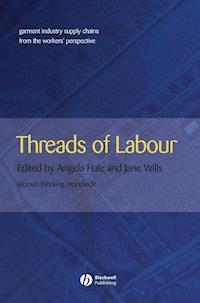
Threads of Labour presents new empirical research by a network of garment workers' support organizations and makes sense of global supply chains from the bottom up. * Presents new empirical research by a network of garment workers' support organizations in ten different locations in Asia, Europe and Mexico. * Creates a blueprint for conducting worker-orientated action research in order to better understand and resist the negative impact of globalization on labour. * Ensures that workers' voices reach those who are already trying to reconfigure global capitalism in more humane directions. * Explores the ways in which workers might begin to develop new forms of organization that are more suited to securing gains in the global garment industry. * Bridges the gap between activist and academic research, improving the conversation between these two groups.
Sie lesen das E-Book in den Legimi-Apps auf:
Seitenzahl: 483
Veröffentlichungsjahr: 2011
Ähnliche



















Contents
List of Figures
List of Tables
List of Boxes
About the Authors
Acknowledgements
Abbreviations and Acronyms
1 Threads of Labour in the Global Garment Industry
Introduction
Networked Capitalism
Corporate Social Responsibility
Threads of Labour
2 The Changing Face of the Global Garment Industry
Introduction
Making Sense of the Global Garment Industry
Basic Trends in Supply Chain Management
Changes in the Regulation of Trade and Investment
Conclusion
Notes
3 Organising and Networking in Support of Garment Workers: Why We Researched Subcontracting Chains
Introduction
Women Garment Workers and the Emergence of New Forms of Organising
Linking the Women Workers’ Movement to the Drive for ‘Corporate Responsibility’
Conclusion
4 Action Research: Tracing the Threads of Labour in the Global Garment Industry
Introduction
The Value of Action Research
Transnational Action Research Across Ten Organisations in Asia and Europe
Education and Action: Outcomes from the Research
The Challenges of Conducting Internationally Networked Action Research
Conclusions
5 Unravelling the Web: Supply Chains and Workers’ Lives in the Garment Industry
Introduction
Weaving the Web: The Operation of Supply Chains in the Global Garment Industry
Caught in the Web: Supply Chains and Workers’ Lives
Conclusion
Note
6 Coming Undone: The Implications of Garment Industry Subcontracting for UK Workers
Introduction
Industry Overview
Research into the Clothing Industry in the UK
Homeworkers
Power and Knowledge Within Subcontracting Chains in the UK
Conclusion
7 The Impact of Full-Package Production on Mexico’s Blue Jean Capital
Introduction
The Tehuacan Garment Industry
Tehuacan Research
Industry Hierarchy
Impact of US Downturn: 2004 Update
The Tehuacan Maquila Workforce and Their Working Conditions
Freedom of Association and the Right to Bargain Collectively
Postscript
Conclusion
Notes
8 Defending Workers’ Rights in Subcontracted Workplaces
Introduction: The Challenges Facing Garment Workers in Defending Their Rights
Regular Workers in Large-Scale Units
Irregular Workers in Large, Medium and Small Units
Informal Workers
Conclusion
Notes
9 The Phase-Out of the Multi-Fibre Arrangement from the Perspective of Workers
The MFA Phase-Out
Changing Global Distribution
Implications for Workers
Labour Movement Responses
A Multi-Stakeholder Approach?
Conclusion
10 Conclusion
References
Index
Antipode
ANTIPODE BOOK SERIES
General Editor: Noel Castree, Professor of Geography, University of Manchester, UK Like its parent journal, the Antipode Book series reflects distinctive new developments in radical geography. It publishes books in a variety of formats – from reference books to works of broad explication to titles that develop and extend the scholarly research base – but the commitment is always the same: to contribute to the praxis of a new and more just society.
Published
David Harvey: A Critical Reader
Edited by Noel Castree and Derek Gregory
Threads of Labour
Edited by Angela Hale and Jane Wills
Life’s Work: Geographies of Social Reproduction
Edited by Katharyne Mitchell, Sallie A. Marston and Cindi Katz
Redundant Masculinities? Employment Change and White Working Class Youth
Linda McDowell
Spaces of Neoliberalism
Edited by Neil Brenner and Nik Theodore
Space, Place and the New Labour Internationalism
Edited by Peter Waterman and Jane Wills
Forthcoming
Working the Spaces of Neoliberalism: Activism, Professionalisation and Incorporation
Edited by Nina Laurie and Liz Bondi
Neo-liberalization: Borders, Edges, Frontiers, Peoples
Edited by Kim England & Kevin Ward
Cities of Whiteness
Wendy Shaw
The South Strikes Back: Labour in the Global Economy
Rob Lambert and Edward Webster
© 2005 by Blackwell Publishing Ltd
BLACKWELL PUBLISHING
350 Main Street, Malden, MA 02148-5020, USA
9600 Garsington Road, Oxford OX4 2DQ, UK
550 Swanston Street, Carlton, Victoria 3053, Australia
The right of Angela Hale and Jane Wills to be identified as the Authors of the Editorial Material in this Work has been asserted in accordance with the UK Copyright, Designs, and Patents Act 1988.
All rights reserved. No part of this publication may be reproduced, stored in a retrieval system, or transmitted, in any form or by any means, electronic, mechanical, photocopying, recording or otherwise, except as permitted by the UK Copyright, Designs, and Patents Act 1988, without the prior permission of the publisher.
First published 2005 by Blackwell Publishing Ltd
1 2005
Library of Congress Cataloging-in-Publication Data
Threads of labour : garment industry supply chains from the workers' perspective/edited by Angela Hale and Jane Wills.
p. cm. — (Antipode book series)
Includes bibliographical references and index.
ISBN-13: 978-1-4051-2637-3 (hardback : alk. paper)
ISBN-10: 1-4051-2637-X (hardback : alk. paper)
ISBN-13: 978-1-4051-2638-0 (pbk. : alk. paper)
ISBN-10: 1-4051-2638-8 (pbk. : alk. paper)
1. Women clothing workers—Economic conditions. 2. Clothing trade—Subcontracting. 3. Clothing workers—Labor unions. 4. Employee rights. I. Hale, Angela. II. Wills, Jane. III. Series.
HD6073.C6T477 2005
331.7'687—dc22
2005006164
Figures
1.1Countries where the research was conducted2.1World textile and clothing exports2.2Simplified functions of a garment supply chain2.3The pyramid/iceberg model of the supply chain2.4A Gap supply chain5.1The tiers of production in garment supply chains5.2The Induico supply chain5.3The Fanco supply chain5.4The Benetton supply chain5.5Diagram of a ‘market-based’ network5.6Comparative wages in a typical supply chain in Guangdong Province, China6.1Typical subcontracting chain of Leeds homeworker6.2Typical subcontracting chain of Rochdale homeworker6.3Subcontracting map of the Manchester knitting factories6.4Typical subcontracting chain of companies that produce both in the UK and abroad7.1Map of Mexico showing Tehuacan7.2The Tehuacan garment industry hierarchyTables
2.1Major clothing companies in the industrialised countries2.2Hourly wage rates for selected countries, 20024.1The organisations involved in the research and their research objectives4.2The main activities following the research5.1Insourcing and outsourcing to increase production5.2The differences between local and migrant workers in Guangdong Province, China9.1Hourly labour costs including social and fringe benefits (US$), 19969.2Summary of recommendations for action in response to the end of the MFA (public sector)9.3Summary of recommendations for action in response to the end of the MFA (private sector)Boxes
2.1A Gap supply chain2.2Export processing zones2.3The case of Ramatex in Namibia3.1Organising garment workers in Korea3.2Sri Lanka: An eye is worth 5 dollars3.3The Philippines: Campaign in support of a year-long lock-out3.4The Maria Elena Cuadra Women’s Movement (MEC) in Nicaragua3.5The September 19th women garment workers’ union in Mexico3.6Victory at Jaqalanka, Sri Lanka3.7International links in support of Lesotho garment workers4.1Research conducted by the Women Workers’ Project (Innabuyog-Metro) Baguio City, Philippines4.2The research conducted by the Union Research Group, India5.1Employment conditions at a Tier 1 factory in Thailand5.2Behind the scenes at Next’s design and sourcing department5.3Working in a neighbour’s house5.4An example of homeworking in Guangdong Province, China5.5An example of homeworking in India5.6Employee or employer? Subcontracting to family and friends5.7The gender composition of the garment industry in Bulgaria5.8The problem of irregular hours of work5.9Behind the factory door: Health and safety in Bangladeshi factories5.10Zarina’s and Delowara’s stories5.11Blacklisted for organising in the Philippines6.1Homeworking in Leeds6.2Homeworking in Rochdale6.3Working in knitwear in Manchester6.4Working in a garment company with outsourced production abroad9.1The Agreement on Textiles and Clothing (ATC)9.2Bangladesh9.3Sri LankaAbout the Authors
Maggie Burns has worked on a freelance basis for the past five years undertaking research and evaluation, facilitating North-South advocacy meetings and co-ordinating international campaigns with a Southern base. She is a Director of Women Working Worldwide (WWW) and represents WWW within the Ethical Trading Initiative (ETI) in the UK. Currently she is the NGO co-ordinator for ETI and is working with OXFAM International in the South Asia region to give support to a campaign on the implications of the phasing-out of the Multi-Fibre Arrangement in 2004. Her publications include a report on UK companies operating in Indonesia (CIIR 1999) and ‘Effective monitoring of corporate codes of conduct’ (CIIR & NEF, 1997).
Angela Hale is full-time Director of Women Working Worldwide, which is based at Manchester Metropolitan University, where she previously lectured in sociology. Angela has also worked for several development agencies, notably Oxfam, War on Want and Womankind. She has published a number of articles on strategies for defending the rights of women workers in a globalised economy, which have built on collaborative work with organisations in Asia and Africa. These include ‘Trade liberalisation in the garment industry: Who is really benefitting?’ (2002); ‘Women workers and the promise of the ethical trade in the globalised garment industry’ (with Linda Shaw 2001); ‘The Emperor’s new clothes: What codes mean for workers in the garment industry’ (with Linda Shaw 2002); ‘Beyond the barriers: New forms of labour internationalism’ (2004); ‘Globalised production and networks of resistance: Women Working Worldwide and new alliances for the dignity of labour’ (2004); and ‘Humanising the cut flower chain: Confronting the realities of flower production for workers in Kenya’ (with Maggie Opondo 2005).
Rohini Hensman has worked with trade unions and women’s groups in Bombay since 1980, and is a member of the Union Research Group. She is also an active member of Women Working Worldwide and has worked in that capacity on research, consultation and education programmes with women workers in Bombay and Sri Lanka on the social clause, codes of conduct and subcontracting chains. Her publications on these issues include: ‘How to support the rights of workers in the context of trade liberalisation’ in Trade Myths and Gender Reality edited by A Hale (1998); and ‘World trade and workers’ rights: In search of an internationalist position’ in Place, Space and the New Labour Internationalisms edited by P Waterman and J Wills (2001). She has also co-authored My Life is One Long Struggle: Women, Work, Organisation and Struggle (1984) and Beyond Multinationalism: Management Policy and Bargaining Relationships in International Companies (1990).
Jennifer Hurley worked as Research Co-ordinator with Women Working Worldwide on the project exploring garment industry supply chains featured in this book. She has done research into the international garment industry, supply chains and workers’ rights for six years. Her interests include the rights of women workers, the global garment industry and research methodology. She has a PhD in International Political Economy.
Doug Miller is Senior Lecturer in Industrial Relations at the University of Northumbria. Since 2000 he has been seconded to the International Textile Garment and Leather Workers’ Federation as the Targeting Multinationals Project Co-ordinator, an initiative concerned with the development of global trade union networks within multinational companies, the provision of assistance for national organising drives and campaigns, and support for the negotiation of international framework agreements on global employment standards in the sector. Doug has published recently on European Works Councils and international framework agreements in the textile, clothing and footwear sector.
Lynda Yanz and Bob Jeffcott are founding members of the Maquila Solidarity Network (MSN), a Canadian network that works closely with WWW. MSN promotes solidarity with women’s and labour rights groups in Mexico, Central America and Asia working with export processing zone workers to improve working conditions and wages. Lynda is president of the tri-national Coalition for Justice in the Maquiladoras. Lynda and Bob are co-authors of numerous articles on the globalised garment industry and on the strengths and weaknesses of codes of conduct as tools for improving working conditions. Recent publications include: A Needle in a Haystack: Tracing Canadian Garment Connections to Mexico and Central America (Toronto: MSN 2000); A Canadian Success Story: Gildan Activewear: T-Shirts, Free Trade and Worker Rights (Toronto: MSN 2003); and Tehuacan: Blue Jeans, Blue Waters and Worker Rights (Toronto: MSN 2003).
Camille Warren has a Masters in Human Rights and currently works for Women Working Worldwide as a research and outreach worker. She has written articles on the implications of subcontracting for UK workers, on the use of patents in agriculture and on peace issues. She has also contributed to campaigning and awareness raising events in support of the rights of garment workers and workers producing fresh produce for UK supermarkets.
Jane Wills is a Reader in Geography at Queen Mary, University of London and a board member of Women Working Worldwide. Jane’s recent research has included enquiry into the use of International Framework Agreements to secure improved labour standards and into community unionism as a means to widen labour organisation to contingent labour markets in the UK. Current research is focused on migrant labour in low-paid employment and the work of the living wage campaign in London. Previous publications include Union Retreat and the Regions (with Ron Martin and Peter Sunley, 1996); Geographies of Economies (edited with Roger Lee, 1997); Dissident Geographies: An Introduction to Radical Ideas and Practice (with Alison Blunt, 2000); and Place, Space and the New Labour Internationalisms (edited with Peter Waterman, 2001).
Women Working Worldwide is a small NGO that supports the rights of women workers in industries supplying the world market with consumer goods such as clothing, footwear and fresh produce. Collaborative projects are developed with an international network of trade unions and women workers’ organisations, with the aim of increasing the ability of women workers to organise and claim their rights. The outcomes from these projects are used to inform public campaigning and advocacy work in Europe about the impact of the world economy on women workers and the appropriateness of different strategies for defending workers’ rights in international supply chains.
Acknowledgements
This book would not have happened without the collaborative work of many people. First of all the contributors themselves, who worked with us as a team to present a comprehensive picture of the garment industry from the perspective of workers. Thank you for all your hard work and also for keeping to deadlines in spite of the weight of other commitments. Also many thanks to all the people in Asia, Bulgaria and Mexico who contributed to the research that underlies much of this book. In particular, we would like to thank project co-ordinators and researchers: Rokeya Baby and Pratima Paul-Majumdar in Bangladesh, Verka Vassileva and Ivan Tishev in Bulgaria, Monina Wong and Jennifer Chuck in Hong Kong, Chanda Korgaokar and Rohini Hensman in India, Aima Mahmood and Nabila Gulzar in Pakistan, Diane Reyes, Marlen Bartes, Gerry Doco-Cacho and Cristi Facsoy-Torafing in the Philippines, Kelly Dent and all members of the Women's Centre and Da Bindu in Sri Lanka and Manee Khupakdee and Jaded Chouwilai in Thailand.
We would like to give a special thanks to Eva Neitzert and Jeremy Anderson who have done a fantastic job in rescuing us from all the work of formatting, checking and amending the final draft of the book. Thanks also go to Steve Kelly of Manchester Metropolitan University Design Department for his contribution to design and artwork and to Edward Oliver who has done a superb job in drawing most of the maps, diagrams and figures.
We would also like to thank the funding agencies that made this book possible, the Community Fund and Department of International Development which supported the action research and the European Community which funded a project that enabled us to spend time publishing the findings. Also thanks go to Francois Beaujolin and the Fondation des Droits de L'Homme au Travail for valuable contributions to both the work in Asia and the publication itself.
We are delighted that the book is being published as part of the Antipode book series and are very grateful to Noel Castree and Jamie Peck for agreeing to support the work. We also owe a big thanks to all the staff at Blackwell, and particularly Jacqueline Scott and Angela Cohen for their work in getting the book into production.
Jane would like to thank Anibel Ferus-Comelo, Jane Holgate, Lina Jamoul, Jeremy Anderson, Paula Hamilton and Claire Frew for all the valuable discussions we have had about the condition of workers and the challenges facing organisers today. Teaching the postgraduate masters degree course at Queen Mary entitled Globalisation and Development has also helped in thinking through many of the issues raised in this book. In addition, working with a team of wonderful colleagues has fed into this book in many different ways and I would like to give special mention to Alison Bunt, Kavita Datta, Roger Lee, Cathy Mcllwaine, David Pinder, Adrian Smith, David Smith and to Stuart Howard from the International Transport Workers' Federation. Jim Chapman, Agnes and Eric have all fallen over piles of paper that were earlier drafts of this book as they walked and/or crawled round the house, and they deserve a big thank-you for being so supportive both to me and the project.
Angela would like to thank all the management committee and staff of WWW, whose work and inspiration underlie much of the material in this book. Thank you to committee members Diane Elson, Linda Shaw, Peta Turvey, Alana Dave, Barbara Evers, Gerry Reardon, Yvonne Rivers and Helen O'Connell and, of course, to Jane Wills, Rohini Hensman and Maggie Burns who have contributed directly to the contents. Thanks to present and past staff Jess Mock, Joanne Smith and Mary Sayer and above all to Jennifer Hurley and Camille Warren who kept working patiently in spite of the pressure of other demands. I would also like to thank staff of the International Textile, Garment and Leather Workers Federation, the Clean Clothes Campaign and Labour Behind the Label for valuable collaboration and also the staff from Gap who responded positively to our findings. Thanks also go to the Sociology Department of Manchester Metropolitan University, where WWW is based, and in particular to Bernard Leach, Paul Kennedy and Susie Jacobs, for the encouragement given to all WWW's work. Finally thanks go to my family, Richard, Amy and Sonya for constant patience and support, and we would like to dedicate the publication to my grandson Freddy who was born at the same time as this book.
Acronyms
AFL-CIO American Federation of Labor-Congress of Industrial Organizations AGOA African Growth and Opportunity Act AMT Ayuntamiento Municipal de Tehuacan ATC Agreement on Textiles and Clothing B2B business to business B2C business to customer CAFTA US/Central American Free Trade Agreement CAW Committee for Asian Women CAWN Central America Women’s Network CCC Clean Clothes Campaign CCEIA Carnegie Council on Ethics and International Affairs CMT cut, make and trim COVERCO Commission for the Verification of Codes of Conduct CROM Regional Confederation of Mexican Workers CSR corporate social responsibility CTM Confederation of Mexican Workers EMDA East Midlands Development Agency EPZ export processing zone ETI Ethical Trading Initiative FOB free on board FDI foreign direct investment FLA Fair Labor Association FNV Dutch Trade Union Federation FOW Friends of Women FROC-CROC Revolutionary Confederation of Workers and Campesinos FTZ free trade zone FTZGSEU Free Trade Zone and General Services Employees’ Union ICFTU International Confederation of Free Trade Unions ILO International Labour Organisation IMSS Social Security Programme of the Mexican Government ITGLWF International Textile Garment and Leather Workers’ Federation JLCT Junta Local de Conciliacio´n de Tehuacan KEWWO Kenyan Women Workers’ Organisation KFAT National Union of Knitwear, Footwear and Apparel Trades KWWAU Korean Women Workers Associations United LBL Labour Behind the Label MEC Maria Elena Cuadra Women’s Movement MFA Multi-Fibre Arrangement MNC multinational corporation MSN Maquila Solidarity Network NAFTA North America Free Trade Agreement NGH National Group on Homeworkers NGO non-governmental organisation NICWJ National Interfaith Committee for Workers Justice NMW National Minimum Wage NWDA North West Development Agency OECD Organisation for Economic Co-operation and Development OI Oxfam International OPT outward processing trade RFP request for price RFQ request for quote RMALC Mexican Action Network on Free Trade SCMD State Centre for Municipal Development SEWA Self-Employed Women’s Association SITEMEX Independent Union of Mex Mode Workers SUTIC Garment Industry Workers’ Union TAG-MEX Tarrant Apparel Group TCSG Textile and Clothing Strategy Group TELCO The East London Communities Organisation T&G Transport and General Workers’ Union TIE Transnational Information Exchange TNC transnational corporation UNCTAD United Nations Conference on Trade and Development UNDP United Nations Development Programme URG Union Research Group USAS United Students Against Sweatshops WIEGO Women in Informal Employment: Globalizing and Organizing WIN Women’s International Network WTO World Trade Organisation WWO Working Women’s Organisation WWRE World Wide Retail Exchange WWW Women Working Worldwide1
Threads of Labour in the Global Garment Industry
Jane Wills with Angela Hale
Introduction
An estimated 40 million workers, most of them women, are employed in the global garment industry. The industry is worth at least US$350 billion (£190 billion) and is expanding year by year (de Jonquiéres 2004). Clothing production is a major source of employment in many poor countries in the South, and, as such, the industry could play an important role in social and economic development on a very large scale. For it to do so, however, there needs to be a massive reconfiguration of the distribution of wealth and power in the industry. Contemporary trends in the organisation of production, reinforced by the re-regulation of the global economy, have made it very difficult for workers to organise and/or to improve their conditions of work.
Lesen Sie weiter in der vollständigen Ausgabe!
Lesen Sie weiter in der vollständigen Ausgabe!
Lesen Sie weiter in der vollständigen Ausgabe!
Lesen Sie weiter in der vollständigen Ausgabe!
Lesen Sie weiter in der vollständigen Ausgabe!
Lesen Sie weiter in der vollständigen Ausgabe!
Lesen Sie weiter in der vollständigen Ausgabe!
Lesen Sie weiter in der vollständigen Ausgabe!
Lesen Sie weiter in der vollständigen Ausgabe!
Lesen Sie weiter in der vollständigen Ausgabe!
Lesen Sie weiter in der vollständigen Ausgabe!
Lesen Sie weiter in der vollständigen Ausgabe!




