


177,99 €
Mehr erfahren.
- Herausgeber: John Wiley & Sons
- Kategorie: Wissenschaft und neue Technologien
- Sprache: Englisch
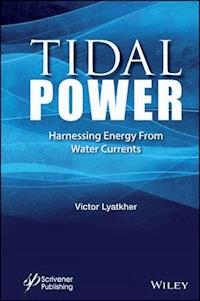
Offers a unique and highly technical approach to tidal power and how it can be harnessed efficiently and cost-effectively, with less impact on the environment than traditional power plants With the demand for energy outstripping conventional sources from fossil fuels, new sources of energy must be found. Tidal power is a potentially rich source of renewable energy. Even though power plants that run on hydropower have been around a long time, new types, such as those run without dams, have not been as heavily researched and presented to the scientific community. This book is a step in that direction--suggesting more cost-effective and less environmentally intrusive methods for creating power sources from rivers, the tides, and other sources of water. Presenting a detailed discussion of the costs, risks, and challenges of building power plants that run on hydropower, Tidal Power: Harnessing Energy From Water Currents: * Covers the technical aspects of tidal power plants without dams, or "Marine Hydro Kinetic (MHK)" power plants * Covers tidal barrages with reservoirs and how they can be utilized to generate renewable energy * Details the regulations of hydro power plants that do not use dams * Gives real examples of turbines that have been built using these new technologies As the global supply of conventional energy sources, such as fossil fuels, dwindles and becomes more and more expensive, unconventional and renewable sources of energy, such as power generation from water sources, becomes more important--making Tidal Power an incredibly valuable text for engineers, students, and researchers working in the field.
Sie lesen das E-Book in den Legimi-Apps auf:
Seitenzahl: 257
Veröffentlichungsjahr: 2014
Ähnliche


















Contents
Cover
Half Title page
Title page
Copyright page
Preface
Chapter 1: Marine Hydro Kinetic- MHK
References
Chapter 2: Rivers (Channels) Power Plants without a Dam
References
Chapter 3: Low-Speed Hydro-Kinetic Turbines
References
Chapter 4: Large Power Hydro Turbines
References
Chapter 5: Examples of Turbines Produced
Specifications
Description and Work
References
Chapter 6: Water Current Power-Looking to the Future
Summary
References
Subject Index
Tidal Power
Scrivener Publishing 100 Cummings Center, Suite 541J Beverly, MA 01915-6106
Publishers at Scrivener Martin Scrivener ([email protected]) Phillip Carmical ([email protected])
Copyright © 2014 by Scrivener Publishing LLC. All rights reserved.
Co-published by John Wiley & Sons, Inc. Hoboken, New Jersey, and Scrivener Publishing LLC, Salem, Massachusetts. Published simultaneously in Canada.
No part of this publication may be reproduced, stored in a retrieval system, or transmitted in any form or by any means, electronic, mechanical, photocopying, recording, scanning, or otherwise, except as permitted under Section 107 or 108 of the 1976 United States Copyright Act, without either the prior written permission of the Publisher, or authorization through payment of the appropriate per-copy fee to the Copyright Clearance Center, Inc., 222 Rosewood Drive, Danvers, MA 01923, (978) 750-8400, fax (978) 750-4470, or on the web at www.copyright.com. Requests to the Publisher for permission should be addressed to the Permissions Department, John Wiley & Sons, Inc., 111 River Street, Hoboken, NJ 07030, (201) 748-6011, fax (201) 748-6008, or online at http://www.wiley.com/go/permission.
Limit of Liability/Disclaimer of Warranty: While the publisher and author have used their best efforts in preparing this book, they make no representations or warranties with respect to the accuracy or completeness of the contents of this book and specifically disclaim any implied warranties of merchantability or fitness for a particular purpose. No warranty may be created or extended by sales representatives or written sales materials. The advice and strategies contained herein may not be suitable for your situation. You should consult with a professional where appropriate. Neither the publisher nor author shall be liable for any loss of profit or any other commercial damages, including but not limited to special, incidental, consequential, or other damages.
For general information on our other products and services or for technical support, please contact our Customer Care Department within the United States at (800) 762-2974, outside the United States at (317) 572-3993 or fax (317) 572-4002.
Wiley also publishes its books in a variety of electronic formats. Some content that appears in print may not be available in electronic formats. For more information about Wiley products, visit our web site at www.wiley.com.
For more information about Scrivener products please visit www.scrivenerpublishing.com.
Library of Congress Cataloging-in-Publication Data:
ISBN 978-1-118-92091-2
“Proof discussions pervade science just as much as mathematics, but by themselves (as in mathematics itself), they are not able to provide significant new knowledge about the world around us. Anything new that we learn about the world, is connected with plausible reasoning, which is the only type of reasoning that we are interested in everyday affairs.”
George Polya “Mathematics and plausible reasoning” (English edition, 1954).
Preface
Water current power can be an important renewable energy source and is influenced by the sun, the moon or both at the same time. Their influence is shaped by the peculiarities of the earth - its motion and the presence of the atmosphere and hydrosphere. The feasibility of using renewable sources at a scale compared with major energy generators is essentially determined by:
The economic and ecological limits vary with social, political and geographic conditions. Political will, regulations, and social compliance enables this technological advance. Site location and delivery of base load RE (renewable energy) is of critical importance.
In many parts of the world, environmental constraints on energy are lowered. That allows politicians to give a decisive role to energy development associated with petroleum and radioactive material risks. With the development of social activism and potential economic changes, the emphasis on cleaner sources is increasing.
Among renewable sources taking into account their economic efficiency and environmental performance, energy use of river and ocean currents is significantly growing. The energy capability of these currents is considerably greater than the needs of humanity, even in the distant future. The economic evaluation of technologies for converting this energy should be based on a direct measurement of received energy rather than the efficiency of the generator.
The author suggests specific modern technologies for the cost-effective use of tidal, and river power without creating a waterfront. In some regions, for example, in the Kola Peninsula, Kamchatca, Kuril Islands as well as in the other northern and eastern Russia, it is possible that the cost-effective use of tidal and rivers power in advanced grids, or in complexes with hydrogen production, can provide a universal source of energy.
We propose new technological methods of energy conversion, which create acceptable cost-effectiveness of systems and increase their investment attractiveness.
The following energy production methods are emphasized, with the appropriate use of new structural and technological solutions for each of them, to provide a low cost per installed kilowatt of power and a low cost of power production.
- Tidal current energy use without the creation of a waterfront and the cutting off the tidal basin from the sea such as with tidal barrages, but with the provision (if necessary) of guaranteed basic system components
- The use of river power without dams or a disruption to ship traffic, which introduces variability of current speeds as the regulating factor of river energy production
- Production and transportation of liquid hydrogen, with special piping in conjunction with superconducting channels of transmission.
The development of these areas can meet the energy needs of much of the world at a reasonable cost, without environmental damage, the unnecessary increase in global risk made by intensive nuclear power plant construction or the increased rate of hydrocarbon combustion.
Earlier results are covered in some Russian books by the author, “Renewable power. Effective decisions.”, M.-Izewsk: 2011, 172 p., “Technical and economic bases of the accelerated development of wind power”, M: 1990, 67 p., “Wind power stations of big power"-M: 1987, 72 p. The same general calculation and testing problems are discussed in the author’s new book in English “Wind Power. Turbine Design, Selection, and Optimization”, 2013, p.311.
Chapter 1
Marine Hydro Kinetic- MHK
Traditional tidal power plants (TPP-tidal barrages) result in a complete separation of a sea from a gulf in order to create one or several power producing reservoirs [1]. Such systems have a number of fundamental flaws, which hamper the development of this energy industry.
All projects require the building of dams and other hydro-technical construction, which cut off the TPP basin from the sea. The existence of this kind of front noticeably changes the ecological situation in the basin.
The existence of a head front (dams and head construction) defines an often unfavorable system of finance where it is necessary to completely finish the building (and completely pay for all required work) and only after will the station begin to generate energy and return capital investments.
The heads at TPP are not large, the traditional hydropower equipment is expensive, and production is relatively small. The cost of TPP building and head front constructions designed for gale oceanic wave and heavy ice load is high. This establishes high capital investments per unit of the installed capacity and a relatively high primary cost of energy.
The power of TPP is changed in accordance with the tidal water regime with may be at zero many times per day.
A new MHK design approach has no such shortcomings and is based on the use of free tidal currents at maximum water speed areas. For the use of tidal energy, it is not necessary to completely block the mouth of the basin in order to create the structural works. The maximum possible power and maximum possible energy output is obtained under a specific hydraulic resistance introduced by turbines, and due to the economic feasibility, is also obtained by structures that funnel the water flow at the entrance to the MHK reservoir (at the narrowest part) [2].
Lesen Sie weiter in der vollständigen Ausgabe!
Lesen Sie weiter in der vollständigen Ausgabe!
Lesen Sie weiter in der vollständigen Ausgabe!
Lesen Sie weiter in der vollständigen Ausgabe!
Lesen Sie weiter in der vollständigen Ausgabe!
Lesen Sie weiter in der vollständigen Ausgabe!
Lesen Sie weiter in der vollständigen Ausgabe!




