


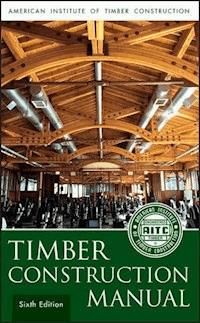
Timber Construction Manual E-Book
122,99 €
Mehr erfahren.
- Herausgeber: John Wiley & Sons
- Kategorie: Wissenschaft und neue Technologien
- Sprache: Englisch
THE DEFINITIVE DESIGN AND CONSTRUCTION INDUSTRY SOURCE FOR BUILDING WITH WOOD—NOW IN A THOROUGHLY UPDATED SIXTH EDITION
Since its first publication in 1966, Timber Construction Manual has become the essential design and construction industry resource for building with structural glued laminated timber. Timber Construction Manual, Sixth Edition provides architects, engineers, contractors, educators, and related professionals with up-to-date information on engineered timber construction, including the latest codes, construction methods, and authoritative design recommendations. Content has been reorganized to flow easily from information on wood properties and applications to specific design considerations.
Based on the most reliable technical data available, this edition has been thoroughly revised to encompass:
- A thorough update of all recommended design criteria for timber structural members, systems, and connections
- An expanded collection of real-world design examples supported with detailed schematic drawings
- New material on the role of glulam in sustainable building practices
- The latest design and construction codes, including the 2012 National Design Specification for Wood Construction, AITC 117-2010, and examples featuring ASCE 7-10 and IBC 2009
- More cross-referencing to other available AITC standards on the AITC website
Since 1952, the AMERICAN INSTITUTE OF TIMBER CONSTRUCTION has been the national technical trade association of the structural glued laminated timber industry. AITC-recommended building and design codes for wood-based structures are considered authoritative in the United States building industry.
Sie lesen das E-Book in den Legimi-Apps auf:
Seitenzahl: 611
Veröffentlichungsjahr: 2012
Ähnliche




















Table of Contents
Title Page
Copyright
Preface
Chapter 1: Timber Construction
1.1 Introduction
1.2 Materials
1.3 Structural Systems
1.4 Economy
1.5 Permanence
1.6 Seasoning
1.7 Handling, Storage, and Erection
1.8 Conclusion
Chapter 2: Wood Properties
2.1 Introduction
2.2 Specific Gravity and Specific Weight of Commercial Lumber Species
2.3 Dimensional Changes Due to Moisture and Temperature
2.4 Thermal Insulating Properties
2.5 Wood in Chemical Environments
2.6 Acoustical Properties
2.7 Electrical Properties
2.8 Coefficient of Friction
2.9 Conclusion
Chapter 3: Timber Design
3.1 Introduction
3.2 Loads
3.3 Design Values
3.4 Adjustment Factors
3.5 Deflection
3.6 Camber
3.7 Ponding
3.8 Conclusion
Chapter 4: Timber Beams
4.1 Introduction
4.2 Structural Evaluation of Beams
4.3 Simple Beams
4.4 Continuous Members
4.5 Biaxial Bending (Bending about Both Axes)
4.6 Torsion
4.7 Conclusion
Chapter 5: Timber Columns and Tension Members
5.1 Introduction
5.2 Column Design Criteria
5.3 Rectangular Columns
5.4 Round Columns
5.5 Tapered Columns
5.6 Spaced Columns
5.7 Built-Up Columns
5.8 Columns with Flanges
5.9 Tension Members
5.10 Conclusion
Chapter 6: Timber Beam-Columns and Tension Beams
6.1 Introduction
6.2 General Equation for Beam-Columns
6.3 Centric Axial Compression and Side Load Bending about Both Axes
6.4 Centric Axial Compression and Side Load Bending about Strong Axis Only
6.5 Eccentric Axial Compression Only
6.6 Axial Compression Eccentricity in Strong Direction Only
6.7 Columns with Side Brackets
6.8 Combined Axial Tension and Bending
6.9 Conclusion
Chapter 7: Tapered Beams
7.1 Introduction
7.2 Tapered Beam Design
7.3 Beams with Tapered End Cuts
7.4 Conclusion
Chapter 8: Curved Glulam Beams
8.1 Introduction
8.2 Curved Beams with Constant Depth
8.3 Pitched and Tapered Curved Beams
8.4 Pitched and Tapered Curved Beams with Mechanically Attached Haunch
8.5 Conclusion
Chapter 9: Glulam Arches
9.1 Introduction
9.2 Preliminary Design Procedure
9.3 Conclusion
Chapter 10: Heavy Timber Decking
10.1 Introduction
10.2 Installation Requirements
10.3 Design Formulas
10.4 Section Properties
10.5 Decking Design Values
10.6 Conclusion
Chapter 11: Connections in Timber Structures
11.1 Introduction
11.2 Connection Detailing Principles
11.3 Types of Fasteners
11.4 Reference Design Values for Fasteners
11.5 Adjustment Factors
11.6 Conclusion
Chapter 12: Member Capacity at Connections
12.1 Introduction
12.2 Member Capacity at Connections Loaded Perpendicular-to-Grain
12.3 Member Capacity at Connections Loaded Parallel-to-Grain
12.4 Member Capacity at Connections Loaded at an Angle to Grain
12.5 Conclusion
Chapter 13: Dowel-Type Fasteners
13.1 Introduction
13.2 Dowel-Type Fasteners Loaded Laterally
13.3 Dowel-Type Fasteners Loaded in Withdrawal
13.4 Dowel-Type Fasteners Loaded Laterally and in Withdrawal
13.5 Conclusion
Chapter 14: Shear Plates and Split Rings
14.1 Introduction
14.2 Connectors in Side Grain
14.3 Timber Connectors in End Grain
14.4 Conclusion
Chapter 15: Moment Splices
15.1 Introduction
15.2 Shear Transfer
15.3 Moment Transfer
15.4 Conclusion
Chapter 16: Load and Resistance Factor Design
16.1 Introduction
16.2 Design Values and Adjustment Factors
16.3 Design Checks
16.4 Conclusion
Chapter 17: Timber Bridges
17.1 Introduction
17.2 Types of Timber Bridges
17.3 Advantages of Glued Laminated Timber
17.4 Preservative Treatments
17.5 Wearing Surfaces
17.6 Guardrails
17.7 Design Methods
17.8 Conclusion
Chapter 18: LRFD Bridge Design
18.1 Introduction
18.2 Longitudinal Stringers
18.3 Transverse Glulam Deck Panels
18.4 Longitudinal Deck (with Stiffeners)
18.5 Conclusion
Chapter 19: ASD Bridge Design
19.1 Introduction
19.2 Longitudinal Stringers (Girders)
19.3 Interconnected Transverse Deck Panels
19.4 Non-Interconnected Transverse Deck Panels
19.5 Longitudinal Deck (with Stiffeners)
19.6 Static Design of Guardrail System
19.7 Conclusion
Chapter 20: Fire Safety
20.1 Introduction
20.2 Types of Construction
20.3 Lessons from Actual Fires
20.4 Performance of Wood in Fire
20.5 Wood versus Steel
20.6 Heavy Timber Construction
20.7 Fire-Resistance-Rated Construction
20.8 Use of Stock Glulam Beams in Fire Rated Construction
20.9 Fire Retardant Treatment
20.10 Conclusion
Appendix A: Design Examples
Introduction
Comparative Shrinkage of Sawn Timber and Glulam Beams (See also Section 2.3.1)
Simple Beam Design (ASD Method) (See also Sections 4.1, 4.2, 4.3)
Upside-Down Beam Analysis (ASD Method) (See also Section 4.3.2)
Tension-Face Notch (ASD Method) (See also Section 12.2.2)
Compression-Face Notch (ASD Method) (See also Section 12.2.3)
Sloped End Cut (ASD Method) (See also Section 12.2.3)
Beam Stability (Effective Length Method, ASD) (See also Sections 3.4.3.1, 4.3.4)
Beam Stability (Equivalent Moment Method, ASD) (See also Sections 3.4.31, 4.3.4)
Cantilever Beam Stability (Equivalent Moment Method, ASD) (See also Section 3.4.3.1, 4.3, 4.4)
Two-Span Continuous Beam Stability (Equivalent Moment Method, ASD) (See also Sections 3.4.3.1, 4.4)
Biaxial Bending (ASD Method) (See also Section 4.5)
Beam with Ponding Load (ASD Method) (See also Section 3.7)
Compression Web Design (ASD Method) (See also Sections 3.4.3.9, 5.2, 5.3)
Column with Centric Load, Beam Lay-Up (ASD Method) (See also Sections 3.4.3.9, 5.2, 5.3)
Column with Eccentric Load, Beam Lay-Up (ASD Method) (See also Sections 3.4.3.9, 6.1.2, 6.5)
Column with Side Bracket, Uniform Grade Layup (ASD Method) (See also Section 6.7)
Continuous Truss Chord, Beam Lay-Up (ASD Method) (See also Sections 6.4, 12.3.1)
Single-Tapered Straight Beam (ASD Method) (See also Sections 3.4.3.8, 7.2)
Double-Tapered Straight Beam (ASD Method) (See also Sections 3.4.3.8, 7.2)
Constant-Depth Curved Beam (ASD Method) (See also Sections 8.1, 8.2)
Pitched and Tapered Curved DF Beam (ASD Method) (See also Section 8.3)
Pitched and Tapered Curved SP Beam (ASD Method) (See also Section 8.3)
Bolted Tension Connection with Steel Side Plates (ASD Method) (See also Sections 12.3, 13.2)
Bolted Tension Connection with Steel Kerf Plate (ASD Method) (See also Sections 12.3, 13.2)
Shear Plate Tension Connection (ASD Method) (See also Sections 12.3, 14.2.3.1)
TUDOR ARCH PEAK SHEAR PLATE CONNECTION (ASD Method) (See also Sections 11.5.4, 14.3)
Moment Splice (ASD Method) (See also Chapters 9, 14, 15)
One-Hour Fire-Rated Beam Analysis (See also Section 20.7.4)
One-Hour Fire-Rated Column Analysis (See also Section 20.7.4)
Heavy Timber Roof Decking (ASD Method) (See also Chapter 10)
Appendix B: Reference Information (An optimized version of this appendix may be viewed atwww.wiley.com/go/timbertables)
B.1 Beam Diagrams and Formulas
B.2 Typical Fastener Dimensions and Yield Strengths
B.3 Structural Glued Laminated Timber Reference Design Values
References
Chapter 1
Chapter 2
Chapter 3
Chapter 4
Chapter 5
Chapter 6
Chapter 7
Chapter 8
Chapter 9
Chapter 10
Chapter 11
Chapter 12
Chapter 13
Chapter 14
Chapter 15
Chapter 16
Chapter 17
Chapter 18
Chapter 19
Chapter 20
Index
This book is printed on acid-free paper.
Copyright © 2012 by American Institute of Timber Construction. All rights reserved.
Published by John Wiley & Sons, Inc., Hoboken, New Jersey
Published simultaneously in Canada
No part of this publication may be reproduced, stored in a retrieval system, or transmitted in any form or by any means, electronic, mechanical, photocopying, recording, scanning, or otherwise, except as permitted under Section 107 or 108 of the 1976 United States Copyright Act, without either the prior written permission of the Publisher, or authorization through payment of the appropriate per-copy fee to the Copyright Clearance Center, 222 Rosewood Drive, Danvers, MA 01923, (978) 750-8400, fax (978) 646-8600, or on the web at www.copyright.com. Requests to the Publisher for permission should be addressed to the Permissions Department, John Wiley & Sons, Inc., 111 River Street, Hoboken, NJ 07030, (201) 748-6011, fax (201) 748-6008, or online at www.wiley.com/go/permissions.
Limit of Liability/Disclaimer of Warranty: While the publisher and the author have used their best efforts in preparing this book, they make no representations or warranties with respect to the accuracy or completeness of the contents of this book and specifically disclaim any implied warranties of merchantability or fitness for a particular purpose. No warranty may be created or extended by sales representatives or written sales materials. The advice and strategies contained herein may not be suitable for your situation. You should consult with a professional where appropriate. Neither the publisher nor the author shall be liable for damages arising herefrom.
For general information about our other products and services, please contact our Customer Care Department within the United States at (800) 762-2974, outside the United States at (317) 572-3993 or fax (317) 572-4002.
Wiley publishes in a variety of print and electronic formats and by print-on-demand. Some material included with standard print versions of this book may not be included in e-books or in print-on-demand. If this book refers to media such as a CD or DVD that are not included in the version you purchased, you may download this material at http://booksupport.wiley.com. For more information about Wiley products, visit www.wiley.com.
Library of Congress Cataloging-in-Publication Data:
Timber construction manual / American Institute of Timber Construction.—Sixth edition.
pages cm
Includes index.
ISBN 978-0-470-54509-6 (hardback); 978-1-118-27961-8 (ebk.); 978-1-118-27964-9 (ebk.); 978-1-118-27965-6 (ebk.); 978-1-118-27966-3 (ebk.); 978-1-118-27968-7 (ebk.); 978-1-118-27973-1 (ebk.)
1. Building, Wooden—Handbooks, manuals, etc. I. American Institute of Timber Construction.
TA666.T47 2012
694—dc23
Preface
The American Institute of Timber Construction (AITC) has developed this Timber Construction Manual for convenient reference by architects, engineers, contractors, teachers, the laminating and fabricating industry, and all others having a need for reliable, up-to-date technical data and recommendations on engineered timber construction. The information and the recommendations herein are based on the most reliable technical data available and reflect the commercial practices found to be most practical. Their application results in structurally sound construction.
The American Institute of Timber Construction, established in 1952, is a nonprofit industry association for the structural glued laminated timber industry. Its members design, manufacture, fabricate, assemble, and erect structural timber systems utilizing both sawn and structural glued laminated timber components. These systems are used in homes; schools; churches; commercial and industrial buildings; and for other structures such as bridges, towers, and marine installations. Institute membership also includes engineers, architects, building officials, and associates from other industries related to timber construction.
The first edition of the Timber Construction Manual was published in 1966. Changes in the wood products industry, technological advances, and improvements in the structural timber fabricating industry necessitated revisions of the Manual. New lumber sizes and revisions in grading requirements for lumber and glued laminated timber were reflected in the second edition published in 1974. The third edition was published in 1985 to reflect new information on timber design methods. The fourth edition of the Manual was published in 1994 and contained updated design procedures used for timber construction. The fifth edition (2005) added sections on timber rivet fasteners and load and resistance factor design.
This sixth edition represents a major revision of the format of the Timber Construction Manual. Chapters have been completely restructured for more logical and complete presentation of information. Long chapters have been divided into smaller chapters for improved readability and reference.
The sixth edition has also been expanded with completely new chapters on glulam arches, LRFD bridge design, fire safety, and moment splices. More than 30 new design examples have been added, including an appendix entirely composed of design examples.
Preparation of the Timber Construction Manual was guided by the AITC Technical Advisory Committee and was carried out by AITC staff, the engineers and technical representatives of AITC member firms, and private consultants. Suggestions for the improvement of this manual will be welcomed and will receive consideration in the preparation of future editions.
Although the information herein has been prepared in accordance with recognized engineering principles and is based on the most accurate and reliable technical data available, it should not be used or relied on for any general or specific application without competent professional examination and verification of their accuracy, suitability, and applicability by a licensed professional engineer, designer, or architect. By the publication of this manual, AITC intends no representation or warranty, expressed or implied, that the information contained herein is suitable for any general or specific use or is free from infringement of any patent or copyright. Any user of this information assumes all risk and liability arising from such use.
Chapter 1
Timber Construction
1.1 Introduction
The American Institute of Timber Construction (AITC) has developed this Timber Construction Manual to provide up-to-date technical information and recommendations on engineered timber construction. Topics of the first chapter include materials, structural systems, economy, permanence, seasoning, handling, storage, and erection. With an understanding of these topics, the designer can more effectively utilize the advantages of wood construction. Specific design information and recommendations are covered in subsequent chapters, with accompanying design examples. Supplementary information is provided in appendices.
1.2 Materials
This manual applies primarily to two types of wood materialssawn lumber and structural glued laminated timber (glulam). Sawn lumber is the product of lumber mills and is produced from many species. Glued laminated timbers are produced in laminating plants by adhesively bonding dry lumber, normally of 2-in. or 1-in. nominal thickness, under controlled conditions of temperature and pressure. Members with a wide variety of sizes, shapes, and lengths can be produced having superior strength, stiffness, and appearance. In addition, heavy timber decking, structural panels, and round timbers are also discussed.
1.2.1 Lumber
In its natural state, wood has limited structural usefulness, so it must be converted to a structural form that is compatible with construction needs. The most common structural wood material is sawn lumber. Sawn lumber is also the primary component of structural glued laminated timber. This section will discuss common growth characteristics of wood and their effects on the properties of structural lumber. It will also discuss common grading systems for lumber.
1.2.1.1 Lumber Grading
As it is sawn from a log, lumber is quite variable in its mechanical properties. Individual pieces may differ in strength by as much as several hundred percent. For simplicity and economy in use, pieces of lumber of similar quality are classified into various structural grades. The structural properties of a particular grade depend on the sorting criteria used, species or species group, and other factors.
Rules for determining lumber grades are written by rules writing agencies authorized by the American Lumber Standards Committee (ALSC) [1]. Four such agencies are the Southern Pine Inspection Bureau (SPIB) [2], the West Coast Lumber Inspection Bureau (WCLIB) [3], the Western Wood Products Association (WWPA) [4], and the National Lumber Grades Authority (NLGA) [5]. Lumber grading is also certified by agencies authorized by the American Lumber Standards Committee. Generally, the designer of timber structures is not charged with grading but instead with selecting commercially available grades that meet necessary structural requirements.
Lumber rules writing agencies also establish design values and adjustment factors for each grade. Design values provided by the agencies are published in the National Design Specification (NDS) [6]. These values and factors are generally accepted by model and/or local building codes but are occasionally adopted with amendments particular to the jurisdiction.
Grading is accomplished by sorting pieces according to visually observable characteristics (visual grading) or according to measurable mechanical properties and visual characteristics (mechanical grading). Both grading methods relate key lumber characteristics to expected strength.
1.2.1.2 Characteristics Affecting Structural Lumber Quality
Within any given species of wood, several natural growth characteristics observed in structural lumber are important for the determination of quality of the material and the assignment of design values. The main characteristics of concern include: specific gravity, knots, slope of grain, and modulus of elasticity. Other important characteristics include reaction wood, juvenile (pith-associated) wood, and compression breaks. Lumber grading rules regulate these characteristics based on the effect they have on the strength of a piece.
1.2.1.2.1 Specific Gravity
Specific gravity is a good index for strength and stiffness of clear wood (free of knots and other strength-reducing characteristics). As the specific gravity of wood increases, so do its mechanical properties (strength and stiffness). The specific gravity of certain species of lumber can be estimated by the amount of latewood in the piece. Because latewood is typically more dense than earlywood, higher proportions of latewood equate to higher specific gravities. This relationship is commonly used in grade rules for structural lumber. Visual grading rules classify lumber according to growth ring measurements as having dense, medium, or coarse grain based on the width of the rings and on the proportion of latewood present. Mechanical grading systems may use weight or calibrated x-ray machines to determine specific gravity.
1.2.1.2.2 Knots
A knot is formed by sawing through a portion of the tree trunk that formed around a branch. Knots are considered as defects in structural lumber. The presence of a knot disrupts the longitudinal orientation of the wood fibers as they deviate around the knot. A knot may be intergrown with the surrounding wood or encased by the surrounding wood without intergrown fibers. The latter type of knot is called a and often falls out, leaving a knothole. Both types of knots reduce the capacity and stiffness of a structural member, particularly in tension. Grade rules typically restrict the size, location, and frequency of knots, knot clusters, and knot holes allowed by each grade.
Lesen Sie weiter in der vollständigen Ausgabe!
Lesen Sie weiter in der vollständigen Ausgabe!
Lesen Sie weiter in der vollständigen Ausgabe!
Lesen Sie weiter in der vollständigen Ausgabe!
Lesen Sie weiter in der vollständigen Ausgabe!
Lesen Sie weiter in der vollständigen Ausgabe!
Lesen Sie weiter in der vollständigen Ausgabe!
Lesen Sie weiter in der vollständigen Ausgabe!
Lesen Sie weiter in der vollständigen Ausgabe!
Lesen Sie weiter in der vollständigen Ausgabe!
Lesen Sie weiter in der vollständigen Ausgabe!
Lesen Sie weiter in der vollständigen Ausgabe!
Lesen Sie weiter in der vollständigen Ausgabe!
Lesen Sie weiter in der vollständigen Ausgabe!
Lesen Sie weiter in der vollständigen Ausgabe!
Lesen Sie weiter in der vollständigen Ausgabe!
Lesen Sie weiter in der vollständigen Ausgabe!
Lesen Sie weiter in der vollständigen Ausgabe!
Lesen Sie weiter in der vollständigen Ausgabe!
Lesen Sie weiter in der vollständigen Ausgabe!
Lesen Sie weiter in der vollständigen Ausgabe!
Lesen Sie weiter in der vollständigen Ausgabe!
Lesen Sie weiter in der vollständigen Ausgabe!




