


85,99 €
Mehr erfahren.
- Herausgeber: John Wiley & Sons
- Kategorie: Wissenschaft und neue Technologien
- Sprache: Englisch
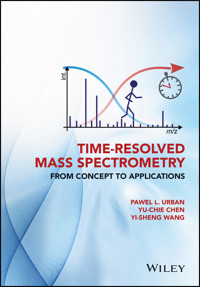
Time is an important factor in physical and natural sciences. It characterizes the progress of chemical and biochemical processes. Mass spectrometry provides the means to study molecular structures by detecting gas-phase ions with the unique mass-to-charge ratios. Time-resolved mass spectrometry (TRMS) allows one to differentiate between chemical states that can be observed sequentially at different time points. Real-time mass spectrometric monitoring enables recording data continuously with a specified temporal resolution. The TRMS approaches – introduced during the past few decades – have shown temporal resolutions ranging from hours down to microseconds and beyond.
This text covers the key aspects of TRMS. It introduces ion sources, mass analyzers, and interfaces utilized in time-resolved measurements; discusses the influence of data acquisition and treatment; finally, it reviews most prominent applications of TRMS – in the studies of reaction kinetics and mechanism, physicochemical phenomena, protein structure dynamics, biocatalysis, and metabolic profiling.
It will assist science and engineering students to gain a basic understanding of the TRMS concept, and to recognize its usefulness. In addition, it may benefit scientists who conduct molecular studies in the areas of chemistry, physics and biology.
Sie lesen das E-Book in den Legimi-Apps auf:
Seitenzahl: 752
Veröffentlichungsjahr: 2016
Ähnliche



















Table of Contents
Cover
Title Page
Copyright
Author Biographies
Preface
Acknowledgments
List of Acronyms
Chapter 1: Introduction
1.1 Time in Chemistry
1.2 Mass Spectrometry
1.3 Time-resolved Mass Spectrometry
1.4 Dynamic Matrices
1.5 Real-time
vs.
Single-point Measurements
1.6 Further Reading
References
Chapter 2: Ion Sources for Time-resolved Mass Spectrometry
2.1 Electron Ionization
2.2 Chemical Ionization
2.3 Atmospheric Pressure Chemical Ionization
2.4 Electrospray Ionization
2.5 Atmospheric Pressure Photoionization
2.6 Desorption/Ionization
2.7 Innovations in the 21st Century
2.8 Concluding Remarks
References
Chapter 3: Mass Analyzers for Time-resolved Mass Spectrometry
3.1 Overview
3.2 Individual Mass Analyzers
3.3 Integrated Analytical Techniques
References
Chapter 4: Interfaces for Time-resolved Mass Spectrometry
4.1 Molecules in Motion
4.2 Time-resolved Mass Spectrometry Systems
4.3 Concluding Remarks
References
Chapter 5: Balancing Acquisition Speed and Analytical Performance of Mass Spectrometry
5.1 Overview
5.2 Spectrum Acquisition Speed
5.3 Relationship between Spectrum Acquisition Time and Mass Spectrometer Performance
References
Chapter 6: Hyphenated Mass Spectrometric Techniques
6.1 Introduction
6.2 Separation Techniques Coupled with Mass Spectrometry
6.3 Ion-mobility Spectrometry
6.4 Other Hyphenated Systems
6.5 Influence of Data Acquisition Speed
6.6 Concluding Remarks
References
Chapter 7: Microfluidics for Time-resolved Mass Spectrometry
7.1 Overview
7.2 Fabrication
7.3 Microreaction Systems
7.4 Hydrodynamic Flow
7.5 Coupling Microfluidics with Mass Spectrometry
7.6 Examples of Applications
7.7 Digital Microfluidics
7.8 Concluding Remarks
References
Chapter 8: Quantitative Measurements by Mass Spectrometry
8.1 The Challenge of Quantitative Mass Spectrometry Measurements
8.2 Selection of Instrument
8.3 Solutions to Quantitative Mass Spectrometry
8.4 Data Treatment
8.5 Concluding Remarks
References
Chapter 9: Data Treatment in Time-resolved Mass Spectrometry
9.1 Overview
9.2 Definition of Terms
9.3 Spectral Patterns
9.4 Mass Accuracy
9.5 Structural Derivation
9.6 Molecule Abundance
9.7 Time-dependent Data Treatment
References
Chapter 10: Applications in Fundamental Studies of Physical Chemistry
10.1 Overview
10.2 Chemical Kinetics
10.3 Chemical Equilibrium
References
Chapter 11: Application of Time-resolved Mass Spectrometry in the Monitoring of Chemical Reactions
11.1 Organic Reactions
11.2 Catalytic Reactions
11.3 Photochemical Reactions
11.4 Concluding Remarks
References
Chapter 12: Applications of Time-resolved Mass Spectrometry in the Studies of Protein Structure Dynamics
12.1 Electrospray Ionization in Protein Studies
12.2 Mass Spectrometry Strategies for Ultra-fast Mixing and Incubation
12.3 Hydrogen/Deuterium Exchange
12.4 Photochemical Methods
12.5 Implementation of Ion-mobility Spectrometry Coupled with Mass Spectrometry
12.6 Concluding Remarks
References
Chapter 13: Applications of Time-resolved Mass Spectrometry in Biochemical Analysis
13.1 Enzymatic Reactions
13.2 Time-resolved Mass Spectrometry in Systems and Synthetic Biology
13.3 Monitoring Living Systems
13.4 Concluding Remarks
References
Chapter 14: Final Remarks
14.1 Current Progress
14.2 Instrumentation
14.3 Software
14.4 Limitations
References
Index
End User License Agreement
Pages
xi
xiii
xiv
xv
xvii
xviii
xix
xx
1
2
3
4
5
6
7
8
9
10
11
12
13
14
15
16
17
18
19
20
21
22
23
24
25
26
27
28
29
30
31
32
33
34
35
36
37
38
39
40
41
42
43
44
45
46
47
48
49
50
51
53
54
55
56
57
58
59
60
61
62
63
64
65
66
67
68
69
70
71
72
73
74
75
76
77
78
79
80
81
82
83
84
85
86
87
88
89
90
91
92
93
94
95
96
97
98
99
100
101
102
103
104
105
106
107
108
109
110
111
112
113
114
115
116
117
118
119
120
121
122
123
124
125
126
127
128
129
130
131
132
133
134
135
136
137
138
139
140
141
142
143
144
145
146
147
148
149
150
151
152
153
154
155
157
158
159
160
161
162
163
164
165
166
167
169
170
171
172
173
174
175
176
177
178
179
180
181
182
183
184
185
186
187
188
189
190
191
192
193
195
196
197
198
199
200
201
202
203
204
205
206
207
208
209
210
211
212
213
214
215
216
217
218
219
220
221
222
223
224
225
226
227
228
229
230
231
232
233
234
235
236
237
238
239
240
241
242
243
244
245
246
247
249
250
251
252
253
254
255
256
257
258
259
260
261
262
263
264
265
266
267
268
269
270
271
272
273
274
275
276
277
278
279
280
281
282
283
284
285
286
287
288
289
291
292
293
294
295
296
297
298
299
300
301
302
303
304
305
306
307
308
309
310
311
312
313
314
315
316
317
318
319
320
321
322
323
324
325
326
327
328
329
330
331
332
333
334
335
336
337
338
339
340
341
342
343
344
345
346
347
348
349
350
351
352
353
354
355
Guide
Cover
Table of Contents
Preface
Begin Reading
List of Illustrations
Chapter 1: Introduction
Figure 1.1 Main components of a mass spectrometer. Reproduced from Kandiah and Urban [29] with permission of The Royal Society of Chemistry
Figure 1.2 (a) Mass spectra obtained by Aston using the early mass spectrometer. Reproduced from Squires [50] with permission of The Royal Society of Chemistry. (b) Mass spectrum of caffeine obtained using a modern ESI-IT mass spectrometer. Courtesy of E.P. Dutkiewicz
Chapter 2: Ion Sources for Time-resolved Mass Spectrometry
Figure 2.1 Ion sources which have been utilized in time-resolved mass spectrometry (TRMS) studies (a dichotomy)
Figure 2.2 Schematic illustration of the EI source. M, analyte; M
+•
, molecular ion; F
+
, fragment ion
Figure 2.3 Plot showing the relationship between the ionization efficiency and the energy of the electron beam used in EI
Figure 2.4 Schematic depiction of the CI source
Figure 2.5 The residence time of the ions in the CI source versus gas pressure. (a) Effective ion source residence time as a function of inlet pressure for three different initial Ar/O
2
, compositions. (b) The ratio of effective ion source residence time to inlet pressure as a function of inlet pressure [19]. Reprinted with permission from Griffith, K.S., Gellene, G.I. (1993) A Simple Method for Estimating Effective Ion Source Residence Time. J. Am. Soc. Mass Spectrom. 4: 787–791. Copyright (1993) American Chemical Society
Figure 2.6 Schematic representation of the APCI source
Figure 2.7 General schematic representation of the processes in ESI-MS [32]. Reprinted with permission from Kebarle, P., Tang, L. (1993) From Ions in Solution to Ions in the Gas Phase. The Mechanism of Electrospray Mass Spectrometry. Anal. Chem. 64: 972A–986A. Copyright (1993) American Chemical Society
Figure 2.8 Time spent on ion formation in ESI. (a) Schematic representation of time history of parent and offspring droplets. Droplet at the top left is a typical parent droplet created near the ESI capillary tip at low flow rates. Evaporation of solvent at constant charge leads to uneven fission. The number beside the droplets gives radius and number of elementary charge N on droplet; corresponds to the time required for evaporative droplet shrinkage to the size where fission occurs. Only the first three successive fissions of a parent droplet are shown. At the bottom right, the uneven fission of an offspring droplet to produce offspring droplet is shown. The timescale is based on (, radius of droplet; , time), which produces only a rough estimate. Inset: Tracing of photograph by Gomez and Tang [36] of droplet undergoing “uneven” fission. Typical droplet loses 2% of its mass, producing some 20 smaller droplets that carry 15% of the parent charge [32]. Reprinted with permission from Kebarle, P., Tang, L. (1993) From Ions in Solution to Ions in the Gas Phase. The Mechanism of Electrospray Mass Spectrometry. Anal. Chem. 64: 972A–986A. Copyright (1993) American Chemical Society. (b) Droplet histories for charged water droplets produced by nanoESI. The first droplet is one of the droplets produced at the spray tip. This parent droplet is followed for three evaporation and fission events. The first generation droplets are shown as well as the fission of one of these to lead to second generation offspring droplets [40]. Reproduced from Peschke, M. et al. (2004) [40] with permission of Springer. Data shown based on experimental results [41] and calculations [40]. (c) In this molecular dynamic simulation, an unfolded protein chain that was initially placed within a Rayleigh-charged water droplet gets ejected via the chain ejection model. Side chains and backbone moieties are represented as beads [42]. Reproduced with permission from Konermann, L., Ahadi, E., Rodriguez, A.D., Vahidi, S. (2013) Unraveling the Mechanism of Electrospray Ionization. Anal. Chem. 85: 2–9. Copyright (2013) American Chemical Society.
Lesen Sie weiter in der vollständigen Ausgabe!
Lesen Sie weiter in der vollständigen Ausgabe!
Lesen Sie weiter in der vollständigen Ausgabe!
Lesen Sie weiter in der vollständigen Ausgabe!
Lesen Sie weiter in der vollständigen Ausgabe!
Lesen Sie weiter in der vollständigen Ausgabe!
Lesen Sie weiter in der vollständigen Ausgabe!
Lesen Sie weiter in der vollständigen Ausgabe!
Lesen Sie weiter in der vollständigen Ausgabe!
Lesen Sie weiter in der vollständigen Ausgabe!
Lesen Sie weiter in der vollständigen Ausgabe!
Lesen Sie weiter in der vollständigen Ausgabe!
Lesen Sie weiter in der vollständigen Ausgabe!
Lesen Sie weiter in der vollständigen Ausgabe!
Lesen Sie weiter in der vollständigen Ausgabe!
Lesen Sie weiter in der vollständigen Ausgabe!
Lesen Sie weiter in der vollständigen Ausgabe!
Lesen Sie weiter in der vollständigen Ausgabe!
Lesen Sie weiter in der vollständigen Ausgabe!
Lesen Sie weiter in der vollständigen Ausgabe!
Lesen Sie weiter in der vollständigen Ausgabe!
Lesen Sie weiter in der vollständigen Ausgabe!




