


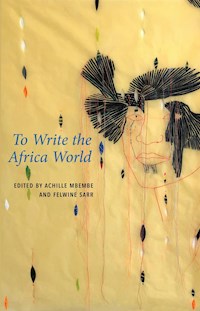
To Write the Africa World E-Book
19,99 €
Mehr erfahren.
- Herausgeber: John Wiley & Sons
- Kategorie: Geisteswissenschaft
- Serie: Critical South
- Sprache: Englisch
In October 2016, thirty intellectuals and artists from Africa, its diasporas, and beyond gathered together in Dakar and Saint-Louis, Senegal, to reflect on the present and future of Africa in the midst of transformations that are sweeping through the contemporary world. The aim was to take stock of the renewal of Afro-diasporic critical thought and to discuss the new perspectives emerging from the ongoing projects constructing political, cultural, and social imaginaries for and from the African continent.
This book brings together and makes available to the English-speaking world the material presented at the 2016 Ateliers de la pensée – Workshops of Thought – in Dakar. The authors deal with a wide range of issues, including decolonization, the development of social utopias, and the pursuit of new forms of political, economic, and social production on the African continent. Running throughout is a constant concern to interrogate the categories and frames of meaning that have served to characterize the dynamics of the African continent and a shared desire to produce new frames of intelligibility through which to see Africa’s present realities and its future. The contributions also attest to the view that there is no African question that is not also a global question, and that the Africanization of the global question will be a decisive feature of the twenty-first century.
To Write the Africa World and its companion volume The Politics of Time will be indispensable for anyone interested in Africa – its past, present, and future – and in the new forms of critical thought emerging from Africa and the Global South.
Sie lesen das E-Book in den Legimi-Apps auf:
Seitenzahl: 620
Veröffentlichungsjahr: 2022
Ähnliche




















Table of Contents
Cover
Series Title
Title Page
Copyright Page
Thinking for a New Century
Achille Mbembe and Felwine Sarr
I
(European?) Universalism Put to the Test by Indigenous Histories
Mamadou Diouf
Notes
Laetitia Africana
: Philosophy, Decolonization, and Melancholy
Nadia Yala Kisukidi
The names of philosophy
Futures, defeat, and melancholy
Notes
For a Truly Universal Universal
Souleymane Bachir Diagne
Notes
Migrant Writers: Builders of a Balanced Globalization of Africa/Europe
Benaouda Lebdai
Reconstructive memory
The deconstruction of borders
The innovative role of African migrant writers
Bibliography
Notes
II
For What is Africa the Name?
Léonora Miano
Notes
Epistemological Impasses Concerning the Object Africa: Imprudence and Impudence of a Subjugated Exoticism and a Hyperbolic Narcissism
Maurice Soudieck Dione
The uncontrollable traps of a universalist thought
The hegemonic ruses concerning developmentalism
The hegemonic ruses concerning dependentism
The uncomfortable seats at the table of relativistic thought
Devaluing relativistic thought
An enthusiastic relativistic thought
Notes
Reinventing African Modernity
Blondin Cissé
Senghor and the philosophy of complementarity
Nkrumah or philosophical synthesis
Towa and the theory of alienation
In conclusion: Black African ideology – a doctrine in crisis
Bibliography
Notes
What Is a Postcolonial Author?
Lydie Moudileno
The overflowing library
What is a postcolonial author?
The desire of the author, denial of fiction, and literature in person
Notes
III
How Can One Be
African/e
? From Self-Shame to the Consciousness of the Oppressed: Philosophical Reflections by Way of Steve Biko, Malcolm X, and Audre Lorde
Hourya Bentouhami
Epistemology and phenomenology of the oppressed consciousness
A politics of liberation: a becoming-negro
Notes
Rediscovering Meaning
Bonaventure Mve-Ondo
First question: What constitutes the creative core of Africa?
Second question: Under what conditions can Africa invent itself and continue to invent itself?
Third question: In its encounter with other cultures, how is Africa reinventing itself today?
Notes
Esteem for Self: Creating One’s Own Sense/Carving Out One’s Own Path
Séverine Kodjo-Grandvaux
Bibliography
Notes
Dictionary for Lovers of the African Continent: Two Entries
Alain Mabanckou and Abdourahman Waberi
By way of an introduction
Arlit
The urban adventure
Notes
Emancipatory Utopias
Françoise Vergès
Notes
IV
Martiality and Death in Sexual Relations in Cameroon: Sociology for a Lexicon of Copulation
Parfait D. Akana
Signification and place
War
Reasons for violence
The paradoxes of a recovery
Conclusion: What is the takeaway?
Bibliography
Discography
Notes
Demographic Challenges and Technological Mutations: Does a Good-Paying Job Have a Future in Africa?
Ndongo Samba Sylla
The employment situation in Africa
A brief overview of demographic tendencies
Learning from India and China
Confronted with the specter of technological unemployment: where will the millions of decent jobs come from?
Conclusion
Bibliography
Notes
Healing Commonality: Contribution to an Anthropology of Political Corruption in Senegal
Abdourahmane Seck
Introduction
Ordinary self-dispossession … or when history can be read everywhere
Yes, in a
democracy
, you can inherit the Republic … because that is pardonable
The Karim Wade adventure has a genealogy: it did not arise from a madness without memory
From names for the production of poverty … to signs still worth believing in … So as not to conclude
Bibliography
Notes
V
Paths of the Universal
Sami Tchak
Re-enchanting the World: Husserl in the Postcolony
Nado Ndoye
A postcolonial Husserl?
Pluralizing the world
Notes
Writing about the Humanities from the Vantage Point of Africa
Felwine Sarr
Notes
Thinking about the World from the Vantage Point of Africa: Questions for Today and Tomorrow
Achille Mbembe
1
2
3
4
5
6
7
8
9
10
11
12
Notes
Index
End User License Agreement
Guide
Cover
Table of Contents
Begin Reading
Pages
ii
iii
iv
1
2
3
4
5
6
7
8
9
10
11
12
13
14
15
16
17
18
19
20
21
22
23
24
25
26
27
28
29
30
31
32
33
34
35
36
37
38
39
40
41
42
43
44
45
46
47
48
49
50
51
52
53
54
55
56
57
58
59
60
61
62
63
64
65
66
67
68
69
70
71
72
73
74
75
76
77
78
79
80
81
82
83
84
85
86
87
88
89
90
91
92
93
94
95
96
97
98
99
100
101
102
103
104
105
106
107
108
109
110
111
112
113
114
115
116
117
118
119
120
121
122
123
124
125
126
127
128
129
130
131
132
133
134
135
136
137
138
139
140
141
142
143
144
145
146
147
148
149
150
151
152
153
154
155
156
157
158
159
160
161
162
163
164
165
166
167
168
169
170
171
172
173
174
175
176
177
178
179
180
181
182
183
184
185
186
187
188
189
190
191
192
193
194
195
196
197
198
199
200
201
202
203
204
205
206
207
208
209
210
211
212
213
214
215
216
217
218
219
220
221
222
223
224
225
226
227
228
229
230
231
232
233
234
235
236
237
238
239
240
241
242
243
244
245
246
247
248
249
250
251
252
253
254
255
256
257
258
259
260
261
262
263
264
265
266
267
268
269
270
271
272
273
274
275
276
316
317
318
319
320
321
322
323
324
325
Series Title
Critical South
The publication of this series is supported by the International Consortium of Critical Theory Programs funded by the Andrew W. Mellon Foundation.
Series editors: Natalia Brizuela, Victoria Collis-Buthelezi, and Leticia Sabsay
Leonor Arfuch,
Memory and Autobiography
Paula Biglieri and Luciana Cadahia,
Seven Essays on Populism
Aimé Césaire,
Resolutely Black
Bolívar Echeverría,
Modernity and “Whiteness”
Diego Falconí Trávez,
From Ashes to Text
Celso Furtado,
The Myth of Economic Development
Eduardo Grüner,
The Haitian Revolution
Premesh Lalu,
Undoing Apartheid
Karima Lazali,
Colonial Trauma
María Pia López,
Not One Less
Achille Mbembe and Felwine Sarr,
The Politics of Time
Achille Mbembe and Felwine Sarr,
To Write the Africa World
Valentin Y. Mudimbe,
The Scent of the Father
Pablo Oyarzun,
Doing Justice
Néstor Perlongher,
Plebeian Prose
Bento Prado Jr.,
Error, Illusion, Madness
Nelly Richard, Eruptions of Memory
Silvia Rivera Cusicanqui,
Ch’ixinakax utxiwa
Tendayi Sithole,
The Black Register
Maboula Soumahoro,
Black is the Journey, Africana the Name
Dénètem Touam Bona,
Fugitive, Where Are You Running?
To Write the Africa World
Edited by
Achille Mbembe and Felwine Sarr
Translated by Drew Burk
polity
Copyright Page
Originally published in French as Écrire l’Afrique-Monde © 2017 Editions Jimsaan, Dakar, Sénégal
This English edition © Polity Press, 2023
Polity Press
65 Bridge Street
Cambridge CB2 1UR, UK
Polity Press
111 River Street
Hoboken, NJ 07030, USA
All rights reserved. Except for the quotation of short passages for the purpose of criticism and review, no part of this publication may be reproduced, stored in a retrieval system or transmitted, in any form or by any means, electronic, mechanical, photocopying, recording or otherwise, without the prior permission of the publisher.
ISBN-13: 978-1-5095-5106-4- hardback
ISBN-13: 978-1-5095-5107-1- paperback
A catalogue record for this book is available from the British Library.
Library of Congress Control Number: 2022936522
by Fakenham Prepress Solutions, Fakenham, Norfolk NR21 8NL
The publisher has used its best endeavours to ensure that the URLs for external websites referred to in this book are correct and active at the time of going to press. However, the publisher has no responsibility for the websites and can make no guarantee that a site will remain live or that the content is or will remain appropriate.
Every effort has been made to trace all copyright holders, but if any have been overlooked the publisher will be pleased to include any necessary credits in any subsequent reprint or edition.
For further information on Polity, visit our website: politybooks.com
Thinking for a New CenturyAchille Mbembe and Felwine Sarr
The new century that confronts us opens up to a horizon comprising two historical displacements. Europe is no longer understood or viewed as the center of the world even though it is still a vibrant and relatively important and decisive actor on the global stage. For its part, Africa – and the Global South in general – has seen its status continue to rise in importance as one of the principal theaters where, in some distant point in time, the future of the planet will more than likely play out.
For those who, for a long time, have grown accustomed to being snared in the conquering gaze of the other, the moment has come once again to launch a new project of critical thought that will not merely be content with just a series of lamentations and taunts. Confident in its own manner of speaking and at ease wading through the archives of all humanity, this thought is capable of anticipating, of truly creating, and, in so doing, of opening up new paths able to face up to the challenges of our current era. In order for such a project to run for the long term, it seemed to us appropriate to invent a new, open platform in favor of a form of speech and discussion that would necessarily be understood as plural, both confident in its own potentials and powers of speech, and allowing for the unpredictable if necessary – in any case, a platform open to the vast horizon in front of us.
And it’s with such a platform of thought in mind that we held the inaugural event, the Ateliers de la pensée (Workshops of Thought), between October 28 and 31 in Dakar and Saint-Louis-du-Senegal. About thirty intellectuals and artists were invited from across the African continent and the diasporas to reflect on the present and the possible future of an Africa that finds itself in the midst of contemporary global transformations. Not only was this workshop a way to get a better overall idea of the ongoing renewal of French-speaking Afro-diasporic critical thinking; it also served as an impetus for generating new perspectives concerning the contribution from Afro-diasporic discourse to debates on the contemporary world. For those intellectuals and artists who had the privilege of participating, this unique and unforgettable gathering was a momentous occasion for renewed reflection – Africa’s time is inseparable from the time of the world, and the creative task that confronts us is seeking to enable Africa’s future to come into being.
If there is a general optics to be found in the essays gathered together in this volume, it is certainly in the notion of “the event to come,” and it is in this “call to creation” that one will be able to find it. The only Africa that exists is the one that will be created. And for us, then, the fundamental task before us is to make believable, or to believe in, this creation. In order to do this, we must take as our starting point the interconnection between the future fate of both Africa and the world and finally reflect on how to end the misconception that there is a vast separation between them, which has often been taken as a given between the sign that Africa constitutes and the time of the world. And it’s precisely this conception and rather archaic notion, which we will also reflect upon, that, over several centuries, has attempted to claim and make a general population believe that Africa constituted a world apart, un hors-monde – an outside world.
At the dawn of this new century, in seeking to restore a kinship identity between Africa and the world, one recognizes that there exists a variety of ways of being-in-the-world, of being a world, of composing the world one wants to shed light on. How can we bring together all these diverse ways of being and composing, of deciphering and expressing, of articulating what such a call responds to? Such will be the object of our reflection. Each time we attempt to employ such a thought of a world, it will serve as a way of conceiving the possibility of a surprise. From such a perspective, then, this book is not so much a manifesto – in the sense that it would somehow serve to reveal or traverse a threshold into some newfound light of day, unearthing some hidden truths from the preceding generations – and yet it will nevertheless present several vital analyses.
First and foremost, this volume will deal with the notion of urgency. Given that, for Africa, time is now both of the essence and favorable, there is no reason to wait. We are our own witnesses. We must absolutely unite if we are to take back this essential task that we can’t simply delegate to others – namely: reading, writing, deciphering, decrypting, sketching, and calling into question our age, creating a blockade around those languages (our own as well as others) in which we speak in phrases that no longer ring true, which have become mute. We must rehabilitate, in the very act of thought, a form of errancy, of wandering, which serves as a condition for surprise.
Second, thinking for oneself is an exercise that is inseparable from action, since, in Africa, as in the rest of the world, one doesn’t act without thinking, in the same way that one doesn’t think without acting, except when, in both cases, one wants simply to yield to a path of catastrophe. In the end, what we are seeking here is a way to create a new form of construction. To accomplish this, we must first begin by not only opening up all the borders, but also by inventing a way to render the archive – every archive – as legible as possible.
This book is therefore a general call, as pressing as it is intense, to take up the old battles that have never quite been completed and to engage in others that this new century calls on us to address, which inevitably calls for scrambling and erasing many demarcation lines so as to be able trace and sketch out new ones.
The workshops in Dakar, as well as the ones in Saint-Louis-du-Senegal, constitute our response to an amalgam of reconfigurations dealing with the overall conditions for the construction of contemporary thought. On the one hand, the hegemony exerted by Western discourse concerning almost every construct of human knowledge and culture – be it in literature, art, philosophy, or, more broadly, the humanities or social sciences – either is now in retreat or, at the very least, is being strongly contested. There is no doubt that academic institutions in the Global North continue to be powerful. But over the last quarter of the twentieth century, we began to bear witness to the emergence of new trends in many disciplines that called into question this Western-centric worldview of cultural production. And thanks to the arrival of such new interdisciplinary approaches, we are also furnished with new ways of interpreting world history.
This movement in favor of a decentering of thought and the humanities in general is nothing new. However, it is accelerating. Today, pretty much everywhere around the world, new territories of life are taking hold and seeing the light of day. Informal policy practices call into question and overthrow what had, up until now, been considered common sense. Democracy itself is in the throes of reinventing itself, starting in the most common areas of ordinary life. We are all now living with migrants and other peoples who, perhaps at first glance, don’t seem to belong to our community; yet today, we recognize that we are, in fact, all in the same boat. Computational techniques not only transform knowledge into information; they have multiplied our ability to produce knowledge outside the current institutional models as we have come to understand them.
In spite of all the attempts to create enclosures, borders are increasingly becoming elastic, and all sorts of basic dichotomies have begun to collapse. Deterritorialization and reterritorialization go hand in hand. Far from being oppositional, subject and object now form one and the same foundational framework. The conceptions of here and elsewhere have become entangled. Nature is found in culture, and vice versa. Human beings and other living creatures have begun to partake in relations of co-constitution. There is no history that does not simultaneously encompass human persons; technological ensembles; objects; mineral, vegetal, and geoclimatic materials; and even spirits. Given these new conditions, to decenter thought is, above all, to return to a certain conception of the Whole, or Tout.1 Or, to use Édouard Glissant’s term, we must return to a conception of the Tout-Monde. And in this case, we must recall and understand the Tout-Monde not as something that is complete, but rather as something that forces us to reflect and think about how to make life habitable for all.
We therefore find ourselves at a propitious moment to relaunch a project of critical thought – what we call a practice of creation – that will draw its forces and originality through an encounter between the humanities, the disciplines of the imagination, and what we can refer to in a general manner as the arts of the living. For, as far as we are concerned, critical thought is not merely limited to the production of philosophical texts. Far from it. It comprises both a literary and a non-discursive corpus (be it graphic or pictorial). It includes a multiplicity of gestures, fields, and styles, which include music and dance, architecture and photography, as well as cinema, among others. It gathers together all practices of writing, of creation, interpretation, and imagination. Such a thought comprises and makes use of all threads of the imagination. From time to time, both here and elsewhere, this thought is also of a purely performative nature.
The imperative to decentralize thought and the humanities is not a task confined simply to those regions that have, up until now, been found at the margins of the West. Such a project began to take shape in the very heart of the citadel itself, nourished as it is by feminist critique, race critique, a return to conceptions of deep history, and a number of other epistemological currents. On the African continent and in its diasporas, over the past decade, we have also started to notice an upswing in intellectual and artistic creativity, a rekindled vitality in the principal themes, and a fervent desire to renew the forms, the frameworks of thought, and the attempts to grasp the real in the process of being created.
So, we see here that there is something worth exploring and creatively playing with, a new toolbox that we can make use of in order to construct something else with our creative energies. We once again have at our disposal a new generation of critics, intellectuals, researchers, writers, and artists who are working on the African continent as well as in a great many establishments of higher learning throughout the rest of the world. For a number of years now, this generation has been proposing renewed approaches and innovative concepts that, today, serve as new cartographies for reading the world and for interpreting the time period in which we live, while at the same time recording the African and diasporic predicate in a larger framework, one that could truly be understood as global. From now on, it’s clear that, in order to move forward, the world at large can no longer ignore the oeuvres from Africa or its diaspora, whether in the arts, critique, forms of knowledge, literature, or other domains of creativity and imagination.
To be more precise: there is no longer an African or diasporic question that is not at the same time a global question.
Or, to put it another way: the Africanization of the global question will perhaps constitute, at the level of the philosophical and the aesthetic, the event par excellence of the twenty-first century. If there is no African question that is not also a global one, and if, perhaps, the future of the planet largely plays itself out on the African continent, then there exists a variety of challenges that are truly and wholly new for African and diasporic thought, as well as for creativity, and writing. In order to accept the task of confronting these challenges, we can no longer afford not to think together, not to reflect and move forward on common ground. We must therefore compose a body – a body that is entirely open, flexible, and made up of a network, an impactful body whose multiplication of forces will generate and contribute to a much vaster conception of the world itself.
The principal task of these workshops was to take up a theoretical initiative and to focus our diverse gaze on the realities of the African continent and the futures to which it will give rise, starting from a conception of place: Africa. But equally, our task was also to propose renewed frameworks of analysis, of the production of significations and meaning, and the innovative and fertile dynamics at work across the entire continent.
The questions put forward were multiple, and the colleagues invited were first asked to come together to reflect in the workshops themselves, to debate, discuss, to test out their respective propositions, and attempt to open up, by thinking together, a reflection that would be enriched by the contributions of each and every one of them, in a space for debate whose sights were set on such an end goal. Subsequently, further engagements and gatherings with the general public were organized where an even more open dialogue allowed participants to not only truly identify their preoccupations or concerns, but also to give way to a larger demand for a social and collective intelligence emanating from the public itself.
The texts presented in this volume consist of the contributions written by participants in the Workshops of Thought. They are thus the fruit of the distinct perspective of each of the authors, enriched, without doubt, by the exchanges in both Dakar and Saint-Louis-du-Senegal. They deal with questions of decoloniality, the elaboration of social utopias, the global condition of the African question, the articulation of the universal and the singular, the reconstruction of self-esteem, and the practice of thinking-in-common. From these contributions, what can be seen posited is a constant concern for the production of new forms of intelligibility concerning the different realities and future of Africa. The authors, from a broad range of disciplines, have chosen to join forces in order to shed new light on the challenges faced by an Africa World in full mutation, and open to a universe of plurality and myriad horizons.
Dakar-Johannesburg, March 2017
Notes
1
In English,
Tout
can refer both to the notion of the Whole, or the All, a conception of Totality, and also, simply, to the primordial All or wholeness, or, as in this case, to a reference in the work of Édouard Glissant and his conception of the
Tout-Monde
, whereby everything can be understood as resonating within a Whole or a conception of all. [T.N.]
Part I
(European?) Universalism Put to the Test by Indigenous HistoriesMamadou Diouf
Mamadou Dioufholds the Leitner Family Chair in African Studies and History at Columbia University in New York City, where he is also director of the Institute of African Studies. From 1982 to 1991, he taught in the history department at the Cheikh Anta Diop University of Dakar, where he also directed the Council for the Development of Social Science Research in Africa (CODESRIA). His large number of publications include Tolerance, Democracy, and the Sufis in Senegal (Columbia University Press, 2013); Les Arts de la citoyenneté au Sénégal. Espaces contestés et civilités urbaines (Karthala, 2013); The Arts of Citizenship in Africa. Spaces of Belonging (co-edited with Rosalind Fredericks; Palgrave Macmillan, 2014); Rhythms of the Afro-Atlantic: Rituals and Remembrances (co-edited with Ifeoma Nwankwo; University of Michigan Press, 2010); New Perspectives on Islam in Senegal: Conversion, Migration, Wealth, Power, and Femininity (co-edited with Mara Leichtman; Palgrave Macmillan, 2009). He is on the editorial committees of several journals, including African Studies Review, Social Dynamics, and Comparative Studies of South Asia, Africa, and the Middle East (CSSAAME). He is president of the council of directors for the Social Science Research Council (SSRC) and the scientific council of the Réseau français des instituts d’études avancées (RFIEA).
But education is something to make you fine!
No, education is planned to make a sharp, snooty, rooting hog. A Negro getting it is an anachronism. We ought to get something new, we Negros. But we get our education – like our houses. When the Whites move out, we move in and take possession of the old dead stuff. Dead stuff that this age has no use for.
Claude McKay1
The following reflection focuses on a specific moment in the intellectual history of an African and Black community, whose history, pain, and suffering, and social, political, and religious interrogations are etched in the Atlantic space. A territory that is the product of a vast structure of networks connecting worlds, European, African, and American, under the impetus and drive of an expanding Europe. However, this essay does not fail, in its ambition, to incorporate the world-system of the Indian Ocean. Its ambition is to open up, rather than simply pursue, a discussion whose principal object is to appreciate the formulas put in circulation so as to determine one or more African modernities capable of taking charge, or reassessing, the various distinct non-European cultures, in order to reconsider what we understand as a universal history;2 to recivilize a humanity that was decivilized by colonial barbarism,3 and to contribute to the emergence of a civilization of the universal.4
The universal enterprises in question have their sights set on a dual objective: to dismantle the imperialist maneuver of expropriating non-Western societies from the field of history that has been defined as that of political affairs and to firmly establish a historicity set to other rhythms than that of “Western reason,” namely, to establish something of an everyday history.5
To a certain extent, this process is one where philosophy (Plato’s Republic), political economy (Karl Marx’s Capital), and sociology (Max Weber’s The Protestant Ethic and the Spirit of Capitalism as well as his Economy and Society)6 will be replaced by poetry, the only practice capable of narrating, in a creative manner, the daily affairs under way in contrast to the history taught in academia, which is often focused exclusively on that of the nation-state and public affairs. What we are speaking of here is an invitation – already offered up to us by Rabindranath Tagore – vigorously taken up so poetically, and subsequently moved forward, by Guha.7
The experience of daily life in the imperialist metropolises, during the interwar years, laid bare the contradiction between universalist ideas and discriminatory practices, and also exposed the evil that still resided in certain Western “civilizing missions.” It puts into context the questions of the first generations of Black intellectuals, from Africa as well as the diaspora, relating to modernity, modernization, and their meanings. Indeed, they constitute the very core of universalism. And it calls into question the event and arrival of modernity. Why did modernity occur? Is there some sort of meaning and significance that connects its diverse resources into a unique and intelligible narrative? What are the distinctive elements that make it so that modernity is such a singular event? Is it truly possible to account for modernity in a human history considered as a totality and not simply as a series of fragments? Is it possible to reconcile – pace Weber – magic and reason, the kingdom of childhood (Senghor), and world history (Hegel)? Should reason (perhaps) recoil, withdraw, and give way to faith and/or traditions? Is it possible and productive to negotiate the spirit of modernity (the sciences, arts, and politics) and the rules of the concept of a generation and the genre of the African tradition? Such questions are as important as they are urgent. Do they not affect the very debates concerning democratic traditions? In Democracy in America, Tocqueville refers to a twofold transition: that of authoritarian political systems toward democratic political systems and that of traditional societies to modern and open societies. In the case of the Ancien Régime in France, he refers to aristocratic rule.8 What rules should we do away with in order to better promote open societies?
The context in which such a discussion is led is characterized by several propositions. Nativist propositions are interested in the exhumation of African traditions and reconnection with an African past. The Marxist theory of history in its diverse variants, of which the main ones – revisionist, Trotskyist, and Maoist – celebrate the heroic achievements of the bourgeoisie as the collective agent of global change, before the arrival of the proletariat and the realization of its historical mission, thanks to the modernization of the world by capitalism. This theory considers that the dissolution of the last vestiges of feudalism, the suppression of local customs and traditions, and the growth of industrial production, leading to a reduction of social categories into two antagonistic classes that engage in a fight to the death, announce the end of capitalism and history itself. An indigenous modernization/modernity in the Western margins and in the imperial peripheries of capitalism is, according to the Marxist schema, impossible. Marx himself, in The Communist Manifesto, asserts that all nations should submit, under penalty of extinction, to the bourgeois forces of modernity. As a result, the end of the precapitalist and precolonial era is the very sine qua non condition for the beginning of scientific, technical, and social progress in non-Western societies. This position is affirmed with force through the correlation it establishes between the introduction of the steam engine and the dissolution of the “village system.”9 Weber’s ambition and that of his theory of modernity is to identify and analyze the forces that contributed to the arrival of modernity as the only rational civilization. His point of departure: the structure of authority from which he lists three forms – traditional, charismatic, and legal-rational. Weber notes that the legal-rational form is the most dominant in the Western world and constitutes the reason why “Western civilization” has a “universal meaning and validity.” The ongoing progress of rational procedures serves as the very foundation for the production of the institutions of the ideals of Western modernity. The price to pay for the extraordinary gains produced by reason is the departure from religious territory. And some of the lasting effects of this departure are the following: a disconnection from cosmic and religious structures, the imposition of bureaucratic rules, the market economy, and the progress of science and forms of knowledge.
The highest price to be paid is disenchantment of the world, and its most unfortunate consequence is the arrival of “anti-humanism.”10 Against this, theoreticians of negritude oppose a militant commitment whose primary preoccupation is the reconstruction of a humanism that has been led in the wrong direction by colonialism. The humanism found in negritude is a response to a certain “disenchantment” of the world. It is on a quest to uncover another kind of rationality that emerges out of a refusal to abandon intuition and spirituality. A spirituality that is expressed in a pagan grammar. This transactional commitment collides with and responds to another commitment of the proponent of negritude and African presence, Richard Wright. Wright’s paradox can be summarized in the following way: an ardent defense of Enlightenment philosophers and the modernization of Asia and Africa; the celebration of secularism and reason – rationality and industrialization considered as antidotes to non-Western spiritual traditions and economies; the impossible capacity of African and Asian societies to imprint themselves in world time, threatened by the erasure of their traditions and the denial of their spiritual or religious beliefs and cultural aesthetics, as well as the economic and social practices of humanity. Wright asserts forcefully that the realities of the political order of the postwar period require the imposition of a modern subjectivity along with various institutions associated with it, secular democracy, the rule of law/nation-states, industrial and technological progress, bureaucratic order and rational organization of the public space – physical and institutional – and a rigorous defense of the “spirit of the Enlightenment, of the Reformation, which made Europe great, [and which] now has a chance to be extended to all mankind!”11
In contrast, Henry L. Gates considers that Wright’s total adherence to the Enlightenment protocols leads him to concede the superiority of Western rationality. Let’s quickly summarize Wright’s argument: “Colonization was the best thing that could have happened to the African continent” and, in spite of its destructive rage, it was, in the end, beneficial to the non-Western world. Colonization led to the liberation of the masses in Asia and Africa, freeing them from the smothering tyranny of their old traditions and religious beliefs.12 They should thank “the White man” for having freed them from their rotten traditions and customs marked with a seal of irrationality.13 In contrast, Manthia Diawara maintains that Wright’s approach is inscribed in a reinterpretation of the secularism of industrialization and the Enlightenment: two universal paradigms that were betrayed by the West, initially meant to serve as a means of granting true independence to third world nations. In light of this, Diawara considers that Wright is by no means an advocate of mimicry; on the contrary, he proposes postcolonial versions of modernity.14
Under these circumstances, how should we configure an African modernity that corresponds to a specific historicity in the more general historical landscape of modernity? Should we simply erase or reconfigure political formations, as well as the social, economic, and intellectual structures based on ethnicity, which has become the accursed part of African societies? How then, under these conditions, can they be reconstructed, taking into account the contradictory trajectories of geographies, sources, and resources of power, authority, and representation? So many questions that encourage us to look again and reflect on paganism with a critical eye, understanding it as a “tribal encyclopedia”15 that nourishes the pluralism of African societies, to re-read Marc Augé’s Génie du paganisme, and translate his conception of religious anthropology into a political anthropology. Augé’s ambition is to restore to paganism its sociological and religious meaning, distinguishing it from Christianity. In the preface to his book, he affirms that paganism “can be radically distinguished, in its diverse modalities, from Christianity and its diverse versions,” at least concerning three points:
Paganism is never dualist and never attempts to contrast the body with the spirit (mind), nor faith with knowledge. It does not constitute some sort of morality that is, in principal, external to power relations and meaning [rapports de force] that are translated through the various currents of individual and social life. It postulates a continuity between the biological and the social orders that, on the one hand, relativizes the opposition between individual life and that of the collective in which it is situated. On the other hand, paganism also tends to make of every individual or social problem a question of reading: it postulates that all events comprise signs and that all signs make sense. Salvation, transcendence, and mystery are essentially foreign to paganism. As a result, paganism welcomes novelty with interest and in a spirit of tolerance, always ready to expand the list of deities in an ever-growing list, and always open to addition and change, but not to synthesis.16 Such, doubtless, is the reason for the most profound misconceptions and conflations of paganism with Christian proselytism: for paganism has never included, as part of its practice, any form of missionary work.17
A world where everything is visible and where there is no reliance on any principle of exteriority to legitimize its order and history, opening itself up to constant negotiation and transactions that are likely to be called into question. Augé uncovers an indigenous anthropology that inserts the individual along a relational path in which everyone recognizes their dependence on each other, dramatizing and highlighting their differences in rites and rituals that are meticulously orchestrated.
The exercise at the heart of this examination of Augé’s proposition is to test and attest to the consistency of African spiritual, communitarian, cultural, and economic boundaries and to establish the structural rules of the genre and generation so as to administer pluralism and diversity. Either, following Wright’s reflections, we must resolve to bring Africa into the time of the world, burying its traditions as deeply as possible so as to be reborn in the history of others; or Africa should become accustomed to a permanent crisis caused by the impossible reconciliation between the two very different public spheres identified by Peter Ekeh: “the primordial public” and the “civic public.”18 This claim made by the Nigerian sociologist has been corroborated by historical studies. Catherine Coquery-Vidrovitch is well aware of such an issue when she proclaims:
Power, in sub-Saharan Africa, is the result of a long-term process that inextricably mixes elements inherited from successive and largely contradictory political systems, schematically speaking: precolonial, colonial, and postcolonial; hence the emergence, even dominance, of phenomena that it would be completely erroneous to analyze today in a static fashion, that is, without referring, in depth, to diachrony. But it is also necessary to escape the ethnographic temptation, which was often a tendency to insist on, beyond any sort of proper means of measure, a heritage derived exclusively from a precolonial past: the colonial episode, although brief in the wider history of the continent, was nevertheless profoundly traumatizing since it led to an indelible transformation of previous structures.19
She identifies, in a very precise manner, the dilemma in which African intellectuals find themselves trapped, since the very early days of nationalist struggles, a forced second-hand modernization (to use Al Schwartz’s highly effective expression20), which yields to a rather outrageous form of “Westernization” – the condition of their claim to a messianic role – a façade of nativism, in order to mobilize the masses and, worse still, the rejection of ethnicity understood as a primitive principle of social organization. In this sense, African intellectuals are the true heirs of colonial ethnology and its civilizing mission. If ethnicities have a history,21 this history is contemporary, not simply because of their resilience, but because of their ability, starting in the 1960s, to defeat, or resist, all forms of political construction.
Nascent Africanist political science shares the same preoccupations as history and sociology. It investigates the nature of political regimes in formation, the possible futures that they authorize, whether authoritarian, totalitarian, or democratic, and the resources at their disposal, as much in terms of infrastructures (political parties, unions, youth movements, women’s movements …) and ideologies as in the treatment of ethnicity and modes of organization of power and authority. Aristide R. Zolberg provides a hint of his investigations, taking into account the “drama of the human quest for a political regime that plays itself out across the new and strange environment” of Africa.22 He elucidates this area of research by commentating on the “argument between the optimists and the pessimists.” The first camp, represented by David Apter, maintains that the democratic future of Africa is based less on democratic constitutions than on the actions of leaders of nationalist movements and their effects on society as a whole. In the case of the Gold Coast, before independence, he assures us, there is an undeniable success in the transition from tribal dependence to parliamentary democracy, thanks to the leadership role played by Nkrumah and the Convention People’s Party.23 Apter ends with a powerful conclusion: “Ghana is, for all intents and purposes, a one-party democracy.”24 The second camp, represented by Henry Bretton, makes use of the same Ghanaian sources, analyzing the role of “Kwame Nkrumah, the structure of the party and the political thought of the new leaders in order to announce that the political trajectory will not conclude by way of the arrival of a parliamentary democracy.” The only conclusion appears to be authoritarianism and totalitarianism.25
The urgent need to definitively put an end to questions of ethnicity and its manifestations, for the benefit of the citizen and his or her national symbols – of political modernity – becomes the sine qua non condition of the establishment of democracy and the stability and organization of the nation-state. Such imperatives certainly explain how the struggles of the first independent “evolved” states in the British and French empires were directed against the early leaders introduced into the inner workings of the colonial administrations. In the case of Senegal, we can trace this suspicion vis-à-vis ethnicity and the science that produced it, along with the ethnology and colonial governance that supported it. When Mamadou Dia became president of the Council of Senegal after the creation of Loi-Cadre in 1957,26 he enlisted the help of Père Lebret, who established a series of in-depth investigations throughout all Senegalese regions in order to produce a knowledge whose principal function was to support a new administrative geography of a territory in the process of decolonialization. A territorialization that would wipe the slate clean of a colonial architecture that had been encumbered by circles and cantons, without, however, returning to the traditional precolonial provinces. Abdou Diouf, for instance, would redesign, on several occasions, the foundational framework of the administrative cartography under pressure from the International Monetary Fund, the World Bank, and the crisis in the Casamance. In 2001, claiming to be attentive to the social and political imaginary of Senegal’s populations, Abdoulaye Wade, newly elected president of Senegal in 2000, proposed a return to the historic provinces and ethnic territories, in contrast to the colonial, nationalist (Senghor, Mamadou Dia), and technocratic (Abdou Diouf) geographies. Following the disgruntled responses of intellectuals, Wade had eventually to forgo and withdraw his project.
Returning to the inscription of Africa in the time of the world requires setting out on an indispensable detour in order to rethink the twists and turns of the production of African modernity and its variants, in multiple temporalities and spaces that are constantly reconfigured. It makes it possible to trace the contours of the territory in which the questions identified in the introductory section must be shaped.
The first moment established the West, its territorial expansion, its discovery (or – to use the concept proposed by Edward Said, Terence Ranger, and Valentin-Yves Mudimbe27 – its invention) of other peoples and their identification, their classification, their place in the history and geography of Europe. Europe becomes the only reference point and metric for the human condition and civilization, along with its religious, cultural, scientific, moral, and philosophical typologies. Europe confiscates, for its benefit alone, the historic initiative. It combines an imaginary cartography of the universe and a universalist philosophy that conjointly set up the scaffolding for new imperial and conceptions of political domination and a modernity that grants itself the right to impose cultural and religious formulas on others, in a permanent tension that has ensured fluidity and flexibility toward colonial domination in its different incarnations.
After the First World War, concomitantly with the consolidation of colonial rule, the intellectual, religious, economic, and military elites maneuvered between the colonial administration and its privileged interlocutors – traditional tribal leaders, guardians of centuries-old tribal traditions – so as to stake a claim on the world stage. An “African presence” outside tribal cages, soliciting a plurality of resources as much African as European or Asian in order to celebrate humankind and universal values and reclaim a reconditioning of the history of humanity – seeking to render to ancient Egypt and Ethiopia its roots of Black Africa and the queen of Sheba. These African elites begin to incorporate African contributions into the civilization of the universal (Léopold Sédar Senghor), into Western modernity (C. L. R. James), as well as into ongoing struggles for emancipation, freedom, and citizenship (Aimé Césaire, C. L. R. James, and E. Glissant). The flash point: the most radical revolution of the eighteenth century of the slaves of Santo-Domingo and the establishment of the Haitian Republic. They proclaimed the universality of freedom, dissociating race and humanity, thereby reclaiming – with insistence, violence, and supporting arguments – a place at the world table. In taking Haiti as the founding moment and space for the erasure of the colonial condition, the Afro-Atlantic, African, and Afro-American community (in a broad sense) inscribed its action in a perspective of inclusion, refusing to grant any sense of centrality to the notion of race. On the contrary, this community attempted to submit the concept to intense questioning concerning its narrative construction relating to progress, culture, and civilization.
The debate on race, modernity, and the necessary inclusion of “dark races” – black, yellow, and red (W. E. B. Du Bois and Bernard Dadié) – into a humanity that had finally become truly human, was once again reopened during this time period. It was the start of the negritude movement, which Sartre qualified as “antiracist racism.” The same period came to a close with the ascent, during the 1950s and 1960s, of the former European African colonies toward international sovereignty. The Gold Coast became independent, and took the name of Ghana, in 1957. It was followed, just as quickly, by the independence of almost all the French, Belgian, and English colonies. Their independence was quickly followed by the Portuguese colonies in 1974, Southern Rhodesia in 1980, and, finally, South Africa, where apartheid came to an end in 1994.
The debates and controversies surrounding the consequences of European expansion concerning the Indian Ocean world system have not lost their intensity. Historians, novelists, poets, and other experts in the social sciences continue to partake in the most sophisticated arguments. In contrast with the Atlantic world in formation, the precolonial Indian Ocean was characterized by a non-stop traffic of capital, work, ideas, and forms of knowledge and cultural formulations that largely participated in the configuration of modernity and universalism, whose commercial and financial pillars were solidly established in a territory understood to reside somewhere between Zanzibar on the African coast, and Singapore and the China Sea. For some, this commercial, cultural, and financial space – principally energized by Chinese and Indian merchants – would have constituted its own “specific international system.”28 For others, the territory was engulfed by European political and economic domination throughout the second half of the eighteenth century, eventually leading to destruction of the zone’s organic unity. The latter thesis was rejected by those who continued to affirm that the Indian Ocean “never lost its identity in a world largely dominated by the West.”29
The singular trajectory of the region would be achieved around three unifying nodes: a racial node constructed of continuous migratory flows, a cultural node whose rhythms and forces are Indian, and, finally, a religious node configured by the expansion of Islam, a universalist religion whose unity, in a constant state of renewal, would accommodate itself to the regional and cultural variations.30 One should nevertheless note that disagreements remain among historians in relation to the geography and history of the Indian Ocean.31 Kirti Chaudhuri, for example, identifies four different but comparable civilizations in this space: an Islamic civilization, an Indian/Sanskrit civilization, a Chinese civilization, and a Southeast Asian civilization. The Indian Ocean side of Africa is excluded from the circles of convergences and divergences drawn by their interactions because of a difference in historical logic and the autonomy of African communities in relation to the rest of the Indian Ocean.32 These circles constitute historical logics opening up to multiple modes of universalization whose principal characteristics are contingency and instability. It’s perhaps Sheldon Pollock who provides the best illustration of this in his reflection on the ancient history of precolonial India, making a comparison between the Indian and European “imagination of empire.”33 The former rests on what he refers to as a “finite universalism,” which eventually conforms to universal political formulas while simultaneously recognizing the cultural and religious pluralism of communities (multiple Indias in the same region). In contrast to this, Pollock posits the conception of the Roman empire – a reference to the European colonial empires – that, on the contrary, is characterized by centralization, ethnicization, racialization, and a universalist cultural and religious aggression.
The imagination of empire therefore deploys, if we are to follow Pollock’s logic, the Roman imperium and its unique urbs at the heart of an undeniable orbis terrarum, so as to found its civilizing mission. While proposing these contrasting trajectories between India and Europe, Pollock does not neglect pointing out the controversies related to the interpretation of modern European political thought. Several sequences can be unpacked from the proposed interpretations.34
In this context, taking account of the identical, parallel, and divergent developments between Europe and non-European societies helps to better situate the specific history of the deployment of the universal, by identifying with a certain precision the moment when their cultural and artistic narratives, their moral and political orders, slowly became divergent. Sheldon Pollock, in my eyes, proposes the most productive approach to understanding these differences of the universal by raising several questions that merit our attention when he writes:
Although the histories and processes of vernacularization in the domain of expressive literature were remarkably similar in India and Europe, why did only the latter proceed to vernacularize in the domains of science and scholarship more generally? Why did Dinkara’s quest to “uproot the thoughts of the outmoded authorities” fail, whereas that of Descartes, “to start anew from first principles,” succeeded? Why, when both India and Europe witnessed a strikingly similar Quarrel of the Ancients and the Moderns, was the one case settled in favor of the Ancients and the other in favor of the Moderns? Why did both experience a kind of neoclassicism at the political and cultural level, yet only Europe witnessed the correlative development (if it was correlative) of true absolutism, revolution, and intellectual upheaval?
These are hard questions to answer, but even harder is my last, which concerns the interpretation of comparative data. Would India have remained premodern so long as it remained precolonial? Was there another modernity – or if we have no need for the self-constituting value of this import, another sufficiency – lying hidden in what colonialism and capitalism came to define as premodernity?35
Here, we see the dual perspective, which forces us to take into account, and reflect upon, the significance as well as the places and moments of contact between Europe and other peoples. Contact spaces are sites for the production of knowledge, which, by inventing or (re)imagining the other, encloses it in an epistemological construction that establishes a large place for its living area, its customs and daily habits, so as to inscribe it – and no longer enclose it – in a stage setting [mise en scène] that is, at the same time, a setting of meaning [mise en sens], reducing the world to that of the explorer/director [réalisateur]. Certainly, the mise en scène and setting of meaning have undergone, and will continue to undergo, revisions since the very founding moments of the long colonial period that began with the discovery of America by Christopher Columbus.
Several figures take into account the universality that accompanies European expansion and the implementation of its political, economic, and social hegemony. Such expansion bestows upon Europe a monopoly over historical initiative and the civilizing mission in order to incorporate non-European populations into a history that has ceased to be geographically determined. This civilizing mission rests on the promise of reason and the emancipation of universals that, carried by the philosophies of the Enlightenment, associate modernity with progress and powerful capacities for the destruction of irrational and unreasoned practices, in a struggle between science and rationality, on the one hand, and faith and religion on the other. Understood in this manner, the universal is a singular moment in Western history whose principal signs are the following: secularism, humanism, and, above all, modernity – technical and scientific progress whose crowning achievement can be seen in the industrial revolution and its rhythms.
As a result, Western universalism is the product of a vast and unstable history. It established its referentiality in Europe at the end of the seventeenth century.36 A historian of China, Bernard Schwartz, highlights the fact that universalism, just like its attributes, does not refer to a simple geographical entity – Europe/the West – nor even to a combination and homogeneous series of manifestations or practices, or modes of thought, nor even to its place of origin (European countries that often maintained very different traditions), nor even to its non-European space of deployment. And yet, taking all this into account, such a universalism should not be considered a complete and synthetic whole. Rather, it is fraught with tensions and conflicts.37 In order to decipher the ambiguous nature of this universalism, Schwartz, for example, draws attention to the need to take into consideration the shared experience of crises, traumas, and convulsions that shook Western society during and after the First World War. They clearly had a strong influence and led to a restructuring of Western modernity, as much at the level of its infrastructural contents and identity as in the way it tested various nations.38 In this same vein, in focusing on the Indian trajectory, Sheldon Pollock is adamant that we must focus on the contemporary situation and context in order both to interpret this history (the intellectual history of non-European worlds) and to test the very definition of history – two operations that are constitutive of the “historiographical adventure.”39 The contemporary context to which he makes reference is that which associates the triumph of capitalism in India with the end of the indigenous intellectual history. Such an association makes it very difficult to gather a full picture and understanding of the history of India that is only revealed – that only takes on its signification – via the country’s contact with Europe.40 Sheldon Pollock presents us then with a challenge: “how to chart a path between an Occidentalist narrative of the inevitability of the triumph of capitalist modernity and an indigenist belief in the perfected world of India before that modernity destroyed it.”41
In the end, what should we retain from discussions concerning the universal? As regards the African situation, Ivorian writer Bernard Dadié interprets the encounter with European presence in terms of an introduction of noise: “A new sound had added itself to those ancient sounds – the noise of air conditioners. Now, when the European travels, not only does he bring his habits and customs with him, but also his climate.”42 In contrast to Dadié’s proud indigenous irony is the unbridled celebration of the philosophy of the Enlightenment, and its universalism, which reorganizes the world and its specific histories in order to inscribe them in a unique narrative: that of the deployment of emancipatory reason. Contained in, and expressed by, the West, such reason imposes its most significant norms on other non-European societies in such a manner that they have no way of ridding themselves of them. On the contrary, they must conform to them, submit to them, since these non-European cultures have no choice but to aspire to them. Concerning this question, Bernard Dadié, once again, provides us with a striking aphoristic shortcut when he writes: “Intelligence and genius are not the privilege of one race, or one color. And yet, the White man outside of his continent would like for everything to revolve around him, subordinating everything to his color.”43
The erasure of geographical place, which completes the passage from a mapped territoriality to the constitution of one fixed reference point, is accompanied by a logic that creates an impassable boundary between the general – European sources and resources – and the particular of indigenous cultures. The general (the universal) in this way ensures the subordination of the particular and, in case of any resistance by the latter, organizes its definitive eradication. In the first instance, indigenous populations are relegated to territories exclusively reserved for private and domestic affairs. Such an inscription, while completely stripping them of any political or historical momentum, reconfigures the indigenous as objects of knowledge and as primary materials subject to the operations of transformation and recuperation. Colonial modernity functions, it is true, by disqualifying both indigenous forms of knowledge and their philosophical foundations.44 It simply substitutes its own colonial forms for indigenous forms, or reinvents them, using and abusing their syntax.45 The dissymmetry that colonialism establishes as constitutive is what, to refer once again to the situations meticulously studied by Sheldon Pollock, leads to the impasse concerning the parallel development of European and Indian traditions.46 Following the trace of the logics of convergence and divergence between them, he forcefully affirms the symmetry between European and Indian traditions up to the eighteenth century and the divergence of political trajectories in the seventeenth century, after a parallel development that had endured for almost a thousand years.47 In this way, he is capable of demonstrating how the politics of distinction and difference, indispensable to the colonial project, was established through so-called imperial and colonial sciences: orientalism, religious and biblical sciences, but also history, anthropology, and linguistics in their different figures and variations.
In other words, two principles seem to have guided the deployment of Western universalism: an expression of scientific rationality and the insistence on forms and formulations of democracy. The particular emphasis on secularism and human values excludes religion from the public domain.
The enthusiastic promotion of a Western universalist narrative and its attributes carefully distracts one’s gaze from its entanglement with a history of colonization, coinciding with a violence that stages and practices the repressive formulations of governance. Colonization is just as much physical as it is moral and rhetorical. Born out of the violence of its very site of production, modernity deploys itself via a violence that is itself beyond borders. “How ironic then,” Pollock writes, “that the very project of modern discourse, albeit so deeply rooted in its specific contextual determinants, was to believe itself capable of rising above context so as to produce universalist theory.”48




