


113,99 €
Mehr erfahren.
- Herausgeber: John Wiley & Sons
- Kategorie: Wissenschaft und neue Technologien
- Serie: Advancing River Restoration and Management
- Sprache: Englisch
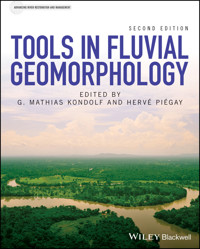
Fluvial Geomorphology studies the biophysical processes acting in rivers, and the sediment patterns and landforms resulting from them. It is a discipline of synthesis, with roots in geology, geography, and river engineering, and with strong interactions with allied fields such as ecology, engineering and landscape architecture. This book comprehensively reviews tools used in fluvial geomorphology, at a level suitable to guide the selection of research methods for a given question. Presenting an integrated approach to the interdisciplinary nature of the subject, it provides guidance for researchers and professionals on the tools available to answer questions on river restoration and management.
Thoroughly updated since the first edition in 2003 by experts in their subfields, the book presents state-of-the-art tools that have revolutionized fluvial geomorphology in recent decades, such as physical and numerical modelling, remote sensing and GIS, new field techniques, advances in dating, tracking and sourcing, statistical approaches as well as more traditional methods such as the systems framework, stratigraphic analysis, form and flow characterisation and historical analysis.
This book:
- Covers five main types of geomorphological questions and their associated tools: historical framework; spatial framework; chemical, physical and biological methods; analysis of processes and forms; and future understanding framework.
- Provides guidance on advantages and limitations of different tools for different applications, data sources, equipment and supplies needed, and case studies illustrating their application in an integrated perspective.
It is an essential resource for researchers and professional geomorphologists, hydrologists, geologists, engineers, planners, and ecologists concerned with river management, conservation and restoration. It is a useful supplementary textbook for upper level undergraduate and graduate courses in Geography, Geology, Environmental Science, Civil and Environmental Engineering, and interdisciplinary courses in river management and restoration.
Sie lesen das E-Book in den Legimi-Apps auf:
Seitenzahl: 1976
Veröffentlichungsjahr: 2016
Ähnliche



















Table of Contents
Cover
Title Page
Copyright
List of contributors
Series Foreword
Advancing River Restoration and Management
Preface to the Second Edition
Section I: Background
Chapter 1: Tools in fluvial geomorphology: problem statement and recent practice
1.1 Introduction
1.2 Tools and fluvial geomorphology: the terms
1.3 What is a tool in fluvial geomorphology?
1.4 Overview and trends of tools used in the field
1.5 Scope and organization of this book
Acknowledgements
References
Section II: The Temporal Framework: Dating and Assessing Geomorphological Trends
Chapter 2: Surficial geological tools in fluvial geomorphology
2.1 Introduction
2.2 Overview of surficial geological approaches
2.3 Applications of surficial geological approaches to geomorphic interpretation
2.4 Summary and conclusions
References
Chapter 3: Archaeology and human artefacts
3.1 Introduction
3.2 General considerations in using archaeological evidence in geomorphology
3.3 Archaeological tools
3.4 Legacy sediment
3.5 Using archaeological data: case studies
3.6 Conclusions
References
Chapter 4: Using historical data in fluvial geomorphology
4.1 Introduction
4.2 The documentary record
4.3 The cartographic record
4.4 The topographic record
4.5 The modern historical record: remote-sensing
4.6 Conclusion
Acknowledgements
References
Section III: The Spatial Framework: Emphasizing Spatial Structure and Nested Character of Fluvial Forms
Chapter 5: System approaches in fluvial geomorphology
5.1 System, fluvial system, hydrosystem
5.2 Components of the fluvial system
5.3 Fluvial system, a conceptual tool for geomorphologists
5.4 Examples of applications
5.5 Conclusions
Acknowledgements
References
Chapter 6: Analysis of remotely sensed data for fluvial geomorphology and river science
6.1 Introduction
6.2 The physical basis
6.3 River geomorphology and in-channel processes
6.4 Floodplain geomorphology and fluvial processes
6.5 Conclusions
Acknowledgements
References
Chapter 7: Geomorphic classification of rivers and streams
7.1 Introduction
7.2 Classifications for fluvial understanding
7.3 Interactions between geomorphic classifications and ecology
7.4 Geomorphic classification and quality of river environments
7.5 Applying geomorphic classification schemes to fluvial systems
Acknowledgements
References
Chapter 8: Modelling catchment processes
8.1 Introduction
8.2 Approaches to catchment processes modelling
8.3 Conceptual models
8.4 Problem-centred interpretative models
8.5 Data-driven empirical models
8.6 Numerical models
8.7 Tools for developing a catchment process model: representation and accuracy considerations
8.8 Prospect
Acknowledgements
References
Section IV: Chemical, Physical and Biological Evidence: Dating, Emphasizing Spatial Structure and Fluvial Processes
Chapter 9: Using environmental radionuclides, mineral magnetism and sediment geochemistry for tracing and dating fine fluvial sediments
9.1 Introduction
9.2 The tools
9.3 Applications
9.4 Case study
9.5 The prospect
References
Chapter 10: Vegetation as a tool in the interpretation of fluvial geomorphic processes and landforms
10.1 Introduction
10.2 Scientific background: plant ecological–fluvial geomorphic relations
10.3 Vegetation as a tool: an overview
10.4 Dendrogeomorphology in fluvial systems
10.5 Description of fluvial landforms through vegetation
10.6 Communities as an indicator of disturbance regime
10.7 Conclusions
References
Section V: Analysis of Processes and Forms: Water and Sediment Interactions
Chapter 11: Channel form and adjustment: characterization, measurement, interpretation and analysis
11.1 Introduction
11.2 Characterization and measurement
11.3 Interpretation and analysis
11.4 Conclusions
References
Chapter 12: Flow measurement and characterization
12.1 Introduction
12.2 Velocity measurement
12.3 Discharge measurements
12.4 Indirect methods of discharge estimation
12.5 Flow hydrographs and analysis of flow records
12.6 Issues in selecting methods
12.7 Conclusion
References
Chapter 13: Measuring bed sediment
13.1 Introduction
13.2 Attributes and reporting of sediment size distributions
13.3 Particle shape and roundness
13.4 Surface versus subsurface layers in gravel bed rivers
13.5 Sampling sand and finer grained sediment
13.6 Sampling and describing the surface of gravel beds
13.7 Subsurface sampling methods
13.8 Sample size requirements
13.9 Comparability of pebble counts and bulk samples
13.10 Sampling strategy
13.11 Applications of bed sediment sampling related to aquatic habitat
13.12 Case study: determining changes in fine sediment content during flushing flows, Trinity River, California
13.13 Case study: application of
V*
to French and Bear Creeks, California
13.14 Conclusion: selecting an appropriate sampling method
Acknowledgement
References
Chapter 14: Coarse particle tracing in fluvial geomorphology
14.1 Introduction
14.3 Tracing methods
14.5 Conclusion
Acknowledgements
References
Chapter 15: Sediment transport
15.1 Introduction
15.2 Basic concepts
15.3 Suspended load sampling and monitoring
15.4 Bedload sampling, measurement and prediction
15.5 Total load
15.6 Estimating sediment yields from reservoir sedimentation
15.7 Key points for designing a sediment measurement programme – a summary
15.8 Case example: sediment budget for Upper Clutha River, New Zealand
Acknowledgements
References
Chapter 16: Sediment budgets as an organizing framework in fluvial geomorphology
16.1 Introduction
16.3 Designing a sediment budget
16.4 Examples
16.5 Conclusions
References
Section VI: Discriminating, Simulating and Modelling Processes and Trends
Chapter 17: Models in fluvial geomorphology
17.1 Introduction
17.2 Conceptual models
17.3 Statistical models
17.4 Analytical models
17.5 Numerical models
17.6 Use of remote sensing and GIS in fluvial geomorphological modelling
17.7 Physical models
17.8 Overview of the modelling process
17.9 Modelling applications in fluvial geomorphology
17.10 Generic framework for fluvial geomorphological modelling applications
17.11 Case study: meander dynamics
17.12 Conclusion
Acknowledgements
References
Chapter 18: Modelling flow, sediment transport and morphodynamics in rivers
18.1 Introduction
18.2 Flow conservation laws
18.3 Sediment-transport relations
18.4 Numerical methods
18.5 One-dimensional models
18.6 Two-dimensional models
18.7 Three-dimensional models
18.8 Bank evolution models
18.9 Bedform models
18.10 Practical considerations
18.11 Conclusions and future directions
References
Chapter 19: Modelling fluvial morphodynamics
19.1 Introduction
19.2 Modelling longitudinal profiles
19.3 Modelling hydraulic geometry of rivers
19.4 Modelling channel planforms
19.5 Modelling floodplain sedimentation and erosion
19.7 Conclusion
References
Chapter 20: Experimental studies and practical challenges in fluvial geomorphology
20.1 Introduction
20.2 Experimental methods and facilities
20.3 Example experimental studies
20.4 Scaling issues and application of experimental results
20.5 Additional areas for experimentation
20.6 Conclusion
Acknowledgements
References
Chapter 21: Statistics and fluvial geomorphology
21.1 Introduction
21.2 Bivariate statistics to explore patterns of forms and their drivers
21.3 Exploration of datasets using multivariate statistics
21.4 Describing, explaining and predicting through probabilities and distributions
21.5 Describing, explaining and predicting variables in space and time
21.6 Relevance and limitations of statistical tools
21.7 Conclusion
Acknowledgements
References
Section VII: Conclusion: Applying the Tools
Chapter 22: Integrating geomorphological tools to address practical problems in river management and restoration
22.1 Introduction
22.2 Motivations for applying fluvial geomorphology
22.3 Meeting the demand: geomorphological training and application
22.4 The role of geomorphology in planning and management
22.5 Current geomorphological practices
22.6 Case study: preventing erosion risks, from top-down to bottom-up approaches
22.7 Case study: pre-appraisal approach for sediment reintroduction in the Rhine: evaluating risks of restoring processes
22.8 Case study: the River Wylye: a post-project monitoring framework to establish the performance of a range of rehabilitation schemes
22.9 Conclusion
Acknowledgements
References
Index
End User License Agreement
Pages
xi
xii
xiii
xv
xvii
1
3
4
5
6
7
8
9
10
11
12
13
15
16
17
18
19
20
21
22
23
24
25
26
27
28
29
30
31
32
33
Lesen Sie weiter in der vollständigen Ausgabe!
Lesen Sie weiter in der vollständigen Ausgabe!
Lesen Sie weiter in der vollständigen Ausgabe!
Lesen Sie weiter in der vollständigen Ausgabe!
Lesen Sie weiter in der vollständigen Ausgabe!
Lesen Sie weiter in der vollständigen Ausgabe!
Lesen Sie weiter in der vollständigen Ausgabe!
Lesen Sie weiter in der vollständigen Ausgabe!
Lesen Sie weiter in der vollständigen Ausgabe!
Lesen Sie weiter in der vollständigen Ausgabe!
Lesen Sie weiter in der vollständigen Ausgabe!
Lesen Sie weiter in der vollständigen Ausgabe!
Lesen Sie weiter in der vollständigen Ausgabe!
Lesen Sie weiter in der vollständigen Ausgabe!
Lesen Sie weiter in der vollständigen Ausgabe!
Lesen Sie weiter in der vollständigen Ausgabe!
Lesen Sie weiter in der vollständigen Ausgabe!
Lesen Sie weiter in der vollständigen Ausgabe!
Lesen Sie weiter in der vollständigen Ausgabe!
Lesen Sie weiter in der vollständigen Ausgabe!
Lesen Sie weiter in der vollständigen Ausgabe!
Lesen Sie weiter in der vollständigen Ausgabe!
Lesen Sie weiter in der vollständigen Ausgabe!
Lesen Sie weiter in der vollständigen Ausgabe!
Lesen Sie weiter in der vollständigen Ausgabe!
Lesen Sie weiter in der vollständigen Ausgabe!
Lesen Sie weiter in der vollständigen Ausgabe!
Lesen Sie weiter in der vollständigen Ausgabe!
Lesen Sie weiter in der vollständigen Ausgabe!
Lesen Sie weiter in der vollständigen Ausgabe!
Lesen Sie weiter in der vollständigen Ausgabe!
Lesen Sie weiter in der vollständigen Ausgabe!
Lesen Sie weiter in der vollständigen Ausgabe!
Lesen Sie weiter in der vollständigen Ausgabe!
Lesen Sie weiter in der vollständigen Ausgabe!
Lesen Sie weiter in der vollständigen Ausgabe!




