


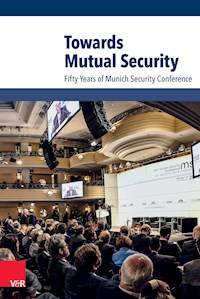
Towards Mutual Security E-Book
Erhalten Sie Zugang zu diesem und mehr als 300000 Büchern ab EUR 5,99 monatlich.
- Herausgeber: Vandenhoeck & Ruprecht
- Kategorie: Geisteswissenschaft
- Sprache: Deutsch
The Munich Security Conference, founded as "Wehrkundetagung" in 1963, has evolved into the leading independent forum for security policy. Traditionally seen as a kind of transatlantic family meeting for debating NATO strategy during the Cold War, the conference has increasingly broadened its agenda and today attracts participants from across the globe. Each year, dozens of heads of state and government, ministers, and experts from different fields of security policy gather in Munich for an open exchange of ideas and policies on the most pressing international security issues – ranging from regional conflicts, international peace operations and nuclear disarmament to cyber security and environmental challenges. On the occasion of the conference's 50th anniversary in 2014, a number of prominent participants, including former and current foreign and defense ministers, reflect on the conference's history and significance, some of the major issues debated, and on key security challenges facing the international community.
Sie lesen das E-Book in den Legimi-Apps auf:
Seitenzahl: 779
Veröffentlichungsjahr: 2014
Das E-Book (TTS) können Sie hören im Abo „Legimi Premium” in Legimi-Apps auf:
Ähnliche




















Towards Mutual Security
Fifty Years of Munich Security Conference
Edited by Stiftung Münchner Sicherheitskonferenz Wolfgang Ischinger
Editorial Team Tobias Bunde, Antje Lein-Struck, and Adrian Oroz
You can find alternative editions of this book and additional material on our Website:
www.v-r.de/Munich-Security-Conference
Bibliographic information published by the Deutsche Nationalbibliothek
The Deutsche Nationalbibliothek lists this publication in the Deutsche Nationalbibliografie; detailed bibliographic data available online: http://dnb.d-nb.de.
ISBN 978-3-647-99543-4
© 2014, Vandenhoeck & Ruprecht GmbH & Co. KG, Göttingen / Vandenhoeck & Ruprecht LLC, Bristol, CT, U. S. A.www.v-r.de All rights reserved. No part of this work may be reproduced or utilized in any form or by any means, electronic or mechanical, including photocopying, recording, or any information storage and retrieval system, without prior written permission from the publisher.
Copyediting by Rebecca van Dyck Image editing by SchwabScantechnik, Göttingen Layout and typesetting by textformart, Göttingen | www.text-form-art.de
Printed and bound in Germany by Hubert & Co, Göttingen
Printed on non-aging paper.
Table of Contents
Acknowledgments
Anniversary Messages
Message from the Federal Chancellor to Mark the Fiftieth Anniversary of the Munich Security Conference
Angela Merkel
Congratulating the Munich Security Conference on Fifty Years of Contributions to Transatlantic Security
Joseph R. Biden
The 50th Munich Security Conference—Security Policy in the Era of Globalization
Wolfgang Reitzle
The Chairmen
Toward Mutual Security: From Wehrkunde to the Munich Security Conference
Wolfgang Ischinger
The Munich Conference on Security Policy—Continuity and Change
Horst Teltschik
Remembering Ewald von Kleist
John McCain
Ewald-Heinrich von Kleist: The Man behind Wehrkunde
Peter C. Hughes and Theresa M. Sandwith
Wehrkunde and the Cold War
Theo Sommer in Conversation with Helmut Schmidt
The Discussions in the Critical Period of the East-West Conflict from the Mid-Sixties to the Early Nineties
Lothar Rühl
Wehrkunde and the Transatlantic Nuclear Discourse
Uwe Nerlich
“The Shorter the Range, the Deader the Germans”
Egon Bahr
NATO’s Double-Track Decision, the Peace Movement, and Arms Control
Karl Kaiser
Wehrkunde and the End of the Cold War
Richard Burt
Countering Nuclear Threats: From Cold War Wehrkunde to Today’s Munich Security Conference
Sam Nunn
New Challenges after the End of the Cold War
Why Didn’t We Stop the Bosnia War Earlier? Thoughts and Lessons
Carl Bildt
From the Fall of the Berlin Wall to the Admission of New Members to NATO
Ulrich Weisser
The 1999 Munich Conference on Security Policy—Paving the Way for the Kosovo Air Campaign Operation Allied Force
Klaus Naumann
Key Meetings at the Margins—Kosovo and the Munich Conference
Rudolf Scharping
The Margins at Munich: The Conference from Kosovo to Iraq
George Robertson
The Munich Security Conference in the Post-9/11 Era
James L. Jones
The Iraq War and the Transatlantic Rift
Kerstin Müller
Capacity for Adaptation: The Munich Conference and European Security
Javier Solana
Euro-Atlantic Security in a Globalized World
Transatlantic Ties That Must Still Bind
John Kerry
Peace and Security in Germany, Europe, and the World
Guido Westerwelle
The Transatlantic Partnership—The Foundation of German Security Policy
Thomas de Maizière
The Munich Security Conference at Fifty: The Challenge of Change
Chuck Hagel
Keeping NATO Strong
Anders Fogh Rasmussen
NATO: Quo Vadis?
James Stavridis
The United States, Europe, and a Pivot to Reality
Ruprecht Polenz
Indispensable Partners in an Uncertain World
Constanze Stelzenmüller
Euro-Atlantic Security: Before and after the “Reset”
Frank-Walter Steinmeier
The Munich Security Conference and the Russia-NATO Relationship
Igor S. Ivanov
Enter the Arab People: The Munich Security Conference, the Middle East, and the Arab Revolts
Volker Perthes
Not the Whole Picture: The History of the Incomplete Answer to Iran’s Nuclear Threat
Omid Nouripour
Europe, the United States, and the Rise of the Asia-Pacific
Kevin Rudd
Asia’s Rise and Asia’s Risks
Eberhard Sandschneider
Climate Change and Its Impact on Security
Nikolaus von Bomhard
The Shifting Geopolitics of Energy—The Green and Shale Revolution
Friedbert Pflüger
Moving the Conversation Forward on Nuclear Disarmament
Jane Harman
To Tweet or Not to Tweet? The Impact of Social Media on Global Politics
Anne-Marie Slaughter
The New Frontier: Cyberspace and International Security
Keith B. Alexander
Cyberspace and International Security
Toomas Hendrik Ilves
Spotlights on the Conference
A Constant Reminder of the Transatlantic Alliance’s Strategic and Moral Imperative
Joseph I. Lieberman
Good Arguments Are What Matters
Hans-Ulrich Klose
Little Patience for Frivolous Speeches—A Personal Remembrance of Wehrkunde and Ewald-Heinrich von Kleist
William S. Cohen
The Munich Security Conference: A British Perspective
Charles Powell
The German-American Relationship Remains at the Conference’s Heart
Jim Hoagland
Talking Points. The Conference between Genuine Debate, Catwalk, and Public Ambiguity
Stefan Kornelius
From Munich to the World: Broadcasting the MSC
Ulrich Wilhelm
“I Didn’t Know They Were Letting Girls Go to Wehrkunde”
Catherine McArdle Kelleher
The Munich Young Leaders
Klaus Wehmeier and Thomas Paulsen
Fasching, Family Reunions, and Hard Power. The Munich Security Conference, the Alliance, and International Security—A Very Personal Remembrance
Josef Joffe
Mutual Security in the Twenty-First Century
The Future of Power in the Twenty-First Century
Joseph S. Nye, Jr.
Atlanticism in the Era of Globalization
Strobe Talbott
The Future Isn’t What It Used to Be
François Heisbourg
Munich Security Conference 1963–2063: The European Union as a Superpower?
Radoslaw Sikorski
Appendix
Image Credits
List of Abbreviations
Acknowledgments
We would like to thank all of the authors as well as their respective staff members for their personal commitment and enthusiasm. This project would not have been possible without their support and dedication.
We would also like to extend our thanks to the team of our publisher, Vandenhoeck & Ruprecht, for their advice, patience, and cooperation throughout the project. This applies especially to Dr. Wilhelm Ruprecht, Dr. Martina Kayser, Daniel Sander, Ulrike Bade, and Rebecca van Dyck.
Working on this book, we were grateful for the kind support of a number of archives and committed individuals regarding documents and photos. We particularly thank the Political Archive of the Federal Foreign Office, the Archives for Christian-Social Politics, and the European Security & Defence Magazine for granting printing rights and providing the necessary scans, as well as Karin Ehinger and Haide Hormann from the German Federal Foreign Office for the transcription of the conversation with Chancellor Helmut Schmidt.
For their legal consulting throughout the project, our gratitude goes to Ksenia Ilina, Matthias Lupp, and Hans Peter Wiesemann.
We are particularly grateful to Munich Re and the Federal Foreign Office, without whose generous contribution the compilation of this volume would not have been feasible.
We extend our thanks to Dr. Timo Noetzel for his valuable academic advice throughout this project. Our most cordial thanks go to Thomas Bauer for crucially reinforcing the editorial team. His work and dedication ensured thoroughly observed style guides, turning individual contributions into a homogeneous volume.
Last but not least, we would like to offer a special note of appreciation to Helmut Bialek, Björn Boening, Kathleen Damerius, Dr. Benedikt Franke, Tim Gürtler, Michael Heller, Mirjam Issing, Marcel Lewicki, Barbara Mittelhammer, Mirjana Richter, Oliver Rolofs, Jean-Pierre Schnaubelt, Florian Wiesböck, and Sara-Sumie Yang, the team members of the Munich Security Conference Foundation, and to Sabine Schulz-Plink and Gonca Treu. They spent endless hours supporting us by contributing ideas toward the volume’s concept, arranging for photographs, identifying interesting documents, and providing the necessary administrative support for the project.
Finally, it should be noted that the opinions expressed in the contributions to this volume are the opinions of the respective authors alone and do not necessarily reflect the opinions of the Stiftung Münchner Sicherheitskonferenz gGmbH. The authors were last able to review the manuscripts in early fall and were thus unable to include any developments that may have occurred afterwards. All information in this book, including biographical information about the authors, was last updated on November 30, 2013.
Wolfgang Ischinger Tobias Bunde Antje Lein-Struck Adrian Oroz
Anniversary Messages
Chancellor Angela Merkel speaking at the 2011 MSC
Message from the Federal Chancellor to Mark the Fiftieth Anniversary of the Munich Security Conference
Angela Merkel
The Munich Security Conference, a unique forum for the debate on international security policy, is taking place for the fiftieth time in 2014. It brings together decision-makers and opinion leaders who shoulder a special responsibility in the constant struggle for peace, freedom, and stability. This conference enjoys a high standing, largely owing to dedicated individuals who devote their energies to promoting dialogue year after year. All of them deserve our thanks and recognition for the great success of the conference, which now has a long tradition.
The success story of the Munich Security Conference is and remains first and foremost linked to the name Ewald-Heinrich von Kleist. As a young lieutenant, he was one of those willing to risk their lives in the resistance to Hitler. After the end of World War II, the promotion of transatlantic relations was a matter very close to his heart. A key expression of this endeavor was the establishment of the International Wehrkunde Conference fifty years ago, later renamed the Munich Security Conference, which Ewald-Heinrich von Kleist developed within a short space of time into a central forum for exchanging views on transatlantic security policy and which he chaired until 1998. This conference offered an excellent opportunity for Germany to actively take part in the dialogue on the global political situation.
Ewald-Heinrich von Kleist died in March 2013. We have honored his memory. His achievements as the long-standing chairman of the Munich Security Conference have received a particularly fitting tribute in the form of the award that bears his name. The Ewald von Kleist Award, first presented in 2009, is granted to individuals in recognition of their outstanding commitment to peace and conflict resolution.
Although the aim of the conference, to give substance to the dialogue on security policy, has not changed during the last half-century, the political environment has changed fundamentally. While the first conference years were marked by the Cold War, new challenges came to the fore once the East-West confrontation was overcome, initially in the Balkans and then in particular in the wake of the appalling terrorist attacks of September 11, 2001.
The Munich Security Conference has always addressed topical issues and further developed its areas of focus in the spirit of networked security. Inevitably, this has also resulted in the circle of participants being expanded—a real boon for the conference—to include representatives from other regions, from Central and Eastern European countries, from Russia, and from Asia.
However, the transatlantic dialogue—the cornerstone and fixture of the Munich Security Conference—has retained its outstanding importance, especially when it is put to the test, for example by data protection issues. The unique partnership between the United States and Europe remains the fundamental basis for our security and freedom.
We work closely together within NATO. In partnership with other allies, we stand shoulder to shoulder in carrying out missions such as the one in Afghanistan. We Europeans and Americans are cooperating to tackle key foreign policy challenges. This applies—to name just a few examples—to the situation in Syria and the changes sweeping the Arab world, the Middle East peace process, Iran’s nuclear program, the promotion of democracy and stability in Mali, as well as to the fight against terrorism and piracy.
Ewald-Heinrich von Kleist called Europe—once a divided and today a united continent—a fortunate oasis. And he added: “However, it has to be looked after.” This is the aim of the Munich Security Conference. It is always open to new participants and themes. It thus remains in step with the times as an international forum for fostering understanding and mutual appreciation. On that note, I would like to wish all participants a sure hand and continued success.
Dr.Angela Merkelis chancellor of the Federal Republic of Germany.
US Vice President Biden addressing the 2013 MSC
Congratulating the Munich Security Conference on Fifty Years of Contributions to Transatlantic Security1
Joseph R. Biden
For more than fifty years, American foreign and defense ministers, legislators, and academics—and even vice presidents—have regularly made the annual pilgrimage to Munich to share in an open dialogue with our closest friends and Allies on the most pressing issues affecting the transatlantic partnership and beyond.
I first went to the Munich Security Conference during the grip of the Cold War in 1980, when it was still known as Wehrkunde. Those were very different times, but even then there was not a question in my mind, or in the minds of those who had traveled to Munich with me, that our work was essential and that the opportunities before us were genuine and significant.
Since that time, much has changed. The Iron Curtain that once divided Europe was replaced by an open door. NATO grew from fifteen allies in 1980 to an ever strengthened and more inclusive alliance of twenty-eight countries. During the same period, the size of the European Community tripled.
New forces have begun shaping the twenty-first century. We have realized that neither the United States nor Europe can afford to look inward, that instead we must engage in the world around us. And we have.
Today’s threats are as real and, at times, as daunting as those we faced during the Cold War. They transcend borders and nation states and impact global security and economic prosperity in profound ways. And so the work of the Munich Security Conference has become even more essential.
Preserving stability and peace for our children and grandchildren requires constant vigilance, dialogue, and cooperation. It requires that we strengthen our ability to prevent cyber attacks, to stop the spread of the world’s most dangerous weapons, and to mitigate the consequences of a warming planet. And it requires continued work at home, from stimulating new growth to continuing the important work of building a Europe that is whole, free, and at peace.
And just as the transatlantic relationship has evolved, so too has the Munich Security Conference, in part thanks to the vision and leadership of my good friend Ambassador Wolfgang Ischinger.
Munich started out as a small gathering of Germans and Americans focused on defense and security in Europe. Over time, it added other Europeans, other disciplines, and other countries. And now instead of looking inward at the Euro-Atlantic space, today’s Munich is focused on how Americans and Europeans engage in the world around us.
Today, Munich is the place to go to hear bold policies announced, new ideas and approaches tested, old partnerships reaffirmed, and new ones formed. Like no other global forum, today’s Munich connects European leaders and thinkers with their peers from across the world to have an open and frank exchange of ideas on the most pressing issues we currently face—from the crisis in Syria to the global financial crisis and its impact on security, as well as cyber security. And while the formal discussions are important, it is the informal chats in the coffee bar and the Stuben that cement relationships, foster intellectual ferment, and bring people from disparate political stripes together, including many of my colleagues from Congress.
That’s why I chose Munich as the place to outline the Obama administration’s new approach toward foreign policy, including our desire to reset relations with Russia while maintaining our principled position rejecting spheres of influence.
It’s why, in 2013, I returned to Munich to take stock of what America had accomplished with our friends and partners over the previous four years, including responsibly ending the war in Iraq and drawing down our forces in Afghanistan, to lay out a new agenda of cooperation for the next four years—challenges we face together, such as strengthening our global trading system and creating jobs on both sides of the Atlantic, and broadening our engagement in the Asia-Pacific.
All of us who have participated in the Munich Security Conference over the years know something simple and fundamental: important partnerships do not build themselves. They require hard work and constant conversation, and are best fostered at forums like the Munich Security Conference. I have every confidence that Munich’s best days are yet to come. Congratulations on fifty years of essential work!
Joseph R. Bidenis vice president of the United States.
Notes
1 This foreword is meant to commemorate the fiftieth anniversary of the Munich Security Conference and does not suggest approval or endorsement by the vice president or the White House of any particular views expressed in the anthology.
The conference hall during the 2013 Munich Security Conference
The 50th Munich Security Conference—Security Policy in the Era of Globalization
Wolfgang Reitzle
When, in the fall of 1963, the first Internationale Wehrkunde-Begegnung was held in Munich, nobody could guess how significant the conference would one day become. It was the time of the Cold War, the Cuban missile crisis, and the historic speech by President John F. Kennedy from the balcony of Berlin City Hall.
Today we know: that beginning, fifty years ago, marked the start of a success story. Wehrkunde was to become one of the most important international conferences on questions of foreign and security policy: the Munich Security Conference, which has been held under the leadership of Ambassador Wolfgang Ischinger since 2008.
Ewald von Kleist, the formative chairman of the conference for more than three decades, had conceived the conference as an independent private discussion forum, bringing together international personalities and experts from the worlds of transatlantic politics, military, and diplomacy. From the very start, the opportunity for an informal exchange untrammeled by protocol and for confidential discussions on the margin was an essential feature of the conference.
Against the background of the Cold War, the conference in those initial decades was characterized above all by questions of military cooperation and collaboration within NATO. After the end of the Cold War, it was continuously opened up and expanded to include new themes and regional priorities. This development was steadily pushed forward under the auspices of Kleist’s successor as chairman, Horst Teltschik, and led to more intensive collaboration in particular with the states of Central and Eastern Europe. Furthermore, Horst Teltschik emphasized the significance of the rising powers.
Under the current chairman, Ambassador Ischinger, the Munich Security Conference has continued to explore new topics, building his concept of the conference on a more extended understanding of security.
Today, topics such as threats to global trade routes and data streams, economic espionage and cyber security, the secure procurement of raw materials, and environmental and climate risks complement the agenda of the conference—of course, without losing sight of more traditional areas of security policy.
This diversity is also apparent among the participants: alongside heads of state, ministers, and high-ranking military representatives, guests now also include Nobel Peace Prize laureates and representatives of organizations such as Greenpeace. In the future, the objective is to continue to make the conference a bit younger and less predominantly male.
In recent years, the Munich Security Conference has become even more relevant internationally under the leadership of Ambassador Ischinger. We in the MSC Advisory Council would like to express our very sincere thanks to him for his vision and his great personal commitment to modernizing the focus and organization of the conference.
The end of the Cold War was not—as many had hoped—“the end of history.” Given the current conflicts and challenges, the Munich Security Conference remains an essential institution in the international debate on foreign and security policy. With that in mind, the Advisory Council wishes everyone a successful fiftieth conference—and hopes that you will find the diverse mix of essays in this book both entertaining and insightful.
Prof. Dr.Wolfgang Reitzleis chief executive officer of Linde AG and chairman of the Advisory Council of the Munich Security Conference.
Advisory Council of the Munich Security Conference
Chairman
Reitzle, Prof. Dr. Wolfgang
Chief Executive Officer, Linde AG
Members
Achleitner, Dr. Paul
Chairman of the Supervisory Board, Deutsche Bank AG
Al Saud, Prince Turki Al Faisal bin Abdulaziz
Chairman, King Faisal Center for Research and Islamic Studies
von Bomhard, Dr. Nikolaus
Chairman of the Board, Munich Re
Diekmann, Michael
Chairman of the Board of Management, Allianz SE
Gref, Herman O.
Chairman of the Board and Chief Executive Officer, Sberbank RF
Harman, Jane
Director, President, and Chief Executive Officer, Woodrow Wilson International Center for Scholars
Haun, Frank
Chief Executive Officer, Krauss-Maffei Wegmann GmbH & Co. KG
Lauvergeon, Anne
Chairman and Chief Executive Officer of A.L.P. S.A.; Member of the Board of Directors of EADS
Rudloff, Hans-Joerg
Chairman of the Investment Bank, Barclays
Solana, Dr. Javier
Former Secretary General of NATO; former High Representative of the European Union for Foreign Affairs and Security Policy; Distinguished Fellow, the Brookings Institution; President, ESADE Center for Global Economy and Geopolitics
Stoiber, Dr. Dr. h.c. Edmund
Former Minister-President of the Free State of Bavaria
The Chairmen
Wolfgang Ischinger opening day three of the 2012 Munich Security Conference
Towards Mutual Security: From Wehrkunde to the Munich Security Conference
Wolfgang Ischinger
Since its inception in the fall of 1963,1 the conference we today call the Munich Security Conference has changed in many ways—not just in terms of its name. Yet in some ways, it has not changed at all. What was the main rationale behind the first conferences remains true today. Munich was, is, and will hopefully continue to be an important independent venue for policymakers and experts for open and constructive discussions about the most pressing security issues of the day—and of the future. These debates take place both on the podium and, crucially, behind the scenes, at the margins of the conference. Since its inaugural meeting under the name of Internationale Wehrkunde-Begegnung, the conference has built a unique reputation as a not-to-be-missed meeting for the strategic community, particularly for those from NATO member states. As Ivo Daalder, at the time US ambassador to NATO, remarked last year via Twitter, Munich is the “Oscars for security policy wonks.”
The Munich Security Conference has attracted many of the West’s leading practitioners and thinkers on security issues. In 2013, more than sixty foreign and defense ministers were in attendance, along with eleven heads of state and government. We have hosted United Nations secretary generals, heads of international organizations, the president of the European Council, vice presidents of the United States, and Nobel Peace Prize laureates such as Tawakkol Karman. Given the limited space at the Hotel Bayerischer Hof—the conference venue in the heart of Munich—and the few spots on the different panels, setting the agenda, inviting participants, and selecting the speakers is not always an enviable task. Yet it is a challenge we happily embrace.
Nonetheless, the participation of high-level speakers is not the only feature that makes the Munich Security Conference unique. Most importantly, there is a very special atmosphere that fills the corridors every year when decision-makers and experts from different fields of foreign and security policy invade the Hotel Bayerischer Hof. Where else do you find a couple of European ministers in a small corner of the rustic Palais Keller restaurant in the hotel’s basement arguing—amicably, I should add—with Cathy Ashton over a beer, without protocol, without staff, without a preset agenda? Where else is the mix of high-ranking participants so diverse, and the physical space so limited, that you can hardly avoid running into officials whom you would rather not talk to? Where else can you see, just a few steps from the hotel, a head of government running into another leader right after one of them snuck out to buy a pair of Lederhosen and both having a good laugh about it? We may not spend much time during the MSC weekend celebrating Fasching anymore—as the attendees did in the early Wehrkunde years—but the event continues to be, despite so many official delegations, an informal event featuring Bavarian hospitality, and with the always welcome opportunity to sneak away for an hour or two into downtown Munich, right outside the door. Many of the foreign participants have also enjoyed coming to the conference for these very reasons.
In turn, the extraordinary commitment not only of the German government but of every single US administration and of key members of Congress has contributed enormously to the success and the reputation of the conference. For Germans, Wehrkunde, which literally translates as “military science,” is a rather old-fashioned notion, but the fact that our US participants continue to refer to the conference as Wehrkunde underlines the powerful tradition of the institution. Over the years, the annual meeting has built lasting ties across the Atlantic, in many cases personal friendships. I am glad that the US commitment to the Munich Security Conference is as strong as ever. Last year, one full tenth of the US Senate attended the conference. Where else do you ever find ten senators—from both parties—in one room together outside the United States? I very much appreciate the continued dedication by the congressional delegation, especially by its long-time leaders William Cohen, John McCain, and Joe Lieberman, who have all contributed personal essays to this book.
Moreover, it is certainly no coincidence that, in 2009 and in 2013, Vice President Joe Biden came to Munich for the Obama administration’s first major foreign policy addresses of both the first and second term, and that Munich was the place Secretary of State Hillary Clinton and Secretary of Defense Leon Panetta attended together in 2012 to try and dissipate European worries about the so-called rebalancing of the United States toward the Asia-Pacific. While the transatlantic security relationship will certainly change, US representatives have underscored in recent years that Europe remains America’s most important partner in engaging with the world, which is why the conference will remain an important date in the calendar of our US allies. As Secretary of State John Kerry writes in his contribution to this volume, “President Obama’s plan to rebalance our interests and investments in [the Asia-Pacific] region does not diminish in any way our close and continuing partnership with Europe.”
Our participants come to Munich to talk—and to listen. The conference itself does not “produce” any direct “result,” and this is actually a good thing. Since there is no need to agree on a final communiqué, participants are free to voice their views and explore their divergent opinions. This does not mean that the conference does not have an impact. On the contrary, contributions to this volume point out how some of the debates have had a major influence on a number of diplomatic initiatives. In contrast to many other diplomatic events controlled by protocol, the Munich Security Conference is a rather unregulated marketplace of ideas. Here, new or old proposals are floated—sometimes successfully, sometimes not. But if they are uttered here, they will be heard and not soon be forgotten by the community. One example among many: when NATO secretary general Anders Rasmussen proposed his Smart Defence initiative in 2011, he did so in Munich.
The annual meeting also often becomes a hub for diplomatic initiatives and the preparation for important decisions in response to crises. After all, it is hard to imagine a place where it is easier to get as many key players into a single room than here. In 2012, for example, informal UN Security Council deliberations essentially took place in Munich, as many key foreign ministers were present, arguing the merits of the proposed Syria resolution both on the podium and behind closed doors. And the essays contributed to this volume by Rudolf Scharping and Klaus Naumann, for instance, provide insight into the decisions relating to Kosovo during the 1999 conference. In addition, the MSC offers protected space for informal meetings between representatives from governments who might not be on the best terms but who may wish to meet informally, behind the scenes. Where else do you have the chance to see so many of your colleagues in one spot? Some ministers have been known to hold up to two dozen bilateral meetings over the span of a conference weekend.
Sometimes, foreign and defense ministers even use their joint presence in Munich to agree on and sign important bilateral documents. One particularly noteworthy example could be witnessed during the 2011 conference, when Russian Foreign Minister Sergey Lavrov and US Secretary of State Hillary Clinton exchanged the instruments of ratification for the New START treaty in the Hotel Bayerischer Hof.
Increasingly, the conference also serves as a meeting place for a number of nongovernmental initiatives and events. For instance, important Track II initiatives such as the Euro-Atlantic Security Initiative or the Global Zero Commission have met in the context of the MSC and presented reports, providing independent food for thought for the decision-makers present in the audience or the wider public. And side events like the “women’s breakfast” or a CEO lunch provide unique opportunities to bring key people together.
Today, the debate about security issues involves an ever-increasing number of people. For the first decades of the Munich Security Conference, the participants did not hail from as many countries as they do today—and that was entirely by design. Back then, the audience was relatively small, not exceeding a few dozen people. While Wehrkunde was an international conference from the very beginning, it was first of all a venue where German participants met their counterparts from their most important ally, the United States, but also from other NATO member states. Mutual security at that time meant, first of all, shared security among the transatlantic allies. Debates in Munich concentrated on Western policy within the overarching framework of the Cold War confrontation. Long-time participants such as Lothar Rühl, Karl Kaiser, Richard Burt, Sam Nunn, and others describe some of these debates in this volume. The basic idea of Wehrkunde was to bring together decision-makers and experts from NATO member states to discuss and develop a common strategy vis-à-vis the Soviet Union and the Warsaw Pact. Just like today, these intra-alliance debates were far from uncontroversial, at times even heated. Yet Wehrkunde was an important meeting place where differences could be voiced and mitigated, and where conceptual thinking beyond the urgent issues of the day had a place. As a result, the conference has often been dubbed the “transatlantic family meeting.” It is a testament to the extraordinary work and personality of Ewald von Kleist, who sadly passed away in March of 2013, that it developed and kept such a high reputation. The Munich Security Conference will always be his conference. We will continue to honor his name by each year dedicating the Ewald von Kleist Award to a leader who has contributed to global peace and security.
When the Cold War came to an end, both von Kleist and his successor as chairman from 1998 on, Horst Teltschik, built on the unique character of this transatlantic meeting, but they also decided to invite participants from countries that had not been part of the Western world before. They made room for participants from Central and Eastern European countries that had begun their transition processes from Soviet-dominated state economies to liberal democracies with a market-based economy. As these countries made clear that they wanted to become a part of the West, where they felt they belonged anyway, they also became regular participants of the Munich conferences. But even beyond those states that would soon become members of NATO and the European Union, Kleist and Teltschik reached out to the successor states of the Soviet Union, notably the Russian Federation. They understood that the conference—much like NATO—had to move beyond the confines of one “side” of the Cold War if it were to remain relevant.
In fact, it is this ability to transform itself that a number of contributors to this volume see as one of the key reasons that the MSC’s relevance has managed to remain so remarkably high. As US Secretary of Defense Chuck Hagel writes in his essay, “[t]he Munich Security Conference has stayed relevant for fifty years because of its ability to adapt to a constantly changing world.“
Over the years, as the number and variety of important players in international security has increased, the circle of conference participants has continued to grow wider. At the same time, the core of the conference will always be transatlantic. It is sometimes said of NATO that it is not a global alliance but an alliance in a global world. The same is true for the Munich Security Conference. It cannot and will not become a global conference, but it has to be a conference reflecting a globalized world.
Today, we welcome high-ranking participants from key rising powers, such as China, Brazil, and India. They will have an important role to play in any future international security architecture. Moreover, I am glad that, over the past decade, the MSC has evolved into a meeting that allows both NATO member states and prominent representatives from the Russian Federation to address their respective grievances and to attempt to find more common ground. As such, both Vladimir Putin’s speech in 2007 (as well as the reactions to it) and Joe Biden’s “reset” speech in 2009 reflect the role of Munich. In this volume, Igor Ivanov, former foreign minister of the Russian Federation, and Frank-Walter Steinmeier reflect on the ups and downs of NATO-Russia relations.
In addition, in recent years, both the Arab uprisings and the debate about Iran’s nuclear ambitions brought leaders from the Middle East to Munich, sparking both controversial arguments and the opportunity for further dialogue on and off the conference stage.
The audience today is not only more diverse in terms of geography, it also mirrors the broader understanding of security itself. Now, when the participants gather at the Hotel Bayerischer Hof, you still see military leaders—and rightly so. But you also see CEOs, human rights activists, environmentalists, and other leaders representing global civil society. Munich will not lose sight of its core themes belonging to traditional “hard security.” We will continue to debate traditional topics such as regional crises, arms races, nuclear proliferation, the purpose and role of NATO, transatlantic burden sharing, or European military capabilities. However, current security policy is more than counting missiles and debating military doctrines. When the financial crisis hit our economies, I welcomed participants to the conference by saying that we would have to discuss “banks, not tanks” in the opening session. We have also invited specialists who inform our audience about issues such as cyber security, energy, or environmental challenges that affect our mutual security. Moreover, together with the Körber Foundation, we initiated the Munich Young Leaders program, bringing a group of younger experts and practitioners to Munich each year.
Another aspect in which today’s Munich Security Conference clearly differs from Wehrkunde is the degree of transparency. The early meetings were held behind closed doors. Security policy, and NATO military doctrines in particular, were discussed by elites and often kept secret. Over time, the conference has become more transparent. For a number of years, the panel debates have been transmitted not only in parts by our broadcast partners, Bayerischer Rundfunk and Deutsche Welle, but also as a live stream on our website. Whereas space in the Hotel Bayerischer Hof itself is limited, this service offers the opportunity to everyone with access to the Internet to follow the debates in Munich. Increasingly, this will cease to be a one-way street. We have already welcomed input by our friends and followers on Facebook and Twitter and are confident that these new ways of interacting with the interested public can strengthen the social debate on security policy. In 2013, our hashtag #MSC2013 became trending on Twitter for the first time, with participants at the Hotel Bayerischer Hof commenting on the panel debates and interacting with people who followed the debates online.
Of course, the increasing level of transparency does have its drawbacks. High-level speakers who know that their words will be immediately spread across the globe are understandably more careful about what they say. As a consequence, speeches may be less controversial than they used to be. However, given the technological advances, the public interest, and the number of participants, keeping the entire proceedings off the record would today be futile and next to impossible. With that said, we are mindful of the importance of smaller formats, which is why we have begun to introduce breakout sessions during the main conference. Similarly, we have initiated a number of smaller conferences throughout the year: the MSC Core Group Meetings held in a number of capitals around the world, bringing together roughly fifty high-level participants, as well as day-long events such as the Cyber Security Summit in 2012 and 2013 or The Future of European Defence Summit in April 2013.
Thus, as it turns fifty, the Munich Security Conference is evolving, and it is as alive and well as it has ever been. Instead of asking you to take my admittedly biased word for it, I would simply point you to the table of contents of this book. I am proud that the conference enjoys such a reputation that not only is it a must for so many to find their way to Munich each year, but that so many also found the time to contribute to this volume. The authors provide unique perspectives on the first fifty conferences held in Munich and on key security challenges that the international community has faced and continues to face.
In many ways, this is a book much like the Munich Security Conference, and the essays are much like the debates and speeches. Some are short, others long. Some focus on one or two concrete arguments or events, others span decades. Some refer in particular to the debates in Munich, while others frame a certain issue more broadly. A number of essays mostly look ahead—on key issues such as European security policy, cyber security, the “rise” of the Asia-Pacific, or the future of transatlantic and Euro-Atlantic security.
Finally, it is important to note that this is not, and cannot be, a work of history. The conference itself does not have an official archive dating back to the first meetings. The book does, however, aim to illuminate some aspects of the conference’s history. You will be able to read a number of very personal, heartfelt reflections about Wehrkunde and Ewald von Kleist. A number of authors shed light on specific conferences, including the one held in 1999 just before the Kosovo intervention, and, depending on where you stand, highly publicized highlights or lowlights of the conference, such as the transatlantic crisis over Iraq, epitomized by the proceedings in Munich in 2003. I am delighted that former German chancellor Helmut Schmidt, who came to the conference for the first time in the mid-sixties, found the time to reflect on a number of key debates of the Wehrkunde era.
When the Internationale Wehrkunde-Begegnung first took place, mutual assured destruction and zero-sum thinking were the ideas of the time. The term “mutual security” could only be applied within NATO. Today more than ever before, the quest for “mutual security” is a global proposition. National interests will not suddenly disappear, and neither will those instances when states understand them too narrowly. Munich is a place where we can and should define and search for our common interests, understood as enlightened self-interest that thinks in win-win categories. As Poland’s foreign minister Radoslaw Sikorski puts it in his essay, in the future “what defines a superpower will not be its weapons of mass destruction that can never be used or the ability to conquer and destroy. It will be the ability to combine and build, the power of mass innovation and mass teamwork based on flexibility, tolerance, and inclusiveness.”
The conflict that helped give birth to the conference no longer exists, but that does not mean that the Munich Security Conference’s reason to exist has become any less relevant. Quite the contrary: it may well be even more important in an era in which global governance in general, and international security in particular, is certain to become messier and more difficult to manage, and in which the transatlantic partners will have to both stick together as well as reach out to new partners.
AmbassadorWolfgang Ischingertook over from Professor Horst Teltschik as chairman of the Munich Security Conference in 2008. His career in the German foreign service included positions as director of policy planning, as political director, and as state secretary (deputy foreign minister), followed by appointments as German ambassador to the United States and the United Kingdom. He is currently global head of public policy and economic research at Allianz SE, Munich.
Notes
1 A quick note on why the 2014 meeting is the conference’s fiftieth edition, although a 1963 founding might suggest 2012 would have been: a few years after the meeting was founded, one year was skipped when the conference date moved from late fall to early February. Moreover, in 1997, when Ewald von Kleist had indicated his intention to retire as chairman, the conference did not take place. In 1991, the planned and prepared conference was canceled at the very last minute due to the start of the Gulf War, but was always counted.
Horst Teltschik (left) with Secretary of Defense Robert Gates in 2007
The Munich Conference on Security Policy—Continuity and Change
Horst Teltschik
When I took over the chairmanship of the Munich Conference on Security Policy, now the Munich Security Conference, in 1999, it was a case of continuing a great tradition: a tradition that my predecessor, Ewald-Heinrich von Kleist, had established in 1963 and carefully fostered. The thirty-fifth conference was to be my first.
The conference was not new territory for me, since Ewald-Heinrich von Kleist had previously invited me to be a participant on numerous occasions. He had twice invited me to a private discussion to talk about his succession. We discussed various names but never mine, until one day a request came via the chairman of my supervisory board at the BMW Group, Mr. Eberhard von Kuenheim, asking for me to take over the conference. Our first joint response was negative. There followed calls from the German chancellor Helmut Kohl, the Bavarian minister president Edmund Stoiber, and even Egon Bahr from the Social Democratic Party urging me to chair the conference. The latter was particularly important for me, as his call showed the impartiality of the conference. With that, the decision was taken.
In the run-up to my first conference in February 1999 I was frequently asked what I wanted to do differently than my predecessor. As a result, I said rather provocatively in my opening speech: “It is impossible for anyone trying to follow in the footsteps of their predecessor to overtake him.” However, I added that anything that had proved its worth should not be changed, and I quoted the German chancellor, Gerhard Schröder, who was present, and who had said during the election campaign that he did not want to do everything differently than his predecessor but just do some things better.
Lesen Sie weiter in der vollständigen Ausgabe!
Lesen Sie weiter in der vollständigen Ausgabe!
Lesen Sie weiter in der vollständigen Ausgabe!
Lesen Sie weiter in der vollständigen Ausgabe!
Lesen Sie weiter in der vollständigen Ausgabe!
Lesen Sie weiter in der vollständigen Ausgabe!
Lesen Sie weiter in der vollständigen Ausgabe!
Lesen Sie weiter in der vollständigen Ausgabe!
Lesen Sie weiter in der vollständigen Ausgabe!
Lesen Sie weiter in der vollständigen Ausgabe!
Lesen Sie weiter in der vollständigen Ausgabe!
Lesen Sie weiter in der vollständigen Ausgabe!
Lesen Sie weiter in der vollständigen Ausgabe!
Lesen Sie weiter in der vollständigen Ausgabe!
Lesen Sie weiter in der vollständigen Ausgabe!
Lesen Sie weiter in der vollständigen Ausgabe!
Lesen Sie weiter in der vollständigen Ausgabe!
Lesen Sie weiter in der vollständigen Ausgabe!
Lesen Sie weiter in der vollständigen Ausgabe!
Lesen Sie weiter in der vollständigen Ausgabe!
Lesen Sie weiter in der vollständigen Ausgabe!
Lesen Sie weiter in der vollständigen Ausgabe!
Lesen Sie weiter in der vollständigen Ausgabe!
Lesen Sie weiter in der vollständigen Ausgabe!
Lesen Sie weiter in der vollständigen Ausgabe!
Lesen Sie weiter in der vollständigen Ausgabe!
Lesen Sie weiter in der vollständigen Ausgabe!
Lesen Sie weiter in der vollständigen Ausgabe!
Lesen Sie weiter in der vollständigen Ausgabe!
Lesen Sie weiter in der vollständigen Ausgabe!
Lesen Sie weiter in der vollständigen Ausgabe!
Lesen Sie weiter in der vollständigen Ausgabe!
Lesen Sie weiter in der vollständigen Ausgabe!
Lesen Sie weiter in der vollständigen Ausgabe!
Lesen Sie weiter in der vollständigen Ausgabe!
Lesen Sie weiter in der vollständigen Ausgabe!
Lesen Sie weiter in der vollständigen Ausgabe!
Lesen Sie weiter in der vollständigen Ausgabe!
Lesen Sie weiter in der vollständigen Ausgabe!
Lesen Sie weiter in der vollständigen Ausgabe!
Lesen Sie weiter in der vollständigen Ausgabe!
Lesen Sie weiter in der vollständigen Ausgabe!
Lesen Sie weiter in der vollständigen Ausgabe!
Lesen Sie weiter in der vollständigen Ausgabe!
Lesen Sie weiter in der vollständigen Ausgabe!
Lesen Sie weiter in der vollständigen Ausgabe!
Lesen Sie weiter in der vollständigen Ausgabe!
Lesen Sie weiter in der vollständigen Ausgabe!
Lesen Sie weiter in der vollständigen Ausgabe!
Lesen Sie weiter in der vollständigen Ausgabe!
Lesen Sie weiter in der vollständigen Ausgabe!
Lesen Sie weiter in der vollständigen Ausgabe!
Lesen Sie weiter in der vollständigen Ausgabe!
Lesen Sie weiter in der vollständigen Ausgabe!
Lesen Sie weiter in der vollständigen Ausgabe!
Lesen Sie weiter in der vollständigen Ausgabe!
Lesen Sie weiter in der vollständigen Ausgabe!
Lesen Sie weiter in der vollständigen Ausgabe!
Lesen Sie weiter in der vollständigen Ausgabe!




