


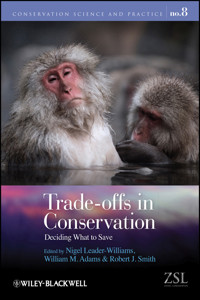
Trade-offs in Conservation E-Book
63,99 €
Mehr erfahren.
- Herausgeber: John Wiley & Sons
- Kategorie: Wissenschaft und neue Technologien
- Serie: Conservation Science and Practice
- Sprache: Englisch
This book demonstrates that trade-offs can be very important for conservationists. Its various chapters show how and why trade-offs are made, and why conservationists need to think very hard about what, if anything, to do about them. The book argues that conservationists must carefully weigh up, and be explicit about, the trade-offs that they make every day in deciding what to save. Key Features: * Discusses the wider non-biological issues that surround making decisions about which species and biogeographic areas to prioritise for conservation * Focuses on questions such as: What are these wider issues that are influencing the decisions we make? What factors need to be included in our assessment of trade-offs? What package of information and issues do managers need to consider in making a rational decision? Who should make such decisions? * Part of the Conservation Science and Practice book series This volume is of interest to policy-makers, researchers, practitioners and postgraduate students who are concerned about making decisions that include recognition of trade-offs in conservation planning.
Sie lesen das E-Book in den Legimi-Apps auf:
Seitenzahl: 623
Veröffentlichungsjahr: 2011
Ähnliche




















Contents
copyright
Contributors
Preface and Acknowledgments
Introduction
1 Deciding What to Save: Trade-offs in Conservation
Introduction
Understanding terms
Current approaches and toolkits
Influence of value systems
Economics and governance
Social and institutional constraints
Future challenges
References
Part I Current Approaches and Toolkits
2 Prioritizing Trade-offs in Conservation
Introduction
Background
Allocation of funds to achieve conservation goals
Allocation of funds through time subject to a fixed budget
There is more to conservation than biodiversity
How much time and resources should be spent on learning?
Trading off biodiversity benefit and investment security
Conclusions
References
3 Trade-offs in Identifying Global Conservation Priority Areas
Introduction
Background to global conservation priority schemes
Methods in relation to goals
Thresholds for identifying priority regions
Scoring systems for identifying priority regions
General issues relating to existing approaches
Return on investment
Conclusions
Acknowledgments
References
4 Trade-offs in Making Ecosystem Services and Human Well-being Conservation Priorities
Introduction
Congruence between important sites for biodiversity and ecosystem service provision
Financial support for conserving ecosystem services and biodiversity
Do World Bank projects achieve conservation and development goals?
Integrating multiple ecosystem services in a mapping tool
Conclusions
Acknowledgments
References
5 Defining and Measuring Success in Conservation
Introduction
Background to assessing success in conservation
A new approach to measuring conservation success
The CCF framework and evaluation tool
Conclusions
Acknowledgments
References
Part II Influence of Value Systems
6 Conserving Invertebrates: How Many can be Saved, and How?
Introduction
Seeking generalizations for invertebrate conservation
Valuing invertebrates
The importance of invertebrates
The ‘great challenges’
After systematic conservation planning, then what?
Synthetic management approach for invertebrates and other biodiversity
How many invertebrates are going to be saved?
Conclusions
Acknowledgments
References
7 Trade-offs between Animal Welfare and Conservation in Law and Policy
Introduction
Animal welfare and conservation
Clarification of terms
Animal welfare, animal liberation and animal rights
Conservation and its ethical basis
Aspects of animal welfare and conservation regulation
Confluence and conflict, trade-offs and stand-offs
Reconciling animal welfare and conservation in international law
References
8 Protection or Use: a Case of Nuanced Trade-offs?
Introduction
Definitions and philosophy
Protection and use in practice
Performance of protection and use approaches
What are the challenges to effectiveness of protection and use?
Future trade-offs and more nuanced approaches to protection and use?
Conclusions
References
9 Whose Value Counts? Trade-offs between Biodiversity Conservation and Poverty Reduction
Introduction
Complex relationships between biodiversity conservation and poverty reduction
Biodiversity priorities of poor people and international conservation organizations
Trade-offs for ‘pro-poor’ conservation
The way forward: managing trade-offs, maximizing synergies
References
10 The Power of Traditions in Conservation
Introduction
Co-option of tradition in conservation
Tradition and conservation in Maasailand
Maasai traditions, livelihoods and conservation
References
Part III Economics and Governance
11 Misaligned Incentives and Trade-offs in Allocating Conservation Funding
Introduction
Evaluating trade-offs in allocating scarce conservation funds
Effective conservation in theory and practice
Constraints to effective conservation in developing countries
Perverse incentives underpinning current conservation practice
Shifts in the right direction
Conclusions
Acknowledgments
References
12 Marketing and Conservation: How to Lose Friends and Influence People
Introduction
Introduction to marketing
Marketing and conservation
Types of campaign
Problems with marketing conservation
Reducing the limitations
Conclusions
References
13 Trade-offs between Conservation and Extractive Industries
Introduction
The challenge of sustainability for developing countries
Development visions, extractive industries and conservation in Latin America
Conservation and extractive industries in Peru
Conclusions
References
14 A Fighting Chance: can Conservation Create a Platform for Peace within Cycles of Human Conflict?
Introduction
Characteristics of armed conflict
Links between conflict and natural resources
Guerillas and gorillas
People of the forest
Ambition versus pragmatism
Conclusions
Acknowledgments
References
Part IV Social and Institutional Constraints
15 Trading-off ‘Knowing’ versus ‘Doing’ for Effective Conservation Planning
Introduction
‘Knowing’ and ‘doing’ as trade-offs for effective conservation planning
Trade-offs for effective conservation planning
Navigating trade-offs for effective conservation planning
Conclusions
References
16 Path Dependence in Conservation
Introduction
Path dependence in conservation policy
Policy change
Parks and narrative change
What factors encourage path dependence?
Addressing path dependence in conservation policy
References
17 Conservation Trade-offs and the Politics of Knowledge
Introduction
Background issues: conservation and trade-offs
Politics of knowledge and analysis of conservation trade-offs
Other avenues to analyze conservation trade-offs and politics of knowledge
Indigenous knowledge
Conclusions: recognizing regimes of credibility
Part V Future Challenges
18 Climate Change and Conservation
Centre for Ecosystem Sciences Introduction
Global climate change
Impacts of recent climate change on species
Potential problems arising from future climate change
Strategies to conserve biodiversity
Projecting changes due to climate change
Combined threats of climate change and habitat loss
Lags in climate change impacts
An integrated and holistic approach to developing conservation strategy
Trade-offs and prioritization
Acknowledgments
References
19 Drivers of Biodiversity Change
Introduction
The main drivers of biodiversity loss
Trends in drivers
Emerging threats from climate change
The knowledge needed to become proactive
Some really hard problems
Conclusions
References
20 Another Entangled Bank: Making Conservation Trade-offs More Explicit
Introduction
Why are trade-offs in conservation so severe?
Improving the decision-making process: toolkits and beyond
Widening the discussion
Widening support
Final conclusions
References
Index
Colour plates
Conservation Science and Practice Series
Published in association with the Zoological Society of London
Wiley-Blackwell and the Zoological Society of London are proud to present our Conservation Science and Practice series. Each book in the series reviews a key issue in conservation today. We are particularly keen to publish books that address the multidisciplinary aspects of conservation, looking at how biological scientists and ecologists are interacting with social scientists to effect long-term, sustainable conservation measures.
Books in the series can be single or multi-authored and proposals should be sent to:
Ward Cooper, Senior Commissioning Editor, Wiley-Blackwell, John Wiley & Sons, 9600 Garsington Road, Oxford OX4 2DQ, UK
Email: [email protected]
Each book proposal will be assessed by independent academic referees, as well as our Series Editorial Panel. Members of the Panel include:
Richard Cowling, Nelson Mandela Metropolitan University, Port Elizabeth, South Africa
John Gittleman, Institute of Ecology, University of Georgia, USA
Andrew Knight, University of Stellenbosch, South Africa
Georgina Mace, Imperial College London, Silwood Park, UK
Daniel Pauly, University of British Columbia, Canada
Stuart Pimm, Duke University, USA
Hugh Possingham, University of Queensland, Australia
Peter Raven, Missouri Botanical Gardens, USA
Helen Regan, University of California, Riverside, USA
Alex Rogers, Institute of Zoology, London, UK
Michael Samways, University of Stellenbosch, South Africa
Nigel Stork, University of Melbourne, Australia
Previously published
Urban Biodiversity and Design
Edited by Norbert Müller, Peter Werner and John G. Kelcey
ISBN: 978-1-4443-3267-4 Paperback; ISBN 978-1-4443-3266-7 Hardcover; 640 pages; April 2010
Wild Rangelands: Conserving Wildlife While
Maintaining Livestock in Semi-Arid
Ecosystems
Edited by Johan T. du Toit, Richard Kock and James C. Deutsch
ISBN: 978-1-4051-7785-6 Paperback; ISBN 978-1-4051-9488-4 Hardcover; 424 pages; January 2010
Reintroduction of Top-Order Predators
Edited by Matt W. Hayward and Michael J. Somers
ISBN: 978-1-4051-7680-4 Paperback; ISBN: 978-1-4051-9273-6 Hardcover; 480 pages; April 2009
Recreational Hunting, Conservation and Rural
Livelihoods: Science and Practice
Edited by Barney Dickson, Jonathan Hutton and Bill Adams
ISBN: 978-1-4051-6785-7 Paperback; ISBN: 978-1-4051-9142-5 Hardcover; 384 pages; March 2009
Participatory Research in Conservation andRural Livelihoods: Doing Science Together
Edited by Louise Fortmann
ISBN: 978-1-4051-7679-8 Paperback; 316 pages; October 2008
Bushmeat and Livelihoods: Wildlife Management and Poverty Reduction
Edited by Glyn Davies and David Brown
ISBN: 978-1-4051-6779-6 Paperback; 288 pages; December 2007
Managing and Designing Landscapes for Conservation: Moving from Perspectives to Principles
Edited by David Lindenmayer and Richard Hobbs
ISBN: 978-1-4051-5914-2 Paperback; 608 pages; December 2007
This edition first published 2010, © 2010 by Blackwell Publishing Ltd
Blackwell Publishing was acquired by John Wiley & Sons in February 2007. Blackwell’s publishing program has been merged with Wiley’s global Scientific, Technical and Medical business to form Wiley-Blackwell.
Registered office: John Wiley & Sons Ltd, The Atrium, Southern Gate, Chichester, West Sussex, PO19 8SQ, UK
Editorial offices: 9600 Garsington Road, Oxford, OX4 2DQ, UK
The Atrium, Southern Gate, Chichester, West Sussex, PO19 8SQ, UK
111 River Street, Hoboken, NJ 07030–5774, USA
For details of our global editorial offices, for customer services and for information about how to apply for permission to reuse the copyright material in this book please see our website at www.wiley.com/wiley-blackwell
The right of the author to be identified as the author of this work has been asserted in accordance with the Copyright, Designs and Patents Act 1988.
All rights reserved. No part of this publication may be reproduced, stored in a retrieval system, or transmitted, in any form or by any means, electronic, mechanical, photocopying, recording or otherwise, except as permitted by the UK Copyright, Designs and Patents Act 1988, without the prior permission of the publisher.
Wiley also publishes its books in a variety of electronic formats. Some content that appears in print may not be available in electronic books.
Designations used by companies to distinguish their products are often claimed as trademarks. All brand names and product names used in this book are trade names, service marks, trademarks or registered trademarks of their respective owners. The publisher is not associated with any product or vendor mentioned in this book. This publication is designed to provide accurate and authoritative information in regard to the subject matter covered. It is sold on the understanding that the publisher is not engaged in rendering professional services. If professional advice or other expert assistance is required, the services of a competent professional should be sought.
Library of Congress Cataloguing-in-Publication Data
Trade-offs in conservation: deciding what to save/edited by Nigel Leader-Williams, William M. Adams, and Robert J. Smith.
p. cm. – (Conservation science and practice series)
Based on presentations at a meeting held in London in November 2007.
‘‘Published in association with the Zoological Society of London.’’
Includes bibliographical references and index.
ISBN: 978-1-4051-9383-2 (pbk.: alk. paper) – ISBN 978-1-4051-9384-9 (hardcover: alk. paper)
1. Wildlife conservation – Decision making – Congresses. 2. Wildlife conservation – Social aspects – Congresses. I. Leader-Williams, N. II. Adams, W. M. (William Mark), 1955– III. Smith, Robert J. (Robert James), 1971–
QL81.5.T73 2010
333.95′16 – dc22
2010016467
Contributors
William M. (Bill) Adams is Moran Professor of Conservation and Development at the University of Cambridge, where he has taught in the Department of Geography since 1984. His research focuses on social dimensions of conservation and the evolution of conservation policy and strategy, with an emphasis on conservation in the UK and in Africa. He is a Trustee of Fauna & Flora International. Department of Geography, University of Cambridge, Downing Place, Cambridge CB2 3EN, UK; [email protected].
Helen Anthem is Programme Manager for the Conservation Livelihoods and Governance Programme at Fauna & Flora International. Helen’s expertise bridges the development and environment sectors and her research interests include the impact of conflict on livelihood options for women, as well as issues of human rights in relation to the environment. Her recent work has included analysis of environmental partnerships in post-conflict and post-disaster situations in Eurasia, Asia-Pacific, Africa and the Americas. Fauna & Flora International, Jupiter House, Station Road, Cambridge CB1 2JD, UK; [email protected].
Rosalind Aveling is Deputy Chief Executive Officer at Fauna & Flora International. A primatologist, Rosalind has set up conservation initiatives for Great Apes in both Indonesia and Central Africa. Her focus is on conservation within landscapes that include human use and, as former Director of Program Design with the African Wildlife Foundation, she has concentrated on issues of environmental governance and sustaining conservation finance. Within FFI, she has established the division of Conservation Partnerships, which explores the economic, social, ecological and institutional determinants of effective conservation. Her current interests include maintaining a focus on biodiversity within climate adaptation and mitigation strategies. Fauna & Flora International, Jupiter House, Station Road, Cambridge CB1 2JD, UK; [email protected].
Andrew Balmford is Professor of Conservation Science in the University of Cambridge. His main research interests are the costs and benefits of effective conservation, quantifying the changing state of nature, conservation planning, evaluating the success of conservation interventions, and exploring how best to reconcile conservation and farming, especially in developing countries. He tries to tackle these problems through collaborations across disciplines and with conservation practitioners. He helped found the Cambridge Conservation Forum and the Cambridge Conservation Initiative, which is building carefully targeted collaborations among 10 organizations, as well as the Student Conference on Conservation Science, which each year attracts ~200 young scientists from ~60 countries. Conservation Science Group, Department of Zoology, University of Cambridge, Downing Street, Cambridge CB2 3EJ, Cambridge, UK; [email protected].
Michael Bode is Research Fellow at the Applied Environmental Decision Analysis (AEDA) Research Hub, University of Melbourne. He is primarily interested in quantitative conservation decision making. Applied Environmental Decision Analysis Research Hub, Department of Botany, University of Melbourne, Melbourne, Victoria 3010, Australia; [email protected].
J. Peter Brosius is Professor of Anthropology at the University of Georgia, and Director of the Center for Integrative Conservation Research. His research focuses on political ecology and the cultural politics of conservation at both local and global scales. He previously worked on international environmental politics in Sarawak, with an early focus on Penan, and more recently with the Kelabit community. With the ACSC initiative, Pete focuses on global conservation and the politics of scale, with a particular focus on ecoregional planning and conservation finance. He was past president of the Anthropology and Environment Section, American Anthropological Association, and is a member of the IUCN Commission on Economic, Environmental and Social Policy (CEESP) Co-Management Working Group and the World Commission on Protected Areas/CEESP Theme on Indigenous and Local Communities, Equity and Protected Areas (TILCEPA). He was awarded the Lourdes Arizpe Award in Anthropology and Environment in 2005. Center for Integrative Conservation Research, Department of Anthropology, University of Georgia, 250A Baldwin Hall, Jackson Street, Athens, GA 30602-1619, USA; [email protected].
Aaron Bruner is Director of Economic Incentives and Protected Area Finance at Conservation International. Aaron’s work focuses on improving the effectiveness of protected area management and on developing the use of conservation agreements as a means to engage communities in conservation. Past work has covered a range of scales and issues, including analyses of protected area effectiveness and the cost of moving towards effective protected area management, economic assessments of a range of forest products, and analysis of strategies for increasing the contribution of the tourism industry to biodiversity conservation. He holds a Bachelor’s degree in Economics from Wesleyan University. Conservation International, 2011 Crystal Drive, Suite 500, Arlington, VA 22202, USA; [email protected].
Philip Bubb is Senior Programme Officer atthe United Nations Environment Programme World Conservation Monitoring Centre (UNEP-WCMC). Philip has 20 years’ experience in project management, design and training for international biodiversity conservation. At UNEP-WCMC, he works with assessments and indicators, including in the UK National Ecosystem Assessment. He also supports countries and organizations to develop and use biodiversity indicators, building on experience as manager of the Biodiversity Indicators in National Use project from 2002 to 2005. He is particularly involved in capacity building, including training and the production of guidelines in biodiversity assessment and monitoring for protected areas. Prior to UNEP-WCMC, Philip worked for 7 years in Mexico on forest conservation and rural development projects. UNEP World Conservation Monitoring Centre, 219c Huntingdon Road, Cambridge CB3 0DL, UK; [email protected].
Peter Carey is Director of Bodsey Ecology Limited. Pete is an independent academic researcher specializing in biogeography, climate change and the evaluation of agri-environment schemes. He is an Affiliated Lecturer in the Department of Plant Sciences at the University of Cambridge. He spent 18 years at ITE/CEH Monks Wood, where he worked on The Countryside Survey from 2004 to 2009 and was the lead author of the National Reports. Bodsey Ecology Limited, 4 Bodsey Cottages, Ramsey, Cambridgeshire PE26 2XH, UK; [email protected].
Richard M. Cowling is Professor of Botany at Nelson Mandela Metropolitan University. Richard has published extensively – in the scientific and popular literature – on the ecology and conservation of the South Africa’s fynbos, succulent karoo and subtropical thicket biomes. He is widely acclaimed for his contribution to the theory and application of conservations science. He was rated a world leader in conservation science by the National Research Foundation, and has been awarded a Pew Fellowship, a Distinguished Service Award by the Society for Conservation Biology, a Gold Award for Innovating Conservation by the Cape Action for People and the Environment, and a Flora Conservation Award by the Botanical Society of South Africa. He was elected Foreign Associate of the National Academy of Sciences USA. Department of Botany, Nelson Mandela Metropolitan University, PO Box 77000, Port Elizabeth 6031, South Africa; [email protected].
Gretchen C. Daily is Bing Professor of Environmental Science and Director of the Center for Conservation Biology at Stanford University, and Senior Fellow in the Woods Institute for the Environment. She is also Chair of The Natural Capital Project, a partnership among The Nature Conservancy, World Wildlife Fund and Stanford University, whose goal is to align economic forces with conservation. An ecologist by training, Gretchen’s work spans scientific research, teaching, public education and working with leaders to advance practical approaches to environmental challenges. Department of Biological Sciences, Stanford University, 371 Serra Mall, Gilbert Hall, Stanford, CA 94305-5020, USA; [email protected].
Juan Luis Dammert is Assistant Professor at the Pontificia Universidad Católica del Peru (PUCP). He holds a BA in Sociology from PUCP. His research interests include decentralization, political representation, local conflicts and citizen participation. He is currently developing projects for the PUCP on ‘Political representation in Latin America’, and the Instituto de Estudios Peruanos on ‘Gobiernos locales y conflictividad social en la Región Puno’. He has published articles in academic journals such as Debate Agrario on ‘Participación, concertación y confrontación en espacios locales: el Caso de la Mesa de Concertación para la Lucha Contra la Pobreza del Departamento de Puno’, co-authored with Aldo Panfichi (2006), and in Palestra on ‘Análisis de la Representación Congresal por Regiones’ in 2006. Department of Social Sciences, Catholic University of Peru, Avenida Universitaria 1801, San Miguel, Lima 32, Peru;[email protected].
Abigail Entwistle is Director of Science at Flora & Fauna International, where she has worked for over 13 years, after completing a PhD on bats. During this time she has held a range of positions, and has undertaken direct conservation management across a wide range of countries and environments. She has a particular interest in conservation planning and impact monitoring. Fauna & Flora International, Jupiter House, Station Road, Cambridge CB1 2JD, UK;[email protected].
Rebecca L. Goldman is Senior Scientist in the Central Science Division at The Nature Conservancy. Rebecca joined TNC in 2008, after completing her PhD at Stanford University in Environment and Resources. Her main responsibilities include working with scientists on the Board of Directors, and on ecosystem services topics and projects. Most recently her focus has been on water fund projects in Latin America. Specifically, she is helping design technical monitoring plans for these ecosystem servicesbased projects to ensure that conservation investments are effective and is analyzing the potential for replicating the water fund approach globally. The Nature Conservancy, 4245N Fairfax Drive, Suite 100, Arlington, VA 22203, USA;[email protected].
Hedley Grantham is Research Fellow at the University of Queensland. He is a conservation scientist with research interests in conservation decision making in marine and terrestrial ecosystems. He is currently working on marine spatial planning projects in Indonesia and South Africa. Ecology Centre, University of Queensland, Brisbane, Queensland 4072, Australia;[email protected].
Stuart R. Harrop is Professor of Wildlife Management Law at the University of Kent, and since 2009 Director of the Durrell Institute of Conservation and Ecology. His research interests encompass the full spectrum of the regulation of human relationships with wildlife. The context of his research is predominantly the international policy and regulatory matrix with occasional excursions into the regional and national. Durrell Institute of Conservation and Ecology, School of Anthropology and Conservation, Marlowe Building, University of Kent, Canterbury CT2 7NR, UK;[email protected].
Jon Hoekstra is Managing Director of the Global Climate Change Program at The Nature Conservancy. Jonathan provides strategic and scientific leadership for policy and field-based efforts to reduce greenhouse gas emissions by protecting and restoring forests, and to help people and nature adapt to unavoidable climate change impacts. Jonathan collaborates with experts from around the world to develop innovative, practical solutions to climate change problems based on top-notch science and real-world experience. Jonathan previously directed TNC’s Emerging Strategies Unit and led the Conservancy’s Global Habitat Assessment Team. He earned BS and MS degrees from Stanford University, and a PhD from the University of Washington. The Nature Conservancy, 1917 First Avenue, Seattle, WA 98101, USA;[email protected].
David G. Hole was in the School of Biological and Biomedical Sciences at Durham University, but is now Climate Change Researcher at Conservation International. His research focuses principally on the nexus between biodiversity, ecosystem services and human well-being, and seeks to build understanding across these still disparate fields, focusing particularly on the consequences of climate-driven shifts in biodiversity on the mitigation and adaptation potential of conservation resources (e.g. protected areas) and ecosystems more widely. Understanding how to increase the resilience of both ecosystems and human communities to climate change, and other global change drivers, is a principal goal of his research. Conservation International, 2011 Crystal Drive, Suite 500, Arlington, VA 22202, USA;[email protected].
Katherine M. Homewood is Professor in Anthropology at University College London. She works on the interplay between conservation and development, with a focus on African pastoralist people and savanna environments. Her Human Ecology Research Group integrates natural and social sciences approaches to analyze implications of developing country rural resource use and land use change for environment and wildlife on the one hand, and of environmental conservation policy and management for human welfare and livelihoods on the other. Recent publications include Ecology ofAfrican Pastoralist Societies published by James Currey and Ohio University Press in 2008, and Staying Maasai: livelihoods, conservation and developmentin East African rangelands published by Springer in 2009. Department of Anthropology, University College London, Gower Street, London WC1E 6BT, UK;[email protected].
John Hopkins is Principal Specialist at Natural England. John has worked in the statutory conservation sector for nearly 30 years, including roles as Grassland Specialist, Head of Biotopes Team and Scientific Advisor. In his current role, John is responsible for developing an ecosystems approach to the work of Natural England, the government’s statutory advisor on biodiversity and landscape conservation in England. Natural England, Northminster House, Peterborough, Cambridgeshire PE1 1UA, UK;[email protected].
BrianHuntley is Professor in the School of Biological and Biomedical Sciences at Durham University. His research investigates the relationships between environmental change and changes in the distributions of organisms, as well as in the composition, structure and dynamics of ecosystems. He also studies the interactions between the land surface and the atmosphere, especially biospheric feedbacks to the climate system. His research uses a combination of palaeoecological, ecological and biogeographic methods, including techniques like pollen analysis, palaeoclimate reconstruction, modelling of ecological processes and of species distributions, geographic information systems and Earth observation. In 2007, Brian acted as a consultant to the Council of Europe Bern Convention Group of Experts on Biodiversity and Climate Change and is now an observer on this group. In 2008, Brian joined the Steering Group for the North-East Regional Climate Change and Biodiversity Study. Centre for Ecosystem Sciences, School of Biological and Biomedical Sciences, Durham University, South Road, Durham DH1 3LE, UK;[email protected].
Valerie Kapos is Senior Programme Officer at the United Nations Environment Programme World Conservation Monitoring Centre (UNEPWCMC). Valerie trained as a tropical forest ecologist and conducted field research in Latin America and the Caribbean for 15 years, including studies of the ecological effects of forest fragmentation in Amazonia and remote sensing of forest cover change. She has since focused on applying ecological knowledge to support policy and practice in conservation and natural resource management. Her recent work has examined development and use of biodiversity indicators to support policy and decision making at international and national scales, and developing measures of the effectiveness of conservation action. UNEP World Conservation Monitoring Centre, 219c Huntingdon Road, Cambridge CB3 0DL, UK;[email protected].
Peter Kareiva is Chief Scientist at The Nature Conservancy. Peter moved to TNC after working as a university professor and at NOAA. His past publications and research have concerned such diverse fields as mathematical biology, fisheries science, insect ecology, risk analysis, population viability analysis, landscape ecology and global climate change. Peter maintains connections with several universities, and still advises students, as well as teaching courses on occasion. His responsibilities at TNC include reporting to the Board of Directors on science at TNC, mentoring TNC scientists, identifying opportunities and shortcomings that warrant science attention, advising leadership on emerging conservation challenges, and serving as one of several external spokespeople for TNC Science. Central Science, The Nature Conservancy, 4722 Latona Avenue NE, Seattle, WA 98105, USA;[email protected].
Andrew T. Knight is Senior Lecturer at the University of Stellenbosch. During 7 years as a conservation planner with the New South Wales National Parks and Wildlife Service, Australia, Andrew assisted planning expansion of the state’s reserve network, and co-developed conservation plans for priority bioregions. He completed a PhD examining implementation of conservation plans at the Nelson Mandela Metropolitan University in Port Elizabeth, South Africa, which included a 2-year post as Implementation Specialist for a conservation plan. His research interests include spatial prioritizations fusing social and ecological information, social learning institutions promoting adaptive management, and the gap between research and implementation. Department of Conservation Ecology and Entomology, University of Stellenbosch, Matieland 7602, Stellenbosch, Western Cape, South Africa;[email protected].
Annette Lanjouw heads the grant making, convening and strategy formulation of the Arcus Foundation’s Great Apes Fund, the world’s largest private funder of Great Ape conservation. Annette has worked with chimpanzees, bonobos and gorillas in the wild. She joined the Arcus Foundation after gaining years of previous experience in the areas of conservation strategy, programme implementation, research and fieldwork. Most recently she served as International Program Officer to the Howard G. Buffett Foundation. She previously served for 10 years as Director of the International Gorilla Conservation Programme (IGCP) – a three-way collaboration of WWF, African Wildlife Foundation and Fauna & Flora International, which successfully worked to secure safety for nearly 800 mountain gorillas that range across the three countries of Rwanda, Democratic Republic of Congo (DRC) and Uganda – and as Project Manager/Field Director for the Frankfurt Zoological Society’s Chimpanzee Conservation Project in eastern DRC. Arcus Foundation, Wellington House, East Road, Cambridge CB1 1BH, UK;[email protected].
Nigel Leader-Williams was Professor of Biodiversity Management at the University of Kent, and Director of the Durrell Institute of Conservation andEcologyuntil2009.HeiscurrentlyDirectorofConservationLeadership in the Department of Geography at the University of Cambridge. His research focuses on issues related to sustainable use and human-wildlife conflict. Department of Geography, University of Cambridge, Downing Place, Cambridge CB2 3EN, UK;[email protected].
Georgina M. Mace is Professor of Conservation Science at Imperial College London. Her research interests are in the assessment of biodiversity and the implications of its loss. Centre for Population Biology, Imperial College London, Silwood Park, Ascot, Berkshire SL5 7PY, UK;[email protected].
Douglas C. MacMillan is Professor in Conservation and Applied Resource Economics, and Head of the School of Anthropology and Conservation, at the University of Kent. His research interests lie in the economics of wildlife conservation, ecological modelling, and collaboration in land and wildlife management and forest resources. Durrell Institute of Conservation and Ecology, School of Anthropology and Conservation, Marlowe Building, University of Kent, Canterbury CT2 7NR, UK;[email protected].
Andrea Manica is Senior Lecturer in Population Biology at the University of Cambridge. As well as working on biological problems, he is interested in questions at the boundary between biology and the social sciences. Current topics of research are which factors predict sustainable exploitation of wild resources, methods of assessing the success of conservation initiatives, and the quantification of factors that affect public attitudes towards environmental issues, such as biodiversity, conservation and climate change. Department of Zoology, University of Cambridge, Downing Street, Cambridge CB2 3EJ, UK;[email protected].
Bruno Monteferri is a lawyer from the Peruvian Society for Environmental Law (SPDA) and co-ordinator of SPDA’s decentralized office at Iquitos in Loreto. Bruno graduated from the Faculty of Law of the Pontificia Universidad Católica del Peru (PUCP) with a spell at Barcelona University, Spain. He holds a Diploma in Integral Management of Coastal Marine Areas from GuadalajaraUniversity, Mexico. Hespecializes in legal environmental issues and especially on governance, and public and private conservation mechanisms. He is a member of the Initiative for Private Conservation Team, of the Private Conservation Network and the Management Committee of Pacaya Samiria National Reserve. He has published several articles on the analysis of legal conservation opportunities and participated in two books Management Committees: constructing governance for the natural protected areas from Peru and Essay of the National Context: the coast and its people. Peruvian Society for Environmental Law, Prolongación Arenales 438, Lima 27, Peru;[email protected].
Teresa Mulliken is Co-ordinator of Programme Development and Evaluation at TRAFFIC International. Teresa has a degree in biology from the University of Maryland and an MSc in Environment and Development from the University of East Anglia. She has worked for TRAFFIC since 1989 on research and advocacy on a wide range of wildlife trade issues, including the wild bird trade, trade in medicinal and aromatic plants, the development implications of wildlife trade, and implementation of the Convention on International Trade in Endangered Species of Wild Fauna and Flora (CITES). She is specifically interested in increasing understanding of the factors driving unsustainable and illegal use of wild resources and the effectiveness of different approaches to bringing harvest and trade within sustainable levels. TRAFFIC International, 219a Huntingdon Road, Cambridge CB3 0DL, UK;[email protected].
William Murdoch is Professor at the University of California at Santa Barbara. Bill gained his BSc at Glasgow University and his DPhil at Oxford University. His research has involved mainly theory and experiments in population regulation and predator–prey dynamics. He became interested in efficient decision making in conservation when serving on the Board of Directors of The Nature Conservancy. Department of Ecology, Evolution and Marine Biology, University of California, Santa Barbara, CA 93106, USA;[email protected].
Eduard T. Niesten is Senior Director of Economics and Planning at Conservation International. Eduard received his PhD in Applied Economics from Stanford University, with a focus on natural resource economics as well as agricultural and development economics. Before joining Conservation International, he was an Associate with Hardner and Gullison, where he conducted feasibility studies and cost assessments for conservation incentive agreements throughout the tropics. He currently concentrates on incentive-based conservation approaches, and promoting awareness and understanding of such approaches. He also supplies economics expertise to projects implemented by other CI programmes and partners, such as estimating costs of protected area management in Liberia and sustainable developmentplanninginSuriname.ConservationInternational,2011CrystalDrive,Suite500,Arlington,VA22202,USA;[email protected].
Steve Polasky is Fesler-Lampert Professor of Ecological/Environmental Economics at the University of Minnesota. Stephen received a PhD in Economics from the University of Michigan. His research interests include ecosystem services, natural capital, biodiversity conservation, endangered species policy, integrating ecological and economic analysis, common property resources and environmental regulation. He was Senior Staff Economist for Environment and Resources for the President’s Council of Economic Advisers. He is a Fellow of the American Academy of Arts and Sciences, and of the American Association for the Advancement of Science. Department of Applied Economics and Department of Ecology, Evolution and Behavior, University of Minnesota, 1994 Buford Avenue, St Paul, MN 55112, USA;[email protected].
Hugh P. Possingham is Director of the Ecology Centre and ARC Federation Fellow in Maths and Biology at the University of Queensland. Hugh accidentally completed a BSc in Applied Mathematics in 1984 with top honours and gained a DPhil as a Rhodes Scholar at Oxford University in 1987. He became Professor and Chair at Adelaide University in 1995, and Director of the Ecology Centre at the University of Queensland in 2000. He was elected Fellow of the Australian Academy of Sciences in 2005. He has co-authored 300 papers generating 5000 citations. His research helped stop land clearing in Queensland and NSW, thereby securing at least 1 billion tonnes of carbon dioxide. He used Marxan to rezone the Great Barrier Reef. This software is now used in 100 countries, and is changing the face of the planet. Hugh suffers from obsessive bird watching. He campaigns on biodiversity issues, directly informs policy, deals with media and advises government everyday. Ecology Centre, University of Queensland, Brisbane, Queensland 4072, Australia;[email protected].
Manuel Pulgar-Vidal has been the executive director of the Peruvian Society for Environmental Law (SPDA) since 1994. SPDA is arguably one of the most important and influential environmental law organizations in Latin America. Manuel’s areas of work and expertise include environmental policy, with an emphasis on promoting dialogue between the public and private for-profit and non-for-profit sectors, and pollution prevention in productive sectors, especially mining and fisheries. He works frequently as a consultant for national and international organizations on environmental policy in Peru and throughout Latin America. He has been a conference speaker at numerous national and international fora. Manuel was a visiting professor in the North South Center at the University of Miami from 1999 to 2000, and is currently Professor of Environmental Law at the Universidad Católica del Perú and Universidad Peruana de Ciencias Aplicadas. Manuel is currently a Board Member of FONDEBOSQUE – the national fund for sustainable management of forests – and was on the Board of PROFONANPE – the trust fund for protected areas in Peru – until 2000. He also chaired the Board of the Permanent Seminar for Agrarian Research (SEPIA) from 2003 to 2005. Peruvian Society for Environmental Law, Prolongación Arenales 438, Lima 27, Peru;[email protected].
Richard E. Rice is Chief Conservation Officer at Save Your World. Richard has more than 20 years’ experience in natural resource and public policy analysis, most recently as Chief Economist at Conservation International. While at CI, he conducted extensive research on the costs and effectiveness of different approaches to tropical biodiversity conservation. He has supervised research projects and protected area development throughout the tropics. He has published widely on the economics of sustainable forest management and was instrumental in pioneering CI’s first conservation concession – an approach to habitat protection that involves annual payments to resource owners in exchange for long-term commitments to conservation. Save Your World, LLC, 7404 Cedar Avenue, Takoma Park, MD 20912, USA;[email protected]>
Dilys Roe is Senior Researcher in the Natural Resources Group at the International Institute of Environment and Development. Dilys Roe has worked for IIED – a sustainable development policy research institute based in London – since 1992. Her work focuses on exploring the links between biodiversity conservation and poor people’s livelihoods and informing policy in this field. Specific activities have included co-ordinating an international ‘Learning Group’ on poverty–conservation linkages; working with international conservation organizations to explore the development of a human rights charter to guide practice in developing countries; reviewing the impacts and achievements of community-based wildlife management in Africa; and providing technical support on biodiversity to the UK Department for International Development. International Institute for Environment and Development, 3 Endsleigh Street, London WC1H 0DD, UK;[email protected].
Alison M. Rosser was until recently Lecturer in Biodiversity Conservation at the University of Kent. She has worked in the NGO sector for TRAFFIC in Tanzania and for the IUCN Species Programme responsible for much of IUCN’s input to the Convention on International Trade in Endangered Species of Wild Fauna and Flora (CITES).Herinterestsincludeinvestigating means to ensure that the use of wild species will be sustainable and developing pragmatic methods to support conservation decision making. She is now Senior Programme Officer in the Biodiversity, Biomass and Food Security Programme at the United Nations Environment Programme World Conservation Monitoring Centre (UNEP-WCMC). UNEP World Conservation Monitoring Centre, 219c Huntingdon Road, Cambridge CB3 0DL, UK;[email protected].
RogerSafford is Senior Programme Manager at BirdLife International. Roger Safford has worked on tropical conservation programmes and projects since 1988. He spent 5 years in the field in Mauritius, Madagascar and other Western Indian Ocean islands with special attention to the endemic birds of Mauritius; this region and its biodiversity has remained a focus ever since. Roger’s other main areas of work have been on wetlands and rainforests and their ecology and conservation, and building the capacity of national conservation institutions in developing countries, particularly at BirdLife where he has worked since 2000. BirdLife International, Wellbrook Court, Girton Road, Cambridge CB3 0NA, UK;[email protected].
Michael J. Samways is Professor and Chair of the Department of Conservation Ecology and Entomology, University of Stellenbosch. Michael completed his PhD at London University. His research is mainly aimed at designing landscapes for the future. Michael is very involved internationally, especially representing invertebrates. He has published eight books, three special issues, 43 book chapters and peer-reviewed scientific papers. He is a Fellow of Royal Society of South Africa, and Member of the Academy of Science of South Africa. He is a John Herschel Medallist of the Royal Society of South Africa, Senior Captain Scott Medallist of the South African Academy of Sciences and Arts, and Gold Medallist of the Academy of Science of South Africa. Department of Conservation Ecology and Entomology, University of Stellenbosch, Matieland 7602, Stellenbosch, South Africa;[email protected]
Robert J. (Bob) Smith is Research Fellow at the University of Kent and a Senior Fellow at the United Nations Environment Programme World Conservation Centre (UNEP-WCMC). Much of his work focuses on designing conservation landscapes and protected area networks, especially as part of long-term projects in southeast Africa and the English Channel. He has worked on projects in 14 countries in Africa, Asia and Europe and this has given him a broad interest in the factors that affect conservation policy and practice. In particular, he has published work on the impacts of corruption, measuring project effectiveness, the role of positive incentives and how marketing influences the conservation agenda. Durrell Institute of Conservation and Ecology, School of Anthropology and Conservation, Marlowe Building, University of Kent, Canterbury CT2 7NR, UK;[email protected]
Alison Stattersfield is Head of Science, Policy and Information at BirdLife International. Ali has had a life-long interest in wildlife and conservation. After completing a BA in Zoology at Cambridge University in 1978, she worked as a teacher before joining the International Council for Bird Preservation (BirdLife International’s precursor) as a research assistant in 1986. She was involved in the first comprehensive evaluation of the Red List status of the world’s birds, and in pioneering work on broad-scale priority setting using Endemic Bird Areas. She is now Head of Science at BirdLife’s Secretariat with an interest in using scientific analyses to guide advocacy and policy decisions. BirdLife International, Wellbrook Court, Girton Road, Cambridge CB3 0NA, UK;[email protected].
Diogo Veríssimo is a PhD student at the Durrell Institute of Conservation and Ecology (DICE) in the University of Kent. His first job in conservation was as an educator and guide at the Lisbon Zoological Park in Portugal. He completed a BSc in Environmental Biology at Lisbon University and an MSc in Conservation Biology at DICE. His research interests lie at the interface between human and wildlife communities but also in applied terrestrial and marine ecology. Diogo is currently undertaking research on conservation marketing, focusing on optimizing the use of flagship species in different contexts. Durrell Institute of Conservation and Ecology, School of Anthropology and Conservation, Marlowe Building, University of Kent, Canterbury CT2 7NR, UK;[email protected].
Matthew J. Walpole is Head of the Ecosystem Assessment Programme at the United Nations Environment Programme World Conservation Monitoring Centre (UNEP-WCMC). Matt is a conservation biologist with almost two decades of multidisciplinary research, consultancy, teaching and project/programme management experience at the interface between biodiversity conservation and rural livelihoods. He has worked and travelled in over 50 countries, with a particular focus on Africa and Asia. After leading the development of a global programme on biodiversity and human needs for Fauna & Flora International, Matt joined UNEP-WCMC where he heads a team developing biodiversity and ecosystem service indicators and assessment tools and products for national and intergovernmental policy makers. UNEP World Conservation Monitoring Centre, 219c Huntingdon Road, Cambridge CB3 0DL, UK;[email protected].
Stephen G. Willis is Lecturer at Durham University. His recent research examines the role of climate and habitat in determining species distributions, with a major emphasis on examining the effects of environmental change, particularly global climate change, on ecosystems and the mechanisms by which environmental change acts upon species. Stephen also examines how environmental change impacts upon factors such as biodiversity and causes range shifts in both native and invasive species. Most of his research in this area involves ecological modelling using spatially explicit models and GIS, often incorporating remote-sensed data, although he also undertakes experimental manipulations in the field. Centre for Ecosystem Sciences, School of Biological and Biomedical Sciences, Durham University, South Road, Durham DH1 3LE, UK;[email protected].
KerrieA.Wilson is Senior Lecturer at the University of Queensland. She holds a BSc in Environmental Science from University of Queensland (University Medallist in 1999) and obtained a DPhil in Ecology from the University of Melbourne in 2004. Her research into the socioeconomic aspects of conservation involves collaborations with national and international government and non-government organizations. She has authored ~50 scientific publications, including in Science and Nature, and edited one book. She was awarded an Australian Leadership Award and European Erasmus Mundus Fellowship in 2009. Kerrie has previously held leadership positions with NGOs, including as Director of Conservation for The Nature Conservancy, Australia. University of Queensland, School of Biological Sciences, Brisbane, Queensland 4072, Australia;[email protected].
Preface and Acknowledgments
Conservation practitioners aim to address one of the greatest challenges facing human kind during the 21st century, that of saving global biodiversity and all its associated services. In order to conserve biodiversity, conservationists make trade-offs on a regular basis during the course of their work. Yet such trade-offs are only recognized infrequently, nor debated explicitly. This book is based on presentations made at a 2-day meeting entitled ‘Trade-offs in conservation: deciding what to save’, held in London in November 2007, that sought to address the important issue of trade-offs in conservation. This meeting was a Zoological Society of London (ZSL) Symposium in Conservation Biology that was organized by the editors of this book. In particular, the editors would like to thank the presenters of talks and authors of chapters for the diligence and panache that they have brought to talking and writing about their allotted topics.
We would like to thank ZSL very warmly for hosting the meeting that led to this book. Joy Hayward and Linda DaVolls of ZSL worked tirelessly and with great good grace to pull off a faultlessly organized 2 days. They, the organizers and the speakers were rewarded with a full house and lots of interesting discussion on this important topic. We are very grateful to Dan Brockington, Tim Coulson, E-J. Milner-Gulland and Mark Wright for chairing sessions that ran perfectly to time. Cathy Dean, Toby Gardner, Bruno Monteferri and Ana Rodrigues made thought-provoking summary presentations at the end of the meeting to crystallize thoughts on the previous 2 days’ proceedings. Rosalind Aveling of Fauna & Flora International and Sheila O’Connor of Advancing Conservation in a Social Context provided generous sponsorship for the meeting and much moral support to the organizers.
We are most grateful to Ward Cooper, Delia Sandford, Kelvin Matthews and Rosie Hayden at Wiley-Blackwell for their support while producing this book. We also thank Jane Andrew for her careful editing of the book. Philip Stickler and David Watson at the Department of Geography in the University of Cambridge drew the final maps and diagrams with great skill. Finally, we thank our own institutions for their support in running the meeting and producing the book: the Durrell Institute of Conservation and Ecology at the University of Kent, and the Department of Geography at the University of Cambridge.
Nigel Leader-Williams, Bill Adams and Bob Smith
February 2010
Lesen Sie weiter in der vollständigen Ausgabe!
Lesen Sie weiter in der vollständigen Ausgabe!
Lesen Sie weiter in der vollständigen Ausgabe!
Lesen Sie weiter in der vollständigen Ausgabe!
Lesen Sie weiter in der vollständigen Ausgabe!
Lesen Sie weiter in der vollständigen Ausgabe!
Lesen Sie weiter in der vollständigen Ausgabe!
Lesen Sie weiter in der vollständigen Ausgabe!
Lesen Sie weiter in der vollständigen Ausgabe!
Lesen Sie weiter in der vollständigen Ausgabe!
Lesen Sie weiter in der vollständigen Ausgabe!
Lesen Sie weiter in der vollständigen Ausgabe!
Lesen Sie weiter in der vollständigen Ausgabe!
Lesen Sie weiter in der vollständigen Ausgabe!
Lesen Sie weiter in der vollständigen Ausgabe!
Lesen Sie weiter in der vollständigen Ausgabe!
Lesen Sie weiter in der vollständigen Ausgabe!
Lesen Sie weiter in der vollständigen Ausgabe!
Lesen Sie weiter in der vollständigen Ausgabe!
Lesen Sie weiter in der vollständigen Ausgabe!
Lesen Sie weiter in der vollständigen Ausgabe!
Lesen Sie weiter in der vollständigen Ausgabe!
Lesen Sie weiter in der vollständigen Ausgabe!
Lesen Sie weiter in der vollständigen Ausgabe!
Lesen Sie weiter in der vollständigen Ausgabe!
Lesen Sie weiter in der vollständigen Ausgabe!
Lesen Sie weiter in der vollständigen Ausgabe!
Lesen Sie weiter in der vollständigen Ausgabe!




