


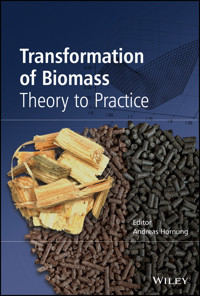
74,99 €
Mehr erfahren.
- Herausgeber: John Wiley & Sons
- Kategorie: Wissenschaft und neue Technologien
- Sprache: Englisch
Biomass is a key resource for meeting the energy and material demands of mankind in the future. As a result, businesses and technologies are developing around biomass processing and its applications.
Transformation of Biomass: Theory to Practice explores the modern applications of biomass and bio-based residues for the generation of energy, heat and chemical products. The first chapter presents readers with a broad overview of biomass and its composition, conversion routes and products. The following chapters deal with specific technologies, including anaerobic digestion, pyrolysis and gasification, as well as hydrothermal and supercritical conversion. Each chapter details current practises, recent developments, business case models and comprehensive analysis of the problems associated with each approach, and how to optimize them.
Topics covered include:
- Anaerobic digestion
- Reactor design
- Pyrolysis
- Catalysis in biomass transformation
- Engines for combined heat and power
- Influence of feedstocks on performance and products
- Bio-hydrogen from biomass
- Analysis of bio-oils
- Numerical simulation and formal kinetic parameters evaluation
- Business case development
This textbook will provide students, researchers and industry professionals with a practical and accessible guide to the essential skills required to advance in the field of bioenergy.
Sie lesen das E-Book in den Legimi-Apps auf:
Seitenzahl: 647
Veröffentlichungsjahr: 2014
Ähnliche



















Transformation of Biomass
Theory to Practice
Editor
ANDREAS HORNUNG
Fraunhofer UMSICHT - Institute Branch
Sulzbach-Rosenberg, Germany
and
Chair in Bioenergy
School of Chemical Engineering
College of Engineering and Physical Sciences
University of Birmingham, UK
This edition first published 2014 © 2014 John Wiley & Sons, Ltd
Registered officeJohn Wiley & Sons Ltd, The Atrium, Southern Gate, Chichester, West Sussex, PO19 8SQ, United Kingdom
For details of our global editorial offices, for customer services and for information about how to apply for permission to reuse the copyright material in this book please see our website at www.wiley.com.
The right of the author to be identified as the author of this work has been asserted in accordance with the Copyright, Designs and Patents Act 1988.
All rights reserved. No part of this publication may be reproduced, stored in a retrieval system, or transmitted, in any form or by any means, electronic, mechanical, photocopying, recording or otherwise, except as permitted by the UK Copyright, Designs and Patents Act 1988, without the prior permission of the publisher.
Wiley also publishes its books in a variety of electronic formats. Some content that appears in print may not be available in electronic books.
Designations used by companies to distinguish their products are often claimed as trademarks. All brand names and product names used in this book are trade names, service marks, trademarks or registered trademarks of their respective owners. The publisher is not associated with any product or vendor mentioned in this book.
Limit of Liability/Disclaimer of Warranty: While the publisher and author have used their best efforts in preparing this book, they make no representations or warranties with respect to the accuracy or completeness of the contents of this book and specifically disclaim any implied warranties of merchantability or fitness for a particular purpose. It is sold on the understanding that the publisher is not engaged in rendering professional services and neither the publisher nor the author shall be liable for damages arising herefrom. If professional advice or other expert assistance is required, the services of a competent professional should be sought.
The advice and strategies contained herein may not be suitable for every situation. In view of ongoing research, equipment modifications, changes in governmental regulations, and the constant flow of information relating to the use of experimental reagents, equipment, and devices, the reader is urged to review and evaluate the information provided in the package insert or instructions for each chemical, piece of equipment, reagent, or device for, among other things, any changes in the instructions or indication of usage and for added warnings and precautions. The fact that an organization or Website is referred to in this work as a citation and/or a potential source of further information does not mean that the author or the publisher endorses the information the organization or Website may provide or recommendations it may make. Further, readers should be aware that Internet Websites listed in this work may have changed or disappeared between when this work was written and when it is read. No warranty may be created or extended by any promotional statements for this work. Neither the publisher nor the author shall be liable for any damages arising herefrom.
Library of Congress Cataloging-in-Publication Data
Transformation of biomass : theory to practice / editor, Andreas Hornung. pages cm Includes bibliographical references and index. ISBN 978-1-119-97327-0 (hardback) 1. Biomass chemicals. 2. Biomass. I. Hornung, Andreas. TP248.B55T73 2014 662′.88–dc23 2014004300
A catalogue record for this book is available from the British Library.
ISBN: 9781119973270
Contents
About the Editor
List of Contributors
Preface
Chapter 1: Biomass, Conversion Routes and Products – An Overview
1.1 Introduction
1.2 Features of the Different Generations of Biomass
1.3 Analysis of Biomass
1.4 Biomass Conversion Routes
1.5 Bio-Oil Characteristics and Biochar
1.6 Scope of Pyrolysis Process Control and Yield Ranges
1.7 Catalytic Bio-Oil Upgradation
1.8 Bio-Oil Reforming
1.9 Sub and Supercritical Water Hydrolysis and Gasification
Questions
References
Chapter 2: Anaerobic Digestion
2.1 Introduction
Questions
References
Chapter 3: Reactor Design and Its Impact on Performance and Products
3.1 Introduction
3.2 Thermochemical Conversion Reactors
3.3 Design Considerations
3.4 Reactions and their Impact on the Products
3.5 Mass and Energy Balance
3.6 Reactor Sizing and Configuration
3.7 Reactor Performance and Products
3.8 New Reactor Design and Performance
Nomenclature
Questions
References
Chapter 4: Pyrolysis
4.1 Introduction
4.2 How Pyrolysis Reactors Differ
4.3 Fast Pyrolysis
4.4 Fast Pyrolysis Reactors
4.5 Intermediate Pyrolysis
4.6 Slow Pyrolysis
4.7 Comparison of Different Pyrolysis Techniques
4.8 Future Directions
4.9 Pyrolysis in Application
4.10 Pyrolysis of Low Grade Biomass Using the Pyroformer Technology
Questions
References
Books and Reviews
Chapter 5: Catalysis in Biomass Transformation
5.1 Introduction
5.2 Biomass, Biofuels and Catalysis
5.3 Biomass Transformation Examples
5.4 Hydrogen Production
5.5 Catalytic Barriers and Challenges in Transformation
Questions
References
Chapter 5.A: Catalytic Reforming of Brewers Spent Grain
5.A.1 Biomass Characterisation
5.A.2 Permanent Gas Analysis
5.A.3 Pyrolysis and Catalytic Reforming without Steam
5.A.4 Pyrolysis and Catalytic Reforming with Steam
Reference
Chapter 6: Thermochemical Conversion of Biomass
6.1 Introduction
6.2 The Thermochemical Conversion Process
6.3 Combustion
6.4 Gasification
6.5 Historical Perspective on Gasification Technology
6.6 Gasification Technology
6.7 Open-Top Dual Air Entry Reaction Design – the IISc's Invention
6.8 Technology Package
Questions
References
Chapter 7: Engines for Combined Heat and Power
7.1 Spark-Ignited Gas Engines and Syngas
7.2 Dual-Fuel Engines and Biofuels
7.3 Advanced Systems: Biowaste Derived Pyrolysis Oils for Diesel Engine Application
7.4 Advanced CHP Application: Dual-Fuel Engine Application for CHP Using Pyrolysis Oil and Pyrolysis Gas from Deinking-Sludge
Questions
References
Chapter 8: Hydrothermal Liquefaction – Upgrading
8.1 Introduction
8.2 Chemistry of Hydrothermal Liquefaction
8.3 Hydrothermal Liquefaction of Carbohydrates
8.4 Hydrothermal Liquefaction of Lignin
8.5 Technical Application
8.6 Conclusion
Questions
References
Chapter 9: Supercritical Conversion of Biomass
9.1 Introduction
9.2 Supercritical Water Gasification
9.3 Supercritical Water Oxidation
9.4 Water–Gas Shift Reaction under the Supercritical Conditions
9.5 Catalysts in the Supercritical Processes
9.6 The Solubilities of Gases in the Supercritical Water
9.7 Fugacities of Gases in the Supercritical Water
9.8 Mechanism of the Supercritical Water Gasification
9.9 Corrosion in the Supercritical Water
9.10 Advantages of the Supercritical Conversion of Biomass
9.11 Conclusion
Questions
References
Chapter 10: Influence of Feedstocks on Performance and Products of Processes
10.1 Humidity of Feedstocks
10.2 Heteroatoms in Feedstocks
References
Chapter 11: Integrated Processes Including Intermediate Pyrolysis
11.1 Coupling of Anaerobic Digestion, Pyrolysis and Gasification
11.2 Intermediate Pyrolysis, CHP in Combination with Combustion
11.3 Integration of Intermediate Pyrolysis with Anaerobic Digestion and CHP
11.4 Pyrolysis Reforming
11.5 The BIOBATTERY
11.6 Pyrolysis BAF Application
11.7 Birmingham 2026
11.8 Conclusion
References
Chapter 12: Bio-Hydrogen from Biomass
12.1 World Hydrogen Production
12.2 Bio-hydrogen
12.3 Routes to Hydrogen
12.4 Costs of Hydrogen
12.5 Conclusion
References
Further Reading
Chapter 13: Analysis of Bio-Oils
13.1 Definition
13.2 Introduction
13.3 General Aspects
13.4 Whole Oil Analyses
13.5 Fractionation Techniques
Questions
References
Chapter 14: Formal Kinetic Parameters – Problems and Solutions in Deriving Proper Values
14.1 Introduction
14.2 Chemical Kinetics on Thermal Decomposition of Biomass
14.3 Kinetic Evaluation Methods
14.4 Experimental Kinetic Analysis Techniques
14.5 Complex Reaction
14.6 Variation in Kinetic Parameters
14.7 Case Study: Kinetic Analysis of Lignocellulosic Derived Materials under Isothermal Conditions
14.8 Conclusion
Nomenclature
Questions
References
Chapter 15: Numerical Simulation of the Thermal Degradation of Biomass – Approaches and Simplifications
15.1 Introduction
15.2 Kinetic Schemes Applied in Complex Models
15.3 Thermal Aspects of Biomass Degradation Modeling
15.4 Conclusion
Questions
Nomenclature
References
Chapter 16: Business Case Development
16.1 Introduction
16.2 Biomass for Power Generation and CHP
16.3 Business Perspective
16.4 The Role of Business Models
16.5 Financial Model Based on Intermediate Pyrolysis Technology
References
Chapter 17: Production of Biochar and Activated Carbon via Intermediate Pyrolysis – Recent Studies for Non-Woody Biomass
17.1 Biochar
References
Further Reading
17.2 Activated Carbon
References
Further Reading
Index
End User License Agreement
List of Tables
Chapter 1
Table 1.1
Table 1.2
Table 1.3
Table 1.4
Table 1.5
Table 1.6
Table 1.7
Table 1.8
Table 1.9
Table 1.10
Table 1.11
Chapter 2
Table 2.1
Table 2.2
Chapter 3
Table 3.1
Table 3.2
Table 3.3
Table 3.4
Table 3.5
Table 3.6
Table 3.7
Table 3.8
Chapter 5
Table 5.1
Table 5.2
Table 5.3
Table 5.4
Table 5.5
Table 5.6
Table 5.7
Table 5.8
Chapter 5A
Table 5.A.1
Table 5.A.2
Table 5.A.3
Table 5.A.4
Table 5.A.5
Table 5.A.6
Chapter 6
Table 6.1
Table 6.2
Table 6.3
Chapter 7
Table 7.1
Table 7.2
Table 7.3
Table 7.4
Table 7.5
Table 7.6
Table 7.7
Chapter 8
Table 8.1
Table 8.2
Chapter 10
Table 10.1
Table 10.2
Table 10.3
Table 10.4
Table 10.5
Chapter 12
Table 12.1
Table 12.2
Chapter 13
Table 13.1
Table 13.2
Table 13.3
Table 13.4
Table 13.5
Table 13.6
Table 13.7
Table 13.8
Chapter 14
Table 14.1
Table 14.2
Chapter 16
Table 16.1
Table 16.2
Table 16.3
Table 16.4
Table 16.5
Table 16.6
Table 16.7
Chapter 17
Table 17.1.1
Table 17.1.2
Table 17.1.3
Table 17.1.4
Table 17.1.5
Table 17.2.1
Table 17.2.2
Guide
Cover
Table of Contents
Preface
Pages
xiii
xiv
xv
xvi
xvii
xviii
1
2
3
4
5
6
7
8
9
10
11
12
13
14
15
16
17
18
19
20
21
22
23
24
25
26
27
28
29
30
31
32
33
34
35
36
37
38
39
40
41
42
43
44
45
46
47
48
49
50
51
52
53
54
55
56
57
58
59
61
62
63
64
65
66
67
68
69
70
71
72
73
74
75
76
77
78
79
80
81
82
83
84
85
86
87
88
89
90
91
92
93
94
95
96
97
99
100
101
102
103
104
105
106
107
108
109
110
111
112
113
114
115
116
117
118
119
120
121
122
123
125
126
127
128
129
130
131
133
134
135
136
137
138
139
140
141
142
143
144
145
146
147
148
149
150
151
152
153
154
155
156
157
159
160
161
162
163
164
165
166
167
168
169
170
171
172
173
175
176
177
178
179
180
181
182
183
184
185
186
187
188
189
190
191
192
193
194
195
196
197
198
199
200
201
202
203
204
205
206
207
209
210
211
212
213
214
215
216
217
218
219
220
221
222
223
224
225
227
228
229
230
231
232
233
234
235
236
237
238
239
240
241
242
243
244
245
246
247
248
249
250
251
252
253
254
255
256
257
258
259
260
261
262
263
264
265
266
267
268
269
270
271
272
273
274
275
276
277
278
279
280
281
282
283
284
285
286
287
288
289
290
291
292
293
294
295
296
297
298
299
300
301
302
303
305
306
307
308
309
310
311
312
313
314
315
316
317
318
319
320
321
322
323
324
325
326
327
328
329
330
331
332
333
334
335
336
337
338
339
340
341
342
343
344
345
346
347
348
349
350
About the Editor
Prof. Dr. rer. nat. Dipl.-Ing Andreas Hornung CEng FIChemE FRSC completed his studies at the TU Darmstadt in Germany, where he graduated as an engineer in chemistry in 1991. He did his PhD at the TU Kaiserslautern in Germany whilst developing reactor systems for the pyrolysis-based recycling of plastics. He continued to work at the TU Karls- ruhe in Germany in developing reactor systems for the recycling of resins and electronic scrap, and expanded his topic to the conversion of biomass from 1996 onward. From 2000 to 2002, Hornung worked for companies in Austria and Italy on the development of the first prototypes. Such units have been used since 2001 at the Karlsruhe Institute of Technology, where he worked until 2007 as head of the pyrolysis and gas treatment division. In 2007, he took over the chair in chemical engineering and applied chemistry at Aston University in Birmingham, UK. In 2008, he founded the European Bioenergy Research Institute EBRI which he led as director until the end of 2013. At the beginning of 2013 he became the director of the Institute Branch Sulzbach-Rosenberg of Fraunhofer UMSICHT. Since 2010 he has been a Fellow of the Royal Society of Chemistry (England), a Fellow of the Institution of Chemical Engineers as well as chartered engineer in Britain, and he became Green Leader of the West Midlands in 2012. In 2013, his technology received the British National Climate Week Award in the breakthrough category. He holds 18 patents and has published more than 150 scientific publications to date. His institutes employed, in 2013, about 120 staff members and are carrying out applied research in various sustainable topics. In May 2014 he has been appointed as chair in bioenergy at the University of Birmingham, UK.
The main strategic topic of Hornung's work today is the development of decentralised power providing units combined with pyrolysis, gasification and digestion units – called the Biobattery.
In a biogas scenario, a Biobattery installation seeks to use peaks in energy supply to add to the energy output from a biogas installation and enable the thermochemical transformation of the more recalcitrant lignin-based components of digestion feedstocks. The use of digestate solids as feedstock for intermediate pyrolysis means that the amount of digestate for application to land is reduced to the liquid fraction. This is desirable where there is an oversupply of nitrogenous materials for application to land, such as in areas of intensive livestock production, since digestates can be a source of both greenhouse gas emissions and nitrogen losses to water bodies. Hence, the Biobattery not only adds to the flexibility of energy supply and storage, it also increases the energy and financial gain achieved from existing biogas infrastructure, while reducing their environmental impact.
The Biobattery concept aims to deliver local integrated system solutions, to capture peaks in available power from solar and wind sources and convert and store this power over periods of varying durations (minutes to days), thereby enabling the delivery of on-demand power compensation. The Biobattery concept uses a pool of renewable energy technologies, that is high and low temperature thermal storage systems, thermochemical biomass processes, for example intermediate pyrolysis and gasification, thereby delivering solid, liquid and gaseous energy products which can be stored and used to produce either energy on an on-demand basis, or sold as products for other use.
List of Contributors
Gökçen Akgül
Department of Energy Systems Engineering, Recep Tayyip Erdoğan University, Turkey
S. Dasappa
Indian Institute of Science, India
Matthias Franke
Fraunhofer UMSICHT – Institute Branch Sulzbach-Rosenberg, Germany
Andreas Hornung
Fraunhofer UMSICHT – Institute Branch Sulzbach-Rosenberg, Germany and Chair in Bioenergy, School of Chemical Engineering, College of Engineering and Physical Sciences, University of Birmingham, UK
Ursel Hornung
Karlsruhe Institut für technologie – Institut für Katalyseforschung und–Technologie, Germany
Andrea Kruse
Universität Hohenheim, Institut für Agrartechnik, Konversionstechnologie und Systembewertung nachwachsender Rohstoffe, Germany
Asad Mahmood
European Bioenergy Research Institute (EBRI), Aston University, UK
Yassir T. Makkawi
European Bioenergy Research Institute (EBRI), Aston University, UK
István Marsi
Faculty of Education, Department of Chemical Informatics, University of Szeged, Hungary
Dietrich Meier
Thünen-Institut für Holzforschung, Germany
Lynsey Melville
Centre for Low Carbon Research (CLCR), Birmingham City University, UK
Pravakar Mohanty
Department of Chemical Engineering, Indian Institute of Technology Delhi, India
Miloud Ouadi
European Bioenergy Research Institute (EBRI), Aston University, UK
K.K. Pant
Department of Chemical Engineering, Indian Institute of Technology Delhi, India
Neeranuch Phusunti
Department of Chemistry, Faculty of Science, Prince of Songkla University, Hat Yai, Thailand
Sudhakar Sagi
European Bioenergy Research Institute (EBRI), Aston University, UK
Elisabeth Schröder
Karlsruher Institut für Technologie – Institut für Kern-und Energietechnik, Germany
James O. Titiloye
Chemical & Environmental Engineering, College of Engineering, Swansea University, UK
Andreas Weger
Fraunhofer UMSICHT – Institute Branch Sulzbach-Rosenberg, Germany
Sonja Wiesgickl
Fraunhofer UMSICHT – Institute Branch Sulzbach-Rosenberg, Germany
Michael Windt
Thünen Institut für Holzforschung, Germany
Yang Yang
European Bioenergy Research Institute (EBRI), Aston University, UK
Preface
Biomass is seen as a key feed material for the energy and material demands of mankind in the future. New businesses and technologies are therefore developing around biomass and its application. This textbook aims to help create an understanding of such processes related to the conversion of biomass into energy, heat and chemical products: processes based on biological or thermal routes.
Lesen Sie weiter in der vollständigen Ausgabe!
Lesen Sie weiter in der vollständigen Ausgabe!
Lesen Sie weiter in der vollständigen Ausgabe!
Lesen Sie weiter in der vollständigen Ausgabe!
Lesen Sie weiter in der vollständigen Ausgabe!
Lesen Sie weiter in der vollständigen Ausgabe!
Lesen Sie weiter in der vollständigen Ausgabe!
Lesen Sie weiter in der vollständigen Ausgabe!
Lesen Sie weiter in der vollständigen Ausgabe!
Lesen Sie weiter in der vollständigen Ausgabe!
Lesen Sie weiter in der vollständigen Ausgabe!
Lesen Sie weiter in der vollständigen Ausgabe!
Lesen Sie weiter in der vollständigen Ausgabe!
Lesen Sie weiter in der vollständigen Ausgabe!
Lesen Sie weiter in der vollständigen Ausgabe!
Lesen Sie weiter in der vollständigen Ausgabe!
Lesen Sie weiter in der vollständigen Ausgabe!
Lesen Sie weiter in der vollständigen Ausgabe!
Lesen Sie weiter in der vollständigen Ausgabe!
Lesen Sie weiter in der vollständigen Ausgabe!




