


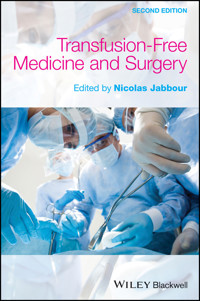
Transfusion-Free Medicine and Surgery E-Book
73,99 €
Mehr erfahren.
- Herausgeber: John Wiley & Sons
- Kategorie: Fachliteratur
- Sprache: Englisch
This book aims to be a guide to the practice of blood conservation. The first chapter discusses the legal and administrative aspects of bloodless medicine describing the legal principles and practical issues relatd to refusal of transfusion. The second is on balancing the risks and benefits of transfusion includes clinical vignettes of appropriate and inappropriate transfusion. The remainder of the book covers the principles and practice of bloodless medicine, including a chapter on the scientific issues of haemostasis and the investigation of bleeding idsorders. The book concludes with chapters on blood conservation in neonatal and paediatric surgery, the costs associated with blood transfusion and the quest for artifical blood. New chapters will be included to address blood utilization in oncology and geriatric patients.
Sie lesen das E-Book in den Legimi-Apps auf:
Seitenzahl: 700
Veröffentlichungsjahr: 2014
Ähnliche




















Table of Contents
Cover
Title Page
Copyright
Dedication
Contributors
Preface
Chapter 1: History of blood transfusion and patient blood management
Introduction
Blood: early beliefs and practice
Blood transfusion
Transfusion with animal blood
First human blood transfusion
Karl Landsteiner to the twenty-first century
New transfusion issues emerge
The new paradigm
References
Chapter 2: The ethical complexities of transfusion-free medicine, surgery and research
Introduction
Ethics and informed consent
Children, assent, and consent
Professionalism and transfusion-free practices
Jehovah's witnesses
Organ transplantation
Research ethics
References
Chapter 3: Transfusion therapy—Balancing the risks and benefits
Introduction/overview
The clinical utility of transfusion therapy
Summary and conclusions
References
Chapter 4: The physiology of anemia and the threshold for blood transfusion
Introduction
Etiologies of anemia
Physiologic response to anemia
The transfusion threshold
Risks of blood transfusion
Summary
References
Chapter 5: Blood transfusion in surgery
Introduction
The cost-effectiveness of blood products: a surgical perspective
Pre-operative optimization of the surgical patient
Intra-operative approach to blood conservation
Post-operative care
Trends in transfusion-free surgery
Conclusion
References
Chapter 6: Current view of coagulation system
Normal hemostasis
Regulation of hemostasis
Abnormal hemostasis
Evaluation of hemostasis
Management of intraoperative coagulation
Hemostatic drug therapy
References
Chapter 7: Topical hemostatic agents
Introduction
History of hemostatics
The biology of hemostasis
Hemostasis in surgery
Safety of hemostatics
Topical hemostatics
Adhesive hemostatics (fibrin glues)
Topical hemostatics (Passive agents)
References
Chapter 8: Intraoperative strategies for transfusion-free medicine
Introduction
General considerations
Autologous blood
Pharmacologic agents for blood conservation
Controlled hypotension
Summary
References
Chapter 9: Post-operative management in transfusion-free medicine and surgery in the ICU
Introduction
Anemia in the ICU
Role of transfusion in resuscitation
Monitoring the adequacy of oxygenation
Reducing transfusion requirements
Conclusion
References
Chapter 10: The changing transfusion practice of neonatal and pediatric surgery
Introduction
Transfusion considerations specific to the pediatric population
Strategies to limit need or transfusion
Applications of transfusion-limiting strategies to specific surgical situations
Conclusion
Acknowledgements
References
Chapter 11: Current management of anemia in oncology
Overview
Epidemiology and pattern of treatment
Prognostic significance and rationale for correcting anemia in oncology
Pathophysiology of anemia in cancer patients
Diagnostic evaluation and risk assessment
Treatment options
Peripheral red blood cell (PRBC) transfusion
Trend of increased transfusions because of decreased ESA use
Current recommendations
Evolving concepts
Conclusion
References
Chapter 12: Artificial blood
Background
Basics of blood oxygen transportation
Defining the need for artificial oxygen carriers
Hb-based oxygen carriers
Perfluorocarbons
Conclusion
References
Chapter 13: Translational strategies to minimize transfusion requirement in liver surgery and transplantation: Targeting ischemia-reperfusion injury
Introduction
Role of ischemia-reperfusion injury in liver surgery and transplantation
Surgical and pharmacological strategies to mimimize I/R injury in liver surgery and transplantation
Conclusion
References
Chapter 14: Legal and administrative issues related to transfusion-free medicine and surgery programs
Introduction
History of Jehovah's Witnesses and blood
Acceptable products, treatments, and procedures
Overview of legal principles related to refusal of blood
Evolution of bloodless programs
Legal structure of bloodless program
Future expansion of transfusion-free programs
References
Chapter 15: Basic principles of bloodless medicine and surgery
Index
End User License Agreement
Pages
ix
x
xi
xiii
1
2
3
4
5
6
7
8
9
10
11
12
13
14
15
16
17
18
19
20
21
22
23
24
25
26
27
28
29
30
31
32
33
34
35
36
37
38
39
40
41
42
43
44
45
46
47
48
49
50
51
52
53
54
55
56
57
58
59
60
61
62
63
64
65
66
67
68
69
70
71
72
73
74
75
76
77
78
79
80
81
82
83
84
85
86
87
88
89
90
91
92
93
94
95
96
97
98
99
100
101
102
103
104
105
106
107
108
109
110
111
112
113
114
115
116
117
118
119
120
121
122
123
124
125
126
127
128
129
130
131
132
133
134
135
136
137
138
139
140
141
142
143
144
145
146
147
148
149
150
151
152
153
154
155
156
157
158
159
160
161
162
163
164
165
166
167
168
169
170
171
172
173
174
175
176
177
178
179
180
181
182
183
184
185
186
187
188
189
190
191
192
193
194
195
196
197
198
199
200
201
202
203
204
205
206
207
208
209
210
211
212
213
214
215
216
217
218
219
220
221
222
223
224
225
226
227
228
229
230
231
232
233
234
235
236
237
238
239
240
241
242
243
244
245
246
247
248
249
250
251
252
253
254
255
256
257
258
259
260
261
262
263
264
265
266
267
268
269
270
271
272
273
274
275
276
277
278
279
280
281
282
283
284
285
286
287
288
289
290
291
292
293
294
295
296
297
298
299
300
301
302
303
304
305
306
307
308
309
310
311
312
313
314
315
316
317
318
319
320
321
322
323
324
325
326
327
328
329
330
331
332
333
334
335
336
337
338
339
340
341
342
343
344
345
346
347
348
349
350
351
352
353
354
355
356
357
358
359
360
361
Guide
Cover
Table of Contents
Preface
Chapter 1: History of blood transfusion and patient blood management
List of Illustrations
Figure 1.1
Figure 6.1
Figure 6.2
Figure 6.3
Figure 6.4
Figure 6.5
Figure 6.6
Figure 6.7
Figure 6.8
Figure 6.9
Figure 6.10
Figure 6.11
Figure 6.12
Figure 6.13
Figure 7.1
Figure 9.1
Figure 9.2
Figure 12.1
Figure 13.1
Figure 14.1
Figure 14.2
Figure 14.3
Figure 14.4
List of Tables
Table 1.1
Table 3.1
Table 6.1
Table 6.2
Table 6.3
Table 8.1
Table 8.2
Table 8.3
Table 8.4
Table 8.5
Table 10.1
Table 10.2
Table 10.3
Table 10.4
Table 11.1
Table 11.2
Table 11.3
Table 12.1
Transfusion-Free Medicine and Surgery
Second Edition
Edited by
Nicolas Jabbour, MD
Professor of Surgery
Chairman Service de Chirurgie et transplantation abdominale
Cliniques universitaires Saint-Luc
Bruxelles, Belgium
This edition first published 2014 © 2005, 2014 by John Wiley & Sons Ltd.
Registered office: John Wiley & Sons, Ltd, The Atrium, Southern Gate, Chichester, West Sussex, PO19 8SQ, UK
Editorial offices: 9600 Garsington Road, Oxford, OX4 2DQ, UK
The Atrium, Southern Gate, Chichester, West Sussex, PO19 8SQ, UK
111 River Street, Hoboken, NJ 07030-5774, USA
For details of our global editorial offices, for customer services and for information about how to apply for permission to reuse the copyright material in this book please see our website at www.wiley.com/wiley-blackwell
The right of the author to be identified as the author of this work has been asserted in accordance with the UK Copyright, Designs and Patents Act 1988.
All rights reserved. No part of this publication may be reproduced, stored in a retrieval system, or transmitted, in any form or by any means, electronic, mechanical, photocopying, recording or otherwise, except as permitted by the UK Copyright, Designs and Patents Act 1988, without the prior permission of the publisher.
Designations used by companies to distinguish their products are often claimed as trademarks. All brand names and product names used in this book are trade names, service marks, trademarks or registered trademarks of their respective owners. The publisher is not associated with any product or vendor mentioned in this book. It is sold on the understanding that the publisher is not engaged in rendering professional services. If professional advice or other expert assistance is required, the services of a competent professional should be sought.
The contents of this work are intended to further general scientific research, understanding, and discussion only and are not intended and should not be relied upon as recommending or promoting a specific method, diagnosis, or treatment by health science practitioners for any particular patient. The publisher and the author make no representations or warranties with respect to the accuracy or completeness of the contents of this work and specifically disclaim all warranties, including without limitation any implied warranties of fitness for a particular purpose. In view of ongoing research, equipment modifications, changes in governmental regulations, and the constant flow of information relating to the use of medicines, equipment, and devices, the reader is urged to review and evaluate the information provided in the package insert or instructions for each medicine, equipment, or device for, among other things, any changes in the instructions or indication of usage and for added warnings and precautions. Readers should consult with a specialist where appropriate. The fact that an organization or Website is referred to in this work as a citation and/or a potential source of further information does not mean that the author or the publisher endorses the information the organization or Website may provide or recommendations it may make. Further, readers should be aware that Internet Websites listed in this work may have changed or disappeared between when this work was written and when it is read. No warranty may be created or extended by any promotional statements for this work. Neither the publisher nor the author shall be liable for any damages arising herefrom.
Library of Congress Cataloging-in-Publication Data
Transfusion-free medicine and surgery / edited by Nicolas Jabbour. — Second edition.
p. ; cm.
Includes bibliographical references and index.
ISBN 978-0-470-67408-6 (cloth)
I. Jabbour, Nicolas, editor of compilation.
[DNLM: 1. Bloodless Medical and Surgical Procedures. 2. Blood Substitutes--therapeutic use. WH 450]
RD33.35
615′.39—dc23
2014004643
A catalogue record for this book is available from the British Library.
Wiley also publishes its books in a variety of electronic formats. Some content that appears in print may not be available in electronic books.
Cover image: iStock #11024906 © mediaphotos
Cover design by Garth Stewart
To my family: Banu, Nicole and Jacques
Contributors
Katrina A. Bramstedt, PhD
Associate Professor
Medical Ethics and Professionalism
Bond University School of Medicine
Gold Coast, Queensland, Australia
Jason Bryant, MD
Staff Anesthesiologist
Department of Anesthesiology and Pain Medicine
Nationwide Children's Hospital;
Department of Anesthesiology
The Ohio State University
Columbus, OH, USA
Fabrizio Di Benedettom, MD, PhD
Professor of Surgery
Hepato-pancreato-biliary Surgery and
Liver Transplantation Unit
University of Modena and Reggio Emilia
Modena, Italy
Elia Elia, MD
Clinical Associate Professor
Department of Anesthesiology
Thomas Jefferson University Jefferson Medical College
Philadelphia, PA, USA
Shannon L. Farmer
Adjunct Research Fellow
School of Surgery, Faculty of Medicine Dentistry and Health Sciences
University of Western Australia
Perth, Western, Australia;
Adjunct Senior Research Fellow
Centre for Population Health Research,
Curtin Health Innovation Research Institute
Curtin University, Perth, Western Australia
Lance W Griffin, MD
Instructor of General Surgery
University of Texas Medical Branch
Galveston, TX, USA
Randy Henderson
Program Director
Transfusion-Free Surgery and Patient Blood Program Management
Keck Medical Center and Keck Hospital of USC
University of Southern California
Los Angeles, CA, USA
James Isbister BSc(Med), MBBS, FRACP, FRCPA
Clinical Professor of Medicine
University of Sydney, Sydney, Australia;
Adjunct Professor
University of Technology, Sydney;
Adjunct Professor
Monash University, Melbourne;
Conjoin Professor of Medicine
University of New South Wales
Sydney, Australia;
Emeritus Consultant
Haematology & Transfusion Medicine
Royal North Shore Hospital
Sydney, NSW, Australia
Nicolas Jabbour, MD
Professor of Surgery
Chairman Service de Chirurgie et transplantation abdominale
Cliniques universitaires Saint-Luc
Bruxelles, Belgium
Mazyar Javidroozi, MD, PhD
Department of Anesthesiology and Critical Care Medicine
Englewood Hospital and Medical Center
Englewood, NJ, USA
Yoogoo Kang, MD
Professor
Department of Anesthesiology
Thomas Jefferson University Jefferson Medical College
Philadelphia, PA, USA
S. Kamran Hejazi Kenari, MD
Assistant Professor of Surgery
Division of Organ Transplantation
Department of Surgery
Rhode Island Hospital
Alpert Medical School of Brown University
Providence, RI, USA
Pamela J. Kling MD
Professor
Meriter Hospital and University of Wisconsin
Madison School of Medicine and Public Health
Madison, WI, USA
Senthil G. Krishna, MD
Staff Anesthesiologist
Department of Anesthesiology and Pain Medicine Nationwide Children's Hospital;
Department of Anesthesiology The Ohio State University Columbus, OH, USA
Michael F. Leahy, MB ChB, FRACP, FRCP, FRCPath.
Consultant Haematologist
Head of Department of Haematology
Fremantle Hospital and Health Service;
Clinical Professor in Medicine
School of Medicine and Pharmacology
University of Western Australia
Perth, WA, Australia
Irina Maramica, MD PhD
Associate Professor Health Sciences
Medical Director of Transfusion Medicine
Department of Pathology and Laboratory Medicine
University of California Irvine Medical Center
Orange, CA, USA
Seth Perelman, MD
Department of Anesthesiology and Critical Care Medicine
Englewood Hospital and Medical Center
Englewood, NJ, USA
Reza F. Saidi, MD, FICS, FACS
Assistant Professor of Surgery
Division of Organ Transplantation
Department of Surgery
Rhode Island Hospital
Alpert Medical School of Brown University
Providence, RI, USA
Aryeh Shander, MD, FCCM, FCCP
Chief, Department of Anesthesiology, Critical Care Medicine, Pain Management and Hyperbaric Medicine
Englewood Hospital & Medical Center Englewood, NJ
Shelly Sharma, MD
Clinical Research Fellow
Department of Radiation Oncology
St. Jude Children's Research Hospital
Memphis, TN, USA
Sharad Sharma, MD, MRCS
Assistant Professor
Department Of Transplant Surgery, UTMB
Galveston, TX, USA
Ira A. Shulman, MD
Vice Chair and Professor of Pathology
Keck School of Medicine at the University of Southern California (USC)
Director of the USC Transfusion Medicine Services Group
Los Angeles, CA, USA
Ahsan Syed, MD
Staff Anesthesiologist
Department of Anesthesiology and Pain Medicine Nationwide Children's Hospital;
Department of Anesthesiology The Ohio State University Columbus, OH, USA
Giuseppe Tarantino, MD
Hepato-pancreato-biliary Surgery and
Liver Transplantation Unit
University of Modena and Reggio Emilia
Modena, Italy
Joseph D. Tobias, MD
Chairman
Department of Anesthesiology and Pain Medicine Nationwide Children's Hospital;
Department of Anesthesiology The Ohio State University Columbus, OH, USA
Jean-Louis Vincent, MD, PhD
Professor of Intensive Care
Head, Department of Intensive Care
Erasme Hospital
Université libre de Bruxelles
Brussels, Belgium
Preface
This is the second edition of the book entitled Transfusion-Free Medicine and Surgery, which was first published in 2005.
Since its first publication, there have been some noticeable changes in the field.
As a result of more expended testing of blood donors, the blood has become safer; however, as mentioned in the first edition, blood will never be 100% safe because of the inherent risk of it's administration and storage such as clerical error. Therefore, the benefit of avoiding blood transfusion cannot be underestimated.
In most hospitals and in several services, we noticed that the notion of transfusion-free medicine and surgery is no longer limited to Jehovah's witness patients. The medical community pays more attention to blood utilization and has installed stricter criteria for blood transfusion both in and outside the operation room, in particular, in the intensive care unit.
In the area of artificial blood products, there is currently no real breakthrough, but ongoing research hopefully will lead to a product on the market in the near future.
Topical hemostasis has been more studied, and several new products were introduced in the operating room with measurable success in terms of control of bleeding and blood utilization.
Seemingly remote basic research in certain areas, such as reperfusion injury in organ transplantation, has contributed to the understanding of intraoperative bleeding.
The fact remains, however, that more than 50% of blood transfusion is prescribed by surgeons, and we as physicians in general and surgeons in particular have the responsibility of objectively assessing the risk, availability, and cost of blood products.
Blood conservation is still a measure of higher standard of care and has more room to grow.
Chapter 1History of blood transfusion and patient blood management
Shannon L. Farmer1, James Isbister2, and Michael F. Leahy3
1School of Surgery, Faculty of Medicine, Dentistry and Health Sciences, University of Western Australia, Perth, Western Australia; Centre for Population Health Research, Curtin Health Innovation Research Institute, Curtin University, Perth, Western Australia
2University of Sydney, Sydney, AustraliaUniversity of Technology, Sydney, AustraliaMonash University, Melbourne, Australia University of New South Wales, Sydney, Australia;Haematology & Transfusion Medicine, Royal North Shore Hospital, Sydney, Australia
3Department of Haematology, Fremantle Hospital and Health Service, Fremantle, Western Australia;School of Medicine and Pharmacology, University of Western Australia, Perth, Western Australia
Introduction
For more than two decades authorities have been calling for a major change in transfusion practice [1]. This is now even more urgent as new challenges continue to emerge. These include supply difficulties due to a diminishing donor pool and an increasing aging and consuming population, spiraling costs of blood and ongoing safety issues. Knowledge of transfusion limitations continues to grow, while a burgeoning literature demonstrates a strong dose-dependent relationship between transfusion and adverse patient outcomes [2, 3]. These factors combine to now make change vital [4].
Historically, changing long-standing medical practice has been challenging—perhaps even more so in transfusion. Despite professional guidelines and educational initiatives, wide variations in transfusion practice exist between countries, institutions and even between individual clinicians within the same institution [5–8]. This suggests that much practice may be based on misconceptions, belief and habit rather than evidence.
It is not the first time strongly entrenched belief has been an impediment to scientific progress. Edwin Hubble's description of an expanding universe in 1929 has been hailed as one of the great intellectual revolutions of the twentieth century. However, it has been suggested that, because of knowledge of Newton's law of gravity, an expanding universe could have been predicted over two hundred years earlier [9]. What slowed scientific progress? The widely held belief in a static universe prevailed. The belief was so strong at the time that in 1915 Einstein even modified his theory of relativity to accommodate it [9].
Lesen Sie weiter in der vollständigen Ausgabe!
Lesen Sie weiter in der vollständigen Ausgabe!
Lesen Sie weiter in der vollständigen Ausgabe!
Lesen Sie weiter in der vollständigen Ausgabe!
Lesen Sie weiter in der vollständigen Ausgabe!
Lesen Sie weiter in der vollständigen Ausgabe!
Lesen Sie weiter in der vollständigen Ausgabe!
Lesen Sie weiter in der vollständigen Ausgabe!
Lesen Sie weiter in der vollständigen Ausgabe!
Lesen Sie weiter in der vollständigen Ausgabe!
Lesen Sie weiter in der vollständigen Ausgabe!
Lesen Sie weiter in der vollständigen Ausgabe!
Lesen Sie weiter in der vollständigen Ausgabe!
Lesen Sie weiter in der vollständigen Ausgabe!
Lesen Sie weiter in der vollständigen Ausgabe!
Lesen Sie weiter in der vollständigen Ausgabe!




