


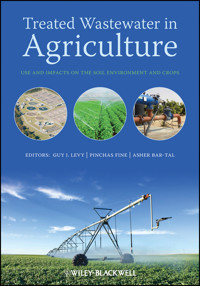
Treated Wastewater in Agriculture E-Book
175,99 €
Mehr erfahren.
- Herausgeber: John Wiley & Sons
- Kategorie: Fachliteratur
- Sprache: Englisch
As the world's population increases and the demand for water increases apace there is a rising demand for information concerning the reuse of wastewater, particularly for the irrigation of key food crops worldwide. This important new book addresses in detail the use of treated wastewater in agricultural situations, its impact on crops and the soil environment. Coverage includes the composition and treatment of wastewater, health considerations, regulations and economic aspects. Major sections of the book also concentrate on crop management and the soil environment. This book is an essential purchase for all those working in irrigation, water management and crop production worldwide. * Use of Treated Wastewater (TWW) for irrigation is increasingly important as the world's population increases * Chapters prepared by leading scientists in the field * Comprehensive coverage of current knowledge and advances in the area of TWW * Focus on possible environmental impacts (positive and negative)
Sie lesen das E-Book in den Legimi-Apps auf:
Seitenzahl: 1006
Veröffentlichungsjahr: 2011
Ähnliche




















Contents
Preface
Contributors list
Part I GENERAL ASPECTS
Chapter 1 Sources and composition of sewage effluent; treatment systems and methods
1.1 Sources of usable wastewater
1.2 Main characteristics of usable wastewater
1.3 Wastewater treatments
1.3.5 Disinfection
1.4 Framework for the selection of the optimal treatment train
References
Chapter 2 Health considerations in the recycling of water and use of treated wastewater in agriculture and other non-potable purposes
2.1 Introduction
2.2 Rationale: why should society allow, regulate, and thus encourage exposure of the population to known health risks?
2.3 Persistence of pathogenic microorganisms in water, soil, and on crops from wastewater-irrigation
2.4 Disease transmission by wastewater-irrigation
2.5 Control of crops and irrigation methods to reduce health risks
2.6 Development of health standards and guidelines for wastewater use
2.7 Conclusions
Dedication
References
Chapter 3 Irrigation with recycled water: guidelines and regulations
Terminology definitions
3.1 Introduction
3.2 Historical development of water recycling and reuse regulations
3.3 Water recycling in agriculture: quality issues
3.4 Treatment requirements and TWW quality monitoring
3.5 Water reuse criteria: irrigation of agricultural crops and landscapes
3.6 Conclusions
References
Chapter 4 Economic aspects of irrigation with treated wastewater
4.1 Introduction
4.2 Wastewater in agriculture
4.3 Wastewater and the regulation of its reuse
4.4 Treatment
4.5 Cost
4.6 Replacement of fertilizers
4.7 Cost allocation and prices
4.8 Further considerations and alternatives
4.9 Agreements
4.10 The role of the government
4.11 Concluding comments
References
Part II IMPACTS ON THE SOIL ENVIRONMENT AND CROPS
Chapter 5 Major minerals
5.1.3 TWW-N availability to plants
5.1.6 Conclusions
References
5.2 Phosphorus
5.2.1 Introduction
5.2.2 Phosphorus forms and species in effluents
5.2.3 Sorption, transport and transformations of effluent P in soil
5.2.4 Treated wastewater irrigation
5.2.5 Case studies
5.2.6 Conclusions and outlook
Acknowledgement
References
5.3 Calcium and carbonate
5.3.1 Introduction
5.3.2 Sources and distribution
5.3.3 Carbonate system in the soil environment
The effect of irrigation on soil carbonate
5.3.5 Environmental aspects
5.3.6 Summary
References
Chapter 6 Toxic elements
6.1.1 Introduction
6.1.2 Boron in TWW
6.1.3 Boron chemistry in aqueous media
6.1.4 Boron - soil interactions
6.1.5 Boron - crop interactions
6.1.6 Irrigation with TWW containing high B levels: a case study
References
6.2 Chlorides in treated wastewater and their effects on plants
6.2.1 Introduction
6.2.2 Chloride in plants
6.2.3 Absorption mechanisms of chloride by plant roots
6.2.4 Effects of irrigation with TWW containing high Cl concentrations on crops
6.2.5 Foliar damage by Cl in sprinkler irrigated TWW
6.2.6 Concluding comments
References
Chapter 7 Heavy metals in soils irrigated with wastewater
Introduction
7.2 Heavy metals in effluents
7.3 Organic matter: composition in wastewater effluents and behavior in soil
7.4 Attenuation of heavy metals in soils irrigated with effluents
7.5 Loading limits of metals
7.6 Metals: interaction with soil components
7.7 Distribution of metals among the soil’s solid fractions
7.8 The stability, pH and Eh of free oxides, and their effect on the geochemical distribution of metals
7.9 Heavy metal solubility and speciation in the soil solution
7.10 Mobility of heavy metals in the soil profile
7.11 Availability to plants
7.12 Summary and conclusions
References
Chapter 8 Salinity
8.1 The nature of salinity
8.2 Measuring salinity
8.3 Mechanism of soil salinisation
8.4 Salinity in wastewater
8.5 Effects of salinity on plant growth and water use
8.6 Water use
8.7 Managing root-zone salinity
8.8 Summary and conclusions
Acknowledgements
References
Chapter 9 Physical aspects
9.1 Introduction
9.2 Soil structural stability
9.3 Soil hydraulic properties
9.4 Soil surface sealing, infiltration and runoff
9.5 Soil erosion
9.6 Water repellency
9.7 Concluding comments
References
Chapter 10 Fouling in microirrigation systems applying treated wastewater effluents
10.1 Introduction
10.2 Quality of treated effluents as a source of irrigation water
10.3 Emitter clogging in relation to irrigation water quality
10.4 Management of emitter clogging
10.5 Recovery of clogged emitters
10.6 Concluding remarks and future prospects
References
Chapter 11 Effects of treated municipal wastewater irrigation on soil microbiology
11.1 Introduction
11.2 Soil microbial ecology and activities
11.3 Human pathogens
11.4 Summary and conclusions
References
Chapter 12 Impact of irrigation with treated wastewater on pesticides and other organic microcontaminants in soils
12.1 Introduction
12.2 The effect of DOM on the chemical behavior of organic xenobiotics
12.3 Effluent-borne organic contaminants
12.4 Summary and conclusions
References
Chapter 13 Organic matter in wastewater and treated wastewater-irrigated soils: properties and effects
13.1 Introduction
13.2 Organic matter in wastewater
13.3 Soil organic matter (SOM)
13.4 The influence of treated-wastewater-borne organic matter on soil organic matter
13.5 The influence of treated-wastewater-borne organic matter on soil properties
13.6 Concluding remarks
Acknowledgements
References
Chapter 14 Analysis of transport of mixed Na/Ca salts in a three-dimensional heterogeneous variably saturated soil
14.1 Introduction
14.2 Modeling of transport of mixed Na/Ca salts in spatially heterogeneous, variably saturated soils
14.3 Simulation of transport of mixed Na/Ca salts in spatially heterogeneous, variably saturated soils
14.4 Summary and concluding remarks
References
Index
This edition first published 2011 2011 Blackwell Publishing Ltd.
Blackwell Publishing was acquired by John Wiley & Sons in February 2007. Blackwell’s publishing programme has been merged with Wiley’s global Scientific, Technical, and Medical business to form Wiley-Blackwell.
Registered office
John Wiley & Sons Ltd, The Atrium, Southern Gate, Chichester, West Sussex, PO19 8SQ, UK
Editorial offices
9600 Garsington Road, Oxford, OX4 2DQ, UK
The Atrium, Southern Gate, Chichester, West Sussex, PO19 8SQ, UK
2121 State Avenue, Ames, Iowa 50014–8300, USA
For details of our global editorial offices, for customer services and for information about how to apply for permission to reuse the copyright material in this book please see our website at www.wiley.com/wiley-blackwell.
The right of the authors to be identified as the authors of this work has been asserted in accordance with the UK Copyright, Designs and Patents Act 1988.
All rights reserved. No part of this publication may be reproduced, stored in a retrieval system, or transmitted, in any form or by any means, electronic, mechanical, photocopying, recording or otherwise, except as permitted by the UK Copyright, Designs and Patents Act 1988, without the prior permission of the publisher.
Wiley also publishes its books in a variety of electronic formats. Some content that appears in print may not be available in electronic books.
Designationsusedbycompaniestodistinguishtheirproductsareoftenclaimedastrademarks.Allbrandnamesand product names used in this book are trade names, service marks, trademarks or registered trademarks of their respective owners. The publisher is not associated with any product or vendor mentioned in this book. This publication is designed to provide accurate and authoritative information in regard to the subject matter covered. It is sold on the understanding that the publisher is not engaged in rendering professional services. If professional advice or other expert assistance is required, the services of a competent professional should be sought.
Library of Congress Cataloging-in-Publication Data
Treated wastewater in agriculture: use and impacts on the soil environment and crops/edited by Guy J. Levy, Pinchas Fine and Asher Bar-Tal. – 1st ed.
p. cm.
Includes bibliographical references and index.
ISBN 978-1-4051-4862-7 (hardback: alk. paper) 1. Water reuse. 2. Sewage irrigation-Environmental aspects. 3. Water in agriculture. I. Levy, Guy J.
II. Fine, Pinchas. III. Bar-Tal, A. (Asher)
TD429.T735 2011
631.5’8–dc22
2010011216
A catalogue record for this book is available from the British Library.
This book is published in the following electronic formats: ePDF (9781444328578); Wiley Online Library (9781444328561)
Preface
Irrigated agriculture produces one-third of the world’s crop yield and half the return from global crop production. Yet, in many parts of the world, especially in semiarid and arid regions the future of irrigated agriculture is threatened by existing or expected shortages of freshwater. These shortages result mainly from the ever-increasing demand put upon water resources by the world’s rapidly growing population and their improving standard of living. The constant rise in population and in water use per capita leads also to an evergrowing volume of municipal sewage water which requires to be disposed. Water recycling and the use of treated municipal sewage effluents, (herein referred to as treated wastewater (TWW)) for agriculture, industry and non-potable urban and environmental applications can afford a highly effective and sustainable strategy to exploit a water resource in areas afflicted by water scarcity. Irrigation with TWW can contribute a significant quantity of nutrients, and hence can contribute to the conservation of diminishing resources.
However, irrigation with TWW is not free of risk both to crop production and the soil environment. Potential risks include reduction in yield due to elevated salinity and specific ion toxicity, migration of pollutants towards surface- and groundwater, and deterioration of soil structure. It is important, therefore to understand the way in which parameters such as quality of TWW, irrigation management practices, and soil and crop characteristics affect processes occurring in the irrigated field.
The central role that irrigated agriculture plays in food production, coupled with the increasing need to utilize TWW for irrigation, motivated this attempt to assemble relevant core knowledge and recent advances in research on irrigation with TWW in the form of a comprehensive book. Our goal was to prepare a volume that consolidates the state-of-the art knowledge on the various aspects of irrigation with TWW and analyzes the possible impacts (either positive or negative) of such irrigation water, both from the agricultural and the environmental perspectives.
The book is divided into 14 chapters arranged in two parts. The first part includes four chapters that cover technical, regulatory, and economic aspects of TWW reuse. The first chapter takes the reader step by step through the multitude of processes available for the treatment of municipal sewage effluents, from extensive, low-tech processes such as lagooning and constructed wetlands to enhanced tertiary and quaternary processes, all aimed at providing TWW that comply with quality criteria set by local and international regulators.
Treatment of sewage effluents should lead to the effective control of health hazards associated with the use of TWW and safeguard the farming community, the consumers of crops, and the population at large from exposure to pathogenic microorganisms that are originally present in the treatment stream. The second chapter deals with the question of what constitutes sufficient protection of the public welfare and introduces the idea that it might be socially and morally justified to allow exposure of the population to a predetermined and well-regulated level of risk to be associated with the reuse of TWW. The author endorses an approach to treating sewage effluents for agricultural use based on the assessment and characterization of the associated risk rather than adoption of the best available technology to treat these wage effluents to an excessive, unnecessarily high level.
Chapter 3 presents the most updated regulations and guidelines for TWW use in agriculture embraced by various countries. The different basic philosophies adopted to protect public health and the environment are discussed in this chapter.
The last chapter in the first part (Chapter 4) highlights economic considerations involved in the use of TWW for irrigation. It presents a basic approach to pricing and cost allocation associated with the use of TWW by both large and small farming communities. This chapter also lends support to the role of government as a regulator and an arbitrator regarding the strong external interests and complex economic issues involved in the use of TWW.
The second part of the volume covers the impact of irrigation with TWW on the agricultural ecosystem. The agricultural and environmental aspects of the presence of organic and mineral forms of major nutrients (nitrogen and phosphorus) in TWW are discussed in Chapter 5 (5.1 and 5.2). The fate of organic N and ammonium in soil, including chemical transformations, mobility, uptake by plants, and the risk of groundwater contamination by excessive leaching, as well as emission of greenhouse gases and other losses to the atmosphere, are described and discussed in Chapter 5 (5.1). Examples of experiments and observations in which TWW was used are presented and compared with freshwater. In Chapter 5 (5.2) the fate of inorganic and organic P in soil, including its chemical transformations, mobility, uptake by plants, and the risk of excess P accumulation in agricultural soils and potential contamination of surface water bodies by runoff loaded with P are reviewed and discussed. Results of laboratory studies, field experiments and surveys of plots in which TWW was used are presented and compared with the results of control runs with freshwater. An additional section of this Chapter 5 (5.3) focuses on a subject that thus far has received little attention, namely the chemistry of calcium and of carbonates in TWW-irrigated soils. This topic is important from the environmental point of view because TWW contains relatively high concentrations of carbonates (and in particular bicarbonates), and their accumulation in soils and groundwater may be an important pathway of carbon sequestration.
The inorganic constituents, the concentrations of which in TWW are frequently higher than in fresh water, are discussed in Chapters 6,7, and 8. Chapter 6 focuses on two elements (boron and chloride) that may reach toxic levels in TWW-irrigated soil. Boron reactions and interactions in soils and its uptake, transport, and distribution in plants are reviewed in Chapter 6 (6.1), as is the issue of boron toxicity resulting from the relatively high boron concentration often encountered in TWW. The specific toxicity of the chloride ion to plants is discussed in Chapter 6 (6.2), where a summary of the role of the chloride ion in plant physiology, as well as some examples of the effect on plants of chloride added through irrigation with TWW, are also given. Chapter 7 discusses the fate of heavy metals in TWW-irrigated soils. It highlights the role of two main factors, pH and Eh, that affect the behavior and fate of metals due to these parameters’ strong influences on the solubility of metals and organic matter and on the properties and stability of the surfaces of the soil’s solid components. It is argued that, in many cases, especially when less advanced methods for TWW production and higher irrigation rates are employed, it is the effect of the TWW on metals already present in the soil rather than on the metals contained in the irrigation water themselves that will govern the mobility and availability of metals in the TWW-soil-plant system.
The fact that TWWs are appreciably more saline than the freshwater from which they originated deserves attention. The salinity of the water increases throughout the long path of TWW formation. In Chapter 8, general aspects of the effect of salinity on crop production are presented, as well as some specific examples of the effect on irrigated trees. Innovative management methods to counteract the damage that may be caused by salinity are highlighted.
The potentially adverse effects on the stability of soil-structure and on the soil’s hydraulic properties, which are associated with the elevated levels of certain organic and inorganic constituents in TWW as compared with freshwater are evaluated in Chapter 9. The reviewed literature reveals that reports on the effects of TWW on soil’s physical characteristics are inconsistent and that existing knowledge is insufficient to support reliable modeling efforts for predicting the soil’s response to irrigation with TWW.
The fate of organic matter and organic contaminants present in TWW and their effect on irrigation systems and the soil environment are discussed in Chapters 10, 11, 12, and 13. Biofilm buildup and its role in clogging irrigation systems, an issue that was often overlooked in the past, is discussed in Chapter 10. Special emphasis is put on the presentation of up-to-date knowledge of the mechanisms of biofilm formation and of state-of-the-art practical information on the effects of biofilm buildup on irrigation systems. Some useful schemes to minimize problems associated with biofilm formation are presented. Chapter 11 reviews the impact of various components of TWW, including microorganisms, on the soil’s microbial population and activity. High levels of mineral solutes, as well as of dissolved organic carbon, detergents, pharmaceuticals, pollutants such as pesticides and other organic chemicals and trace metals, may affect the diversity, structure, and functioning of microbial communities, and hence also affect soil fertility and structure. The authors conclude that current knowledge on the effects of TWW on the soil microflora is insufficient. Especially lacking are data on the effect of the various components of TWW, separately or in combination, on the composition of the microbial community in soils.
Chapter 12 reviews the long-term risks posed by the potential interactions between the dissolved organic matter in TWW and anthropogenic chemicals present both in the soil and in the TWW. Special emphasis is put on the binding of anthropogenic chemicals to TWW originated dissolved organic matter and the resultant possibility of enhanced transport of pollutants to groundwater. The characteristics of the organic matter in TWW and its influence on the soil organic matter are discussed in Chapter 13. Based on available knowledge, it is concluded that addition of dissolved or particulate organic matter through irrigation with TWW can ultimately result in either an increase or a decrease in the soil’s organic matter content, depending on site-specific soil properties and conditions and microbial activity.
Transport of water and solutes in the soil profile as affected by irrigation with high sodium adsorption ratio (SAR) water is described in Chapter 14. High SAR values are common in TWW. The results of the flow and transport simulations discussed in Chapter 14, suggest that on the field-scale, under realistic flow conditions and over an extended period of time, the adverse effects of low solute concentration and a relatively high SAR on the flow and the transport are smaller as compared with the effects measured in laboratory systems in which the transport obeys the classical Darcy equation. These systems (unlike the conditions in the field) consist of a one-dimensional vertical, spatially homogeneous flow domain. This finding has practical implications regarding the use of TWW for irrigation. The data presented may be used for water quality classification as related to soils of different textures and as a tool for water and soil management.
In as much as this book covers a wide range of topics related to the use of TWW, it may serve as a reference book for scientists, agronomists, engineers, ecologists, and students. Hopefully, this volume will contribute to the continuation of capacity building in the many areas related to the use of TWW for irrigation and to optimizing the impact of irrigation with TWW on the agricultural ecosystem and the environment at large.
Contributors list
Andreas N. Angelakis National Agricultural Research Foundation (NAGREF), Institute of Iraklio, Iraklio, Greece Shmuel Assouline Institute of Soil, Water and Environmental Sciences, Agricultural Research Organization, The Volcani Center, Bet Dagan, Israel Asher Bar-Tal Institute of Soil, Water and Environmental Sciences, Agricultural Research Organization, The Volcani Center, Bet Dagan, Israel Bnayahu Bar-Yosef Institute of Soil, Water and Environmental Sciences, Agricultural Research Organization, The Volcani Center, Bet Dagan, Israel Alon Ben-Gal Institute of Soil, Water and Environmental Sciences, Agricultural Research Organization, Gilat Research Center, Israel Yona Chen Department of Soil and Water Sciences, Robert H. Smith Faculty of Agriculture, Food and Environment, The Hebrew University of Jerusalem, Rehovot, Israel. Carlos G. Dosoretz Division of Environmental, Water and Agricultural Engineering, Faculty of Civil and Environmental Engineering and Grand Water Research Institute, Technion-Israel Institute of Technology, Haifa, Israel Gil Eshel Soil Erosion Research Station, Ministry of Agriculture & Rural Development, State of Israel, Ruppin Institute, Israel Pinchas Fine Institute of Soil, Water and Environmental Sciences, Agricultural Research Organization, The Volcani Center, Bet Dagan, Israel Zev Gerstl Institute of Soil, Water and Environmental Sciences, Agricultural Research Organization, The Volcani Center, Bet Dagan, Israel David Giraldi Department of Civil Engineering, University of Pisa, Pisa, Italy Ellen R. Graber Institute of Soil, Water and Environmental Sciences, Agricultural Research Organization, The Volcani Center, Bet Dagan, Israel Amir Hass Agricultural and Environmental Research Station, Gus R. Douglass Land-Grant Institute, West Virginia State University, Institute WV, USA, and USDA-ARS, Appalachian Farming Systems Research Center, Beaver, West Virginia, USA Efrat Hadas Investment Financing Department, Ministry of Agriculture and Rural Development, Bet Dagan, Israel Renato Iannelli Department of Civil Engineering, University of Pisa, Pisa, Italy Elizabeth Jüeschke Institute of Geography, Ruhr University, Bochum, Germany Uzi Kafkafi The Robert H. Smith Institute of Plant Sciences and Genetics in Agriculture, The Robert H. Smith Faculty of Agriculture, Food and Environment, The Hebrew University of Jerusalem, Rehovot, Israel Rachel Karyo Sackler Faculty of Medicine, Tel Aviv University, Israel Ilan Katz Division of Environmental, Water and Agricultural Engineering, Faculty of Civil and Environmental Engineering and Grand Water Research Institute, Technion-Israel Institute of Technology, Haifa, Israel Elisha Kenig Irrigation and Soil Division, Extension Service, Ministry of Agriculture and Rural Development, Bet Dagan, Israel Rami Keren Institute of Soil, Water and Environmental Sciences, Agricultural Research Organization, The Volcani Center, Bet Dagan, Israel Yoav Kislev Department of Agricultural Economics and Management, Faculty of Agricultural, Food and Environmental Quality Sciences, Hebrew University of Jerusalem, Rehovot, Israel Guy J. Levy Institute of Soil, Water and Environmental Sciences, Agricultural Research Organization, The Volcani Center, Bet Dagan, Israel Nico E. Marcar CSIRO Sustainable Ecosystems, Canberra, Australia Bernd Marschner Institute of Geography, Ruhr University, Bochum, Germany Uri Mingelgrin Institute of Soil, Water and Environmental Sciences, Agricultural Research Organization, The Volcani Center, Bet Dagan, Israel Dror Minz Institute of Soil, Water and Environmental Sciences, Agricultural Research Organization, The Volcani Center, Bet Dagan, Israel Nikolaos V. Paranychianakis Department of Environmental Engineering, Technical University of Crete, Greece David Russo Institute of Soil, Water and Environmental Sciences, Agricultural Research Organization, The Volcani Center, Bet Dagan, Israel Miquel Salgot Water Research Institute, University of Barcelona, Barcelona, Spain Hillel Shuval Hadassah Academic College-Jerusalem and The Hebrew University of Jerusalem, Israel Michael J. Singer Land Air and Water Resources Department, University of California Davis, CA, USA Daryl P. Stevens Arris Pty Ltd, Richmond, Victoria, Australia Jorge Tarchitzky Department of Soil and Water Sciences, Robert H. Smith Faculty of Agriculture, Food and Environment, The Hebrew University of Jerusalem, Rehovot, Israel Tivi Theiveyanathan CSIRO Sustainable Ecosystems, Canberra, Australia Uri Yermiyahu Institute of Soil, Water and Environmental Sciences, Agricultural Research Organization, Gilat Research Center, IsraelPart I
General Aspects
Chapter 1
Sources and composition of sewage effluent; treatment systems and methods
Renato Iannelli and David Giraldi
1.1 Sources of usable wastewater
From an ideal point of view, all kinds of wastewater can be reused if they undergo appropriate reclamation treatments. At present, available technologies allow removal of almost all detectable contaminants from wastewaters, making them suitable for every use, despite their original pollution levels. However, selection of the usable wastewater source is the first, and most important, aspect of every reclamation project.
Quality, quantity and location are three important characteristics for the possible use of wastewater. The quality of wastewater defines the required treatment level and related costs. Quantity considerations are strictly related to scale economies for reclamation costs and returns; but, are also related to the comparison between the available wastewater to be reclaimed and the demand for usable water. The location of the source is an important factor that affects the costs related to transport of wastewater from the source to the reclamation plant and then to the final reuse destination. This can be a reason to opt for a reclaimed wastewater source rather than primary water to be transported from a distant location.
Comparison between the cyclic behaviors of potentially usable wastewater and water demand is another aspect of significant relevance in terms of required exploitation costs. As neither produced wastewater nor water demand are usually constant in time, the assessment should include a comparison of cyclic variations of available wastewater with that of water demand. If the two variation shapes match, the construction of compensation tanks/reservoirs can be avoided or significantly reduced, with remarkable cost savings. Conversely, non-matching shapes result in a requirement for compensation tanks/reservoirs, the volume of which depend on the differences between the shapes. Specifically, cycles with long periods (as, for instance, the annual cycle of the agricultural water demand, which is required only during the irrigation season) require the construction of storage reservoirs of extremely large volumes if the production of usable wastewater is constant all year round, as in the case of urban wastewater.
The main sources of usable wastewater can be basically classified into domestic, industrial, and a combination of the two, as often found in urban sewer systems.
1.1.1 Domestic and municipal wastewater
Domestic wastewaters are discharged from residential areas, commercial areas (offices, hotels, restaurants, shopping centers, theaters, museums, airports, etc.), and institutional facilities (schools, hospitals, old people's homes, prisons, etc.). The contaminants in domestic wastewaters are almost the same all over the world, although some differences can be found between developed and underdeveloped countries, particularly related to chemicals used in personal care and housekeeping products. The average concentration of contaminants mainly depends on the water supply per capita, which varies with water availability and climatic regions. According to different conditions, we can have weak, medium or strong sewage effluent. Moreover, the quantity of domestic wastewater depends also on the water supply per capita. The temporal variability of both wastewater flow and concentration of contaminants is due to the habits of community residents and seasonal conditions.
Municipal wastewater often includes both domestic and industrial wastewaters that are collected in the same sewer system. The variable, and sometimes partially unknown, incidence of the industrial component can result in significant variations of wastewater composition, with relevant effects on complexity, effectiveness, and reliability of the reclamation treatment.
1.1.2 Municipal, combined, and dedicated stormwater sewers
For combined sewer systems, municipal wastewater also includes urban stormwater. Both flow rate and pollution level can increase significantly during storm events. If urban stormwater is collected in dedicated sewer systems, it can also be reused. The amount of urban stormwater runoff has progressively increased in recent decades as a result of urban expansion; large areas of vegetated and forested land have been replaced by impervious surfaces. In the past, stormwater was commonly collected for direct water reuse, especially in the countryside, but recently it has been recognized that urban stormwater can be significantly polluted, especially during the first flush, thus requiring specific reclamation processes. Certain land uses and activities, sometimes referred to as stormwater "hotspots" (e.g., commercial parking lots, vehicle service and maintenance facilities, and industrial rooftops), are known to produce high loads of pollutants such as metals and toxic chemicals. presents the principal pollutants found in urban stormwater and typical pollutant sources.
Lesen Sie weiter in der vollständigen Ausgabe!
Lesen Sie weiter in der vollständigen Ausgabe!
Lesen Sie weiter in der vollständigen Ausgabe!
Lesen Sie weiter in der vollständigen Ausgabe!
Lesen Sie weiter in der vollständigen Ausgabe!
Lesen Sie weiter in der vollständigen Ausgabe!
Lesen Sie weiter in der vollständigen Ausgabe!
Lesen Sie weiter in der vollständigen Ausgabe!
Lesen Sie weiter in der vollständigen Ausgabe!
Lesen Sie weiter in der vollständigen Ausgabe!
Lesen Sie weiter in der vollständigen Ausgabe!
Lesen Sie weiter in der vollständigen Ausgabe!
Lesen Sie weiter in der vollständigen Ausgabe!
Lesen Sie weiter in der vollständigen Ausgabe!
Lesen Sie weiter in der vollständigen Ausgabe!
Lesen Sie weiter in der vollständigen Ausgabe!
Lesen Sie weiter in der vollständigen Ausgabe!
Lesen Sie weiter in der vollständigen Ausgabe!




