


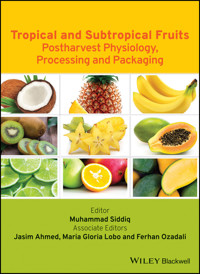
Tropical and Subtropical Fruits E-Book
230,99 €
Mehr erfahren.
- Herausgeber: John Wiley & Sons
- Kategorie: Fachliteratur
- Sprache: Englisch
Tropical and sub-tropical fruits have gained significant importance in global commerce. This book examines recent developments in the area of fruit technology including: postharvest physiology and storage; novel processing technologies applied to fruits; and in-depth coverage on processing, packaging, and nutritional quality of tropical and sub-tropical fruits. This contemporary handbook uniquely presents current knowledge and practices in the value chain of tropical and subtropical fruits world-wide, covering production and post-harvest practices, innovative processing technologies, packaging, and quality management.
Chapters are devoted to each major and minor tropical fruit (mango, pineapple, banana, papaya, date, guava, passion fruit, lychee, coconut, logan, carombola) and each citrus and non-citrus sub-tropical fruit (orange, grapefruit, lemon/lime, mandarin/tangerine, melons, avocado, kiwifruit, pomegranate, olive, fig, cherimoya, jackfruit, mangosteen). Topical coverage for each fruit is extensive, including: current storage and shipping practices; shelf life extension and quality; microbial issues and food safety aspects of fresh-cut products; processing operations such as grading, cleaning, size-reduction, blanching, filling, canning, freezing, and drying; and effects of processing on nutrients and bioavailability. With chapters compiled from experts worldwide, this book is an essential reference for all professionals in the fruit industry.
Sie lesen das E-Book in den Legimi-Apps auf:
Seitenzahl: 1791
Veröffentlichungsjahr: 2012
Ähnliche




















Contents
Cover
Title Page
Copyright
Contributors
Preface
Part I: Overview, Innovative Technologies and Quality Management
Chapter 1: Introduction and Overview
INTRODUCTION
TRENDS IN PRODUCTION AND MARKETING
TRENDS IN CONSUMPTION
CURRENT POSTHARVEST TECHNOLOGY, RESEARCH AND DEVELOPMENT TRENDS
FOOD SAFETY AND SECURITY (DEFENSE)
POTENTIAL OF BIOTECHNOLOGY TO IMPROVE QUALITY AND POSTHARVEST SHELF LIFE OF FRUITS
POSTHARVEST LOSSES
CONCLUDING REMARKS
Chapter 2: Postharvest Physiology and Storage
INTRODUCTION
PREHARVEST FACTORS AFFECTING FRUIT QUALITY
HARVESTING INDICES
POSTHARVEST PHYSIOLOGY
POSTHARVEST HANDLING
PHYSIOLOGICAL DISORDERS
POSTHARVEST STORAGE
Chapter 3: Enzymes in Quality and Processing of Tropical and Subtropical Fruits
INTRODUCTION
POLYPHENOL OXIDASE (PPO)
POLYGALACTURONASE (PG)
PECTIN METHYLESTERASE (PME)
LIPOXYGENASE (LOX)
PEROXIDASE (POD)
CELLULASE
CONCLUSION
Chapter 4: Phytochemicals and Bioactive Compounds in Tropical and Subtropical Fruits
INTRODUCTION
PHENOLIC COMPOUNDS
HEALTH FUNCTIONALITY OF PHYTOCHEMICALS/BIOACTIVE COMPOUNDS
SUMMARY
Chapter 5: Novel Processing Technologies for Fruits
INTRODUCTION
HIGH-PRESSURE PROCESSING (HPP)
PULSED ELECTRIC FIELD PROCESSING
OHMIC HEATING
MICROWAVE HEATING
RADIO FREQUENCY HEATING
OTHER NOVEL TECHNOLOGIES FOR FRUIT PROCESSING
CONCLUSION
Chapter 6: Quality Management, ISO 22000:2005 and HACCP in Fruit Processing and Packaging
INTRODUCTION
HACCP APPLICATION IN TROPICAL FRUITS PROCESSING
CONCLUSION
Chapter 7: Current and Innovative Packaging Technologies for Tropical and Subtropical Fruits
INTRODUCTION
ROLE OF PACKAGING IN FRESH AND PROCESSED TROPICAL AND SUBTROPICAL FRUITS
CURRENT AND INNOVATIVE PACKAGING TECHNOLOGIES
PACKAGING FOR INNOVATIVELY PROCESSED TROPICAL AND SUBTROPICAL FRUITS
SUMMARY AND FUTURE RESEARCH NEEDS
Part II: Tropical Fruits
Chapter 8: Banana
INTRODUCTION
WORLD PRODUCTION AND TRADE
CONSUMPTION TRENDS
PRODUCTION, VARIETIES, AND HARVESTING
POSTHARVEST PHYSIOLOGY AND STORAGE TECHNOLOGIES
FRESH-CUT OR MINIMALLY PROCESSED BANANA
PROCESSING AND PROCESSED PRODUCTS
NUTRITIONAL PROFILE
HEALTH-BENEFICIAL COMPOUNDS
INNOVATIVE PROCESSING TECHNOLOGIES
SUMMARY
Chapter 9: Coconut
INTRODUCTION
CULTIVATION OF COCONUT
VARIETIES AND HYBRID CROSSES
HARVESTING AND POSTHARVEST STORAGE
COCONUT KERNEL PROCESSING AND FINISHED PRODUCTS
COCONUT NUTRITION
CONCLUSION
Chapter 10: Dates
INTRODUCTION
MATURITY STAGES
DATE HARVESTING
COMPOSITION
DATE CONSUMPTION TRENDS
POSTHARVEST PHYSIOLOGY
POSTHARVEST TREATMENTS
STORAGE OF DATES
POSTHARVEST QUALITY
CONTAMINANTS IN DATES
MICROBIAL CONTAMINATION AND SPOILAGE OF DATES
DATE PACKAGING
PROCESSING AND PROCESSED PRODUCTS
MANAGING QUALITY IN DATE PROCESSING
BY-PRODUCT UTILIZATION (DATE PITS)
INNOVATIVE PROCESSING OF DATES
NUTRITIONAL PROFILE AND HEALTH BENEFITS OF DATES
ACKNOWLEDGEMENT
Chapter 11: Guava
INTRODUCTION
POSTHARVEST PHYSIOLOGY AND STORAGE TECHNOLOGIES
MINIMALLY PROCESSED OR FRESH-CUT PRODUCTS
PROCESSING AND PROCESSED PRODUCTS
NUTRITIONAL PROFILE AND HEALTH BENEFITS
Chapter 12: Longan and Carambola
INTRODUCTION
VARIETIES, PRODUCTION, AND HARVESTING
CONSUMPTION TRENDS, SIGNIFICANCE IN HUMAN HEALTH
POSTHARVEST PHYSIOLOGY AND STORAGE TECHNOLOGIES
MINIMALLY OR FRESH-CUT PRODUCTS
PROCESSING AND PROCESSED PRODUCTS
NUTRITIONAL PROFILE AND HEALTH BENEFITS
INTRODUCTION
ORIGIN AND MAJOR PRODUCTION AREAS/COUNTRIES
VARIETIES, PRODUCTION, AND HARVESTING
CONSUMPTION TRENDS, SIGNIFICANCE IN HUMAN HEALTH
POSTHARVEST PHYSIOLOGY AND STORAGE TECHNOLOGIES
MINIMALLY OR FRESH-CUT PRODUCTS
PROCESSING AND PROCESSED PRODUCTS
NUTRITIONAL PROFILE AND HEALTH BENEFITS
SUMMARY
Chapter 13: Lychee (Litchi)
INTRODUCTION
POSTHARVEST PHYSIOLOGY
POSTHARVEST TREATMENTS AND STORAGE TECHNOLOGIES
MINIMALLY OR FRESH-CUT PRODUCTS
PROCESSING AND PROCESSED PRODUCTS
NUTRITIONAL PROFILE AND HEALTH BENEFITS
INNOVATIVE PROCESSING TECHNOLOGIES
SUMMARY
ACKNOWLEDGMENTS
Chapter 14: Mango Production, Postharvest Physiology and Storage
INTRODUCTION
MANGO VARIETIES, MATURITY INDICES, AND HARVESTING
POSTHARVEST PHYSIOLOGY
SHELF LIFE EXTENSION AND QUALITY
STORAGE TECHNOLOGIES
Chapter 15: Mango Processing, Products and Nutrition
INTRODUCTION
MINIMALLY PROCESSED OR FRESH-CUT PRODUCTS
MANGO PROCESSING AND PRODUCTS
NUTRITIONAL PROFILE AND HEALTH BENEFITS
SUMMARY
Chapter 16: Papaya
INTRODUCTION
WORLD DISTRIBUTION AND PRODUCTION
SIGNIFICANCE IN HUMAN HEALTH AND CONSUMPTION TRENDS
TAXONOMY AND MORPHOLOGY
MAJOR CULTIVARS
HARVESTING, POSTHARVEST HANDLING, AND STORAGE
FRESH-CUT PROCESSING
PAPAYA PROCESSING
NUTRITIONAL PROFILE AND HEALTH BENEFITS
ACKNOWLEDGMENTS
Chapter 17: Passion Fruit
INTRODUCTION
FRUIT AND PLANT CHARACTERISTICS
HARVESTING
POSTHARVEST PHYSIOLOGY AND HANDLING
CHEMICAL COMPOSITION AND HEALTH BENEFITS
PROCESSING AND PROCESSED PRODUCTS
APPLICATION OF EMERGING TECHNOLOGIES
WASTE UTILIZATION
Chapter 18: Pineapple
INTRODUCTION
WORLD DISTRIBUTION AND PRODUCTION
SIGNIFICANCE IN HUMAN HEALTH AND CONSUMPTION TRENDS
MAIN CULTIVARS
MORPHOLOGY
HARVESTING, POSTHARVEST HANDLING, AND STORAGE
POSTHARVEST LOSSES: CAUSES AND REMEDIES
FRESH-CUT PINEAPPLE
PROCESSING AND PROCESSED PRODUCTS
FOOD SAFETY OF FRESH-CUT AND PROCESSED PRODUCTS
NUTRITIONAL PROFILE AND HEALTH BENEFITS
ACKNOWLEDGMENTS
Part III: Subtropical Fruits—Citrus Group
Chapter 19: Grapefruit
INTRODUCTION
PRODUCTION, VARIETIES, AND HARVESTING
CONSUMPTION TREND, SIGNIFICANCE TO HUMAN HEALTH
POSTHARVEST PHYSIOLOGY AND STORAGE TECHNOLOGIES
FRESH-CUT AND MINIMALLY PROCESSED PRODUCTS
PROCESSING AND PROCESSED PRODUCTS
NUTRITIONAL PROFILE AND HEALTH BENEFITS
Chapter 20: Lemon and Lime
INTRODUCTION
LEMON AND LIME FRUIT STRUCTURE
PRODUCTION, VARIETIES, AND HARVESTING
CONSUMPTION TRENDS: CULINARY USES
POSTHARVEST PHYSIOLOGY AND STORAGE TECHNOLOGIES
MARKET QUALITY AND SHELF LIFE EXTENSION
MINIMALLY PROCESSED AND FRESH-CUT PRODUCTS
PROCESSING AND PROCESSED PRODUCTS
NUTRITIONAL PROFILE AND HEALTH BENEFITS
Chapter 21: Oranges
INTRODUCTION
HARVEST, POSTHARVEST PHYSIOLOGY, PACKINGHOUSE OPERATIONS, AND STORAGE TECHNOLOGIES
MICROBIOLOGY OF FRESH AND PROCESSED ORANGES
ORANGE COMPONENTS, FLAVOR CHEMISTRY, AND TECHNOLOGY
QUALITY STANDARDS
PROCESSING AND PROCESSED PRODUCTS
QUALITY ASSURANCE METHODS OF ANALYSIS
ORANGE BY-PRODUCTS
NUTRITIONAL PROFILE AND HEALTH BENEFITS
SUMMARY
Chapter 22: Tangerine, Mandarin and Clementine
INTRODUCTION
WORLD PRODUCTION
PRODUCTION PRACTICES, PREHARVEST MANAGEMENT, AND HARVEST
POSTHARVEST PHYSIOLOGY, TREATMENTS, AND STORAGE
POSTHARVEST LOSSES AND REMEDIAL TREATMENTS
PROCESSING AND PROCESSED PRODUCTS
NUTRITIONAL PROFILE, BIOACTIVE COMPOUNDS, AND HEALTH BENEFITS
SUMMARY
Part IV: Subtropical Fruits—Noncitrus Group
Chapter 23: Avocado
INTRODUCTION
WORLD PRODUCTION AND TRADE
PRODUCTION, VARIETIES, AND HARVESTING
CONSUMPTION TRENDS AND HEALTH SIGNIFICANCE
POSTHARVEST PHYSIOLOGY AND STORAGE
MINIMALLY PROCESSED OR FRESH-CUT PRODUCTS
PROCESSING AND PROCESSED PRODUCTS
NUTRITIONAL PROFILE
INNOVATIVE PROCESSING TECHNOLOGIES
SUMMARY
ACKNOWLEDGMENTS
Chapter 24: Figs
INTRODUCTION
WORLD PRODUCTION AND TRADE
PRODUCTION, CULTIVARS, AND HARVEST
POSTHARVEST PHYSIOLOGY AND STORAGE
FIG PROCESSING AND PROCESSED PRODUCTS
NUTRITIONAL PROFILE
SUMMARY
Chapter 25: Kiwifruit
INTRODUCTION
WORLD PRODUCTION AND TRADE
CONSUMPTION TRENDS AND SIGNIFICANCE
PRODUCTION, VARIETIES, AND HARVESTING
POSTHARVEST PHYSIOLOGY AND STORAGE TECHNOLOGIES
MINIMALLY OR FRESH-CUT PRODUCTS
PROCESSING AND PROCESSED PRODUCTS
INDIGENOUS PROCESSED PRODUCTS AND BY-PRODUCT UTILIZATION
NUTRITIONAL PROFILE AND HEALTH BENEFITS
SUMMARY
Chapter 26: Olives and Olive Oil
INTRODUCTION
WORLD PRODUCTION AND TRADE
TABLE OLIVES
OLIVE OIL
Chapter 27: Pomegranate
INTRODUCTION
PRODUCTION, VARIETIES, AND HARVEST
POSTHARVEST PHYSIOLOGY AND STORAGE TECHNOLOGIES
MINIMALLY PROCESSED POMEGRANATE ARILS
PROCESSING AND PROCESSED PRODUCTS
NUTRITIONAL PROFILE AND HEALTH BENEFITS
SUMMARY
Chapter 28: Watermelon, Cantaloupe and Honeydew
WATERMELON
CANTALOUPE
HONEYDEW
SUMMARY
Part V: Lesser Known Tropical and Subtropical Fruits
Chapter 29: Acerola, Cashew Apple, Cherimoya and Pitanga
INTRODUCTION
ACEROLA
CASHEW APPLE
CHERIMOYA
PITANGA
SUMMARY
Chapter 30: Dragon Fruit and Durian
INTRODUCTION
DRAGON FRUIT
DURIAN
Chapter 31: Jujube and Loquat
INTRODUCTION
JUJUBE
LOQUAT
Index
This edition first published 2012 © 2012 by John Wiley & Sons, Inc.
Wiley-Blackwell is an imprint of John Wiley & Sons, formed by the merger of Wiley's global Scientific, Technical and Medical business with Blackwell Publishing.
Editorial offices: 2121 State Avenue, Ames, Iowa 50014-8300, USA The Atrium, Southern Gate, Chichester, West Sussex, PO19 8SQ, UK 9600 Garsington Road, Oxford, OX4 2DQ, UK
For details of our global editorial offices, for customer services and for information about how to apply for permission to reuse the copyright material in this book please see our website at www.wiley.com/wiley-blackwell.
Authorization to photocopy items for internal or personal use, or the internal or personal use of specific clients, is granted by Blackwell Publishing, provided that the base fee is paid directly to the Copyright Clearance Center, 222 Rosewood Drive, Danvers, MA 01923. For those organizations that have been granted a photocopy license by CCC, a separate system of payments has been arranged. The fee codes for users of the Transactional Reporting Service are ISBN-13: 978-0-8138-1142-0/2012.
Designations used by companies to distinguish their products are often claimed as trademarks. All brand names and product names used in this book are trade names, service marks, trademarks or registered trademarks of their respective owners. The publisher is not associated with any product or vendor mentioned in this book. This publication is designed to provide accurate and authoritative information in regard to the subject matter covered. It is sold on the understanding that the publisher is not engaged in rendering professional services. If professional advice or other expert assistance is required, the services of a competent professional should be sought.
Library of Congress Cataloging-in-Publication Data
Tropical and subtropical fruits : postharvest physiology, processing and packaging / editor, Muhammad Siddiq ; associate editors, Jasmim Ahmed, Maria Gloria Lobo, Ferhan Ozdali. p. cm. Includes bibliographical references and index. ISBN 978-0-8138-1142-0 (hardcover : alk. paper) 1. Tropical fruit–Processing. I. Siddiq, Muhammad, 1957– TP440.T76 2012 664′.8046–dc23 2011048258
A catalogue record for this book is available from the British Library.
Wiley also publishes its books in a variety of electronic formats. Some content that appears in print may not be available in electronic books.
Contributors
Preface
Tropical and subtropical fruits have gained significant importance in global commerce in recent years, as evidenced by significant growth in their production and consumption since the mid-1990s. Two factors have contributed to this continued growth: (1) increased consumption of fruits and vegetables to promote good health and well-being and (2) the growing popularity of tropical and subtropical fruits among North American and European consumers, which has resulted in increased trade. Tropical and subtropical fruits are a good source of a number of vitamins, minerals, and other natural substances, for example, bioactive phytochemicals, making their demand grow further.
This book is a contemporary collective work that brings together current knowledge and practices in the value chain of tropical and subtropical fruits from “farm-to-fork.” This value chain approach to the topic’s coverage is the unique feature of this book. An experienced team of more than 60 contributors from North America, South America, Asia, Africa, and Europe has written 31 chapters, divided into five parts. The contributors come from diverse disciplines, including horticulture, postharvest physiology, food science and technology, food biochemistry, food engineering, and packaging technology.
Part I of the book has seven chapters, covering an introduction and overview, postharvest physiology and storage technologies, role of enzymes in fruit quality and processing, phytochemicals, packaging technologies, innovative and novel fruit processing technologies, and quality management of tropical and subtropical fruits. Part II has 11 chapters on tropical fruits (banana, coconut, dates, guava, longan and carambola, lychee, mango, papaya, passion fruit, and pineapple). Part III has four chapters on citrus-group subtropical fruits (grapefruit, lemon and lime, orange, tangerine, mandarin, and clementine), and Part IV covers six chapters on noncitrus subtropical fruits (avocado, figs, kiwifruit, olives and olive oil, pomegranate, watermelon, cantaloupe, and honeydew). The last part, Part V, has three chapters on eight lesser known tropical and subtropical fruits (acerola, cashew apple, cherymoya and pitanga, dragon fruit and durian, and jujube and loquat). Each of these 31 chapters provides an in-depth review of topics covering history, production, consumption trends, varieties and field practices, harvesting and postharvest physiology/storage, commercial processing, application of novel processing techniques, composition and nutritional profiles of raw and processed fruit products, and potential health benefits.
Currently there are a very limited number of books on the tropical and subtropical fruits, with none taking a multidisciplinary approach to covering the topics, as we have attempted in this work. This book is intended as a contemporary source book on tropical and subtropical fruits’ postharvest physiology, processing, and packaging for industry, academia, government agencies, libraries, research institutes, laboratories, and other interested professionals.
The editorial team acknowledges many individuals for their support from conception through final development of this book. Foremost is our sincere thanks and gratitude to all authors for their contributions and for bearing with us during the review and finalization process of their chapters. We are grateful to our family members for their understanding and support, enabling us to complete this work.
Muhammad Siddiq
Jasim Ahmed
Maria Gloria Lobo
Ferhan Ozadali
Part I
Overview, Innovative Technologies and Quality Management




