


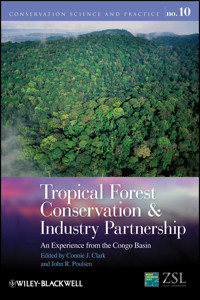
Tropical Forest Conservation and Industry Partnership E-Book
107,99 €
Mehr erfahren.
- Herausgeber: John Wiley & Sons
- Kategorie: Wissenschaft und neue Technologien
- Serie: Conservation Science and Practice
- Sprache: Englisch
Historically, the conservation of forests and wildlife has focused on the creation of national parks and reserves. However, only 9% of protected areas are larger than 14,000 hectares, likely making them too small to conserve ecosystem services and prevent loss of wide-ranging keystone species such as elephant and leopard. New approaches are needed that extend conservation beyond protected area boundaries into areas where economic considerations prevail. The book describes one such emerging model of conservation: the integration of the private sector into partnerships to protect biodiversity and improve forest management. While such partnerships are being created in nearly every sector of resource extraction, detailed analyses of how such partnerships work and whether they benefit biodiversity conservation are rare. Using a case study from the Congo Basin, the book examines principles of conservation and partnership, and provides technical and methodological details to replicate an innovative conservation model. It presents concrete solutions for expanding conservation across multi-use landscapes, a necessary action as industry expands to all the corners of the globe.
Sie lesen das E-Book in den Legimi-Apps auf:
Seitenzahl: 378
Veröffentlichungsjahr: 2012
Ähnliche




















Table of Contents
Conservation Science and Practice Series
Title Page
Copyright
Contributors
Foreword
Preface
List of Acronyms
Chapter 1: Introduction
Chapter 2: Building Partnerships for Conservation
Chapter 3: Land-use Planning in a Co-management Context: Establishing Access Regulations that Promote Biodiversity Conservation and Support Local Livelihoods
Chapter 4: Reducing Pressure on Wildlife and Biodiversity
Chapter 5: Assessing the Impact of Logging on Biodiversity in the CIB Concessions
Chapter 6: Impact of Industrial Logging on Human Demography and Patterns of Wildlife Harvest and Consumption
Chapter 7: Conclusions and Lessons Learned
References
Index
Conservation Science and Practice Series
Published in association with the Zoological Society of London
Wiley-Blackwell and the Zoological Society of London are proud to present our Conservation Science and Practice series. Each book in the series reviews a key issue in conservation today. We are particularly keen to publish books that address the multidisciplinary aspects of conservation, looking at how biological scientists and ecologists are interacting with social scientists to effect long-term, sustainable conservation measures.
Books in the series can be single or multi-authored and proposals should be sent to:
Ward Cooper, Senior Commissioning Editor, Wiley-Blackwell, John Wiley & Sons,
9600 Garsington Road, Oxford OX4 2DQ, UK
Email: [email protected]
Each book proposal will be assessed by independent academic referees, as well as our Series Editorial Panel. Members of the Panel include:
Richard Cowling, Nelson Mandela Metropolitan University, Port Elizabeth, South Africa
John Gittleman, Institute of Ecology, University of Georgia, USA
Andrew Knight, University of Stellenbosch, South Africa
Georgina Mace, Imperial College London, Silwood Park, UK
Daniel Pauly, University of British Columbia, Canada
Stuart Pimm, Duke University, USA
Hugh Possingham, University of Queensland, Australia
Peter Raven, Missouri Botanical Gardens, USA
Helen Regan, University of California, Riverside, USA
Alex Rogers, Institute of Zoology, London, UK
Michael Samways, University of Stellenbosch, South Africa
Nigel Stork, University of Melbourne, Australia
Previously published
Trade-offs in Conservation: Deciding What to Save
Edited by Nigel Leader-Williams, William M. Adams and Robert J. Smith
ISBN: 978-1-4051-9383-2 Paperback; ISBN: 978-1-4051-9384-9 Hardcover; 398 pages; September 2010
Urban Biodiversity and Design
Edited by Norbert Müller, Peter Werner and John G. Kelcey
ISBN: 978-1-4443-3267-4 Paperback; ISBN
978-1-4443-3266-7 Hardcover; 640 pages; April 2010
Wild Rangelands: Conserving Wildlife While Maintaining Livestock in Semi-Arid Ecosystems
Edited by Johan T. du Toit, Richard Kock and James C. Deutsch
ISBN: 978-1-4051-7785-6 Paperback; ISBN 978-1-4051-9488-4 Hardcover; 424 pages; January 2010
Reintroduction of Top-Order Predators
Edited by Matt W. Hayward and Michael J. Somers
ISBN: 978-1-4051-7680-4 Paperback;
ISBN: 978-1-4051-9273-6 Hardcover; 480 pages; April 2009
Recreational Hunting, Conservation and Rural Livelihoods: Science and Practice
Edited by Barney Dickson, Jonathan Hutton and Bill Adams
ISBN: 978-1-4051-6785-7 Paperback; ISBN: 978-1-4051-9142-5 Hardcover; 384 pages; March 2009
Participatory Research in Conservation and Rural Livelihoods: Doing Science Together
Edited by Louise Fortmann
ISBN: 978-1-4051-7679-8 Paperback; 316 pages; October 2008
Bushmeat and Livelihoods: Wildlife Management and Poverty Reduction
Edited by Glyn Davies and David Brown
ISBN: 978-1-4051-6779-6 Paperback; 288 pages; December 2007
Managing and Designing Landscapes for Conservation: Moving from Perspectives to Principles
Edited by David Lindenmayer and Richard Hobbs
ISBN: 978-1-4051-5914-2 Paperback; 608 pages; December 2007
Reintroduction Biology: Integrating Science and Management
Tropical Forest Conservation and Industry Partnership: An Experience from the Congo Basin
This edition first published 2012 © 2012 by Wildlife Conservation Society
Wiley-Blackwell is an imprint of John Wiley & Sons, formed by the merger of Wiley's global Scientific, Technical and Medical business with Blackwell Publishing.
Registered office: John Wiley & Sons, Ltd, The Atrium, Southern Gate, Chichester, West Sussex, PO19 8SQ, UK
Editorial offices: 9600 Garsington Road, Oxford, OX4 2DQ, UK
The Atrium, Southern Gate, Chichester, West Sussex, PO19 8SQ, UK
111 River Street, Hoboken, NJ 07030-5774, USA
For details of our global editorial offices, for customer services and for information about how to apply for permission to reuse the copyright material in this book please see our website at www.wiley.com/wiley-blackwell.
The right of the author to be identified as the author of this work has been asserted in accordance with the UK Copyright, Designs and Patents Act 1988.
All rights reserved. No part of this publication may be reproduced, stored in a retrieval system, or transmitted, in any form or by any means, electronic, mechanical, photocopying, recording or otherwise, except as permitted by the UK Copyright, Designs and Patents Act 1988, without the prior permission of the publisher.
Designations used by companies to distinguish their products are often claimed as trademarks. All brand names and product names used in this book are trade names, service marks, trademarks or registered trademarks of their respective owners. The publisher is not associated with any product or vendor mentioned in this book. This publication is designed to provide accurate and authoritative information in regard to the subject matter covered. It is sold on the understanding that the publisher is not engaged in rendering professional services. If professional advice or other expert assistance is required, the services of a competent professional should be sought.
Library of Congress Cataloging-in-Publication Data
Tropical forest conservation and industry partnership: an experience from the Congo Basin / edited by Connie J. Clark and John R. Poulsen.
p. cm.
Includes bibliographical references and index.
ISBN 978-0-470-67373-7 (cloth)
1. Rain forests–Congo (Brazzaville)–Parc national de Nouabalé-Ndoki–Management. 2. Buffer zones (Ecosystem management)–Congo (Brazzaville)–Parc national de Nouabalé-Ndoki. 3. Wildlife conservation–Congo (Brazzaville)–Parc national de Nouabalé-Ndoki. 4. Logging–Environmental aspects–Congo (Brazzaville)–Parc national de Nouabalé-Ndoki. I. Clark, Connie J. II. Poulsen, John R.
SD414.C74T76 2012
577.34096724–dc23
2011037508
Contributors
Thomas Breuer, WCS Congo Program, Wildlife Conservation Society, B.P. 14537, Brazzaville, Republic of Congo.Terry Brncic, Long-term Ecology Laboratory, Oxford University Centre for the Environment, South Parks Road, Oxford, OX1 3QY, UK.Connie J. Clark, Nicholas School of the Environment, Duke University, P.O. Box 90328, Durham, NC, USA.Jean-Claude Dengui, Direction de la Faune et des Aires Protégées, B.P. 98, Brazzaville, Republique du Congo.Mitchell J. Eaton, NY Cooperative Fish and Wildlife Research Unit, US Geological Survey, Department of Natural Resources, Cornell University, B02 Bruckner Hall, Ithaca, NY 14853, USA.Paul W. Elkan, WCS Africa Program, International Programs, Wildlife Conservation Society, 2300 Southern Boulevard, Bronx, NY 10460-1099, USA.Sarah Elkan, WCS Africa Program, International Programs, Wildlife Conservation Society, 2300 Southern Boulevard, Bronx, NY 10460-1099, USA.Heather E. Eves, 5607 7th Street South, Arlington, VA 22204, USA.David J. Harris, Royal Botanic Garden Edinburgh, 20A Inverleith Row, Edinburgh, Scotland, EH3 5LR, UK.Jean Ibara, Ministry of Sustainable Development, Forest Economy and the Environment, Brazzaville, Republic of Congo.Pierre Kama, Direction de la Faune et des Aires Protégées, B.P. 98, Brazzaville, Republic of Congo.Kibino Kimbembe, Wildlife Conservation Society, B.P. 14537, Brazzaville, Republic of Congo.Richard Malonga, Wildlife Conservation Society, B.P. 14537, Brazzaville, Republic of Congo.Germain A. Mavah, School of Natural Resources and Environment, 3014 Turlington Hall, P.O. Box 117315, University of Florida, Gainesville, FL 32611-7315, USA, and WCS Congo Program, Wildlife Conservation Society, BP 14537, Brazzaville, Republic of Congo.Olivier Mbani, Wildlife Conservation Society, B.P. 14537 Brazzaville, Republic of Congo.Miranda Mockrin, Department of Ecology, Evolution, and Environmental Biology, 1200 Amsterdam Avenue, Columbia University, New York, NY 10027, USA, and Rocky Mountain Research Station, USDA Forest Service, 2150 Centre Ave Bldg A, Fort Collins, CO 80521, USA.Jerome Mokoko-Ikonga, WCS Congo Program, Wildlife Conservation Society, B.P. 14537, Brazzaville, Republic of Congo.David B. Morgan, Lincoln Park Zoo, Lester E. Fisher Center for the Study and Conservation of Apes, Department of Anthropology, Washington University, One Brookings Drive, Campus Box 1114, Saint Louis, MO 63130, and WCS Congo Program, Wildlife Conservation Society, B.P. 14537, Brazzaville, Republic of Congo.Antoine Moukassa, Wildlife Conservation Society, BP 14537, Brazzaville, Republic of Congo.Marcel Ngangoué, Société Likouala Timber, B.P. 14, Bétou, Republic of Congo.Dominique Nsosso, Direction de la Faune et des Aires Protes, B.P. 98, Brazzaville, Republic of Congo.Jean Robert Onononag, Goualougo Triangle Ape Project, Wildlife Conservation Society, B.P. 14537, Brazzaville, Republic of Congo.Jean-Michel Pierre, 7, Rue des Genêts, 66680 Canohès. France.John R. Poulsen, Nicholas School of the Environment, Duke University, P.O. Box 90328, Durham, NC, USA.Scott Poynton, The Forest Trust, 4 Chemin des Brumes, 1263 Crassier, Switzerland.Michael Riddell, School of Geography and the Environment, Oxford University Centre for the Environment (Dyson Perrins Bldg.), University of Oxford, South Parks Road, Oxford, OX1 3QY, UK.Richard G. Ruggiero, US Fish & Wildlife Service, Division of International Conservation, 4401 N. Fairfax Drive Room 100, Arlington, VA 22203-1622, USA.Crickette M. Sanz, Department of Anthropology, Washington University, One Brookings Drive, Campus Box 1114, Saint Louis, MO 63130, and WCS Congo Program, Wildlife Conservation Society, B.P. 14537, Brazzaville, Republic of Congo.Emma J. Stokes, Wildlife Conservation Society, Global Conservation Program, 2300 Southern Boulevard, Bronx, NY 10460-1099, USA.Samantha Strindberg, Global Conservation Program, Wildlife Conservation Society, 2300 Southern Boulevard, Bronx, NY 10460-1099.Hannah L. Thomas, Wildlife Conservation Society Congo Program, 2300 Southern Boulevard, Bronx, NY 10460-1099.Lucas Van der Walt, Olam International Limited, 9 Temasek Blvd., #25-01 Suntec Tower Two, Singapore 038989.David S. Wilkie, Global Conservation Program, Wildlife Conservation Society, 2300 Southern Boulevard, Bronx, NY 10460-1099.Foreword
The conservation argument for working in managed landscapes has long been promulgated, and is compelling. In its broadest interpretation conservation is about maintaining the ecological systems that support life on earth, and that requires working across large-scale landscapes. That means seeking for conservation outcomes across the range of different land uses: where nature is protected, where natural resources are being harvested and extracted, where agriculture is the primary human activity and where human impacts are the most intense. That also means working with the full range of institutions, from local government to civil society organizations to multinational corporations.
In a narrower interpretation, conservation is about stewarding biodiversity, from wild species to natural communities. If conservation is to achieve even this narrower goal, it cannot restrict its aspiration to parks and protected areas. Parks and reserves in isolation are too small to protect many species, and ecosystems function at a scale much larger than even the largest protected areas.
Despite the broad consensus that conservationists need to work outside of protected areas and in the broader landscape, few conservationists have however picked up the gauntlet. Fewer still have engaged where it has meant working with extractive industries. This has been a challenge on forested lands in particular, and the typical relationship between conservationists and forestry companies has been one of antagonism. Less than 8% of the world's forests are in protected areas however; if large extents of forests are to be well managed and not converted into other land uses, then conservation organizations need to work with companies on lands that are being logged.
This book explores the successful collaboration between the Wildlife Conservation Society (WCS), an international conservation organization, and the Congolaise Industrielle des Bois (CIB), a European timber company which has been operating timber concessions in the north of the Republic of Congo (Brazzaville) since 1969. The collaboration did not begin especially auspiciously. In the early 1990s, WCS had a management presence in the Nouabalé Ndoki National Park. Surveys in 1989 had identified a forest block of unparalleled biological importance and, in 1993, the Government of Congo had established the park. Immediately to the south and west of the park, CIB had rapidly expanding forestry operations in three timber concessions: Kabo, Pokola and Loundougou. Associated with the forestry operations, the area had experienced dramatic in-migration. In the 1960s, when CIB inherited the small-scale forestry operations of the Société Forestiere du Sangha, the town of Pokola had a population of under 300. By the 1990s, the population had grown to over 11,000 and CIB was employing 1500 workers. Most of the animal protein consumed by the people came from the surrounding forest and there was an active commercial bushmeat trade, with meat being carried on logging trucks leaving the concessions. Hunting, emanating from the towns of Pokola and Kabo and from logging camps, was imperiling the wildlife across the whole landscape and increasingly threatening the park itself.
Difficult negotiations (led by Mike Fay on the WCS side and CIB president Heinrich Stoll) led to a consensus between WCS and CIB in 1995, and the signing of a Protocole d'Accord between CIB and leaders of local communities living in the concession areas. That protocol discouraged commercial hunting and established internal regulations prohibiting the transport of bushmeat on logging trucks. Putting operational teeth behind this general agreement was the job of Paul Elkan of WCS and, in 1999, the program was officially launched by WCS, CIB and the Ministry of Forestry. Paul would become the first director of a program that focused on managing and localizing subsistence hunting, controlling the commercial bushmeat trade and providing alternative sources of animal protein. A brigade of eco-guards was recruited under the authority of the Ministry to provide enforcement and WCS assisted with management, fundraising and a program of ecological and law-enforcement monitoring. John Poulsen and Connie Clark, the editors of this volume, began working in the Nouabalé-Ndoki landscape in 2000 and would succeed Paul as WCS program directors in 2005, building on the original foundations.
The collaboration between the conservation organization, the timber company and the government was identified as a test case for conservation in a tropical production forest. The project received early support from the Global Environment Facility (GEF) through the World Bank, USAID's Central African Program for the Environment (CARPE) and the International Timber Trade Organization (ITTO). The project was also viewed with intense suspicion by many conservation and social justice advocates, however. CIB was accused of hiding behind ‘green’ window-dressing and continuing operations as usual. WCS was accused of being a ‘volunteer cheerleader for a billion-dollar industry of exploitation’. The conservation organization was charged with ‘selling out’ to the exploitative corporation, which itself was only interested in its own profits. Critics expressed concerns that forestry operations would open up the forest, allowing hunting and threatening the livelihoods of forest-dwelling people. Over the years the transaction costs of responding constructively to critics, incurred by all the collaborators, have been significant.
Fifteen years after the initiation of the project, the conservation outcomes are evident although the negative social and environmental consequences of forestry operations in tropical forests need to be recognized. The Nouabalé-Ndoki National Park has been buffered and remains one of the great wildlife refuges in Central Africa. (CIB has sequestered parts of their concessions as strict nature reserves with no logging including, in 2001, the area adjacent to the park known as the ‘Goualougo Triangle’.) Within the CIB concessions, overall hunting pressure has been reduced and the commercial bushmeat trade is more controlled. Gorilla, chimpanzee and buffalo are common through the concession, in densities rivaling the park, and elephants still traverse the concession. Additionally, the CIB concessions have continued to strengthen their environmental and social responsiveness. CIB has drawn up an integrated forest management plan and continues to address social issues of forest-dwelling peoples. CIB has worked with Greenpeace and the Tropical Forest Trust, and has responded to recommendations of SGS Qualifor and Rainforest Alliance's Smartwood program to receive Forest Stewardship Council (FSC) certification for its concessions (the first in Africa).
Achieving this success has involved compromises. The collaboration has not been an easy one, as the interests of the partners are not identical and are often antithetical. The collaborators have had to step away from the ideal and engage pragmatically with what is possible. Nevertheless, from a conservation perspective, the net result has been very positive and conservation outcomes are at a scale that could not have been achieved by solely focusing on protected areas.
John G. Robinson
Chief Conservation Officer,
Wildlife Conservation Society
Preface
The idea for this book was conceived on the eve of the ten-year anniversary of a partnership between a government, an international conservation organization and a logging company. These unlikely partners were in the middle of realizing a remarkable achievement: a sustained collaboration to manage wildlife and conserve biodiversity in logging concessions surrounding one of the most pristine national parks in the world, the Nouabalé-Ndoki National Park in the Republic of Congo, Africa. After nearly a decade it had become clear that this new model of conservation, a partnership with the private sector, was making progress and showing discernible outcomes. No project is perfect, but promising results were emerging. The certification of the concessions created one of the largest tracts of tropical forest under management for sustainable timber production. Research showed that despite timber extraction the area still harbored remarkable densities of endangered apes and elephants and, despite challenges, the partners continued to persevere.
The goal of this book is to help to expand the conservation estate by promoting the replication of the partnership in other forests and with different partners. To do this, the book describes and analyzes the history, strategies, activities and management systems of the partnership and its creation, the Buffer Zone Project (BZP). In addition to discussing the principles of conservation and of partnership, and the lessons learned from nearly ten years of experience, the book provides the technical and methodological details to serve as a type of how-to manual. Of course, given the multi-disciplinary nature of biodiversity conservation and management, a real how-to manual would be encyclopedic in scope and encompass biology, economics, anthropology, administration and finance. We hope that this book provides a sufficiently detailed framework for initiating similar projects. The expansion of extractive industries into tropical forest is not limited to the logging sector. The issues addressed, examples given and lessons learned from this initiative cut across industries and are relevant to other extractive industries including mining, oil and agriculture.
The project owes its success to three institutions with the vision to create a partnership and the dedication to keep it going: the Government of Congo (specifically, the Ministry of Forestry Economy or MEF); the Congolaise Industrielle des Bois (CIB) logging company; and the Wildlife Conservation Society (WCS), an American non-governmental conservation organization.
The project received its funding from the governments of Switzerland, Japan, United States and France through the Global Environment Facility, along with the International Tropical Timber Organization, the United States Agency for International Development's Central African Regional Program for the Environment, United States Fish and Wildlife Service, United States Forest Service, Liz Claiborne Art Ortenberg Foundation, Fonds Français pour l'Environnement Mondial, Columbus Zoo, WCS and CIB.
Multiple people contributed to the project in the field. Notably, Paul Elkan and Sarah Elkan of WCS founded the BZP. With help from their colleagues from MEF and CIB, they built a project from scratch, putting into place the majority of the existing project systems and activities and building the project infrastructure. Paul served as the Project Director from 1998–2003 and then directed the WCS-Congo program as the General Director from 2003–2007. Sarah was the project manager and then the WCS-Congo Financial Director over the same period.
From the WCS side, Mike Fay, John Robinson, Richard Ruggiero, Amy Vedder and Bill Weber all played a role in the development of the partnership. Over the twelve years of the project (1998–2010), Philippe Auzel, Jim Beck, Connie Clark, Mark Dripchack, Antoine Moukassa, Richard Malonga, Germaine Mavah, Suzanne Mondoux, Colby Prevost, John Poulsen and Moise Zoniaba contributed to the management of the project. They were supported by the leadership of WCS-Congo, particularly Bryan Curran, Paul Elkan, Sarah Elkan, Jerome Mokoko-Ikonga and Paul Telfer.
From the CIB side, the management of the company, including Yves Dubois, Jaques Glannaz, Robert Hunink, Jean-Marie Mevellec and Heinrich Stoll supported the creation and maintenance of the initiative. Fred Glannaz, CIB Forest Management Planner, deserves particular credit for building the relationship between CIB, WCS and MEF and for working with WCS to develop the wildlife management principles at the beginning of the partnership. Later, several people from the forest management team had a hand in continuing the project operations and expanding the program, including Olivier Desmet, Dominique Paget, Jean-Michel Pierre and Lucas Van der Walt.
From the MEF side, Jean-Claude Dengui, Pierre Kama and Jean-Pierre Onday-Otsouma headed the project. Etienne Balenga, Delphin Essieni Elondza, Jean Eyana, Alphonse Ngangambé, Marcel Ngangoué and Pierre Ngouembé directed the law enforcement unit. Léon Embon served as the MEF envoy to the CIB forestry management unit. Many other MEF agents have served the project and the partnership in various technical capacities, and their contributions are greatly appreciated.
The Buffer Zone Project worked because of the dedication and labors of its Congolese staff. The list of employees is too long to name everyone, but the following people were among those who had a particularly strong impact on the project and its success: Cerylle Assobaum, Gervais Ikeba, Bienvenu Kimbembé, Jean Noel Langa-Langa, Calixte Makoumbou, Richard Malonga, Germain Mavah, Jean Claude Metsampito, Antoine Moukassa, Yves Nganga, Albert Niamazock, Nestor Nianga and Moise Zoniaba. We apologize to the numerous others that we have neglected to mention.
Finally, many local people and communities participated in and contributed to the project, and others have actively engaged in the management of their forest resources.
As ever in an enterprise such as this, a large number of people have contributed to bringing this book to fruition. We are grateful to those who have contributed to chapters through data, writings and boxes, and for their good humor throughout. We also thank those who took the time to review chapters: some of the authors themselves, as well as Olivier Desmet, Paul Elkan, Liz Forest, Suzanne Mondoux, Dominque Paget, Jack Putz, Paul Telfer, John Waugh and David Wilkie.
Finally, it is our hope that this book will highlight the challenge of biodiversity conservation in a rapidly changing world where the human appetite for resources is always in potential conflict with conservation. We proffer one practical solution for mitigating the impacts of natural resource extraction, to bring us a step closer to securing the future of tropical forests and all their diversity.
List of Acronyms
BACIPSBefore-after-paired-control impact series (BACIPS)BZPBuffer Zone ProjectCARPECentral Africa Regional Program for the Environment (USAID)CBDUnited Nations Convention on Biological DiversityCBFPCongo Basin Forest PartnershipCBMCommunity-based managementCFACentral African franc (Coopération financière en Afrique centrale)CMCollaborative managementCIBCongolaise Industrielle des BoisDLHDalhoff Larsen and Horneman groupFMUForest management unitFSCForest Stewardship CouncilGISGeographic information systemGPSGlobal positioning systemGOCGovernment of CongoINCEFInternational Conservation and Education FundITTOInternational Tropical Timber OrganizationIUCNInternational Union for Conservation of NatureLCAOFLiz Claireborne Art Ortenberg FoundationLEMLaw enforcement monitoringLTCRLac Télé Community ReserveMDDEFEMinistère de le Développement Durable, Economie Forestière, et de l'EnvironnementMEFMinistère de l'Economie ForestièreMOUMemorandum of understandingNGONon-governmental organizationNNNPNouabalé-Ndoki National ParkNPNational ParkNTFPNon-timber forest productPROGEPPProjet de la Gestion des Ecosystèmes Périphériques au ParcPSPCPrivate sector partnership for conservationPTAPrincipal technical advisorREDDReducing Emissions from Deforestation and forest DegradationRILReduced-impact loggingROCRepublic of CongoSNBSSociété Nouvelle des Bois de la SanghaSPTDSemi-permanent transect designSTNSangha Tri-national NetworkTFTThe Forest TrustUNFCCCUnited Nations Framework Convention on Climate ChangeUSAIDUnited States Agency for International DevelopmentUSLABUnité de Surveillance de Lutte Anti-BraconnageUSFWSUnited States Fish and Wildlife ServicesWCSWildlife Conservation SocietyChapter 1
Introduction
Connie J. Clark and John R. Poulsen
Nicholas School of the Environment, Duke University, Durham, NC
Lesen Sie weiter in der vollständigen Ausgabe!
Lesen Sie weiter in der vollständigen Ausgabe!
Lesen Sie weiter in der vollständigen Ausgabe!
Lesen Sie weiter in der vollständigen Ausgabe!
Lesen Sie weiter in der vollständigen Ausgabe!
Lesen Sie weiter in der vollständigen Ausgabe!
Lesen Sie weiter in der vollständigen Ausgabe!
Lesen Sie weiter in der vollständigen Ausgabe!




