


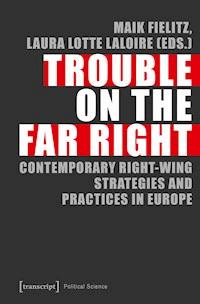
Trouble on the Far Right E-Book
17,99 €
Mehr erfahren.
- Herausgeber: transcript Verlag
- Kategorie: Geisteswissenschaft
- Serie: Edition Politik
- Sprache: Englisch
In Europe, the far right is gaining momentum on the streets and in parliaments. By taking a close look at contemporary practices and strategies of far-right actors, the present volume explores this right-ward shift of European publics and politics. It assembles analyses of changing mobilization patterns and their effects on the local, national and transnational level.
International experts, among them Tamir Bar-On, Liz Fekete, Matthew Kott, and Graham Macklin, scrutinize new forms of coalition building, mainstreaming and transnationalization tendencies as aspects of diversified far-right politics in Europe.
Das E-Book können Sie in Legimi-Apps oder einer beliebigen App lesen, die das folgende Format unterstützen:
Seitenzahl: 335
Veröffentlichungsjahr: 2016
Ähnliche




















MAIK FIELITZ, LAURA LOTTE LALOIRE (EDS.)
Trouble on the Far Right
Contemporary Right-Wing Strategies and Practices in Europe
Gefördert mit Mitteln des Auswärtigen Amts.
Bibliographic information published by the Deutsche Nationalbibliothek
The Deutsche Nationalbibliothek lists this publication in the Deutsche Nationalbibliografie; detailed bibliographic data are available in the Internet at http://dnb.d-nb.de
© 2016 transcript Verlag, Bielefeld
All rights reserved. No part of this book may be reprinted or reproduced or utilized in any form or by any electronic, mechanical, or other means, now known or hereafter invented, including photocopying and recording, or in any information storage or retrieval system, without permission in writing from the publisher.
Cover layout: Kordula Röckenhaus, Bielefeld
Typeset by Michael Rauscher, Bielefeld
EPUB-ISBN 978-3-7328-3720-5
Print-ISBN 978-3-8376-3720-5
PDF-ISBN 978-3-8394-3720-9
Content: Trouble …
… TO BEGIN WITH
Trouble on the Far Right
Introductory Remarks
Maik Fielitz and Laura Lotte Laloire
Europe’s Far Right in Flux
Liz Fekete
… AT THE BALLOT BOX
No One-Trick Ponies
The Multifaceted Appeal of the Populist Radical Right
Stijn van Kessel
The Far Right in Austria
Small on the Streets, Big in Parliament
Bernhard Weidinger
The Turning Fortunes of Romania’s Far Right
The Rise and Fall of Greater Romania Party
Mihnea-Simion Stoica
Svoboda and the Restructuring of Ukrainian Nationalism
Mathias Schmidt
… ON THE STREET
Don’t Call Me Right!
The Strategy of Normalization in German Right-Wing Extremism
Holger Marcks
On Patrol with the New German Vigilantes
Oliver Saal
CasaPound Italia
The Fascist Hybrid
Heiko Koch
Who are ‘They’?
Continuities and Changes in the Discourse of CasaPound Italia on Migration and Otherness
Caterina Froio
What’s in the Mind of the Neo-Nazi Next Door?
A Personal Reflection on the Rise and Persistence of Golden Dawn in Greece
Angélique Kourounis
… OVER CULTURAL HEGEMONY
Preparing for (Intellectual) Civil War
The New Right in Austria and Germany
Natascha Strobl and Julian Bruns
The Strategy of the French Identitaires
Entering Politics through the Media
Samuel Bouron
Arguing with the Nouvelle Droite
Substantive Debate, Partisan Polemics or Truth-Seeking?
Tamir Bar-On
Black Sheep in a Far-Right Zoo?
Fethullah Gülen’s Strategy of ‘Non-Violence’
Laura Lotte Laloire
Women and their Rights in the Nationalists’ Strategies
Abortion as a Contentious Issue in the Polish ‘Culture War’
Halina Gąsiorowska
… UNDERGROUND
A Warfare Mindset
Right-Wing Extremism and ‘Counter-State Terror’ as a Threat for Western Democracies
Daniel Koehler
Right-Wing Terrorism and Hate Crime in the UK
A Historical Perspective
Alex Carter
… WITHIN
Patterns of Far-Right and Anti-Muslim Mobilization in the United Kingdom
Graham Macklin
But – Where Do These People Come From?
The (Re)Emergence of Radical Nationalism in Finland
Oula Silvennoinen
The Far Right in Latvia
Should We Be Worried?
Matthew Kott
The Achilles’ Heel of Bulgaria’s Patriotic Front
Yordan Kutiyski
The Changing Faces of Neo-Nazism
Militant Far-Right Activism in Greece
Maik Fielitz
List of Contributors
Trouble …
The Other Side: Street sign in the German city Kassel, where Halit Yozgat, a local resident, was assassinated in his internet café by members of the far-right terrorist organization National Socialist Underground (NSU). (Original photograph taken by Sören Kohlhuber, edited by Deniz Beşer, 2016).
… To Begin With
Trouble on the Far Right
Introductory Remarks
Maik Fielitz and Laura Lotte Laloire
Europe is in trouble as right-wing motivated attacks have become a regular occurrence. Their targets span from religious minorities, such as Muslims and Jews, and ethnic minorities, such as Roma, to participants of LGBTQ1 parades, civil society protagonists and sometimes even representatives of the political order. At the same time, a xenophobic discourse, especially against migrants and refugees, has gained momentum among European publics, further blurring the lines between far-right agitation and mainstream politics. Likewise, far-right actors have become increasingly influential at various levels: political parties in Austria, France and Slovakia have achieved electoral successes. Movement organizations in Germany and Italy have mobilized thousands of people onto the streets. In Finland and Great Britain, vigilante and terrorist groups have been waging an armed struggle. Last, but not least, ‘illiberal models of democracy’ in Poland and Hungary demonstrate the far right’s capacity to transform entire political systems.
Several causes for this rightward shift are being discussed by the media and within academia; the most prominent of which are the economic crisis, the diversification of European societies as a consequence of the arrival of migrants and refugees, the post-democratic European austerity politics, and the vague disenchantment with liberal democracy.2 While these analyses tend to focus on macro-level explanatory factors, the actual strategies and practices used by far-right actors remain largely unexamined – at least outside of activist debates.3 This diagnosis stands in contrast to an expressed concern among policy-makers and within civil society about how to assess new forms of far-right organization and mobilization.
The contemporary European far right goes through a process of restructuring that is taking place within two distinct types of actors as well as between them. On the one hand, new far-right actors have recently emerged and gained influence in national and European political spheres. They draw on new forms of mobilization, agitation and (transnational) networking while integrating ideological components that had previously been alien to far-right ideologies and constituencies. At the same time, the scene is home to parties and movements that trace a long existence but have begun to fundamentally alter their image and political positions. The interaction between these two types of actors on the far right ranges from a division of labor to a struggle over hegemony in a contested far-right arena.
THREE CONTEMPORARY DEVELOPMENTS IN FAR-RIGHT POLITICS
Far-right activism today is being transformed by social conditions as well as by deliberate decisions by its actors, which are creating new political constellations. This has made contemporary far-right politics increasingly unpredictable and opened them to external influence. In the face of the changing landscape of far-right actors, some central research categories formerly used for far-right politics are being dissolved or hybridized. Below, we summarize three of the most striking tendencies:
First, the clear-cut boundaries between parties, movements and subcultural actors4 are increasingly becoming obsolete. For instance, actors from former neo-Nazi subcultures have established themselves as political parties in the political mainstream of Sweden, Slovakia and Greece.5 At the same time, far-right movements simultaneously act on different stages and, according to the respective setting, may appear as sober opponents one moment or as violent militias the next. In contrast, other actors bank on street mobilizations to distance themselves from the political establishment. Second, setting the far right strictly apart from the political mainstream has become increasingly difficult to maintain owing to the fact that mainstream attitudes and, in effect, the political center have shifted to the right – most visibly, for example, in Poland, Hungary and France. As a consequence, the threshold for the far right to enter mainstream politics is much lower today than it was in the 2000s, when the political center tried to keep far-right influences at the margins. This shift is also being facilitated through broader media attention and a general transformation of the media landscape. Third, it is hardly feasible to discuss far-right actors in purely national terms anymore. As the Nouvelle Droite6, the Identitarians7 and various racial nationalist groups have proven, the far right is not only capable of organizing beyond national borders, it also envisions common geopolitical strategies and sometimes even prioritizes Europe over the nation state.8 The following three paragraphs will elaborate on these developments in further detail.
The Diversification of Far-Right Activism
Internal schisms within far-right activism as well as external shifts in public opinion have set into motion the dynamics of changing boundaries between different actors of the far right as well as between these groups and representatives of the political order. In this context, the bifurcation between the ‘old extreme right’ – that has little chance in elections given its positive stance to fascism – and ‘new extreme right’ – that is flexible to adapt to the political environment –9 are increasingly difficult to maintain today. With the rise of neo-fascist movement parties such as Golden Dawn10 in Greece along with New Right militant formations such as the Identitarians11 in France, such accepted distinctions blurred. Hence, in several instances, a mix of different, and sometimes even contradictory, influences can be detected, as illustrated by the case of the ideological and organizational hybridization of CasaPound Italia12. Similarly, this process has fostered a diversified appearance within the far right, with new actors springing up and others ceasing to exist, as has been the case in Ukraine, Finland and Latvia.13 While conflicting issues have emerged and new forms of activism have been negotiated among far-right cadres, interactions between different actors within the far right are constantly oscillating between competition and collaboration.
This development may lead to unexpected encounters and new patterns of collaboration that can even hinge on trivial factos like personal loyalty. Paradigmatically, vigilante justice has exceedingly been put into practice, especially in regions through which refugees pass, such as in Hungary and Bulgaria but even in Scandinavia. The step from local controversies about shelters for refugees to paramilitarism or right-wing terrorism is not as great as sometimes assumed in mainstream public discourse. At the same time, violence as part of the far-right repertoire is adaptable to political circumstances and can be conducted under the cover of state institutions or by other unobtrusive means. Often neglected due to a focus on the larger framework, far-right micro-politics in the form of what has been called entryism into youth subcultures, the infiltration of (un-)civil society organizations and/or the subversion of direct democratic procedures now stand to receive greater academic attention. Such grassroots dynamics reveal local strategies and practices that quickly connect with other, seemingly isolated incidences, which, taken together, are meant to produce a (self-)perceived flourishing movement on which far-right entrepreneurs can rely.
Fading Lines: The Far Right and the Political Mainstream
When comparing today’s European far right with the ‘third wave of right-wing extremism’ from the late 1980s and 1990s14, we are now witnessing a tremendous transformation in the constellation, representation and acceptance of such politics. Mobilization patterns are changing – such as through the greater use of social media for propaganda – and far-right issues are constantly being renegotiated and modified. Far beyond the focus on migration, a multifaceted appeal to voters is being cultivated and kept flexible to permit entry into or the take-over of mainstream discourses.15 So as to not be blinded by far-right ‘strategies of normalization’16, this volume aims to investigate both official and hidden agendas. For example, repertoire variation and strategic re-framings of far-right claims only come across as comprehensible strategies when taking their potential for contagion of the political ‘center’ into account.17 Building on wide-spread prejudices and propensity for authoritarianism and disenchantment with liberal democracies, actors on the far right function as catalysts of a gradual rightward shift taking place in European societies.18
Recent developments have accelerated the radicalization of the political mainstream in terms of increasingly nationalist rhetoric and measures, transforming the institutional landscape. The Slovakian parliamentary elections and the presidential elections in Austria represent two central events that are products of this inherent dynamic. In both cases, the major parties heeded the anti-migration impetus of their far-right contenders and eventually moved to the right themselves. Another example of a tremendously altered political order is Poland, where the right-wing government has begun curtailing fundamental liberties such as the freedom of press and women’s right to abortion, thereby fostering authoritarian values and shifting the country’s political discourse to the right.
This trend has provided space and political opportunities for more radical forces which strive to escalate social and political conflicts. In other words: far-right activism should be understood as tactically oriented in the short run; at the same time, it may also target gradual changes in mindset, discourse, values, loyalties and legitimacy in the long run. One aspect of the long-term strategy is the professionalized political appearance of many right-wing organizations, which has contributed to the gradual disappearance of a so-called cordon sanitaire: a figurative firewall that the political mainstream would previously use to block far-right influences.19
Processes of Transnationalization
Beyond the national consensus, far-right actors are joining forces at a transnational level. Discourses, ideological fragments, strategies and practices can diffuse beyond borders despite (and sometimes precisely because of) their nationalist outlooks. This includes on the one hand the creation of new platforms and (in)formal cooperation in the European Parliament as well as common appearances on the streets of European cities. Besides traditional party-coalitions, New Right actors such as the Identitarians constitute European projects that frame nationalist sentiments in ‘European’ terms.
On the other hand, more subtle processes of cross-fertilization are taking place and have contributed to a collective experience in regards to specific political situations: What happens on the streets of Athens may serve as inspiration for local struggles in Great Britain; electoral gains in Austria can have ramifications for the political situation in France; members of the Latvian far right may fight alongside Swedish far-right militants in Ukraine. The increasing overlap of discourses and the mutual exchange of strategies and mobilization patterns in different places – regardless of geographical distance – prove that we must understand far-right activism in international contexts. The translation of discourses and practices from one region to another as well as the mechanisms of transnational diffusion are recurring issues throughout this volume.
Taking these three recent developments as a starting point, there is a need for broader reflection on these new forms of politics within the far right and in its exchanges with the political system. This volume discusses contemporary developments in the European far right, focusing on the actors involved and their practices in conjunction with social developments. The favorable climate throughout European societies that was caused by (deliberately spread) anxieties and resentments during the so-called refugee crisis turned the possibility of a social backlash from a remote threat into a tangible reality. How is the far right responding to this situation? More specifically: How do actors on the far right capitalize on social grievances, and in which cases do they fail to do so? Which short or medium-term strategies have been used in attempts to reshape European societies? How do far-right actors mobilize on various levels and terrains? And how do they interact with the political mainstream? These questions serve as common threads that guide the following chapters.
ACADEMIA IN TROUBLE: CHALLEGING PERSPECTIVES ON THE FAR RIGHT
Scholarly debates on far-right politics are far from a consensus as to the use of concepts, terminologies and methodologies. Conflicts abound concerning the normative basis of research, the appropriate instruments for empirical inquiry and the relationship to the research object.20 As the editors of this volume, we offer a pluralist framework that has encouraged the contributing authors to use different approaches. We apply a broad definition of far right including the margins of the center right as well as armed insurrection. For us, the far right is a political space whose actors base their ideology and action on the notion of inequality among human beings, combining the supremacy of a particular nation, ‘race’ or ‘civilization’ with ambitions for an authoritarian transformation of values and styles of government.
As in other publications, we use far right as an umbrella term to subsume actors, attitudes and behaviors, spanning from those which articulate dissent within the framework of representative democracy but are not geared towards the entire system (radical right) to those which deny the values, rules and arenas of democracy, impelling a revolutionary overthrow (extremist right).21 In contrast to conventional extremism studies22 we do not see the state as the sole addressee of far-right actors, neither as the sole reference to evaluate their behavior. Rather, we highlight that far-right politics also operate below and above the nation state and target different constituencies, some of which are far less protected than state institutions. Without placing particular focus on this issue in our volume, we are well aware of blatant political realities in Europe at the time, such as far right representatives in office – be it in the form of illiberal democrats of the Hungarian Fidesz23 or the Polish party Law and Justice (PiS)24 – and far-right elements appropriated by the mainstream.
In the same vein, we find the academically established distinction between populist and extreme right as being increasingly blurred, and not only due to the hybridization of far-right politics as described above. Instead, we point to the mutability of far-right actors who may incorporate timely aspects to appear more moderate and to their steady drive towards the political center. Hence, we do not consider (right-wing) populism as a phenomenon per se, but rather one contemporary feature of far-right politics that varies in its form and degree.25 In line with this approach, we neither intend to continue the academic ‘war of words’ on far-right definitions26 nor fall back into simplistic schemes of plug and play designs.
Closely intertwined with these quarrels about concepts and definitions is the question of how scholars are to approach the far right as an object of study. Since academic analyses influence public debates, every researcher has to find her or his own way of communicating academic knowledge and, where necessary, actively intervene in those debates in a responsible manner. Scholars can hardly remain neutral spectators or commentators: they increasingly need to take a position on issues such as inequality, migration and citizenship. As a consequence, opinions and estimations about the political nature and impact of far-right actors will inevitably diverge on different levels among the authors of this volume. Actually we are convinced that such disagreements will be productive, that they will provide new perspectives on contentious issues and also enhance our understanding of the phenomenon. An adequate analysis of authoritarian tendencies and narrow worldviews requires a plurality of perspectives in academia – for scientific as well as political reasons.
UNDERSTANDING FAR RIGHT POLITICS – LOOKING BEYOND STRUCTURES, NATIONS AND PARTIES
Research on the far right in times of political and/or economic crisis especially cultivates demand-side explanations that focus on “socioeconomic developments such as the impact of migration, unemployment or rapid social change”27. For many observers, it seems obvious that this situation bears the rise of reactionary and protectionist actors and contributes to a social polarization that is ethnicized by far-right protagonists. There is ample evidence for this thesis which is exemplified by the rise of neo-fascism in Greece. However, this neither is a direct consequence of social and economic conditions nor do these changes simply advance any far-right agenda. The connection between social and economic circumstances and the rise of far-right groups is certainly not this straightforward. In countries such as Spain28 and Portugal but also in Romania29, for example, which face high unemployment and the emigration of large numbers of young people – in other words, places where demand for far-right options should be high – no such actor has thus far managed to exploit the situation.
Bringing organizational capacities back into the academic debate, a burgeoning strand of literature emphasizes the supply-side of (mainly) far-right parties – meaning, for example, the study of party programs and the role of leadership.30 Influenced by the tools and insights of social movement studies, some focus on political opportunity structures and/or resource mobilization of far-right parties,31 and others on the recruitment strategies and internal compositions of far-right organizations.32 However, apart from a few studies that use political process models to contextualize far-right politics,33 there is a large gap between demand- and supply-side approaches. This divide undermines a dialectic understanding that incorporates both the agency of far-right actors and processes of social change that reconfigure (power) relations between ruling forces and challengers. Through this volume, we do not argue for supply-side rather than demand-side approaches, but instead concentrate on how social and economic conditions shape – and are shaped by – forms of far-right mobilization and their potentials.
Another deficit is the oftentimes one-sided focus of far-right research on elections and numbers thereby neglecting extra-parliamentary manifestations of the far right which also have long-term influences on European societies and should be evaluated accordingly. One testament to this rising complexity are massive street mobilizations such as the homophobe Manifs Pour Tous rallies in France (and beyond) and the migrant-hostile Stop Invasione demonstrations in Italy, by the radicalization of vigilantes, and by the flourishing relations between state authorities and far-right movements, such as the Greek Golden Dawn and the German National Socialist Underground34.
Innovation is also needed when considering the scale of analysis. Despite growing international exchange on the respective trends35, in terms of methodology, many approaches remain trapped in a national framework and hardly discuss the far right from a European perspective. They argue that national peculiarities outweigh parallels (and differences) in far-right activism throughout Europe, and thereby restrict themselves to country-based case studies. However, we believe that an examination of the far right today demands a view beyond the national horizon. National or even local developments are hardly understandable without taking processes in other European countries into account.
In sum, this volume offers a collection of different actors’ practices, strategies, and their instruments to mobilize support. The pan-European approach aims to not only identify parallels and differences of mobilization efforts or electoral performance among different countries, it also points to core ideologies, interconnections and organizational structures of the far right that have far surpassed national boundaries and therefore demand a transnational response.
In order to realize the idea of sharing scholarly research with a broader audience, we have kept the chapters short, the language basic and questions of definition to a minimum. As such, we did not conceptualize this volume as being purely academic or highly theoretical, and have instead opted to incorporate accounts by practitioners and filmmakers in prominent positions to provide in-depth insights from the people on the ground. By not setting one over-arching theoretical framework, we invite readers to use the empirical insights to draw their own conclusions.
FIVE TERRAINS THAT STRUCTURE THIS BOOK
This volume originated from an article-series that was published on the academic blog sicherheitspolitik-blog.de. Altogether, twenty-five international scholars and practitioners grappled with recent developments related to far-right politics in Europe and built a forum to exchange their insights. Rather than simply analyzing far-right politics through case studies for different countries, we have attempted to classify the chapters within five ‘terrains’ on which far-right politics take place. Though some may overlap, they abide by different logics, appeal to different constituencies and thus also demand diverse styles of inquiry. The terrains we have identified are: competition at the ballot box, action-based performance on the street, long-term (meta)strategies to prepare the cultural grounds for political change, armed insurrection underground, and changing tides of far-right constellations as an arena for internal far-right competition.
To introduce the metamorphosis within the European far right laid out here, we placed Liz Fekete’s overview of recent changes in far-right activism at the very beginning, followed by twenty-one chapters that are clustered into their respective terrains.
Trouble at the Ballot Box
In the first part of the volume, contemporary electoral campaigns, voter turnout and changing constellations of far-right political parties in Europe are discussed. Populist radical right parties in Europe have been able to boost their votes – and not only by instrumentalizing the refugee issue. Stijn van Kessel shows how the populist radical right manages to generate a multifaceted appeal by addressing and combining various issues such as culture and economy. Taking a closer look at specific cases, Bernhard Weidinger discusses why the Austrian far right, in the guise of the Austrian Freedom Party36, has been successful in parliament, yet not in terms of street-based mobilizations. The changing tides of electoral success for far-right parties dominate the two chapters that follow. First, Mihnea-Simion Stoica discusses the changing fortunes of the Greater Romania Party37 and asks what is left of Romania’s far right. Subsequently, Mathias Schmidt elaborates on the dynamic restructuring of Ukrainian nationalism by tracing the rise and fall of Svoboda38.
Trouble on the Street
Moving beyond the focus on political parties, the next chapters provide analyses that delve into street-based practices and argumentation strategies of far-right actors that have recently emerged and received much attention from the media. At the beginning, Holger Marcks examines strategies of far-right rhetoric and their reciprocity with mainstream discourse in Germany. Oliver Saal exhibits the fluent passage from vigilantism to far-right terrorism by examining the German group FTL/36039 and its self-representation on social media platforms. In Italy, the neo-fascist movement party CasaPound Italia made headlines on account of their disruptive public appearance. Heiko Koch approaches this actor by scrutinizing its organizational and ideological hybridity. Placing the magnifying glass over a special feature of the same organization, its discourse on migration, Caterina Froio analyzes the strategic ‘othering’ of refugees by the self-proclaimed ‘fascists of the third millennium’. Another movement party that became infamous for their direct political action is the Greek Golden Dawn. Filmmaker Angélique Kourounis followed its leadership as well as its rank and file for five years to understand the intrinsic motivation of the members and voter base. She reflects on her experiences in this chapter.
Trouble over Cultural Hegemony
New Right and religiously oriented members of the far-right family have proven that its politics are not just the domain of everyday affairs. They tend to pursue strategies on the meta-level; influencing the epistemological setting and attempting to steadily shift cultural hegemony in civil society. This intellectual current within the far right has gained further influence as Natascha Strobl and Julian Bruns explain in their account of New Right politics in Germany and Austria where like-minded protagonists have entered the political stage. They argue that intellectual debate no longer precludes an action-oriented repertoire comprising street-based mobilizations, as epitomized by the expanding transnational model of the Identitarians. Referring to the archetype of this movement, the French Identitarian Bloc40, Samuel Bouron investigates its media strategy and reveals how its actors attempt to occupy a cultural and ‘meta-political’ territory that was once the monopoly of the left, likewise making smart use of the Internet. After years of debating with Alain de Benoist, the leader of the French Nouvelle Droite, Tamir Bar-On assesses the arguments and methods de Benoist uses to convey far-right content in a seemingly sophisticated, philosophical way. Laura Lotte Laloire analyzes the different strategic means used by the Turkish Nationalist and Islamist preacher, Fethullah Gülen, who was able to mobilize worldwide followers over the course of decades before being decried a ‘terrorist’ by the Turkish President Erdoğan. Also applying a long-term perspective, Halina Gąsiorowska decodes the racist and sexist discourses of nationalists who frame anti-abortion campaigns resonating in a general atmosphere of a ‘Polish culture war’.
Trouble Underground
Analyzing ‘clandestine’ groups who act from the underground and use political violence as their main tool, two of our authors provide insights into recent developments and historical continuities, differentiating among two addressees of their actions. Describing ‘counter-state terror’ in Germany and beyond, Daniel Koehler showcases quantitative figures about how far-right violence is directed against the stability of state institutions. In contrast, Alex Carter reviews the historical evolution of right-wing terrorism and hate crime targeting civil society in the United Kingdom.
Trouble Within
Considering the far right as a heterogeneous space, we find it important to deal with internal struggles over representation and recognition as a factor shaping far-right politics. Beginning with a detailed insight into anti-Muslim mobilizations in the United Kingdom, Graham Macklin evaluates the far right’s chances for success given a high fragmentation and various conflicting lines within it. For the Finnish case, Oula Silvennoinen shows how nationalist groups have thrived after the demise of The Finns Party.41 He describes the ways through which they exploit a situation of political crisis and how they have ended up creating a highly fragmented far-right scene. In Latvia, internal disputes within the far right are mainly due to a divide between Latvian ethno-nationalists and pro-Russian neo-fascists, as Matthew Kott explains in his chapter. Yordan Kutiyski deals with the dependency of the Patriotic Front on the militant fringe of the Bulgarian far right and its ambiguous behavior in different political arenas. Finally, the development of the Greek Golden Dawn is put into the broader Greek context by Maik Fielitz, who shines light on emerging issues of their credibility, attempts at demarcation, and criticism by other far-right groups.
ACKNOWLEDGMENT
We would like to express our gratitude to the critical and professional assistance of our colleagues and friends Philip Wallmeier, Janusz Biene and Lisa Bogerts. Further, the artistic work done by Deniz Beşer has enhanced this volume greatly – thank you! Last, but not least, we thank our extremely reliable and highly creative language editor, Nick Gemmell. We hope that this exchange beyond borders, disciplines and academia will provide new insights that allow for a better understanding of contemporary far-right politics as well as a critical appraisal of the conditions in which they breed. Knowing the terrains ultimately means knowing where to engage.
ANNOTATIONS
1 | LGBTQ is the acronym of Lesbian, Gay, Bi-Sexual, Trans-Gender, Queer and expresses the diversity of sexuality and gender identities and/or subsumes subjects typically excluded from the heterosexual mainstream.
2 | See Chantal Mouffe (2005): The End of Politics and the Challenge of Right-Wing Populism. In: Francisco Panizza (ed.): Populism and the Mirror of Democracy. London, New York: Verso (Phronesis), pp. 50–71.
3 | We want to point out some noteworthy exceptions: Stephan Braun/Alexander Geisler/Martin Gerster (eds.) (2009): Strategien der extremen Rechten: Hintergründe – Analysen – Antworten [Strategies of the Extreme Right: Background Analysis-Responses]. Wiesbaden: VS Verlag für Sozialwissenschaften; Claudia Globisch (ed.) (2011): Die Dynamik der europäischen Rechten: Geschichte, Kontinuitäten und Wandel [The Dynamic of the European Right: History, Continuity, and Change]. Wiesbaden: VS Verlag für Sozialwissenschaften; Andrea Mammone/Emmanuel Godin/Brian Jenkins (eds.) (2012): Mapping the Extreme Right in Contemporary Europe: From Local to Transnational. London, New York: Routledge (Routledge Studies in Extremism and Democracy, No. 16); Andrea Mammone/Emmanuel Godin/Brian Jenkins (eds.) (2013): Varieties of Right-Wing Extremism in Europe. Abingdon: Routledge (Routledge Studies in Extremism and Democracy).
4 | Manuela Caiani/Donatella Della Porta/Claudius Wagemann (2012): Mobilizing on the Extreme Right: Germany, Italy, and the United States. Oxford: Oxford University Press.
5 | Aristotle Kallis (2015): When Fascism Became Mainstream: The Challenge of Extremism in Times of Crisis. Second Lecture on Fascism. In: Fascism: Journal of Comparative Fascist Studies, 4/1, pp. 1–24.
6 | In English it means New Right, but the French name is used as an exception, as it is known internationally.
7 | The Identitarians (original name in French: Les Identitaires) are a far-right youth movement originally from France and at the same time a school of thought close to the New Right. This model of organization spread transnationally.
8 | See Manuela Caiani/Patricia Kröll (2014): The Transnationalization of the Extreme Right and the Use of the Internet. In: International Journal of Comparative and Applied Criminal Justice, 4/39, pp. 1–21; Christina Schori Liang (ed.) (2007): Europe for the Europeans: The Foreign and Security Policy of the Populist Radical Right. Aldershot, England, Burlington: Ashgate; Graham Macklin (2013): Transnational Networking on the Far Right: The Case of Britain and Germany. In: West European Politics, 36/1, pp. 176–198; Stuart A. Wright (2009): Strategic Framing of Racial-Nationalism in North America and Europe: An Analysis of a Burgeoning Transnational Network. In: Terrorism and Political Violence, 21/2, pp. 189–210.
9 | Cf. Piero Ignazi (2003): Extreme Right Parties in Western Europe. Oxford, New York: Oxford University Press; Piero Ignazi/Colette Ysmal (1992): New and Old Extreme Right Parties. In: European Journal for Political Research, 22/1, pp. 101–121.
10 | Original name in Greek: Xρυσή Aυγή. See Angélique Kourounis and Maik Fielitz in this volume.
11 | See Samuel Bouron and Natascha Strobl/Julian Bruns in this volume.
12 | The original Italian name will be used throughout the text because the original goes back to a personal name that cannot be translated. See Heiko Koch in this volume.
13 | See Mathias Schmidt, Oula Silvennoinen and Matthew Kott in this volume.
14 | Klaus von Beyme (1988): Right-Wing Extremism in Western Europe. London: Frank Cass.
15 | Piero Ignazi (1992): The Silent Counter-Revolution. In: European Journal for Political Research, 22/1, pp. 3–34. See also Stijn van Kessel on the diverse focuses of populist-radical right parties.
16 | See Holger Marcks in this volume.
17 | Jens Rydgren (2005): Is Extreme Right-Wing Populism Contagious? Explaining the Emergence of a New Party Family. In: European Journal of Political Research, 44/3, pp. 413–437 and Aristotle Kallis (2013): Far Right ‘Contagion’ or a Failing ‘Mainstream’? How Dangerous Ideas Cross Borders and Blur Boundaries. In: Democracy and Security, 9/3, pp. 221–46.
18 | Cas Mudde (2013): Three Decades of Populist Radical Right Parties in Western Europe: So What? In: European Journal of Political Research, 52/1, pp. 1–19.
19 | William M. Downs (2002): How Effective Is the Cordon Sanitaire? Lessons from Efforts to Contain the Far Right in Belgium, France, Denmark and Norway. In: Journal für Konflikt- und Gewaltforschung, 4/1, pp. 32–51.
20 | For an overview, see Piero Ignazi (2002): The Extreme Right, pp. 21–37.
21 | Cas Mudde (2000): The Ideology of the Extreme Right. Manchester: Manchester University Press.
22 | Eckhard Jesse/Tom Thieme (eds.) (2011): Extremismus in den EU-Staaten [Extremism in EU Member States]. Wiesbaden: VS Verlag für Sozialwissenschaften.
23 | The abbreviation is used here since it is more widely known than the official name Alliance of Young Democrats. The original name in Hungarian is: Fiatal Demokraták Szövetsége.
24 | Original name in Polish: Prawo i Sprawiedliwość.
25 | Andrea Mammone (2009): The Eternal Return? Faux Populism and Contemporarization of Neo-Fascism across Britain, France and Italy. In: Journal of Contemporary European Studies, 17/2, pp. 171–192; Nigel Copsey (2013): ‘Fascism… But with an Open Mind’: Reflections on the Contemporary Far Right in (Western) Europe. In: Fascism: Journal of Comparative Fascist Studies, 2/1, pp. 1–17.
26 | Cas Mudde (1996): The War of Words Defining the Extreme Right Party Family. In: West European Politics 19/2, pp. 225–248.
27 | Roger Eatwell (2003): Ten Theories of the Extreme Right. In: Peter H. Merkl/Leonard Weinberg (Hg.): Right-Wing Extremism in the Twenty-First Century. London, Portland: Frank Cass, p. 46.
28 | Sonia Alonso/Cristóbal Rovira Kaltwasser (2014): Spain: No Country for the Populist Radical Right? In: South European Society and Politics 20/1, pp. 21–45; Daphne Halikiopoulou/Sofia Vasilopoulou (2016): Breaching the Social Contract: Crises of Democratic Representation and Patterns of Extreme Right Party Support. In: Government & Opposition, pp. 1–25.
29 | See Mihnea Stoica in this volume.
30 | Cf. Roger Eatwell (2003): Ten Theories, pp. 55–63.
31 | See for example Kai Arzheimer/Elisabeth L. Carter (2006): Political Opportunity Structures and Right-Wing Extremist Party Success. In: European Journal Political Research 45/3, pp. 419–443.
32 | See Bert Klandermans/Nonna Mayer (2006): Extreme Right Activists in Europe: Through the Magnifying Glass. London: Routledge.
33 | See for example Michael Minkenberg (ed.): Transforming the Transformation.
34 | Original name in German: Nationalsozialistischer Untergrund. For further examples of ‘collusion’ between state institutions and far-right groups, see Liz Fekete.; for the involvement of the Turkish state and the Gülen Movement, see Lotte Laloire – both in this volume.
35 | Uwe Backes/Patrick Moreau (eds.) (2012): The Extreme Right in Europe: Current Trends and Perspectives. Göttingen: Vandenhoeck & Ruprecht (Schriften des Hannah-Arendt-Instituts für Totalitarismusforschung, No. 46).
36 | Original name in German: Freiheitliche Partei Österreichs (FPÖ).
37 | Original name in Romanian: Partidul România Mare (PRM).
38 | Full name: All-Ukrainian Union Svoboda; Svoboda translates as Freedom. Original name in Ukrainian: Всеукраїнське об’єДнання “СВобоДа”.
39 | Original name in German: Bürgerwehr FTL/360. FTL is the abbreviation of the Saxon town Freital where this group is from.
40 | Original name in French: Bloc Identitaire.
41 | Also called True Finns, original name in Finnish: Perussuomalaiset.
Europe’s Far Right in Flux
Liz Fekete
Since 2011, signs have been multiplying in Europe of a far-right grassroots insurgency in the making.1 At the same time, signals of a racist insurrection have been surfacing as well, by way of arson attacks, petrol bombs, paramilitary and vigilante activities, and the stockpiling of weapons. The first major indication of the far right’s capacity for mass murder came from Norway on July 22, 2011, when Anders Behring Breivik killed 77 people, mainly teenagers, whom he shot dead at the Norwegian Labor Party2 youth summer camp on Oslo’s Utøya Island. At his trial, Breivik described the youngsters he so cruelly murdered as ‘traitors’ who had embraced immigration in order to promote an ‘Islamic colonization of Norway’.3
Breivik’s actions were set against the backdrop of his 1,500-page manifesto, 2083: A European Declaration of Independence, which was sent out to 1,003 people he considered fellows 90 minutes before he embarked on his killing spree. This should very well have alerted people of the dangerous ideological underpinnings of the defense leagues, pro-identity and anti-Islam movements that were blossoming all across Europe. These supporters of more and more wars in the ‘Muslim world’, which can broadly be described as ‘counter-jihadism’, began to emerge during the Gulf War but became more visible and vocal following the events of September 11, 2001. For a variety of reasons, the threat posed by these ultra-patriotic movements was not taken seriously enough, nor was there much reflection upon the broader political context that was nourishing the far right.
Neoliberal economic policies, emergency laws, a permanent culture of war and the securitization of migration have all inflated the cause of the far right; of course, this finds echoes of its racist politics in the prevailing rhetoric against migrants, Muslims, Roma and the indolent poor – the ‘scroungers’ that hold the ‘strivers’ back. Yet the far right is insurgent: its growth represents a challenge to the neoliberal status quo inasmuch as it sees neoliberalism as antithetical to a hierarchical, nationalist, mono-cultural society with a strong state. But who are the political actors that harbor such views? In this chapter, I provide an anatomy of the far right, from its various currents and mutations to its web of relationships, fanatical fronts, criminal subculture, provocations and violence.
ANATOMY OF THE FAR RIGHT
It is hard to delineate Europe’s far right precisely. It comprises a fluid, constantly mutating and evolving scene. Differing ideological factions are loosely linked in a web of relationships, sometimes splitting off, sometimes coming together in the spaces provided by specific subcultures – such as around music and sports. Football firms4 are now an integrated part of the far right. Hooligans Against Salafists (Ho.Ge.Sa)5, for instance, which first emerged in Cologne in 2014, describe themselves as a temporary fighting alliance between rival football firms and the resistance against “the true enemies of our common homeland”6.
These various factions include the anti-capitalist CasaPound Italia in Italy and the Autonomous Nationalists7, which originated in Germany but are now moving both westwards and eastwards. Their long hair and black clothes stand in stark contrast to the Free Forces8, whose middle-class and professional supporters in Germany are sometimes referred to as ‘Tie Nazis’9. Easier to pinpoint are the white supremacists (Blood & Honour, Ku Klux Klan, Stormfront, White Aryan Resistance), the National Socialists (the most high-profile of which include the National Democratic Party of Germany10 and the Party of the Swedes11), pro-identity movements (such as the Identitarian Bloc12 in France), and the defense leagues (such as the notorious English Defence League




