


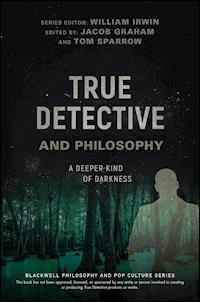
True Detective and Philosophy E-Book
11,99 €
Mehr erfahren.
- Herausgeber: John Wiley & Sons
- Kategorie: Geisteswissenschaft
- Serie: The Blackwell Philosophy and Pop Culture Series
- Sprache: Englisch
Investigating the trail of philosophical leads in HBO's chilling True Detective series, an elite team of philosophers examine far-reaching riddles including human pessimism, Rust's anti-natalism, the problem of evil, and the 'flat circle'. * The first book dedicated to exploring the far-reaching philosophical questions behind the darkly complex and Emmy-nominated HBO True Detective series * Explores in a fun but insightful way the rich philosophical and existential experiences that arise from this gripping show * Gives new perspectives on the characters in the series, its storylines, and its themes by investigating core questions such as: Why Life Rather Than Death? Cosmic Horror and Hopeful Pessimism, the Illusion of Self, Noir, Tragedy, Philosopher-Detectives, and much, much more * Draws together an elite team of philosophers to shine new light on why this genre-expanding show has inspired such a fervently questioning fan-base
Sie lesen das E-Book in den Legimi-Apps auf:
Seitenzahl: 353
Veröffentlichungsjahr: 2017
Ähnliche




















The Blackwell Philosophy and Pop Culture Series
Series editor William Irwin
A spoonful of sugar helps the medicine go down, and a healthy helping of popular culture clears the cobwebs from Kant. Philosophy has had a public relations problem for a few centuries now. This series aims to change that, showing that philosophy is relevant to your life—and not just for answering the big questions like “To be or not to be?” but for answering the little questions: “To watch or not to watch South Park?” Thinking deeply about TV, movies, and music doesn't make you a “complete idiot.” In fact it might make you a philosopher, someone who believes the unexamined life is not worth living and the unexamined cartoon is not worth watching.
Already published in the series:
24 and Philosophy: The World According to JackEdited by Jennifer Hart Weed, Richard Brian Davis, and Ronald Weed
30 Rock and Philosophy: We Want to Go to ThereEdited by J. Jeremy Wisnewski
Alice in Wonderland and Philosophy: Curiouser and CuriouserEdited by Richard Brian Davis
Alien and Philosophy: I Infest, Therefore I AmEdited by Jeffrey A. Ewing and Kevin S. Decker
Arrested Development and Philosophy: They've Made a Huge MistakeEdited by Kristopher Phillips and J. Jeremy Wisnewski
Avatar and Philosophy: Learning to SeeEdited by George A. Dunn
The Avengers and Philosophy: Earth's Mightiest ThinkersEdited by Mark D. White
Batman and Philosophy: The Dark Knight of the SoulEdited by Mark D. White and Robert Arp
Battlestar Galactica and Philosophy: Knowledge Here Begins Out ThereEdited by Jason T. Eberl
The Big Bang Theory and Philosophy: Rock, Paper, Scissors, Aristotle, LockeEdited by Dean Kowalski
The Big Lebowski and Philosophy: Keeping Your Mind Limber with Abiding WisdomEdited by Peter S. Fosl
BioShock and Philosophy: Irrational Game, Rational BookEdited by Luke Cuddy
Black Sabbath and Philosophy: Mastering RealityEdited by William Irwin
The Daily Show and Philosophy: Moments of Zen in the Art of Fake NewsEdited by Jason Holt
Downton Abbey and Philosophy: The Truth Is Neither Here Nor ThereEdited by Mark D. White
Dungeons & Dragons and Philosophy: Read and Gain Advantage on All Wisdom ChecksEdited by Christopher Robichaud
Ender's Game and Philosophy: The Logic Gate is DownEdited by Kevin S. Decker
Family Guy and Philosophy: A Cure for the PetardedEdited by J. Jeremy Wisnewski
Final Fantasy and Philosophy: The Ultimate WalkthroughEdited by Jason P. Blahuta and Michel S. Beaulieu
Game of Thrones and Philosophy: Logic Cuts Deeper Than SwordsEdited by Henry Jacoby
The Girl With the Dragon Tattoo and Philosophy: Everything is FireEdited by Eric Bronson
Green Lantern and Philosophy: No Evil Shall Escape this BookEdited by Jane Dryden and Mark D. White
Heroes and Philosophy: Buy the Book, Save the WorldEdited by David Kyle Johnson
The Hobbit and Philosophy: For When You've Lost Your Dwarves, Your Wizard, and Your WayEdited by Gregory Bassham and Eric Bronson
House and Philosophy: Everybody LiesEdited by Henry Jacoby
House of Cards and Philosophy: Capitalism without ConsumerismEdited by J. Edward Hackett
The Hunger Games and Philosophy: A Critique of Pure TreasonEdited by George Dunn and Nicolas Michaud
Inception and Philosophy: Because It's Never Just a DreamEdited by David Johnson
Iron Man and Philosophy: Facing the Stark RealityEdited by Mark D. White
LEGO and Philosophy: Constructing Reality Brick by BrickEdited by Roy T. Cook and Sondra Bacharach
Lost and Philosophy: The Island Has Its ReasonsEdited by Sharon M. Kaye
Mad Men and Philosophy: Nothing Is as It SeemsEdited by James South and Rod Carveth
Metallica and Philosophy: A Crash Course in Brain SurgeryEdited by William Irwin
The Office and Philosophy: Scenes from the Unfinished LifeEdited by J. Jeremy Wisnewski
Sons of Anarchy and Philosophy: Brains Before BulletsEdited by George A. Dunn and Jason T. Eberl
South Park and Philosophy: You Know, I Learned Something TodayEdited by Robert Arp
Spider-Man and Philosophy: The Web of InquiryEdited by Jonathan Sanford
Superman and Philosophy: What Would the Man of Steel Do?Edited by Mark D. White
Supernatural and Philosophy: Metaphysics and Monsters…for IdjitsEdited by Galen Foresman
Terminator and Philosophy: I'll Be Back, Therefore I AmEdited by Richard Brown and Kevin Decker
True Blood and Philosophy: We Wanna Think Bad Things with YouEdited by George Dunn and Rebecca Housel
Twilight and Philosophy: Vampires, Vegetarians, and the Pursuit of ImmortalityEdited by Rebecca Housel and J. Jeremy Wisnewski
The Ultimate Daily Show and Philosophy: More Moments of Zen, More Moments of Indecision TheoryEdited by Jason Holt
The Ultimate Harry Potter and Philosophy: Hogwarts for MugglesEdited by Gregory Bassham
The Ultimate Lost and Philosophy: Think Together, Die AloneEdited by Sharon Kaye
The Ultimate South Park and Philosophy: Respect My Philosophah!Edited by Robert Arp and Kevin S. Decker
The Ultimate Star Trek and Philosophy: The Search for SocratesEdited by Kevin S. Decker and Jason T. Eberl
The Ultimate Star Wars and Philosophy: You Must Unlearn What You Have LearnedEdited by Jason T. Eberl and Kevin S. Decker
Veronica Mars and Philosophy: Investigating the Mysteries of Life (Which is a Bitch Until You Die)Edited by George A. Dunn
The Walking Dead and Philosophy: Shotgun. Machete. Reason.Edited by Christopher Robichaud
Watchmen and Philosophy: A Rorschach TestEdited by Mark D. White
Wonder Woman and Philosophy: The Amazonian MystiqueEdited by Jacob M. Held
X-Men and Philosophy: Astonishing Insight and Uncanny Argument in the Mutant X-VerseEdited by Rebecca Housel and J. Jeremy Wisnewski
TRUE DETECTIVE AND PHILOSOPHY
A DEEPER KIND OF DARKNESS
Edited by
Jacob Graham and Tom Sparrow
This edition first published 2018
© 2018 John Wiley & Sons Ltd
All rights reserved. No part of this publication may be reproduced, stored in a retrieval system, or transmitted, in any form or by any means, electronic, mechanical, photocopying, recording or otherwise, except as permitted by law. Advice on how to obtain permission to reuse material from this title is available at http://www.wiley.com/go/permissions.
The right of Jacob Graham and Tom Sparrow to be identified as the authors of the editorial material in this work has been asserted in accordance with law.
Registered Offices
John Wiley & Sons, Inc., 111 River Street, Hoboken, NJ 07030, USA
John Wiley & Sons Ltd, The Atrium, Southern Gate, Chichester, West Sussex, PO19 8SQ, UK
Editorial Office
9600 Garsington Road, Oxford, OX4 2DQ, UK
For details of our global editorial offices, customer services, and more information about Wiley products visit us at www.wiley.com.
Wiley also publishes its books in a variety of electronic formats and by print-on-demand. Some content that appears in standard print versions of this book may not be available in other formats.
Limit of Liability/Disclaimer of Warranty While the publisher and authors have used their best efforts in preparing this work, they make no representations or warranties with respect to the accuracy or completeness of the contents of this work and specifically disclaim all warranties, including without limitation any implied warranties of merchantability or fitness for a particular purpose. No warranty may be created or extended by sales representatives, written sales materials or promotional statements for this work. The fact that an organization, website, or product is referred to in this work as a citation and/or potential source of further information does not mean that the publisher and authors endorse the information or services the organization, website, or product may provide or recommendations it may make. This work is sold with the understanding that the publisher is not engaged in rendering professional services. The advice and strategies contained herein may not be suitable for your situation. You should consult with a specialist where appropriate. Further, readers should be aware that websites listed in this work may have changed or disappeared between when this work was written and when it is read. Neither the publisher nor authors shall be liable for any loss of profit or any other commercial damages, including but not limited to special, incidental, consequential, or other damages.
Library of Congress Cataloging-in-Publication Data
Names: Graham, Jacob editor. | Sparrow, Tom, 1979– editor.
Title: True detective and philosophy : a deeper kind of darkness / edited by Jacob Graham, Tom Sparrow.
Description: Hoboken : Wiley, 2018. | Series: The Blackwell philosophy and popculture series | Includes bibliographical references and index. | Identifiers: LCCN 2017014278 (print) | LCCN 2017028324 (ebook) | ISBN 9781119280798 (pdf) | ISBN 9781119280828 (epub) | ISBN 9781119280781 (pbk.)
Subjects: LCSH: True detective (Television program)
Classification: LCC PN1992.77.T79 (ebook) | LCC PN1992.77.T79 T78 2017 (print) | DDC 791.45/72--dc23
LC record available at https://lccn.loc.gov/2017014278
Cover Design: Wiley
Cover Images: Guy © 4x6/Gettyimages; Texture © TothGaborGyula/Gettyimages; Forest © odebala/Gettyimages
Contents
Introduction: Welcome to the Psychosphere
Part I “It's All One Ghetto, Man … a Giant Gutter in Outer Space”: Pessimism and Anti-natalism
1 Why Life Rather than Death?: Answers from Rustin Cohle and Arthur Schopenhauer
Arthur Schopenhauer's Pessimism
Why Not Suicide?
Schopenhauer on Compassion
Rust's Doubt
Rust's Conversion
Notes
2 Grounding Carcosa: Cosmic Horror and Philosophical Pessimism in True Detective
“This Is Some Halloween Shit”
“It Means I'm Bad at Parties”
“Time Is a Flat Circle”
“The Light Is Winning”
Notes
3 Hart and Cohle: The Hopeful Pessimism of True Detective
What Pessimism Is and Is Not
Pessimism, Freedom, and Truth
Pessimism and Hope
Notes
4 Loving Rust's Pessimism: Rationalism and Emotion in True Detective
“Boundaries Are Good”
“This World Is a Veil, and the Face You Wear Is Not Your Own”
“I Consider Myself a Realist”
“Was January the Third, My Daughter's Birthday, I Remember”
“She Saved Me from the Sin of Being a Father”
“I Was a Part of Everything that I Ever Loved”
Notes
Part II “We Get the World We Deserve”: Cruelty, Violence, Evil, and Justice
5 Rust's Anti-natalism: The Moral Imperative to “Opt Out of a Raw Deal”
Rust Cohle as an Anti-natalist
Rust's Scattershot Philosophy of Anti-natalism
Benatar on Anti-natalism
Returning to Cohle's Life Is an Inherently Bad Proposition
Notes
6 Where Is the Cruelty in True Detective?
Knowing Cruelty
Embracing Suffering
Two Sufferers
Affirmation or Death
Notes
7 Nevermind: Subjective and Objective Violence in Vinci
“Subjective” and “Objective” Violence: Life in Vinci
Frank Goes Straight
The World We Deserve vs. the World We Want
“The Story's Told, with Facts and Lies …”
Notes
8 Naturalism, Evil, and the Moral Monster: The Evil Person in True Detective
“Green-Eared Spaghetti Monsters”
“He's Worse than Anybody”
“This World Is a Veil, and the Face You Wear Is Not Your Own”
Notes
9 “But I Do Have a Sense of Justice”: Law and Justice in the Bleak World of Vinci
Law Divorced from Morality
“Call It What You Want, Revenge, Justice … Retirement Package”
“I Don't Know if It'll Make Any Difference, but It Should, Because We Deserve a Better World”
Justice and the Law
Notes
Part III “Everybody's Nobody”: Consciousness, Existence, and Identity
10 A Dream Inside a Locked Room: The Illusion of Self
Life Is a Dream
Eastern Views
Western Views
Pessimism and Nihilism
Transcendence
Notes
11 I Am Not Who I Used to Be, But Am I Me?: Personal Identity and the Narrative of Rust
A Story of Three Rusts
The Puzzle of Personal Identity
Where to Now?
Notes
12 “The Light Is Winning”
Stories to Keep Children Busy
The Family Man
The Poison of Nihilism
The Vulnerable Hold the Antidote
The Head of the Snake
“The Light Is Winning”
Notes
13 The Tragic Misstep: Consciousness, Free Will, and the Last Midnight
The Constitution for Suicide
More than a Biological Puppet
Nature Separate from Nature
“Everybody's Nobody”
Opting Out
“The Light Is Winning”
Notes
Part IV “This Is My Least Favorite Life”: Noir, Tragedy, and Philosopher-Detectives
14 The Tragedy of True Detective Season Two: Living Our “Least Favorite Lives”
Attic Tragedy: “Sometimes Your Worst Self Is Your Best Self”
Dionysian Wisdom or a Philosophy of the Good?
“Sometimes Your Worse Self Is” Just … Worse
A “Good Woman” to “Mitigate Our Baser Tendencies”?
Feminism as the Good
Is Athena Right? Is This Just “My Fucking Problem?”
The Crossing of the Good
Notes
15 The Noir Detective and the City
Philosophy and the City
The Dark City of the Detective
The City Inside
Notes
16 Cohle and Oedipus: The Return of the Noir Hero
The Lack of Cohle and Hart
“You're Obsessed, Just Not with Your Work”
Cohle and Oedipus: The Return of the Noir Hero
Notes
Part V “Time Is a Flat Circle”: Time in True Detective
17 Time Is a Flat Circle: Nietzsche's Concept of Eternal Recurrence
A Purposeless Will at the Heart of Reality
The True Test of Life Affirmation
Finding Meaning in Conflict
The “Lightening” of Cohle's Pessimism
Notes
18 Eternal Recurrence and the Philosophy of the “Flat Circle”
Rust's Philosophy: Pessimism and the Escape from Time
Does Rust Really Believe Time Is Circular?
What Does “Time is a Flat Circle” Not Mean?
Nietzsche's Eternal Recurrence
Circular Time as a Solution that Replaces a Pessimistic Problem
Notes
Known Associates
Index
EULA
Guide
Cover
Table of Contents
Pages
C1
iii
iv
ix
x
1
3
4
5
6
7
8
9
10
11
12
13
14
15
16
17
18
19
20
21
22
23
24
25
26
27
28
29
30
31
42
43
44
45
46
47
48
49
50
51
53
55
56
57
58
59
60
61
62
63
64
65
66
67
68
69
70
71
72
73
74
75
76
77
78
79
80
81
82
83
84
85
86
87
88
89
90
91
92
93
94
95
96
97
99
100
101
102
103
104
105
106
107
108
109
110
111
112
113
114
115
116
117
118
119
120
121
122
123
124
125
126
127
128
129
130
131
132
133
134
135
136
137
138
139
140
141
142
143
145
146
147
148
149
150
151
152
153
154
155
156
157
158
159
160
161
162
163
164
165
166
167
168
169
170
171
172
173
174
175
176
177
179
180
181
182
183
184
185
186
187
188
189
190
191
192
193
194
195
196
197
198
199
200
201
202
203
204
205
206
207
208
209
Introduction: Welcome to the Psychosphere
Jacob Graham and Tom Sparrow
If you're anything like us, you enjoy listening to Rust wax philosophical as much as you like watching Marty balk at the odd shit that comes out of Rust's mouth. When it comes to big questions about value, meaning, truth, and existence, these characters couldn't be further apart. Professionally, on the other hand, they complement each other pretty well: they get the job done, solve the case. For two guys responsible for enforcing the law, however, their moral compasses don't always point them in the right direction. Which is not to say that the officers in Vinci shoot any straighter. Remember that time Velcoro kicked the crap out of Aspen Conroy's father right in front of the kid? Of course you do. It was kind of wrong, but felt kind of right, didn't it? The cops in True Detective can be as twisted as the backroads of the Louisiana bayou and the freeways of Los Angeles. They're defined as much by their deceit, disloyalty, substance abuse, self-loathing, and violence as they are their compassion, duty, and peculiar sense of justice.
As we ride along with Cohle and Hart or Bezzerides and Velcoro, it's impossible not to marvel at the bleak Louisiana and California landscapes. Drenched in shadow, foretelling something sinister, they are populated by masked men, cruel and murderous—the worst kinds of men. Corruption, decay, and degradation touch everything. And yet, we viewers choose to linger in those desolate landscapes, happily pursuing real-life monsters in the squad car of our true detectives, enthralled by the promise of some unforeseen horror. But why do we watch? What draws us in? Do we detect something of ourselves in these worlds? That should worry us. Do we know who we really are? There'd be a victory in that.
We'll leave it for you to decide where you fit in the picture or what makes for a true detective, but we'd like to suggest that detectives and philosophers have something in common—both seek the truth—and that True Detective can teach us a lot about philosophy. Unlike detective work, however, and fortunately for us, the risk of imminent physical harm is low with philosophy. Yet, the stakes are still high, especially if, as Socrates (470–399 bce) said, “the unexamined life is not worth living.” Through the eyes of the characters and the stories of True Detective, the squad of authors in this book pull back the curtain on some philosophical ideas more powerful than any cultic demigod or corrupt mayor. By exposing the philosophical roots and contexts of pessimism, our squad uncovers just why Rust is so bad at parties. Examining topics such as good and evil, tragedy, personal identity, and time, they introduce us to philosophers such as Socrates, Schopenhauer, Nietzsche, Lacan, and Žižek. Ultimately, though, you must become your own detective and figure out the truth for yourself.
So, why should you, dear reader, continue beyond this introduction? Because you have a debt. You owe it to yourself to do some truth detecting, to step back into the forsaken world of True Detective where ominous shadows grow ever darker and stories are told with facts and lies. We're not asking you to make this journey one of silent reflection. We want you to figure out for yourself what you think, to give yourself the philosophical world that you deserve, and to remove the mask from the truth that lives among us, well disguised.
Part I“IT'S ALL ONE GHETTO, MAN … A GIANT GUTTER IN OUTER SPACE”Pessimism and Anti-natalism
1Why Life Rather than Death?:Answers from Rustin Cohle and Arthur Schopenhauer1
Sandra Shapshay
Rustin Cohle, the protagonist of the first season of True Detective, declares that he is “in philosophical terms, a pessimist.” Before we are introduced to him, Rust has already experienced the terrible loss of his two-year-old daughter and the painful dissolution of his marriage. His employment confronts him daily with the horrors of human conduct, where the “law of the stronger” reigns and the strong and sadistic exploit the weak and vulnerable. Throughout season one, we see Rust struggling to find the best, truest response to all this seemingly endemic and unredeemed suffering.
Rust thinks that human consciousness is a “tragic misstep in nature.” The doctrine of “pessimism” espoused by Rust is remarkably similar to the view adumbrated by Arthur Schopenhauer (1788–1860), who holds that (1) conscious life (both human and nonhuman animal) involves a tremendous amount of suffering that is essentially built into the structure of the world and (2) there is no Creator (providential or otherwise) to redeem all of this suffering, by, say, punishing the wicked and rewarding the good.
Arthur Schopenhauer's Pessimism
Schopenhauer is just as attuned as Rust to the tremendous amount of evil in the world, caused for the most part by other human beings. Whereas the “true detective” is nauseated and jaded by the sadistic acts of bayou killers who prey mostly on innocent girls and young women, Schopenhauer is nauseated and jaded by more institutional sources of human suffering in nineteenth-century Europe and the United States that spring largely from pervasive human egoism and, to a lesser but not insignificant extent, malice:
The chief source of the most serious evils affecting man is man himself; homo homini lupus. He who keeps this last fact clearly in view beholds the world as a hell, surpassing that of Dante by the fact that one man must be the devil of another. … How man deals with man is seen, for example, in Negro slavery, the ultimate object of which is sugar and coffee. However, we need not go so far; to enter at the age of five a cotton-spinning or other factory, and from then on to sit there every day first ten, then twelve and finally fourteen hours, and perform the same mechanical work, is to purchase dearly the pleasure of drawing breath. But this is the fate of millions, and many more millions have an analogous fate.2
Additionally, Schopenhauer focuses on the suffering of nonhuman animals at the hands of human beings who view them as mere instruments for their use:
Because … Christian morals give no consideration to animals, they are at once free as birds in philosophical morals too, they are mere “things”, mere means to whatever ends you like, as for instance vivisection, hunting with hounds, bull-fighting, racing, whipping to death in front of an immovable stone-cart and the like.3
Why Not Suicide?
Given this grim view of the human condition, it makes sense to raise the question of suicide: Why not put an end to one's life, in order to escape from this ultimately senseless vale of tears? Throughout True Detective, Rust struggles with “letting go” and, regarding the last episode of season one, “Form and Void,” the creator, Nic Pizzolatto, explains that the episode “represents the dilemma Rust walked for some time: why life rather than the opposite?”4 Rust thinks that our “programming” (in Schopenhauer's terms, the “will-to-live”) “gets us out of bed in the morning” but that it would be better, all things considered, to “deny our programming” and walk ourselves “hand in hand into extinction” (“The Long Bright Dark”). Thus, Rust enunciates his in principle embrace of suicide.
In this positive attitude toward suicide, Rust actually parts ways with Schopenhauer, which is surprising since the philosopher is one of the most famous pessimists in the history of Western thought. In fact, Schopenhauer regarded suicide as a “futile and foolish act.”5 What accounts for this divergence?
Schopenhauer's Answer
Schopenhauer does not discourage suicide out of philosophical optimism: he doesn't think that this is the best of all possible worlds, as Gottfried Leibniz (1646–1716) does; neither does he believe that the world must get better because of a necessary rational structure, as Georg Wilhelm Friedrich Hegel (1770–1831) holds; nor that the world is a self-justifying divine cause, as Baruch Spinoza (1632–1677) argues. Also, he doesn't see life as a gift, to be thankfully accepted. Schopenhauer is convinced that the world is and will always be full of unredeemed suffering, for nature involves an internecine struggle for existence rather than a “peaceable kingdom” of animals living largely in harmony. And he is convinced that much of this suffering will go uncompensated in this life, as the sources of suffering seem to outweigh the sources of happiness and tranquility. Above all, he is an uncompromising atheist who holds that there is no providential God to redeem all of this suffering in an afterlife.
It might be surprising, then, that Schopenhauer thinks suicide is a “futile and foolish act.” Perhaps, like Rust, Schopenhauer should embrace suicide. For the nature of the will-to-live is ultimately blind, senseless striving and suffering for no particular end. Yet the reason Schopenhauer rejects suicide is that suicide does not negate but rather affirms the will-to-live, for the person who would die by suicide desires life; it's just that the individual is unsatisfied with the conditions on offer for their particular life. Within this logic, suicide is foolish because it prevents a person from attaining the highest wisdom and the true inner peace that would come from actual renunciation of the will-to-live. Thus, Schopenhauer writes, suicide is “an act of will” through which “the individual will abolishes the body … before suffering can break it.” He thereby likens a suicidal person to a sick person who “having started undergoing a painful operation that could cure him completely, does not allow it to be completed and would rather stay sick.”6 There is only one remarkable exception to his overall view on suicide: death by voluntary starvation. At the highest levels of asceticism, the negation of the will-to-live can attain such a point where “even the will needed to maintain the vegetative functions of the body through nutrition can fall away.”7
Rust's Answer
Returning to True Detective, we see that Rust struggles with many of the same issues that occupy Schopenhauer. For instance, though Rust embraces pessimism and resignationist tendencies, as evidenced by his rather ascetic lifestyle and in principle embrace of suicide, Rust does not actually resign himself from life. He is, after all, the eponymous “true detective” and throws himself assiduously into the task of solving the ritualistic rapes and murders and bringing the perpetrators to justice.
So what really motivates Rust to spend most of his waking life (and he doesn't seem to sleep all that much) attempting to solve these crimes? Is it the intellectual puzzle? Is it compassion for the victims and potential new victims? Is it a thirst for justice?
At times it seems that it is merely the intellectual challenge that motivates Rust. This recalls Schopenhauer's own expressed reason to devote himself to philosophy: “Life is an unpleasant business; I have resolved to spend it reflecting upon it.”8 Yet, what preoccupies Rust's mind and takes up a good bit of wall space in his barely furnished apartment is reflection with a specific practical aim—namely, to solve the crimes in order to prevent future victims and to bring the perpetrators to justice.
Thus, Rust seems not just motivated by the intellectual puzzle but also by a morality of compassion and justice. After all, his aim is not merely to solve the crimes but also to apprehend or otherwise stop the perpetrators. Further, these moral motives get to the heart of Rust's espousal of pessimism in the first place, for he is—unlike how Marty often seems—acutely sensitive to the sufferings of others and—again, unlike Marty but in line with Schopenhauer—rejects any theological story of redemption for all of this suffering.
What I want to suggest, then, is that Rust's own practice belies his stated pessimistic views. It is not just “programming”—the will-to-live, egoistic striving—that gets Rust out of bed in the morning; rather, it is the sense that if there is to be any kind of redemption it has to be earthly, in the form of prevention or alleviation of suffering, and in bringing criminals to justice.
Schopenhauer on Compassion
Surprisingly, Schopenhauer at certain points in his writings seems to recommend the general, compassionate, and justice-seeking path that Rust takes in True Detective. Especially in his underappreciated essay “On the Basis of Morality,” Schopenhauer recommends acts of justice and loving-kindness in response to the myriad sources of misery. For example, he praises the British nation's spending “up to 20 million pounds” to buy the freedom of slaves in America.9 He also champions the proliferation of animal protection societies in Continental Europe, recommending English newspaper reports to address “the associations against the torture of animals now established in Germany, so that they see how one must attack the issue if anything is to come of it” and he acknowledges “the praiseworthy zeal of Councillor Perner in Munich who has devoted himself entirely to this branch of beneficence and spread the initiative for it throughout the whole of Germany.”10
Finally, Schopenhauer recognizes that the work of civic organizations, especially in securing legal change, can bring about real moral change and reduce suffering. Again, with respect to the animal protection movement and laws against animal cruelty, Schopenhauer writes, “Everything adduced here gives evidence that the moral chord in question … is gradually beginning to sound in the occidental world.”11
Schopenhauer opposes all forms of suicide, except the redeeming ascetic one, because suicide robs a person of the highest wisdom regarding the apparent futility of life. However, the hopeful ethics of compassion that Schopenhauer also espouses looks like a second-rate option. On the traditional reading of Schopenhauer, he holds that it is better to go beyond willing and therefore beyond compassion as well to a real renunciation of the will-to-live, if one can. Only in renunciation is the patient truly cured of the rather absurd scourge that is the will-to-live. Yet, the rationality of the choice between compassionate action, on the one hand (action that tries to improve the world), and resignation, on the other (inaction that constitutes a redemption from the world), hinges on whether there are good grounds for hope.
Rust's Doubt
Returning to True Detective, we see Rust doubt whether there are good grounds for hope. The task of preventing and alleviating suffering as well as bringing a measure of justice into the world is onerous. It also threatens to seem futile given the large numbers of murders and disappearances, and the rampant cruelty and degradation inflicted especially upon children, teenage girls, and women throughout the series. This sense of futility, it seems, overtakes Rust in the interim between “solving” the first crime introduced in the show and the second spate of similar murders.
During this hiatus, Rust has indeed opted for resignation as a response to pessimism. Although he does not have the constitution for outright suicide—as he says to Marty—he is nonetheless doing a pretty good job of drinking himself to death. He has essentially retreated from the world into a dark bar where he can engage in almost nonstop anesthetization through the bottle, until a spate of new, similar murders awakens him from his resignationist slumber, resparking his intellectual curiosity as well as his compassion and sense of justice.
But it takes the final, spooky, and frankly nauseating confrontation with evil incarnate, in the form of the “Yellow King,” to show Rust a legitimate path to the affirmation of life, as opposed to what he sees as an intellectually dishonest, optimistic, theological route. After surviving the bizarre melee and shutting down the activities of this serial killer, Rust gains a sense that perhaps his thoroughgoing pessimism is, at bottom, unwarranted. Despite the fact of tremendous suffering and injustice in the world, there are, nonetheless, nontrivial victories for compassion and justice. Additionally, Marty's quasi-reconciliation with his family shows Rust that a measure of forgiveness and understanding can be attained even after a long history of strained relationships. Rust also finds that he can take some comfort in knowing that his daughter did not suffer at the end of her short life.
Rust's Conversion
There are intimations of an afterlife in the final scene of the first season, and some sublime meditations on the starry night sky, to be sure, but in the end it does not seem that Rust's conversion is theological in nature. Rather, I interpret his final turn as resulting from the realization that some degree of affirmation is warranted by the empirical evidence. In other words, he realizes that thoroughgoing pessimism and resignation from life is not an intellectually honest stance to take. In light of his epistemic shift, he might even come to the view that his former resignation might be positively immoral, but Rust's character arc, with the series, ends only with the former, more ecumenical realization.
So, Rust's character throughout the series goes from (1) self-described jaded, wannabe-suicidal pessimist who belies his own self-understanding by energetically fighting crime to (2) one who really embraces that self-description, resigns from life, and aims to drink himself to death to (3) the cautious affirmer of life through compassionate engagement with the world. Rust finds some grounds for hope, and he chooses to continue on the path of compassion and justice, the path to try to improve the world. This prompts the question of whether he ever really embraced suicide in principle, and just lacked the constitution to pull it off, or whether, like Schopenhauer, he perhaps always found the intellectual grounds for such a radical decision to be shaky. At the very least, we can conclude that, as the eponymous “true detective,” he was duty-bound to pursue the evidence—evidence for hope or lack thereof—wherever it would lead.
Notes
1
An earlier version of this chapter originally appeared online at
The Critique.
2
Arthur Schopenhauer,
The World as Will and Representation
, vol. 2, trans. R. B. Haldane and J. Kemp (London: Routledge & Kegan, 1957), 578. First printed 1883.
3
Arthur Schopenhauer, “Prize Essay on the Basis of Morals,” in
The Two Fundamental Problems of Ethics
, trans. and ed. Christopher Janaway (New York: Cambridge University Press, 2009), 162.
4
“True Detective Season 1: Inside the Episode #8 (HBO).”
YouTube
, March 9, 2014.
https://www.youtube.com/watch?v=cE2n-nwiqDs
.
5
Arthur Schopenhauer,
The World as Will and Representation
, vol. 1, trans. and ed. Judith Norman, Alistair Welchman, and Christopher Janaway (New York: Cambridge University Press, 2010), sec. 69, 426. German original:
Die Welt als Wille und Vorstellung
(Zürich: Haffsmans Verlag, 1988).
6
Schopenhauer,
World as Will and Representation
, vol. 1, 426–427.
7
Ibid., 428.
8
Rüdiger Safranski,
Schopenhauer and the Wild Years of Philosophy
, trans. Ewald Iosers (London: Weidenfeld & Nicolson, 1989), 105.
9
Ibid., 218.
10
Ibid., fn. 230.
11
Ibid., 231.
2Grounding Carcosa: Cosmic Horror and Philosophical Pessimism in True Detective
Christopher Mountenay
Like many fans of True Detective, I was somewhat disappointed with the season one finale, “Form and Void.” It was definitely not a bad hour of television, but it undid much of the work that the first seven episodes had done. “Form and Void” both diminished the element of cosmic horror into something more terrestrial and mundane and replaced Rust Cohle's trademark philosophical pessimism with a metaphysical optimism.
“This Is Some Halloween Shit”
Let's clarify what we mean by cosmic horror, supernatural horror, or weird fiction.1 Most horror fiction that the West consumes consists either of familiar folkloric archetypes or completely naturalistic violence. The former is often only frightening to children because the familiarity of, say, vampires and werewolves makes them into easy objects of self-parody for most people. The latter includes subgenres such as slasher films, which rely on scenarios that, while typically outlandish, are at least physically possible. Partisans of this type of horror will argue that it is the scariest since it could “really happen.”
Cosmic horror takes the opposite approach. A tale of cosmic horror will typically, but not always, begin with elements that seem “realistic” but then veer into things that are impossible, at least from a rationalistic, naturalistic perspective. Yet what makes these things scary is not that they can occur in the realm of possibility but that they actually alter our understanding of what is possible. The master of this style, H. P. Lovecraft (1890–1937), in his long essay Supernatural Horror in Literature, describes it as follows:
This type of fear-literature must not be confounded with a type externally similar but psychologically widely different; the literature of mere physical fear and the mundanely gruesome. … These things are not the literature of cosmic fear in its purest sense. The true weird tale has something more than secret murder, bloody bones, or a sheeted form clanking chains according to rule. A certain atmosphere of breathless and unexplainable dread of outer, unknown forces must be present; and there must be a hint, expressed with a seriousness and portentousness becoming its subject, of that most terrible conception of the human brain—a malign and particular suspension or defeat of those fixed laws of Nature which are our only safeguard against the assaults of chaos and the daemons of unplumbed space.2
Lovecraft's form of horror is not concerned with “physical fear.” The fear of death, even a violent death, is not what Lovecraft is trying to invoke. Rather, he sees the “oldest” and “strongest” fear to be the “fear of the unknown.”3 Lovecraft fears the “hidden and fathomless worlds of strange life which may pulsate in the gulfs beyond the stars, or press hideously upon our own globe in unholy dimensions which only the dead and the moonstruck can glimpse.”4
A typical Lovecraft story involves a protagonist discovering some oddity, investigating it, and then watching his world unravel as eldritch horrors are awoken and a secret history of the world is unearthed. The protagonist of the story begins in a state of relative naïveté, not understanding the secret nature of the world and thinking that things ultimately make sense. While Rust is an exception to this trope, Marty Hart, despite his rough exterior, is such a character. In “The Long Bright Dark” he describes himself as “just a regular dude with a big-ass dick.” Marty proclaims his Christian faith and is horrified by Rust's philosophical views. We also see the value that he places on his family and his libido, though the two are at odds. As the season continues, Marty's faith in all of these things is shaken, though perhaps not to the point that one would expect from a cosmic horror story. Though Lovecraft's protagonists tend to be nebbish antiquarians and academics, not all protagonists of cosmic horror tales are squeamish. In fact, some of the best cosmic horror stories of the early twenty-first century, namely those by Laird Barron, feature protagonists displaying Marty's style of machismo. The lesson that they often learn, though, is that even such fortitude is ultimately futile in the face of cosmic horror.5 The best-case scenario in most works of cosmic horror is that the monstrosity that was unveiled goes back to sleep. All too often, though, heroes learn that the horrors they face are not only very real but also deeply woven into their own identity.
The horror is based not around the fear of what the monster can do to us but rather around the very fact that there are monsters. This is what separates cosmic horror from fantasy. A story involving monsters, such as The Lord of the Rings or the Harry Potter books, is not necessarily a horror story. A fantasy story typically presents the existence of monsters as a matter of fact. The characters react to the revelation of the existence of ghosts and goblins in the same way that a reader of a science magazine might react to the discovery of a new species of lizard: possibly with interest, but nothing life-defining. The reason is that no new philosophical questions are raised by the existence of the paranormal. If there are talking animals, what does that say about our previously held notion of humans being the sole sapient species on earth? The existence of ghosts should both settle debates and open up new questions about the existence of life after death. Yet, in much fiction, these discoveries are treated in a blasé manner.
Cosmic horror works differently. Even if we may find Lovecraft's beautifully described monsters to be hokey, we must question the role of humans in the cosmos. Lovecraft's monsters are not malevolent. Rather, they are of the mindset that humanity is beneath consideration. Humanity is to them as insects are to us. This goes against the typical religious or humanist doctrines that see humanity as either the highest of God's creations or the pinnacle of evolution. If beings like Cthulhu or the Yellow King do exist, humanity's precarious place is threatened. If things exist that can violate the laws of nature, then how may we trust those laws? Lovecraft's description of these “safeguards” is apt. Modern science has been a candle in the dark, but cosmic horror blows that candle out.
Thomas Ligotti, a living master of cosmic horror, said that “in the right surroundings our entire being is made of eyes that dilate to witness the haunting of the universe.”6 And what is more horrific is that, once one's eyes have been opened to it, no light can chase it away, since “horror eats the light and digests it into darkness.”7 It's not the threat of being taken by the Green Man to be sacrificed to the Yellow King that should scare us when we watch and imagine the world of True Detective. What's truly scary is living in a world where such things exist and in which our very sense of self is permeated with that darkness. Why would someone enjoy such imaginings? The simple answer is that we like to be scared. But Ligotti proposes something darker. Some of us already have the sort of philosophical inklings that someone like Rust has, and by personifying them and making a spectacle of them, as we do when we read cosmic horror, we're allowed to step outside ourselves and enjoy the horror while not feeling it devours us.




