


134,99 €
Mehr erfahren.
- Herausgeber: John Wiley & Sons
- Kategorie: Wissenschaft und neue Technologien
- Serie: Wiley - IEEE
- Sprache: Englisch
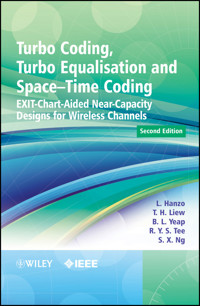
Covering the full range of channel codes from the most conventional through to the most advanced, the second edition of Turbo Coding, Turbo Equalisation and Space-Time Coding is a self-contained reference on channel coding for wireless channels. The book commences with a historical perspective on the topic, which leads to two basic component codes, convolutional and block codes. It then moves on to turbo codes which exploit iterative decoding by using algorithms, such as the Maximum-A-Posteriori (MAP), Log-MAP and Soft Output Viterbi Algorithm (SOVA), comparing their performance. It also compares Trellis Coded Modulation (TCM), Turbo Trellis Coded Modulation (TTCM), Bit-Interleaved Coded Modulation (BICM) and Iterative BICM (BICM-ID) under various channel conditions.
The horizon of the content is then extended to incorporate topics which have found their way into diverse standard systems. These include space-time block and trellis codes, as well as other Multiple-Input Multiple-Output (MIMO) schemes and near-instantaneously Adaptive Quadrature Amplitude Modulation (AQAM). The book also elaborates on turbo equalisation by providing a detailed portrayal of recent advances in partial response modulation schemes using diverse channel codes.
A radically new aspect for this second edition is the discussion of multi-level coding and sphere-packing schemes, Extrinsic Information Transfer (EXIT) charts, as well as an introduction to the family of Generalized Low Density Parity Check codes.
This new edition includes recent advances in near-capacity turbo-transceivers as well as new sections on multi-level coding schemes and of Generalized Low Density Parity Check codes
- Comparatively studies diverse channel coded and turbo detected systems to give all-inclusive information for researchers, engineers and students
- Details EXIT-chart based irregular transceiver designs
- Uses rich performance comparisons as well as diverse near-capacity design examples
Sie lesen das E-Book in den Legimi-Apps auf:
Seitenzahl: 1312
Veröffentlichungsjahr: 2011
Ähnliche




















Contents
Cover
Half Title Page
Title Page
Copyright
Dedication
About the Author
Other Related Wiley–IEEE Press Books
Acknowledgements
Chapter 1 Historical Perspective, Motivation and Outline
1.1 A Historical Perspective on Channel Coding
1.2 Motivation for this Book
1.3 Organisation of the Book
1.4 Novel Contributions of the Book
Chapter 2 Convolutional Channel Coding
2.1 Brief Channel Coding History
2.2 Convolutional Encoding
2.3 State and Trellis Transitions
2.4 The Viterbi Algorithm
2.5 Summary and Conclusions
Chapter 3 Soft Decoding and Performance of BCH Codes
3.1 Introduction
3.2 BCH codes
3.3 Trellis Decoding
3.4 Soft-input Algebraic Decoding
3.5 Summary and Conclusions
Part I Turbo Convolutional and Turbo Block Coding
Chapter 4 Turbo Convolutional Coding
4.1 Introduction
4.2 Turbo Encoder
4.3 Turbo Decoder
4.4 Turbo-coded BPSK Performance over Gaussian Channels
4.5 Turbo Coding Performance over Rayleigh Channels
4.6 Summary and Conclusions
Chapter 5 Turbo BCH Coding
5.1 Introduction
5.2 Turbo Encoder
5.3 Turbo Decoder
5.4 Turbo Decoding Example
5.5 MAP Algorithm for Extended BCH Codes
5.6 Simulation Results
5.7 Summary and Conclusions
Part II Space-time Block and Space-time Trellis Coding
Chapter 6 Space-time Block Codes
6.1 Classification of Smart Antennas
6.2 Introduction to Space-time Coding
6.3 Background
6.4 Space-time Block Codes
6.5 Channel-coded Space-time Block Codes
6.6 Performance Results
6.7 Summary and Conclusions
Chapter 7 Space–time Trellis Codes
7.1 Introduction
7.2 Space–time Trellis Codes
7.3 Space–time-coded Transmission over Wideband Channels
7.4 Simulation Results
7.5 Space–time-coded Adaptive Modulation for OFDM
7.6 Summary and Conclusions
Chapter 8 Turbo-coded Adaptive Modulation versus Space-time Trellis Codes for Transmission over Dispersive Channels
8.1 Introduction
8.2 System Overview
8.3 Simulation Parameters
8.4 Simulation Results
8.5 Summary and Conclusions
Part III Turbo Equalisation
Chapter 9 Turbo-Coded Partial-Response Modulation
9.1 Motivation
9.2 The Mobile Radio Channel
9.3 Continuous Phase Modulation Theory
9.4 Digital Frequency Modulation Systems
9.5 State Representation
9.6 Spectral Performance
9.7 Construction of Trellis-based Equaliser States
9.8 Soft-output GMSK Equaliser and Turbo Coding
9.9 Summary and Conclusions
Chapter 10 Turbo Equalisation for Partial-Response Systems
10.1 Motivation
10.2 Principle of Turbo Equalisation Using Single/Multiple Decoder(s)
10.3 Soft-in/Soft-out Equaliser for Turbo Equalisation
10.4 Soft-in/Soft-out Decoder for Turbo Equalisation
10.5 Turbo Equalisation Example
10.6 Summary of Turbo Equalisation
10.7 Performance of Coded GMSK Systems Using Turbo Equalisation
10.8 Discussion of Results
10.9 Summary and Conclusions
Chapter 11 Comparative Study of Turbo Equalisers
11.1 Motivation
11.2 System Overview
11.3 Simulation Parameters
11.4 Results and Discussion
11.5 Non-iterative Joint Channel Equalisation and Channel Decoding
11.6 Summary and Conclusions
Chapter 12 Reduced-complexity Turbo Equaliser
12.1 Motivation
12.2 Complexity of the Multilevel Full-response Turbo Equaliser
12.3 System Model
12.4 In-phase/Quadrature-phase Equaliser Principle
12.5 Overview of the Reduced-complexity Turbo Equaliser
12.6 Complexity of the In-phase/Quadrature-phase Turbo Equaliser
12.7 System Parameters
12.8 System Performance
12.9 Summary and Conclusions
Chapter 13 Turbo Equalisation for Space-time Trellis-coded Systems
13.1 Introduction
13.2 System Overview
13.3 Principle of In-phase/Quadrature-phase Turbo Equalisation
13.4 Complexity Analysis
13.5 Results and Discussion
13.6 Summary and Conclusions
Part IV Coded and Space-time-Coded Adaptive Modulation: TCM, TTCM, BICM, BICM-ID and MLC
Chapter 14 Coded Modulation Theory and Performance
14.1 Introduction
14.2 Trellis-coded Modulation
14.3 The Symbol-based MAP Algorithm
14.4 Turbo Trellis-coded Modulation
14.5 Bit-interleaved Coded Modulation
14.6 Bit-interleaved Coded Modulation Using Iterative Decoding
14.7 Coded Modulation Performance
14.8 Near-capacity Turbo Trellis-coded Modulation Design Based on EXIT Charts and Union Bounds
14.9 Summary and Conclusions
Chapter 15 Multilevel Coding Theory
15.1 Introduction
15.2 Multilevel Coding
15.3 Bit-interleaved Coded Modulation
15.4 Bit-interleaved Coded Modulation Using Iterative Decoding
15.5 Conclusion
Chapter 16 MLC Design Using EXIT Analysis
16.1 Introduction
16.2 Comparative Study of Coded Modulation Schemes
16.3 EXIT-chart Analysis
16.4 Precoder-aided MLC
16.5 Chapter Conclusions
Chapter 17 Sphere Packing-aided Space-time MLC/BICM Design
17.1 Introduction
17.2 Space-time Block Code
17.3 Orthogonal G2 Design Using Sphere Packing
17.4 Iterative Demapping for Sphere Packing
17.5 STBC-SP-MLC
17.6 STBC-SP-BICM
17.7 Chapter Conclusions
Chapter 18 MLC/BICM Schemes for the Wireless Internet
18.1 Introduction
18.2 Multilevel Generalised Low-density Parity-check Codes
18.3 An Iterative Stopping Criterion for MLC-GLDPCs
18.4 Coding for the Wireless Internet
18.5 LT-BICM-ID Using LLR Packet Reliability Estimation
18.6 Chapter Conclusions
Chapter 19 Near-capacity Irregular BICM–ID Design
19.1 Introduction
19.2 Irregular Bit-interleaved Coded Modulation Schemes
19.3 EXIT-chart Analysis
19.4 Irregular Components
19.5 Simulation Results
19.6 Chapter Conclusions
Chapter 20 Summary and Conclusions
20.1 Summary of the Book
20.2 Future Work
20.3 Concluding Remarks
Bibliography
Subject Index
Author Index
Turbo Coding, Turbo Equalisation and Space–Time Coding
This edition first published 2011© 2011 John Wiley & Sons Ltd
Registered office
John Wiley & Sons Ltd, The Atrium, Southern Gate, Chichester, West Sussex, PO19 8SQ, United Kingdom
For details of our global editorial offices, for customer services and for information about how to apply for permission to reuse the copyright material in this book please see our website at www.wiley.com.
The right of the author to be identified as the author of this work has been asserted in accordance with the Copyright, Designs and Patents Act 1988.
All rights reserved. No part of this publication may be reproduced, stored in a retrieval system, or transmitted, in any form or by any means, electronic, mechanical, photocopying, recording or otherwise, except as permitted by the UK Copyright, Designs and Patents Act 1988, without the prior permission of the publisher.
Wiley also publishes its books in a variety of electronic formats. Some content that appears in print may not be available in electronic books.
Designations used by companies to distinguish their products are often claimed as trademarks. All brand names and product names used in this book are trade names, service marks, trademarks or registered trademarks of their respective owners. The publisher is not associated with any product or vendor mentioned in this book. This publication is designed to provide accurate and authoritative information in regard to the subject matter covered. It is sold on the understanding that the publisher is not engaged in rendering professional services. If professional advice or other expert assistance is required, the services of a competent professional should be sought.
Library of Congress Cataloging-in-Publication Data
Turbo coding, turbo equalisation, and space-time coding : exit-chart-aided near-capacity designs for wireless channels / by L. Hanzo … [et al.]. p. cm. Rev. ed. of: Turbo coding, turbo equalisation, and space-time coding / by L. Hanzo, T.H. Liew, B.L. Yeap. 2002. Includes bibliographical references and index. ISBN 978-0-470-97290-8 (cloth) 1. Signal processing-Mathematics. 2. Coding theory. 3. Iterative methods (Mathematics) I. Hanzo, Lajos, 1952- TK5102.92.H36 2011 621.382’2-dc22
2010037016
A catalogue record for this book is available from the British Library.
Print ISBN: 9780470972908 (H/B)
ePDF ISBN: 9780470978498
oBook ISBN: 9780470978481
ePub ISBN: 9780470978337
Set in 9/11pt Times by Sunrise Setting Ltd, Torquay, UK.
We dedicate this monograph to the contributors of this field listed in the Author Index
About the Authors
Lajos Hanzo, Fellow of the Royal Academy of Engineering, graduated in Electronics in 1976 and in 1983 he was conferred a doctorate in the field of Telecommunications. In 2004 he received a DSc for his research on adaptive wireless transceivers from the University of Southampton. During his 34-year career in telecommunications he has held various research and academic posts in Hungary, Germany and the UK. Since 1986 he has been with the School of Electronics and Computer Science, University of Southampton, UK and has been a consultant to Multiple Access Communications Ltd, UK. He currently holds the established Chair of Telecommunications.
He has co-authored 19 Wiley/IEEE Press books on mobile radio communications and published in excess of 900 research papers. He was awarded a number of distinctions, most recently the 2007 WCNC best paper award, a best-paper award at ICC’2009, the 2007 IEEE/ComSoc Wireless Technical Committee Achievement Award and the IETs Sir Monti Finniston Award for contributions across the entire field of engineering. His current teaching and research interests cover the range of {mobile multimedia communications}, including voice, audio, video and graphical source compression, channel coding, modulation, networking as well as the joint optimisation of these system components. He is managing a research group in the wide field of wireless multimedia communications funded by the Engineering and Physical Sciences Reseach Council (EPSRC), the Commission of European Communities (CEC) and the Virtual Centre of Excellence in Mobile Communications known as MVCE. Lajos is a Fellow of the IEEE and the IEE as well as an IEEE Distinguished Lecturer of both the ComSoc and VTS. He has been appointed the Editor-in-Chief of the IEEE Press and paved the way for the joint IEEE Press/Wiley imprint books to appear in IEEE Xplore V.3.0 during 2009.
T.-H. Liew received his BEng degree in Electronics from the University of Southampton, UK and in 2001 he was awarded a PhD degree. Following a one-year spell as a postdoctoral research fellow, he joined Ubinetics in Cambridge, UK. He then transferred to TTP Comms. Ltd in Cambridge and is currently working for Motorola. His research interests are associated with coding and modulation for wireless channels, space–time coding and adaptive transceivers. He has published his research results widely.
Bee Leong Yeap graduated in Electronics Engineering from the University of Southampton, UK, with a first class honours degree in 1996. In 2000, he was awarded a PhD degree and then continued his research as a postdoctoral research fellow in Southampton for a period of three years. He then joined Radioscape in London, UK, where he designed the signal processing algorithms of DAB transceivers. Recently, he joined Motorola in the UK. His research interests include turbo coding, turbo equalisation, adaptive modulation and space–time coding.
Ronald Yee Siong Tee received a BEng degree with first-class honours in Electrical and Electronics Engineering from the University of Manchester Institute of Science and Technology (UMIST) in 1999, an MSc degree from the National University of Singapore in 2004 and a PhD degree from the University of Southampton in 2008. He was involved in research collaboration with Nokia, UK, in signal processing and handwriting recognition in 2000. From 2001 to 2002 he worked at Nortel Networks, Switzerland, in the area of data and optical networks. In 2003, he was with a local Singapore IT company, where he headed the telecommunication business. His research interests include iterative decoding, sphere packing modulation, coded modulation schemes and computer networking. Dr Tee is the recipient of several academic awards, including the Overseas Research Scheme, the ASEAN scholarship and a Malaysian Government studentship. He is currently with Ernst & Young, London, working in forensic technology and electronic disclosure.
Soon Xin Ng (S′99-M′03-S′08) received a BEng degree (First class) in Electronics Engineering and a PhD degree in Wireless Communications from the University of Southampton, Southampton, UK, in 1999 and 2002, respectively. From 2003 to 2006, he was a postdoctoral research fellow working on collaborative European research projects known as SCOUT, NEWCOM and PHOENIX. Since August 2006, he has been a lecturer in Wireless Communications at the University of Southampton. He has been part of a team working on the OPTIMIX European project since March 2008. His research interests include adaptive coded modulation, channel coding, space–time coding, joint source and channel coding, OFDM, MIMO, cooperative communications and distributed coding. He has published numerous papers and coauthored a book in this-field.
Other Related Wiley–IEEE Press Books
R. Steele, L. Hanzo (Ed): Mobile Radio Communications: Second and Third Generation Cellular and WATM Systems, 2nd edition, 1999, 1090 pagesL. Hanzo, F. C. A. Somerville, J. P. Woodard: Voice Compression and Communications: Principles and Applications for Fixed and Wireless Channels, 2001, 672 pagesL. Hanzo, P. Cherriman, J. Streit: Wireless Video Communications: Second to Third Generation Systems and Beyond, 2001, 1092 pagesL. Hanzo, T. H. Liew, B. L. Yeap: Turbo Coding, Turbo Equalisation and Space–Time Coding for Transmission over Fading Channels, 2002, 766 pagesJ. S. Blogh, L. Hanzo: Third-Generation Systems and Intelligent Wireless Networking: Smart Antennas and Adaptive Modulation, 2002, 408 pagesL. Hanzo, C. H. Wong, M. S. Yee: Adaptive Wireless Transceivers: Turbo-Coded, Turbo-Equalized and Space–Time Coded TDMA, CDMA and OFDM Systems, 2002, 752 pagesL. Hanzo, L.-L. Yang, E.-L. Kuan, K. Yen: Single- and Multi-Carrier DS-CDMA: Multi-User Detection, Space–Time Spreading, Synchronisation, Networking and Standards, 2003, 1104 pagesL. Hanzo, M. Münster, T. Keller, B.-J. Choi, OFDM and MC-CDMA for Broadband Multi-User Communications, WLANs and Broadcasting, 2003, 1014 pagesL. Hanzo, S.-X. Ng, T. Keller and W. T. Webb, Quadrature Amplitude Modulation: From Basics to Adaptive Trellis-Coded, Turbo-Equalised and Space–Time Coded OFDM, CDMA and MC-CDMA Systems, 2nd Edition, 2004, 1036 pagesL. Hanzo, T. Keller, OFDM and MC-CDMA: A Primer, 2006, 430 pagesL. Hanzo, F. C. A. Somerville, J. P. Woodard: Voice and Audio Compression for Wireless Communications, 2nd Edition, 2007, 880 pagesL. Hanzo, P. J. Cherriman, J. Streit: Video Compression and Communications: From Basics to H.261, H.263, H.264, MPEG4 for DVB and HSDPA-Style Adaptive Turbo-Transceivers, 2007, 702 pagesL. Hanzo, J. S. Blogh, S. Ni: 3G, HSPA and FDD Versus TDD Networking: Smart Antennas and Adaptive Modulation, 2nd Edition, 2008, 596 pagesL. Hanzo, O. Alamri, M. El-Hajjar, N. Wu: Near-Capacity Multi-Functional MIMO Systems: Sphere-Packing, Iterative Detection and Cooperation, 2009, 738 pagesL. Hanzo, J. Akhtman, L. Wang, M. Jiang: MIMO-OFDM for LTE, WIFI and WIMAX: Coherent versus Non-Coherent and Cooperative Turbo-Transceivers, 2010, 692 pagesL. Hanzo, R. Maunder, J. Wang, L.-L. Yang: Near-Capacity Variable-Length Coding: Regular and EXIT-Chart-Aided Irregular Designs, 2010, 516 pagesAcknowledgements
We are indebted to our many colleagues who have enhanced our understanding of the subject. These colleagues and valued friends, too numerous to be mentioned, have influenced our views concerning various aspects of wireless multimedia communications. We thank them for the enlightenment gained from our collaborations on various projects, papers and books. We are grateful to Steve Braithwaite, Jan Brecht, Jon Blogh, Marco Breiling, Marco del Buono, Sheng Chen, Peter Cherriman, Stanley Chia, Byoung Jo Choi, Joseph Cheung, Sheyam Lal Dhomeja, Dirk Didascalou, Lim Dongmin, Stephan Ernst, Peter Fortune, Eddie Green, David Greenwood, Hee Thong How, Thomas Keller, Ee Lin Kuan, W. H. Lam, C. C. Lee, Xiao Lin, Chee Siong Lee, Rob Maunder, Matthias Münster, Jason Ng, M. A. Nofal, Jeff Reeve, Redwan Salami, Clare Somerville, Rob Stedman, David Stewart, Jürgen Streit, Jeff Torrance, Spyros Vlahoyiannatos, William Webb, Stephan Weiss, John Williams, Jason Woodard, Choong Hin Wong, Henry Wong, James Wong, Lie-Liang Yang, Mong-Suan Yee, Kai Yen, Andy Yuen, and many others with whom we enjoyed an association.
We also acknowledge our valuable associations with the Virtual Centre of Excellence (VCE) in Mobile Communications, in particular with its chief executive, Dr Walter Tuttlebee, and other leading members of the VCE, namely Dr Keith Baughan, Professor Hamid Aghvami, Professor Ed Candy, Professor John Dunlop, Professor Barry Evans, Profesor Peter Grant, Professor Joseph McGeehan, Professor Steve McLaughlin and many other valued colleagues. Our sincere thanks are also due to the EPSRC, UK for supporting our research. We would also like to thank Dr Joao Da Silva, Dr Jorge Pereira, Dr Bartholome Arroyo, Dr Bernard Barani, Dr Demosthenes Ikonomou, Dr Fabrizio Sestini and other valued colleagues from the Commission of the European Communities, Brussels, Belgium, as well as Andy Aftelak, Mike Philips, Andy Wilton, Luis Lopes and Paul Crichton from Motorola ECID, Swindon, UK, for sponsoring some of our recent research. Further thanks are due to Tim Wilkinson and Ian Johnson at HP in Bristol, UK, for funding some of our research efforts.
Without the kind support of Mark Hammond and Sophia Travis as well as their colleagues at the Wiley editorial office in Chichester, UK, this second edition would never have materialised. Finally, our sincere gratitude is due to the numerous authors listed in the Author Index – as well as to those whose work was not cited due to space limitations – for their contributions to the state of the art, without whom this book would not have been conceived.
L. Hanzo, T. H. Liew, B. L. Yeap, R. Y. S. Tee and S. X. NgSchool of Electronics and Computer ScienceUniversity of Southampton
Chapter 1
Historical Perspective, Motivation and Outline
1.1 A Historical Perspective on Channel Coding
The history of channel coding or Forward Error Correction (FEC) coding dates back to Shannon’s pioneering work [1] in 1948, predicting that arbitrarily reliable communications are achievable with the aid of channel coding, upon adding redundant information to the transmitted messages. However, Shannon refrained from proposing explicit channel coding schemes for practical implementations. Furthermore, although the amount of redundancy added increases as the associated information delay increases, he did not specify the maximum delay that may have to be tolerated in order to be able to communicate near the Shannonian limit. In recent years researchers have been endeavouring to reduce the amount of latency inflicted, for example, by a turbo codec’s interleaver that has to be tolerated for the purpose of attaining a given target performance.
Historically, one of the first practical FEC codes was the single error correcting Hamming code [2], which was a block code proposed in 1950. Convolutional FEC codes date back to 1955 [3], which were discovered by Elias, while Wozencraft and Reiffen [4,05], as well as Fano [6] and Massey [7], proposed various algorithms for their decoding. A major milestone in the history of convolutional error correction coding was the invention of a maximum likelihood sequence estimation algorithm by Viterbi [8] in 1967. A classic interpretation of the Viterbi Algorithm (VA) can be found, for example, in Forney’s often-quoted paper [9]. One of the first practical applications of convolutional codes was proposed by Heller and Jacobs [143] during the 1970s.
We note here that the VA does not result in minimum Bit Error Rate (BER), rather it finds the most likely sequence of transmitted bits. However, it performs close to the minimum possible BER, which can be achieved only with the aid of an extremely complex full-search algorithm evaluating the probability of all possible 2n binary strings of a k-bit message. The minimum BER decoding algorithm was proposed in 1974 by Bahl et al. [11], which was termed the Maximum A Posteriori (MAP) algorithm. Although the MAP algorithm slightly outperforms the VA in BER terms, because of its significantly higher complexity it was rarely used in practice, until turbo codes were contrived by Berrou et al. in 1993 [12] and 1996 [13].
Focusing our attention on block codes, the single error correcting Hamming block code was too weak for practical applications. An important practical milestone was the discovery of the family of multiple error correcting Bose-Chaudhuri-Hocquenghem (BCH) binary block codes [14] in 1959 and in 1960 [15,16]. In 1960, Peterson [17] recognised that these codes exhibit a cyclic structure, implying that all cyclically shifted versions of a legitimate codeword are also legitimate codewords. The first method for constructing trellises for linear block codes was proposed by Wolf [18] in 1978. Owing to the associated high complexity, there was only limited research in trellis decoding of linear block codes [19,20]. It was in 1988, when Forney [21] showed that some block codes have relatively simple trellis structures. Motivated by Forney’s work, Honary et al. [19,22–25], as well as Lin et al. [20,26,27] proposed various methods for reducing the associated complexity. The Chase algorithm [28] is one of the most popular techniques proposed for near maximum likelihood decoding of block codes.
Furthermore, in 1961 Gorenstein and Zierler [29] extended the binary coding theory to treat non-binary codes as well, where code symbols were constituted by a number of bits, and this led to the birth of burst-error correcting codes. They also contrived a combination of algorithms, which is referred to as the Peterson-Gorenstein-Zierler (PGZ) algorithm. In 1960 a prominent non-binary subset of BCH codes was discovered by Reed and Solomon [30] ; they were named Reed-Solomon (RS) codes after their inventors. These codes exhibit certain optimality properties, since their codewords have the highest possible minimum distance between the legitimate codewords for a given code rate. This, however, does not necessarily guarantee attaining the lowest possible BER. The PGZ decoder can also be invoked for decoding non-binary RS codes. A range of powerful decoding algorithms for RS codes was found by Berlekamp [31,32] and Massey [33,34]. Various soft-decision decoding algorithms were proposed for the soft decoding of RS codes by Sweeney et al. [35–37] and Honary and Markarian [19]. In recent years RS codes have found practical applications, for example, in Compact Disc (CD) players, in deep-space scenarios [38], and in the family of Digital Video Broadcasting (DVB) schemes [39], which were standardised by the European Telecommunications Standardisation Institute (ETSI).
Lesen Sie weiter in der vollständigen Ausgabe!
Lesen Sie weiter in der vollständigen Ausgabe!
Lesen Sie weiter in der vollständigen Ausgabe!
Lesen Sie weiter in der vollständigen Ausgabe!
Lesen Sie weiter in der vollständigen Ausgabe!
Lesen Sie weiter in der vollständigen Ausgabe!
Lesen Sie weiter in der vollständigen Ausgabe!
Lesen Sie weiter in der vollständigen Ausgabe!
Lesen Sie weiter in der vollständigen Ausgabe!
Lesen Sie weiter in der vollständigen Ausgabe!
Lesen Sie weiter in der vollständigen Ausgabe!
Lesen Sie weiter in der vollständigen Ausgabe!
Lesen Sie weiter in der vollständigen Ausgabe!
Lesen Sie weiter in der vollständigen Ausgabe!
Lesen Sie weiter in der vollständigen Ausgabe!
Lesen Sie weiter in der vollständigen Ausgabe!
Lesen Sie weiter in der vollständigen Ausgabe!
Lesen Sie weiter in der vollständigen Ausgabe!
Lesen Sie weiter in der vollständigen Ausgabe!
Lesen Sie weiter in der vollständigen Ausgabe!
Lesen Sie weiter in der vollständigen Ausgabe!
Lesen Sie weiter in der vollständigen Ausgabe!
Lesen Sie weiter in der vollständigen Ausgabe!
Lesen Sie weiter in der vollständigen Ausgabe!
Lesen Sie weiter in der vollständigen Ausgabe!
Lesen Sie weiter in der vollständigen Ausgabe!
Lesen Sie weiter in der vollständigen Ausgabe!




