


6,99 €
Mehr erfahren.
- Herausgeber: No Exit Press
- Kategorie: Gesellschafts- und Liebesromane
- Sprache: Englisch
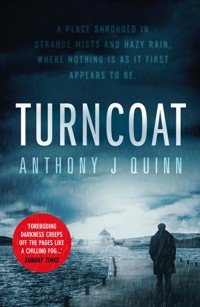
'Haunting and poetic' Crime Reads 'Unexpected, thought-provoking, and unsettling' Liz Robinson The sole survivor of a murderous ambush, a Belfast police detective is forced into a desperate search for a mysterious informer that takes him to a holy island on Lough Derg, a place shrouded in strange mists and hazy rain, where nothing is as it first appears to be. A keeper of secrets and a purveyor of lies, the detective finds himself surrounded by enemies disguised as pilgrims, and is drawn deeper into the mysteries of the purgatorial island, where he is forced to confront a series of disturbing secrets and ghosts in his own life. Haunting and unsettling,Turncoat probes the legacy of the Troubles, the loss of collective memories and the moral consequences for the individual. It is a story of guilt, survival and the terrible price of self-knowledge, told through the voice of a detective with a double life. Descending into paranoia, he uncovers a sinister panorama of cover-ups and conspiracies. The closer he edges to the truth, the deeper he is drawn into the currents of power, violence and guilt engulfing his country...
Das E-Book können Sie in Legimi-Apps oder einer beliebigen App lesen, die das folgende Format unterstützen:
Veröffentlichungsjahr: 2020
Ähnliche















Praise for Anthony J Quinn
‘Quinn’s is a highly original take on a much-traversed topic. He writes with melancholic elegance’ – Times Books of the Year
‘Atmospheric, elegant…It is a police procedural of the highest quality and has remained in my mind since I encountered it five months ago… a crime novel to be savoured’ – Daily Mail Books of the Year
‘Quinn’s pacy prose walks a fine line between a James Lee Burke-like melancholy and the sort of muscularity found in Michael Connelly’s works… a tense and unpredictable ride’ – Sunday Herald
‘Finely honed plotting… Quinn’s greatest skill is the evocation of the landscape’ – Financial Times
‘Beautifully written… the experience of reading the book is irresistible’ –Independent
‘A powerful tale stained with the darkest of noir’– Irish Times
‘The truth gradually becomes clear in this beautifully written novel’ – Literary Review
‘An absolute winner – a crime novel that doesn’t waste a single word in delivering its lean and muscular narrative’ – Good Book Guide
‘Carefully wrought, often lyrical prose, always rich with foreboding’ – Booklist
‘Quinn’s very readable novel is that unusual thing, an action story, with lots of uncut violence, written in a literary manner’ – Irish News
‘A superb depiction of the very human side of political strife’ – Crime Reads
‘A fascinating reworking of Yeats’ genuine fascination with the occult and a historical mystery novel, The Blood-DimmedTide is the first in a trilogy set in Ireland during this fascinating period of Irish history. If you enjoy this keep an eye out for those that follow’ – Dublin Duchess
‘Bringing vividly to life a pivotal point in Ireland’s history, The Blood-Dimmed Tide is a thrilling mystery storyfrom a unique voice in Irish crime fiction’– Brian McGilloway
‘Anthony Quinn blends crime fiction and literature into something truly wondrous and highly entertaining’ – Ken Bruen
‘This should make Quinn a star’ – Daily Mail
‘Outstanding. In the hands of reporter Anthony Quinn, who grew up in Northern Ireland in the 1970s and 80s, the beautifully written Disappeared is much more than a routine whodunnit as it unflinchingly lays bare the deep ambivalence that haunts post-peace process Northern Ireland society as it tries to come to terms with its violent past’ – Irish Independent
‘A superb debut steeped in the atmosphere of Northern Ireland’ – Irish Examiner
‘A tough yet lyrical novel’ –Sunday Times
‘The Troubles of Northern Ireland are not over. They may no longer reach the headlines, but they continue to damage lives and memories. This is the message so disturbingly, convincingly and elegantly conveyed in Anthony Quinn’s first novel, Disappeared… Beautifully haunting’ –Times
‘Much more than a routine whodunnit… Outstanding’ –Irish Independent
For my fellow Belfast pilgrims, Phelim Cavlan, Manuel Haas, Timothy Lawlor, Colmog McCluskey and Maura Toomey.
Irish Border, 1994
When the car carrying him and his police colleagues turned into the lane shortly after ten o’clock, the driver killed the headlights and let the vehicle roll along the track. Moments later, the bulk of the derelict farmhouse and its outbuildings swung into view, a collection of grey fragments tucked away amid the gloom of blackthorn and elder thickets. There was just enough moonlight for him to make out the smooth shapes of two white horses, their heads bowed together, standing eerily calm amid the thorns, as though they belonged to a dream or a different dimension.
He told the other detectives to remain in the car and stepped outside. He stared at the horses, which were hardly trembling at all in his presence, and then at the windows of the house, the broken panes covering sheets of blackness, the front door hanging slightly ajar, everything about the place receding into shadow or floating against the dishevelled pattern of silhouettes. He felt a flicker of fear in his stomach. He glanced back at the car and saw the face of Special Branch Detective Ian Robinson watching him closely, his eyes gleaming with anticipation. The insolent pleasure in the detective’s gaze made his skin prickle, but it also had the effect of galvanising him.
For the past month, he had grown used to Robinson being his tail, asking probing questions about his investigations, following him wherever he went with his set stare, lingering where he stayed. He dreaded to think what his mistakes and failures might look like through the eyes of this cold and attentive shadow, a detective who had advanced his career by patiently watching and waiting for Catholic officers like him to step over invisible lines of loyalty and political allegiance.
He shifted his weight from the gravel-strewn yard and stepped on to a patch of grass. He moved as quietly as he could, but his sneaking advance disturbed the two horses, which, in the low light, were the double of each other. They bolted with a minimum of effort, leaping a broken-down fence and galloping away in a long flowing movement. His chest tightened, and, for a moment, like a coward, he wanted to abandon his duties and flee the farmhouse. His eyes followed the pale shadows of the horses dipping and rising across the moonlit fields. Their synchronised flight and the way they hurried soundlessly into the night added to the air of unreality around the farm.
He surveyed the scene and his chest tightened again. It was the lack of human life, the broken silhouettes, the complicating shadows confronting him, which belonged more to the world of informers and betrayal than that of justice and order, and the sense of guilt he felt lurking in his heart, this strange feeling that he was slinking behind his own back, a sure sign that bad things were at hand. Was avoiding this feeling not a form of cowardice in itself?
He still had time to call off the operation. All he had to do was walk back to the car, order the driver to return to the city, and then, later, tidy up and file away the details of tonight’s journey as a wild goose chase into border country. It would be fitting if his career, which had been a sad trajectory through the purgatories of his accursed country, ended at this farmhouse hunched amid thorn trees. Tomorrow he would speak to his commanders, tell them he wished to give up the game of hide-and-seek with spies and suspects, the endless hours chasing down leads and examining bodies in derelict farms and border ditches. One corpse was like another, the much too long investigations blurring into each other, along with the dreamless nights and the mornings spent shakily riding the latest hangover.
However, he was almost upon the farmhouse. It would only take a few more moments to scoot around the rear and check that the place was clear. Everything was quiet apart from the whispering of the wind in the nearby trees, but somehow the air felt charged with the static of danger. The wind picked up, agitating the branches, multiplying the patterns that fell across the cracked walls of the farmhouse. He peered into the canopy of shadows trying to see what was being concealed amid the fan-like movements. He crept forwards, and then a movement made him look across.
Huddled behind a derelict tractor were three men in balaclavas with sub-machine guns. Before he could raise the alarm, they stood up, turning their weapons on him and the police car, and then they opened fire. The yard filled with the flaring of bullets and the sounds of metal rending. He felt the bullets whiz past him and bite the ground, stinging his face with bits of gravel. It was no longer a bad dream but a nightmare, moving too quickly for him to comprehend, the bullets flying everywhere, darting and unstoppable. The yard stretched interminably ahead, making it impossible for him to find cover. He knelt down and waited for the impact of the bullets, but felt nothing, a silence enveloping his body like a shield. At that instant, everything slowed down with the clarity of approaching death. He watched the shells of the bullets erupt from the jolting mouths of the guns and travel through the air in long trails and clusters, the eyes of the gunmen bulging as their bodies buckled against the recoil of their weapons.
Behind him, the police driver panicked, the gears of the car grinding horribly as he tried to reverse, and then the vehicle lurched to a stop. He looked back and saw the bewildered shapes of Robinson and his colleagues lunge for escape and then shudder under the hail of fire. Was it the whine of the bullets or their pitiful cries that he could hear, garbled and broken with echoes from the empty outbuildings?
Someone called his name. Looking up, he saw one of the gunmen take out a revolver and stand over him. The gunman raised his balaclava with one thumb to reveal a grinning face and a thick moustache that he vaguely recognised, before taking aim at close range and firing. First, he was blinded, and then he felt bathed in a searing light. He slipped forward, his mind leaving behind the dark pit of the farmyard, and the shadows of his past, all the piled-up murders of the Troubles and his entire secret history. He rose upwards, feeling so pure and free that he smiled with relief, willing himself higher towards the tranquillity of the floating stars, but then the feeling faded, and the light leaked back into darkness and the murk of the farmyard. He felt himself dragged down into the gunfire by the stubborn beating of his heart and its lonely black mass of guilt. He lay for several long moments staring at the unfathomable night sky, hearing further gun blasts and the sounds of running feet.
He raised himself to a sitting position and realised that he was uninjured and the gunmen gone. Mesmerised by his survival, he sank back to the ground, panting heavily. A while later, he hauled himself to his feet and stumbled over to the bullet-ridden car.
The interior of the vehicle was torn to pieces. Blood seeped from the opened doors, forming thick pools on the yard. The three men inside were not moving. He stared at their dying bodies with his estranged detective’s eye. They were fresh-faced, but already grey lines were deepening around their features. Should he attempt resuscitation, pump their ribcages, try to breathe life back into their mouths and lungs? He could tell it was too late. Robinson’s eyes gazed at him, impudent and full of suspicion, but they were open only to death now, turning glassy and cold. No longer would the Special Branch officer prowl around the edges of his investigations, or hover at his door like a gleeful messenger about to break bad news.
He was used to cold-blooded murder, and attacks like these were part of his weekly routine. However, some meaning in the crime scene eluded him. He was the lead detective, the one who had organised the operation. He should have died here, the way police heroes were supposed to die, but somehow he was still alive. What did it all mean? He had done nothing wrong. It was not his fault that the gunmen had mounted an ambush and killed his colleagues. Then why this feeling of fear and guilt? He felt the menace in Robinson’s dead eyes, the suspicions that would gather at the implausibility of his survival. These officers had come to the farmhouse because of him and now they were dead. No amount of protestations would change that fact. His career as a detective would never be the same again. He did a double take of the scene and saw how it suggested the darkest form of betrayal, a ghostly farmhouse with no eyewitnesses, a carload of executed police officers, the killers mysteriously vanishing into the night and the sole survivor standing at a safe distance, completely unscathed.
He left the car and the dead bodies, and ran into the night as if seeking refuge from a gathering storm. He made long zigzagging sweeps in the shadows, running in the direction the horses had taken. He had no guide or track to follow. His journey was just beginning. Before the night was over, he would have to fashion a story for himself, otherwise no one would believe him. He would have to concoct an explanation for his unlikely escape, a reason why the gunmen had missed him in their relentless fire. The detectives in the car and the driver, they were the ones who deserved a story to themselves, not him, but already they were beginning to lose their reality, their cold faces taking on the shining edges of fallen martyrs.
He felt hollow inside, unsure of anything, least of all his own thoughts and feelings, stumbling over his shadow, the ghost of a lonely detective who had somehow escaped his own execution.
ONE
Morning-time and a sodden darkness had settled over Belfast, rain falling on to the dirty lumps of buses and army Land Rovers, the roar of their diesel engines sounding reckless and barely civilised amid the gushing flow of water. Everything was dripping wet, the gutter pipes and shop canopies, the bedraggled pigeons, the trembling shapes of the buildings and the office workers organising themselves like gangs at the bus-stops, their faces peeking from beneath soaking hats and umbrellas, even the smoke and fumes were dripping wet.
Like a prisoner breaking parole, I dashed down Great Victoria Street, avoiding the drainpipes and spraying traffic, and slipped into a café opposite the Europa Hotel.
I ignored the breakfast menu, ordered a cup of tea, and grabbed the newspapers, which were filled with headlines of the IRA ambush. I slumped into a seat at the back and scanned the reports, a lonely dread descending upon me that had nothing to do with the weather. The waitress brought me a cup of boiling hot tea and smiled, as if to reassure me, but I was far from feeling reassured.
I put away the papers and stared through the window, feeling the dripping water penetrate to the toes of my feet, wishing that the rain would wash away the newspaper headlines. I should have resigned from the force weeks ago on the day Special Branch assigned Robinson to my team. However, to do so now would only arouse more suspicions. Might I approach a doctor and ask for a medical certificate, instead? A simple enough solution, surely, especially after the shock of the ambush. I knew of detectives who had made their escape thanks to a sympathetic doctor, and they had managed the transition to civilian life well enough.
By any other measure, in any other career, I was nowhere near past it, but the fact that I had survived and walked away Lazarus-like from the bullet-strewn farmyard had left me with an unnerving exhilaration that would not settle. I checked my reflection in the nearby mirror, and caught the sight of blood staining my shirt collar. Fragments of flying gravel had nicked my neck, and the drops of blood were enough to bring out the sweat on my forehead and turn the café floor into a vertiginous tunnel.
My informer, an IRA man code-named Ruby, had supplied the tip-off for the operation that ended in the deaths of my colleagues.
The consequences of this were serious for me. Fingers would be pointed and judgement passed, casting me down into my informer’s secretive and lowly world. I glanced back in the mirror at my face. In my youth, I had written off the habit as a form of narcissism, but this morning I saw it as a darker problem, a need to anchor myself in the world as a solid object, a real person not made up of rumours and half-truths.
I gulped down my tea and measured myself against my reflection. I scrutinised my eyes but saw nothing there, apart from the weariness of a detective trapped in the land of the dead, a detective with dozens of unsolved murders on his books, a detective who felt he could show his true face only in this crowded café, waiting for the look of guilt to surface in his features like that of a fox peeking from its den.
I should not be hiding here.
I should be at the station, reviewing the entire operation with a team of officers, examining where it might have gone wrong, searching for any degree of complacency or negligence in its planning. I tried to put it behind me. My hands began to feel less clammy, and I composed myself. My conscience understood and accepted the fact that the others were dead, and there was no possibility of them ever resuming their mortal lives and pursuing me with their unanswered questions.
All I could do now was try to forget their faces, bury them in the sights and sounds of the café, and afterwards a bottle of vodka and sleep. In a few days, I would return to normality. My conscience would sort itself out and become rock solid, fully secure in my role as a detective in spite of the interference of Special Branch, a trusted handler of spies and informers. Then, I remembered my last conversation with Ruby and once more, the notion of my guilt broke through. I reached for the hip flask in my jacket pocket, spilled a large measure of vodka into the dregs of my cup, and knocked it back.
‘Who were you talking to?’ asked a voice in the passing stream of customers.
‘No one. It was a stranger,’ a young woman answered. ‘He thought he knew me.’
‘Right, but why did he hug you?’
‘I’ve no idea. Like I said, he thought he knew me.’ Her heels tapped on the floor as she waited. Then the queue shuffled onwards and the conversation blurred into an indistinguishable murmur.
I stared at the customers, the rainy light glistening upon their wet jackets and carrier bags. Steam billowed and hissed from the appliances behind the counter. I listened into other conversations, the brief, garbled sentences preventing me from listening to my own thoughts. I tried to stay afloat in their world, without my own feelings opening up and pulling me back down to that lower plane of existence. The more people who crowded around me, the calmer I felt. The city carried on in its sodden way, unmoved by the sense of doom that hung over me and the jabbing fingers of blame I could picture in my mind’s eye. A sense of peace filled me in spite of the sickness in my stomach.
I ordered a fresh cup of tea and poured myself another generous measure of vodka.
Slowly, everything grew blurred. The voices and faces ceased to cohere, like the milk and sugar dissolving in the swirls of hot tea. A moment of balance arrived, the first I had experienced since the ambush.
Perhaps I had nothing to fear after all.
In this café full of innocents, I allowed my thoughts to drift back to the events of the previous evening. I tried not to alter or distort the sequence of decisions that had led to the deaths of the three police officers, wary that my mind might filter the painful details or skim over some vital clue to my culpability.
I racked my brain, going over the details of my recent encounters with Ruby, but I could recall only fragments of what had been said, and had written down almost nothing afterwards. In fact, there existed practically no record of what we had discussed together, no traces left of the fleeting plans we had hatched, the doubts and fears that troubled us, the spoken words that might have been misunderstood or distorted as insults, or the promises I might have made and forgotten, the indiscreet remarks that might have slipped from my tongue, but had been pounced upon by Ruby to forge my downfall.
For years, I had been erasing men like Ruby and their roles from my mind because I had secretly judged our relationships to be degrading and unpleasant. I had hidden them not only from my colleagues and commanders, but from myself, too.
So little existed about Ruby’s identity, and what little there remained was never mentioned or talked about to anyone. I never passed on the details that I knew, and those details were but a tiny fraction of the whole. Special Branch had preached that recruiting informers from the ranks of the IRA was the best way of obtaining information, and I had been doing my detective duty by pushing Ruby, raising the stakes with him, encouraging him to tell me more.
But what were the feelings that ran through me? What did I think when I heard his voice grow more haggard from one late-night telephone conversation to the next? I had always thought ahead, concentrating on the next task, but deep down I had known that our destinies were yoked together; Ruby, the informer, one of the doomed and lowly, and me, his handler, one of the saved and exalted, and that our relationship would end only with the death of one of us.
TWO
I was still staring at my reflection in the mirror when a man with a heavy beard came thrusting through the café doors.
Even in the reflection, I recognised the sarcastic curl to his lips. It was the journalist McCabe, but what was he doing here this morning? And who was he staring at as though he were sizing them up for the drop?
I craned my neck to follow his movements, and, with a start, realised he was making a beeline for me.
McCabe had a photographer in tow, an overweight man, holding a camera in both hands, who kneeled in front of me, aimed and started taking photographs. The bulb flashed and I felt the shock of exposure, the sense that all my years of undercover work as a detective were ending at last.
I raised myself to a half-standing position and ordered him to stop.
In all the time that I had known McCabe, I had never seen him with a photographer before. Now the reporter was staring at me as if I were an interesting object of study. What had singled me out, made me the journalistic prize of the day? Only the names of the officers who had died in the ambush had been released to the news stations, and mine had been kept secret, I presumed for operational reasons. Besides, I had always made myself accessible to the press, made it my raison d’être to be forthcoming with comments, even off the record, and always agreed to interviews. Why then did McCabe feel the need to jump upon me in public? I fell back into my seat, when I should have been moving, pushing through the crowd and exiting the scene as quickly as possible.
McCabe spoke to the photographer. ‘Get a shot of him with the mirror in the background. This will be the scoop of the year.’
‘What are you doing?’ I said.
‘Hunting down the biggest story of my career.’ McCabe breathed heavily. There was something sinister but courtly in the way he leaned towards me. ‘My contacts tell me the intelligence services have been searching for an IRA spy, a traitor operating at the heart of the security services. The latest word is they have you in the frame, Desmond Maguire. They’re gathering evidence that you compromised yourself, your dead colleagues and the public in return for large sums of money.’
I could not get my breath. McCabe spoke in his usual bantering tone, but the firmness of his gaze and the presence of the photographer indicated the seriousness of his intent.
‘I never thought someone like you would send their colleagues to their deaths in such a callous way.’
I was dazzled by the flashing camera, and the intensity of McCabe’s expression. His face glowed like that of an avenging angel clearing the path of truth through a field of lies and cover-ups. I crouched in my seat, willing the hustle and bustle of the café to return so that I might slip away and hide on the streets, among people who were not tied together by secrets, and who were free to come and go as they pleased.
‘Sorry for the abrupt manner in breaking the news to you.’ McCabe watched me carefully. ‘I had no choice, believe me. Very soon every reporter in the city will be looking for you.’
‘I can’t comment on such a ludicrous lie.’
‘I didn’t ask you for a comment.’
‘Then what do you want?’
I could no longer see my own reflection, only theirs. For several moments, I lost myself, or at least the image of myself I presented to the world.
‘I’m not asking you for your opinion of the reports. I want more than that.’
‘But aren’t you interested in hearing what I think of this outrageous claim?’ I held on to the hope that McCabe’s lead might be an accident, some sort of hoax or intelligence operation perpetrated on the wrong person.
‘Afraid not.’
‘What do you want, then?’
‘I want your story. Your true story, not the false one.’
I knew one story only. The story I had been memorising for months and going over in my head all night since the ambush, the unchanging story that had allowed me to survive, the story I had been reciting to myself every day to guide my destiny as a detective.
‘My story is all I have. It belongs to me and no one else, not you, or your editor or your readers.’
‘Wrong, Maguire. Your story belongs to me, now. Remember that, you and Ruby belong to me.’
‘Who’s Ruby? I don’t know anyone of that name.’
‘I know you’re lying. You can’t fool me.’
McCabe was armed with knowledge and he was not shy of showing it. He said the botched operation had begun as a raid on an abandoned farmyard suspected of previously being the centre of a fuel-smuggling racket. The intention had been to search the premises for documents and equipment that would link the fraud back to the IRA. McCabe also knew that one of the smugglers, a man called Brian Fee, had been found dead in a fume-filled car in an Antrim forest a week before. Fee had been due to meet Special Branch detective Ian Robinson to discuss offering information about the role of the IRA’s leadership in various criminal activities and their links to a corrupt police officer. The tip-off about the farm’s location had been supplied after Fee’s death by an informer named Ruby, and I was his handler. McCabe knew that I had been involved at every stage of the raid’s planning. He even had the times of the meetings and the names of those in attendance. Special Branch had wanted to abort the raid, sensing there was something suspicious about the set-up at the farm. It seemed too good to be true, they had counselled, but somehow I had convinced them to go ahead.
‘Who have you been talking to?’ I asked. I would have to hunt down Robinson and find out how the information had been leaked, but then I remembered that Robinson was dead.
‘It’s understandable you have questions to ask, but I’m the one directing this conversation and I’m only in the mood to ask questions not answer them.’
McCabe clearly felt he had the upper hand, that he had acquired the right to dictate the interview. Or was it just a performance, a game of make-believe based on the unfounded suspicions of Special Branch and a few threats added for the occasion?
‘Look, Maguire, you haven’t much time to come up with some answers. I’ve asked the Ministry of Defence to deny or confirm that they are hunting a mole within the RUC. The department is due to release a press statement this afternoon.’
I blinked and said nothing. Now that I looked carefully in the mirror, I could see bits of myself, components of my body and facial features that had somehow been disassembled by McCabe’s accusation. Perhaps when the journalist left I might pick up the pieces and put flesh back on the mask.
‘Why did you ask Detective Ian Robinson to join in the operation?’ asked McCabe.
Robinson had expertise in cracking smuggling cases, and I knew he could handle himself in a tricky situation, but I was not going to tell McCabe that.
The reporter kept pushing, a smirk forming on his face. ‘Nothing to do with the fact that Robinson had reported you for being drunk on duty?’
‘I’m not answering your questions.’
‘Listen, two detectives and a constable out of Crumlin Road Police Station are lying in the morgue, and you were the senior ranking officer. There was just one police car, no backup, and no proper surveillance on the farm. The IRA riddled your vehicle with bullets, but somehow you walked away, miraculously unscathed. It’s not just me who’ll be asking you these questions.’
‘I suggest you ring the press office and stop harassing me.’
‘Absolutely, that’s the correct protocol, but you never followed it in the past. You know, I always thought you were too willing to talk to reporters. Too quick to make a comment. Too present when we attended police briefings. I always suspected you had to be hiding something. The way you searched out answers to our questions. But now I’ve got the inside track, you’re not so confident or forthcoming anymore.’
McCabe’s insistence that he had secret knowledge, mingled with my own uncertainty, was enough to make me almost believe the dangerous claim. The notion of my guilt had haunted me all night, the hopeless feeling that for months I had been pushing a wheel of grim fatality without hearing or seeing or knowing what exactly was going on, that I had been so obsessed with the repetitive nature of my detective’s existence and the nightly relief in alcohol that I had never considered where it might take me. McCabe was right. I was in serious trouble if my survival under a hail of gunfire had not been an outright miracle.
McCabe pushed his card on to the table. ‘Here’s my number. When you feel like talking give it a ring.’
Then he swept out of the café with his photographer in tow. I could see the confident swagger that had taken hold of him, emboldened by his foreknowledge of my downfall. Yet, when he crossed the street, his walk changed. I watched him dodge his way through the crowd, his head down, his hands rammed in his coat pockets, as though he had just won the first round against a dangerous enemy.
THREE
During the worst days of the Troubles, Belfast kept its traitors out of sight, like the homeless drunks who froze to death in back alleyways, or the suicides who threw themselves off bridges into the dank Lagan waters. The bodies of spies and informers were usually transported to the border and left in ditches or covered in bin bags where they no longer posed a risk to anyone, and their deaths might not seem so terrible or pitiable. Was it because traitors were so closely connected with shame and death, their disappearances amounting to a collective act of repression? But what was being concealed from public view? What would happen if the city did not tidy away its informers and spies?
The ambush had the effect of completely obliterating my ordinary life as a detective. All those unsolved murders to investigate and meetings to attend in smoke-filled incident rooms seemed superfluous now. I lay low for the rest of the day and that night, sleeping in my car and avoiding contact with everyone, working my way through a bottle of vodka. The following morning I read the newspapers and tuned in to the radio to hear news about McCabe’s claims. The picture of me in the café was splashed across the front page of the Belfast Telegraph with the caption: ‘One of the police force’s most highly commended Catholic detectives, Desmond Maguire, who miraculously survived the IRA gunfire that killed his colleagues.’
There was not a single mention about a police informer in the bulletins, but the questions the photograph and the reports raised seemed clear enough. ‘By some extraordinary chance’ were the words McCabe used to describe my escape. ‘When questioned, Detective Maguire said he had no explanation for the events,’ he had added. Betrayal or coincidence? Was I a traitor or the beneficiary of a miracle? Somehow, I was alive. In that bloodstained farmyard, I had run from the slumped bodies of my colleagues and into the night. I was still breathing and they were not. My mind had struggled with the shock of their deaths and my survival, and now it had to fight against the mounting fear that the ambush had implicated me. Was it because of something I had said? Did they die because of that? And if I was responsible, what punishment lay ahead for me?
I did not know the answers to these questions. Other people might. It was possible that McCabe knew nothing as well. If he had more evidence, he would have printed it in the newspapers. However, he had been unable to prove his claims, in spite of his bluster in the café. Perhaps he did not have any secrets. The only person who possibly did was Ruby, and I could not contact him, even though I kept imagining his voice whispering at me as I walked the streets. Was it my imagination, or did the pedestrians face me more squarely? As though they had overheard the rumours about my betrayals, and taken to the streets to confront me. I detected a collective swagger of well-being in the way they marched towards me. Even the pigeons swooping close by seemed tempted to alight and take a peck at my eyes.
However, in spite of the publicity around the ambush, the city seemed content to leave me alone and in full view. As if no longer bothered to remove its traitors from the public eye. It seemed unthinkable, but I was able to walk about, order tea in the cafés and sit on park benches, drinking vodka as though it was water, a drunken detective for all to see and pity.
In the evening, I made my way to the Lagan towpath, fortified by a half-bottle of spirits. I walked under skeletal branches that were just beginning to sprout tender little leaves, the new life uncurling and crawling onwards in its march against death and darkness. In spite of the embryonic signs of spring, it had grown cold. I had bundled myself up in an overcoat, a woollen hat and a scarf for extra protection against the biting air and any curious onlookers. My mental habits had changed. I had grown alert to coincidences, wary of what lurked beneath the surface of things, hunting for any clues of the destiny that lay in store for me.
For instance, I worried about the solitary man walking his dog towards me. I wanted to ask him to identify himself and explain his presence at the river because, for a moment, he had given me a nasty turn. I thought I had seen a ghost because he had the same long head and curly hair as Robinson. He even had a similar build and gait. I could not take my eyes off him, until I reminded myself that Robinson had never been a dog-lover and was definitely dead.
I was pondering the similarity when I saw the figure of Chief Inspector Alan Pearson, the head of my outfit at Crumlin Road Police Station, emerge from his parked car. I waved over and he looked around before walking slowly in my direction.
‘Desmond, is it really you?’ he asked, watching me as if I were a cornered animal, unsure of what I was going to do next. ‘You don’t look well. What the hell happened to you?’
‘Don’t even think about going back to the car, Alan. I want you to take a walk with me.’
‘Are you sure?’
‘Yes, the fresh air will do us both good.’
He seemed reluctant. ‘Why the great secrecy? Why send me a cryptic telephone message and ask to meet here alone? Why can’t we go back to the station and talk there?’
‘Start walking.’
He stepped alongside me, cold-eyed. ‘I don’t think you realise the trouble you’re in.’ He stared straight ahead, a regimental gesture, as though he were inspecting me on parade. ‘You’ve compromised yourself by running away from the ambush and not making contact with anyone. Even your closest colleagues are viewing you with the deepest suspicion. They say they’ll never work with you again.’
Hearing him mention the other officers, and the way he glanced to one side, made me think he was referring to Robinson, Clarke, and Elliott, the men killed in the ambush, who had somehow cast their judgements on me from beyond the grave. Then I realised he was talking about the surviving members of the team at the station.
He swung his arms vehemently. ‘And now you’re compromising me by dragging me here in secret. Special Branch has ordered me to relieve you of your police duties and ask for your gun. They want to talk to you about the ambush. Their questions will be aimed at your informer and the nature of your relationship with him.’
I moved ahead of him, walking briskly, expecting him to catch up. ‘Don’t worry; I know I’m in deep trouble. There’s a lot I don’t understand myself, but I’m determined to clear any suspicion hanging over me.’
He was at my shoulder. ‘First you have to tell me what happened at the farmhouse. Were you injured or knocked unconscious? For God’s sake, have you even seen a doctor?’
‘I’ve felt better, but I’ll be all right. When the IRA opened fire, I was trapped and couldn’t move but somehow I managed to avoid their bullets.’
‘What happened?’ He watched me intently. ‘Did you return fire or radio for help? Did you check your colleagues to see if they could be saved?’
‘I don’t remember what I did. I knew we had come under attack and that everyone else in the car was dead or dying. I felt I had to keep running.’




