Table of Contents
The Blackwell Philosophy and Pop Culture Series
Title Page
Copyright Page
Dedication
Acknowledgements
Introduction
PART ONE - TWILIGHT
one - YOU LOOK GOOD ENOUGH TO EAT: LOVE, MADNESS, AND THE FOOD ANALOGY
“Sorry about the Food Analogy”—What’s Your Pleasure?
“What I Knew Was Right . . . and What I Wanted”
The Vampire Socrates
Lambs and the Predators Who Adore Them
“Other Hungers . . . That Are Foreign to Me”
“A Moonless Night”
NOTES
two - DYING TO EAT: THE VEGETARIAN ETHICS OF TWILIGHT
Scene 1. In Which a Reasonable Ethic Is Proposed
Scene 2. In Which a Classmate Brings Up an Unpleasant Scenario
Scene 3. In Which Edward Says No to the Kosher Option
NOTES
three - CAN A VAMPIRE BE A PERSON?
What Is a Person (Other Than Vampire Food)?
What Humans, Vampires, and Animals Have in Common
If Animals Are Human Food, Are We Vampire Food?
Naughty Vampire! No People for You!
NOTES
four - CARLISLE: MORE COMPASSIONATE THAN A SPEEDING BULLET?
Carlisle’s Theory of “Gifts”
Carlisle’s Super-Compassion
Is Compassion a Feeling?
Compassion of a Saint?
Compassion, Caring, and the Cullen Family
The Power of Connections
NOTES
PART TWO - NEW MOON
five - VAMPIRE-DÄMMERUNG: WHAT CAN TWILIGHT TELL US ABOUT GOD?
Evil’s Not a Problem, Because Evil Doesn’t Exist
Evil’s Not a Problem, Because Evil Indicates Ignorance
Evil’s Not a Problem, Because It’s the Necessary Cost of Good
Evil, Transcendence, and Natural Goodness
NOTES
six - TO BITE OR NOT TO BITE: TWILIGHT, IMMORTALITY, AND THE MEANING OF LIFE
More Love and Death
On Losing One’s Soul
I’m Bored . . .
It’s Complicated
NOTES
seven - MIND READING AND MORALITY: THE MORAL HAZARDS OF BEING EDWARD
Does Power Corrupt or Reveal Moral Character?
Benevolence and Mind Reading
Privacy and Mind Reading
Love and the Inequality of Mind Reading
God and Morality
One Last Thought before Dawn
NOTES
eight - LOVE AND AUTHORITY AMONG WOLVES
What’s Free Will, Anyway?
The Wolves, Free Will, and Authority
Wolf Love and Free Will
A Final Worry
Here Jacob Stands: He Can Do No Other
NOTES
PART THREE - ECLIPSE
nine - BELLA SWAN AND SARAH PALIN: ALL THE OLD MYTHS ARE NOT TRUE
Having It All
All of the Myths Are True
Consider Sarah Palin
A Lesson for Serious Feminists
Who Are the Real Elitists?
A Lesson for Feminists
Having It All in Real Life
NOTES
ten - VAMPIRE LOVE: THE SECOND SEX NEGOTIATES THE TWENTY-FIRST CENTURY
Back in Time
The Second Sex in the Twenty-first Century
A Feminist Subtext
The Price of Existence
NOTES
eleven - EDWARD CULLEN AND BELLA SWAN: BYRONIC AND FEMINIST HEROES . . . OR NOT
You’re Only Young Once, but You Can Be Byronic Forever
Why Byronic Heroes Make Bad Bosses
Jane Eyre: Gritty Governess, Runaway Bride, and Feminist Hero
The Byronic Hero: Now Available in Marble-like, Sparkly Perfection
Can You Still Be a Feminist If You Become a Bloodsucking Vampire for Your Husband?
Self-Exiled Harold Wanders Forth Again; or, Basically, Bella and Edward Deserve ...
NOTES
twelve - UNDEAD PATRIARCHY AND THE POSSIBILITY OF LOVE
The Control Issues of Edward Cullen
Bella’s Mixed Reactions
Edward’s Progress
Talked into Love
Risk and Transformation
NOTES
thirteen - THE “REAL” DANGER: FACT VS. FICTION FOR THE GIRL AUDIENCE
Just the Facts, Ma’am
Bella and “Generation Me”
Twilight in the Desert of the Real
New Moon Rising?
NOTES
PART FOUR - BREAKING DAWN
fourteen - TWILIGHT OF AN IDOL: OUR FATAL ATTRACTION TO VAMPIRES
An Undying Wish
Deadly Transformations
Unbreakable
Bloody Special
Lone Wolves
Tortuous Thirsts
The Not-So-Guilty Pleasures of Twilight
Once Bitten, Twice Shy: Grave Concerns about Vegetarian Vampires
NOTES
fifteen - BELLA’S VAMPIRE SEMIOTICS
The Signs around Tyler’s Blue Van
The Philosopher of Oneness, Twoness, Threeness
The Sign of the Cross
The Signs of a Good Vampire
Vampire Semiotics Are No Guarantee . . .
The Semiotic Waltz: One, Two, Three, One, Two, Three, One, Two, Three
NOTES
sixteen - SPACE, TIME, AND VAMPIRE ONTOLOGY
Kantian Space and Time
Kant, Dracula, and Twilight’s Vampires
Abilities beyond Space and Time: Alice, Edward, and Aro
When Worlds Collide
NOTES
seventeen - FOR THE STRENGTH OF BELLA? MEYER, VAMPIRES, AND MORMONISM
What’s Religion Got to Do with It?
Meyer’s Religion and Its Philosophical Context
Eternal Covenants, Binding Promises
Eternal Union in Body and Spirit
Close but Not Too Close: The Erotics of Abstinence
Returning the Gaze
Nice Mormon Girls and Sexy Vampires
NOTES
eighteen - THE TAO OF JACOB
It’s Always Darkest before the Dawn
No Good Deed Goes Unpunished
Bend So That You Don’t Break
The Dawning of a New Era
NOTES
CONTRIBUTORS
INDEX
The Blackwell Philosophy and Pop Culture Series
Series Editor: William Irwin
South Park and Philosophy
Edited by Robert Arp
Metallica and Philosophy
Edited by William Irwin
Family Guy and Philosophy
Edited by J. Jeremy Wisnewski
The Daily Show and Philosophy
Edited by Jason Holt
Lost and Philosophy
Edited by Sharon Kaye
24 and Philosophy
Edited by Richard Davis, Jennifer Hart Week, and Ronald Weed
Battlestar Galactica and Philosophy
Edited by Jason T. Eberl
The Office and Philosophy
Edited by J. Jeremy Wisnewski
Batman and Philosophy
Edited by Mark D. White and Robert Arp
House and Philosophy
Edited by Henry Jacoby
Watchmen and Philosophy
Edited by Mark D. White
X-Men and Philosophy
Edited by Rebecca Housel and J. Jeremy Wisnewski
Terminator and Philosophy
Edited by Richard Brown and Kevin Decker
Heroes and Philosophy
Edited by David Kyle Johnson
Final Fantasy and Philosophy
Edited by Jason Blahuta and Michel Beaulieu
This book is printed on acid-free paper.
Copyright © 2009 by John Wiley & Sons, Inc. All rights reserved
Published by John Wiley & Sons, Inc., Hoboken, New Jersey Published simultaneously in Canada
No part of this publication may be reproduced, stored in a retrieval system, or transmitted in any form or by any means, electronic, mechanical, photocopying, recording, scanning, or otherwise, except as permitted under Section 107 or 108 of the 1976 United States Copyright Act, without either the prior written permission of the Publisher, or authorization through payment of the appropriate per-copy fee to the Copyright Clearance Center, 222 Rosewood Drive, Danvers, MA 01923, (978) 750-8400, fax (978) 646-8600, or on the web at www.copyright.com. Requests to the Publisher for permission should be addressed to the Permissions Department, John Wiley & Sons, Inc., 111 River Street, Hoboken, NJ 07030, (201) 748-6011, fax (201) 748-6008, or online at http://www.wiley.com/go/permissions.
Limit of Liability/Disclaimer of Warranty: While the publisher and the author have used their best efforts in preparing this book, they make no representations or warranties with respect to the accuracy or completeness of the contents of this book and specifically disclaim any implied warranties of merchantability or fitness for a particular purpose. No warranty may be created or extended by sales representatives or written sales materials. The advice and strategies contained herein may not be suitable for your situation. You should consult with a professional where appropriate. Neither the publisher nor the author shall be liable for any loss of profit or any other commercial damages, including but not limited to special, incidental, consequential, or other damages.
For general information about our other products and services, please contact our Customer Care Department within the United States at (800) 762-2974, outside the United States at (317) 572-3993 or fax (317) 572-4002.
Wiley also publishes its books in a variety of electronic formats. Some content that appears in print may not be available in electronic books. For more information about Wiley products, visit our web site at www.wiley.com.
Library of Congress Cataloging-in-Publication Data
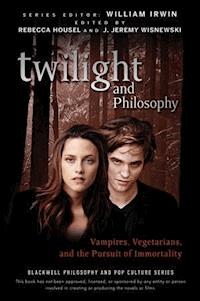
Twilight and philosophy : vampires, vegetarians, and the pursuit of immortality / edited by Rebecca Housel and J. Jeremy Wisnewski.
p. cm.
Includes index.
eISBN : 978-0-470-55414-2
1. Meyer, Stephenie, 1973- Twilight series. 2. Meyer, Stephenie, 1973—Philosophy. 3. Vampires in literature. 4. Immortality in literature.
5. Immortality (Philosophy) 6. Philosophy in literature. I. Housel, Rebecca.
II. Wisnewski, Jeremy.
PS3613.E979Z89 2009
813’.6—dc22 2009030809
To Twilight fans of all ages, both living and undead.
ACKNOWLEDGMENTS
Supernatural Humans We Can’t Live Without
Jeremy and Rebecca would like to collectively thank the contributors of this book for their extraordinary efforts, the team at Wiley who made this project come to life, including Connie Santisteban and Lisa Burstiner, and of course the series editor, William Irwin, for his incredible editorial instincts as well as his pop culture and philosophical prowess—are you sure you’re not a Cullen?
Jeremy thanks his posse for their willingness to put up with endless nonsense and equally endless obsession. Thanks, Dorothy and Audrey. (He’d also like to thank his new son, Lucian Xavier Wisnewski, just because he wants the boy to be thanked in a book—it’s an auspicious start.) Jeremy also wants to thank Meg Lonergan for her patience with proof-reading and her toleration of quirks. She’s been a great help over the past couple of years.
Rebecca conveys hearty appreciation to Laura Smith-Savoca and Jenny Geissler for prepurchasing Twilight tickets, getting to the theater early, and patiently waiting in line with all the tweens and teens so Rebecca could see the movie opening day—what an experience! She also thanks Stephenie Meyer for creating the Twilight universe, Stephen King for being a literary inspiration, and J. K. Rowling for helping to expand the possibilities of the middle-grade/young-adult genre. Abigail Myers gets a shout-out along with Derek Harrison, Ethan Schwartz, Jaime Freedman, and Marguerite Schwartz. Thanks to Mary Conley-Thomas and Eva Schwartz-Barson for being inspirational women who instill a love of story in all their grandchildren and great-grandchildren, and last but certainly not least, Gary, Bob, and Bell for all you do!
INTRODUCTION
Undead Wisdom
Freud once claimed that love and death mark the driving forces of human existence. Having fallen in love with the undead of Twilight, we might well say the same thing about this vampire tale. The Twilight books confront love and death, and so much more, in a way that facilitates a strange recognition—that the dead are indeed wise, and that they are sometimes wise in matters of the heart, even when that heart doesn’t beat. The strange beauty of Twilight lies here, as elsewhere: we are all faced with death, and we all desire to love. These two facts—one deeply unpleasant, the other quite pleasant—are evident in Twilight. This makes for great reading, and as you will soon see, it also provides great philosophical opportunities.
Death is everywhere. It is between any two syllables, waiting to choke the final breath out of you. It is a force like no other: inescapable, ineffable, and absolute—at least for mere mortals. Death captivates. It haunts. The thought that somehow death might not master us enchants the mind until we find ourselves drawn again and again to the hope that we might escape our fate—by being made immortal vampires, or finding an afterlife, or through a scientific “cure” for death. There is little as powerful as the thought of death, and probably little that motivates us in the way that our mortality does.
Except perhaps love. The existentialist philosopher Albert Camus (1913-1960) once claimed that the only real philosophical question was whether or not to kill yourself in the face of an absurd world. The writer Tom Robbins thinks one can only answer this question with one even more basic: Are you able to love? For love, Robbins suggests, is the only thing that makes life worth living. Love allows us to see things we could never see without it. It shapes our perceptions of the world and enables us to be open to deep, meaningful experiences. It can change a humdrum little town in Washington into a world of wonder.
In the world of Twilight, death is not inevitable, and the purest form of love seems to have been found. Such a world not only allows an exploration of the human condition—facing our deepest and darkest fears, as well as our highest hopes. It also demands that we explore our condition—and there is no better companion for such an exploration than philosophy.
The Twilight saga is full of love and death, as well as a host of other topics central to the way we understand ourselves and navigate the world. Philosophical issues permeate the pages of the Twilight books. Bella and Edward are a mirror for our greatest fears and hopes—for all that can go right with our lives and all that can go wrong. They are the human condition writ large, there for our reflection and exploration.
Perhaps surprisingly, we have a lot to learn from the undead, as well as from the way they relate to the living—about ourselves, our experiences, and our relationships with other people. This book aims to help you with just that, asking such questions as: What is the nature of love? Is death something to be feared? How should feminists react to Bella Swan? Is there a moral obligation to be vegetarian? What is it like to experience the world as a vampire? What does it mean to be a person? How free are we?
Forks, Washington, is a small town; unfortunately, minds can be very small places, too. But philosophy has a way of opening up both: It allows us to see what we hadn’t seen before and allows us to explore issues we might not otherwise explore. Only literature rivals philosophy in this capacity, making our examination of the Twilight saga the perfect place for literature and philosophy to meet.
So whether you’re a fan of Edward Cullen or Jacob Black, believe Bella a fool or a romantic, or are a vegan or a carnivore, keep reading! You’ll enjoy chapters on everything from why we love vampires to how Edward is a Byronic hero to the Tao of Jacob, and much more.
PART ONE
TWILIGHT
one
YOU LOOK GOOD ENOUGH TO EAT: LOVE, MADNESS, AND THE FOOD ANALOGY
George A. Dunn
There is always a bit of madness in loving. But there is also always a bit of reason in madness.
—Friedrich Nietzsche1
Edward Cullen is doomed. The new girl sitting next to him in biology class looks and—to make matters even worse—smells good enough to eat. In fact, in the century or so he’s been stalking the Earth, Edward has never before inhaled a fragrance quite so intoxicating. His nostrils have in their delirium taken the rest of his brain hostage. His sanity is on its way to becoming a dim memory, along with all that gentlemanly self-restraint he’s worked so long and hard to cultivate. All he can think about is what he’d like to do with this girl once he gets her alone—and how he can make that happen. Blinded and blindsided by this sudden upsurge of appetite, he’s able to regain control of himself just long enough to bolt out the door and drive to Alaska, where a couple of days of cool mountain air does the work of a long, cold shower, sobering him up and chilling him out.
Lesen Sie weiter in der vollständigen Ausgabe!
Lesen Sie weiter in der vollständigen Ausgabe!
Lesen Sie weiter in der vollständigen Ausgabe!
Lesen Sie weiter in der vollständigen Ausgabe!
Lesen Sie weiter in der vollständigen Ausgabe!
Lesen Sie weiter in der vollständigen Ausgabe!
Lesen Sie weiter in der vollständigen Ausgabe!
Lesen Sie weiter in der vollständigen Ausgabe!
Lesen Sie weiter in der vollständigen Ausgabe!
Lesen Sie weiter in der vollständigen Ausgabe!
Lesen Sie weiter in der vollständigen Ausgabe!
Lesen Sie weiter in der vollständigen Ausgabe!
Lesen Sie weiter in der vollständigen Ausgabe!
Lesen Sie weiter in der vollständigen Ausgabe!
Lesen Sie weiter in der vollständigen Ausgabe!
Lesen Sie weiter in der vollständigen Ausgabe!
Lesen Sie weiter in der vollständigen Ausgabe!
Lesen Sie weiter in der vollständigen Ausgabe!
Lesen Sie weiter in der vollständigen Ausgabe!
Lesen Sie weiter in der vollständigen Ausgabe!
Lesen Sie weiter in der vollständigen Ausgabe!
Lesen Sie weiter in der vollständigen Ausgabe!