


31,19 €
Mehr erfahren.
- Herausgeber: Packt Publishing
- Kategorie: Wissenschaft und neue Technologien
- Sprache: Englisch
TYPO3 is one of the world's leading open source content management systems, written in PHP, which can be used to create and customize your web site. Along with text content, you can display high quality images, audio, and video to your site's visitors by using TYPO3. It is essential to manage various types of multimedia files in content management systems for both editors and the users on the frontend of the site.The book gives you a step-by-step process for organizing an effective multimedia system. It also gives solutions to commonly encountered problems, and offers a variety of tools for dealing with multimedia content. The author's experience in large-scale systems enables him to share his effective solutions to these problems.If you choose to work through all the recipes from the beginning, you will start by setting up a basic web site set up, aimed at future expansion and scalability. Next, you will cover the basics of digital asset management—a major topic important in all enterprises. You can organize user groups because next you will be creating accounts for users and assigning permissions. Then you will jump into metadata—text information describing the multimedia objects—and learn how it can be manipulated in TYPO3. You will embed multimedia on your site when you have read the various methods for embedding mentioned in this book. Before you finish the book you will learn about some advanced topics, such as external API integrations and process automation.
Das E-Book können Sie in Legimi-Apps oder einer beliebigen App lesen, die das folgende Format unterstützen:
Seitenzahl: 215
Veröffentlichungsjahr: 2010
Ähnliche



















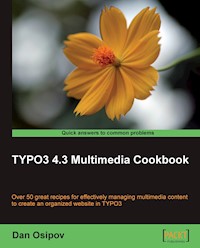
TYPO3 4.3 Multimedia Cookbook
Dan Osipov
TYPO3 4.3 Multimedia Cookbook
Copyright © 2010 Packt Publishing
All rights reserved. No part of this book may be reproduced, stored in a retrieval system, or transmitted in any form or by any means, without the prior written permission of the publisher, except in the case of brief quotations embedded in critical articles or reviews.
Every effort has been made in the preparation of this book to ensure the accuracy of the information presented. However, the information contained in this book is sold without warranty, either express or implied. Neither the author, nor Packt Publishing, and its dealers and distributors will be held liable for any damages caused or alleged to be caused directly or indirectly by this book.
Packt Publishing has endeavored to provide trademark information about all of the companies and products mentioned in this book by the appropriate use of capitals. However, Packt Publishing cannot guarantee the accuracy of this information.
First published: January 2010
Production Reference: 1210110
Published by Packt Publishing Ltd.
32 Lincoln Road
Olton
Birmingham, B27 6PA, UK.
ISBN 978-1-847198-48-8
www.packtpub.com
Cover Image by Vinayak Chittar (<[email protected]>)
Credits
Author
Dan Osipov
Reviewers
Karsten Dambekalns
Mario Rimann
Mathias Schreiber
Acquisition Editor
Rashmi Phadnis
Development Editor
Reshma Sundaresan
Technical Editor
Kavita Iyer
Copy Editor
Ajay Shanker
Indexer
Hemangini Bari
Editorial Team Leader
Mithun Sehgal
Project Team Leader
Lata Basantani
Project Coordinator
Poorvi Nair
Proofreader
Andie Scothern
Graphics
Nilesh R. Mohite
Production Coordinator
Adline Swetha Jesuthas
Cover Work
Adline Swetha Jesuthas
About the Author
Dan Osipov has over 12 years of web development, graphic design, as well as system architecture and application development experience. He has worked on various multipurpose sites, including e-commerce, educational, informational, and dynamic news sites. For the last 4 years, he has worked in the media industry, designing and maintaining an online presence for journals and newspapers.
At the moment of writing, Dan was employed at Calkins Media, where he worked on using TYPO3 as the CMS system powering high traffic, dynamic news sites, like phillyBrubs.com and Timesonline.com. He is also a member of the Digital Asset Management team, focused on the development of the DAM extension for TYPO3.
I would like to thank the Phillyburbs team, as their needs served as an inspiration for a lot of the material in this book. I would like to thank the TYPO3 community at large for "inspiring people to share". Last, but not least, I would like to thank my family for their understanding and support.
About the Reviewers
Karsten Dambekalns, born in 1977, learned the basics of web technology the hard way - by looking at other websites' HTML source. This happened after having learned BASIC and Assembler on a good old Commodore C128.
Karsten discovered PHP in 1999 and and was caught by TYPO3's immense possibilities in 2002. Later, he joined the TYPO3 Association and today is part of the TYPO3 5.0 and FLOW3 development team.
In 2000, he founded his own Internet company together with a friend from university, which he left behind in 2008 to become a freelancer working fully on the development of TYPO3. Karsten also speaks at conferences and writes articles about topics around PHP and TYPO3.
Karsten mostly lives in Germany with his wife Līga, their three kids, and a nameless Espresso machine.
Mario Rimann, born in 1982 in Zürich, Switzerland, started his journey through the IT jungle back in the early 90s. After his primary education as a service technician for office equipment like printers, copy machines, fax machines, and computers, he moved to his first job as a system administrator at a school. After collecting some years of IT and "people-skills", Mario moved onto the European headquarters of a company running a big website in the nightlife business, later he had his own company, and is now again a regular employee.
While being employed at the above-mentioned school, he made his first contact with TYPO3. In the beginning, it was mainly a hobby—which evolved to be the main part of his own company. In 2006 and 2007, he organized the first two international TYPO3 Developer Days, which took place in Switzerland.
Right now, Mario is employed as a project manager and developer at a mid-sized web-agency in central Switzerland that specializes in TYPO3 and Magento.
Alongside his job, Mario also helps out in several TYPO3 projects.
You can contact him at <[email protected]>.
Mathias Schreiber has been working in the Web industry since 1995, developing websites with database-driven content for several large companies throughout Europe. He has been a part of the TYPO3 community since early 2002. Ever since then, he has been close to the core development and also hosted early developer meetings in 2004.
He did more than 100 training sessions in Germany and Switzerland spreading the word about TYPO3 and has trained most of today's successful TYPO3 companies.
In 2004, he founded wmdb Systems together with Peter Kühn, Diana Beer, and Bodo Eichstaedt and since then he maintains large TYPO3 projects for many well-known companies from Europe.
For two years, he has been part of the 12 so called active members of the TYPO3 Association but resigned from his duties to focus on his company and family.
Today, you can find him on almost any TYPO3 event there is—training snowboard-beginners at the TYPO3 Snowboard tours, mentoring bug-fixing sessions on the TYPO3 Developer days, or sharing ideas on the TYPO3 Conference.
Preface
TYPO3 is one of the world's leading open source content management systems, written in PHP, which can be used to create and customize your website. Along with text content, you can display high quality images, audio, and video to your site's visitors by using TYPO3. It is essential to manage various types of multimedia files in content management systems for both editors and the users on the frontend of the site.
This book gives you the step-by-step process for organizing an effective multimedia system. It also gives solutions to commonly encountered problems, and offers a variety of tools for dealing with multimedia content. The author's experience in large-scale systems enables him to share his effective solutions to these problems.
What this book covers
Chapter 1, Getting Started introduces the reader to TYPO3, and helps set up a basic website; where the material in this chapter alone is not enough, the user is directed to other resources to fill in the gaps of knowledge in order to proceed further.
Chapter 2, Managing Digital Assets introduces the reader to the concept of digital asset management. Accounts for various groups of users (editors, administrators, web users) are created and assigned permissions. We also create a first extension that allows web users to upload files into the system.
Chapter 3, Operating with Metadata in Media Files expands upon the digital asset management idea, and cover file metadata, which can be used to classify files. The chapter covers various types and formats of metadata, and how it can be extracted in TYPO3.
Chapter 4, Rendering Images covers how images can be included on a TYPO3-driven website using content elements and a TYPO3 script. It also covers how to embed images in Rich Text Editor. You will learn to render links to media files, create a gallery, and render metadata using a DAM object.
Chapter 5, Rendering Video and Audio explains how you will render audio and video using media content object, TypoScript Object, content elements, and rgmediaimages extension. You will play video using a custom media player and Flash Media Server. We will also create new plugins for rendering audio files.
Chapter 6, Connecting to External APIs shows how external services, specifically Amazon S3, Flickr, and YouTube, can be leveraged to expand the system. We pull in files from YouTube and Flickr. We also use Amazon S3 to provide us with limitless storage.
Chapter 7, Creating Services covers services and hooks powerful concepts in TYPO3, which allow individual sites to add different processing capabilities depending on the system. We use services to parse metadata, and convert files.
Chapter 8, Automating Processes describes how some processes and workflows could be automated; making the computer do all the hard work, while the editor oversees the process.
What you need for this book
In order to get the most from this book, there are some expectations of prior knowledge and experience. It is assumed that the reader has a good understanding of TYPO3, which can be achieved by reading the introductory tutorials—Inside TYPO3, TYPO3 Core API, and Modern Template Building guide—essential to understand how TYPO3 works. Basic TypoScript knowledge is required as well.
Who this book is for
This book is for anyone who is looking for effective systems for managing and operating with multimedia content. You will find this book interesting if you are running, or starting websites rich in multimedia content.
This book assumes some prior knowledge of TYPO3, which is available either from the official documentation, or other books on this topic.
Reader feedback
Feedback from our readers is always welcome. Let us know what you think about this book what you liked or may have disliked. Reader feedback is important for us to develop titles that you really get the most out of.
To send us general feedback, simply send an e-mail to <[email protected]>, and mention the book title via the subject of your message.
If there is a book that you need and would like to see us publish, please send us a note in the SUGGEST A TITLE form on www.packtpub.com or e-mail <[email protected]>.
If there is a topic that you have expertise in and you are interested in either writing or contributing to a book on, see our author guide on www.packtpub.com/authors.
Customer support
Now that you are the proud owner of a Packt book, we have a number of things to help you to get the most from your purchase.
Tip
Downloading the example code for the book
Visit http://www.packtpub.com/files/code/8488_Code.zip to directly download the example code.
The downloadable files contain instructions on how to use them.
Errata
Although we have taken every care to ensure the accuracy of our content, mistakes do happen. If you find a mistake in one of our books—maybe a mistake in the text or the code—we would be grateful if you would report this to us. By doing so, you can save other readers from frustration and help us improve subsequent versions of this book. If you find any errata, please report them by visiting http://www.packtpub.com/support, selecting your book, clicking on the let us know link, and entering the details of your errata. Once your errata are verified, your submission will be accepted and the errata will be uploaded on our website, or added to any list of existing errata, under the Errata section of that title. Any existing errata can be viewed by selecting your title from http://www.packtpub.com/support.
Piracy
Piracy of copyright material on the Internet is an ongoing problem across all media. At Packt, we take the protection of our copyright and licenses very seriously. If you come across any illegal copies of our works, in any form, on the Internet, please provide us with the location address or website name immediately so that we can pursue a remedy.
Please contact us at <[email protected]> with a link to the suspected pirated material.
We appreciate your help in protecting our authors, and our ability to bring you valuable content.
Questions
You can contact us at <[email protected]> if you are having a problem with any aspect of the book, and we will do our best to address it.
Chapter 1. Getting Started
Recently, the Internet has shifted from being a provider of mostly textual information to a rich media platform; delivering high quality audio, video, and more. This shift was pioneered by sites such as YouTube, Flickr, Last.fm, Facebook, and others. The availability of broadband and faster connection speeds, throughout the world, has aided this shift. This change has brought new challenges to content providers, as they now need to organize and deliver to the customer not only textual content, but all other forms of media. While textual information can be easily manipulated, multimedia objects are a lot harder to work with.
Traditional Content Management Systems (CMS) have focused on organizing and manipulating textual information, but modern systems have more support for multimedia. In this book, we will discover how to manage various forms of rich media content in TYPO3 one of the world's leading open source CMSs.
In this chapter, we will cover:
Introduction
Welcome to this book about the vast world of TYPO3 Multimedia! In this book, we will cover various topics that relate to manipulating multimedia objects in the TYPO3 content management system.
In this chapter, we will lay down some expectations for the rest of the book, and set up the environment that we will use for most of the examples used throughout the book.
Expectations and prerequisites
In order to get the most from this book, there are some expectations of prior knowledge and experience. It is assumed that the reader has a good understanding of TYPO3, which can be achieved by reading the introductory tutorials—Inside TYPO3, TYPO3 Core API, and Modern Template Building guide—essential to understanding how TYPO3 works. Basic TypoScript knowledge is required as well.
We will write several extensions in this book; however, we will omit a lot of the details about extension writing, focusing rather on the specifics of the extension. If you're new to extension development in TYPO3, you should look for resources on the subject on www.typo3.org. TYPO3: Extension Development, Dmitry Dulepov, Packt Publishing is an excellent book that covers all of the prerequisites and much more.
There are multiple ways to achieve anything in TYPO3. The best solution depends on the situation, and generally requires some compromises. This book cannot illustrate the best solution to every problem, but attempts to show various possibilities and approaches to problem solving using practical examples.
Most examples assume you have administrator access to the installation. If you are an editor or a designer, and have a restricted access to the system, you should skip the examples that pertain to developers, or ask your system administrator to provide you appropriate access.
Note on IDE
While all of the examples presented in this book can be completed using standard tools such as a web browser and a text editor, I highly recommend using an Integrated Development Environment (IDE) if you're serious about web development. IDE would save you time, boost your productivity, and provide insight into your application that is simply not possible with standard tools.
There are a variety of PHP IDEs available for various platforms and budgets. Popular products include Komodo IDE, Zend Studio, NetBeans, and Eclipse with PDT plugin. My weapon of choice is NuSphere PhpED, and you may see examples and screenshots throughout the book that make use of the PhpEd platform. The examples can be transposed to the IDE you're using, but this may require looking in the manual or searching online for the detailed description.
Setting up a web server on Debian
Before we start anything else, we need to set up a web server. The most common setup for TYPO3 is based on a LAMP stack (Linux, Apache, MySQL, and PHP), although other setups are supported as well. Next, we will install all the components required by TYPO3 on a Debian Linux server.
Note
Paths may vary depending on system and setup options.
Getting ready
Setting up a Debian server is very easy, because all the packages you need are available through APT (Advanced Packaging Tool). Make sure that the package lists are up-to-date by running:
How to do it...
Issue the following command while logged in as root:
Note
At the time of writing, the latest stable version of Apache on Debian (Lenny) is 2.2.9, while PHP is 5.2.6, and MySQL is 5.0.51a. These versions meet the requirements of our system, and don't have any known bugs that prevent TYPO3 from working correctly.
How it works...
APT makes software maintenance easy, as all packages can be upgraded or removed through simple commands. You could install the packages from source, but it would make subsequent upgrades difficult. With APT, you can run the following to update the package cache information and upgrade your system:
Note
One could also use the short notation of this:




