


73,99 €
Mehr erfahren.
- Herausgeber: John Wiley & Sons
- Kategorie: Wissenschaft und neue Technologien
- Serie: Statistics in Practice
- Sprache: Englisch
Features a straightforward and concise resource for introductory statistical concepts, methods, and techniques using R
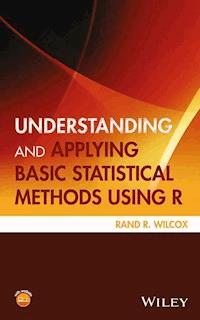
Understanding and Applying Basic Statistical Methods Using R uniquely bridges the gap between advances in the statistical literature and methods routinely used by non-statisticians. Providing a conceptual basis for understanding the relative merits and applications of these methods, the book features modern insights and advances relevant to basic techniques in terms of dealing with non-normality, outliers, heteroscedasticity (unequal variances), and curvature.
Featuring a guide to R, the book uses R programming to explore introductory statistical concepts and standard methods for dealing with known problems associated with classic techniques. Thoroughly class-room tested, the book includes sections that focus on either R programming or computational details to help the reader become acquainted with basic concepts and principles essential in terms of understanding and applying the many methods currently available. Covering relevant material from a wide range of disciplines, Understanding and Applying Basic Statistical Methods Using R also includes:
- Numerous illustrations and exercises that use data to demonstrate the practical importance of multiple perspectives
- Discussions on common mistakes such as eliminating outliers and applying standard methods based on means using the remaining data
- Detailed coverage on R programming with descriptions on how to apply both classic and more modern methods using R
- A companion website with the data and solutions to all of the exercises
Understanding and Applying Basic Statistical Methods Using R is an ideal textbook for an undergraduate and graduate-level statistics courses in the science and/or social science departments. The book can also serve as a reference for professional statisticians and other practitioners looking to better understand modern statistical methods as well as R programming.
Rand R. Wilcox, PhD, is Professor in the Department of Psychology at the University of Southern California, Fellow of the Association for Psychological Science, and an associate editor for four statistics journals. He is also a member of the International Statistical Institute. The author of more than 320 articles published in a variety of statistical journals, he is also the author eleven other books on statistics. Dr. Wilcox is creator of WRS (Wilcox’ Robust Statistics), which is an R package for performing robust statistical methods. His main research interest includes statistical methods, particularly robust methods for comparing groups and studying associations.
Sie lesen das E-Book in den Legimi-Apps auf:
Seitenzahl: 882
Veröffentlichungsjahr: 2016
Ähnliche




















Table of Contents
Title Page
Copyright
List of Symbols
Preface
About The Companion Website
Chapter 1: Introduction
1.4 R Packages
1.5 Access to Data Used in This Book
1.6 Accessing More Detailed Answers to The Exercises
1.7 Exercises
Chapter 2: Numerical Summaries of Data
2.1 Summation Notation
2.2 Measures of Location
2.3 Quartiles
2.4 Measures of Variation
2.5 Detecting Outliers
2.6 Skipped Measures of Location
2.7 Summary
2.8 Exercises
Chapter 3: Plots Plus More Basics on Summarizing Data
3.1 Plotting Relative Frequencies
3.2 Histograms and Kernel Density Estimators
3.3 Boxplots and Stem-and-Leaf Displays
3.4 Summary
3.5 Exercises
Chapter 4: Probability and Related Concepts
4.1 The Meaning of Probability
4.2 Probability Functions
4.3 Expected Values, Population Mean and Variance
4.4 Conditional Probability and Independence
4.5 The Binomial Probability Function
4.6 The Normal Distribution
4.7 Nonnormality and The Population Variance
4.8 Summary
4.9 Exercises
Chapter 5: Sampling Distributions
5.1 Sampling Distribution of , The Proportion of Successes
5.2 Sampling Distribution of the Mean Under Normality
5.3 Nonnormality and the Sampling Distribution of the Sample Mean
5.4 Sampling Distribution of the Median and 20% Trimmed Mean
5.5 The Mean Versus the Median and 20% Trimmed Mean
5.6 Summary
5.7 Exercises
Chapter 6: Confidence Intervals
6.1 Confidence Interval for The Mean
6.2 Confidence Intervals for The Mean Using
s
( Not Known)
6.3 A Confidence Interval for The Population Trimmed Mean
6.4 Confidence Intervals for The Population Median
6.5 The Impact of Nonnormality on Confidence Intervals
6.6 Some Basic Bootstrap Methods
6.7 Confidence Interval for The Probability of Success
6.8 Summary
6.9 Exercises
Chapter 7: Hypothesis Testing
7.1 Testing Hypotheses about the Mean, Known
7.2 Power and Type II Errors
7.3 Testing Hypotheses about the mean, Not Known
7.4 Student's
T
and Nonnormality
7.5 Testing Hypotheses about Medians
7.6 Testing Hypotheses Based on a Trimmed Mean
7.7 Skipped Estimators
7.8 Summary
7.9 Exercises
Chapter 8: Correlation and Regression
8.1 Regression Basics
8.2 Least Squares Regression
8.3 Dealing with Outliers
8.4 Hypothesis Testing
8.5 Correlation
8.6 Detecting Outliers When Dealing with Two or More Variables
8.7 Measures of Association: Dealing with Outliers
8.8 Multiple Regression
8.9 Dealing with Curvature
8.10 Summary
8.11 Exercises
Chapter 9: Comparing Two Independent Groups
9.1 Comparing Means
9.2 Comparing Medians
9.3 Comparing Trimmed Means
9.4 Tukey's Three-Decision Rule
9.5 Comparing Variances
9.6 Rank-Based (Nonparametric) Methods
9.7 Measuring Effect Size
9.8 Plotting Data
9.9 Comparing Quantiles
9.10 Comparing Two Binomial Distributions
9.11 A Method for Discrete or Categorical Data
9.12 Comparing Regression Lines
9.13 Summary
9.14 Exercises
Chapter 10: Comparing More than Two Independent Groups
10.1 The Anova Test
10.2 Dealing With Unequal Variances: Welch's Test
10.3 Comparing Groups Based on Medians
10.4 Comparing Trimmed Means
10.5 Two-Way Anova
10.6 Rank-Based Methods
10.7 R Functions and
10.8 Summary
10.9 Exercises
Chapter 11: Comparing Dependent Groups
11.1 The Paired Test
11.2 Comparing Trimmed Means and Medians
11.3 The Sign Test
11.4 Wilcoxon Signed Rank Test
11.5 Comparing Variances
11.6 Dealing With More Than Two Dependent Groups
11.7 Between-by-Within Designs
11.8 Summary
11.9 Exercises
Chapter 12: Multiple Comparisons
12.1 Classic Methods For Independent Groups
12.2 The Tukey–Kramer Method
12.3 Scheffé's Method
12.4 Methods That Allow Unequal Population Variances
12.5 Anova Versus Multiple Comparison Procedures
12.6 Comparing Medians
12.7 Two-Way Anova Designs
12.8 Methods For Dependent Groups
12.9 Summary
12.10 Exercises
Chapter 13: Categorical Data
13.1 One-Way Contingency Tables
13.2 Two-Way Contingency Tables
13.3 Logistic Regression
13.4 Summary
13.5 Exercises
Appendix A: Solutions to Selected Exercises
Appendix B: Tables
References
Index
End User License Agreement
Pages
xvii
xviii
xix
1
2
3
4
5
6
7
8
9
10
11
12
13
14
15
16
17
18
19
20
21
22
23
25
26
27
28
29
30
31
32
33
34
35
36
37
38
39
40
41
42
43
44
45
46
47
48
49
50
51
53
54
55
56
57
58
59
60
61
62
63
64
65
66
67
68
69
71
72
73
74
75
76
77
78
79
80
81
82
83
84
85
86
87
88
89
90
91
92
93
94
95
96
97
98
99
100
101
102
103
104
105
107
108
109
110
111
112
113
114
115
116
117
118
119
120
121
122
123
124
125
126
127
128
129
130
131
132
133
134
135
136
137
138
139
140
141
142
143
144
145
146
147
148
149
150
151
152
153
154
155
156
157
158
159
160
161
162
163
164
165
166
167
168
169
170
171
172
173
174
175
176
177
179
180
181
182
183
184
185
186
187
188
189
190
191
192
193
194
195
196
197
198
199
200
201
202
203
204
205
207
208
209
210
211
212
213
214
215
216
217
218
219
220
221
222
223
224
225
226
227
228
229
230
231
232
233
234
235
236
237
238
239
240
241
242
243
244
245
246
247
248
249
250
251
252
253
254
255
256
257
258
259
260
261
263
264
265
266
267
268
269
270
271
272
273
274
275
276
277
278
279
280
281
282
283
284
285
286
287
288
289
290
291
292
293
294
295
296
297
298
299
300
301
302
303
304
305
306
307
308
309
310
311
312
313
314
315
316
317
318
319
320
321
322
323
324
325
326
327
328
329
330
331
332
333
334
335
336
337
338
339
340
341
342
343
344
345
346
347
348
349
350
351
352
353
354
355
356
357
358
359
360
361
362
363
364
365
366
367
368
369
370
371
372
373
374
375
376
377
378
379
380
381
382
383
384
385
386
387
388
389
390
391
392
393
394
395
396
397
398
399
400
401
402
403
404
405
406
407
408
409
410
411
412
413
414
415
416
417
418
419
420
421
422
423
424
425
426
427
428
429
430
431
432
433
435
436
437
438
439
441
442
443
444
445
446
447
448
449
450
451
452
453
454
455
456
457
458
459
460
461
462
473
474
475
476
477
Guide
Table of Contents
Preface
Begin Reading
List of Illustrations
Chapter 3: Plots Plus More Basics on Summarizing Data
Figure 3.1 Relative frequencies for the data in Table 3.1
Figure 3.2 Relative frequencies that are symmetric about a central value. For this special case, the mean and median have identical values, the middle value, which here is 3. The relative frequencies in (a) are higher for the more extreme values, compared to (b), indicating that the variance associated with (a) is higher
Figure 3.3 A histogram of the heart transplant data in Table 3.2
Figure 3.4 (a) An example of a histogram that is said to be the skewed to the right. (b) It is skewed to the left
Figure 3.5 A histogram based on a measure of hangover symptoms
Figure 3.6 A histogram of an entire population that is symmetric about 0 with relatively light tails, meaning outliers tend to be rare
Figure 3.7 A histogram based on a sample of 100 observations generated from the histogram in Figure 3.6
Figure 3.8 A histogram of an entire population that is symmetric about 0 with relatively heavy tails, meaning outliers tend to be common
Figure 3.10 An example of a kernel density plot based on the same 100 observations generated from Figure 3.8 and used in Figure 3.9. Note how the kernel density plot does a better job of capturing the shape of the population histogram in Figure 3.8
Figure 3.9 A histogram based on a sample of 100 observations generated from the histogram in Figure 3.8
Figure 3.11 An example of a boxplot with no outliers
Figure 3.12 An example of a boxplot with outliers
Chapter 4: Probability and Related Concepts
Figure 4.1 A normal distribution having mean . The area under the curve and to the left of is 0.158655, which is the probability that an observation is less than or equal to
Figure 4.2 For all normal distributions, the probability that an observation is within one standard deviation of the mean is 0.68. The probability of being within two standard deviations is 0.954
Figure 4.3 The left two distributions have the same mean but different standard deviations, namely, 1 and 1.5. The right distribution has a mean of 2 and standard deviation 1
Figure 4.4 The left tail indicates that for a standard normal distribution, the probability of a value less than or equal to is 0.0606,and the probability of a value greater than or equal to 1.55 is 0.0606 as well
Figure 4.5 Shown is the standard normal and the mixed normal described in the text
Figure 4.6 Two distributions with equal means and variances
Figure 4.7 For skewed distributions, the population mean and median can differ tremendously
Figure 4.8 Taking logarithms sometimes results in a plot of the data being more symmetric, as illustrated here, but outliers can remain
Figure 4.9 Taking logarithms sometimes reduces skewness but does not eliminate it, as illustrated here
Chapter 5: Sampling Distributions
Figure 5.1 An illustration of how the sampling distribution of the sample mean, , changes with the sample size when sampling from a normal distribution
Figure 5.2 The sampling distribution of , the proportion of successes, when randomly sampling from a binomial distribution having probability of success
Figure 5.3 As the sample size gets large, the sampling distribution of the sample mean will approach a normal distribution under random sampling. Here, observations were sampled from a symmetric distribution where outliers tend to occur
Figure 5.4 Examples of skewed distributions having light and heavy tails
Figure 5.5 The distributions of 5,000 sample means when sampling from the skewed distributions in Figure 5.4. The symmetric distributions are the distributions of the sample mean based on the central limit theorem. With skewed, light-tailed distributions, smaller sample sizes are needed to assume that the sample mean has a normal distribution compared to situations where sampling is from a heavy-tailed distribution
Figure 5.6 Although it is often the case that with a sample size of 40, the sampling distribution of the sample mean will be approximately normal, exceptions arise as illustrated here using the sexual attitude data
Figure 5.7 Plots of 5,000 trimmed means (solid line) and medians (dashed line). (a) Plots based on a sample size of . (b) The sample size is 80. As the sample size increases, the sample medians converge to a normal distribution centered around the population median, which here is 1. The 20% trimmed means converge to a normal distribution centered around the population 20% trimmed means, which here is 1.65
Figure 5.8 Plots of 20% trimmed means when data are generated from a discrete distribution where tied values will occur and repeated 5,000 times. (a) Plots based on a sample size of and shows the relative frequencies among the observed 20% trimmed means. (b) The sample size is 80, which illustrates that the distribution of the 20% sample trimmed mean approaches a normal distribution as the sample size increases
Figure 5.9 Plots of 5,000 medians when data are generated from the same discrete distribution used in Figure 5.8. (a) Plots based on a sample size of and shows the relative frequencies among the observed medians. Notice that only seven values for the median were observed. (b) The sample size is 80. Now there are only five observed values for the median. In this particular case, the median does not converge to a normal distribution
Figure 5.10 Boxplots of 10,000 means, 20% trimmed means, and medians using data sampled from a normal distribution
Figure 5.11 Boxplots of 10,000 means, 20% trimmed means, and medians using data sampled from a mixed normal distribution
Figure 5.12 Boxplots of 10,000 means, 20% trimmed means, and medians using data sampled from the skewed distribution in Figure 5.4a for which the proportion of values declared an outlier is typically small
Chapter 6: Confidence Intervals
Figure 6.1 Shown is a standard normal curve and a Student's distribution with four degrees of freedom. Student's distributions are symmetric about zero, but they have thicker tails than a normal distribution
Figure 6.2 A skewed, light-tailed distribution used to illustrate the effects of nonnormality when using Student's
Figure 6.3 Shown is the distribution of (solid line) when sampling from the skewed, light-tailed distribution in Figure 6.2 and the distribution of when sampling from a normal distribution (dotted line)
Figure 6.4 When sampling data from the distribution (a), with , the sampling distribution of the sample mean is approximately normal (b). But compare this to the sampling distribution of shown in Figure 6.5
Figure 6.5 When sampling data from the distribution in Figure 6.4a, with , the sampling distribution of , indicated by the solid line, differs substantially from a Student's distribution, indicated by the dotted line, even though the sampling distribution of the sample mean is approximately normal
Figure 6.6 When dealing with data from actual studies, situations are encountered where the actual distribution of differs even more from the distribution of under normality than is indicated in Figure 6.3 and 6.5. Shown is the distribution of when sampling from the data in Table 2.3, with the extreme outlier removed. The sample size is . With the extreme outlier included, the distribution of becomes even more skewed to the left
Figure 6.7 The distribution of based on % and 20% trimming when sampling observations from the distribution in Figure 6.2. The distribution of when sampling from a normal distribution is indicated by the dashed line. Compare this to Figure 6.3
Figure 6.8 The distribution of based on and when sampling observations from the distribution in Figure 6.2. The distribution of when sampling from a normal distribution is indicated by the dashed line. Compare this to Figure 6.3 and 6.7
Chapter 7: Hypothesis Testing
Figure 7.1 A graphical depiction of the rejection rule when using and . The shaded portions indicate the rejection regions
Figure 7.2 The distribution of based on the bootstrap-t method and the data stemming from a study on hangover symptoms
Chapter 8: Correlation and Regression
Figure 8.1 A few outliers among the independent variable can drastically alter the least squares regression line. Here, the outliers in the upper-left corner result in a regression line having a slightly negative slope. The MAD–median rule indicates that the five smallest surface temperature values are outliers. These are the four points in the upper-left corner, as well as the surface temperature value 3.84. If these outliers are removed, the slope is positive and better reflects the association among the bulk of the points
Figure 8.2 An illustration of homoscedasticity: The variation associated with the dependent variable (C-peptide) does not depend on the value of the independent variable (the age of the participant)
Figure 8.3 An illustration of heteroscedasticity: The variation associated with the dependent variable (C-peptide) depends on the value of the independent variable (the age of the participant)
Figure 8.4 A scatterplot of the marital aggression data. Also shown is the least squares regression line. Notice the apparent outliers in the upper-left corner. Removing these five points, now the regression line is nearly horizontal
Figure 8.5 An illustration that the magnitude of Pearson's correlation is influenced by the magnitude of the residuals
Figure 8.6 When checking for outliers among bivariate data, simply applying the boxplot rule for each of the variables can miss outliers, as illustrated here. The first boxplot in (b) is based on the data stored in the variable x1, ignoring the data stored in x2. The other boxplot is based on the data stored in x2, ignoring x1. No outliers are detected by the boxplots, but the point indicated by the arrow in (a) is an outlier. What is needed is an outlier detection method that takes into account the overall structure of the data
Figure 8.7 This scatterplot illustrates that outliers, properly placed, can have a large influence on both Kendall's tau and Spearman's rho. The two points in the lower-right corner are outliers based on how the data were generated. Kendall's tau, using all of the data, is 0.31, but ignoring the two outliers it is 0.49. Spearman's rho is 0.29 using all of the data and 0.48 when the two outliers are ignored
Figure 8.8 Shown is the smooth created by the R function rplot. The solid line reflects an estimate of the typical CESD measure (depressive symptoms) given a value for the CAR (the cortisol awakening response). Notice that there appears to be a distinct bend close to where the CAR is zero
Figure 8.9 Shown is the smooth created by the R function lplot using the diabetes data. The smooth suggests that there is a positive association up to about the age of 7, but for older children, there seems to be little or no association
Figure 8.10 Shown is the smooth created by the R function lplot using the CAR and CESD to predict the typical MAPA score. Notice the distinct bend close to where CESD is equal to 16. Focusing on only those participants who have a CESD score less than 16, an association is found between CAR and MAPA, in contrast to an analysis where any possibility of curvature is ignored
Figure 8.11 Shown is the smooth created by the R function rplot where the goal is to predict the typical Totagg score, given values for engage and GPA. This illustrates again that curvature can mask an association and that assuming that a regression surface is a plane can yield misleading results
Chapter 9: Comparing Two Independent Groups
Figure 9.1 A skewed distribution with a mean of zero
Figure 9.2 The distribution of (the solid line) when sampling 40 values from a standard normal distribution and 60 values from the distribution in Figure 9.1. Also shown is the distribution of when both groups have normal distributions. This illustrates that differences in skewness can have an important impact on
Figure 9.3 (a) Power is 0.96 based on Student's , and sample sizes . (b) The distributions are not normal, but rather mixed normals, and now, power is only 0.28
Figure 9.5 (a) Estimates of the two distributions in the self-awareness study. (b) The boxplots are based on the same data
Figure 9.4 Examples of error bars using the self-awareness data in Section 9.1
Figure 9.6 The distribution of depressive symptoms for a control group (solid line) and an experimental group (dotted line). The plot suggests that relatively high measures of depressive symptoms are more likely for the control group compared to the group that received intervention
Figure 9.7 Pots of the relative frequencies for the graphics group (solid line) and the text-only group (dashed line)
Figure 9.8 The solid line is the regression lined for the first group (the control group) for predicting MAPA scores based on CAR. The dashed line is the regression line for the second group (the group that received intervention)
Chapter 10: Comparing More than Two Independent Groups
Figure 10.1 The distribution when comparing four groups with 10 observations in each group and the hypothesis of equal means is true. That is, , , so and . If the Type I error is to be , reject if
Chapter 11: Comparing Dependent Groups
Figure 11.1 Boxplots of the difference scores based on the weight of cork borings. The left boxplot is based on the difference between north and east sides of the trees. The right boxplot is based on the east and south sides
Chapter 13: Categorical Data
Figure 13.1 Shown are two chi-squared distributions. One has two degrees of freedom and the other has four degrees of freedom
Figure 13.2 Examples of logistic regression lines based on Equation (13.16). (a) and . Because , the predicted probability is monotonically increasing. (b) , and now the predicted probability is monotonically decreasing
Figure 13.3 The estimated regression line suggests that the probability of kyphosis increases with age, up to a point, and then decreases, which is contrary to the assumption of the basic logistic regression model in Section 13.3
List of Tables
Chapter 1: Introduction
Table 1.1 Weight Gain of Rats in Ozone Experiment
Table 1.2 A Summary of Basic Commands for Accessing Data When Working with a Vector x
Chapter 2: Numerical Summaries of Data
Table 2.1 Changes in Cholesterol Level after 1 Month on an Experimental Drug
Table 2.2 Changes in Cholesterol Level after 1 Month of Taking a Placebo
Table 2.3 Responses by Males in the Sexual Attitude Study
Chapter 3: Plots Plus More Basics on Summarizing Data
Table 3.1 One Hundred Ratings of a Film
Table 3.3 Frequencies and Relative Frequencies for Grouped T5 Scores,
Table 3.2 T5 Mismatch Scores from a Heart Transplant Study
Table 3.4 Word Identification Scores
Table 3.5 Examination Scores
Chapter 4: Probability and Related Concepts
Table 4.1 Hypothetical Probabilities for Getting a Flu Shot and Getting the Flu
Table 4.2 Hypothetical Probabilities for Rating a Book
Chapter 6: Confidence Intervals
Table 6.1 Additional Hours Sleep Gained by Using an Experimental Drug
Table 6.2 Common Choices for and
Table 6.3 Self-Awareness Data
Table 6.4 Actual Probability Coverage for Three Methods Designed to Compute a 0.95 Confidence Interval for the Population Mean
Table 6.5 Actual Probability Coverage When Computing a 0.95 Confidence Interval for the Population 20% Trimmed Mean
Chapter 7: Hypothesis Testing
Table 7.1 Four Possible Outcomes When Testing Hypotheses
Table 7.2 Actual Type I Error Probabilities When Testing Some Hypothesis about the Mean at the Level
Table 7.3 Actual Probability of a Type I Error When Using a 20% Trimmed Mean,
Chapter 8: Correlation and Regression
Table 8.1 Boscovich's Data on Meridian Arcs
Table 8.2 Computing the Least Squares Slope Using Boscovich's Data
Table 8.3 Sale Price of Homes (Divided by 1,000) and Size in Square Feet
Table 8.4 Measures of Marital Aggression and Recall Test Scores
Table 8.5 Reading Data
Chapter 9: Comparing Two Independent Groups
Table 9.1 Weight Gain, in Grams, for Large Babies
Table 9.2 Self-Awareness Data
Chapter 10: Comparing More than Two Independent Groups
Table 10.1 Weight Gains (in Grams) for Rats on One of Four Diets
Table 10.2 Depiction of the Population Means for Four Diets
Table 10.3 Commonly Used Notation for the Means in a -by- ANOVA
Table 10.4 Hypothetical Data Illustrating the Kruskal–Wallis Test
Chapter 11: Comparing Dependent Groups
Table 11.1 Bacteria Counts Before and After Treatment
Table 11.2 Cork Boring Weights for the North, East, South, and West Sides of Trees
Chapter 12: Multiple Comparisons
Table 12.1 Hypothetical Data for Three Groups
Table 12.2 Ratings of Methods for Treating Migraine Headaches
Table 12.3 Critical Values, , for Rom's Method
Table 12.4 An Illustration of Rom's Method
Chapter 13: Categorical Data
Table 13.1 Hypothetical Data on Homework Survey
Table 13.2 Approval Rating of a Political Leader
Table 13.3 Probabilities Associated with a Two-Way Contingency Table
Table 13.4 Notation for Observed Frequencies
Table 13.5 Hypothetical Results on Personality and Blood Pressure
Table 13.6 Ratings of 100 Figure Skaters
Table 13.7 Estimated Probabilities for Personality versus Blood Pressure
Table 13.8 Mortality Rates per 100,000 Person-Years from Lung Cancer and Coronary Artery Disease for Smokers and Nonsmokers of Cigarettes
Understanding and Applying Basic Statistical Methods Using R
Rand R. Wilcox
Copyright © 2017 by John Wiley & Sons, Inc. All rights reserved
Published by John Wiley & Sons, Inc., Hoboken, New Jersey
Published simultaneously in Canada
No part of this publication may be reproduced, stored in a retrieval system, or transmitted in any form or by any means, electronic, mechanical, photocopying, recording, scanning, or otherwise, except as permitted under Section 107 or 108 of the 1976 United States Copyright Act, without either the prior written permission of the Publisher, or authorization through payment of the appropriate per-copy fee to the Copyright Clearance Center, Inc., 222 Rosewood Drive, Danvers, MA 01923, (978) 750-8400, fax (978) 750-4470, or on the web at www.copyright.com. Requests to the Publisher for permission should be addressed to the Permissions Department, John Wiley & Sons, Inc., 111 River Street, Hoboken, NJ 07030, (201) 748-6011, fax (201) 748-6008, or online at http://www.wiley.com/go/permissions.
Limit of Liability/Disclaimer of Warranty: While the publisher and author have used their best efforts in preparing this book, they make no representations or warranties with respect to the accuracy or completeness of the contents of this book and specifically disclaim any implied warranties of merchantability or fitness for a particular purpose. No warranty may be created or extended by sales representatives or written sales materials. The advice and strategies contained herein may not be suitable for your situation. You should consult with a professional where appropriate. Neither the publisher nor author shall be liable for any loss of profit or any other commercial damages, including but not limited to special, incidental, consequential, or other damages.
For general information on our other products and services or for technical support, please contact our Customer Care Department within the United States at (800) 762-2974, outside the United States at (317) 572-3993 or fax (317) 572-4002.
Wiley also publishes its books in a variety of electronic formats. Some content that appears in print may not be available in electronic formats. For more information about Wiley products, visit our web site at www.wiley.com.
Library of Congress Cataloging-in-Publication Data:
Names: Wilcox, Rand R., author.
Title: Understanding and applying basic statistical methods using R / Rand R.
Wilcox.
Description: Hoboken, New Jersey : John Wiley & Sons, 2016. | Includes
bibliographical references and index.
Identifiers: LCCN 2015050582| ISBN 9781119061397 | ISBN 9781119061410 (epub)
| ISBN 9781119061403 (Adobe PDF)
Subjects: LCSH: Statistics–Computer programs. | R (Computer program language)
Classification: LCC QA276.45.R3 W55 2016 | DDC 519.50285/5133–dc23 LC record available at
http://lccn.loc.gov/2015050582
LIST OF SYMBOLS
Type I error probability (alpha)
Type II error probability (beta)
The intercept of a regression line
The slope of a regression line
A measure of effect size (delta)
Population median or the odds ratio (theta)
Population mean (mu)
Population trimmed mean
Degrees of freedom (nu)
Pearson's correlation (rho)
Spearman's correlation
Population standard deviation (sigma)
Population variance
Summation
Kendall's tau
Phi coefficient
Odds (omega)
Sample median
Probability of success. Also used to indicate a
-value as well as a measure of effect size associated with the Wilcoxon–Mann–Whitney method
Estimate of
, Pearson's correlation
Winsorized correlation
A
PREFACE
The goal of this book is to introduce basic statistical principles, techniques, and concepts in a relatively simple and concise manner. The book is designed for a one-semester course aimed at nonstatisticians. Numerous illustrations are provided using data from a wide range of disciplines. Answers to the exercises are in Appendix A. More detailed answers to all of the exercises and data sets for the exercises can be downloaded from .
Lesen Sie weiter in der vollständigen Ausgabe!
Lesen Sie weiter in der vollständigen Ausgabe!
Lesen Sie weiter in der vollständigen Ausgabe!
Lesen Sie weiter in der vollständigen Ausgabe!
Lesen Sie weiter in der vollständigen Ausgabe!
Lesen Sie weiter in der vollständigen Ausgabe!
Lesen Sie weiter in der vollständigen Ausgabe!
Lesen Sie weiter in der vollständigen Ausgabe!
Lesen Sie weiter in der vollständigen Ausgabe!
Lesen Sie weiter in der vollständigen Ausgabe!
Lesen Sie weiter in der vollständigen Ausgabe!
Lesen Sie weiter in der vollständigen Ausgabe!
Lesen Sie weiter in der vollständigen Ausgabe!
Lesen Sie weiter in der vollständigen Ausgabe!
Lesen Sie weiter in der vollständigen Ausgabe!
Lesen Sie weiter in der vollständigen Ausgabe!
Lesen Sie weiter in der vollständigen Ausgabe!
Lesen Sie weiter in der vollständigen Ausgabe!
Lesen Sie weiter in der vollständigen Ausgabe!




