


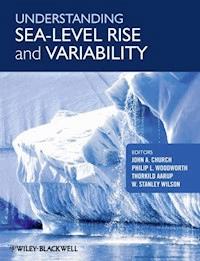
Understanding Sea-level Rise and Variability E-Book
63,99 €
Mehr erfahren.
- Herausgeber: John Wiley & Sons
- Kategorie: Wissenschaft und neue Technologien
- Sprache: Englisch
Understanding Sea-Level Rise and Variability identifies the major impacts of sea-level rise, presents up-to-date assessments of past sea-level change, thoroughly explores all of the factors contributing to sea-level rise, and explores how sea-level extreme events might change. It identifies what is known in each area and what research and observations are required to reduce the uncertainties in our understanding of sea-level rise so that more reliable future projections can be made. A synthesis of findings provides a concise summary of past, present and future sea-level rise and its impacts on society. Key Features: * Book includes contributions from a range of international sea level experts * Multidisciplinary * Four color throughout * Describes the limits of our understanding of this crucial issue as well as pointing to directions for future research The book is for everyone interested in sea-level rise and its impacts, including policy makers, research funders, scientists, students, coastal managers and engineers. Additional resources for this book can be found at: http://www.wiley.com/go/church/sealevel.
Sie lesen das E-Book in den Legimi-Apps auf:
Seitenzahl: 893
Veröffentlichungsjahr: 2010
Ähnliche




















Table of Contents
Cover
Table of Contents
Half title page
Dedication
Title page
Copyright page
Editor Biographies
Contributors
Foreword
Acknowledgments
Abbreviations and Acronyms
1 Introduction
2 Impacts of and Responses to Sea-Level Rise
2.1 Introduction
2.2 Climate Change and Global/Relative Sea-Level Rise
2.3 Sea-Level Rise and Resulting Impacts
2.4 Framework and Methods for the Analysis of Sea-Level-Rise Impacts
2.5 Recent Impacts of Sea-Level Rise
2.6 Future Impacts of Sea-Level Rise
2.7 Responding to Sea-Level Rise
2.8 Next Steps
2.9 Concluding Remarks
Acknowledgments
3 A First-Order Assessment of the Impact of Long-Term Trends in Extreme Sea Levels on Offshore Structures and Coastal Refineries
3.1 Introduction
3.2 Design Considerations
3.3 Impact of Long-Term Trends in Extreme Sea Levels
3.4 Evaluating the Economic Impact
3.5 Conclusions
4 Paleoenvironmental Records, Geophysical Modeling, and Reconstruction of Sea-Level Trends and Variability on Centennial and Longer Timescales
4.1 Introduction
4.2 Past Sea-Level Changes
4.3 Sea-Level Indicators
4.4 Geophysical Modeling of Variability in Relative Sea-Level History
4.5 Regional Case Studies
4.6 Discussion and Conclusions
Acknowledgments
5 Modern Sea-Level-Change Estimates
5.1 Introduction
5.2 Estimates from Proxy Sea-Level Records
5.3 Estimates of Global Sea-Level Change from Tide Gauges
5.4 Estimates of Global Sea-Level Change from Satellite Altimetry
5.5 Recommendations
Acknowledgments
6 Ocean Temperature and Salinity Contributions to Global and Regional Sea-Level Change
6.1 Introduction
6.2 Direct Estimates of Steric Sea-Level Rise
6.3 Estimating Steric Sea-Level Change Using Ocean Syntheses
6.4 Inferring Steric Sea Level from Time-Variable Gravity and Sea Level
6.5 Modeling Steric Sea-Level Rise
6.6 Conclusions and Recommendations
Acknowledgments
7 Cryospheric Contributions to Sea-Level Rise and Variability
7.1 Introduction
7.2 Mass-Balance Techniques
7.3 Ice-Sheet Mass Balance
7.4 Mass Balance of Glaciers and Ice Caps
7.5 Glacier, Ice-Cap, and Ice-Sheet Modeling
7.6 Summary and Recommendations
8 Terrestrial Water-Storage Contributions to Sea-Level Rise and Variability
8.1 Introduction
8.2 Analysis Tools
8.3 Climate-Driven Changes of Terrestrial Water Storage
8.4 Direct Anthropogenic Changes of Terrestrial Water Storage
8.5 Synthesis
8.6 Recommendations
9 Geodetic Observations and Global Reference Frame Contributions to Understanding Sea-Level Rise and Variability
9.1 Introduction
9.2 Global and Regional Reference Systems
9.3 Linking GPS to Tide Gauges and Tide-Gauge Benchmarks
9.4 Recommendations for Geodetic Observations
Acknowledgments
10 Surface Mass Loading on a Dynamic Earth: Complexity and Contamination in the Geodetic Analysis of Global Sea-Level Trends
10.1 Introduction
10.2 Glacial Isostatic Adjustment
10.3 Sea Level, Sea Surface, and the Geoid
10.4 Rapid Melting and Sea-Level Fingerprints
10.5 Great Earthquakes
10.6 Final Remarks
Acknowledgments
11 Past and Future Changes in Extreme Sea Levels and Waves
11.1 Introduction
11.2 Evidence for Changes in Extreme Sea Levels and Waves in the Recent Past
11.3 Mid-Latitude and Tropical Storms: Changes in the Atmospheric Drivers of Extreme Sea Level
11.4 Future Extreme Water Levels
11.5 Future Research Needs
11.6 Conclusions
Acknowledgments
12 Observing Systems Needed to Address Sea-Level Rise and Variability
12.1 Introduction
12.2 Sustained, Systematic Observing Systems (Existing Capabilities)
12.3 Development of Improved Observing Systems (New Capabilities)
12.4 Summary
13 Sea-Level Rise and Variability: Synthesis and Outlook for the Future
13.1 Historical Sea-Level Change
13.2 Why is Sea Level Rising?
13.3 The Regional Distribution of Sea-Level Rise
13.4 Projections of Sea-Level Rise for the 21st Century and Beyond
13.5 Changes in Extreme Events
13.6 Sea Level and Society
Index
UNDERSTANDING SEA-LEVEL RISE AND VARIABILITY
In Memoriam: M.B. Dyurgerov
The Editors and Authors of this volume wish to honor the memory of Dr Mark B. Dyurgerov and acknowledge his valuable contributions to it. He will be missed by the glaciological and sea-level communities as an honest broker and an excellent scientist.
This edition first published 2010, © 2010 by Blackwell Publishing Ltd
Blackwell Publishing was acquired by John Wiley & Sons in February 2007. Blackwell’s publishing program has been merged with Wiley’s global Scientific, Technical and Medical business to form Wiley-Blackwell.
Registered office: John Wiley & Sons Ltd, The Atrium, Southern Gate, Chichester, West Sussex, PO19 8SQ, UK
Editorial offices: 9600 Garsington Road, Oxford, OX4 2DQ, UK
The Atrium, Southern Gate, Chichester, West Sussex, PO19 8SQ, UK
111 River Street, Hoboken, NJ 07030-5774, USA
For details of our global editorial offices, for customer services and for information about how to apply for permission to reuse the copyright material in this book please see our website at www.wiley.com/wiley-blackwell
The right of the author to be identified as the author of this work has been asserted in accordance with the Copyright, Designs and Patents Act 1988.
All rights reserved. No part of this publication may be reproduced, stored in a retrieval system, or transmitted, in any form or by any means, electronic, mechanical, photocopying, recording or otherwise, except as permitted by the UK Copyright, Designs and Patents Act 1988, without the prior permission of the publisher.
Wiley also publishes its books in a variety of electronic formats. Some content that appears in print may not be available in electronic books.
Designations used by companies to distinguish their products are often claimed as trademarks. All brand names and product names used in this book are trade names, service marks, trademarks or registered trademarks of their respective owners. The publisher is not associated with any product or vendor mentioned in this book. This publication is designed to provide accurate and authoritative information in regard to the subject matter covered. It is sold on the understanding that the publisher is not engaged in rendering professional services. If professional advice or other expert assistance is required, the services of a competent professional should be sought.
Library of Congress Cataloguing-in-Publication Data
Understanding sea-level rise and variability edited by John A. Church ... [et al.].
p. cm.
Includes bibliographical references and index.
ISBN 978-1-4443-3451-7 (hardcover : alk. paper) – ISBN 978-1-4443-3452-4 (pbk. : alk. paper)
1. Sea level. I. Church, John, 1951-
GC89.U53 2010
551.45′8–dc22
2010012130
ISBN: 978-1-4443-3452-4 (paperback); 978-1-4443-3451-7 (hardback); 978-1-4443-4077-8 (ebk)
A catalogue record for this book is available from the British Library.
Editor Biographies
John A. Church, FTSE
John Church is an oceanographer with the Centre for Australian Weather and Climate Research and the Antarctic Climate and Ecosystems Cooperative Research Centre. He was co-convening lead author for the chapter on sea level in the IPCC Third Assessment Report. He was awarded the 2006 Roger Revelle Medal by the Intergovernmental Oceanographic Commission, a CSIRO Medal for Research Achievement in 2006, and the 2007 Eureka Prize for Scientific Research.
Philip L. Woodworth
Philip Woodworth works at the Proudman Oceanographic Laboratory in Liverpool. He is a former Director of the Permanent Service for Mean Sea Level (PSMSL) and Chairman of Global Sea Level Observing System (GLOSS). He has been a lead or contributing author for each of the IPCC Research Assessments. He was awarded the Denny Medal of IMAREST in 2009 for innovation in sea-level technology and the Vening Meinesz Medal of the European Geosciences Union in 2010 for work in geodesy.
Thorkild Aarup
Thorkild Aarup is Senior Program Specialist with the Intergovernmental Oceanographic Commission of UNESCO and serves as technical secretary for the Global Sea Level Observing System (GLOSS) program. He has a PhD in oceanography from the University of Copenhagen.
W. Stanley Wilson
Stan Wilson has managed programs during his career, first at the Office of Naval Research where he led the Navy’s basic research program in physical oceanography, then at NASA Headquarters where he established the Oceanography from Space program, and finally at NOAA where he helped organize the 20-country coalition in support of the Argo Program of profiling floats. Currently the Senior Scientist for NOAA’s Satellite & Information Service, he is helping transition Jason satellite altimetry from research into a capability to be sustained by the operational agencies NOAA and EUMETSAT.
Contributors
T. Aarup, Intergovernmental Oceanographic Commission, UNESCO, Paris, France ([email protected])
W. Abdalati, Earth Science & Observation Center, CIRES and Department of Geography, University of Colorado, Boulder, CO, USA ([email protected])
D. Alsdorf, School of Earth Sciences, The Ohio State University, Columbus, OH, USA ([email protected])
Z. Altamimi, Institut Géographique National, Champs-sur-Marne, France ([email protected])
F. Antonioli, Department of Environment, Global Change and Sustainable Development, Ente per le Nuove Tecnologie, l’Energia e l’Ambiente, Rome, Italy ([email protected])
M. Anzidei, Istituto Nazionale di Geofisica e Vulcanologia, Rome, Italy ([email protected])
J. Benveniste, ESRIN, European Space Agency, Frascatti, Italy ([email protected])
N.B. Bernier, Department of Oceanography, Dalhousie University, Halifax, Canada ([email protected])
G. Blewitt, Nevada Bureau of Mines and Geology, University of Nevada, Reno, NV, USA ([email protected])
H. Bonekamp, European Organisation for the Exploitation of Meteorological Satellites, Darmstadt, Germany ([email protected])
A. Cazenave, Laboratoire d’Etudes en Géophysique et Océanographie, Toulouse, France ([email protected])
D.P. Chambers, College of Marine Science, University of South Florida, St. Petersburg, FL, USA ([email protected])
J.A. Church, Centre for Australian Weather and Climate Research, A Partnership between CSIRO and BoM, and the Antarctic Climate and Ecosystems Cooperative Research Centre, Hobart, Australia ([email protected])
J.G. Cogley, Department of Geography, Trent University, Peterborough, Ontario, Canada ([email protected])
J. Davis, Harvard-Smithsonian Center for Astrophysics, Cambridge, MA, USA ([email protected])
C.M. Domingues, Centre for Australian Weather and Climate Research, A Partnership between CSIRO and BoM, Melbourne, Australia ([email protected])
M.R. Drinkwater, European Space Agency, ESTEC, The Netherlands ([email protected])
M.B. Dyurgerov, INSTAAR, University of Colorado, Boulder, CO, USA (deceased)
J.S. Famiglietti, University of California, Irvine, CA, USA ([email protected])
L.-L. Fu, Jet Propulsion Laboratory, Pasadena, CA, USA ([email protected])
W.R. Gehrels, School of Geography, University of Plymouth, Plymouth, UK ([email protected])
J.E. Gilson, Scripps Institution of Oceanography, La Jolla, CA, USA ([email protected])
V. Gornitz, NASA/GISS and Columbia University, New York, NY, USA ([email protected])
J.M. Gregory, NCAS-Climate, Department of Meteorology, University of Reading, UK and Met Office, Hadley Centre, UK ([email protected])
R. Gross, Jet Propulsion Laboratory, California Institute of Technology, Pasadena, CA, USA ([email protected])
S. Gulev, P.P. Shirshov Institute of Oceanology, Moscow, Russia ([email protected])
B.J. Haines, Jet Propulsion Laboratory, California Institute of Technology, Pasadena, CA, USA ([email protected])
E. Hanna, Department of Geography, University of Sheffield, Sheffield, UK ([email protected])
D.E. Harrison, Pacific Marine Environmental Laboratory, NOAA, Seattle, WA, USA ([email protected])
K.J. Horsburgh, Proudman Oceanographic Laboratory, Liverpool, UK ([email protected])
J.R. Hunter, Antarctic Climate and Ecosystems Cooperative Research Centre, Hobart, Tasmania, Australia ([email protected])
P. Huybrechts, Earth System Sciences and Department of Geography, Vrije Universiteit Brussel, Brussel, Belgium ([email protected])
E.R. Ivins, Jet Propulsion Laboratory, California Institute of Technology, Pasadena, CA, USA ([email protected])
G.C. Johnson, Pacific Marine Environmental Laboratory, NOAA, Seattle, WA, USA ([email protected])
M. Johnson, formerly Climate Program Office, NOAA, Silver Spring, MD, USA (now retired; [email protected])
T. Knutson, Geophysical Fluid Dynamics Laboratory, NOAA, Princeton, NJ, USA ([email protected])
A. Köhl, Institut für Meereskunde, University of Hamburg, Hamburg, Germany ([email protected])
C.-Y. Kuo, National Cheng Kung University, Taiwan ([email protected])
J. Laborel, Université de la Méditerranée Aix-Marseille II, Marseille, France ([email protected])
J.L. LaBrecque, Earth Science Division, NASA, Washington DC, USA ([email protected])
K. Lambeck, Research School of Earth Sciences, Australian National University, Canberra, Australia and Antarctic Climate and Ecosystems Cooperative Research Centre, Australia ([email protected])
F.W. Landerer, Max Planck Institute for Meteorology, Hamburg, Germany (now at Jet Propulsion Laboratory, Pasadena, CA, USA) ([email protected])
K. Laval, Laboratoire de Météorologie Dynamique, Paris, France ([email protected])
F.G. Lemoine, NASA Goddard Space Flight Center, Greenbelt, MD, USA ([email protected])
P.-Y. Le Traon, Operational Oceanography, IFREMER, Centre de Brest, Brest, France ([email protected])
D.P. Lettenmaier, University of Washington, Seattle, WA, USA ([email protected])
E.J. Lindstrom, Earth Science Division, NASA, Washington DC, USA ([email protected])
J.A. Lowe, The Hadley Centre, Met Office, UK ([email protected])
B. MacKenzie, Institute of Marine Engineering, Science and Technology, London, UK ([email protected])
J. Marotzke, Max Planck Institute for Meteorology, Hamburg, Germany ([email protected])
R.E. McDonald, The Hadley Centre, Met Office, UK ([email protected])
K.L. McInnes, CSIRO, Aspendale, Australia ([email protected])
M.A. Merrifield, Department of Oceanography, University of Hawai’i, Honolulu, Hawai’i, HI, USA ([email protected])
L. Miller, NOAA Laboratory for Satellite Altimetry, Silver Spring, MD, USA ([email protected])
P.C.D. Milly, US Geological Survey, Princeton, NJ, USA ([email protected])
G.A. Milne, Department of Earth Sciences, University of Ottawa, Ontario, Canada ([email protected])
G.T. Mitchum, College of Marine Sciences, University of South Florida, St. Petersburg, FL, USA ([email protected])
J.X. Mitrovica, Department of Earth and Planetary Sciences, Harvard University, Cambridge, MA, USA ([email protected])
A.W. Moore, Jet Propulsion Laboratory, California Institute of Technology, Pasadena, CA, USA ([email protected])
R.E. Neilan, Jet Propulsion Laboratory, California Institute of Technology, Pasadena, CA, USA ([email protected])
R.S. Nerem, Department of Aerospace Engineering Sciences, University of Colorado, Boulder, CO, USA ([email protected])
R.J. Nicholls, School of Civil Engineering and the Environment, and the Tyndall Centre for Climate Change Research, University of Southampton, Southampton, UK ([email protected])
E.C. Pavlis, University of Maryland and Space Geodesy Laboratory, NASA Goddard Space Flight Center, Greenbelt, MD, USA ([email protected])
S. Piotrowicz, Climate Program Office, NOAA, Silver Spring, MD, USA ([email protected])
H.P. Plag, Nevada Bureau of Mines and Geology,University of Nevada, Reno, NV, USA ([email protected])
S.C.B. Raper, Department for Air Transport and the Environment, Manchester Metropolitan University, Manchester, UK ([email protected])
R. Rayner, Institute of Marine Engineering, Science and Technology, London, UK ([email protected])
E. Rignot, Centro de Estudios Cientificos, Valdivia, Chile; Jet Propulsion Laboratory, California Institute of Technology, Pasadena, CA, USA and University of California, Department of Earth System Science, Irvine, CA, USA ([email protected])
D. Roemmich, Scripps Institution of Oceanography, La Jolla, CA, USA ([email protected])
M. Rothacher, GeoForschungsZentrum, Potsdam, Germany ([email protected] )
D.L. Sahagian, Environmental Initiative, Lehigh University, Bethlehem, PA, USA ([email protected])
T. Schöne, GeoForschungsZentrum, Potsdam, Germany ([email protected])
C.K. Shum, School of Earth Sciences, The Ohio State University, Columbus, OH, USA ([email protected])
M.G. Sideris, Department of Geomatics Engineering, University of Calgary, Alberta, Canada ([email protected])
D. Stammer, University of Hamburg, Hamburg, Germany ([email protected])
K. Steffen, CIRES (Cooperative Institute for Research in Environmental Sciences), University of Colorado, Boulder, CO, USA ([email protected])
W. Sturges, Department of Oceanography, Florida State University, Tallahassee, FL, USA ([email protected])
T. Suzuki, Japan Agency for Marine-Earth Science and Technology, Yokohama, Japan ([email protected])
V. Swail, Environment Canada, Downsview, Canada ([email protected])
M.E. Tamisiea, Proudman Oceanographic Laboratory, Liverpool, UK ([email protected])
R.H. Thomas, EG&G Services, NASA/GSFC/Wallops Flight Facility, Wallops Island, VA, USA ([email protected])
E. Thouvenot, Strategy & Programmes Directorate, CNES, Toulouse, France ([email protected])
P. Tregoning, The Australian National University, Canberra, Australia ([email protected])
A.S. Unnikrishnan, National Institute of Oceanography, Goa, India ([email protected])
L.L.A. Vermeersen, Delft Institute of Earth Observation & Space Systems (DEOS), Delft University of Technology, The Netherlands ([email protected])
H. von Storch, GKSS, Geesthacht, Germany ([email protected])
J.M. Wahr, University of Colorado, Boulder, CO, USA ([email protected])
R. Weisse, GKSS, Geesthacht, Germany ([email protected])
N.J. White, Centre for Australian Weather and Climate Research, A Partnership between CSIRO and BoM, and the Antarctic Climate and Ecosystems Cooperative Research Centre, Hobart, Australia ([email protected])
J.K. Willis, Jet Propulsion Laboratory, California Institute of Technology, Pasadena, CA, USA ([email protected])
C.R. Wilson, University of Texas, Austin, TX, USA ([email protected])
W.S. Wilson, NOAA Satellite & Information Service, Silver Spring, MD, USA ([email protected])
J. Wolf, Proudman Oceanographic Laboratory, Liverpool, UK ([email protected])
C.D. Woodroffe, School of Earth and Environmental Sciences, University of Wollongong, NSW, Australia ([email protected])
P.L. Woodworth, Proudman Oceanographic Laboratory, Liverpool, UK ([email protected])
K. Woth, GKSS, Geesthacht, Germany ([email protected])
A.J. Wright, Faculty of Earth and Life Sciences, Department of Marine Biogeology, Vrije Universiteit, Amsterdam, The Netherlands ([email protected])
S. Zerbini, Department of Physics, University of Bologna, Italy ([email protected])
Foreword
Sea-level variability and change are manifestations of climate variability and change. The 20th-century rise and the recently observed increase in the rate of rise were important results highlighted in the Intergovernmental Panel on Climate Change (IPCC) Fourth Assessment Report completed in 2007.
In the last few years, there have been a number of major coastal flooding events in association with major storms such as Hurricane Katrina in 2005 and the Cyclones Sidr and Nargis in 2007 and 2008 respectively. The loss of life has been measured in hundreds of thousands and the damage to coastal infrastructure in billions of dollars. Such major coastal flooding events are likely to continue as sea level rises and have a greater impact as the population of the coastal zone increases.
The rate of coastal sea-level rise in the 21st century and its impacts on coasts and islands as expressed in the 2007 IPCC report contained major uncertainties. Incomplete understanding of the ocean thermal expansion, especially that of the deeper parts of the ocean, and uncertainties in the estimates of glacier mass balance and the stability of ice sheets are among the many factors which limit our ability to narrow projections of future sea-level rise. In particular, the instability of ice sheets requires special attention because it could lead potentially to a significant increase in the rate of sea-level rise over and above that of the 2007 IPCC report.
The World Climate Research Programme has led the development of the physical scientific basis that underpins the IPCC Assessments. On 6–9 June 2006 it organized a workshop in Paris, France, that brought together the world’s specialists on the many aspects of the science of sea-level change to provide a robust assessment of our current understanding as well as the requirements for narrowing projections of future sea-level rise. The present book is based on the deliberations at the workshop and provides a comprehensive overview of present knowledge on the science of sea-level change.
The findings in this book will help set priorities for research and for observational activities over the next decade that will contribute to future assessments of the IPCC. In turn, the improvements in these assessments will better inform governments, industry, and society in their efforts to formulate sound mitigation and adaptation responses to rising greenhouse gas concentrations and sea level, and their economic and social consequences. In that respect, information on global and regional sea-level comprises an important product of a climate service. Its generation cuts across many disciplines and observation systems and requires effective coordination among many organizations.
Michel Jarraud
Secretary-General, World Meteorological Organization
Wendy Watson-Wright
Assistant Director-General, UNESCO
Executive Secretary, Intergovernmental Oceanographic Commission of UNESCO
Deliang Chen
Executive Director, International Council for Science
Acknowledgments
The World Climate Research Programme, with the support of the Intergovernmental Oceanographic Commission of UNESCO, initiated the Sea-Level Workshop that led to this book. The completion of this book would not have been possible without the participation of attendees in the original workshop and their contributions to the various chapters, and of course without the help of the many sponsors and participating organizations listed below. We thank all of these people and organizations for their support. We would particularly like to express our appreciation to Emily Wallace (GRS Solutions) for her administrative and logistical support to the organizing committee prior to, during, and immediately following this workshop. We also thank Catherine Michaut (WCRP/COPES Support Unit, Université Pierre et Marie Curie) for administrative support and website development; as well as Pam Coghlan, Laurence Ferry, and Adrien Vannier (Intergovernmental Oceanographic Commission of UNESCO) for administrative logistical assistance prior to and during the workshop. We also thank Neil White, Lea Crosswell, Craig Macauley, Louise Bell, and Robert Smith for their efforts in the preparation of a number of the figures.
JAC acknowledges the support of the Australian Climate Change Science Program, the Wealth from Oceans Flagship, and the Australian Government’s Cooperative Research Centres Program through the Antarctic Climate and Ecosystems Cooperative Research Centre. WSW acknowledges the financial support provided by the Research-to-Operations Congressional Earmark to NOAA.
John A. Church, Philip L. Woodworth, Thorkild Aarup, and W. Stanley Wilson
Cosponsors
ACE CRC: Antarctic Climate and Ecosystems Cooperative Research Centre (Australia)
AGO: Australian Greenhouse Office (Australia)
BoM: Bureau of Meteorology (Australia)
CNES: Centre National d’Etudes Spatiales (France)
CNRS: Centre National de la Recherche Scientifique (France)
CSIRO: Commonwealth Scientific and Industrial Research Organization (Australia)
DFO: Department of Fisheries & Oceans (Canada)
EEA: European Environment Agency
ESA: European Space Agency
ESF-Marine Board: Marine Board of the European Science Foundation
EUMETSAT: European Organization for the Exploitation of Meteorological Satellites
EU: European Union
GEO: Group on Earth Observations
GKSS: GKSS Forschungszentrum (Germany)
IASC: International Arctic Science Committee
IAG: International Association of Geodesy
IAPSO: International Association for the Physical Sciences of the Oceans
IACMST: Interagency Committee on Marine Science and Technology (UK)
ICSU: International Council for Science
IFREMER: Institut Français de Recherche pour l’Exploitation de la Mer (France)
IGN: Institut Geographique National (France)
IOC of UNESCO: Intergovernmental Oceanographic Commission
IPY: International Polar Year
IRD: Institut de Recherche pour le Développement (France)
NASA: National Aeronautics and Space Administration (USA)
NSF: National Science Foundation (USA)
NOAA: National Oceanic and Atmospheric Administration (USA)
NERC: Natural Environment Research Council (UK)
Rijkswaterstaat (The Netherlands)
SCAR: Scientific Committee for Antarctic Research
TU Delft: Delft University of Technology (The Netherlands)
UKMO: The Met Office (UK)
UNESCO: United Nations Educational, Scientific and Cultural Organization
WCRP: World Climate Research Programme
WMO: World Meteorological Organization
Participating Organizations and Programs
Argo: International Argo Project
CryoSat: ESA’s Ice Mission (ESA)
ENVISAT: Environmental Satellite (ESA)
ERS: European Remote Sensing satellite (ESA)
GCOS: Global Climate Observing System
GGOS: Global Geodetic Observing System
GLOSS: Global Sea-Level Observing System
GOCE: Gravity Field and Steady-State Ocean Circulation Explorer (ESA)
GOOS: Global Ocean Observing System
GRACE: Gravity Recovery and Climate Experiment (NASA)
ICESat: Ice, Cloud, and Land Elevation Satellite (NASA)
IGS: International GNSS Service
Jason: Ocean Surface Topography from Space (NASA/CNES)
SMOS: Soil Moisture and Ocean Salinity (ESA)
Abbreviations and Acronyms
AES40
North Atlantic wind and wave climatology developed at Oceanweather with support from Climate Research Branch of Environment Canada
ANU
Australian National University
AOGCM
atmosphere–ocean general circulation model
AR4
IPCC Fourth Assessment Report
BP
before present
CCM2
NCAR Community Climate Model version 2
cGPS
continuous GPS
CLASIC
Climate and Sea Level in parts of the Indian Subcontinent
CLIMBER
Climate and Biosphere model (of the Potsdam Institute for Climate)
CLIVAR
Climate Variability and Predictability project
CLM
Climate Version of the Local Model developed from the LM by the CLM Community (clm.gkss.de)
CNES
Centre National d’Etudes Spatiales (France)
CRF
celestial reference frame
CS3
POL barotropic model for the European Continental Shelf (1/9°×1/6° latitude by longitude or approximately 12 km resolution)
CSIRO
Commonwealth Scientific and Industrial Research Organisation (CSIRO); also to refer to the climate model developed by CSIRO
CSX
POL barotropic model for the European Continental Shelf (1/3°×1/2° latitude by longitude or approximately 35 km resolution)
CZMS
Coastal Zone Management Subgroup
DIVA model
Dynamic Interactive Vulnerability Assessment model
DORIS
Doppler Orbitography and Radiopositioning Integrated by Satellite
ECHAM3, ECHAM4, ECHAM5
atmosphere-only versions of the European Centre Hamburg climate model
ECHAM5-OM, ECHAM4/ OPYC3, ECHAM5/MPI-OM1
alternative coupled models(atmosphere and ocean) versions of the European Centre Hamburg climate model
ECMWF
European Centre for Medium-Range Weather Forecasts
ENSO
El Niño Southern Oscillation
ENVISAT
Environmental Satellite (ESA)
EOF
empirical orthogonal function
EOP
Earth Orientation Parameters
ERA-40
reanalysis product provided by ECMWF (http://www.ecmwf.int/research/era/)
ERS-1, -2
European Remote Sensing satellites 1 and 2
ESA
European Space Agency
EUMETSAT
European Organisation for the Exploitation of Meteorological Satellites
GCM
general circulation model
GCN
GLOSS Core Network
GCOM2D
Global Coastal Ocean Model, depth-average version
GCOS
Global Climate Observing System
GEOSS
Global Earth Observation System of Systems
GFDL
Geophysical Fluid Dynamics Laboratory (of the National Oceanic and Atmospheric Administration)
GFO
GeoSat Follow-on Satellite
GGOS
Global Geodetic Observing System
GIA
glacial isostatic adjustment
GLIMS
Global Land Ice Measurements from Space
GLONASS
Global Orbiting Navigation Satellite System
GLOSS
Global Sea Level Observing System
GNSS
Global Navigation Satellite System
GOCE
Gravity Field and Steady-State Ocean Circulation Explorer
GODAE
Global Ocean Data Assimilation Experiment
GOOS
Global Ocean Observing System
GPS
Global Positioning System
GRACE
Gravity Recovery and Climate Experiment
HadAM3, HadAM3P, HadAM3H
variants of the Hadley Centre atmospheric climate model, version 3
HadCM2, HadCM3
versions of the Hadley Centre coupled climate model
HadRM2, HadRM3
versions of the Hadley Centre regional atmospheric climate model
IAG
International Association of Geodesy
ICESat
Ice, Cloud, and Land Elevation Satellite
IDS
International DORIS Service
IERS
International Earth Rotation and Reference Systems Service
IGFS
International Gravity Field Service
IGOS-P
Integrated Global Observing Strategy-Partnership
IGS
International GNSS Service
ILRS
International Laser Ranging Service
InSAR
interferometric synthetic aperture radar
IOC
Intergovernmental Oceanographic Commission
IPCC
Intergovernmental Panel on Climate Change
ISMASS
Ice Sheet Mass Balance and Sea Level project
ITRF
International Terrestrial Reference Frame
ITRS
International Terrestrial Reference System
IVS
International VLBI Service
JCOMM
WMO/IOC Joint Technical Commission for Oceanography and Marine Meteorology
JMA
Japan Meteorological Agency
JMA T106
JMA GCM with T106 spatial resolution (1.1°×1.1°)
ka
thousand years ago
KNMI
Royal Netherlands Meteorological Institute
LGM
Last Glacial Maximum
LSM
land-surface model
MEO
Medium Earth Orbit(er)
MIROC
Model for Interdisciplinary Research on Climate series of models
MIS
marine oxygen isotope stage
MLWS
mean low water springs
MWP
melt water pulse
NAO
North Atlantic Oscillation
NASA
National Aeronautics and Space Administration (USA)
NCAR
National Center for Atmospheric Research (USA)
NCEP
National Centers for Environmental Prediction (NOAA)
NOAA
National Oceanic and Atmospheric Administration (USA)
ODINAfrica
Ocean Data and Information Network for Africa
ORCHIDEE
French global land surface model
OSTM
Ocean Surface Topography Mission (radar altimeter mission)
PDI
power dissipation index
POL
Proudman Oceangraphic Laboratory (UK)
POLCOMS
POL Coastal-Ocean Modelling System (a three-dimensional model for shelf regions)
POM
Princeton Ocean Model
PRUDENCE
Prediction of Regional Scenarios and Uncertainties for Defining European Climate Change Risks and Effects (European Union-funded project)
PSMSL
Permanent Service for Mean Sea Level
RACMO
Regional Atmospheric Climate Model (KNMI)
RCAO
Rossby Centre Regional Atmosphere-Ocean model
REMO
Hamburg regional climate model
RLR
Revised Local Reference data set of the PSMSL
RSLR
relative sea-level rise
SAR
synthetic aperture radar
SLR
satellite laser ranging
SRALT
satellite radar altimetry
SRES
Special Report on Emissions Scenarios, and the scenarios therein
SST
sea-surface temperature
STOWASUS
Regional Storm, Wave and Surge Scenarios for the 2100 century
SWH
significant wave height
SWOT
Surface Water Ocean Topography (NASA)
TAR
IPCC Third Assessment Report
TE2100
Thames Estuary in 2100 project (of the UK Environment Agency)
TIGA-PP
Tide Gauge Benchmark Monitoring Pilot Project of the IGS
T/P
TOPEX/Poseidon radar altimeter satellite
TPW
true polar wander
TRF
terrestrial reference frame
TRIMGEO
Tidal Residual and Intertidal Mudflat Model
TRS
Terrestrial Reference System
UNESCO
United Nations Educational, Scientific and Cultural Organization
VLBI
very-long-baseline interferometry
WASA
Waves and Storms in the North Atlantic (European Union-funded project)
WCRP
World Climate Research Programme
WMO
World Meteorological Organization
WOCE
World Ocean Circulation Experiment
XBT
expendable bathythermograph
1
Introduction
Philip L. Woodworth, John A. Church, Thorkild Aarup, and W. Stanley Wilson
Millions of people are crowded along the coastal fringes of continents, attracted by rich fertile land, transport connections, port access, coastal and deep-sea fishing, and recreational opportunities. In addition, significant populations live on oceanic islands with elevations of only a few meters (Figure 1.1). Many of the world’s megacities, cities with populations of many millions, are situated at the coast, and new coastal infrastructure developments worth billions of dollars are being undertaken in many countries. This coastal development has accelerated over the past 50 years (e.g. Figure 1.2), but it has taken place with an assumption that the stable sea levels of the past several millennia will continue; there has been little consideration of global sea-level rise.
Figure 1.1 Malé, the capital of the Maldive Islands. In common with most coral islands, the Maldives have elevations of only several meters
(photo credit: Yann Arthus Bertrand/Earth from Above/UNESCO).
Figure 1.2 Increased coastal development on the Gold Coast (Queensland, Australia) from 1958 (a) to 2007 (b). Over this period the permanent population of the region increased by more than an order of magnitude from less than 40 000 in 1958 to over 480 000 in 2007 and with about 3.8 million visitors per year in 2008–9
(photo credit: Gold Coast City Council State Library).
Global sea-level rise and its resultant impact on the coastal zone, one of the consequences of global climate change, has been identified as one of the major challenges facing humankind in the 21st century. Impacts on the environment, the economy, and societies in the coastal zone will likely be large (e.g. Chapters 2 and 3 of this volume; Intergovernmental Panel on Climate Change (IPCC) Working Group 2 Report1; Stern Review of the Economics of Climate Change2; Millennium Ecosystem Assessment3). However, estimates of the timescales, magnitudes, and rates of future sea-level rise vary considerably, partly as a consequence of uncertainties in future emissions and the associated climate response, but also because of the lack of detailed understanding of the processes by which the many contributions to sea-level change will evolve in a future climate. The study of historical records of sea level and their proxies offers a means for understanding and quantifying the many uncertainties, as well as determining how a global monitoring system suitable for improved understanding of sea level change in the future might be established.
Lesen Sie weiter in der vollständigen Ausgabe!
Lesen Sie weiter in der vollständigen Ausgabe!
Lesen Sie weiter in der vollständigen Ausgabe!
Lesen Sie weiter in der vollständigen Ausgabe!
Lesen Sie weiter in der vollständigen Ausgabe!
Lesen Sie weiter in der vollständigen Ausgabe!
Lesen Sie weiter in der vollständigen Ausgabe!
Lesen Sie weiter in der vollständigen Ausgabe!
Lesen Sie weiter in der vollständigen Ausgabe!
Lesen Sie weiter in der vollständigen Ausgabe!
Lesen Sie weiter in der vollständigen Ausgabe!
Lesen Sie weiter in der vollständigen Ausgabe!
Lesen Sie weiter in der vollständigen Ausgabe!




