


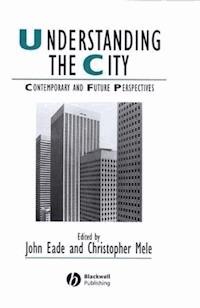
Understanding the City E-Book
24,99 €
Mehr erfahren.
- Herausgeber: John Wiley & Sons
- Kategorie: Wissenschaft und neue Technologien
- Serie: Studies in Urban and Social Change
- Sprache: Englisch
This cutting-edge, multi-disciplinary analysis looks ahead to the direction which urban studies is likely to take during the twenty-first century.
Das E-Book Understanding the City wird angeboten von John Wiley & Sons und wurde mit folgenden Begriffen kategorisiert:
Anthropologie, Anthropology, Geographie, Geography, Social & Cultural Anthropology, Sociology, Soziale u. kulturelle Anthropologie, Soziologie, Stadtgeographie, Stadtsoziologie, Urban Geography, Urban Sociology
Sie lesen das E-Book in den Legimi-Apps auf:
Seitenzahl: 892
Veröffentlichungsjahr: 2011
Ähnliche




















Contents
List of Illustrations
List of Tables
List of Contributors
Series Editors’ Preface
Preface
Part I: Introduction
1 Understanding the CityJohn Eade and Christopher Mele
Symbols, Signs, and Discourse
The Indeterminacy of the Social
Postcolonialism, Transnationalism, and Globalization
Toward Understanding the City
About this Volume
Bibliography
Part II: A Middle Ground? Difference, Social Justice, and the City
2 Rescripting Cities with DifferenceRuth Fincher, Jane M. Jacobs, and Kay Anderson
Situated Scripts
Difference in Urban Analysis – Theoretical Takes
Three Contemporary Scripts about Cities
Conclusion
Bibliography
3 The Public CitySophie Watson
Public Space – Public Realm
Difference in the City and the Making of Symbolic Space
Bibliography
4 Social Justice and the South African CityDavid M. Smith
Introduction
Social Justice (and the City?)
South Africa under Apartheid
Social Justice after Apartheid
Epilogue
Bibliography
5 The Dangerous Others: Changing Views on Urban Risks and Violence in France and the United StatesSophie Body–Gendrot
The Evolution of Research: Redefining Urban Violence and its Potential Causes
Hotspots versus Violent Youths: The Theoretical Debate
Business Cycles, Polarization, and Urban Threats
Radical Rethinking: The Evolution of Policies of Social Control in Cities
Conclusion: An Elusive Complexity
Bibliography
Part III: The Global and Local, the Information Age, and American Metropolitan Development
6 Power in Place: Retheorizing the Local and the GlobalMichael Peter Smith
The Confines of the Local in Urban Structuralism
The Limits of the Postmodern Turn to the Local
Rethinking the Ethnographic Turn
Transnational Networks and the Localization of Power/Knowledge
Reimagining the Politics of Everyday Life
Transnationalism and the Politics of Place-making
Bringing the Social Back In
Bibliography
7 Depoliticizing Globalization: From Neo-Marxism to the Network Society of Manuel Castells1Peter Marcuse
The Evolution of Urban Studies
The Information Age and the Network Society in Manuel Castells’s Trilogy
The Depoliticization of Globalization in Castells
Conclusion: The Subtleties of Language
Prescription: What is to be Done?
Notes
Bibliography
8 Urban Analysis as Merchandising: The “LA School” and the Understanding of Metropolitan DevelopmentMark Gottdiener
The “LA School” as a Form of Logocentric Ideology
The Ideological Objectification and Valorization of Physical Location
Downplaying History
Is Geography, and the LA School Geography in Particular, the Only Insightful Discipline Studying Contemporary Urbanism?
What Can Be Learned from the Critique of “LA School” Hype?
Understanding the New Spatial Form
Characteristics of the Multi-centered Metropolitan Region
A Typical Multi-centered Region
Understanding the Sociospatial Forces of Multi-centered Development
The Multi-centered Form and the Interventionist State
The Role of Real Estate in the Production of the Multi-centered Metropolitan Region
The Role of Space in the Production of the Multi-centered Region
Multi-centeredness and Multiculturalism
The Role of Culture/Symbols in the Production of the Built Environment
Beyond LA Hype
Bibliography
Part IV: Urban Research in Particular Regions of the Globe
9 State Socialism, Post-socialism and their Urban Patterns: Theorizing the Central and Eastern European ExperienceChris Pickvance
The State Socialist Period
Post-socialism
Conclusion
Notes
Bibliography
10 The China Difference: City Studies Under Socialism and BeyondDorothy J. Solinger and Kam Wing Chan
The Impact of Politics
Western Literature: Disciplinary Approaches
Geography and Urban Planning
Political Science
Sociology
Anthropology
Cultural Studies
Urban Studies in the PRC
The Future
Notes
Bibliography
11 Economic Miracles and Megacities: The Japanese Model and Urbanization in East and Southeast AsiaJ. S. Eades
From the 1980s to the 1990s in Japanese Urban Ethnography
The Implications for Urban Theory
The Relevance of Japanese Urbanism for East and Southeast Asia
Conclusion
Bibliography
Part V: Urban Processes and City Contexts: India and the Middle East
12 Cities of the Past and Cities of the Future: Theorizing the Indian Metropolis of Bangalore
Urban Sociology in India/Sociology of the Indian City
Discourses of Return
The Mnemonics of Space
Encrypted Spaces, Multiple Bodies
Divided Spaces, Ethereal Bodies
Utopian Spaces, Cosmic Bodies
Conclusion
Notes
Bibliography
13 The Syntax of Jerusalem: Urban Morphology, Culture, and PowerShlomo Hasson
Introduction: Questions and Major Arguments
Review of the Literature
Reading the Urban Landscape of Jerusalem
The Urban Discourse: Cross-temporal Relations
Factors Shaping the Urban Discourse
Conclusions
Bibliography
14 Muslim Civil Society in Urban Public Spaces: Globalization, Discursive Shifts, and Social MovementsPaul M. Lubeck and Bryana Britts
Framing: Muslim Movements in Urban Situations
Urban Structural Processes, Discourses, and Movements
Global Restructuring: Petrodollars and the Rise of Neoliberal Regulation
The Legitimacy Crisis of the Postcolonial Secular State
Discursive Shift: The Iranian Revolution as “Demonstration Effect”
Islamic Reform: The Origins of Modern Islamist Urban Movements
Radical Islamist Discourses: Sayyid Qutb as Insurrectionary Theorist
Urban Egypt: A Case Study of Islamism within Civil Society
Education Policy, Urban Networks, and Civil Society
Public Education: Incubator of the Discursive Shift to Islamism
Urban Civil Society: Islamist Charities and Networks
Professional Associations and the Muslim Brothers: A State within the State?
Cairo: Islamism and Survival Strategies among the Popular Classes
Comparative Perspectives: Islamism, Democracy and Urban Insurrection
Muslim Women in Cities: Gender Relations and New Islamic Dress
Discursive Struggle: The Emergence of Muslim Feminists
Concluding Reprise
Bibliography
Part VI: Urban Processes and City Contexts: The United States
15 The Bullriders of Silicon Alley: New Media Circuits of Innovation, Speculation, and Urban DevelopmentMichael Indergaard
Networks and the Remaking of Space
Rethinking the Economy/Culture Divide
Silicon Alley: The Institutional Nexus
Online Consumer Circuits
Connecting with the Bull Market
Circuits and Currencies of Urban Development
Circuit Disconnects and Decay
Morphing Manhattan: From Silicon Alley to Times Square
City of Circuits
Bibliography
16 Fear and Lusting in Las Vegas and New York: Sex, Political Economy, and Public SpaceAlexander J. Reichl
Las Vegas
New York City
Sexuality and Public Space
Theorizing the Political Value of Public Space
Bibliography
17 Efficacy or Legitimacy of Community Power? A Reassessment of Corporate Elites in Urban StudiesLeonard Nevarez
Elites of Urban Governance
Reconstructing Urban Elites in the New Economy
Elite Discourses in the Quality-of-life District
Conclusion
Bibliography
18 Dream Factory Redux: Mass Culture, Symbolic Sites, and Redevelopment in HollywoodJan Lin
The Dream Factory: Mass Culture, Media Conglomerates, and Labor Struggles
Symbols and Culture in Urban Theory
Hollywood the Place and Icon
Dream Palaces and Mass Spectacles
Redevelopment and the Reclaiming of Hollywood
Conclusion
Notes
Bibliography
Index
Studies in Urban and Social Change
Published by Blackwell in association with the International Journal of Urban and Regional Research. Series editors: Chris Pickvance, Margit Mayer and John Walton.
Published
Fragmented Societies
Enzo Mingione
Free Markets and Food Riots
John Walton and David Seddon
Post-Fordism
Ash Amin (ed.)
The People’s Home? Social Rented Housing in Europe and America
Michael Harloe
Cities After Socialism: Urban and Regional Change and Conflict in Post-Socialist Societies
Gregory Andrusz, Michael Harloe, and Ivan Szelenyi (eds.)
Urban Poverty and the Underclass: A Reader
Enzo Mingione
Capital Culture: Gender at Work in the City
Linda McDowell
Contemporary Urban Japan: A Sociology of Consumption
John Clammer
Globalizing Cities: A New Spatial Order?
Peter Marcuse and Ronald van Kempen (eds.)
The Social Control of Cities? A Comparative Perspective
Sophie Body-Gendrot
Cinema and the City: Film and Urban Societies in a Global Context
Mark Shiel and Tony Fitzmaurice (eds.)
The New Chinese City: Globalization and Market Reform
John R. Logan (ed.)
Understanding the City: Contemporary and Future Perspectives
John Eade and Christopher Mele (eds.)
Forthcoming
European Cities in a Global Age: A Comparative Perspective
Alan Harding (ed.)
Urban South Africa
Alan Mabin and Susan Parnell
Urban Social Movements and the State
Margit Mayer
© 2002 by Blackwell Publishers Ltd
a Blackwell Publishing company
except for editorial arrangement and introduction © 2002 by John Eade and Christopher Mele
Editorial Offices:
108 Cowley Road, Oxford OX4 1JF, UK
Tel: +44 (0)1865 791100
350 Main Street, Malden, MA 02148–5018, USA
Tel: +1 781 388 8250
The right of John Eade and Christopher Mele to be identified as the Authors of the editorial material has been asserted in accordance with the UK Copyright, Designs and Patents Act 1988.
All rights reserved. No part of this publication may be reproduced, stored in a retrieval system, or transmitted, in any form or by any means, electronic, mechanical, photocopying, recording or otherwise, except as permitted by the UK Copyright, Designs and Patents Act 1988, without the prior permission of the publisher.
First published 2002 by Blackwell Publishers Ltd
Library of Congress Cataloging-in-Publication Data has been applied for.
ISBN 0-631-22406-8 (hbk) 0-631-22407-6 (pbk)
A catalogue record for this title is available from the British Library.
Set in 101/2 on 12 Baskerville MT
by SNP Best-set Typesetter Ltd., Hong Kong
Printed in Great Britain by TJ International, Padstow, Cornwall
For further information on
Blackwell Publishers, visit our website:
www.blackwellpublishers.co.uk
Illustrations
12.1 Map of South Asian urban sites and places associated with the Sai Baba movement
12.2 Map of the Bangalore metropolitan area in 1995
12.3 Shivamma Thayee’s house and temple constructed by her in Rupena Agrahara
12.4 The black stone image of Shirdi Sai Baba in Rupena Agrahara
12.5 The Shirdi Sai Baba temple in Someshvarapura
12.6 Sathya Sai Baba (left) and Shirdi Sai Baba (right)
12.7 Sai Darshan in Indiranagar
13.1 Map of the cities of Jerusalem
Tables
9.1 The housing situation of different occupational groups in two provincial cities in Hungary in 1968 14.1 Population trends of major Muslim cities 14.2 Gender, education, and labor force participation 18.1 Domestic box-office market shares 18.2 Diverse media and entertainment conglomeratesContributors
Kay Anderson is Professor of Geography at Durham University. Her published work includes books and articles on race, place, and nation in Australia and Canada, such as Vancouver’s Chinatown: Racial Discourse in Global Times (1991). She co-edited (with Fay Gale) Inventing Places: Studies in Cultural Geography (1992/1999) and, more recently, she has been writing about the nexus of culture/nature/colonialism.
Sophie Body-Gendrot is a Professor of Political Science and American Civilization at the Sorbonne in Paris and a CNRS researcher. Her research focuses on comparative public policies, urban unrest, ethnic and racial issues, and citizen participation. Among her books in English are The Social Controlof Cities? A Comparative Perspective (2000), The Urban Moment (edited with R. Beauregard, 1999), and Minorities in European Cities (edited with M. Martiniello, 2000).
Bryana Britts was awarded an honors degree in Sociology at the University of California, Santa Cruz, where she teaches and researches urban social policy. Currently a postgraduate researcher at the Center for Global, International, and Regional Studies, she is conducting research on globalization, Islamic movements, civil society, and human rights. She plans to pursue a graduate degree in international public policy and human rights advocacy.
Kam Wing Chan is a Professor in Geography at the University of Washington. He received a Ph.D. from the University of Toronto. He is the author of Cities with Invisible Walls (1994) and has written extensively on China’s urbanization, migration, the household registration system, labor market, and economic development. He has also served as a consultant to the Asian Development Bank, International Labor Office, World Bank, and the Chinese government.
John Eade is Professor of Sociology and Anthropology at Roehampton University of Surrey. He has undertaken research in Calcutta and, for the last twenty years, in the “East End” of London. He is the author of The Politicsof Community (1989) and Placing London (2000). He also edited Living the GlobalCity (1997) and co-edited (with Tim Allen) Divided Europeans (1999) and (with Michael Sallnow) Contesting the Sacred (1991). He is also a founder editor of Journeys: The International Journal of Travel and Travel Writing (Berghahn).
J. S. (Jerry) Eades is Professor of Asia Pacific Studies at the Ritusmeikan Asia Pacific University in Beppu, Japan, and Senior Honorary Research Fellow in the Anthropology Department of the University of Kent, where he formerly lectured. His early research concentrated on West Africa, migration, ethnicity, and the informal sector, but after teaching at the University of Tokyo from 1991 to 1994, his interests now extend to the Asia Pacific region, urbanization, the environment, and tourism. He is co-editor of the monograph series, Japan in Transition (SUNY Press), and Asian Anthropologies (Berghahn).
Ruth Fincher is Professor of Urban Planning and Adjunct Professor of Geography at the University of Melbourne. She received her Ph.D. from Clark University in Worcester, Massachusetts. Her research and writing about inequality and locational disadvantage and the politics of difference in cities are informed by feminist and political economic conceptualizations of institutions. Her recent work includes Creating Unequal Futures? Rethinking Poverty, Inequality and Disadvantage (co-edited with Peter Saunders, 2001), Cities of Difference (co-edited with Jane M. Jacobs, 1998), and Australian Poverty Then andNow (co-edited with John Nieuwenhuysen, 1998). She is currently conducting research on practices of ethnic differentiation in the residential construction industry, for a major project entitled “Building on Ethnicity.”
Mark Gottdiener is Professor of Sociology and Adjunct Professor of Architecture and Planning at the University at Buffalo. His interests are in contemporary theory, semiotics, urbanism, and cultural studies. Among his many books are The Social Production of Urban Space (2nd edition), The New Urban Sociology (2nd edition with Ray Hutchison), The Theming of America (2nd edition), Las Vegas: the Social Production of an All-American City (with C. Collins and D. Dickens), and, as editor, New Forms of Consumption. His latest research is on the emerging social world of air travel and some of this work was recently published as Living in the Air: Surviving the New Culture of Air Travel.
Shlomo Hasson is Professor of Geography and Urban Planning at the Hebrew University of Jerusalem. He is the author of Urban Social Movementsin Jerusalem (1993) and co-author of Neighbourhood Organizations and the WelfareState (1994). He is currently writing on issues of divided cities, identity, culture, and urban morphology.
Michael Indergaard is Associate Professor of Sociology at St. John’s University. He has published on economic restructuring and urban redevelopment in journals such as Urban Affairs Review, Social Problems, and Research inUrban Sociology.
Jane M. Jacobs is an Associate Professor in the School of Anthropology, Geography, and Environmental Studies at the University of Melbourne. She gained her Ph.D. from University College, London. She has published widely in the area of cultural geography, with special interests in the cultural politics of cities, contested heritage, and postcolonial spaces. She is the author of Edge of Empire: Postcolonialism and the City (1996), co-author (with Ken Gelder) of Uncanny Australia: Sacredness and Identity in a Postcolonial Nation (1988), and co-editor (with Ruth Fincher) of Cities of Difference (1998). She is currently writing a book on the cultural technologies of the globalized residential highrise.
Jan Lin is Associate Professor of Sociology at Occidental College in Los Angeles. He taught previously at Amherst College and the University of Houston. He is Principal Investigator on a three-year grant from the US Department of Housing and Urban Development to Occidental College for the Northeast Los Angeles Community Outreach Partnership Center. He is the author of Reconstructing Chinatown: Ethnic Enclave, Global Change (1998). He is currently engaged in research for a forthcoming book, tentatively titled: Bright-Light Company Town: Redevelopment, Globalization, and Labor inHollywood.
Paul M. Lubeck is Professor of Sociology and Director of the Center for Global, International, and Regional Studies at the University of California, Santa Cruz. His first book, Islam and Urban Labor in Northern Nigeria: The Makingof a Muslim Working Class, won the Herskovits Prize. Besides researching the potential of information technology as a regional development strategy in Southeast Asia, Mexico, and Africa, Lubeck directs a Carnegie Corporation-funded working group analyzing the impact of globalization and Islamic social movements on the capacity of national states to govern and sustain national identities.
Peter Marcuse is Professor of Urban Planning at Columbia University in New York City, where he teaches urban planning. He has also taught in the Union of South Africa and in both West and East Germany. He has written extensively on housing, urban development, and globalization. His most recent book, co-edited with Ronald van Kempen, is Globalizing Cities: A NewSpatial Order? (1999). He is working on a book on the history of working-class housing in New York City.
Christopher Mele is Associate Professor of Sociology at the University at Buffalo. He is the author of Selling the Lower East Side: Culture, Real Estate,and Resistance in New York City (2000) and a number of articles on urban development and residential development in New York. He is currently completing a book-length study of regional development in southeastern North Carolina.
Leonard Nevarez is Assistant Professor of Sociology at Vassar College. He writes on corporate power and urban politics in the new economy, high-technology work and organizations, and the political economy of natural resource development. He is currently publishing a book on the local politics of “new economy” industry.
Chris Pickvance is Professor of Urban Studies at the University of Kent at Canterbury. His interests include urban theory, urban protest, locality, comparative analysis, and Central and Eastern Europe. He co-edited (with
E. Preteceille) State Restructuring and Local Power (1991) and (with K. Lang-Pickvance and N. Manning) Environmental and Housing Movements: GrassrootsExperience in Hungary, Russia and Estonia (1997). He is currently writing a book on local environmental policy implementation in Hungary.
Alexander J. Reichl is an Associate Professor of Political Science at Queens College of the City University of New York. He is the author of Reconstructing Times Square: Politics and Culture in Urban Development (1999), and he has published in the Journal of Urban Affairs and Urban Affairs Review. His current research examines the place of public housing in the changing social and physical landscape of US cities.
David M. Smith retired from his post as Professor of Geography at Queen Mary, University of London, in 2001. His research interests cover geographical perspectives on inequality, social justice, and morality, combining theory with case studies set in the United States, Eastern Europe, Israel, and South Africa. His books include Geography and Social Justice (1994), Human Geography:A Welfare Approach (1997), and Moral Geographies: Ethics in a World of Difference (2000). He lived and worked in South Africa for a year during the era of apartheid and has been a regular, recent visitor. In addition to publishing papers on South Africa he has edited two collections on urbanization and social change: Living under Apartheid (1982) and The Apartheid City and Beyond (1992).
Michael Peter Smith is Professor of Community Studies and Development at the University of California-Davis, and a Faculty Associate of the Center for California Studies at the University of California-Berkeley. He has published several influential books on cities, global migration, and urbanism, including The City and Social Theory (1979), The Capitalist City (1987), City, State,and Market (1988), The Bubbling Cauldron (1995), Transnationalism from Below (1998), and, most recently, Transnational Urbanism (2001). He is the editor in chief of the Comparative Urban and Community Research book series. His latest publication in this series is City and Nation: Rethinking Place and Identity (2001), co-edited with Thomas Bender. Smith is currently conducting a bi-national field research project, investigating a transnational community development initiative which links Mexican migrants from Napa, California, to economic and community development projects in their home town of Timbinal, Mexico.
Dorothy J. Solinger is Professor of Political Science in the School of Social Sciences at the University of California, Irvine. Her most recent book is Contesting Citizenship in Urban China: Peasant Migrants, The State and the Logicof the Market (1999). She is also co-editor of States and Sovereignty in the GlobalEconomy (1999). She has also published China’s Transition from Socialism (1993), a collection of essays about the reform of socialism in China’s urban areas.
Smriti Srinivas received a Ph.D. in Sociology from the Delhi School of Economics, India, and worked at the Institute for Social and Economic Change, Bangalore, India from 1994 to 1997 as an Assistant Professor (Sociology). Between 1997 and 1998 she was attached as a Rockefeller Fellow to the International Center for Advanced Studies, New York University, and was a Mellon Fellow at the Department of Sociology, University of Maryland, College Park, in 1998–9. She is currently Assistant Professor, Division of Comparative Studies in the Humanities, Ohio State University. She is the author of The Mouths of People, the Voice of God: Buddhists and Muslims in a Frontier Community of Ladakh (1998), and Landscapes of Urban Memory: The Sacred andthe Civic in India’s High-Tech City (2001). Her research interests are in the study of cities and contemporary religious forms and practices.
Sophie Watson is Professor of Urban Cultures at the University of East London. She was formerly Professor in Policy Studies at the University of Bristol, and Professor of Urban and Regional Planning at Sydney. She wrote (with Peter Murphy) Surface City: Sydney at the Millennium (1997), and edited (with K. Gibson) Metropolis Now (1995) and Postmodern Cities and Spaces (1995), and (with Gary Bridge) The Blackwell Companion to the City (2001). She is currently working on public space and the multicultural city.
Series Editors’ Preface
In the past three decades there have been dramatic changes in the fortunes of cities and regions, in beliefs about the role of markets and states in society, and in the theories used by social scientists to account for these changes. Many of the cities experiencing crisis in the 1970s have undergone revitalization while others have continued to decline. In Europe and North America new policies have introduced privatization on a broad scale at the expense of collective consumption, and the viability of the welfare state has been challenged. Eastern Europe has witnessed the collapse of state socialism and the uneven implementation of a globally driven market economy. Meanwhile, the less developed nations have suffered punishing austerity programs that divide a few newly industrializing countries from a great many cases of arrested and negative growth.
Social science theories have struggled to encompass these changes. The earlier social organizational and ecological paradigms were criticized by Marxian and Weberian theories, and these in turn have been disputed as allembracing narratives. The certainties of the past, such as class theory, are gone and the future of urban and regional studies appears relatively open.
The aim of the series Studies in Urban and Social Change is to take forward this agenda of issues and theoretical debates. The series is committed to a number of aims but will not prejudge the development of the field. It encourages theoretical works and research monographs on cities and regions. It explores the spatial dimension of society, including the role of agency and of institutional contexts in shaping urban form. It addresses economic and political change from the household to the state. Cities and regions are understood within an international system, the features of which are revealed in comparative and historical analyses.
The series also serves the interests of university classroom and professional readers. It publishes topical accounts of important policy issues (e.g., global adjustment), reviews of debates (e.g., post-Fordism) and collections that explore various facets of major changes (e.g., cities after socialism or the new urban underclass). The series urges a synthesis of research and theory, teaching and practice. Engaging research monographs (e.g., on women and poverty in Mexico or urban culture in Japan) provide vivid teaching materials, just as policy-oriented studies (e.g., of social housing or urban planning) test and redirect theory. The city is analyzed from the top down (e.g., through the gendered culture of investment banks) and the bottom up (e.g., in challenging social movements). Taken together, the volumes in the series reflect the latest developments in urban and regional studies.
Subjects which fall within the scope of the series include: explanations for the rise and fall of cities and regions; economic restructuring and its spatial, class, and gender impact; race and identity; convergence and divergence of the “east” and “west” in social and institutional patterns; new divisions of labor and forms of social exclusion; urban and environmental movements; international migration and capital flows; politics of the urban poor in developing countries; cross-national comparisons of housing, planning, and development; debates on post-Fordism, the consumption sector, and the “new” urban poverty.
Studies in Urban and Social Change addresses an international and interdisciplinary audience of researchers, practitioners, students, and urban enthusiasts. Above all, it endeavors to reach the public with compelling accounts of contemporary society.
Editorial Committee
John Walton, Chair
Margit Mayer
Chris Pickvance
Preface
This volume is the product of a virtual community of scholars who were invited to contribute to a multidisciplinary analysis of (1) the directions that urban research has taken during the 1990s and (2) the avenues that may open up during the early part of the twenty-first century. The book provides a wideranging insight into recent debates where the widespread influence of political economy perspectives, as well as other, non-Marxist approaches, has been challenged by explorations of cultural processes and social difference. In particular, Understanding the City: Contemporary and Future Perspectives shows the degree to which a middle ground has emerged between political economy and cultural turn approaches.
We are grateful to the editors of the Blackwell Studies in Urban and SocialChange series, especially Chris Pickvance and John Walton, for inviting us to produce this volume. They readily responded to our ideas and to the usual twists and turns involved in compiling a multi-authored work. Indeed, Chris Pickvance generously agreed to contribute a chapter on developments in Central and Eastern Europe. Sarah Falkus and Joanna Pyke at Blackwell also provided support and advice during the preparation of the volume. We thank Christina Weber and Joan A. Cabral, graduate students in sociology at the University of Buffalo, for their editing assistance. Last but not least, we should like to thank our colleagues for their forbearance and understanding. A special debt of gratitude is owed by John Eade to his wife, Caroline Egan-Strang, who understands well the obsessions of academics.
John Eade
Christopher Mele
Part I
Introduction
1 Understanding the City
John Eade and Christopher Mele
1
Understanding the City
John Eade and Christopher Mele
The beginning of the twenty-first century is an exciting time for those wanting to understand the city. There is a growing realization that the “cultural turn,” through its emphasis on meaning, identity and the politics of difference, for example, provides the cutting edge of urban research. At the same time the cultural turn has contributed to the fragmentation of urban studies and has had little impact on traditional urban investigations. When culturalist analyses of cities have directly engaged with political economy or the older urban ecology approaches, they have usually sought to move beyond those perspectives. Here we resist this tendency and explore the dynamic interplay between the cultural turn and political economy. We want to contribute to closing this gap through explorations of a middle ground where the traditional concerns within urban studies – restructuring, globalization, North/South urbanization, for instance – may intersect with culturalist approaches. In Understandingthe City: Contemporary and Future Perspectives, we aim to provide the first concerted effort at addressing this emergent middle ground.
What, then, does “understanding the city” entail? In our opinion it does not mean a descriptive survey of contemporary epistemological and theoretical approaches to the city. Furthermore, we do not want to place ourselves within a unified body (school or paradigm) of scholarship frozen in a particular moment of time or based exclusively upon a limited range (i.e., Western) of cases. We prefer to define “understanding” as an ongoing and continual transdisciplinary practice: an enterprise which is both an individual process of scholarly research and writing, and a collective dialogue with other people’s work. This is an enterprise which corresponds to changes not only in the social world (globalization, migration, etc.) but also within the larger theoretical advances that derive from those changes and seek to comprehend (and change) them, such as feminist theory, postcolonialism, and poststructuralism.
In practical terms, understanding the city consists of multiple and modest endeavors aiming to reconcile the ways in which urban social processes (comprised of the cultural as well as the political and economic) are constituted at particular historical moments. At the same, this approach accepts that the reconciliation can never be fully comprehensive nor complete. It insists on an open scholarly awareness (recognition – but not necessarily full inclusion) of theoretical and empirical advances. It also calls for a conscious acknowledgment of the significance of structural forms of political economy and the indeterminacy of social and cultural processes to one’s own work and to urban studies in general.
Perhaps most importantly, the perspective affirms that the initial issues of power, conflict, and social resistance in the urban context, which defined a paradigm shift three decades ago, remain critical. Those concerns are clearly political economic as well as cultural and social. The work of understanding the city is, therefore, not to fix and define, once and for all, the relationship between (or hierarchy among) the social, the cultural, and the political economic. Rather, it needs to problematize these connections in particular cities and time periods and continuously strive to develop new and innovative ways to comprehend their intersections.
The theoretical acknowledgment of the importance of signification and of the indeterminacy of the social to urban studies has, if anything, heightened the need for careful empirical work that produces situated knowledges (as opposed to static models or all-encompassing theories) about the city. While no single epistemology or related methodology appears comparatively better suited for understanding the city, the approaches taken by the contributors to identify a valuable set of prescriptions and precautions for urban studies. They examine the need for:
Lesen Sie weiter in der vollständigen Ausgabe!
Lesen Sie weiter in der vollständigen Ausgabe!
Lesen Sie weiter in der vollständigen Ausgabe!
Lesen Sie weiter in der vollständigen Ausgabe!
Lesen Sie weiter in der vollständigen Ausgabe!
Lesen Sie weiter in der vollständigen Ausgabe!
Lesen Sie weiter in der vollständigen Ausgabe!
Lesen Sie weiter in der vollständigen Ausgabe!
Lesen Sie weiter in der vollständigen Ausgabe!
Lesen Sie weiter in der vollständigen Ausgabe!
Lesen Sie weiter in der vollständigen Ausgabe!
Lesen Sie weiter in der vollständigen Ausgabe!
Lesen Sie weiter in der vollständigen Ausgabe!
Lesen Sie weiter in der vollständigen Ausgabe!
Lesen Sie weiter in der vollständigen Ausgabe!
Lesen Sie weiter in der vollständigen Ausgabe!
Lesen Sie weiter in der vollständigen Ausgabe!
Lesen Sie weiter in der vollständigen Ausgabe!
Lesen Sie weiter in der vollständigen Ausgabe!
Lesen Sie weiter in der vollständigen Ausgabe!
Lesen Sie weiter in der vollständigen Ausgabe!
Lesen Sie weiter in der vollständigen Ausgabe!
Lesen Sie weiter in der vollständigen Ausgabe!




