


6,99 €
Mehr erfahren.
- Herausgeber: Corvus
- Kategorie: Gesellschafts- und Liebesromane
- Sprache: Englisch
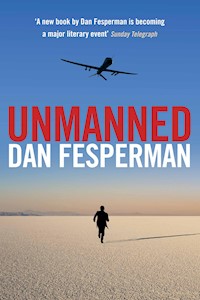
As an F-16 fighter pilot, Darwin Cole was a family man on top of his world. Now he's a washout - drunk and alone in a trailer in the Nevada desert, haunted by the memory of an Afghan child running for her life from the Predator drone he 'piloted'. Reluctantly, Cole teams up with three journalists seeking to discover the identity of the anonymous intelligence operative who called the shots in that ill-fated mission. But in a surveillance culture, even the well-intentioned must sometimes run for their lives. Especially when they're tracking leads to the very heart of that culture - in intelligence, in the military, and among the unchecked private contractors who stand to profit richly from the advancing technology... Technology not just for use 'over there', but for right here, right now.
Das E-Book können Sie in Legimi-Apps oder einer beliebigen App lesen, die das folgende Format unterstützen:
Veröffentlichungsjahr: 2014
Ähnliche




















Dan Fesperman’s travels as a writer have taken him to thirty countries and three war zones. Lie in the Dark won the Crime Writers’ Association of Britain’s John Creasey Memorial Dagger Award for best first crime novel, The Small Boat of Great Sorrows won their Ian Fleming Steel Dagger Award for best thriller, and The Prisoner of Guantánamo won the Dashiel Hammett Award from the International Association of Crime Writers. He lives in Baltimore.
ALSO BY DAN FESPERMAN
The Double Game
Layover in Dubai
The Arms Maker of Berlin
The Amateur Spy
The Prisoner of Guantánamo
The Warlord’s Son
The Small Boat of Great Sorrows
Lie in the Dark
First published in the United States in 2014 by Alfred A. Knopf, a division of Random House LLC, New York, and in Canada by Random House of Canada Limited, Toronto, Penguin Random House companies.
Published in trade paperback in Great Britain in 2014 by Corvus, an imprint of Atlantic Books Ltd.
Copyright © Dan Fesperman, 2014
The moral right of Dan Fesperman to be identified as the author of this work has been asserted by him in accordance with the Copyright, Designs and Patents Act of 1988.
All rights reserved. No part of this publication may be reproduced, stored in a retrieval system, or transmitted in any form or by any means, electronic, mechanical, photocopying, recording, or otherwise, without the prior permission of both the copyright owner and the above publisher of this book.
This novel is entirely a work of fiction. The names, characters and incidents portrayed in it are the work of the author’s imagination. Any resemblance to actual persons, living or dead, events or localities, is entirely coincidental.
10 9 8 7 6 5 4 3 2 1
A CIP catalogue record for this book is available from the British Library.
Trade paperback ISBN: 978 0 85789 342 0
E-book ISBN: 978 0 85789 343 7
Printed in Great Britain
Corvus
An imprint of Atlantic Books Ltd
Ormond House
26–27 Boswell Street
London
WC1N 3JZ
www.corvus-books.co.uk
For all men and women who serve –
whether with the pen or the sword
Contents
Chapter One
Chapter Two
Chapter Three
Chapter Four
Chapter Five
Chapter Six
Chapter Seven
Chapter Eight
Chapter Nine
Chapter Ten
Chapter Eleven
Chapter Twelve
Chapter Thirteen
Chapter Fourteen
Chapter Fifteen
Chapter Sixteen
Chapter Seventeen
Chapter Eighteen
Chapter Nineteen
Chapter Twenty
Chapter Twenty-One
Chapter Twenty-Two
Chapter Twenty-Three
Chapter Twenty-Four
Chapter Twenty-Five
Chapter Twenty-Six
Chapter Twenty-Seven
Chapter Twenty-Eight
Chapter Twenty-Nine
Chapter Thirty
Chapter Thirty-One
Chapter Thirty-Two
Chapter Thirty-Three
Chapter Thirty-Four
Chapter Thirty-Five
Chapter Thirty-Six
Chapter Thirty-Seven
Chapter Thirty-Eight
Acknowledgments
CHAPTER ONE
THIRTY SECONDS TO IMPACT.
On the video display, Captain Darwin Cole watches black crosshairs quiver on a mud rooftop. He doesn’t budge the stick and rudder. No piloting needed now. All that matters is the missile, which Airman Zach Lewis guides by laser from a seat to Cole’s immediate right.
Ten seconds pass while Cole wiggles his toes, numb from the air-conditioning. No one speaks into their headsets. Even the chatter screen is calm, as if everyone in their viewing audience was holding his breath. It is 3:50 a.m., and Cole’s sense of detachment is so profound that he has to remind himself this is not a game, not a drill. It is death in motion, as real as it gets, and for the moment he is reality’s instrument of choice, the one whose name will go on the dotted line now and forevermore. His kill.
A sobering thought anytime, but especially when you’re sitting in a trailer on the floor of the Nevada desert, drowsy from breathing air that smells like warm electronics. Cole is a grounded fighter jock, as wingless as a plucked housefly, yet here he is about to zap a roomful of bad guys on the other side of the world. The upholstery creaks as he shifts in his seat. Nearly four hours in the saddle. Numb butt, numb toes, numb brain. Zach begins the countdown in a voice edgy with youthful eagerness.
“Ten, nine, eight, seven, six, five, four . . .”
On the screen, sudden movement.
The door of the house opens and a girl appears at the threshold. On Cole’s eighteen-inch monitor she is only three inches high, but the afternoon sunlight paints her vividly—red shawl, white pants, blue scarf. She looks young, ten or eleven, and for a disastrous second she gazes straight at the lens before she darts left, disappearing from the screen just as two small boys run out the door behind her, sandals flopping.
“What the fuck!” Cole says. “Can you—?”
“Too late.”
Zach shoves the joystick anyway, but it will take two seconds for his command to reach the missile across seven thousand miles of space and wiring, and by then the whole thing will be over.
Cole is wide awake now, and in the panic flash of this final moment before the explosion he is reminded that all his commands tonight have passed above the schools, rivers, farms, houses, malls, and highways of a sleeping America. Each twitch of his hand flings a signal of war across the nation’s night owls as they make love, make a sandwich, make a mess of things, or click the remote. The signal then hurdles the Atlantic, Europe, and the Middle East before finally reaching the bright blue afternoon of eastern Afghanistan, nine hours into the future, where at this moment his MQ-1 Predator drone gazes down from ten thousand feet upon the stony valley and mud homes of Sandar Khosh, a remote village of farmers and herdsmen.
Cole hopes the girl is running fast. The boys, too.
“Zero,” Zach announces.
The main screen erupts silently in a boiling cloud of fire and dust.
Cole gawks. The job does not allow him to turn away. No one says a word.
Already he feels the moment taking root in a fallow corner of his imagination—a seed of torment, a nascent preoccupation. From experience he knows that during the next few hours, word of this event will filter from the trailer like a noxious gas. By the end of his shift the chaplain will be waiting, along with the shrink who insists on calling himself a medic, as if they were right there on the battlefield with the dead and wounded. As always, Cole will politely decline their offers of counsel, although doom seems to follow him everywhere lately, closing in like a posse that rides only by night.
For the moment there is pressing business to attend to. He speaks into his headset.
“Zoom out, Zach. Where’d those kids go?”
Cole’s mind wants to shriek, but his voice remains calm, a cool Virginia baritone in the reassuring timbre of pilots the world over. It is an intelligent voice of great utility, patient and searching. Only seven hours earlier it was reading a bedtime story to Danny, his youngest, employing the soft cadences needed to make a restless five-year-old fall asleep. Somewhere toward the back of Cole’s brain the book’s rhythmic words still tumble as gently as socks in a dryer:
In the great green room
There was a telephone
And a red balloon . . .
The lens draws back. The wider view reveals three small bodies just to the left of the ruined house. The worst part is that Cole believes he knows these children. Not personally, but in the way of all watchers who grow familiar with their subjects. He has seen them playing cricket in the rocky field by the old shepherd’s house, digging onions with their mother, hauling firewood from the grove of poplars by the stream. He knows these homes and this village, although it is little more than a smudge on their tactical map. How can this be possible? Then he remembers. Zach and he snooped around here only a month ago with their Predator, first by day and then after dark, switching the camera to infrared so they could lurk like an owl in a high pine while, far below, cook fires burned, animals lay down in their stables, and children—these children, he is sure of it now—played in the open air of an October evening. And with that memory comes the realization that those three kids should not have been in that house, not the one that Zach and he have been watching so intently for four hours. He is not sure how he knows this. Something he noticed earlier, perhaps, or during tonight’s stream of chatter, the ongoing cyber-conversation between all the usual interested parties.
Cole sometimes has to remind himself of what part of the world he’s watching. It might be any dry and rocky valley here in Nevada. It could be the vacant lot behind his daughter’s school. The picture is unaccompanied by smell or soundtrack. When characters move their mouths, it seems almost possible that they’re speaking his language, and when he departs at the end of the day their images accompany him home, a silent movie unspooling in his head during the long drive to the ’burbs of Vegas—shot after shot of hobbled lives in their slow progress, with Cole as the omnipotent eye above; a kindly uncle with a camera, perhaps, making home movies for the world at large. Until you fired a missile.
“We’ve got activity,” Zach says.
On the screen, two adults emerge from a neighboring house, where the door has been blown off its hinges. They stagger as if dazed or wounded, Chaplinesque in their movements.
A fresh line of dialogue pops up on Cole’s chat’s screen, gold letters on a black background:
(FORT1) Nice shooting. Check the truck.
The truck, a white Toyota, is a key piece of the scene. Its arrival moments earlier was their cue for action, the agreed-upon signal that the targeted bad guys had moved into place and were now present and accounted for.
Fort1 is the mission’s J-TAC, or joint terminal attack controller. He has directed much of the action tonight, the stage manager of this drama. Cole knows him only from his call sign, assuming Fort1 is even a he. Cole’s CO, Lieutenant Colonel Scott Sturdivant, mentioned Fort1 only cursorily during the pre-mission briefing, a tipoff that Fort1 is from the intelligence side. He could be in Washington—the Pentagon, the CIA, even the White House—or he could be on the ground at the scene, posted on a nearby hill. Theoretically he could even be here at Creech Air Force Base, a bustling little place tucked against barren mountains, a mere forty miles from Vegas. He could be anywhere his laptop will travel, as long as he has the correct passwords and encryptions.
Wherever he is, Fort1 seems unduly satisfied with what they’ve just accomplished. Cole restrains himself from typing a snarky reply. Everything he says and does tonight will become part of the official record. His “What the fuck!” from a moment ago already weighs against him, so now he must be doubly careful. Swallowing hard, he masters his tone, and then says to Zach without turning his head, “Our J-TAC wants a look at the truck.”
Zach eases the camera right. A white shape emerges from the smoke and dust.
“Here it comes,” Zach says, a slight tremor in his voice. “I’ll zoom it.”
Zach Lewis is only twenty-two. A year ago he was an image analyst, examining satellite photos in quiet rooms. After six months here he still seems to be acclimating to this life on a battlefront where the aftermath must always be studied, evaluated, autopsied.
The truck’s crumpled roof is visible beneath a collapsed wall. Little else of it is recognizable except some orange markings on the hood and a Toyota logo on the tailgate.
(FORT1) Now the house.
So far, not a peep from Colonel Sturdivant. Cole wonders if Sturdy and Fort1 have ever met, or spoken by phone. The ways of such relationships are a mystery to him. By design, of course. For his protection, they tell him.
Cole relays the request. Zach shifts the camera.
Sometimes Cole is overwhelmed by all there is to keep track of at his cramped workstation. He has two keyboards—one for typing flight commands, the other for chat. Occasionally he reaches for the wrong one. Apart from the screens for video and chat, four others display maps, flight telemetry, and masses of other information that change by the second—readouts for velocity, altitude, fuel levels, oil pressure, wind speed and direction, missile paths, air traffic, weather conditions, terrain. It is a neural nightmare, a bit like trying to conduct five trains at once as they careen toward the same station.
The ruins of the house swing into view.
“Holy shit,” Zach mutters.
“Easy as she goes,” Cole says, hoping to soothe him.
The damage is complete. Roof collapsed, everything in a heap. The floor plan, roughly thirty by forty feet, was big enough to hold a lot of people, and here and there Cole spots arms and legs, bright clothing, smears of blood, the fleshy blur of faces with fixed and open eyes. In the calamitous jumble it is impossible to say whether the bodies are male or female, adult or child.
From an operational point of view he supposes that the most important consideration, perhaps the only one, is that their HVT—high-value target—is now dead, along with whoever came to meet him. A nasty gathering, according to Colonel Sturdivant at the briefing. A worthy target. But that’s what they always said, or why bother to shoot?
(FORT1) Move closer.
What could Fort1 be searching for in this mess? Lewis zooms to the camera’s limit, but there is little more to see. Cole finds himself scanning for toys. Seeing none, he is relieved, until he recalls that these children almost never possess anything beyond a slingshot, a cricket bat, and the clothes on their backs. During their earlier reconnaissance of Sandar Khosh his overriding impression was that of a quiet hamlet of farmers, armed only with the occasional stray Kalashnikov, which are as common as pitchforks in these hills. No one even carried a grenade launcher. By local standards the village is as quaintly pacifist as an Amish homestead. Dirt farmers, in other words—their slang for the jetsam of the countryside. Sandar Khosh, the land that both time and terrorism forgot, no American soldiers within miles.
Yet here they were with their Predator for the second time in a month.
Why?
Not his job to ask, nor Sturdy’s to answer.
One of Cole’s occupational hazards is that he has begun to wonder what it would be like to lead a life in which every action was observed from on high for hours at a time. How would he function under those conditions? What must it be like to become an image lodged in the memory of some secret database, your digital signature retrievable by anyone with the proper clearance? More than ever before in his life, Cole now notices all the cameras that seem to be mounted almost everywhere he looks—at stoplights and in convenience stores, in school hallways and Walmarts, shopping malls and parking decks. At toll plazas, the ATM, the branch library. In elevators and hotel lobbies. There is even one installed in the top rim of the screen of his wife’s laptop, right there on the kitchen table, open to the world. Here at Creech, cameras are everywhere. No escape except the desert, and even there you’re an easy mark for the satellites, especially at night, when a man shows up as a throb of thermal brightness marooned on an empty cooling sea. Zach told him all about it.
The chat screen blips.
(FORT1) Any squirters?
Escapees, he means. So called because on infrared they display as squibs of light, streaming from the action like raindrops across a windshield. Before Cole can respond, the screen flashes again.
(FORT1) Check out back. Someone couldve gone out window.
Cole counts to three, then relays the order in his steadiest bedtime story voice. . . . And a quiet old lady who was whispering hush . . . Zach moves the camera. No one is behind the house, but a pair of legs in green pants protrudes from beneath the fallen rear wall.
(FORT1) Hold her there.
Why does this body interest him more than the others? Is this the HVT? Zach holds the close-up for several seconds, then, on his own initiative, pans back toward the front of the house. Cole braces himself as the three small bodies slide back into view. His eyes are drawn to the girl.
Incredibly, her body twitches.
She is alive.
(FORT1) Check the house again.
Fuck that. Did Cole say that or just think it? Zach stays on the girl. Her right arm is severed and lies a foot from her shoulder, with blood pooling in the gap. She struggles to rise, trying to prop herself on her left elbow. Cole watches but says nothing. Zach is also silent. The girl slowly raises her head.
(FORT1) I said the house.
The man is obsessed, either with death or with rubble. Cole opts for life and continues to ignore him, despite a growing sense that there will be consequences—for himself, for Zach, for everyone involved.
An old woman crosses onto the screen from the left. Reaching the girl she bends stiffly to the ground. Her mouth opens wide, and so does the girl’s. Cole’s imagination supplies the soundtrack—two voices in awful harmony, a cry that is keening and forlorn, as if someone had torn open a tender and damaged part of the earth and this is the unbearable sound that issues from within.
The time signature at the bottom of the screen flashes to 04:00, but his mind is still lodged at 3:50, the moment of impact.
Cole blinks. In four hours his shift will end. He will exit the trailer, dodge the chaplain, brush aside the shrink. Then he will drive home on an empty highway with only these images for company. After thirty miles or so he will ease into the dense weave of Vegas traffic and take the exit for his suburban refuge. He will click the remote to open the garage and enter the kitchen door with a smile for his wife. Then, while cartoons blare and the neighbor starts his mower, he will eat Saturday pancakes with his children.
No one but him will know what has happened.
(FORT1) Still need more from the house.
Don’t we all, thinks Cole, mesmerized.
CHAPTER TWO
Fourteen months later
A CONTRAIL OF DUST marked the car’s progress, undulating like a brown caterpillar across the wide expanse of the desert floor. The car was a mile away, maybe two, but there was no mistaking its destination. The only person up here was Darwin Cole, seated on a lawn chair at the door of a sagging trailer in the shade of a sandstone bluff.
Now he could hear the laboring engine, the ping of gravel in the wheel wells. Silver Chevy, practically brand-new. Meaning it was either a rental or government issue. The latter prospect made Cole reach inside the trailer for the loaded 12-gauge he always kept handy. He sat back down and laid the shotgun across his lap like a hunter in a blind, waiting. Then he squinted into the morning sky to check the position of the December sun. Almost nine. Early for company. Early for bourbon, too, but he took another warm swallow from his tumbler of Jeremiah Weed.
The Chevy disappeared into a dip, then reemerged before stopping a hundred yards out, engine idling. The chrome grille smiled up at him like a salesman. Somebody wanted something, but Cole wasn’t in a giving mood. Nothing to give, anyway, except flies, scorpions, a few cans of stew. Plus all those memories, circling like buzzards.
The engine stopped. Everything was silent as the last of the contrail silted to the ground. A door clicked open and a woman got out from the driver’s side. That surprised him. Roughly his age, but not his wife. White blouse, pressed black slacks, brown hair, windblown. She walked around to the passenger side, facing him. Sunglasses hid her eyes, although just as he was thinking that, she took them off.
Her face was vaguely familiar, stirring a warmth that was only skin deep and faded within seconds. He opened his mouth to speak, then thought better of it. Let her go first. Besides, he was unsure of his voice. He’d stopped talking months ago, even to himself, which at the time he’d regarded as a sign of progress.
“You’re not going to shoot me, I hope.” She smiled uncertainly. Cole cleared his throat and reached back for something extra, not wanting to croak.
“Depends on who you are, what you’re here for.” The old baritone seemed fine. Nice to know some things were still in working order.
“That would be easier to explain face-to-face. Then, if you still don’t like me, I’ll go, easy as I came, and nobody will be the wiser. The Air Force doesn’t seem to know you’re up here, if that’s what’s bothering you.”
“Oh, they know where to find me.”
Cole nodded at the sky, as if that explained everything. Instead of answering, she watched, hesitant, while the silence grew between them.
“I’ve got news of your family,” she said. Her voice was a little timid. Cole got the impression she’d been hoping to hold that item in reserve but now had nothing left. “They don’t know where you are, either. I wasn’t planning on telling them unless you want me to.”
Was there a threat in that statement? Or maybe in the one about the Air Force?
“State your business. I’ll decide if it’s worth your while to come any closer.”
“Fort1 is my business. Mine and two other people’s. It’s kind of a club—people who want to know all about Fort1 and everything he’s done. We heard about what happened to you, so we figured you were a prime candidate for membership.”
Cole took a deep breath and stood slowly, still holding the shotgun. Then he remembered her face. A journalist. He’d met her during a deployment, years ago. Aviano Air Base, in Italy, a reporter from Boston back during the air war over Kosovo. She’d interviewed him in the canteen while a PAO hovered nearby, making sure Cole didn’t misbehave. She’d charmed him for an hour, then written a puff piece that made all the generals happy.
“You’re the reporter, aren’t you? Keira something?”
“Keira Lyttle, yeah. Thought you’d remember.” She sounded relieved, her shoulders relaxing. “So what do you say?”
In the car, something moved behind the smoked glass, which reminded him why he didn’t trust reporters. They hid things—motives, opinions, the stuff they already knew. And, like the brass, they were always eager to either piggyback on your success or hang you for your mistakes.
“Who’s in the car?”
“A colleague. His name’s Steve.”
“I don’t want him taking my picture. Does he have a camera?”
She shook her head.
“I want to see him.”
Lyttle knocked on the passenger window. “Steve, roll it down.”
The window hummed open. He was about the same age as Lyttle, hair clipped short. He nodded but didn’t speak. No sign of a lens, but that didn’t mean anything.
“Steve Merritt,” the man offered. “Pleased to meet you.”
“He’s part of the club,” Lyttle said. “He didn’t feel comfortable letting me come up here alone.”
Cole looked down at the gun in his hands. Feeling a little foolish, he propped it against the trailer. The standoff was making him weary. His inclination was to send them away, tell them to forget it. But the mention of Fort1 had hooked him somewhere deep and painful, so he stepped forward, feeling older than his years and wondering if he was ready for this. Shifting his weight from his right foot to his left, he announced his decision.
“Just you. He stays in the car. No cameras, no tape recorders, and no laptops.”
“How ’bout this?”
She held up a small notebook.
“Fine. Long as you got your own pencil.”
She held that up, too, then started climbing the rise toward the trailer. A shadow crossed between them and they flinched, but when Cole looked up he saw it was only a hawk hunting its breakfast. His memories began descending from their holding pattern, and in the vanguard as always was the girl in the red shawl, white pants, and blue scarf, with two boys edging forward from the shadows behind her. Just above them was the black vector of the crosshairs, emblazoned on the mud rooftop like the mark of Cain: Strike here and incur the wrath of God.
“Ready?” Lyttle asked.
She’d materialized in front of him, notebook in hand.
“Not out here.” He nodded at the sky. “They’ll see us. Inside.”
Lyttle turned and waved toward the car, as if to signal the all-clear, although to Cole her smile looked forced.
“You first,” he said, nodding toward the door.
Her lips tightened, but she did as he asked.
They disappeared into the trailer.
CHAPTER THREE
STEVE MERRITT WATCHED the door shut, then checked his phone for a signal. Three bars, even way out here. Barb Holtzman was a late sleeper, but back in Baltimore it would be almost eleven, and she’d want to know. He punched in the number.
“Hi. We made it.”
“You found him?”
“Keira’s in the house as we speak.”
“He has a house?”
“A dump. Trailer in the middle of fucking nowhere. Broken windows, bottles in the yard. If you can call the desert a yard.”
“Charming. Is he lucid?”
Lucid. Another of Barb’s words that worked better in print than in conversation.
“Hard to say. He looks like a horror show.”
Steve glanced at Keira’s newspaper clipping on the front seat, with its old photo of a young Darwin Cole. He’d been a fighter pilot then. Flew F-16s, hottest bird in the sky. Switching to drones must have been like going from a Maserati on the Autostrada to a stationary bike in a mildewed basement. The picture showed a clean-shaven young man in a flight suit, clear-eyed and handsome, a soldier who wasn’t too macho to smile. Maybe Keira had been the reason. She still tended to have that effect on men of a certain age. Steve wasn’t immune, but he kept it under wraps for the sake of teamwork. Most of the time, anyway.
The story itself was a blow job, the kind of piece he would’ve written only if he wanted something in return. Keira said she’d been angling for better access to Air Force intelligence sources, but it hadn’t worked out. Today maybe she’d finally collect on her investment. He hoped so. Come up empty on Cole and they might soon reach a dead end.
“Isn’t that how we expected him to look?” Barb said. “His antisocial tendencies are well documented.”
The stuff from Cole’s court-martial, she meant. A source had sent them a transcript, and the details were ugly. Not long after blowing up a house in the middle of nowhere, Cole and his wingman had nearly botched a recon mission, endangering an American platoon. A day after that, Cole went AWOL in a stolen Cessna Skylane, flying his kids out to Death Valley, where he made camp and proceeded to drink himself into a stupor. A park ranger found them early the next morning, the kids huddled in a tent with Cole outside, passed out in a circle of vomit, flies everywhere. The next night he was caught breaking into his CO’s office at Creech Air Force Base at three in the morning, which landed him in the stockade. He was damn lucky to have made it out after six months with a dishonorable discharge and credit for time served. He’d been released nearly eight months ago, and by that time his wife had hired a lawyer and skipped town, taking the children to her parents’ place in Saginaw, Michigan.
Lesen Sie weiter in der vollständigen Ausgabe!
Lesen Sie weiter in der vollständigen Ausgabe!
Lesen Sie weiter in der vollständigen Ausgabe!
Lesen Sie weiter in der vollständigen Ausgabe!
Lesen Sie weiter in der vollständigen Ausgabe!
Lesen Sie weiter in der vollständigen Ausgabe!
Lesen Sie weiter in der vollständigen Ausgabe!
Lesen Sie weiter in der vollständigen Ausgabe!
Lesen Sie weiter in der vollständigen Ausgabe!
Lesen Sie weiter in der vollständigen Ausgabe!
Lesen Sie weiter in der vollständigen Ausgabe!
Lesen Sie weiter in der vollständigen Ausgabe!
Lesen Sie weiter in der vollständigen Ausgabe!
Lesen Sie weiter in der vollständigen Ausgabe!
Lesen Sie weiter in der vollständigen Ausgabe!
Lesen Sie weiter in der vollständigen Ausgabe!
Lesen Sie weiter in der vollständigen Ausgabe!
Lesen Sie weiter in der vollständigen Ausgabe!
Lesen Sie weiter in der vollständigen Ausgabe!
Lesen Sie weiter in der vollständigen Ausgabe!
Lesen Sie weiter in der vollständigen Ausgabe!
Lesen Sie weiter in der vollständigen Ausgabe!
Lesen Sie weiter in der vollständigen Ausgabe!
Lesen Sie weiter in der vollständigen Ausgabe!
Lesen Sie weiter in der vollständigen Ausgabe!
Lesen Sie weiter in der vollständigen Ausgabe!
Lesen Sie weiter in der vollständigen Ausgabe!
Lesen Sie weiter in der vollständigen Ausgabe!
Lesen Sie weiter in der vollständigen Ausgabe!
Lesen Sie weiter in der vollständigen Ausgabe!
Lesen Sie weiter in der vollständigen Ausgabe!
Lesen Sie weiter in der vollständigen Ausgabe!
Lesen Sie weiter in der vollständigen Ausgabe!
Lesen Sie weiter in der vollständigen Ausgabe!
Lesen Sie weiter in der vollständigen Ausgabe!
Lesen Sie weiter in der vollständigen Ausgabe!




