


162,99 €
Mehr erfahren.
- Herausgeber: John Wiley & Sons
- Kategorie: Wissenschaft und neue Technologien
- Sprache: Englisch
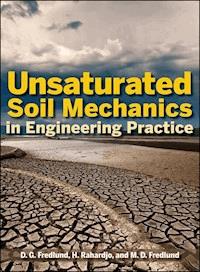
The definitive guide to unsaturated soil-- from the world's experts on the subject This book builds upon and substantially updates Fredlund and Rahardjo's publication, Soil Mechanics for Unsaturated Soils, the current standard in the field of unsaturated soils. It provides readers with more thorough coverage of the state of the art of unsaturated soil behavior and better reflects the manner in which practical unsaturated soil engineering problems are solved. Retaining the fundamental physics of unsaturated soil behavior presented in the earlier book, this new publication places greater emphasis on the importance of the "soil-water characteristic curve" in solving practical engineering problems, as well as the quantification of thermal and moisture boundary conditions based on the use of weather data. Topics covered include: * Theory to Practice of Unsaturated Soil Mechanics * Nature and Phase Properties of Unsaturated Soil * State Variables for Unsaturated Soils * Measurement and Estimation of State Variables * Soil-Water Characteristic Curves for Unsaturated Soils * Ground Surface Moisture Flux Boundary Conditions * Theory of Water Flow through Unsaturated Soils * Solving Saturated/Unsaturated Water Flow Problems * Air Flow through Unsaturated Soils * Heat Flow Analysis for Unsaturated Soils * Shear Strength of Unsaturated Soils * Shear Strength Applications in Plastic and Limit Equilibrium * Stress-Deformation Analysis for Unsaturated Soils * Solving Stress-Deformation Problems with Unsaturated Soils * Compressibility and Pore Pressure Parameters * Consolidation and Swelling Processes in Unsaturated Soils Unsaturated Soil Mechanics in Engineering Practice is essential reading for geotechnical engineers, civil engineers, and undergraduate- and graduate-level civil engineering students with a focus on soil mechanics.
Sie lesen das E-Book in den Legimi-Apps auf:
Seitenzahl: 2286
Veröffentlichungsjahr: 2012
Ähnliche



















Table of Contents
Title Page
Dedication
Foreword
Preface
Acknowledgments
Chapter 1: Theory to Practice of Unsaturated Soil Mechanics
1.1 Introduction
1.2 Moisture and Thermal flux Boundary Conditions
1.3 Determination of Unsaturated Soil Properties
1.4 Stages in Moving Toward Implementation
1.5 Need for Unsaturated Soil Mechanics
1.6 Partial Differential Equations in Soil Mechanics
1.7 Engineering Protocols for Unsaturated Soils
Chapter 2: Nature and Phase Properties of Unsaturated Soil
2.1 Introduction
2.2 Soil Classification
2.3 Phase Properties
2.4 Volume-Mass Variables
2.5 Soil Compaction
2.6 Volume-Mass Relations When Mass Is Lost from System
Chapter 3: State Variables for Unsaturated Soils
3.1 Introduction
3.2 Basis for Stress State Variables
3.3 Stress State Variables for Unsaturated Soils
3.4 Representation of Stress States
3.5 Equations for Mohr Circle
3.6 Role of Osmotic Suction
Chapter 4: Measurement and Estimation of State Variables
4.1 Introduction
4.2 Measurement of Soil Suction
4.3 Measurement of Total Suction
4.4 Measurement of Osmotic Suction
4.5 Measurement of In Situ Water Content
4.6 Estimation of Soil Suction
Chapter 5: Soil-Water Characteristic Curves for Unsaturated Soils
5.1 Introduction
5.2 Volume-Mass Constitutive Relations
5.3 Equations for SWCC
5.4 Regression Analysis on SWCC Equations
5.5 Hysteresis, Initialization, and Interpretation of SWCC
5.6 Pham and Fredlund (2011) Equation for Entire SWCC
5.7 Gitirana and Fredlund (2004) SWCC
5.8 Measurement of SWCC Using Pressure Plate Devices
5.9 Single-Specimen Pressure Plate Devices for Geotechnical Engineering
5.10 Vacuum Desiccators for High Suctions
5.11 Use of Chilled-Mirror or Dew-Point Method
5.12 Estimation of SWCC
5.13 Two-Point Method of Estimating SWCC
5.14 Correlation of Fitting Parameters to Soil Properties
5.15 Application of SWCC
5.16 Guidelines and Recommendations for Engineering Practice
Chapter 6: Ground Surface Moisture Flux Boundary Conditions
6.1 Introduction
6.2 Climatic Classification for a Site
6.3 Boundary Value Framework for Near-Ground-Surface Design
6.4 Challenges of Numerical Modeling Ground Surface Moisture Flux Conditions
Chapter 7: Theory of Water Flow through Unsaturated Soils
7.1 Introduction
7.2 Theory of Flow of Water
7.3 Darcy's Law for Unsaturated Soils
7.4 Partial Differential Equations for Steady-State Water Flow
7.5 Partial Differential Equations for Transient Seepage
7.6 Direct Measurement of Water Flow Properties
Chapter 8: Solving Saturated/Unsaturated Water Flow Problems
8.1 Introduction
8.2 Estimation of Permeability Function
8.3 Application to Saturated-Unsaturated Water Flow Problems
8.4 Conditions under Which Matric Suction Can Be Maintained
Chapter 9: Air Flow through Unsaturated Soils
9.1 Introduction
9.2 Theory of Free Air Flow
9.3 Fick's Law and Darcy's Law for Air Flow
9.4 Diffusion of Air through Water
9.5 Other Components of Air Flow
9.6 Partial Differential Equations for Air Flow through Unsaturated Soils
9.7 Direct Measurement of Air Coefficient of Permeability
9.8 Direct Measurement of Air Diffusion through Water
9.9 Indirect Estimation of Air Flow Properties
9.10 Applications to Saturated-Unsaturated Air Flow Problems
Chapter 10: Heat Flow Analysis for Unsaturated Soils
10.1 Introduction
10.2 Theory of Heat Flow
10.3 Theory of Freezing and Thawing Soils
10.4 Formulation of Partial Differential Equations for Conductive Heat Flow
10.5 Direct Measurement of Thermal Properties
10.6 Estimation Procedures for Thermal Properties
10.7 Applications to Thermal Problems
10.8 One-Dimensional Heat Flow in Unfrozen and Frozen Soils
10.9 Two-Dimensional Heat Flow Example Involving Chilled Pipeline
10.10 Two-Dimensional Heat Flow Example with Surface Temperatures above and below Freezing
10.11 Aldrich (1956) Example of Vertical Column
Chapter 11: Shear Strength of Unsaturated Soils
11.1 Introduction
11.2 Theory of Shear Strength
11.3 Measurement of Shear Strength
11.4 Special Equipment Design Considerations
11.5 Triaxial Test Procedures for Unsaturated Soils
11.6 Interpretation of Triaxial Test Results
11.7 Direct Shear Tests
11.8 Typical Laboratory Test Results
11.9 Selection of Strain Rate
Chapter 12: Shear Strength Applications in Plastic and Limit Equilibrium
12.1 Introduction
12.2 Estimation of Shear Strength Functions for Unsaturated Soils
12.3 Application to Practical Shear Strength Problems in Geotechnical Engineering
12.4 Bearing Capacity
12.5 Slope Stability
12.6 Optimization Procedures to Solve for Factor of Safety
12.7 Application of Slope Stability Analyses
12.8 Hazard Assessment and Decision Analysis Related to Slope Instability
Chapter 13: Stress-Deformation Analysis for Unsaturated Soils
13.1 Introduction
13.2 Concepts of Volume Change and Deformation
13.3 Volume-Mass Constitutive Relations
13.4 Compressibility Form for Unsaturated Soil Constitutive Relations
13.5 Relationship Among Volumetric Deformation Coefficients
13.6 Pham-Fredlund Volume-Mass Constitutive Model (2011a)
13.7 Formulation of Partial Differential Equations for Stress-Deformation in Unsaturated Soils
13.8 Measurement of Stress-Deformation Properties for Unsaturated Soils
Chapter 14: Solving Stress-Deformation Problems with Unsaturated Soils
14.1 Introduction
14.2 Estimation of Stress-Deformation Properties
14.3 Application to Practical Stress-Deformation Problems
14.4 Evaluation of Stress History in Unsaturated Soils
14.5 One-Dimensional Formulations for Deformation Analysis for Unsaturated Soil
14.6 Swelling Theory Formulated in Terms of Incremental Elasticity Parameters
14.7 Evaluation of Elasticity Parameter Functions from Volume Change Indices
14.8 One-Dimensional Solution Using Incremental Elasticity Formulation
14.9 Two-Dimensional Solution Using Incremental Elasticity Formulation
14.10 Challenges in Numerically Modeling of Expansive Soil Problems
Chapter 15: Compressibility and Pore Pressure Parameters
15.1 Introduction
15.2 Coupled and Uncoupled Solutions
15.3 Uncoupled Undrained Loading
15.4 Derivation of Pore Pressure Parameters
15.5 Drained and Undrained Loading
15.6 Solutions of Pore Pressure Equations and Comparisons with Experimental Results
15.7 Rheological Model to Represent Relative Compressibilities of Unsaturated Soil
Chapter 16: Consolidation and Swelling Processes in Unsaturated Soils
16.1 Introduction
16.2 Stress and Seepage Uncoupled and Coupled Systems
16.3 Solution of Consolidation Equations Using Finite Difference Technique
16.4 Typical Consolidation Test Results on Unsaturated Soils
16.5 Dimensionless Consolidation Parameters
16.6 Coupled Formulations and Three-Dimensional Consolidation
16.7 Water, Air Flow, and Nonisothermal Systems
16.8 Two-Dimensional Stress-Deformation and Saturated-Unsaturated Seepage Analysis
16.9 Computer Simulation of Edge Lift and Edge Drop of Slabs-on-Ground
16.10 Theory for Simulation of Swelling Pressure Development
16.11 Rheological Model for Unsaturated Soils
Appendix: Units and Symbols
References
Index
Foreword
In 1993, Professors Fredlund and Rahardjo published the first textbook solely concerned with the behavior of unsaturated soils: Soil Mechanics for Unsaturated Soils. That volume maintained the framework of classical soil mechanics, but extended it to incorporate the soil suction phenomenon as an independent variable that is amenable to measurement and calculation. It marked a major milestone in the evolution of unsaturated soil mechanics.
Professors Fredlund and Rahardjo have now collaborated with Murray Fredlund to publish their successor volume, Unsaturated Soil Mechanics in Engineering Practice. Murray Fredlund adds computational skills to the team and, in the view of the authors, these are essential to meet their objectives of presenting a volume that not only covers our present knowledge of unsaturated soil behavior, but also provides guidance on the manner in which practical problems involving unsaturated soil behavior are formulated and solved. Many flux-related problems in unsaturated soil behavior require the solution of nonlinear partial differential equations with associated boundary conditions and the volume adds guidance on these computational issues as applied to the formulation of water, air, and heat flow through unsaturated soils. Separate chapters concentrate on the shear strength of unsaturated soils and its application to earth pressure, bearing capacity, and stability problems, as well as the formulation of stress-deformation behavior and its application to heave- and stiffness-related problems.
A fundamental distinction between saturated and unsaturated soil behavior is the need to express the relationship in the latter between water content and soil suction, that is, the soil-water characteristic curve. Since 1993, there has been an explosion of studies into the measurement of soil suction and the development of soil-water characteristic curves. A particular effort has been made here to synthesize these developments in a manner that facilitates applications.
While most readers will concentrate on the technical contents of this book, I urge students of the subject to also reflect on the contents of Chapter 1 related to the emergence of unsaturated soil mechanics in a coherent form and the assessment of challenges to its implementation. The guiding spirit of this welcome volume is to give the reader confidence that all of these challenges can be addressed in a consistent and rational manner.
Understandably, given current research efforts in the field of unsaturated soil mechanics, not all researchers and practitioners will accept the total contents of this book in an uncritical manner. Science is the search for truth, predominantly by hypothetico-deductive methods, which drive its progression. However, engineering is the pursuit of functionality and it progresses by incremental improvements to enhance intended function. It is particularly in the latter context that the authors have made an important contribution to geotechnical engineering. I expect that Unsaturated Soil Mechanics in Engineering Practice will remain an essential reference for educators, researchers, and practitioners for a long time to come.
N.R. Morgenstern Distinguished University Professor (Emeritus) of Civil Engineering
and
Past President, International Society of Soil Mechanics and Geotechnical Engineering (1989–1994)
University of Alberta
August, 2011
Preface
Soil mechanics is a relatively young applied science. Karl Terzaghi published his English version of Theoretical Soil Mechanics in 1943. The book provided a science-based context for analyzing the physical behavior of saturated soils.
Geotechnical engineering has changed in many ways since the 1940s. The procedures for performing subsurface investigations have undergone some changes, but the investigative procedures remain quite similar. Boreholes are still drilled with disturbed and undisturbed soil samples taken at intervals for later laboratory testing. However, the manner in which we obtain our geotechnical engineering solutions has changed dramatically. Terzaghi and his contemporaries assembled the context for soil mechanics at a time when the tools for solving mathematical problems were significantly different from the tools that are available today.
In the 1940s, the writers of soil mechanics textbooks attempted to take complex three-dimensional, real-world problems and reduce them to simplified, closed-form solutions. Flownets provided a graphical solution for the movement of water through an isotropic, homogeneous, two-dimensional porous continuum. Methods of (vertical) slices provided a solution for calculating the factor of safety of a two-dimensional slope. Methods of (horizontal) layers provided a solution for the calculation of settlement of a one-dimensional, compressible clay soil. The soil mechanics world contained a series of soil property constants (e.g., k, c′, and ′), and those soil properties that were not constants were converted to a linear form to be represented as constants (e.g., Cc and Cs).
It became clear in the 1960s and 1970s that unsaturated soil properties would need to be defined as nonlinear unsaturated soil property functions (USPFs). Unsaturated soil mechanics became a vibrant area of geotechnical research, and it was apparent that we were entering a new era that required a new paradigm for solving saturated-unsaturated soil mechanics problems. If unsaturated soil mechanics was to find its way into geotechnical engineering practice there needed to be reliable methodologies for obtaining the unsaturated soil property functions at reasonable cost and effort. Consequently, a wide variety of estimation procedures emerged from research in many countries. The estimation procedures relied heavily on the saturated soil properties and an understanding of the soil-water characteristic curve (SWCC), that is, the relationship between water content and soil suction.
The 1960s and 1970s were decades that witnessed rapid growth in our ability to solve complex mathematical formulations. The computer could be used to solve new mathematical formulations that described the physical behavior of saturated-unsaturated soil mechanics problems. Numerical methods of solution emerged for all areas of material behavior, areas that spanned well beyond classical soil mechanics. Soil mechanics problems were visualized as boundary value problems with the following conditions defined: (i) geometry and stratigraphy, (ii) initial conditions and boundary conditions, (iii) soil properties, and (iv) solution techniques. The physics of soil behavior was defined for a referential elemental volume (REV) of the saturated-unsaturated soil continuum and the mathematical formulation describing the physics of soil behavior took on the form of a partial differential equation (PDE). Generally the PDEs were found to be nonlinear because of the nonlinear unsaturated soil property functions required as part of the formulation. The type of equations that many of us disliked as undergraduate students became the heart of unsaturated soil problem solving. Fortunately, we were able to hide the PDE solver in advanced computer software tools.
Geotechnical engineers have benefited from research undertaken in two primary areas: (i) soil physics and agronomy and (ii) computer technology and mathematics. In particular, it was the rapid growth in computing capability (i.e., computer hardware and software) that made the solution of unsaturated soil problems possible. The stage was set for solving saturated-unsaturated soil mechanics problems within a boundary value context through use of numerical modeling techniques.
It is an understatement to say that the digital computer has revolutionized the way that soil mechanics is now implemented in engineering practice. It is safe to say that it would not be possible to model and solve saturated-unsaturated soil mechanics problems within a science framework without the power of the digital computer. Geotechnical engineering has moved into a new paradigm, a problem-solving environment involving SWCCs, USPFs, and PDEs. It is a world in which the challenge becomes the convergence and the uniqueness of the soil mechanics solution. It is a world in which computer software is no longer a luxury but a necessity for sound engineering practice.
During the course of writing this book, numerous example problems were analyzed using the SVOffice geotechnical software suite. The examples in this book are freely distributed as resources related to the learning process associated with unsaturated soil mechanics. Instructions for obtaining these examples may be found at www.soilvision.com/usmep. The examples include seepage (SVFLUX™), slope stability (SVSLOPE®), freeze/thaw (SVHEAT™), and stress/deformation (SVSOLID™) finite element numerical models for which the setup and solution information can be examined.
Eduardo Alonso and Antonio Gens (2011) put it well in the Preface to the Fifth International Conference on Unsaturated Soils, Barcelona, Spain, when they wrote, “The development of unsaturated soil mechanics in recent decades has been remarkable and it has resulted in momentous advances in fundamental knowledge, testing methods, computational procedures, prediction methodologies and geotechnical practice.” As authors, we trust that the book Unsaturated Soil Mechanics in Engineering Practice will further advance the usage of the science of unsaturated soil behavior in engineering practice.
Unsaturated Soil Mechanics in Engineering Practice constitutes a substantial addition and reorganization of information from what was synthesized in the book Soil Mechanics for Unsaturated Soils by D. G. Fredlund and H. Rahardjo. Unsaturated Soil Mechanics in Engineering Practice more thoroughly covers our present knowledge of unsaturated soil behavior and better reflects the manner in which practical unsaturated soil engineering problems are solved. The fundamental physics of unsaturated soil behavior presented in Soil Mechanics for Unsaturated Soils has been retained in the present edition while greater emphasis has been placed on the importance of using the SWCC when solving engineering problems. Greater emphasis has also been placed on the quantification of thermal and moisture boundary conditions based on the use of weather data. In the end, the reader should find Unsaturated Soil Mechanics in Engineering Practice to be a practical book leading geotechnical engineers through to the implementation of unsaturated soil mechanics into engineering practice.
Delwyn G. Fredlund
Acknowledgments
Many persons have contributed to the synthesis of information presented in Unsaturated Soil Mechanics in Engineering Practice. Graduate students and research fellows have contributed much as they have researched a wide range of topics associated with unsaturated soil mechanics. The graduate students have sifted through past research and attempted to assemble a coherent synthesis of the findings of many researchers worldwide. The theses and research papers of many persons have been used in the synthesis of information required for the development of the science for unsaturated soil mechanics.
A number of researchers in unsaturated soil mechanics have volunteered to review various chapters of the book. The authors are grateful for their comments, edits and suggestions. In particular, the authors wish to acknowledge the contributions from the following persons: J. Côté, G. Gitirana, S. G. Goh, S. Houston, E. C. Leong, G. Newman, M. Padilla, H. Pham, A. Satyanaga, J. Stianson, S. Vanapalli, H. Vu, M. Yuan, C. Zapata, Q. Zhai, J. Zhang, and L. M. Zhang. The ongoing mentorship of Dr. N. R. Morgenstern and Dr. R. L. Lytton is also acknowledged and greatly appreciated.
A number of manufacturers of unsaturated soil testing equipment and monitoring devices have generously made information available for this book. The contributions from Campbell Scientific Corporation, Logan, Utah; Decagon Devices, Pullman, Washington; GCTS, Geotechnical Consulting and Testing Services, Tempe, Arizona; GDS Instruments, London; SoilMoisture Equipment Corporation, Santa Barbara, California; UPC, Barcelona, Spain, and Wille Geotechnik, Germany, are acknowledged. The initiatives on the part of many soil testing companies have done much to promote the practice of unsaturated soil mechanics. Their initiatives to develop soil testing and monitoring equipment contributes significantly to the practice of unsaturated soil mechanics.
Others have contributed greatly to the preparation of the manuscript and the figures for this book. Their diligence and willingness to assist have been greatly appreciated. The authors would like to acknowledge the following persons: Esther McAleer, Felicitas Egunyu, Patti Sawchuk, Marilyn D'Souza, Maki Ito, and O. Zapata.
Behind each of the authors there has been a company or institution that has been supportive of the venture to write a new book that embraces more of the recent research findings and engineering protocols for engineering practice. Dr. Del Fredlund has been employed by Golder Associates after his retirement from the University of Saskatchewan, Saskatoon. Golder Associates have been supportive and promoted the development of the Golder Unsaturated Soils Group (GUSG) under the direction of Greg Misfeldt. The GUSG has functioned as a loosely knit Web-based organization of the Golder office with the intent of addressing unsaturated soil problems worldwide. The GUSG has provided a valuable platform for the implementation of practical engineering protocols for a wide range of unsaturated soil problems.
Dr. Harianto Rahardjo has been employed at Nanyang Technological University (NTU), Singapore, since 1990. NTU has shown strong support for unsaturated soils research over many years. The result has been the establishment of a world-class unsaturated soil research laboratory containing most of the latest equipment for testing unsaturated soils. The research program has been complimented with numerous field instrumentation studies on residual soils. There has also been an ongoing series of unsaturated soil studies that have resulted in numerous journal, conference, and research reports.
Dr. Murray Fredlund started the software computing company called SoilVision Systems in 1997. The vision of the company was to provide computer software capable of solving problems involving unsaturated soils as well as saturated soils. This meant that it was necessary to develop and use solvers capable of solving highly nonlinear partial differential equations. SoilVision has not only provided engineering practitioners with software capable of solving a wide range of unsaturated soils problems but has also embarked on numerous research studies in an attempt to determine the most satisfactory solutions to unsaturated soil problems.
The support of Golder Associates, Nanyang Technological University, and SoilVision Systems has provided a framework for developing high-level engineering protocols for unsaturated soil mechanics. The authors want to express their appreciation for the support received through their places of employment. A platform for a vision has been developed for the promotion of unsaturated soil mechanics in geotechnical practice, and the authors are grateful for the opportunities afforded to them.
Delwyn G. FredlundHarianto RahardjoMurray D. Fredlund
Chapter 1
Theory to Practice of Unsaturated Soil Mechanics
1.1 Introduction
Soil mechanics involves a combination of engineering mechanics, soil behavior, and the properties of soils. This description is broad and can encompass a wide range of soil types. These soils could either be saturated with water or have other fluids in the voids (e.g., air). The development of classical soil mechanics has led to an emphasis on particular types of soils. The common soil types are saturated sands, silts and clays, and dry sands. These materials have formed the primary emphasis in numerous soil mechanics textbooks. More and more, it is realized that attention must be given to a broader spectrum of soil materials.
There are numerous soil materials encountered in engineering practice whose behavior is not consistent with the principles and concepts of classical, saturated soil mechanics. The presence of more than one fluid phase, for example, results in material behavior that is challenging to engineering practice. Soils that are unsaturated (i.e., water and air in the voids) form the largest category of soils which do not adhere in behavior to classical saturated soil mechanics.
The general field of soil mechanics can be subdivided into the portion dealing with saturated soils and the portion dealing with unsaturated soils. The differentiation between saturated soils and unsaturated soils becomes necessary due to basic differences in the material nature and engineering response. An unsaturated soil has more than two phases, and the pore-water pressure is negative relative to pore-air pressure. Any soil near the ground surface, present in an environment where the water table is below the ground surface, will be subjected to negative pore-water pressures and possible reduction in degree of saturation.
The process of excavating, remolding, and compacting a soil requires that the material be unsaturated. It has been difficult to predict the behavior of compacted soils within the framework of classical soil mechanics.
Natural surficial deposits of soil are found to have relatively low water contents over a large portion of the earth. Highly plastic clays subjected to a changing environment have produced the category of materials known as swelling or expansive soils. The shrinkage of these soils may pose an equally severe situation. Loose silt soils often undergo collapse when subjected to wetting and possibly a change in the loading environment. The pore-water pressures in both of the above-mentioned cases are initially negative, and volume changes occur as a result of increases in the pore-water pressure. Residual soils have also been of particular concern since their engineering behavior appears to deviate from classical soil mechanics principles. Once again, the primary factor contributing to the unusual behavior of residual soils is negative pore-water pressures.
Unsaturated soil mechanics is herein presented in the context of having a limited number of physical areas of application, namely, water flow (and storage), air flow (storage and compressibility), heat flow (and storage), shear strength, and volume-mass change (including swelling and collapse). The unsaturated soil theories are applied to real-world problems and solutions are illustrated in the context of a boundary value problem. The physical behavior of unsaturated soil is formulated as a partial differential equation(s) that must be solved using a numerical technique. The partial differential equations are generally slightly too highly nonlinear in character and as a result computer analyses play an important role in solving practical engineering problems.
1.1.1 Application of Unsaturated Soil Mechanics in Engineering Practice
The content of this book takes into consideration the history of classical soil mechanics and the significant impact that the computer has had on the practice of geotechnical engineering. It is fair to say that the computer has resulted in a paradigm shift in how geotechnical engineering problems in general and specifically unsaturated soils problems are analyzed. The significant role that the computer has played has also been taken into consideration in assembling the content for this book. The nature of unsaturated soil problems makes it essentially imperative to use numerical methods when solving geotechnical engineering problems.
Terzaghi (1943) contributed significantly toward our understanding of unsaturated soil behavior in two chapters of his textbook Theoretical Soil Mechanics. Chapter 14 on Capillary Forces and Chapter 15 on Mechanics of Drainage (with special attention to drainage by desiccation) illustrate the importance of unsaturated soils. These chapters emphasize the importance of the unsaturated portion of the soil profile and in particular provide insight into the fundamental nature and importance of the air-water interface [i.e., the contractile skin (Fredlund and Rahardjo, 1993a)]. Considerable discussion was directed toward soils with negative pore-water pressures. shows an earth dam illustrating the manner in which water flows above the phreatic line through the capillary zone (Terzaghi, 1943). The contributions of Karl Terzaghi toward unsaturated soil behavior were truly commendable and are still worthy of consideration.
Lesen Sie weiter in der vollständigen Ausgabe!
Lesen Sie weiter in der vollständigen Ausgabe!
Lesen Sie weiter in der vollständigen Ausgabe!
Lesen Sie weiter in der vollständigen Ausgabe!
Lesen Sie weiter in der vollständigen Ausgabe!
Lesen Sie weiter in der vollständigen Ausgabe!
Lesen Sie weiter in der vollständigen Ausgabe!
Lesen Sie weiter in der vollständigen Ausgabe!
Lesen Sie weiter in der vollständigen Ausgabe!
Lesen Sie weiter in der vollständigen Ausgabe!
Lesen Sie weiter in der vollständigen Ausgabe!
Lesen Sie weiter in der vollständigen Ausgabe!
Lesen Sie weiter in der vollständigen Ausgabe!
Lesen Sie weiter in der vollständigen Ausgabe!
Lesen Sie weiter in der vollständigen Ausgabe!
Lesen Sie weiter in der vollständigen Ausgabe!
Lesen Sie weiter in der vollständigen Ausgabe!
Lesen Sie weiter in der vollständigen Ausgabe!
Lesen Sie weiter in der vollständigen Ausgabe!
Lesen Sie weiter in der vollständigen Ausgabe!
Lesen Sie weiter in der vollständigen Ausgabe!
Lesen Sie weiter in der vollständigen Ausgabe!
Lesen Sie weiter in der vollständigen Ausgabe!
Lesen Sie weiter in der vollständigen Ausgabe!




