


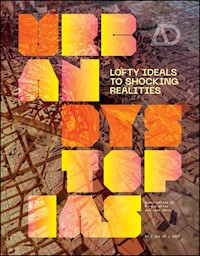
Urban Dystopias E-Book
0,0
30,99 €
30,99 €
-100%
Sammeln Sie Punkte in unserem Gutscheinprogramm und kaufen Sie E-Books und Hörbücher mit bis zu 100% Rabatt.
Mehr erfahren.
Mehr erfahren.
- Herausgeber: John Wiley & Sons
- Kategorie: Geisteswissenschaft
- Serie: Architectural Design
- Sprache: Englisch
Urban Dystopias
Sie lesen das E-Book in den Legimi-Apps auf:
Seitenzahl: 238
Veröffentlichungsjahr: 2023
0,0
Bewertungen werden von Nutzern von Legimi sowie anderen Partner-Webseiten vergeben.
Legimi prüft nicht, ob Rezensionen von Nutzern stammen, die den betreffenden Titel tatsächlich gekauft oder gelesen/gehört haben. Wir entfernen aber gefälschte Rezensionen.
Ähnliche




















URBAN
DYSTOPIAS
01/2023
Marcus White and Jane Burry
About the
Guest-Editors
5
6
Urban Farming
The Reluctant Utopia
Daniele Belleri and Carlo Ratti
14
Pertopia
Speculative Thinking in
a Short-Term World
Justyna Karakiewicz
22
A Truly Golden
Handbook of Urban
DYStopias
Marcus White and Jane Burry
Introduction
An Urban Odyssey
City Beautiful to City
Instagrammable
Jordi Oliveras
Broadband-acre City
‘No Traffic Problem, No
Buffering’
Marcus White and
Stephen Glackin
30
46
Arcological City
Going Underground
Jane Burry and Mehrnoush Latifi
54
Cool Urbanism
The Radiant Exitance City
Marcus White and Tianyi Yang
62
The City of
Frictionless Mobility
Ian Woodcock
72
38
The Mega-Eco-
Garden City
Stories of Rewilding and
Ecodystopia
Nano Langenheim and
Kongjian Yu
99
2
ISSN
0003-8504
ISBN
9781 119 833994
Edited by
Marcus White and Jane Burry
From Another Perspective
Fanning the Flames
of the City Heat
Anton Markus Pasing
Neil Spiller
128
Contributors
134
High-Definition City
An Invisible Horizon of
Technological Human Space
Andong Lu, Jane Burry and
Marcus White
80
The Promises of
Postcolonial Utopias
Perspectives from the
Global South
Tridib Banerjee
88
Cité Industrielle 4.0
Zoning for the Latest
Revolution
Jane Burry
96
Another Normal
A Techno-Social Alternative
to Techno-Feudal Cities
Kas Oosterhuis
104
The Floating
‘Urban Village’
Makoko Futures
Dan Nyandega
112
GAN-Physarum
Shaping the Future of
the Urbansphere
Claudia Pasquero and
Marco Poletto
120
104
This issue of
2
explores the
dichotomy between idealised visions
for the design of urban settlements
and the potentially shocking
realities which may emerge from
those same impulses and intentions
— Marcus White and Jane Burry
3
Rights and Permissions
Requests to the Publisher
should be addressed to:
Permissions Department
John Wiley & Sons Ltd
The Atrium
Southern Gate
Chichester
West Sussex PO19 8SQ
UK
F: +44 (0)1243 770 620
All Rights Reserved. No
part of this publication
may be reproduced, stored
in a retrieval system or
transmitted in any form or
by any means, electronic,
mechanical, photocopying,
recording, scanning or
otherwise, except under
the terms of the Copyright,
Designs and Patents Act
1988 or under the terms
of a licence issued by the
Copyright Licensing Agency
Ltd, 5th Floor, Shackleton
House, Battle Bridge Lane,
London SE1 2HX, without
the permission in writing
of the Publisher.
Subscribe to
1
2
is published bimonthly
and is available to purchase
on both a subscription basis
and as individual volumes
at the following prices.
Prices
Individual copies:
£29.99 / US$45.00
Mailing fees for print
may apply
Annual Subscription Rates
Student: £97 / US$151
print only
Personal: £151 / US$236
print only
Institutional: £357 / US$666
online only
Institutional: £373 / US$695
print only
Institutional: £401 / US$748
print and online
Journal Customer Services
For ordering information,
claims and any enquiry
concerning your journal
subscription please go to
www.wileycustomerhelp
.com/ask or contact your
nearest office.
Americas
T: +1 877 762 2974
Europe, Middle East
and Africa
T: +44 (0)1865 778 315
Asia Pacific
T: +65 6511 8000
Japan
(for Japanese-
speaking support)
T: +65 6511 8010
Visit our Online Customer
Help available in 7 languages
at www.wileycustomerhelp
.com/ask
Print ISSN: 0003-8504
Online ISSN: 1554-2769
Prices are for six issues
and include postage
and handling charges.
Individual-rate subscriptions
must be paid by personal
cheque or credit card.
Individual-rate subscriptions
may not be resold or
used as library copies.
All prices are subject to
change without notice.
Identification Statement
Periodicals Postage paid
at Rahway, NJ 07065.
Air freight and mailing in
the USA by Mercury Media
Processing, 1850 Elizabeth
Avenue, Suite C, Rahway,
NJ 07065, USA.
USA Postmaster
Please send address changes
to
Architectural Design,
John Wiley & Sons Inc.,
c/o The Sheridan Press,
PO Box 465, Hanover,
PA 17331, USA
Editorial Offices
John Wiley & Sons
9600 Garsington Road
Oxford
OX4 2DQ
T +44 (0)18 6577 6868
Editor
Neil Spiller
Managing Editor
Caroline Ellerby
Caroline Ellerby Publishing
Freelance Contributing Editor
Abigail Grater
Publisher
Todd Green
Art Direction + Design
Christian Küsters
Mihaela Mincheva
CHK Design
Production Editor
Elizabeth Gongde
Prepress
Artmedia, London
Printed
in the United Kingdom
by Hobbs the Printers Ltd
EDITORIAL BOARD
Denise Bratton
Paul Brislin
Mark Burry
Helen Castle
Nigel Coates
Peter Cook
Kate Goodwin
Edwin Heathcote
Brian McGrath
Jayne Merkel
Peter Murray
Mark Robbins
Deborah Saunt
Patrik Schumacher
Jill Stoner
Ken Yeang
Front cover
Harrison and White with Flood
Slicer, Implementing the Rhetoric,
Footscray, Victoria, Australia, 2010.
© Harrison and White with Flood
Slicer.
Inside front cover
Shi Percy Pan, Yingna Celina Sun
and Jiaao Wayne Wong,
The Great Ocean Road is Crying
in Tears of Plastic, Studio 05,
Melbourne School of Design,
University of Melbourne,
Australia, 2021. Shi Percy Pan,
Yingna Celina Sun and Jiaao
Wayne Wong
Page 1
Kundi Shu, Kachung Lo and
Xiufeng Li, Rhizomatic bridge as a
hope in Peturbanism: Aquaculture
and Aquatics scenario, Hope in
Peturbanism – Possible Future
of Great Ocean [Road?] CDE
Studio 05, Melbourne School of
Design, University of Melbourne,
Australia, 2021. © Kundi Shu,
Kachung Lo and Xiufeng Li
Disclaimer
The Publisher and Editors cannot
be held responsible for errors or
any consequences arising from the
use of information contained in this
journal; the views and opinions
expressed do not necessarily reflect
those of the Publisher and Editors,
neither does the publication of
advertisements constitute any
endorsement by the Publisher and
Editors of the products advertised.
ARCHITECTURAL DESIGN
Profile No.
January/February
2023
278
Issue
01
4
Text © 2023 John Wiley & Sons Ltd. Images: (t) © Marcus White; (b) © Jane Burry
GUEST-EDITORS
ABOUT THE
MARCUS WHITE AND JANE BURRY
Longstanding academic colleagues Marcus White and Jane Burry have
worked to knit together the tectonics of architecture and a deeper engagement
with the urban realm, adopting accessible and applicable technologies and
digital data to deepen the contextual grounding. At the Swinburne University
of Technology, where White is Professor of Architecture and Urban Design,
and Burry is Professor and Dean of the School of Design and Architecture,
they have been instrumental in co-authoring a unique combined Master’s
programme in architecture and urban design. Proponents of the integration
of education with research and practice, White is a partner in the award-
winning architecture practice Harrison and White (HAW), while Burry’s
research leverages her experience as a project architect in the technical
team at the Sagrada Família in Barcelona.
Both share a deep interest in speculative futures, including micro-scaled
digital fabrication inquiry; investigating sonic and thermal experience at the
interface of built fabric, people and air; innovation in construction methods;
and macro-scaled explorations of radical urban propositions imagining
new ways of living. Their work is conducted through their research within
the Spatio-Temporal Research Urban Design and Architecture Laboratory
(STRÜDAL) at Swinburne’s Centre for Design Innovation. Their enduring
commitment to the exploration of computationally enabled design futures
exposes them to the endlessly divergent possibilities, some markedly dark,
that artificially intelligent and algorithmic urbanisms can invoke.
White’s work focuses on research for and through design, using emerging
technology and data to design liveable cities. He is the creator of the
pedestrian network analysis tool www.PedestrianCatch.com, and led the
City of Melbourne Sunlight Public Open Space Study (2018) in developing
new methodologies to protect sunlight amenity for the city. He is also a
chief investigator in the Neuro-Optimised Virtual Living Lab (NOVELL)
with the Florey Institute of Neuroscience and Mental Health, which recently
won a European Healthcare Design Award (2022), and leads the Australian
Research Council (ARC)-funded ‘Walk-Quality’ Linkage Project. He is
co-author, with Nano Langenheim, of the book
The Death of Urbanism:
Transitions Through Five Stages of Grief
(Art Architecture Design Research
[AADR], 2020), a metamodern exploration of urban design paradigms
through a misappropriation of Elisabeth Kübler-Ross’s five stages of grief.
Burry is the lead author of
The New Mathematics of Architecture
(Thames & Hudson, 2010), editor of
Designing the Dynamic
(Melbourne
Books, 2013) and co-author of
Prototyping for Architects
(Thames &
Hudson, 2016), as well as over a hundred other publications. She has
practised, taught, supervised and researched internationally. She is a recipient
of six Australian Research Council grants, Good Design Awards and the
Robots in Architecture Pioneer’s Award. Her research focuses on mathematics
and computing in contemporary design. Recent partnered research explores
the opportunities for urban and biometric data gathering and application
in modelling; simulation and application for the design of better urban
environments; and leveraging digital fabrication with simulation and feedback
to create better, more sensitive, human-centric spaces. By manipulating
geometry and materiality within the design, architecture can ne tune the
acoustic, thermal and airrow aesthetics to create higher-quality, energy-
efficient environments in buildings and the urban realm.
1
5
INTRODUCTION
MARCUS WHITE AND
JANE BURRY
66
Cities are facing several coinciding global crises. There
is the dominant existential narrative of the impacts of
climate change and the need to adapt to them. Resilient
architecture and urban planning are needed in response
to the unprecedented urbanisation and economic
growth that have impacted environments worldwide.
New approaches to nature and food production, new
modes of transport, renewed anxiety about robots replacing
human workforces, ever-accelerating advances in information
technology and the humbling recent experience of a
global pandemic are challenging norms and expectations.
These factors, all with the potential to foster social division,
are changing life experiences of populations worldwide,
giving rise to the authoritarian politics of anxiety and
creating the sense that people are teetering between
radically different possible futures.
This issue of
2
explores the dichotomy between idealised
visions for the design of urban settlements and the potentially
shocking realities which may emerge from those same
impulses and intentions. It examines the slippery territory
between utopias – the idealised places Oscar Wilde believed
humankind sets sail for, and must realise, for progress to take
place
1
– and some of the ensuing dystopias in urban design
that unfold instead.
Each article re-explores a commonly dismissed historic
urban-utopian proposition to test its relevance through
the lens of a critical contemporary urban challenge.
Each considers both a utopian and dystopian speculative
reinterpretation of these potential urban futures, teasing out
the elements leading to a desirable future as well as those
pointing to unintended malign consequences.
A TRULY
A TRULY
GOLDEN
HANDBOOK
OF URBAN
OF URBAN
DYSTOPIAS
Kundi Shu, Kachung Lo
and Xiufeng Li,
Rhizomatic bridge as a hope
in Peturbanism: Aquaculture
and Aquatics scenario,
Hope in Peturbanism –
Possible Future of Great Ocean
[Road?] CDE Studio 05,
Melbourne School of Design,
University of Melbourne,
Australia,
2021
Section drawing of aquaculture and aquatic
activities for the exploratory design studio
project exploring the integration of natural
and man-made dynamic adaptive systems
and the reuse of waste materials for
ecological restoration. Studio leader:
Justyna Karakiewicz
7
Utopia Versus Dystopia and the Need for Speculative Futures
Predictions of the future are always speculative. The further out
our forecasts reach, the more speculative and stochastic they
become. Although our speculations are built upon historical
data, the future is not the past and the past never repeats itself.
Nevertheless, we have both an endless appetite and a serious
need for speculative futures. They are the basis for planning and
it is critical that in constructing and examining them we embrace
both hope and scepticism. This is a story about reclaiming the
urban design narrative and being alert to the potential impacts
of socio-technical decision-making and design in cities.
In their influential book
Speculative Everything: Design,
Fiction, And Social Dreaming
(2013),
2
Anthony Dunne and
Fiona Raby of the New York design studio Dunne & Raby
describe futurist Stuart Candy’s concept of four kinds of design
speculations: probable, plausible, possible and preferable.
Here, ‘probable’ refers to projections of scenarios that are
likely to occur; ‘plausible’ forecasts alternative economic and
political scenarios that may occur; ‘possible’ is far more radical,
incorporating what is scientifically and technically possible; and
‘preferable’ represents an intersection of probable and plausible.
While not attempting to predict the future, these speculations
are suggested as a way to engage with what might be considered
pathways to desirable futures. This approach has similarities
with the future-casting methods of multinational energy and
mining companies that model available resources, future
demand, the likely impacts of lobbying and investment, and
the profit gained by ensuring that legislation to mitigate climate
change is delayed. Conversely, climate scientists are attempting
to understand the factors that would precipitate a range of
possible futures, from best-case scenarios for carbon emission
reductions to worst-case predictions that result in such dramatic
increases in extreme weather conditions that much of the world
becomes a barren wasteland akin to that in George Miller’s 1979
classic film
Mad Max.
3
Thus, it would be prudent to carefully
consider the potential for dystopian outcomes while thinking
about highly desirable, even utopian futures.
The word ‘utopia’ was coined by Thomas More, and used
as the title for his 1561 work of socio-political satirical fiction.
4
Published in Latin, the book’s subtitle translates to ‘On
the Best
State of a Commonwealth and on the New Island of Utopia,
A Truly Golden Handbook, No Less Beneficial than
Entertaining’.
However, the etymology of the word derives not
from Latin but from ancient Greek:
ou’
(‘not’) and
(‘place’) thus meaning no-place, which might be More’s
admission that it cannot exist in the real world. Its antonym,
‘dystopia’, literally means ‘bad place’.
More’s
Utopia,
a blend of reality and fiction, describes a
provocative alternative reality of Tudor England; a perfect
nation of 54 nearly identical cities surrounded by farmland on
a roughly circular island, where no city may have more than
6,000 residents, family size is controlled, work is important but
limited to six hours a day, and idleness is a punishable ooence.
Gold is devalued, used for chamber pots and worn by slaves;
healthcare is universal; property, possessions and resources,
including food, are communal and all citizens must take turns
participating in farming labour, living a mix of rural and urban
life. While there is much freedom of choice for citizens, men
Ambrosius Holbein,
The Island of Utopia
(Thomas More’s Utopia),
1518
Holbein’s woodcutting shows a
bird’s-eye view of Thomas More’s
Utopia. The
crescent-shaped island
is 322 kilometres (200 miles) wide,
encompassing 54 cities separated
by 38-kilometre (24-mile) wide
green belts, with the capital
Amaurotum at the centre.
Each city-state is roughly square
shaped, with each side at least
32 kilometres (20 miles) long.
Mingjia Shi and Yichen Sheng,
The Garden of Earthly Delights,
Parametric Parasite CDE design studio,
Melbourne School of Design,
University of Melbourne,
2022
This project for a speculative design studio proposes a vision for a possible
future urban environment by introducing bees en masse into Barcelona.
The speculative vision dynamically changes its character between dystopia
and utopia – a future led by machines to nd a new garden of earthly
delights suitable for the present and ready for the future. Studio leaders:
Justyna Karakiewicz and Liang Yang.
8
and women all wear the same clothes, only distinguished by
genders; people’s movement is subject to strictly enforced rules
and all must live ‘in full view’, so no one can break a rule
undetected. Many of More’s concepts have been influential not
only in philosophy and political theory, but also in speculative
city design, such as cities with capped population sizes,
agricultural green belts, urban and rural lifestyles, communal
food production and consumption, and forays into the provision
of urban health, safety, wellbeing and unity through observation
and surveillance. These themes are explored in this issue of
2.
While much of More’s
Utopia
was a positive provocation in the
context of 1500s Tudor England, many of the book’s themes,
such as communal living, slavery and lifetime leaders, became
core ingredients of the dystopias that would follow.
An early dystopian exploration can be found in Jonathan
Swift’s
Gulliver’s Travels
(1726), in which he identified
European society’s socio-political trends and extrapolated
them to satirical extremes, exposing their underlying flaws.
Gulliver, the book’s protagonist, visits cities that initially appear
impressive and wonderful but upon closer inspection turn out
to be deeply problematic. One of these is the Flying Island of
Laputa, a technocratic marvel run by a highly educated elite that
developed multidirectional magnetic levitation transportation
for the city similar in concept to the Shanghai maglev train
(2004). The city floats above the ground-dwelling underclass
and can be moved to block their sunlight – a thinly veiled
criticism of English rule over Ireland. Unlike in science fiction,
where the impossible, such as time travel or defying gravity, is
posited as fact for the purpose of the narrative, literature about
the objectively real possible – a category of literature commonly
termed ‘speculative fiction’ – makes us aware that right now we
already have all the ingredients for certain urban futures.
A collective wrong decision is all that is needed to propel
society towards an oppressive patriarchal religious dystopia
such as that described by Canadian author Margaret Atwood in
The Handmaid’s Tale
(1985).
5
The writer describes a far-right
Christian takeover of the US (now Gilead), a dark response
to loss of fertility, food shortages and a contamination crisis.
The story cuts close to the bone in light of events such as the
Capitol Riots (2021)
6
and the overturning of Roe v Wade in
the US (2022),
7
and Atwood’s speculative fiction gives us a
clear indication of where this politico-religious trend may go if
allowed to continue, while providing hope that it is not too late
for us to reverse the direction in which we are heading.
For a brighter world, society must question what sorts
of cities are wanted. Optimistic speculations, including the
‘probable’ and utopian ‘possible’ propositions, need not be
top-down visions but must provide projections for a plurality
of futures. Putting forward and exploring dystopic fiction
that incorporates speculative design builds an understanding
of the slight forks in the path towards a better future, and an
understanding of the urban design strategies and technologies
that, if adopted and adapted, may lead to disturbing and
potentially damaging outcomes.
JJ Grandville,
Flying island of Laputa from Gulliver’s Travels,
Realm of Balnibarbi east of Japan,
1856
Grandville’s etching depicting Jonathan Swift’s 7-kilometre (4.5-mile) wide
Flying Island of Laputa. The island can be manoeuvred in any direction
using magnetic levitation developed by its scientifically educated but
impractical elite ruling class. Balnibarbi is the country where the underclass
live, below Laputa and controlled by it using threats to pelt the inhabitants
with large stones or cut off sunlight and rain.
9
The Country into the City, or the City into the Country ?
The first group of articles in this issue address, in very diverse
ways, dichotomies of city and country, built urban fabric and
parks, access to nature, food, and ocular-centric control versus
eco-centric coevolution. The challenge of feeding the world will
remain ongoing as long as population continues to expand.
While cities have grown on the strength of surplus agricultural
production, leaving that increasingly efficient and mechanised
production outside the city walls, the impacts of agriculture and
food transport on carbon emissions and world ecology suggest
the need for speculation about subverting or reversing that
relationship. Daniele Belleri and Carlo Ratti explore the extent to
which in-city agriculture is a romance, the answer to a prayer, or
a risky pathway to increased corporatisation and food insecurity.
Blurring the dichotomy between city and country still further,
Justyna Karakiewicz explores these environmental issues by
leaving behind the anthropocentric view of settlement in favour
of dynamic adaptive coevolution between human development
and interacting natural processes.
Frank Lloyd Wright’s Broadacre City concept – the idealisation
of the mid-20th-century suburb – presented in his book
The
Disappearing City
(1932)
8
– has subsequently lost some of its
currency since the environmental impact of human greed for
living space, now incorporated into the concept of our carbon
footprint, has begun to have noticeable and disastrous effects
worldwide. But global pandemic lockdowns, intended to
physically isolate people from one another, spurred a surge in
virtual social interaction and digital commerce. Marcus White
and Stephen Glackin investigate what living in a ‘Broadband-acre
City’ looks like now and for the speculative future far beyond
our current era. Ebenezer Howard’s Garden City (1902) adopted
a concentric plan to increase access to green urban ‘lungs’ for
housing and social and commercial areas. Nano Langenheim and
Kongjian Yu muse on whether his rigid geometrical schema can
be shaken up for the 21st-century relationship between human
habitation and broader ecological interests or, conversely, whether
this might lead to increasing clashes with non-human predators.
In the modern era, the city as a landscape has been
fundamentally influenced by the parterres of 15th- and 16th-
century French formal gardens via the Beaux-Arts architectural
movement (1830s–1870s) and its interpretation by the City
Beautiful movement in the US, lasting from the 1890s to the
early 1900s. The grand urban gestures and vistas, designed to be
seen from above and experienced from the perspective of foot
traac and carriages, gave way to other forms of architecture,
experienced from an aerial perspective and designed with different
priorities, during the 20th and 21st centuries. Jordi Oliveras
charts this journey to the aerotropolis and visual ‘selfie city’ of
today and beyond.
Urban Heat, Movement, Social Divisions and Surveillance
The next group of articles consider questions of problematic
urban microclimates, and how these can or might be addressed in
the future. Specific philosophical, design and structural decisions
underlie the impact of the contemporary urban fabric on carbon
emissions, exacerbated social and income disparities, social unrest,
surveillance and security practices. These decisions and results are
considered and extrapolated to explore where they may lead.
Luke Kim, Arinah Rizal and Qun Zhang,
Diversity through Disruption design elective,
Melbourne School of Design, University of
Melbourne with Los Andes University,
Bogota,
2020
The project explores dynamic adaptive coevolution and the potential of
new manufacturing technologies where, instead of using AI-controlled
drones for surveillance or military strikes, they are used for weaving
nets for recreational activities and natural structures. The project
was part of a course examining complex adaptive systems, human
development and natural processes. Coordinator: Justyna Karakiewicz.
10
Nano Langenheim,
An Eco-dystopic Urban Forest,
Melbourne, Australia,
2022
An exploration of an overgrown ‘rewilded’ urban rejuvenation project
where a well-intended desire for a ‘city in the forest’ has backkred,
resulting in neither an operational city nor a biologically functioning
forest. The project represents a ‘mid-journey’ destruction of both the
forest and the city.
Paolo Soleri,
Infrababel,
original drawing,
1968–9
Utopian architect Soleri coined the term ‘arcology’ to describe the
fusion of architecture with ecology. This conceptual design was to be
located in a stone quarry. Designed for a population of 100,000, it is
one of a series of environmentally driven designs by Soleri, who also
founded and commenced the development of the utopian community
of Arcosanti in the Arizona desert (1970–).
11
Marcus White/Harrison and
White and Tianyi Yang,
Digital rendering of
Le Corbusier’s 1930 Ville Radieuse
(Radiant City),
2022
Though criticised widely, Le Corbusier’s Radiant
City urban design proposal of a series of high-rise
mixed-use towers surrounded by generous green
spaces provides high levels of daylight amenity for
occupants. Due to the scheme’s high levels of sky
view factor across the entire city, it would allow
longwave radiation to escape to the atmosphere
and would therefore be exceptionally well suited to
mitigating the urban heat island effect.
Most contemporary cities have a partially subterranean
mirror city. Its extent depends on many factors – size and
underlying geology perhaps first among them. However, as
the world focuses more on resilience and defensive approaches
to destructive and inhospitable climatic extremes, the
opportunities of going underground become more manifest,
comprehensive and widespread. Jane Burry and Mehrnoush
Latifi use Paolo Soleri’s influential, speculative and partially
realised future Arcological cities (1970) as a stepping-oo point
to ponder the utopian and dystopian realities of building and
living underground.
Marcus White and Tianyi Yang extend this approach
towards mitigating the effects of climate change to reconsider
Le Corbusier’s proposition for Ville Radieuse (1933). While
the widely spaced grid of towers was conceived in a park-like
setting to address air quality and green views, it might also
present a way to address the problem of urban heat islands
in densely packed, rapidly overheating cities. Like thermal
comfort, frictionless mobility has played a huge part in cities
becoming both bloated carbon emitters and, in some aspects,
less than hospitable and healthy. Ian Woodcock considers
the potential pros and cons for the nature of cities in a future
world of autonomous electric mobility. Tridib Banerjee
explores a city that was ‘smart’ before the era of smart cities,
and how it has taken on the contemporary smart-city mantle.
In particular, he uncovers Chandigarh’s underlying postcolonial
roots and the insidious way in which its urban structure has
reinforced and even exacerbated social division. Andong Lu
transports us from Jane Jacobs’ sense of a safer city with eyes
on the street – local citizens engaged in and observing their
immediate environs – to the ways that cybertracking, fixed
camera and mobile surveillance are changing the city and
concepts of privacy. Crime protection or state threat? Where
is this trend heading and how is it likely to influence the city
far into the future?
Zoning, Linearity, Floating and Organic City Planning
The articles mentioned above demonstrate many of the forces
shaping cities and their potential future impacts. The final
articles investigate the overall physical form and distribution of
the city, whilst being driven by very different sets of underlying
12
Yueyao Li, Fungi Punk and
Future Mycelium Cities,
Parametric Parasite
CDE design studio,
Melbourne School of Design,
University of Melbourne,
2022
The project explores a disastrous future.
Sea-level rise devours cities on the
coastline, human-built environments
collapse, but a fungal colony survives and
serves as the new foundation for the city to
re-emerge. Matured mycelium structures
turn to city transportation systems, habitats
and subterranean spaces. Studio leaders:
Justyna Karakiewicz and Liang Yang.
concepts. Tony Garnier’s visionary urban plan Cité Industrielle
(1900s) largely set the agenda for modernist city zoning in
the 20th century, decisively separating industrial activity from
housing, social activity and local commerce. Its influence has
endured through two subsequent industrial revolutions. Jane
Burry questions the place of Garnier’s zoning in the seemingly
placeless, seamlessly digital world of Industry 4.0.
A powerful idea coming from Ivan Leonidov’s
Magnitogorsk (1930) is the concept of the linear city. Kas
Oosterhuis reflects on a career of environmentally driven
ideas for cities and questions whether the time is right for
Magnitogorsk to return in the guise of the new city of NEOM
in Saudi Arabia. Cities are shaped by topography; sometimes
when the land runs out, they take to the water. Dan Nyandega
uncovers the optimistic and less-optimistic futures for Makoko,
an informal floating settlement on Lagos Lagoon in Nigeria.
Claudia Pasquero and Marco Poletto’s article is a fully
speculative return to nature to uncover the optimal form for
the city, deploying data to investigate bio-digital futures and
living with what English philosopher and ecologist Timothy
Morton has called ‘strange strangers’.
9
While this issue of
2
explores dystopic possibilities for the
future of cities, it also ooers hope. What drives us forward, as
German social philosopher Ernst Bloch noted in
The Principle
of Hope
(1986),
10
are optimistic daydreams of a better, brighter
world. Bloch identified utopias and visions of fulfilment as
motivational elements of radical social change, because we
need to be able to see things differently to be able to change
them. Utopian escapism might be the seed required for a new
and more humane social order, and bottom-up utopias are an
‘immature, but an honest substitute for revolution’.
11
1
Notes
1. Oscar Wilde, ‘The Soul of Man under Socialism’,
Fortnightly Review,
February 1891, p 292.
2. Anthony Dunne and Fiona Raby,
Speculative Everything: Design, Fiction,
and Social Dreaming,
MIT Press (Cambridge, MA), 2013, p 224.
3. George Miller,
Mad Max
(film), Roadshow Film Distributors, Australia,
1979.
4. Thomas More,
Utopia: On the Best State of a Commonwealth and On the
New Island of Utopia; A Truly Golden Handbook, No Less Beneficial than
Entertaining,
William Bulmer/Shakespeare Press (London), 1808, originally
published in 1516.
5. Margaret Atwood,
The Handmaid’s Tale,
McClelland and Stewart
(Toronto), 1985.
6. Brenna M Davidson and Tetsuro Kobayashi, ‘The Effect of Message
Modality on Memory for Political Disinformation: Lessons from the 2021
US Capitol Riots’,
Computers in Human Behavior,
132 (107241), January
2022, pp 2, 3.
7. Dan Mangan and Kevin Breuninger, ‘Supreme Court Overturns Roe v
Wade, Ending 50 Years of Federal Abortion Rights’, 24 June 2022: www.
cnbc.com/2022/06/24/roe-v-wade-overturned-by-supreme-court-ending-
federal-abortion-rights.html.
8. William Farquhar Payson,
The Disappearing City by Frank Lloyd Wright,
Stratford Press (New York), 1932.
9.




