


139,99 €
Mehr erfahren.
- Herausgeber: John Wiley & Sons
- Kategorie: Wissenschaft und neue Technologien
- Sprache: Englisch
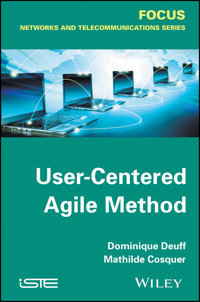
Agile development methods began to emerge around 20 years ago. However, it was not until the early 2000s that they began to be widely used in industry. This growth was often due to the advent of Internet services requiring faster cycles of development in order to heighten the rate at which an ever-greater number of functionalities were made available. In parallel, user-centered design (UCD) methods were also becoming more and more widely used: hence, user-centered design and agile methods were bound to cross paths, at least in the telecoms industry! During this period, in the field of telecommunications, the explosion in the number of connected terminals, Web applications, new use environments (particularly in a domestic setting), etc., meant it was crucial to gain a fuller understanding of users’ requirements and better evaluate the relevance and acceptance of services’ attempts to cater for these requirements. Thus the user-centered agile method, as proposed in this book, aims to mutually integrate two existing methods: user-centered design – as used by ergonomists – and the agile Scrum method – as used by developers. The user testing method is also covered. Analyzing work on this subject spanning the past 10 years, the authors also provide an assessment of the feedback on the user-centered agile method. The method described in this book has been based on all these sources. It is a framework relying on the logic introduced by Scrum, i.e. a framework based on project management. The method proposed is seen as an extension of Scrum which is “centered on humans” because of the integration of user-centered design and user-testing. Therefore the description of the user-centered agile method is based on the basics of the agile Scrum method and uses its terminology and elements. As well as descriptive elements of the user-centered agile method, practical examples of how to implement it are also provided.
Contents
1. Introduction.
2. Intrioduction to the Methods Employed.
3. Sources for this Work.
4. Description of The User-Centered Agile Method.
5. Case Studies.
About the Authors
Dominique Deuff worked at the National Institute of Informatics in Japan for 2½ years before coming back to France in June 2006 and joining Orange Labs France Telecom as a developer in a Scrum team. In 2008, she graduated with a Master’s degree in ergonomics and has since then been applying her new skills to various projects at Orange Labs Lannion.
Mathilde Cosquer joined Orange Labs as an ergonomist after completing her PhD on the question of transparency of technical devices from the user’s point of view. She has taken part in the design and evaluation of numerous innovating services, but over the past four years, she has been more particularly involved in projects of interpersonal communication services.
Sie lesen das E-Book in den Legimi-Apps auf:
Seitenzahl: 164
Veröffentlichungsjahr: 2013
Ähnliche




















Contents
Foreword
1. Introduction
2. Introduction to the Methods Employed
2.1. The agile method - Scrum
2.2. User-Centered Design method
2.3. User testing method
3. Sources for this Work
3.1. State of the art
3.2. Feedback on application of the first version of the UCA method
3.3. Elements retained for the construction of the UCA method
4. Description of the User-Centered Agile Method
4.1. Roles present
4.2. Ceremonies
4.3. Artifacts
4.4. Progression of the method
4.5. Implication of the method in terms of workload
5. Case Studies
5.1. Application of the User-Centered Agile method on the Cat’s Eyes project
5.2. Application of the User-Centered Agile method on the Bind project
5.3. Balanced evaluation of the case studies
Conclusion
Bibliography
Index
First published 2013 in Great Britain and the United States by ISTE Ltd and John Wiley & Sons, Inc.
Apart from any fair dealing for the purposes of research or private study, or criticism or review, as permitted under the Copyright, Designs and Patents Act 1988, this publication may only be reproduced, stored or transmitted, in any form or by any means, with the prior permission in writing of the publishers, or in the case of reprographic reproduction in accordance with the terms and licenses issued by the CLA. Enquiries concerning reproduction outside these terms should be sent to the publishers at the undermentioned address:
ISTE Ltd
27-37 St George’s Road
London SW19 4EU
UK
www.iste.co.uk
John Wiley & Sons, Inc.
111 River Street
Hoboken, NJ 07030
USA
www.wiley.com
© ISTE Ltd 2013
The rights of Dominique Deuff and Mathilde Cosquer to be identified as the author of this work have been asserted by them in accordance with the Copyright, Designs and Patents Act 1988.
Library of Congress Control Number: 2013930462
British Library Cataloguing-in-Publication Data A CIP record for this book is available from the British Library
ISSN: 2051-2481 (Print)
ISSN: 2051-249X (Online)
ISBN: 978-1-84821-453-8
Foreword
Agile development methods began to emerge around twenty years ago now. However, it was not until the early 2000s that they began to be widely used in industry. This growth was often due to the advent of Internet services, requiring faster cycles of development in order to heighten the rate at which an ever-burgeoning number of functionalities were made available. In parallel, User-Centered Design (UCD) methods were also becoming more and more widely used. During this period, in the field of telecommunications, the explosion in the number of connected terminals, Web applications, new use environments (particularly in a domestic setting), etc. meant it was crucial to gain a fuller understanding of users’ requirements and better evaluate the relevance and acceptance of these services’ attempts to cater for these requirements.
Hence, UCD and agile methods were bound to cross paths, at least for the telecoms industry! Yet it is the combination of an engineer/ergonomist specializing in agile development and an ergonomist who is an expert in communication interfaces which has been able to demonstrate the relevance of the complementarity of these two methods. Throughout this book, Dominique Deuff and Mathilde Cosquer put forward a consistent strategy to bring together the best of the two approaches, applying them to the design and development of communication services.
To begin with, the UCD method is used for the phase of design definition, with regular exchanges between designers and evaluators in order to take account of the view of the end-users. Then there is a long “tunnel” of development, at the end of which a new round of user testing will validate the design that has been developed (or not!). Unfortunately, it is often very late in the day, and above all, costly, to take account of the users’ comments and apply them to the already-finished product… The agile methods, by their very approach, make it possible to control, or at least segment, this tunnel effect by performing rounds of development in successive iterations. Thus, from a very tenuous initial definition of the design, on the basis of which, development can begin, it is possible to progressively take account of the expectations, changes or new functional requirements throughout the course of the cycle. By combining these two methods, the users take their place throughout the process of design and development, and their comments can be taken into account as soon as possible. It is an exciting challenge to bring together the future customers and the order-givers!
Yet while it may seem obvious that the opinion of an end-user about a product for which he will ultimately become the customer will be relevant, adopting this approach means breaking down many barriers internal to the company and agreeing to change habits which are firmly entrenched. Bringing UCD and agile methods together means the designers have to go less far in terms of the specification phase, on the one hand, and impress on the business owner the need to heed the opinion of the user during the development process, on the other! So much flies in the face of the established powers! Can people agree to relinquish a certain amount of power, in the interests of moving towards a better and more satisfactory product? Can they accept that knowledge is not unique but rather is diffuse and shared between the actors involved in the design and development processes? Finally, explaining to the “revered authorities” of the established methods and convincing them that such methods can change may be the most difficult task that the authors of the present book have had to face, and which anyone wishing to implement the User-Centered Agile (UCA) method will have to face.
Thus, it is a great adventure that is offered us in these pages, because the challenge is one that is truly worth rising to. Beyond a methodology, it is a philosophy and a global approach to service design which is presented. More than a way of handling a few projects, this is an entirely new vision of enterprise. To place the user at the heart of the design process, to give him a voice in the very early phases of an innovative project, and in particular to listen to his opinions whilst continuing to heed the various professionals in the company, is a real challenge.
Jean-Michel PortugalClaude DalozMarch 2013
1
Introduction
The constant evolution taking place in the field of Information and Communication Technology (ICT) means that an ever-broader range of users are employing this technology in increasingly flexible, changeable and varied cases of use. In parallel to this trend, owing to our demand for the provision of useful and usable solutions, the design of systems, services and products are becoming more and more complex. In response to this demanding context, the User-Centered Agile (UCA) method, which is presented in this book, is conceived to include both User-Centered Design (UCD) and agile development methods, taking full advantage of the particularities and assets of each of these approaches.
Lesen Sie weiter in der vollständigen Ausgabe!
Lesen Sie weiter in der vollständigen Ausgabe!
Lesen Sie weiter in der vollständigen Ausgabe!
Lesen Sie weiter in der vollständigen Ausgabe!
Lesen Sie weiter in der vollständigen Ausgabe!
Lesen Sie weiter in der vollständigen Ausgabe!
Lesen Sie weiter in der vollständigen Ausgabe!




