


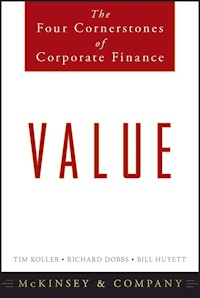
Value E-Book
21,99 €
Mehr erfahren.
- Herausgeber: John Wiley & Sons
- Kategorie: Fachliteratur
- Serie: What is Political Economy?
- Sprache: Englisch
An accessible guide to the essential issues of corporate finance
While you can find numerous books focused on the topic of corporate finance, few offer the type of information managers need to help them make important decisions day in and day out.
Value explores the core of corporate finance without getting bogged down in numbers and is intended to give managers an accessible guide to both the foundations and applications of corporate finance. Filled with in-depth insights from experts at McKinsey & Company, this reliable resource takes a much more qualitative approach to what the authors consider a lost art.
- Discusses the four foundational principles of corporate finance
- Effectively applies the theory of value creation to our economy
- Examines ways to maintain and grow value through mergers, acquisitions, and portfolio management
- Addresses how to ensure your company has the right governance, performance measurement, and internal discussions to encourage value-creating decisions
A perfect companion to the Fifth Edition of Valuation, this book will put the various issues associated with corporate finance in perspective.
Sie lesen das E-Book in den Legimi-Apps auf:
Seitenzahl: 378
Veröffentlichungsjahr: 2010
Ähnliche




















Contents
Cover
Half Title Page
Title Page
Copyright
About the Authors
Acknowledgments
Preface
Part One: The Four Cornerstones
1: Why Value Value?
THE FOUR CORNERSTONES
CONSEQUENCES OF NOT VALUING VALUE
ADVANTAGES OF VALUING VALUE
CHALLENGES FOR EXECUTIVES
2: The Core of Value
RELATING GROWTH, ROIC, AND CASH FLOW
REAL-WORLD EVIDENCE
MANAGERIAL IMPLICATIONS
3: The Conservation of Value
FOUNDATIONS OF VALUE CONSERVATION
MANAGERIAL IMPLICATIONS
4: The Expectations Treadmill
SHAREHOLDER RETURNS AND UNDERLYING VALUE
UNDERSTANDING EXPECTATIONS
MANAGERIAL IMPLICATIONS
5: The Best Owner
WHO'S THE BEST OWNER?
BEST-OWNER LIFE CYCLE
MANAGERIAL IMPLICATIONS
Part Two: The Stock Market
6: Who Is the Stock Market?
A MODEL OF THE MARKET
CONVENTIONAL WISDOM
BETTER WAY TO UNDERSTAND INVESTORS
INTRINSIC INVESTORS DRIVE VALUATION LEVELS
7: The Stock Market and the Real Economy
SHAREHOLDER RETURNS FOR 100 YEARS
STOCK MARKET ERAS 1960–2009
MODELING THE MARKET OVER ONE-YEAR PERIODS
MAKING SENSE OF THE MARKET
8: Stock Market Bubbles
WHY DO BUBBLES ARISE?
MARKETWIDE BUBBLES
SECTOR AND COMPANY BUBBLES
FINANCIAL CRISES
BUBBLES REINFORCE NEED TO FOCUS ON LONG-TERM VALUE CREATION
9: Earnings Management
CONSENSUS ESTIMATES DON'T MATTER
EARNINGS VOLATILITY IS INEVITABLE
ACCOUNTING TREATMENT WON'T CHANGE UNDERLYING VALUE
Part Three: Managing Value Creation
10: Return on Capital
WHAT DRIVES RETURN ON CAPITAL?
RETURN ON CAPITAL SUSTAINABILITY
TRENDS IN RETURNS ON CAPITAL
RETURN ON CAPITAL IS STILL RELEVANT
11: Growth
DIFFERENT GROWTH CREATES DIFFERENT VALUE
GROWTH IS DIFFICULT TO SUSTAIN
GROWTH REQUIRES CONTINUAL SEARCH FOR NEW MARKETS
12: The Business Portfolio
BEST OWNER: CORPORATE VALUE ADDED
DIVESTITURES: REGULAR PRUNING
ADDING TO THE PORTFOLIO
BUSINESS PORTFOLIO DIVERSIFICATION
SIZE AND SCALE
13: Mergers and Acquisitions
MEASURING VALUE CREATION
EMPIRICAL RESULTS
VALUE-CREATING ACQUISITION ARCHETYPES
MORE DIFFICULT STRATEGIES FOR CREATING VALUE FROM ACQUISITIONS
FOCUS ON VALUE CREATION, NOT ACCOUNTING
14: Risk
RISK AFFECTS COMPANIES AND INVESTORS DIFFERENTLY
MEASURING RISK
COMPANIES SHOULD RETAIN SOME RISKS
FINANCIAL MARKETS ARE OF LIMITED HELP IN REDUCING ECONOMIC RISKS
HOW MUCH RISK TO ADOPT
RISK CULTURE
15: Capital Structure
THE MIX OF DEBT AND EQUITY
COMPLEX FINANCIAL STRUCTURES AND FINANCIAL ENGINEERING
DIVIDENDS AND SHARE REPURCHASES
16: Investor Communications
OBJECTIVES OF INVESTOR COMMUNICATIONS
INTRINSIC VALUE VERSUS MARKET VALUE
WHICH INVESTORS MATTER?
COMMUNICATING TO INTRINSIC INVESTORS
GUIDANCE
LISTENING TO INVESTORS
17: Managing for Value
ORGANIZING FOR VALUE
PERFORMANCE MEASUREMENT
COMPENSATION
STRATEGIC PLANNING AND BUDGETING
BOARD OF DIRECTORS
Appendix A: The Math of Value
Appendix B: The Use of Earnings Multiples
Index
VALUE
THE FOUR CORNERSTONES OF CORPORATE FINANCE
Copyright © 2011 by McKinsey & Company. All rights reserved.
Published by John Wiley & Sons, Inc., Hoboken, New Jersey.
Published simultaneously in Canada.
No part of this publication may be reproduced, stored in a retrieval system, or transmitted in any form or by any means, electronic, mechanical, photocopying, recording, scanning, or otherwise, except as permitted under Section 107 or 108 of the 1976 United States Copyright Act, without either the prior written permission of the Publisher, or authorization through payment of the appropriate per-copy fee to the Copyright Clearance Center, Inc., 222 Rosewood Drive, Danvers, MA 01923, (978) 750-8400, fax (978) 646-8600, or on the Web at www.copyright.com. Requests to the Publisher for permission should be addressed to the Permissions Department, John Wiley & Sons, Inc., 111 River Street, Hoboken, NJ 07030, (201) 748-6011, fax (201) 748-6008, or online at http://www.wiley.com/go/permissions.
Limit of Liability/Disclaimer of Warranty: While the publisher and author have used their best efforts in preparing this book, they make no representations or warranties with respect to the accuracy or completeness of the contents of this book and specifically disclaim any implied warranties of merchantability or fitness for a particular purpose. No warranty may be created or extended by sales representatives or written sales materials. The advice and strategies contained herein may not be suitable for your situation. You should consult with a professional where appropriate. Neither the publisher nor author shall be liable for any loss of profit or any other commercial damages, including but not limited to special, incidental, consequential, or other damages.
For general information on our other products and services or for technical support, please contact our Customer Care Department within the United States at (800) 762-2974, outside the United States at (317) 572-3993 or fax (317) 572-4002.
Designations used by companies to distinguish their products are often claimed by trademarks. In all instances where the author or publisher is aware of a claim, the product names appear in Initial Capital letters. Readers, however, should contact the appropriate companies for more complete information regarding trademarks and registration.
Wiley also publishes its books in a variety of electronic formats. Some content that appears in print may not be available in electronic books. For more information about Wiley products, visit our web site at www.wiley.com.
Library of Congress Cataloging-in-Publication Data:
Value : the four cornerstones of corporate finance / McKinsey and Company ; Tim Koller, Richard Dobbs, Bill Huyett. p. cm. Includes index. ISBN 978-0-470-42460-5 (cloth); ISBN 978-0-470-94906-1 (ebk); ISBN 978-0-470-94907-8 (ebk); ISBN 978-0-470-94908-5 (ebk) 1. Corporations—Valuation. 2. Corporations—Finance. 3. Stockholder wealth. I. Koller, Tim. II. Dobbs, Richard. III. Huyett, Bill. IV. McKinsey and Company. HG4028.V3V36 2010 658.15–dc22 2010032747
About the Authors
McKinsey & Company is a management-consulting firm that helps leading private, public, and social sector organizations make distinctive, lasting, and substantial performance improvements. Over the past seven decades, the firm's primary objective has remained constant: to serve as an organization's most trusted external advisor on critical issues facing senior management. With consultants deployed from more than 90 offices in over 50 countries, McKinsey advises companies on strategic, operational, organizational, financial, and technological issues. The firm has extensive experience in all major industry sectors and primary functional areas.
McKinsey's corporate finance practice, along with the firm's strategy and risk practices, uniquely integrates industry insights, the firm's global presence, and proprietary knowledge as it advises clients. Together, these practices help clients set corporate portfolio direction, manage risk in investment choices, and build effective value-management capabilities.
Tim Koller is a partner in McKinsey's New York office, the head of the firm's Corporate Performance Center, and a member of the leadership group of the firm's global corporate finance practice. During his 25 years of consulting based in New York and Amsterdam, Tim has served clients globally on corporate strategy and capital markets, mergers and acquisitions, and value-based management. He is the co-author of Valuation: Measuring and Managing the Value of Companies, which is now in its fifth edition and used around the world by banks, corporations, and leading business schools as the authoritative text on the subject. Tim leads the firm's research activities in valuation and capital markets. Prior to joining McKinsey, Tim was with Stern Stewart & Company and Mobil Corporation. He received an MBA from the University of Chicago.
Richard Dobbs is a partner in McKinsey's Seoul office and a director of the McKinsey Global Institute, the firm's business and economics research arm. Prior to this, Richard oversaw R&D for McKinsey's corporate finance practice. Since joining McKinsey in London in 1988, Richard has served clients globally on corporate strategy and capital markets, mergers and acquisitions, and value-based management. He is a graduate of Oxford University, an associate fellow of the Saïd Business School at Oxford and, as a Fulbright Scholar, received an MBA from the Stanford Graduate School of Business.
Bill Huyett is a partner in McKinsey's Boston office and a leader of the firm's strategy, corporate finance, and health care practices. During his 23 years in consulting based in Boston, Zurich, and Washington D.C., Bill has served clients globally on product development and commercialization, growth, innovation, corporate strategy, mergers and acquisitions, and corporate leadership. Before joining McKinsey, Bill held a variety of line management positions in the electronics industry. His degrees in electronics engineering and computer science are from the University of Virginia, as is his MBA.
Acknowledgments
In 1990, McKinsey first published Valuation: Measuring and Managing the Value of Companies. After having sold more than 500,000 copies in 10 languages, the fifth edition of Valuation was released in mid-2010.
We are greatly indebted to Valuation's authors, because their success led to the formulation of this book. Tom Copeland and Jack Murrin were co-authors of Valuation's first three editions, while Marc Goedhart and David Wessels co-authored the fourth and fifth editions. Without their insight and industry, this book (Value) would not exist today, so we are eternally grateful for these fine colleagues.
We definitely couldn't have created this work without our clients, who hone our thoughts and insights as they interact with us. They provide the reality against which we constantly test our assumptions and ideas, and their experience is the very matter that we combine with academic theory to ferret out the truth.
The intellectual origins of this book lie in the present value method of capital budgeting and in the valuation approach developed by Professors Merton Miller and Franco Modigliani in their 1961 Journal of Business article, “Dividend Policy, Growth and the Valuation of Shares.” Others have gone far to popularize their approach. In particular, Professor Alfred Rappaport of Northwestern University and Joel Stern of Stern Stewart & Company were among the first to extend the Miller-Modigliani enterprise valuation formula to real-world applications.
Ennius Bergsma deserves our special thanks for initiating the development of McKinsey's corporate finance practice in the mid-1980s. He inspired the original internal McKinsey valuation handbook and mustered the support to turn that handbook into a published book for an external audience. We also owe a special debt to Dave Furer for help, and late nights, developing the original drafts of Valuation more than 20 years ago.
We couldn't have devoted the time and energy to this book without the support and encouragement of McKinsey's corporate finance practice leadership, in particular Christian Caspar, Bernie Ferrari, Massimo Giordano, Ron Hulme, Rob Latoff, Thomas Leudi, Nick Leung, Michael Patsalos-Fox, Jean-Marc Poullet, Pedro Rodeia, Michael Silber, Vincenzo Tortoricci, and Felix Wenger.
Likewise we couldn't have devoted the proper time and energy to this work if it weren't for the vision of McKinsey's former managing director, Ian Davis, and the firm's current managing director, Dominic Barton.
We would also like to thank those who have personally shaped our knowledge of corporate finance, strategy, and economics, often through their challenging questions. We thank Buford Alexander, Ennius Bergsma, Peter Bisson, Tom Copeland, Mike Dodd, Bill Fallon, Bernie Ferrari, Richard Foster, Marc Goedhart, John Goetz, Robert Harris, Tim Jenkinson, Larry Kanarek, Jack McDonald, Michael Mauboussin, Colin Meyer, Michael Mire, Jack Murrin, Jonathan Peacock, Chandan Sengupta, Bennett Stewart, Bill Trent, Robert Uhlaner, James Van Horn, and David Wessels.
The authors are honored to work with McKinsey's Corporate Performance Center (CPC), a group of dedicated finance experts who influence our thinking every day. The CPC's leaders include: Ankur Agrawal, André Annema, Andres Cottin, Bas Deelder, Susan Nolen Foushee, Marc Goedhart, Regis Huc, Mimi James, Mauricio Jaramillo, Bin Jiang, Marc Metakis, Jean-Hugues Monier, Rishi Raj, Werner Rehm, Ram Sekar, and Zane Williams.
We've made extensive use of McKinsey's Corporate Performance Analytical Tool (CPAT), which provides a great database and deep analytical capability. Thank you to Bin Jiang, who developed and oversees CPAT, and to Bing Cao, who analyzed the data for us. Dick Foster, a retired McKinsey partner, inspired the development of CPAT.
Neil DeCarlo, our lead editor, was our sounding board, coach, and occasional arbiter, debating the structure of each chapter and helping us find the best language to convey our ideas. He was also incredibly flexible, accommodating our hectic schedules regardless of when it was in his time zone. He was, in many ways, the fourth author of this book.
Rik Kirkland and Michael Stewart ensured that we received great help from McKinsey's external publishing and external communications teams. Bill Javetski and Dennis Swinford, from McKinsey's editorial team, have been serial collaborators with us on the numerous articles and other work that ultimately found its way into this book. Additionally, Joanne Mason orchestrated our marketing and distribution efforts, and fact-checking and editorial support was circumspectly provided by Drew Holzfeind, Joe Mandel, and Katherine Boas.
Kim Bartko expertly oversaw the production of the exhibits in this book, a herculean task given the variety of formats and technologies employed. We can't say enough about the way Kim wielded her visual-communications talent in improving many of our original exhibits. Kim was supported by the efficient and expert production work of Mark Bergeron, Gail Farrar, and Richard Peal.
The ideas in some chapters can be traced to individuals who've influenced our thinking over the years: Rob McLean and John Stuckey for the best-owner principle in Chapter 5, Werner Rehm and Rob Palter for the investor segmentation in Chapter 6 and investor communications in Chapter 16, Marc Goedhart for the discussion of stock market bubbles in Chapter 8, Lee Dranikoff and Antoon Schneider for the discussion of divestitures in Chapter 12, and Marc Goedhart and Werner Rehm for the discussion of capital structure in Chapter 15.
The five editions of Valuation drew upon work, ideas, and analyses from Carlos Abad, Paul Adam, Buford Alexander, Petri Allas, Alexandre Amson, André Annema, the late Pat Anslinger, Vladimir Antikarov, Ali Asghar, Bill Barnett, Dan Bergman, Olivier Berlage, Peter Bisson, the late Joel Bleeke, Nidhi Chadda, Carrie Chen, Steve Coley, Kevin Coyne, Johan Depraetere, Mikel Dodd, Lee Dranikoff, Will Draper, Christian von Drathen, David Ernst, Bill Fallon, George Fenn, Susan Nolen Foushee, Russ Fradin, Gabriel Garcia, Richard Gerards, Alo Ghosh, Irina Grigorenko, Fredrik Gustavsson, Marco de Heer, Keiko Honda, Alice Hu, Régis Huc, Mimi James, Chris Jones, William Jones, Phil Keenan, Phil Kholos, David Krieger, Shyanjaw Kuo, Bill Lewis, Kurt Losert, Harry Markl, Yuri Maslov, Perry Moilinoff, Fabienne Moimaux, Mike Murray, Terence Nahar, Juan Ocampo, Martijn Olthof, Rob Palter, Neha Patel, John Patience, Bill Pursche, S. R. Rajan, Frank Richter, David Rothschild, Michael Rudolf, Yasser Salem, Antoon Schneider, Meg Smoot, Silvia Stefini, Konrad Stiglbrunner, Ahmed Taha, Bill Trent, David Twiddy, Valerie Udale, Sandeep Vaswani, Kim Vogel, Jon Weiner, Jack Welch, Gustavo Wigman, David Willensky, Marijn deWit, Pieter deWit, Jonathan Witter, David Wright, and Yan Yang.
For help in preparing the manuscript and coordinating the flow of paper, e-mails, and phone calls, we owe our thanks to our assistants, Jennifer Fagundes, Sumi Choi, and Alice Morris.
We also extend heartfelt thanks to the team at John Wiley & Sons, including Tiffany Charbonier, Mary Daniello, Bill Falloon, Meg Freeborn, Mike Freeland, Pamela van Giessen, Emilie Herman, Joan O'Neil, and Cristin Riffle-Lash. We can't say enough about the quality and professionalism of the John Wiley team. We're indebted as well to the team at Cape Cod Compositors for their exacting work in polishing our manuscript into its final form as a published book.
Finally, thank you to Melissa Koller, Cathy Dobbs, and Lauren Huyett, and our children. Our wives and families are our true inspirations. This book would not have been possible without their encouragement, support, and sacrifice.
Preface
Most executives have figured out how to create value for shareholders. Through experience, observation, and intuition, they've developed a wealth of personal wisdom that, with some luck, typically takes them in the right direction.
But let's face it: that wisdom doesn't always prevail. Indeed, the run-up to the financial crisis of 2008 is but one example of how easily finance myths, fads, and misconceptions overwhelm wisdom, even in the most sophisticated organizations.
Executives don't have it easy. It's tough to hold steady when shareholders expect absurdly high returns during periods of relative alignment between companies' share prices and underlying economic value. It's even tougher to stick with fundamentals as peers' profits skyrocket in seemingly irrational ways, as they did in 2008, or when share prices reach unprecedented and unsustainable levels, as they did during the Internet-bubble era.
During such periods, seductive new economic theories emerge. These theories catch the attention of journalists, traders, boards, investors, and executives—even though they're blatantly at odds with the tenets of finance that have held true for more than 100 years.
These episodes of wishful thinking have only reinforced the immutable principles of value creation. These four principles, which we call the cornerstones of corporate finance, start with the axiom that companies exist to meet customer needs in a way that translates into reliable returns to investors. Together, the cornerstones form a foundation upon which executives can ground decisions about strategy, mergers and acquisitions, budgets, financial policy, technology, and performance measurement—even as markets, economies, and industries change around them.
For executives with functional, business, or corporate responsibilities, ignoring the cornerstones can lead to decisions that erode value or lead to outright corporate disaster. Let's take two examples.
First, leverage: As the market heated up in 2007 and 2008, many savvy financial services executives thought leverage could be used to create (as opposed to merely redistribute) value. That misconception clashes with the cornerstones. Leverage is a quick way to manufacture accounting profits, but it doesn't add real value to the company or the economy, because it merely rearranges claims on cash flow and increases risk.
Second, volatility: Some say companies are better valued when they deliver steady, predictable earnings growth. That, too, is an assumption that doesn't emerge from the cornerstones. The truth is that the most sophisticated investors—the ones who should matter most to executives—expect some earnings volatility, if only as recognition of changing economic dynamics beyond any one company's control. Related is a belief that earnings per share guidance, and the significant executive time consumed by managing guidance, is valued by investors even though empirical evidence clearly shows otherwise.
Compounding the misconceptions are apparent disconnects in how financial performance reflects economic theory and empirical data. These disconnects can cloud top-management judgments about business strategies and investment cases. Basic economics suggest, for example, that above-cost-of-capital returns will be competed away. Data show, though, that some companies earn consistently superior returns using business models that vaccinate themselves against competitors and new entrants.
In our practice we see uneven development of finance capabilities among general managers and functional leaders. All too often, these leaders have picked up their finance knowledge without a grounding in the cornerstones, leading to such overly simplistic refrains as “We need to grow earnings faster than revenue.'' Or the ungrounded might overemphasize earnings per share at the expense of capital productivity or growth.
When we combine the misconceptions, the contradictions between finance and economics, and the uneven development of finance skills, we understand the roots of decisions that diverge from the perennial principles. The voices of the media don't often shed light, the views expounded by investors about what constitutes value and what doesn't are splintered, and traders cause further confusion by unnaturally bidding up or down stock prices of individual companies and even entire sectors.
Internalizing the four cornerstones of finance, understanding how they relate to the real economy and the public stock markets (or private-owner expectations), and having the courage to apply them across the enterprise have significant upside and little downside. At least, the four cornerstones can prevent executives from making strategic, financial, and business decisions that undermine value creation. At best, the cornerstones can encourage a more constructive, value-oriented dialogue among executives, boards, investors, bankers, and the press—resulting in courageous and even unpopular decisions that build lasting corporate value.
To this end we offer you Value: The Four Cornerstones of Corporate Finance.
Our hope is that this book will be a catalyst and concrete guide for improving how executives plan strategy, make decisions, and build the next generation of leaders. Ultimately, we hope the collective impact of more companies embracing these principles creates a more stable and productive economy.
Part One
The Four Cornerstones
1
Why Value Value?
There's no disputing that value is the defining metric in a market economy. When people invest, they expect the value of their investment to increase by an amount that sufficiently compensates them for the risk they took, as well as for the time value of their money. This is true for all types of investments, including bonds, bank accounts, real estate, or company shares.1
Therefore, knowing how to create and measure value is an essential tool for executives. If we've learned anything from the latest financial crisis, and from periods of economic bubbles and bursts in our history, it's that the laws of value creation and value measurement are timeless. Financial engineering, excessive leverage, the idea during inflated boom times that somehow the old rules of economics no longer apply—these are the misconceptions upon which the value of companies are destroyed and entire economies falter.
Lesen Sie weiter in der vollständigen Ausgabe!
Lesen Sie weiter in der vollständigen Ausgabe!
Lesen Sie weiter in der vollständigen Ausgabe!
Lesen Sie weiter in der vollständigen Ausgabe!
Lesen Sie weiter in der vollständigen Ausgabe!
Lesen Sie weiter in der vollständigen Ausgabe!
Lesen Sie weiter in der vollständigen Ausgabe!
Lesen Sie weiter in der vollständigen Ausgabe!
Lesen Sie weiter in der vollständigen Ausgabe!
Lesen Sie weiter in der vollständigen Ausgabe!
Lesen Sie weiter in der vollständigen Ausgabe!
Lesen Sie weiter in der vollständigen Ausgabe!
Lesen Sie weiter in der vollständigen Ausgabe!
Lesen Sie weiter in der vollständigen Ausgabe!
Lesen Sie weiter in der vollständigen Ausgabe!
Lesen Sie weiter in der vollständigen Ausgabe!
Lesen Sie weiter in der vollständigen Ausgabe!
Lesen Sie weiter in der vollständigen Ausgabe!
Lesen Sie weiter in der vollständigen Ausgabe!
Lesen Sie weiter in der vollständigen Ausgabe!
Lesen Sie weiter in der vollständigen Ausgabe!




