


25,99 €
Mehr erfahren.
- Herausgeber: John Wiley & Sons
- Kategorie: Wissenschaft und neue Technologien
- Serie: RGS-IBG Book Series
- Sprache: Englisch
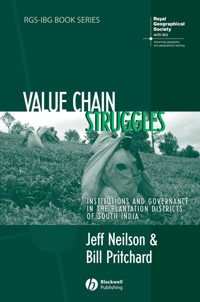
Adopting a 'global value chain' approach, Value Chain Struggles investigates the impact of new trading arrangements in the coffee and tea sectors on the lives and in the communities of growers in South India. * Offers a timely analysis of the social hardships of tea and coffee producers * Takes the reader into the lives of growers in Southern India who are struggling with issues of value chain restructuring * Reveals the ways that the restructuring triggers a series of political and economic struggles across a range of economic, social, and environmental arenas * Puts into perspective claims about the impacts of recent changes to global trading relations on rural producers in developing countries
Sie lesen das E-Book in den Legimi-Apps auf:
Seitenzahl: 582
Veröffentlichungsjahr: 2011
Ähnliche



















Contents
List of Figures
List of Tables
Series Editors’ Preface
Acknowledgements
List of Abbreviations
Numbers, Dates and Measurements
Indian Administrative Geography
Currency Exchange
Chapter One Introduction
Tea, Coffee and the Crisis in Tropical Commodities
Governance, Institutions and Struggle
Towards buyer-driven governance in global tea and coffee industries
Local flavours: An introduction to tea and coffee production in South India
Our Blend: An Outline of the Book’s Structure
Chapter Two Re-inserting Place and Institutions within Global Value Chain Analysis
Part One: Commodity Analysis
Part Two: Global Value Chain Analysis
Part Three: The Institutional Dimensions of Global Value Chains
Part Four: From Words to Deeds – Methodological Considerations in GVC Research
Conclusion
Chapter Three How to Make a (South Indian) Cup of Tea or Coffee
The Input–Output Dimensions of South Indian Tea
The Input-Output Dimensions of South Indian Coffee
The territoriality of South Indian coffee
Conclusion
Chapter Four The Institutional Environment of the South Indian Tea and Coffee Industries
Managing agents and plantation life: The insertion of South Indian tea and coffee into Britain’s colonial project
Institutional reconfigurations after Independence
Institutions and organizations in the South Indian tea and coffee industries in the contemporary period (1990s–)
Conclusion
Chapter Five Struggles over Labour and Livelihoods
What is Ethical Accountability?
Ethical Accountability in Tea and its Influence in South India
Labour Welfare on South Indian Tea Estates
Struggles and Silences: The Interstices of the Ethical Accountability Agenda in South India
Conclusion
Chapter Six Struggles over Environmental Governance in the Coffee Forests of Kodagu
Product Certification in the Coffee Industry
The Coffee Forests of Kodagu
Conservation and Coffee in Kodagu
Conclusion
Chapter Seven Smallholder Engagement in Global Value Chains: Initiatives in the Nilgiris
Smallholders and Global Value Chains: The General Argument
Tea Smallholders in the Nilgiris
Nilgiris Smallholders and the Tea Crisis
The Quality Upgradation Programme
The role of women’s Self-Help Groups and factory participation
Is the Quality Agenda Sufficient to Improve the Lives of Smallholders? The Role of Government Supports
Conclusion
Chapter Eight Making a Living in the Global Economy: Institutional Environments and Value Chain Upgrading
Process Upgrading
Product Upgrading
Functional Upgrading
Intersectoral Upgrading
Summary: The Future of Upgrading for South Indian Tea and Coffee
Chapter Nine Conclusion: What We Brewed
Institutions and Governance in GVC Theory
The Struggles of Upstream Producers: Surviving the Tropical Products Crisis
Appendix A The Role of Managing Agents
Appendix B The Operation and Intended Reform of South India’s Tea Auctions
Appendix C Restructuring of Tata Tea’s Munnar Operations
Notes
Bibliography
Index
RGS-IBG Book Series
Published
Value Chain Struggles: Institutions and Governance in thePlantation Districts of South India
Jeff Neilson and Bill Pritchard
Arsenic Pollution: A Global Synthesis
Peter Ravenscroft, Hugh Brammer and Keith Richards
Queer Visibilities: Space, Identity and Interaction in Cape Town
Andrew Tucker
Resistance, Space and Political Identities: The Making ofCounter-Global Networks
David Featherstone
Mental Health and Social Space: Towards InclusionaryGeographies?
Hester Parr
Climate and Society in Colonial Mexico: A Study in Vulnerability
Georgina H. Endfield
Geochemical Sediments and Landscapes
Edited by David J. Nash and Sue J. McLaren
Driving Spaces: A Cultural-Historical Geography of England’s M1Motorway
Peter Merriman
Badlands of the Republic: Space, Politics and Urban Policy
Mustafa Dikeç
Geomorphology of Upland Peat: Erosion, Form and LandscapeChange
Martin Evans and Jeff Warburton
Spaces of Colonialism: Delhi’s Urban Governmentalities
Stephen Legg
People/States/Territories
Rhys Jones
Publics and the City
Kurt Iveson
After the Three Italies: Wealth, Inequality and Industrial Change
Mick Dunford and Lidia Greco
Putting Workfare in Place
Peter Sunley, Ron Martin and Corinne Nativel
Domicile and Diaspora
Alison Blunt
Geographies and Moralities
Edited by Roger Lee and David M. Smith
Military Geographies
Rachel Woodward
A New Deal for Transport?
Edited by Iain Docherty and Jon Shaw
Geographies of British Modernity
Edited by David Gilbert, David Matless and Brian Short
Lost Geographies of Power
John Allen
Globalizing South China
Carolyn L. Cartier
Geomorphological Processes and Landscape Change: Britain in the Last 1000 Years
Edited by David L. Higgitt and E. Mark Lee
Forthcoming
Aerial Geographies: Mobilities, Subjects, Spaces
Peter Adey
Politicizing Consumption: Making the Global Self in an UnequalWorld
Clive Barnett, Nick Clarke, Paul Cloke and Alice Malpass
Living Through Decline: Surviving in the Places of thePost-Industrial Economy
Huw Beynon and Ray Hudson
Swept-Up Lives? Re-envisaging ‘the Homeless City’
Paul Cloke, Sarah Johnsen and Jon May
Millionaire Migrants: Trans-Pacific Life Lines
David Ley
Complex Locations: Women’s geographical work in the UK1850–1970
Avril Maddrell
In the Nature of Landscape: Cultural Geography on the NorfolkBroads
David Matless
Transnational Learning: Knowledge, Development and the North-South Divide
Colin McFarlane
Domesticating Neo-Liberalism: Social Exclusion and Spaces of Economic Practice in Post Socialism
Adrian Smith, Alison Stenning, Alena Rochovská and Dariusz Świątek
State, Science and the Skies: Governmentalities of the BritishAtmosphere
Mark Whitehead
This edition first published 2009
© 2009 by Jeffrey Neilson and Bill Pritchard
Blackwell Publishing was acquired by John Wiley & Sons in February 2007. Blackwell’s publishing program has been merged with Wiley’s global Scientific, Technical, and Medical business to form Wiley-Blackwell.
Registered Office
John Wiley & Sons Ltd, The Atrium, Southern Gate, Chichester, West Sussex, PO19 8SQ, United Kingdom
Editorial Offices
350 Main Street, Malden, MA 02148–5020, USA
9600 Garsington Road, Oxford, OX4 2DQ, UK
The Atrium, Southern Gate, Chichester, West Sussex, PO19 8SQ, UK
For details of our global editorial offices, for customer services, and for information about how to apply for permission to reuse the copyright material in this book please see our website at www.wiley.com/wiley-blackwell.
The right of Jeffrey Neilson and Bill Pritchard to be identified as the authors of this work has been asserted in accordance with the Copyright, Designs and Patents Act 1988.
All rights reserved. No part of this publication may be reproduced, stored in a retrieval system, or transmitted, in any form or by any means, electronic, mechanical, photocopying, recording or otherwise, except as permitted by the UK Copyright, Designs and Patents Act 1988, without the prior permission of the publisher.
Wiley also publishes its books in a variety of electronic formats. Some content that appears in print may not be available in electronic books.
Designations used by companies to distinguish their products are often claimed as trademarks. All brand names and product names used in this book are trade names, service marks, trademarks or registered trademarks of their respective owners. The publisher is not associated with any product or vendor mentioned in this book. This publication is designed to provide accurate and authoritative information in regard to the subject matter covered. It is sold on the understanding that the publisher is not engaged in rendering professional services. If professional advice or other expert assistance is required, the services of a competent professional should be sought.
Library of Congress Cataloging-in-Publication Data
Neilson, Jeff.
Value chain struggles : institutions and governance in the plantation districts of South India / Jeff Neilson and Bill Pritchard.
p. cm. – (GS-IBG book series)
Includes bibliographical references and index.
ISBN 978-1-4051-7393-3 (hardcover : alk. paper) – ISBN 978-1-4051-7392-6 (pbk. : alk. paper) 1. Coffee industry-India, South. 2. Tea trade-India, South. 3. Globalization–Economic aspects–India, South. I. Pritchard, Bill. II. Title. III. Title: Institutions and governance in the plantation districts of South India.
HD9199.I42N45 2009
338.4′76337309548-dc22
2008037693
List of Figures
1.1Struggles over global value chains with institutional realignments1.2Plantation districts in South India2.1The economics of institutions3.1Basic composition of South Indian tea global value chains3.2Shade cover at Silver Cloud tea estate, Gudalur, Tamil Nadu3.3The difference between orthodox and CTC teas3.4Change in volumes of tea exports between 1990 and 2005, major producing countries3.5Shade-grown coffee, Kodagu District, Karnataka3.6Post-harvest processing stages for coffee3.7Hand-sorting (garbling) of coffee green beans (Tata Coffee curing works, Kushalnagar, Kodagu, Karnataka)3.8ICO composite price for green coffee (1987–2007)4.1Organizational interconnections in South Indian tea production4.2A typical tea planter’s bungalow (Pattumalay Estate, Central Travancore planting district, Kerala)5.1The ethical landscape of the South Indian tea sector5.2Daily minimum adult wages in tea plantations, 1997–20075.3Degraded tea landscape in Central Travancore, 20065.4Abandoned tea factory, Hope Estates, Central Travancore, 20066.1Landuse map and coffee expansion in Kodagu, 1977–20076.2Ainemane house, Kodagu6.3Tala Kauvery, Kodagu7.1Average tea export price (Rupees per kg), North and South India, 1985–20067.2A typical Badagas village7.3Value chains for Nilgiris tea, 20007.4A village-awareness campaign meeting for the Quality Upgradation Programme7.5Tea Board poster mandating that smallholders are not to use sickles in tea pluckingList of Tables
1.1Distribution of value for tea sold into Western European markets1.2Four estimates of the distribution of value for coffee sold into varying markets2.1Methodological strands in product/commodity analysis2.2Key determinants of global value chain governance3.1Indicative estimates of tea production by smallholders, major countries, 20053.2Tea grades used in Indian auctions3.3Average yearly prices (US$) at major tea auctions, 1985, 1990, 1995 and 2000–63.4Role of tea auctions in major black tea producing countries3.5The world’s major tea producing countries, 20053.6The world’s major tea importing countries, 20053.7Coffee production by State and District, 2006–73.8Major exporters of Indian coffee, 2006–73.9Major coffee grades set by the Coffee Board of India3.10The world’s major coffee producing countries, 20063.11The world’s major coffee importing countries, 20063.12The input-output and territoriality dimensions of South Indian tea and coffee4.1South Indian tea growing areas and how they are described in the 2007 ‘Golden Leaf’ awards brochure5.1Status of tea estates in Central Travancore, 20066.1Stated objectives of various ‘Sustainability’ codes in the coffee sector6.2Distribution of coffee farm holdings in India8.1Upgrading initiatives in South Indian tea and coffee industries8.2Functional activities of major corporate groups in the South Indian tea and coffee industriesSeries Editors’ Preface
The RGS-IBG Book Series only publishes work of the highest international standing. Its emphasis is on distinctive new developments in human and physical geography, although it is also open to contributions from cognate disciplines whose interests overlap with those of geographers. The Series places strong emphasis on theoretically-informed and empirically-strong texts. Reflecting the vibrant and diverse theoretical and empirical agendas that characterize the contemporary discipline, contributions are expected to inform, challenge and stimulate the reader. Overall, the RGS-IBG Book Series seeks to promote scholarly publications that leave an intellectual mark and change the way readers think about particular issues, methods or theories.
For details on how to submit a proposal please visit: www.rgsbookseries.com
Kevin Ward
University of Manchester, UK
Joanna Bullard
Loughborough University, UK
RGS-IBG Book Series Editors
Acknowledgements
One benefit of researching South India’s tea and coffee industries was that an invigorating brew of these local beverages was never far away whenever we sat down with our interview informants, colleagues and friends. During our eleven research visits to South India spread over the period 2004–8, we consumed literally hundreds of cups of tea or coffee in offices, living rooms, verandahs, restaurants, hotel lobbies, roadsides, and factory floors. They ranged from the archetypal steaming steel cups of milky chai masala of everyday India, to fine leaf black orthodox teas served in exquisite porcelain cups, and to foaming lattes in oversized paper cups in western-style ‘Coffee Day’ and ‘Barista’ outlets. Sitting over a cup or tea or coffee provided the social micro-climate in which the stories of transformation presented in this book were divulged and debated.
It comes as no surprise, therefore, that in these Acknowledgements we want to recognize the support and generosity of people associated with the South Indian tea and coffee industries. Without their assistance, this book could not have been written. We hope that this book may go some way towards securing a more viable and just future for this regional industry.
Mr Ullas Menon, Secretary-General of the United Planters’ Association of Southern India (UPASI), was extremely generous in sharing with us his extensive knowledge of his industry, and warmly introducing us to many of his colleagues. Also at UPASI, R. Sanjith was a fount of information about the industry, and always bore a friendly smile. We cannot name all those in the planters’ community who gave us their time in support of this book, but specific thanks are due to the following individuals who went out of their way to help us along our path: T. Alexander, N. Dharmaraj, H. Huq, C.P. Kariappa, D.B. King, B. Mandana, R. McAuliffe, T. Pinto, S. Perreira, A. Ponnapa, R. Bajekal, J.K. Thomas, and V. Ramaswamy.
For assisting our fieldwork with small growers, we wish to acknowledge the former Head Scientist at UPASI-KVK, Dr Ramu, his replacement, Mrs Dhanalakshmi Devaraj and all her staff. We also thank the Directors and staff of the Tea Board of India, especially Mr Nazeem I.A.S., and the Directors and staff of the Coffee Board of India, especially Dr Ramamurthy at the research sub-station at Chettali. The directors and staff of the UPASITea Research Foundation are owed a debt of gratitude, as is Mr Lakshman Gowda, President of the Karnataka Grower’s Federation.
In the Indian research community, we acknowledge the assistance of Prof. T. Vasantha Kumaran, Prof. P.G. Chengappa, Dr Ajjan Nanjan, C.P. Kushalappa, Dr C.P. Gracy, Dr A Damodaran, and Dr Claude Garcia (of CIRAD and the French Institute at Pondicherry). Dr Shatadru Chattopadhayay (Partners in Change) and Sanne van der Wal (Dutch Tea Initiative/SOMO) assisted our participation in an NGO Workshop in Darjeeling in 2006, which we gratefully acknowledge.
We enjoyed the good company of Ashish Rozario and family, Steve Rebello and Sanjay Cherian during our fieldwork in India, and also wish to thank the staff at Wallwood Guest House in Coonoor, which became something of an occasional ‘home away from home’ during parts of our field research.
The project to which this book has contributed was funded by the Australian Research Council. We thank and acknowledge our former colleague within the project team, Prof. John Spriggs, who gave us key insights about institutional economics that now see the light of day with this book. Niels Fold, from the Department of Geography at Copenhagen University, spent a productive sabbatical with us in 2006–7 and helped us to hone our ideas. Lindsay Soutar, Nathan Wales and Jasmine Glover assisted in various technical ways in making this manuscript come into being. Our colleagues in Geography at the University of Sydney and our fellow members of the Agri-food Research Network form the basis of our researcher networks, and it is an honour to be part of these scholarly communities. Kevin Ward at the University of Manchester provided supportive and sound advice in bringing our manuscript to final publication, and we thank two anonymous referees for their vigilance in asking us to fine-tune our arguments.
Finally, this project involved considerable time away from home, to the disruption of our families. We dedicate this book to Relyta, Eden and Jemma, and Kerry and Arizona.
Jeff Neilson
Bill Pritchard
Chapter One
Introduction
November 2004, Bangalore. In a downstairs conference room of the four-star Hotel Atria, a special closed session of the 46th Annual Meeting of the Karnataka Planters’ Association (KPA) is under way. The KPA is a member organization of the United Planters’ Association of Southern India (UPASI), which goes back more than 100 years to the age of British planters’ clubs on the subcontinent. A senior economic researcher from one of India’s leading universities, just returned from Europe, is setting forth a series of issues to which the Karnataka coffee industry will be forced to respond. In association with the German development agency Gesellschaftfür TechnischeZusammenarbeit (GTZ), the European coffee community is developing what it refers to as a ‘common code’ for the industry. Under the code, coffee producers wishing to sell to code signatories, which include Kraft and Nestlé, will be required to extensively document the histories of chemical use on their plantations, the environmental conditions under which coffee is grown, and their compliance with labour standards. The code is perceived as essentially a means for defensive brand management by the major coffee companies, and the planters fear that it will soon become a requirement for market access. This being the case, abiding by the code may give the planters an edge in the global marketplace. Yet at the same time, implementing these systems will be costly and time-consuming, especially onerous at a time of low coffee prices when many growers are already struggling to make a living. ‘This is just East India Company imperialism in a new guise’, says one of the planters. ‘The Europeans are setting down new standards, and we have to pay the cost of implementing them.’ The planters around the table nod their heads in agreement.
September 2005, a tea factory in the village of Bitherkad, in the Gudalur district of Tamil Nadu. A crowd of 200 smallholder tea growers awaits officials representing the Tea Board of India. Smallholders have been major losers from changed priorities of international tea buyers in local auctions, who have increasingly bypassed the generally lower-quality teas they produce. The associated slump in tea prices received by smallholders is cutting deep into these growers’ livelihoods. With average tea plantings of less than one hectare each, the 15,000 local tea growers have seen their farm incomes halved, with most now receiving gross incomes of less than US$600 per year from tea. The officials have come to explain a subsidy payment scheme aimed at alleviating the desperate plight of this segment of the rural population. The scheme has been developed after considerable political agitation by growers but, when it becomes apparent that bureaucratic problems will restrict the eligibility of many growers from receiving these payments, the smallholders’ frustrations boil over. Speaker after speaker rails against what they perceive as the evils of globalized markets, industry deregulation, and low tea prices.
Lesen Sie weiter in der vollständigen Ausgabe!
Lesen Sie weiter in der vollständigen Ausgabe!
Lesen Sie weiter in der vollständigen Ausgabe!
Lesen Sie weiter in der vollständigen Ausgabe!
Lesen Sie weiter in der vollständigen Ausgabe!
Lesen Sie weiter in der vollständigen Ausgabe!
Lesen Sie weiter in der vollständigen Ausgabe!
Lesen Sie weiter in der vollständigen Ausgabe!
Lesen Sie weiter in der vollständigen Ausgabe!
Lesen Sie weiter in der vollständigen Ausgabe!
Lesen Sie weiter in der vollständigen Ausgabe!
Lesen Sie weiter in der vollständigen Ausgabe!
Lesen Sie weiter in der vollständigen Ausgabe!
Lesen Sie weiter in der vollständigen Ausgabe!




