


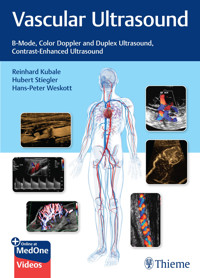
Vascular Ultrasound E-Book
249,99 €
Mehr erfahren.
- Herausgeber: Thieme
- Kategorie: Fachliteratur
- Sprache: Englisch
An interdisciplinary guide to color duplex sonography organized by anatomic region
The indications for vascular color duplex sonography (CDS) have expanded in recent years due to the availability of power Doppler, B-flow, ultrasound contrast agents, 3D reconstruction techniques and fusion with other imaging modalities. CDS enables close-interval follow-ups after interventional procedures with improved prognoses. Edited by Reinhard Kubale, Hubert Stiegler, and Hans-Peter Weskott, Vascular Color Duplex Ultrasound starts with the basic principles of diagnostic ultrasound physics and technology, followed by invaluable tips on equipment settings, possible artifacts, and limitations; hemodynamic essentials; and the use of ultrasound contrast agents. Subsequent chapters organized by anatomic region provide updated coverage on all peripheral and abdominal arterial and venous vascular regions; microcirculation and tumor perfusion; kidney and liver disease; the use of contrast-enhanced ultrasound (CEUS) in biliary, intestinal, splenic, and pediatric diseases; and novel/future techniques.
Key Features
- Contributions from interdisciplinary experts in angiology, neurology, radiology, vascular surgery, gastroenterology, nephrology, phlebology, rheumatology, laser medicine, and physics
- In-depth guidance on examination techniques, findings, and potential pitfalls and how to avoid them
- A wealth of comparative CT, MRI, and angiography CDS images and 37 videos enhance understanding of impacted anatomy, and the ability to master techniques and make accurate diagnoses
This book includes complimentary access to a digital copy on https://medone.thieme.com
Das E-Book können Sie in Legimi-Apps oder einer beliebigen App lesen, die das folgende Format unterstützen:
Seitenzahl: 1309
Veröffentlichungsjahr: 2023
Ähnliche




















To access the additional media content available with this e-book via Thieme MedOne, please use the code and follow the instructions provided at the back of the e-book.
Vascular Ultrasound
B-Mode, Color Doppler and Duplex Ultrasound, Contrast-Enhanced Ultrasound
Reinhard Kubale, MD, PhD
Associate Professor of Radiology and Head of Ultrasound DepartmentClinic of Diagnostic and Interventional RadiologySaarland University Medical CenterHomburg, Germany
Hubert Stiegler, MD
Internist and AngiologistVascular Center Münchener Freiheit;Former Senior Director of Clinic for AngiologyMunich City HospitalMunich, Germany
Hans-Peter Weskott, MD
Internist and HeadUltrasound Outpatient Clinic KRH Clinic SiloahHannover, Germany
1619 illustrations
ThiemeStuttgart • New York • Delhi • Rio de Janeiro
Library of Congress Cataloging-in-Publication Data is available with the publisher.
This book is an authorized, revised, updated, and expanded translation of the 2nd German edition published and copyrighted 2015 by Georg Thieme Verlag, Stuttgart. Title of the German edition: Farbkodierte Duplexsonografie. Interdisziplinärer vaskulärer Ultraschall.
Translator: Terry Telger, Fort Worth, TX, USA
Illustrator: Barbara Gay, Bremen, Germany
© 2023 Thieme. All rights reserved.
Georg Thieme Verlag KG
Rüdigerstrasse 14, 70469 Stuttgart, Germany
+49 [0]711 8931 421, [email protected]
Cover design: © Thieme
Cover image source: © ThiemeIllustration of the human vascular system: © SciePro/stock.adobe.com
Typesetting by TNQ Technologies, India
Printed in Germany by Beltz Grafische Betriebe GmbH 5 4 3 2 1
DOI: 10.1055/b-006-160187
ISBN: 978-3-13-240543-1
Also available as an e-book:
eISBN (PDF): 978-3-13-240686-5
eISBN (epub): 978-3-13-258218-7
Important note: Medicine is an ever-changing science undergoing continual development. Research and clinical experience are continually expanding our knowledge, in particular our knowledge of proper treatment and drug therapy. Insofar as this book mentions any dosage or application, readers may rest assured that the authors, editors, and publishers have made every effort to ensure that such references are in accordance with the state of knowledge at the time of production of the book.
Nevertheless, this does not involve, imply, or express any guarantee or responsibility on the part of the publishers in respect to any dosage instructions and forms of applications stated in the book. Every user is requested to examine carefully the manufacturers’ leaflets accompanying each drug and to check, if necessary, in consultation with a physician or specialist, whether the dosage schedules mentioned therein or the contraindications stated by the manufacturers differ from the statements made in the present book. Such examination is particularly important with drugs that are either rarely used or have been newly released on the market. Every dosage schedule or every form of application used is entirely at the user’s own risk and responsibility. The authors and publishers request every user to report to the publishers any discrepancies or inaccuracies noticed. If errors in this work are found after publication, errata will be posted at www.thieme.com on the product description page.
Some of the product names, patents, and registered designs referred to in this book are in fact registered trademarks or proprietary names even though specific reference to this fact is not always made in the text. Therefore, the appearance of a name without designation as proprietary is not to be construed as a representation by the publisher that it is in the public domain.
Thieme addresses people of all gender identities equally. We encourage our authors to use gender-neutral or gender-equal expressions wherever the context allows.
This book, including all parts thereof, is legally protected by copyright. Any use, exploitation, or commercialization outside the narrow limits set by copyright legislation, without the publisher’s consent, is illegal and liable to prosecution. This applies in particular to photostat reproduction, copying, mimeographing or preparation of microfilms, and electronic data processing and storage.
Contents
Preface
Contributors
Part I: Basic Principles
1Principles of Physics and Technology in Diagnostic Ultrasound
Bernhard J. Arnolds, Bernhard Gaßmann, Peter-Michael Klews
1.1Introduction
1.2Overview of Ultrasound Techniques
1.2.1A-Mode
1.2.2B-Mode
1.2.3M-Mode
1.2.4Color Duplex Sonography (CDS)
1.2.5Power Doppler
1.2.6Tissue Doppler
1.2.7B-Flow
1.2.8Color M-Mode
1.2.9Doppler Spectral Analysis
1.2.10Three-Dimensional Ultrasound Techniques
1.2.11(Tissue) Harmonic Imaging
1.3General Physical Properties
1.4Formation of the Ultrasound Image
1.4.1Frame Rate, Pulse Repetition Frequency, Penetration Depth, and Number (Density) of Scan Lines
1.5Transducers
1.5.1Transducer “Frequency”
1.6The Doppler Effect
1.6.1Problem of Pulsed Sampling—Aliasing
1.7Components of an Ultrasound System
1.7.1Interpretation of Color Duplex Images
1.8Innovations
1.8.1Harmonic Imaging
1.8.2Tissue Doppler
1.8.3Power Doppler
1.8.4Real-Time Compound B-Mode
1.8.5Spatial Compound Imaging
1.8.6Elastography
1.8.7PlaneWave Imaging
1.9Documentation
2Ultrasound Device Settings, Examination Technique, and Artifacts
Reinhard Kubale, Hans-Peter Weskott
2.1Introduction
2.1.1Color Flow Imaging (CFI)
2.2Transducer Selection and Instrument Settings
2.2.1Prerequisites
2.2.2Transducer Selection
2.2.3Transducers
2.2.4Optimizing the Image with Operator-Controlled Settings
2.3Examination Technique, Limitations, and Artifacts
2.3.1Examination Protocol
2.3.2Limitations and Artifacts
2.4Effect of Imaging Technique on Spatial Resolution and Lesion Detectability
3Hemodynamics
Bernhard J. Arnolds, Hubert Stiegler
3.1Introduction
3.2Flow Characteristics in Steady Volume Flow
3.2.1Shear Rate
3.2.2Flow Resistance, Hagen-Poiseuille Law
3.2.3Fahraeus-Lindqvist Effect, Apparent Viscosity, and Axial Migration
3.3Flow Characteristics in Straight Vessels of Constant Cross Section
3.3.1Reynolds Number as the Determinant of Laminar or Turbulent Flow
3.4Flow Characteristics in Vessels of Variable Cross Section
3.4.1Bernoulli Principle
3.4.2Flow Profile at Constrictions and Expansions
3.4.3Flow Separation, Separation Zones, and Turbulent Zones
3.5Characteristics of Pulsatile Volume Flow
3.5.1Velocity Profile of Pulsatile Flow
3.5.2Approach to the Flow Complexity
3.5.3Waveforms of Pulsatile Flow/Helical Flow
3.6Blood Flow through Stenoses
3.6.1Relationship between Vessel Cross Section and Flow Velocity
3.6.2Quantification of Stenosis
3.6.3Intra- and Poststenotic Flow Changes
3.6.4Hemodynamic Significance
3.7Evaluation of Stenoses by Color Duplex Imaging
3.7.1Criteria for Vascular Findings
3.7.2Instrument Settings
3.7.3Envelope Curves of Doppler Spectrum
3.7.4Spectral Window in Doppler Frequency Analysis
3.7.5Timing of Velocity Measurements in Doppler Spectrum
3.7.6Angle Correction
3.7.7Spectral DopplerWaveform Patterns
3.7.8DopplerWaveform Patterns Associated with Stenotic Lesions
3.7.9Color Flow Imaging
3.7.10Integral Display of Flow Velocity and Volume Flow
3.7.11Limitations of Color Duplex Imaging
3.7.12Other Techniques
3.8Flow Indices
3.8.1Analytical Criteria
4Ultrasound Contrast Agents—Fundamentals and Principles of Use
Hans-Peter Weskott, Christian Greis
4.1Structure and Properties of Ultrasound Contrast Agents
4.1.1Structure
4.1.2Pharmacologic Properties of Ultrasound Contrast Agents
4.1.3Acoustic Properties of Ultrasound Contrast Agents
4.2Equipment and Software: Settings and Transducers
4.2.1Quality Aspects of Contrast-Enhanced Imaging
4.2.2Transducer Selection
4.3Vessel- and Organ-Specific Contrast Doses
4.3.1Abdominal and Peripheral Vessels
4.3.2Abdominal Organs
4.3.3Small Parts
4.3.4Intracavitary Use
4.4Interpretation of Findings
4.4.1Documentation: From JPEG to Digital Raw Data
4.4.2Visual Interpretation: Online and Offline
4.4.3TIC: Software-Assisted Analysis of Enhancement Kinetics
Part II: Vascular Ultrasound
5Extracranial Cerebral Arteries
Christian Arning, Günter Seidel
5.1General Remarks
5.2Carotid Artery
5.2.1Anatomy, Examination Technique, and Normal Findings
5.2.2Stenosis
5.2.3Tortuosity and Kinking
5.2.4Occlusion
5.2.5Special Pathologies
5.3Vertebral Artery
5.3.1Anatomy, Examination Technique, and Normal Findings
5.3.2Stenosis
5.3.3Tortuosity and Kinking
5.3.4Occlusion
5.3.5Subclavian Steal
5.3.6Special Pathologies
5.4Color Duplex Sonography Compared with Other Modalities
6Intracerebral Arteries and Brain
Günter Seidel, Christian Arning
6.1General Remarks
6.2Transtemporal Approach
6.2.1Examination Technique and Normal Findings
6.2.2Vascular Pathology
6.2.3Parenchymal Pathology
6.3Transnuchal Approach
6.3.1Examination Technique and Normal Findings
6.3.2Vascular Pathology
6.4Orbital Approach
6.4.1Examination Technique and Normal Findings
6.4.2Pathologic Findings
7Limbs
7.1Upper Extremities
7.1.1Arteries
Thomas Karasch, Hubert Stiegler, Rupert Bauersachs
General Remarks
Anatomy and Variants
Examination Technique
Normal Findings
Pathologic Findings
Documentation
Sources of Error
Utility of Color Duplex Sonography Compared with Other Methods
Conclusion
7.1.2Veins of the Neck and Upper Extremities
Hubert Stiegler, Viola Hach-Wunderle
General Remarks
Anatomy and Variants
Examination Technique and Normal Findings
Pathologic Findings
Documentation
Comparison of Color Duplex Sonography with Other Modalities
Conclusion
7.2Lower Extremities
7.2.1Arteries
Hubert Stiegler, Thomas Karasch, Rupert Bauersachs
General Remarks
Anatomy and Variants
Examination Technique
Normal Findings
Pathologic Findings
Follow-Up of Revascularization Procedures
Sources of Error
Documentation
Utility of Color Duplex Sonography Compared with Other Methods
7.2.2Veins: Superficial Lower Extremity Venous System
Hubert Stiegler, Viola Hach-Wunderle
General Remarks
Anatomy and Variants
Examination Technique and Normal Findings
Pathologic Findings
Documentation
Comparison of Color Duplex Sonography with Other Modalities
Conclusion
7.2.3Veins: Deep Venous System
Hubert Stiegler, Viola Hach-Wunderle
General Remarks
Anatomy and Variants
Examination Technique and Normal Findings
Pathologic Findings
Documentation
Efficacy of Color Duplex Sonography Relative to Other Methods
7.3Hemodialysis Access
Reinhard Kubale, Alexander Maßmann, Gunnar Heine, Gottfried Walker
7.3.1General Remarks
7.3.2Normal Anatomy and Access Types
Brescia-Cimino Fistula
ePTFE Graft
Other Types of Prosthetic Access
7.3.3Examination Technique and Normal Findings
Clinical Examination and History
Examination Protocol and Equipment Settings
Normal Findings
7.3.4Pathologic Findings
Preliminary Remarks
Stenosis and Occlusion
Aneurysms and Perivascular Changes
Functional Problems
7.3.5Pre- and Postinterventional Examinations
Preinterventional Examination
Postinterventional Follow-Ups
7.3.6Documentation
7.3.7Comparison of Color Duplex Sonography with Other Modalities
8Nonatherosclerotic Arterial Diseases: Vasculitis, Fibromuscular Dysplasia, Cystic Adventitial Disease, Compression Syndromes
Hubert Stiegler, Wolfgang A. Schmidt
8.1General Remarks
8.2Examination Technique
8.3Pathologic Findings
8.3.1Vasculitis
8.3.2Thromboangiitis obliterans (Winiwarter-Buerger Disease)
8.3.3Fibromuscular Dysplasia (FMD)
8.3.4Cystic Adventitial Degeneration (CAD)
8.3.5Compression Syndromes
8.4Documentation
8.5Comparison of Color Duplex Sonography with Other Modalities
9Vascular Malformations
Hubert Stiegler, Peter Urban
9.1General Remarks
9.2Etiology and Pathogenesis
9.3Differential Diagnosis
9.4Classification
9.5Pathophysiology
9.5.1Truncular Malformations
9.5.2Extratruncular Malformations
9.6Examination Technique
9.6.1Goals
9.6.2Necessary Equipment
9.6.3Examiner Requirements
9.6.4Patient and Examiner Positions
9.6.5Examination Protocol
9.7Clinical Manifestations and Typical Color Duplex Findings
9.7.1Arterial Malformation (AMF)
9.7.2Arteriovenous Malformation (AVM)
9.7.3Venous Malformation (VMF)
9.7.4Lymphatic Malformation (LMF)
9.7.5Capillary Malformation (CMF)
9.7.6Combined Malformations
9.8Documentation
9.9Comparison of Color Duplex Sonography with Other Modalities
9.10Conclusion
Part III: Abdominal Organs: Vascularization and Perfusion
10Aorta and Outgoing Branches
Dirk-Andre Clevert, Reinhard Kubale, Alexander Maßmann
10.1General Remarks
10.1.1Color Duplex Sonography (CDS)
10.2Aortic Anatomy and Variants
10.2.1Vascular Branches
10.2.2Anatomical Variants
10.3Examination Technique
10.3.1Transducer and Device Settings
10.3.2Color Duplex Sonography of the Aorta
10.3.3Color Duplex Sonography of the Aortic Branching Vessels
10.3.4Contrast-Enhanced Ultrasound (CEUS)
10.4Normal Findings
10.4.1Abdominal Aorta
10.5Pathologic Findings in the CCDS
10.5.1Wall Thickenings, Plaques, Stenoses, and Occlusions
10.5.2Aneurysms
10.5.3Aneurysm Verum
10.5.4Aortic Dissection
10.5.5Inflammatory Aneurysm
10.5.6Infected or Mycotic Aneurysm
10.5.7Complications
10.6Pre- and Postinterventional Diagnostics
10.6.1Pre- and Postsurgical Examinations
10.6.2Pre- and Postinterventional Examinations
10.6.3Examination Technique
10.6.4Procedure in Case of Endoleaks
10.6.5Findings
10.6.6Definition and Classification of Endoleaks
10.6.7Long-Term Follow-up
10.6.8Image Fusion for the Localization and Characterization of Endoleaks and for Further Intervention Monitoring
10.7Documentation
10.8Value of Color Duplex Sonography in Comparison to Other Imaging Methods
10.8.1Computed Tomography
10.8.2Magnetic Resonance Angiography
10.8.3Importance of Color Duplex Sonography and CEUS
11Visceral Arteries
Wilma Schierling, Reinhard Kubale, Karin Pfister
11.1General Remarks
11.2Anatomy, Variants, and Collaterals
11.2.1Celiac Trunk and Its Branches
11.2.2Superior and Inferior Mesenteric Arteries
11.2.3Preformed Arterial Collaterals
11.3Examination Technique
11.3.1Settings
11.3.2Patient Preparations
11.3.3Color Duplex Sonography
11.3.4Examination Time
11.3.5Contrast-Enhanced Ultrasound
11.4Normal Findings and Variants
11.4.1Normal Findings
11.4.2Variants
11.5Pathologic Findings
11.5.1Plaque, Stenosis, and Occlusion
11.5.2Acute Intestinal Ischemia: Embolism, Thrombosis, Dissection, and Nonocclusive Intestinal Ischemia
11.5.3Aneurysms
11.5.4Arteriovenous Malformation
11.5.5Involvement of Visceral Vessels by Systemic and Inflammatory Diseases
11.5.6Chronic Inflammatory Bowel Disease
11.5.7Applications in Vascular Surgery and Interventional Radiology
11.5.8Follow-up after Organ Transplantation
11.6Documentation
11.7Comparison of Color Duplex Sonography with Other Modalities
11.7.1Angiography
11.7.2Sonography
11.7.3Computed Tomography
11.7.4Magnetic Resonance Angiography
11.8Importance of CDS and CEUS in Clinical Diagnosis
11.8.1Aneurysms and Arteriovenous Malformations
11.8.2Stenoses and Occlusions
11.8.3Follow-Up
11.8.4Quantitative Measurements
12Abdominal Veins
Reinhard Kubale, Ernst Michael Jung
12.1General Remarks
12.2Anatomy, Variants, and Collaterals
12.2.1Inferior Vena Cava, Lumbar and Pelvic Veins
12.2.2Renal Veins
12.2.3Gonadal Veins
12.2.4Portal Venous System and Mesenteric Venous System
12.3Examination Technique
12.3.1Transducer
12.3.2Protocol
12.3.3Velocity Measurements
12.4Normal Findings
12.4.1Inferior Vena Cava, Lumbar and Iliac Veins
12.4.2Renal Veins
12.4.3Hepatic Veins
12.4.4Portal and Mesenteric Venous System
12.5Pathologic Findings
12.5.1Malformations
12.5.2Thrombosis, Stenosis, and Occlusion
12.6Applications of CDS in Surgical and Interventional Procedures
12.6.1Vena Cava Filter Placement
12.6.2Extracorporeal Membrane Oxygenation (ECMO)
12.6.3Reconstructive Surgery of Cardiac Anomalies
12.7Documentation
12.8Comparison of Color Duplex Sonography with Other Modalities
12.8.1Inferior Vena Cava and the Renal, Iliac, and Ovarian Veins
12.8.2Mesenteric and Splenoportal Axis
13Microcirculation and Tumor Perfusion
Hans-Peter Weskott
13.1General Remarks
13.2Available Imaging Techniques
13.3Tumor Vasculature and Perfusion
14Kidneys and Renal Transplants
Hans-Peter Weskott, Konrad Friedrich Stock
14.1General Remarks
14.2Anatomy and Variants
14.2.1Orthotopic Kidneys
14.2.2Variants
14.3Examination Technique
14.3.1Procedure
14.4Normal Findings
14.4.1Extrarenal Arteries
14.4.2Intrarenal Arteries
14.5Pathologic Findings
14.5.1Nephrolithiasis and Urolithiasis
14.5.2Inflammatory Renal Diseases
14.5.3Tumors and Tumor Vascularity
14.5.4Primary Vascular Diseases of the Kidney
14.5.5Acute Renal Failure
14.5.6Renal Trauma
14.6Evaluation of Renal Transplants
14.6.1Protocol for Ultrasound Evaluation of Renal Transplants
14.6.2Complications of Renal Transplantation in Clinical Ultrasound
14.6.3Outlook
14.7Documentation
14.8Comparison of Color Duplex Sonography and Contrast-Enhanced Ultrasound
15Liver and Portal Venous System
Hans-Peter Weskott, Reinhard Kubale
15.1General Remarks
15.2Anatomy and Common Variants
15.2.1Oxygen and Nutrient Supply of the Liver
15.2.2Arterial Blood Supply
15.2.3Portal Vein
15.2.4Intrahepatic Vascular Distribution and the Hepatic Segments
15.3Examination Technique Including Contrast Administration
15.3.1Examination Protocol and Doppler Measurements
15.3.2Equipment Settings and Flow Detection Techniques
15.3.3Contrast Examination
15.4Normal Findings, Variants, and Hemodynamics
15.4.1Hemodynamics
15.5Pathologic Findings
15.5.1Aneurysms
15.5.2Malformations of the Portal Venous System
15.5.3Hereditary Hemorrhagic Telangiectasia (Osler-Weber-Rendu Disease)
15.5.4Obstruction of the Hepatic Veins
15.5.5Circumscribed Hepatic Vein Stenosis
15.5.6Thrombosis of the Splenoportal Axis, Portal Vein Thrombosis
15.5.7Diffuse Liver Diseases
15.5.8Portal Hypertension
15.5.9Benign Focal Hepatic Lesions
15.5.10Focal Hepatic Malignancies
15.5.11Liver Transplantation
15.5.12Shunt Procedures
15.5.13Cancer Therapy
15.6Diagnosis in Surgical and Interventional Percutaneous Procedures
15.7Comparison of Color Duplex Sonography and CEUS with Other Modalities
15.7.1Primary Vascular Diseases of the Liver
15.7.2Secondary Vascular Changes in Diffuse Liver Diseases
15.7.3Focal Hepatic Lesions
15.8Conclusion
16Contrast-Enhanced Ultrasound (CEUS) in Biliary Diseases
Hans-Peter Weskott
16.1Background
16.2Examination Technique
16.3Pathologic Findings
16.3.1Cholecystitis and Cholangitis
16.3.2Tumors of the GallbladderWall
17Contrast-Enhanced Ultrasound (CEUS) in Intestinal Diseases
Hans-Peter Weskott
17.1General Remarks
17.2Examination Technique
17.3Pathologic Findings
17.3.1Diverticulitis
17.3.2Inflammatory Bowel Disease
17.3.3Ischemia and Infarction
17.3.4Intestinal Tumors
18Contrast-Enhanced Ultrasound (CEUS) in Pancreatic Diseases
Hans-Peter Weskott, Reinhard Kubale
18.1General Remarks
18.2Examination Technique
18.3Acute Pancreatitis
18.4Pancreatic Masses
18.4.1Solid Pancreatic Tumors
18.4.2Cystic Pancreatic Lesions
19Contrast-Enhanced Ultrasound (CEUS) in Splenic Diseases
Hans-Peter Weskott
19.1General Remarks
19.2Examination Technique, Normal Findings, and Indications for CEUS
19.3Pathologic Findings
19.3.1Benign Solid Lesions
19.3.2Malignant Lesions
19.3.3Splenic Infarction and Bleeding
20Contrast-Enhanced Ultrasound (CEUS) in Pediatric Diseases
Doris Franke
20.1General Remarks
20.2Contrast-Enhanced Ultrasound (CEUS) in Children
20.2.1Voiding Urosonography (VUS) Using Ultrasound Contrast Agents (US-CA)
20.2.2Potential Indications for Intravenous Use of CEUS in Children
20.2.3Indications for Contrast-Enhanced Ultrasound (CEUS) in Children
20.3Technical Aspects and Practical Approach
20.4Dosage of the Ultrasound Contrast Media
20.5Safety, Side Effects, and Contraindications
20.6Limitations
21Novel and Upcoming Ultrasound Techniques
Hans-Peter Weskott, Reinhard Kubale
21.1B-Flow and B-Flow CEUS
21.2Superb Microvascular Imaging (SMI)
21.3PlaneWave Imaging, Ultrafast Doppler, Vector Flow Imaging (VFI)
21.4Novel Calculation Techniques for Arterial Stiffness
21.5Novel Ultrasound Contrast Agents
21.6Novel Dynamic B-Mode Techniques to Evaluate Arterial Stiffness
21.7Fusion Imaging
Index
Preface
Over many decades, ultrasound has constantly evolved to meet the clinical needs and challenges we are facing in our daily practice. In recent years, new ultrasound modes and techniques came to the market to improve patient care, from screening and diagnosis, to therapy decisions and outcome monitoring. The possibility to select a preferred ultrasound technique for a specific clinical application is the best argument to use it as the first imaging modality. Not to forget that ultrasound is the most important examination technique as it requires one to be with, and next to, a patient. For the patient’s sake, decision-making can be done quickly and in many cases without delay.
This book includes the knowledge and experiences of more than 20 renowned clinical and technical experts from different clinical subjects. We deeply appreciate their time and effort contributing to the chapters. Each chapter provides the reader with a first-hand overview of vascular and organ diseases using and sometimes combining both conventional and novel ultrasound techniques.
Contrast-enhanced ultrasound (CEUS) imaging, first introduced in 1998, followed by the advent of a second-generation contrast agent in 2001, has revolutionized many diagnostic fields. It greatly contributes to the detection, characterization, and follow-up of diffuse and focal organ diseases under and after medication, surgery and radiation therapy. This has been proven through several international, comparative studies like computed tomography (CT) and magnetic resonance imaging (MRI). Not only conventional but novel techniques such as CEUS require a reliable user experience, knowledge of the suspected pathology, plus the equipment necessary to perform these examinations.
The motivation for writing this book was to provide the general audience with a broad and updated overview of all important and relevant ultrasound imaging techniques and clinical applications. This includes the evaluation of peripheral and abdominal vasculature and organs---but excludes endoscopy, obstetrics, and gynecology.
Lastly, we would like to thank the team of Thieme Publishers for their effort and support in finalizing this book. We all do hope you will enjoy reading this book and that the knowledge gained will be a beneficial aid in your daily work.
Reinhard Kubale, MD, PhD
Hubert Stiegler, MD
Hans-Peter Weskott, MD
Contributors
Christian Arning, MD, PhD
Specialist in Neurology
Hamburg, Germany
Bernhard J. Arnolds, MD, PhD
Freiburg, Germany
Rupert Bauersachs, MD, PhD
Medical Clinic IV, Max Ratschow Clinic for Angiology
Vascular Center
Darmstadt Hospital GmbH
Darmstadt, Germany
Dirk-Andre Clevert, MD, PhD
Department of Clinical Radiology
Interdisciplinary Ultrasound Center
University of Munich Medical Center, Grosshadern
Munich, Germany
Doris Franke, MD
Pediatric Nephrology and Internal Medicine
Paediatric Sonography, Transplantation Medicine
DTM&H (London);
Clinic for Paediatric Kidney, Liver and Metabolic Diseases;
Center of Paediatric and Adolescent´s Medicine;
Hannover Medical School
Hannover, Germany
Bernhard Gaßmann, MD
Meso International GmbH
Berlin, Germany
Christian Greis, PhD
Bracco Imaging Deutschland GmbH
Konstanz, Germany
Viola Hach-Wunderle, MD, PhD
Interdisciplinary Vascular Center
Division of Angiology and Hemostasis
Nordwest Hospital
Frankfurt, Germany
Gunnar Heine, MD, PhD
Chief of Staff
Department of Internal Medicine IV
Renal and Hypertensive Diseases
Saarland University Medical Center
Homburg, Germany
Ernst Michael Jung, MD, PhD
Ultrasound Center
Regensburg University Medical Center
Regensburg, Germany
Thomas Karasch, MD†
Former Doctor of Internal Medicine, Angiology and Cardiology
Bergisch Gladbach, Germany
Peter-Michael Klews, PhD
D&K Technologies GmbH
Barum, Germany
Reinhard Kubale, MD, PhD
Associate Professor of Radiology and Head of Ultrasound Department
Clinic of Diagnostic and Interventional Radiology
Saarland University Medical Center
Homburg, Germany
Alexander Maßmann, MD
Senior Physician at the Clinic for Diagnostic and Interventional Radiology;
Medical Director of the Certified Interdisciplinary Vascular Center
Saarland University Hospital
Homburg, Germany
Karin Pfister, MD
Department of Vascular and Endovascular Surgery
Regensburg University Medical Center
Regensburg, Germany
Wilma Schierling, MD
Department of Vascular and Endovascular Surgery
Regensburg University Medical Center
Regensburg, Germany
Wolfgang A. Schmidt, MD, PhD
Rheumatology Clinic Berlin-Buch
Immanuel Hospital
Berlin, Germany
Günter Seidel, PhD
Head Center/Neurology
Asklepios Klinik Nord
Hamburg, Germany
Hubert Stiegler, MD
Internist and Angiologist
Vascular Center Münchener Freiheit;
former Senior Director of Clinic for Angiology
Munich City Hospital
Munich, Germany
Konrad Friedrich Stock, MD
Department of Nephrology
Technical University of Munich
Klinikum rechts der Isar
Munich, Germany
Peter Urban, MD
Department of Laser Medicine
Evangelical Elisabeth Hospital
Berlin, Germany
Gottfried Walker, MD
Heidelberg, Germany
Hans-Peter Weskott, MD
Internist and Head
Ultrasound Outpatient Clinic
KRH Clinic Siloah
Hannover, Germany
†Deceased
Part I
Basic Principles
1Principles of Physics and Technology in Diagnostic Ultrasound
2Ultrasound Device Settings, Examination Technique, and Artifacts
3Hemodynamics
4Ultrasound Contrast Agents—Fundamentals and Principles of Use
Chapter 1
Principles of Physics and Technology in Diagnostic Ultrasound
1.1Introduction
1.2Overview of Ultrasound Techniques
1.3General Physical Properties
1.4Formation of the Ultrasound Image
1.5Transducers
1.6The Doppler Effect
1.7Components of an Ultrasound System
1.8Innovations
1.9Documentation
1.10References
1 Principles of Physics and Technology in Diagnostic Ultrasound
Bernhard J. Arnolds, Bernhard Gaßmann, Peter-Michael Klews
1.1 Introduction
Human beings have natural receptors for light and sound. The eyes can process electromagnetic waves over just a limited range of frequencies. The ears have similar limitations when it comes to sound. To perceive frequencies outside these naturally visible or audible ranges, special technology is needed. In a sense, then, the pictures generated by this technology are “artificial” images.
The images produced by X-rays or ultrasound depend on the methods that are used for data acquisition and image processing. An image is considered “good” if it has high spatial resolution and, in the case of gray scale, has a subjectively pleasing distribution of gray levels. Another requirement is high contrast resolution, or the ability to perceive slight differences in adjacent shades of gray.
Blood flow imaging has been a topic of growing interest in diagnostic ultrasound. In 1842, C. Doppler described his eponymous effect, which states that the wavelength of light (or sound) measured by an observer depends on the relative motion between the source and receiver. This effect has been utilized in medicine since the late 1950s. Bidirectional Doppler was introduced in 1959, followed by pulsed Doppler in 1967.
The technique of color encoding of blood flow in the B-mode (gray scale) image was introduced in 1982. This technology is referred to as color duplex sonography (CDS) or color flow imaging (CFI).
The use of ultrasound contrast agents has become an established part of routine ultrasound examinations. The injection of microbubbles increases acoustic backscatter from the blood, and special signal-processing methods are used to suppress the tissue signals, resulting in images with exquisite vascular detail. One important application of this technology is in the diagnosis of intra-abdominal tumors.
Elastography is also being used in vascular ultrasound to investigate the elasticity of artery walls.
1.2 Overview of Ultrasound Techniques
Ultrasonography is used both for determining (organ) morphology and evaluating function. An ultrasound system always consists of a transducer with an application-specific shape and frequency combined with a control unit, which is the ultrasound machine itself.
The Doppler effect is useful for determining the velocity of moving objects. In medicine, the Doppler effect is most commonly used for the investigation of blood flow. Tissue Doppler is a technology that analyzes the motion of tissue structures such as the myocardial walls. Flow characteristics are displayed as either a Doppler spectrum or velocity spectrum plotted over time, or points in the B-mode image are color-encoded according to the motion measurable at those sites (Doppler shift).
All ultrasound imaging techniques described in this chapter, with the exception of continuous-wave (CW) Doppler, are based on the analysis of multiple pulse-echo cycles. The individual pulses are successively emitted from the transducer along selected ultrasound scan lines, while the echoes are continuously received and analyzed for their amplitude, phase, and frequency. Each of the continuously acquired and analyzed echoes represents a sample.
Except for CW Doppler, the ultrasound techniques described here are transit-time techniques, meaning that the depth from which echoes are received is calculated from the total pulse-echo travel time, based on the assumption of a constant sound velocity. To avoid ambiguity, the next pulse is not emitted until the transducer has received an echo from the greatest possible (or preassigned) depth. The only exception to this rule is high pulse-repetition-frequency (HPRF) Doppler, in which additional pulses are transmitted before the echo from the first transmitted pulse has been received.
All ultrasound techniques besides M-mode are sectional imaging techniques. The analysis of many consecutive scan lines, including a technique-dependent interpolation of lines between the received scan lines, results in the creation of a two-dimensional sectional image. Generally speaking, a scan line is defined as a discrete line in the ultrasound image along which the ultrasound pulse travels. It may be oriented in a perpendicular or radial direction relative to the transducer. The scan lines are idealized lines. Their thickness depends on the ultrasound wavelength and they do not take into account the true dimensions of the ultrasound beam. In some cases, as in CDS, multiple pulse-echo cycles are successively transmitted along the same scan line in order to collect the necessary echo information. Many individual scan lines are composed into a side-by-side array to produce a two-dimensional ultrasound image.
The use of multiple pulse-echo cycles per scan line does not increase the number of image increments. Only a write-zoom feature (magnified view) will increase the amount (density) of increments for a given area of interest. Thus, an ultrasound image is formed within a time period that is defined by the image depth, the number of pulse-echo cycles per line, and the number of lines per image. This is different from an ordinary photograph in which all image points are formed at the same time.
The far edges of an ultrasound image may be separated from each other by a time lag of 0.2 s or more. This may become significant, especially in the color-encoded imaging of blood flow. For example, a systolic pulse may be displayed on the left side of the image while the right side is still in diastole. This “windshield-wiper effect” depends strongly on the time required for signal acquisition and processing. The visible parameter for evaluating these temporal characteristics is the image repetition frequency called the frame rate.
The ultrasound scan lines should not be confused with the image lines on the monitor display. The number and density of image lines depend on the video standard and the area of the (ultrasound) monitor image. The number of image increments is considerably smaller than the number of image points, or video pixels; otherwise, image generation would take too long and the frame rate would be much too slow.
1.2.1 A-Mode
A-mode ultrasound (for “amplitude mode”) is rarely used nowadays but forms the basis of the B-mode technique. An A-mode image is a graphic trace of the echo amplitudes of individual scan lines (y-axis) plotted over time (x-axis). The measured transit time is converted to distance from the transducer. The deflection parallel to the y-axis on the monitor screen is proportional to the amplitude of the received echo.
1.2.2 B-Mode
B-mode ultrasound (for “brightness mode”) is the mainstay of ultrasonography and is by far the most widely used ultrasound imaging technique. The B-mode image is gray scale, meaning that it is composed entirely of different gray levels. Many successive scan lines are assembled and displayed side-by-side on the monitor to form a two-dimensional picture. The gray levels in the image are proportional to the amplitudes of the returning echoes. The greater the amplitude, the greater the brightness of the corresponding point in the image (see Fig. 2.2).
1.2.3 M-Mode
Another gray scale technique is the M-mode (for “motion mode”) or TM (“time-motion”) mode (Fig. 1.1). In this technique, different points are insonated along a single scan line. Successive acquisitions of the same scan line are displayed side by side on the monitor, although they originate from the same location in the body. The purpose of M-mode imaging is to track and display dynamic processes inside the body. It is used mainly in cardiology for evaluating the motion of the cardiac valves. M-mode is the basis for color Doppler M-mode techniques. All M-mode techniques supply functional information.
Fig. 1.1 M-mode image tracks the motion of the mitral valve over time. The temporal resolution of M-mode imaging is unmatched by any other technique. M-mode is indispensable for the visualization of moving structures.
1.2.4 Color Duplex Sonography (CDS)
CDS techniques (except for tissue Doppler) work by color encoding of sites in the image where blood flow is detected. Areas devoid of blood flow are shown in gray scale. Thus, CDS or color flow mapping (CFM) superimposes areas of color-encoded motion over the B-mode image (Fig. 1.2). The reference point for defining the direction of blood flow is the transducer (or more precisely, the direction of the scan line). Only components moving toward or away from the transducer are measured. The standard practice in conventional flow-velocity-based CDS images is to encode the different flow directions in shades of red and blue. The operator can choose which flow direction is encoded in blue and which in red. The blood flow velocity indicated in all conventional CDS techniques is the intensity-weighted mean blood flow velocity or Doppler shift (phase shift of the Doppler signals). Lighter shades of color indicate higher flow velocities. The color green may be added to the red and blue shades to indicate variance, especially in scanners designed for echocardiographic use. Variance is often used in medicine as a measure of turbulence. On a physical level, variance represents the scatter of Doppler frequency shifts. Turbulence increases the scatter of flow velocities, with an associated increase in the scatter of Doppler frequencies.
Fig. 1.2 Arterial bifurcation visualized by color duplex sonography. Blood flow toward the transducer is encoded in red. A color reversal (to blue) is noted just proximal to the bifurcation. It is caused by aliasing because the flow velocity in that area exceeds the measurable range (±19 cm/s) and therefore appears at the opposite end of the color scale. A distinctive feature of aliasing is the direct juxtaposition of contrasting colors, whereas a true flow reversal would always show a black zone interposed between the colors (Doppler angle = 90 degrees).
1.2.5 Power Doppler
Rather than color-encoding the sign and amplitude of the Doppler signals as in CDS, a power Doppler image is produced by color-encoding the intensity of the local Doppler signals. Sites with stronger local Doppler signal intensities appear brighter in the image. Red and orange color shades are commonly used (Fig. 1.3). It is also possible to indicate flow direction in the image, but this sacrifices some key advantages of power Doppler, namely, its high sensitivity to very low flow velocities and its ability to depict high flow velocities in the same image without aliasing.
Fig. 1.3 Inflow from a tributary into the jugular vein through a venous valve. (a) Color duplex sonography. Note the reflection of the flow against the proximal wall, with blood streaming in the opposite direction on the right and left sides of the actual jet. (b) “Wideband” Doppler with a lower pulse repetition frequency (PRF) obscures core flow details but increases sensitivity to low velocities. (c) Unidirectional imaging with power Doppler is very sensitive and highly susceptible to artifacts. Long integration times (large number of pulses per scan line) often leads to washout of anatomic boundaries, especially in the distal direction.
1.2.6 Tissue Doppler
In tissue Doppler imaging, the motion of the myocardium or other tissue of interest is color-encoded relative to an arbitrary reference point. The signals arising from blood are not displayed.
1.2.7 B-Flow
B-flow imaging generates a gray scale image of blood flow. As the red cells move between the transmission of two successive pulses, the backscatter from the blood changes. The effect is greatest when the blood flow is directed perpendicular to the ultrasound scan lines. This effect is virtually negligible in blood flowing along the scan lines because successive pulses will “hit” the same red cells. Consequently, this mode is best for imaging blood flow in vessels the run parallel to the skin surface (Fig. 1.4).
Fig. 1.4 B-flow provides a real-time image of splenic blood flow. The vascular architecture is clearly defined, and even higher order branches are visualized. (With kind permission of Dr. H.P. Weskott.)
1.2.8 Color M-Mode
Color M-mode imaging uses pulsed Doppler interrogation along a single scan line similar to conventional M-mode echocardiography. While M-mode echocardiography displays location and intensity of reflected spectral signals, in color M-mode the Doppler velocity shift of moving reflectors is recorded and then color encoded and superimposed on the M-mode image. This process results in high temporal resolution data on the direction and timing of flow events. Since this is a pulse Doppler technique, just as it is with color Doppler imaging, velocity resolution is limited.
Motion is plotted along the time axis, which forms the abscissa, while the ordinate is the scale for image depth. Tissue motion or blood flow is interrogated along a single scan line. Although color M-mode is mainly used in cardiology (Fig. 1.5), it is also used in vascular imaging to determine blood flow volume.35,5
Fig. 1.5 Color M-mode image. This technique can define local flow patterns with high temporal resolution. This is an image of mitral valve prolapse (MVP, bulging of the mitral valve into the left atrium during systole). The course of the Nyquist limit (aliasing, red/blue color reversal) can be used to calculate flow volumes.
1.2.9 Doppler Spectral Analysis
To quantify Doppler-shifted signals from moving reflectors, Doppler spectral analysis using fast Fourier transformation (FFT) is a common standard. The echoes are analyzed for their frequency distribution within a given time interval (e.g., one analysis each 20 ms or faster). The spectra (power spectrum with frequency along the x-axis and amplitude along the y-axis is calculated) of each time interval are then added side by side and displayed as Doppler spectral analysis with time along the x-axis and frequency along the y-axis. The amplitude of each FFT point is represented by color code, e.g., blue for weak and white for echoes with a high amplitude. The amplitudes are not displayed on the axis (Fig. 1.6). The spectrum that plots frequency intensities over time is commonly referred to as the “Doppler spectrum.”
Fig. 1.6 Pulsed-wave (PW) Doppler spectrum from a healthy common carotid artery (CCA) in a standard gray scale display. Data derivable from the spectrum are indicated.
Pulsed-wave (PW) Doppler is distinct from CW Doppler. In PW Doppler, a Doppler sample volume is positioned in the B-mode image by the operator. Only echoes recorded from this user-defined region are analyzed for their spectral (frequency and amplitude) composition. The distance of the sample volume from the transducer defines the maximum pulse repetition frequency (PRF). In CW Doppler, ultrasound pulses are continuously emitted from the transducer while all echoes are continuously received and spectrally analyzed for their Doppler shift relative to the mean frequency of the transducer in use. Depth discrimination is not available as in PW Doppler; hence, the exact site of origin of the velocity information cannot be determined.
HPRF Doppler is a special type of PW Doppler that employs multiple, equidistant Doppler sample volumes of the same size. The number of sample volumes depends on the selected PRF. The higher the PRF, the more sample volumes there are on the selected scan line at a given image depth. The information is ambiguous because the signal to be analyzed may originate from any of the sample volumes. The use of HPRF Doppler is an effective way to avoid aliasing. This technique is most commonly used for the detection of high flow velocities across sites of stenosis.
1.2.10 Three-Dimensional Ultrasound Techniques
Three-dimensional techniques for displaying B-mode and color duplex images will be mentioned only in passing. Conventional systems process a number of sectional images that have been stored in the scanner memory. The sectional images are acquired either as parallel planes (freehand) or as planes arranged in a pyramidal array (motor control). Using computer postprocessing, the volume data set is displayed as a combination of three sectional planes or as a three-dimensional rendering. In the future this display will be generated in the ultrasound machine. This process does not represent a fundamentally new analysis of the original echo signals, but just a different mode of display. While this process creates displays that are pleasing to the eye, it is time-consuming and ultimately does not supply any new information. The most popular use of this technology is in displaying fetal images. Basically, this rendering process is the same as that used for three-dimensional reconstructions in computed tomography (CT) and magnetic resonance imaging (MRI).
A new approach was presented by O. T. von Ramm at the American Institute of Ultrasound in Medicine (AIUM) conference in 1997. An unfocused planar sound wave is transmitted into the body. The receivers consist of numerous, parallel-processing electronic units called “receive beamformers.” At that level, the scanned volume is divided into individual segments, and the signals are analyzed along the scan lines for two-dimensional visualization. The received signals can be analyzed within the individual segments as a function of time to produce a real-time, three-dimensional volumetric image of the scanned volume.
Besides the high costs of this technology, image display requirements place high demands on research and development. How can a volumetric image be displayed on a two-dimensional monitor? Which structures are essential and which should be suppressed? What it is that we wish to display? Like other three-dimensional techniques, real-time volumetric imaging does not achieve higher spatial resolution than two-dimensional imaging.
Real-time, three-dimensional imaging (4D) is integrated in midrange and high-end level ultrasound systems. New techniques and a considerable calculation power are required for that.
The development of matrix transducers combined with high-speed computer technology expanded three-dimensional imaging to 4D imaging. The high frame rate permits the three-dimensional visualization of dynamic structures in real time. This 4D technique has already been widely utilized in the form of 4D-transesophageal echocardiography (4D-TEE) probes. So-called “plane wave imaging” and software beamforming can achieve the high frame rates necessary for 4D imaging.
1.2.11 (Tissue) Harmonic Imaging
In harmonic imaging, a certain fundamental frequency is transmitted into the body, and analysis of the returning echoes is limited to a frequency range that is approximately twice the fundamental transmitted frequency. For a 2.0-MHz transducer, for example, the “second harmonic” waves at a frequency of approximately 4.0 MHz would be analyzed. The signal intensity of the tissue echoes in this range is very faint and therefore requires some type of amplification. The harmonic signal intensities from blood were initially found to be below the detectability threshold. But the total echo signal intensity, including the second harmonics, can be increased to the detectable range by means of microbubble contrast enhancement. The use of phase and amplitude modulation with multiple consecutive pulses can be analyzed on the receiver side in such a way that the tissue signal is strongly suppressed and the backscatter from the contrast agent depicts both the vascular distribution and the time course of the flow (Fig. 1.7). The details of harmonic imaging are discussed more fully in the section on Innovations (p. 27).
Fig. 1.7 The smallest vessels in an enlarged lymph node (lymphoma) can be visualized with a summation technique using microbubble contrast enhancement. (With kind permission of Dr. J. Vogelpohl.)
1.3 General Physical Properties
Light and sound have much in common. Both are based on the propagation of waves and both are subject to the same processes of reflection, refraction, interference, diffraction, attenuation, and absorption.
Electromagnetic radiation (e.g., X-rays and light) and acoustic radiation both involve the propagation of waves. But while electromagnetic radiation can travel even in a vacuum, sound propagation requires a medium such as air or water. As a sound wave passes through the particles that make up the object, it sets them into mechanical vibration about their resting position. The vibrations propagate in a regular, periodic pattern as kinetic energy is transferred from one particle to the next. Each particle transmits momentum to its neighbor along the propagation pathway.
In a reversible process, the particles vibrate but do not change their location during the energy transfer; only a state of motion is transferred from one particle to the next. This locally spreading, periodic change of state is called wave motion. Thus, a wave transports both energy and momentum. The sound wave is a pressure wave (or density wave) and is based on alternating compression and decompression of the medium. The pressure at any given site changes in a time-varying manner.
The stronger the bond between the particles, the faster the state of motion propagates, i.e., the higher the sound velocity in the given medium. Sound velocity depends on the compressibility and density of the medium, and therefore the temperature of the medium is also a factor. For our purposes, the temperature and external pressure may be considered constant in all cases, so sound velocity is viewed as a material constant. The sound velocities in various tissues and fluids are shown graphically in Fig. 1.8.9,10
Fig. 1.8 Velocities of sound propagation in various human tissues and fluids.
A distinction is made between transverse waves and longitudinal waves (Fig. 1.9). In a transverse wave, mobile structures oscillate about their resting point in a direction that is perpendicular to the direction of wave propagation and energy transfer. In a longitudinal wave, the vibration is parallel to the direction of wave propagation and energy transfer. Remember that the particles that oscillate in longitudinal waves do not travel with the wave. Assuming that permanent deformation does not occur (i.e., the amplitudes are within the Hooke range), the pressure wave will cause only a transient disturbance in the medium. Sound propagation can occur in both ways. But because liquids and gases do not transmit shear forces, only longitudinal sound waves can propagate through them. Human beings are composed mostly of water (at least their nonskeletal portions), and so diagnostic ultrasound is based on the propagation of longitudinal waves.
Fig. 1.9 Sound propagation requires a medium. Both transverse and longitudinal waves are generated in solids, while only longitudinal waves occur in liquids and gases. Transverse waves are negligible in human tissues. (a) Transverse waves. (b) Longitudinal waves.
In the range of ultrasonic frequencies, particles vibrate 20,000 to 1 billion times per second about their resting point. The unit of measure for frequency (f) is the hertz, or number of cycles per second (Hz = 1/s). Medical imaging generally employs frequencies between 2 and 25 MHz and occasionally as high as 70 MHz.
Wavelength is defined as the shortest distance between two successive wave peaks. Wave propagation is also subject to the time–distance law, i.e., the ratio of the distance traveled λ and time t equals a constant c. In other words, the propagation velocity c of a wave equals the product of the wavelength λ and the frequency f:
A transmitted frequency of 1.54 MHz has a wavelength of exactly 1 mm in tissue. Doubling the transmitted frequency shortens the wavelength by one-half. The wavelength at 15 MHz is 0.1 mm.
Although the mean sound velocity in tissue is assumed to be 1,540 m/s, the velocity of electromagnetic radiation (light) in tissue is 3.3 × 10⁷ m/s, or 2 × 10⁴ times greater. This means that the wavelength of sound is shorter than that of an electromagnetic wave of equal frequency by the factor stated (Fig. 1.10). The relatively low sound velocity in tissue is a key factor in understanding the processes involved in creating an ultrasound image.
The basic principle of ultrasound imaging is that an ultrasound pulse is emitted from the transducer, and the echoes that return at different times from different depths are received by the same transducer (the pulse-echo principle). A single ultrasound pulse consists of only a few wavelengths. The longer the time interval between pulse transmission and echo reception, the longer the transit time of the sound and thus the greater the distance from the transducer to the reflector from which the sound wave has returned.
Fig. 1.10 Comparison of the frequency ranges of electromagnetic (EM) radiation and sound. In both cases, c = λ f. Because light velocity in tissue (3.3 × 10⁷ m/s) is 2 × 10⁴ times faster than sound velocity in tissue (1540 m/s), the wavelength of EM radiation is greater than that of sound by the same factor, given equal frequencies. (a) Frequency range of electromagnetic radiation. (b) Frequency range of sound.
An echo is generated at the interface between two media with different acoustic properties. The amplitude of the echo depends greatly on the difference in acoustic impedance between the adjacent media. Impedance can be thought of as resistance to transmission. The impedance z of a medium is equal to the product of the sound velocity c in the medium and the density ρ of the medium:
The greater the difference in acoustic impedance between the media, called the impedance mismatch, the greater the amplitude of the returning echo because less sound is transmitted into the adjacent medium. This means that all ultrasound imaging modes (A-mode, B-mode, M-mode) depict only the interfaces that are encountered within the field of view. Without interfaces there are no echoes, and the monitor image will be black and featureless. Signal analysis utilizes the reflected or scattered wave energy that is returned to the transducer. This energy flow is defined in physics by its intensity, and its unit of measure is W/m2. The intensity of a sound wave is proportional to the square of the wave amplitude.
Fig. 1.11 shows that a large impedance mismatch is associated with very little sound transmission, as most of the intensity is reflected. The impedance of air is approximately 0.0004 × 10⁶ kg/m2s due to its low density and sound velocity, while the impedance of tissue is approximately 1.62 × 10⁶ kg/m2s. This fact alone makes it necessary to use an aqueous coupling medium between the skin and transducer during ultrasound imaging, otherwise very little sound intensity could be transmitted into the body. Because the impedance differences in the tissue itself are very small, only weak echoes are generated within tissue, making it possible to achieve deep penetration.
Fig. 1.11 Reflection coefficient R and transmission coefficient T in the case of normally incident sound as a function of the impedance ratio.
Two other properties of wave propagation are reflection and scattering. Reflection occurs only at interfaces that are large relative to the ultrasound wavelength. If the structures are smaller than λ, some of the intensity will be scattered. Reflection is a directional process, whereas scattered energy is distributed in all directions. Because the angle of incidence is equal to the angle of reflection, the angle between the path of the incident sound wave and a line perpendicular to the interface is equal to the reflection angle between the reflected wave path and the perpendicular line. This is why vessel walls perpendicular to the ultrasound beam appear very bright in the B-mode image, since most of the incident wave intensity is reflected back to the transducer.
The intensities It and Ir of the transmitted and reflected pulses (echoes) depend on the ratio of the impedances and the associated angles of incidence, reflection, and refraction (Fig. 1.12). An ultrasound pulse strikes an interface between medium 1 and medium 2 at incidence angle θe. Some of the pulse intensity at that point is reflected at angle θr, and some is transmitted at the refraction or transmission angle θt. Whether the transmission angle is greater or less than the incidence angle depends on the ratio of sound velocities in the media.
When an ultrasound pulse crosses from medium 1 to medium 2, the reflection coefficient R and the transmission coefficient T at that interface are defined by the following formulas:
Fig. 1.12 An ultrasound pulse strikes an interface between medium 1 and medium 2 at the incidence angle θe. Some of the pulse intensity at that point is reflected back at angle θr and some is transmitted at the refraction or transmission angle θt. The transmission angle may be greater than or less than the incidence angle depending on the ratio of the sound velocities in the media.
In case of a normally incident pulse (i.e., one angled 90 degrees to the interface), all the angles are equal to 0 (θr = θt = θe = 0), so:
The weak scattering of ultrasound by red blood cells (spheric emitters) occurs almost uniformly in all spatial directions. Therefore, the echoes from blood that are received by the transducer are extremely faint, and blood vessels appear almost black in the B-mode image relative to tissue, which is a much more efficient scatterer and reflector, for a given scan depth and gain setting. The intensity of scattering by red cells is proportional to the fourth power of the sound frequency.4,7 Attenuation increases with frequency. For example, the scattering intensity of a 7.5-MHz signal is 21 times greater than that of a 3.5-MHz signal. A 5-MHz transducer still provides a fourfold improvement over a 3.5-MHz probe. Thus, the more favorable scattering properties at higher frequencies can compensate for tissue attenuation to some degree.
Scattering plays a central role in ultrasound imaging and in Doppler scans. Structures of different densities act as scatterers. This particularly applies to red blood cells, which range from approximately 7 to 2 μm in their greatest and smallest dimensions. The scattering properties of blood are of key importance in the determination of blood flow. Unfortunately, these properties are very difficult to measure in vivo.
Another phenomenon that occurs at interfaces besides reflection and scattering is refraction (Fig. 1.12, Fig. 1.13). This denotes a change in the direction and velocity of a wave due to a difference in the sound velocities of the media. If the sound velocity in the first medium is greater than in the second, the wave will be refracted toward a line perpendicular to the interface. If the opposite is true, the wave will be refracted away from the perpendicular. Refraction can be misleading when it comes to judging the exact size and location of a perceived structure. Anyone who reaches for an object submerged in water will find that it appears to be at a different depth and location than it actually is. Refraction is usually of minor importance in diagnostic ultrasound but may become significant in ultrasound-guided aspirations and biopsies, for example.
Fig. 1.13 As sound travels through different media, refraction of the sound can cause an apparent displacement. A knowledge of anatomy is essential for recognizing this artifact. The occasional presence of a “double aorta” is a well-known refraction phenomenon.
Interference refers to the interaction of two superimposed waves. The amplitudes of the waves may be added together (constructive interference) or they may diminish or even cancel out (destructive interference), depending on the relative phase positions of the interacting waves.
Diffraction occurs when the wave deviates from a straight line and bends around objects. Without diffraction, we would be unable to hear sounds behind an obstacle. The Huygens principle, which states that each point encountered by a wave becomes the starting point for a spherical wave, provides a qualitative means for describing the beam pattern emanating from a transducer. Diffraction and interference are the primary determinants of beam shape.
Attenuation limits the penetration depth of an ultrasound pulse. This phenomenon reduces the initial intensity I0 of the ultrasound pressure pulse. The intensity I declines exponentially with distance s, the attenuation coefficient α being a material constant. As the intensity of the pulse is attenuated, its energy is converted to heat (absorption), along with intensity losses due to reflection and scattering and other geometric losses.
The human body is definitely not a homogeneous medium. Instead, it is composed of layers. Different types of tissue such as fat, muscle, blood, tendons, and organs each have their own attenuation coefficients.12 Despite local differences in the layered composition of the body, the average attenuation is from 0.3 to 0.6 dB/MHz cm.2 This corresponds to a total round-trip attenuation of 0.6 to 1.2 dB/MHz cm for a pulse-echo system.
Signal amplification, called gain, is used to compensate for ultrasound attenuation in tissue (Fig. 1.14). The settings are based on a combination of time gain compensation (TGC), also called depth gain compensation (DGC), and the overall gain. Because of tissue-dependent differences in attenuation that occur at different sites and among different patients, the gain settings should be optimized for each examination.
Fig. 1.14 Echo signal intensity and gain (normalized). Signal intensity is amplified as a function of depth to compensate for sound attenuation in the tissue. This feature, called time gain compensation, creates a uniform appearance of equally echogenic tissues located at different depths.
As noted above, attenuation is also frequency-dependent. The higher the frequency, the greater the attenuation and thus the lower the penetration depth from which a readable signal can be acquired, assuming maximum gain and power output. Additionally, the center frequency of the pulse is shifted toward lower values with increasing depth because higher frequencies are attenuated more than low frequencies. As a result, the pulse length increases with travel time and the frequency distribution in the pulse becomes narrower. This can be a problem in the interpretation of Doppler spectra that are sampled at greater depths. This is particularly true when short, wideband pulses are used, equivalent to a small Doppler sample volume. The narrower the frequency band of the pulses, the less significant this effect. It is practically negligible in CW Doppler.
The dynamic range is a key determinant of penetration depth. It refers to the difference between the maximum echo amplitude and the minimum amplitude that is still distinguishable from noise. The maximum amplitude is influenced by the maximum ultrasound output power that can be safely delivered to the body without injury. A dynamic range of approximately 110 dB may exist close to the transducer. The dynamic range dwindles with depth due to attenuation. Also, the initially wideband signal becomes narrower and consists of lower frequencies as described above.
Spatial resolution, especially in the axial direction, is correlated with the wavelength. The higher the frequency, the shorter the wavelength according to formula (1.1) and the better the spatial resolution. To make all regions from the abdomen to the thyroid gland accessible with optimum resolution for a given maximum penetration depth, we must use multiple transducers with different center frequencies. The relationship of penetration depth to wavelength as a function of transmitted frequency is shown graphically in Fig. 1.15. It should be noted that this curve is only an estimate with regard to maximum penetration depth because the actual attainable penetration depth will depend strongly on patient-related factors—especially the thickness of the fat layer, which increases scattering and attenuation, as well as total reflection at tissue–air interfaces.
Fig. 1.15 Wavelength and attainable penetration depth as a function of center frequency based on a total assumed attenuation (round trip) of 0.9 dB/cm/MHz.
1.4 Formation of the Ultrasound Image
Ultrasound image formation is based on the analysis of multiple pulse-echo cycles along the individual scan lines that make up the image plane. Numerous individual, adjacent scan lines form a two-dimensional ultrasound image. Different arrangements of the scan lines produce different image formats, which correlate with the type and geometry of the transducer (Fig. 1.16).
Fig. 1.16 Different image formats of sector, convex (curved array), and linear array transducers. Generally, the scan lines are either radial or perpendicular to the transducer. (a) Sector transducer. (b) Curved array transducer. (c) Linear array transducer.
Except for mechanical sector transducers, all standard transducers consist of a linear assembly of piezoelectric elements. When an alternating electrical voltage is applied to the transducer elements, they undergo a rapid mechanical expansion and contraction. In turn, the vibrating elements cause a pressure change in the surrounding medium that is proportional to the amplitude of the vibrations. This pressure change propagates from the transducer into the tissue. The piezoelectric elements also function as receivers for the returning echoes. By changing the pressure on the elements, the echoes induce an electrical voltage that is detected and analyzed by electronic circuitry.
Except in phased array transducers and systems with beam steering, the scan lines always emanate from the transducer face at right angles to the excited (“pulsed”) group of elements. A phased array transducer consists of a linear, planar assembly of piezoelectric elements. These elements are pulsed with a time delay between successive excitations. The summation signal of all the elemental waves from all the transducer elements can be steered through various angles by a precise timing mechanism to create a sector-shaped image. A similar technique is beam steering, which is used in linear array transducers. It produces a more favorable beam angle for Doppler analysis in both spectral Doppler and CFI.
Given the relatively low sound velocity of 1,540 m/s in tissue, plus the desire for real-time imaging capability, only a limited number of real scan lines are available. The transducer cannot emit the pulse for the next scan line until the deepest possible echo from the previous pulse has been received. Otherwise, the echoes could not be uniquely assigned to specific pulses.
Color Doppler requires the use of multiple pulse-echo cycles per scan line. Often it is up to the operator to select the width of the color-encoded image area. The narrower the color window, the higher the frame rate for a specified image depth.
The use of multiple transmit pulses focused to different depths poses another problem in this regard. Because each pulse emitted by the transducer has only one transmit focus, optimum spatial resolution is obtained only at a particular depth. To compensate for this, it is common to use multiple pulse-echo cycles with transmit pulses focused at different depths. As a result, each individual scan line is segmented. In the simplest case, the time required to produce an image is multiplied by the number of transmit focuses that are used.
In electronic transducers, transmit and receive focusing occurs in a direction that is longitudinal to the transducer (i.e., in the image or scan plane) by precisely timing the pattern in which the individual elements are pulsed and summing the signals received by the individual elements in a transmit or receive group. Almost all modern ultrasound systems have “dynamic receive focusing” in the image plane, meaning that receive focusing is optimized in small steps and occurs almost continuously during pulse transit. This eliminates cumulative time losses. Transmit and receive focusing perpendicular to the transducer are accomplished with an acoustic lens. The focal position in this spatial direction cannot be changed in transducers whose elements are arranged in a single row.
Spatial resolution, denoting the size of structures that are still discernible in the image, depends on many factors, including the position of the object in the field of view. As Fig. 1.17 and Fig. 1.18 illustrate for a linear array transducer, resolution varies in the x, y, and z directions. Spatial resolution in the z direction depends directly on the pulse length. Spatial resolution in the y direction depends on electronic focusing and on the given position in the field of view. Spatial resolution in the x direction (perpendicular to the image plane) is also called the slice thickness resolution or elevational resolution. The divergence of the ultrasound beam, even without attenuation, leads to a decline of pressure amplitudes with increasing depth. The acoustic energy is distributed over an ever-expanding volume (Fig. 1.19).
Fig. 1.17 Sound field from a linear array transducer. F1, F2, and F2 are transmit focal zones. One pulse must be transmitted for each transmit focus.
Fig. 1.18 The spatial resolution in a gray scale image is direction-dependent. Resolution is highest in the axial direction. Lateral resolution and elevational resolution (across the slice thickness) are determined by the beam geometry and transducer design.
Fig. 1.19 Pressure variations in the sound field. The distribution of pressure amplitudes along the beam is shown symbolically. The beam spreads out with increasing depth. All reflections and backscatter returning to the transducer are reduced to one image line by the ultrasound machine. A gray scale image is composed of numerous image lines. A schlieren image (inset) shows the sound pressure field of an ultrasound transducer. Zones of high pressure appear dark. The side lobes (outside the acoustic axis) are clearly visible.
1.4.1 Frame Rate, Pulse Repetition Frequency, Penetration Depth, and Number (Density) of Scan Lines
Assuming a constant sound velocity, the depth at which a particular echo is formed can be calculated by measuring the elapsed time from the transmission of a short pulse until the echo is received. To assign the echo unambiguously to a specific depth or range, all possible echoes from the previous pulse must return to the transducer before the next pulse is transmitted. The maximum depth at which echoes can still be received without range ambiguity is determined by the attenuation properties (1.7) and scattering properties of the medium and by the transmit/receive characteristics and signal-to-noise ratio of the ultrasound machine.
The distance s that the sound travels in time t is calculated as follows:




